Reading Skills (한글 읽기)
Korean starts with reading. You cannot say a sentence you cannot read.
The articles take you from letters and final consonants to pronunciation rules, word order, numbers, and spacing.
한국어는 읽기에서 시작합니다. 읽지 못하는 문장은 말할 수 없습니다.
자모와 받침에서 발음 규칙과 어순, 숫자와 띄어쓰기까지 차례로 이어집니다.
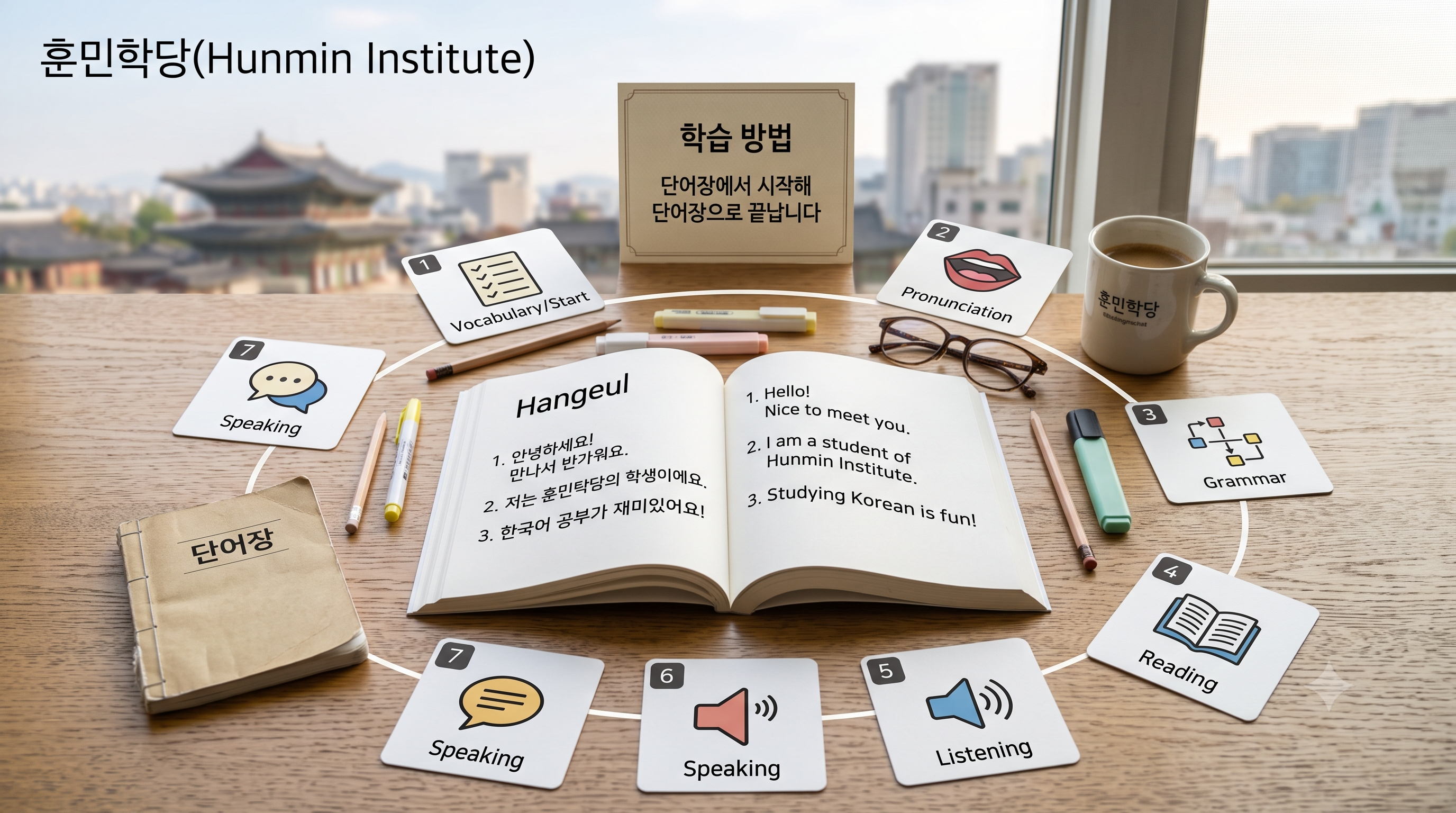
This page is the starting point of the Hangul reading curriculum. Read them in order and every other article here becomes easier.
여기서 배우는 것What You Learn Here
낱글자를 외우는 과정이 아닙니다. 한국어의 소리 규칙과 문장이 놓이는 순서를 익혀, 처음 보는 문장도 스스로 읽어 내는 힘을 만듭니다. 차례대로 정확히 공부하면 한국어 공부에 자신감이 생길 겁니다.This is not about memorizing letters. You learn the sound rules of Korean and the order words fall into, so you can read a sentence you have never seen before. Study them properly in order and you will feel confident about learning Korean.
커리큘럼Curriculum, the full contents in study order
1How to Read Hangul: The Complete Roadmap외국인 한글 공부 완전 정복전체 지도를 먼저 봅니다. 무엇을 어떤 순서로 익히는지 여기서 잡힙니다.See the whole map first. This is where the order of study is set.
2How to Read Hangul Part 1: Consonants and Vowels외국인 한글 공부 1부, 한글 자음 모음 읽는 법글자가 만들어지는 원리를 익힙니다. 자음과 모음이 어떻게 한 글자로 합쳐지는지 봅니다.Learn how a syllable is built, and how consonants and vowels combine into one block.
3How to Read Hangul Part 2: Batchim외국인 한글 공부 2부, 한글 받침 읽는 법받침은 외국인 학습자가 가장 많이 틀리는 자리입니다. 소리가 어디서 끊기는지 잡습니다.Final consonants are where learners slip most. Learn where the sound stops.
4How to Read Hangul Part 3: Pronunciation Rules외국인 한글 공부 3부, 한글 발음 규칙쓰인 대로 소리 나지 않는 이유를 규칙으로 정리합니다. 연음부터 비음화까지입니다.Why Korean is not pronounced as written, organized as rules from liaison to nasalization.
5How to Read Hangul Part 4: Reading Practice외국인 한글 공부 4부, 한글 읽기 실전 연습배운 규칙을 실제 문장에 걸어 봅니다. 소리 내어 읽는 연습 구간입니다.Apply the rules to real sentences. This is the read-aloud stage.
6Korean Word Order Explained: Understand Any Sentence어순으로 문장을 읽는 원리한국어는 끝까지 들어야 뜻이 정해집니다. 문장이 놓이는 순서를 익히면 처음 보는 문장도 읽힙니다.Korean settles its meaning at the end. Learn the order and unfamiliar sentences open up.
7TOPIK Is a Scoring System, Not Just a Test토픽은 실력 시험이 아니라 배점 구조 시험입니다읽기가 잡히면 시험이 보입니다. 토픽이 무엇을 어떻게 채점하는지 구조로 정리합니다.Once reading settles, the test comes into view. See how TOPIK is scored, as a structure.
8Korean Particle Errors: What Learner Data Reveals한국어 학습자가 가장 많이 틀리는 것, 조사학습자 자료가 가리키는 오류 지점은 조사입니다. 이, 가와 은, 는의 차이를 잡고 을, 를을 언제 빼는지 익힙니다.Learner data points to one place: particles. Learn the difference between 이, 가 and 은, 는, and when to drop 을, 를.
9Korean Numbers Part 1: Why Korea Counts in Ten Thousands한국어 숫자 1부, 10,000에서 한 번 무너집니다한국어는 세 자리가 아니라 네 자리마다 단위 이름이 바뀝니다. 두 벌인 숫자 체계와 소리가 어긋나는 자리를 잡습니다.Korean names a new unit every four digits, not three. Fix the two number sets and the places where spelling and sound part ways.
10Korean Numbers Part 2: How to Read Prices and Time화면에는 15:00, 입으로는 오후 세 시입니다1부의 규칙이 가격표와 시계, 전화번호, 층수 위에서 어떻게 작동하는지 확인합니다.See those rules at work on price tags, clocks, phone numbers, and floors.
11Korean Spacing Rules: Where One Chunk Ends한국어는 단어마다 띄지 않고 덩어리마다 띕니다어디서 끊어 읽을지를 정하는 것은 띄어쓰기입니다. 조사와 의존명사, 숫자와 단위가 갈리는 자리를 익힙니다.Spacing decides where a sentence breaks. Learn where particles, bound nouns, and numbers with units divide.
이 목록은 열한 편으로 완성되었습니다. 위에서부터 차례로 읽어 나가시면 한글 읽기가 마무리됩니다.This list is complete at eleven articles. Read them in order from the top and your Hangul reading is done.
학습 자료 안내Study Materials
위 열한 편의 학습 자료는 훈민학당 웹사이트에서 제공합니다. 단어장, 문장, 표, FAQ, TOPIK 문항, 워크시트, 오디오, 학습 영상이 준비되어 있습니다.The study materials for these eleven articles are provided on the Hunmin Institute study service website: vocabulary lists, sentences, tables, FAQ, TOPIK practice questions, worksheets, audio and video lessons.
블로그에 게시된 교재의 학습 서비스는 블로그 구독자에 한하여 훈민학당 웹사이트에서 무료로 이용하실 수 있습니다.The learning services for the teaching materials published on this blog are free for blog subscribers on the Hunmin Institute website.
▸ 훈민학당 웹사이트Hunmin Institute Website
이렇게 읽으세요How to Study These Articles
1본문 맨 아래 단어장을 먼저 훑습니다. 외우지 않아도 됩니다.Skim the vocabulary list at the bottom first. You do not need to memorize it.
2영어를 먼저 읽어 뜻을 잡습니다. 해석에 쓸 힘을 발음에 씁니다.Read the English first to grasp the meaning, so your effort goes to pronunciation.
3한국어를 소리 내어 읽습니다. 눈으로만 읽으면 남지 않습니다.Read the Korean aloud. Silent reading leaves no trace.
4FAQ에 스스로 답한 뒤 단어장을 다시 봅니다.Answer the FAQ on your own, then return to the vocabulary list.
FAQ
Q1. 초급자인데 여기 글을 다 봐야 하나요?I am a beginner. Do I need all of them?
실력과 상관없이 모두 보시기를 권합니다. 상급자도 받침과 발음 규칙은 어긋난 채 굳어 있는 경우가 많습니다.We recommend all of them regardless of level. Even advanced learners often carry fixed errors in batchim and pronunciation.
Q2. 영어를 먼저 읽으면 한국어가 늘지 않는 것 아닌가요?If I read the English first, will my Korean improve?
순서의 문제입니다. 뜻을 모르는 문장을 소리 내어 읽으면 기억에 남지 않습니다.It is a matter of order. Reading aloud a sentence you do not understand leaves nothing behind.
Q3. 이 목록을 마치면 다음은 어디로 가나요?Where do I go after this list?
실전 회화로 넘어갑니다. 공항과 매장, 병원에서 실제로 오가는 말을 익히는 단계입니다.Move on to Real Talk, where you learn the Korean actually spoken at airports, stores, and clinics.
다음 단계Next Step
▸ Real Talk 안내 페이지실전 회화로 넘어가기
▸ Sitemap전체 글 목록 보기
참고 기관Official Sources
국립국제교육원National Institute for International Educationhttps://www.niied.go.kr
Korean Language Education for Global Learners전 세계 학습자를 위한 한국어 교육
※This content (manuscript, images, and example sentences) is the copyrighted property of Hunmin Institute, protected under copyright law. Unauthorized copying, reproduction, redistribution, and use as AI training data are prohibited.
※본 콘텐츠(원고, 이미지, 예문 포함)는 저작권법에 의해 보호받는 훈민학당의 저작물입니다. 무단 복제, 전재, 재배포 및 AI 학습 데이터로의 이용을 금합니다.