Four Stages That Let You Read Any New Word
외국인 한글 공부 완전 정복
Reading Hangul is the first strategy for the Korean you want.
Learn the four stages that let you read any new word.
한글 읽기는 원하는 한국어 실력에 이르는 첫 전략입니다.
이 글에서 처음 보는 단어도 읽어 내는 네 단계를 익힙니다.
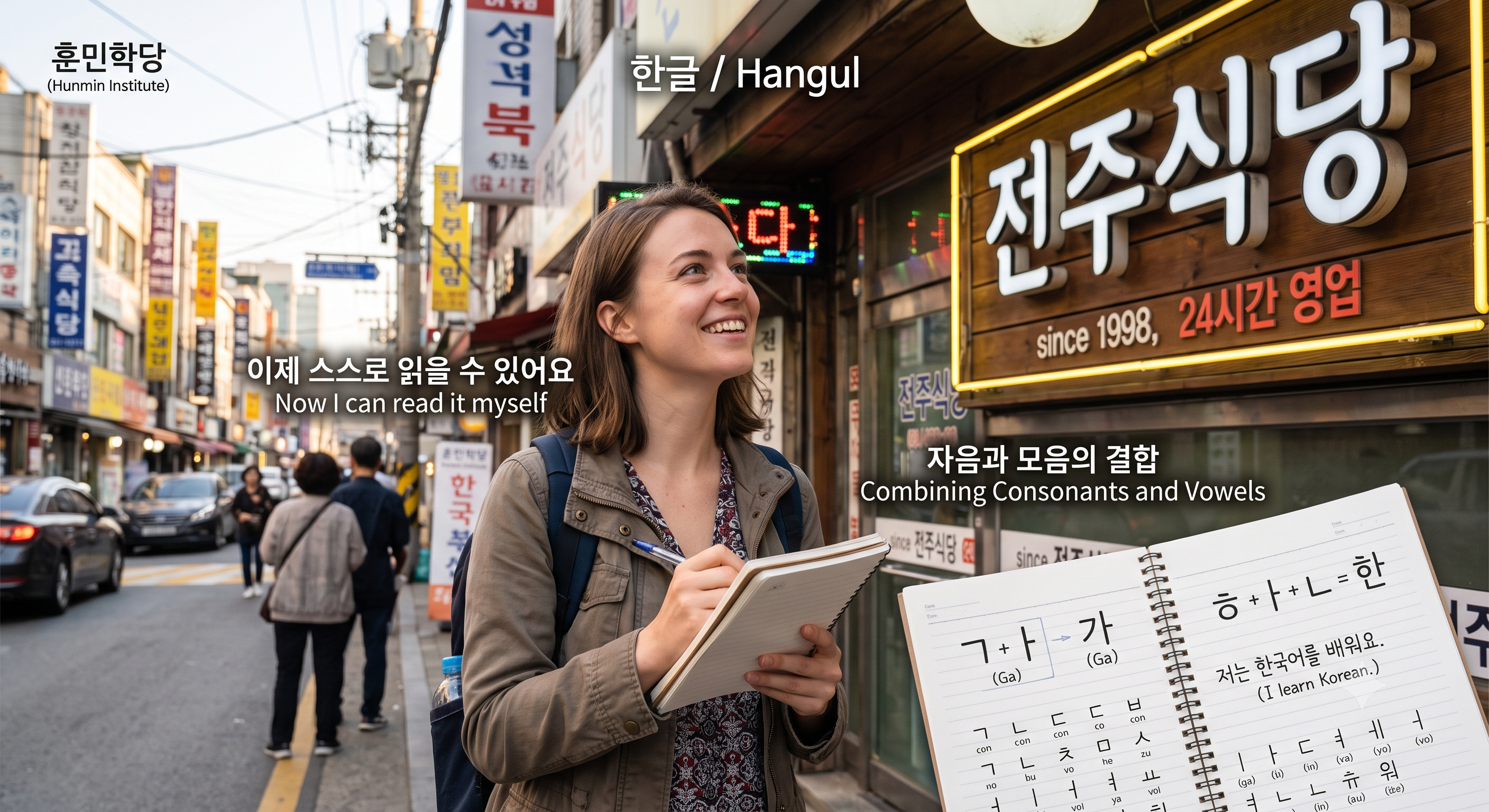
All learning services for the teaching materials published on this blog are free for blog subscribers on the Hunmin Institute website ↗.
이 글에서 배우는 핵심 문장
Key Sentences in This Lesson
한글을 배우는 동안 가장 자주 듣게 되는 문장과 가장 자주 쓰게 되는 문장입니다. 좌우는 한 쌍의 대화가 아니라 각각 따로 익히는 문장입니다. 먼저 눈에 담고 본문으로 들어가십시오.
These are the sentences you hear most often while learning Hangul and the ones you use most often. The two columns are not paired dialogue; each is learned on its own. Take them in first, then move into the text.
| 듣는 문장 Listening |
쓰는 문장 Writing |
|---|---|
| 한글 읽을 줄 아세요? [hangeul ilgeul jul aseyo] Can you read Hangul? |
한글을 읽을 수 있어요. [hangeureul ilgeul su isseoyo] I can read Hangul. |
| 천천히 읽어 보세요. [cheoncheonhi ilgeo boseyo] Try reading it slowly. |
이거 어떻게 읽어요? [igeo eotteoke ilgeoyo] How do I read this? |
| 여기 뭐라고 쓰여 있어요? [yeogi mworago sseuyeo isseoyo] What does it say here? |
천천히 말해 주세요. [cheoncheonhi malhae juseyo] Please speak slowly. |
첫째 줄은 소단락 1에서, 둘째 줄은 소단락 2에서, 셋째 줄은 소단락 4에서 각각 다룹니다.
The first row is covered in Section 1, the second in Section 2, and the third in Section 4.
한국어 공부가 읽기에서 시작해야 하는 이유
Why Korean Study Has to Start With Reading
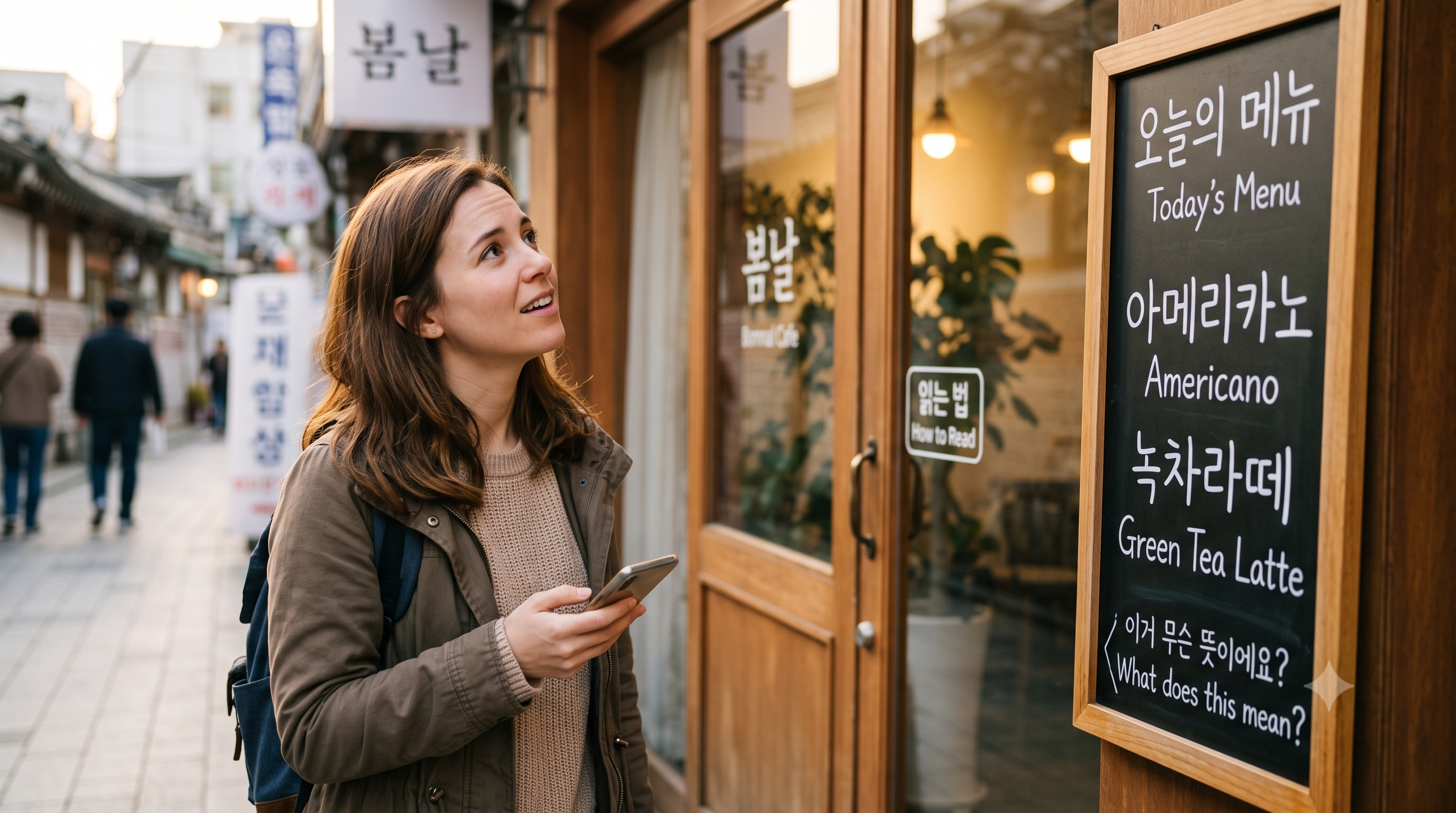
메뉴판, 표지판, 자막, 가사는 모두 한글로 적혀 있습니다. 하루에 마주치는 한국어의 대부분은 소리가 아니라 글자이므로, 읽지 못하는 글자를 만났을 때 오가는 문장부터 보십시오.
Menus, signs, subtitles, and lyrics are all written in Hangul. Most of the Korean you meet in a day is not sound but letters, so start with the sentences exchanged when you hit a block you cannot read.
| 듣는 문장 Listening |
쓰는 문장 Writing |
|---|---|
| 여기 뭐라고 쓰여 있어요? [yeogi mworago sseuyeo isseoyo] What does it say here? |
이거 무슨 뜻이에요? [igeo museun tteusieyo] What does this mean? |
| 한글부터 배우세요. [hangeulbuteo baeuseyo] Learn Hangul first. |
저는 아직 못 읽어요. [jeoneun ajik mon nilgeoyo] I cannot read it yet. |
| 제가 읽어 드릴게요. [jega ilgeo deurilgeyo] Let me read it for you. |
한국어로 뭐라고 해요? [hangugeoro mworago haeyo] What is it called in Korean? |
응용 Apply It
↳ 저는 아직 못 [동사]어요
jeoneun ajik mot [dongsa]eoyo
I cannot [verb] it yet
ex 저는 아직 못 [읽]어요/저는 아직 못 [써]요/저는 아직 못 [들]어요
ROM jeoneun ajik mon [nilg]eoyo/jeoneun ajik mot [sseo]yo/jeoneun ajik mot [deul]eoyo
EN I cannot read it yet/I cannot write it yet/I cannot hear it yet
| 한국어 Korean |
무엇을 가리키는가 What it refers to |
|---|---|
| 한글 [hangeul] |
한국어를 적는 글자 The script in which Korean is written |
| 읽기 [ilgi] |
글자를 소리로 바꾸는 일 Turning letters into sound |
| 표지판 [pyojipan] |
길과 역에 붙은 안내판 The signs on streets and in stations |
| 자막 [jamak] |
화면 아래에 뜨는 글 The text that appears at the bottom of a screen |
| 가사 [gasa] |
노래의 글, 읽기 연습에 좋습니다 Song lyrics, good material for reading practice |
▶못 읽어요는 글자와 다르게 몬 닐거요로 소리 납니다.
못 읽어요 comes out as 몬 닐거요, not the way it is spelled.
읽어요 앞에 없던 ㄴ 소리가 끼어들어 닐거요가 되고, 그 ㄴ 때문에 앞 글자 못의 받침 소리가 ㄷ에서 ㄴ으로 바뀝니다. 두 가지가 잇달아 일어나 몬 닐거요가 됩니다.
An ㄴ that was never written slips in before 읽어요 and turns it into 닐거요, and that ㄴ then pulls the final of 못 from a ㄷ sound to an ㄴ. Two changes in a row give you 몬 닐거요.
순서를 반대로 알아 모 실거요로 읽는 학습자가 많습니다. 이런 자리가 3부 발음 규칙에서 다루는 내용이며, 규칙을 모르면 글자를 알아도 소리가 어긋납니다.
Many learners get the order backwards and say 모 실거요. This is what Part 3 covers, and without the rules you can know the letters and still produce the wrong sound.
한글은 외우는 글자가 아니라 조립하는 원리입니다
Hangul Is Assembled, Not Memorised
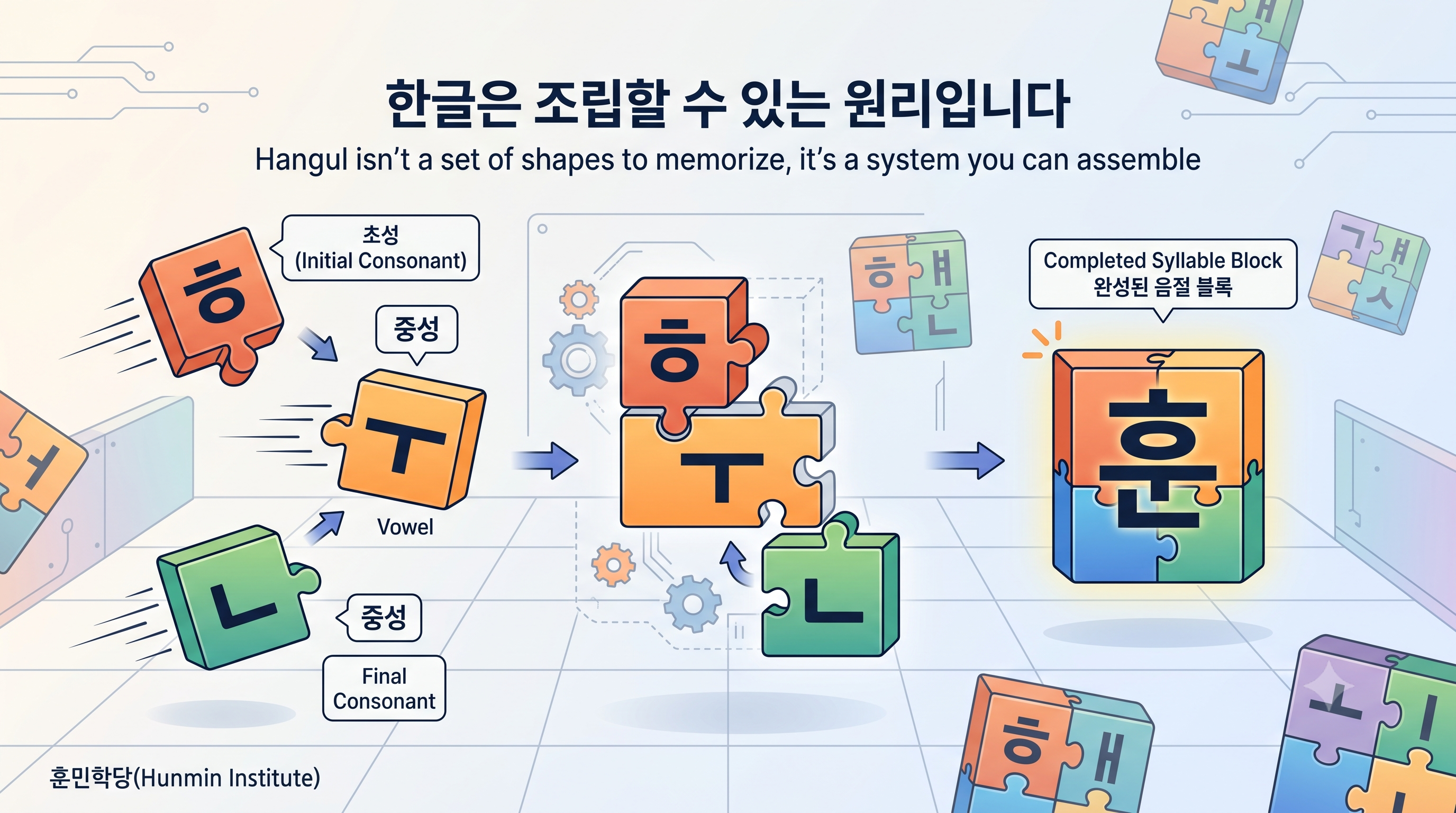
한 글자는 초성과 중성, 필요하면 종성까지 세 자리로 나뉩니다. 일상에서 종성은 받침이라고 부르며, 그 자리를 말로 물을 때 오가는 문장부터 보십시오.
One block splits into an initial, a medial, and, when needed, a final. In everyday speech the final is called 받침, so start with the sentences for asking about that slot.
| 듣는 문장 Listening |
쓰는 문장 Writing |
|---|---|
| 아래에 붙는 자음이에요. [araee bunneun jaeumieyo] It is the consonant attached underneath. |
받침이 뭐예요? [batchimi mwoyeyo] What is a batchim? |
| 한 글자씩 읽어 볼까요? [han geuljasik ilgeo bolkkayo] Shall we read it one block at a time? |
한 글자씩 읽어 주세요. [han geuljasik ilgeo juseyo] Please read it one block at a time. |
| 초성과 중성으로 나뉘어요. [choseonggwa jungseongeuro nanwieoyo] It splits into an initial and a medial. |
이 글자는 어떻게 나눠요? [i geuljaneun eotteoke nanwoyo] How is this block divided? |
| 글자 Block |
초성 Initial |
중성 Medial |
종성 Final |
|---|---|---|---|
| 가 [ga] ga |
ㄱ [giyeok] giyeok |
ㅏ [a] a |
없음 None |
| 강 [gang] gang |
ㄱ [giyeok] giyeok |
ㅏ [a] a |
ㅇ [ieung] ieung |
| 정 [jeong] jeong |
ㅈ [jieut] jieut |
ㅓ [eo] eo |
ㅇ [ieung] ieung |
| 국 [guk] guk |
ㄱ [giyeok] giyeok |
ㅜ [u] u |
ㄱ [giyeok] giyeok |
▶자리를 알면 처음 보는 글자도 소리로 바꿀 수 있습니다.
Once you know the slots, you can turn any unfamiliar block into sound.
정국이라는 이름은 정과 국 두 글자이며 각각 ㅈ과 ㅓ와 ㅇ, ㄱ과 ㅜ와 ㄱ으로 나뉩니다. 이 구조를 이해하면 다음에 만나는 어떤 이름도 같은 방식으로 뜯어 읽을 수 있습니다.
The name 정국 is two blocks, 정 and 국, splitting into ㅈ, ㅓ, ㅇ and ㄱ, ㅜ, ㄱ. Understand that structure and any name you meet next comes apart the same way.
외울 것은 스물넷 낱자와 자리 셋뿐입니다. 그 뒤로는 조합이며, 조합은 외우는 것이 아니라 만드는 것입니다.
What you memorise is twenty-four letters and three slots. Everything after that is combination, and combination is made, not memorised.
원패스 학습법의 네 단계
The Four Stages of the One-Pass Method
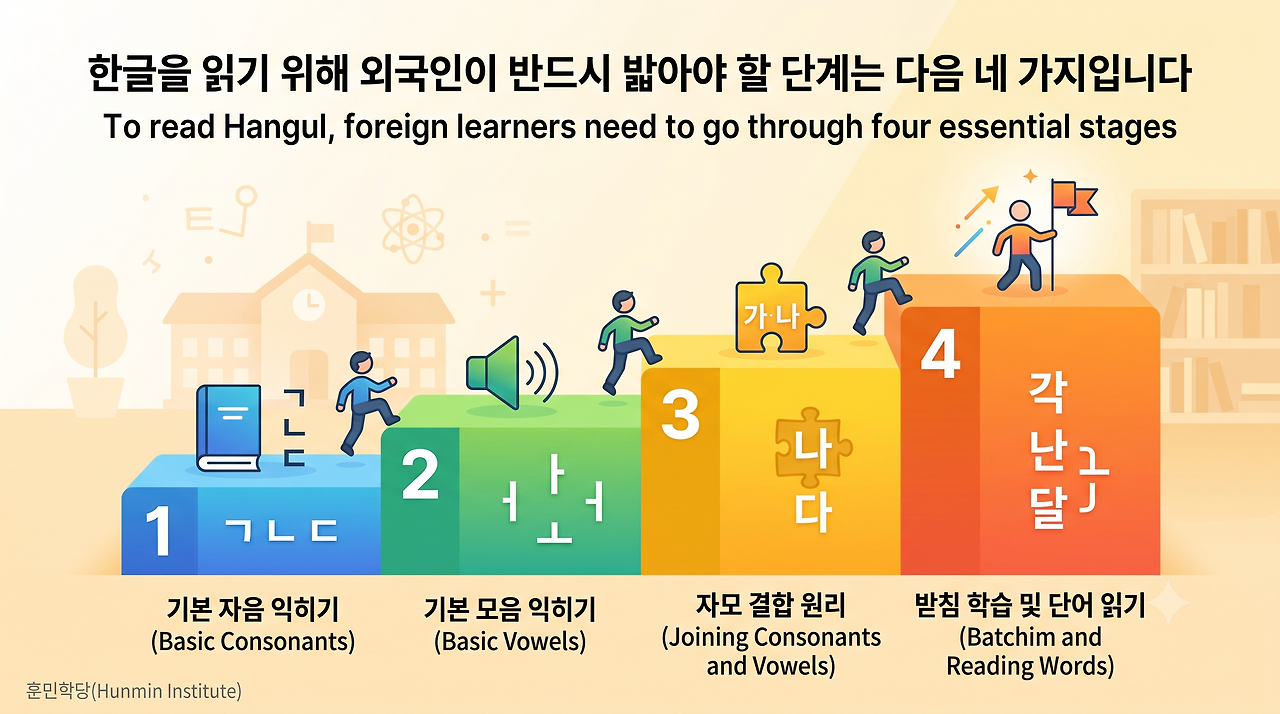
한글을 읽기 위해 밟아야 할 단계는 네 가지이며 순서가 정해져 있습니다. 어디서 시작할지 물을 때 오가는 문장부터 보십시오.
There are four stages to reading Hangul, and the order is fixed. Start with the sentences exchanged when you ask where to begin.
| 듣는 문장 Listening |
쓰는 문장 Writing |
|---|---|
| 1부부터 시작하세요. [ilbubuteo sijakaseyo] Start from Part 1. |
어디부터 시작해요? [eodibuteo sijakaeyo] Where do I start? |
| 다음은 받침이에요. [daeumeun batchimieyo] Batchim comes next. |
다음은 뭐예요? [daeumeun mwoyeyo] What comes next? |
| 순서대로 하세요. [sunseodaero haseyo] Go in order. |
순서를 바꿔도 돼요? [sunseoreul bakkwodo dwaeyo] Can I change the order? |
| 단계 Stage |
배우는 것 What you learn |
그 단계에서 되는 일 What it lets you do |
|---|---|---|
| 1부 Part 1 |
자음과 모음 Consonants and vowels |
초성과 중성을 합쳐 첫 음절을 만듭니다 Join an initial and a vowel into your first block |
| 2부 Part 2 |
받침 Batchim |
받침이 붙으면 소리가 어디서 끊기는지 익힙니다 Learn where the sound stops once a final is added |
| 3부 Part 3 |
발음 규칙 Pronunciation rules |
연음과 경음화, 격음화, 비음화를 익힙니다 Liaison, tensification, aspiration, and nasalisation |
| 4부 Part 4 |
읽기 실전 Reading practice |
조합표로 정리하고 소리 내어 읽습니다 Pull it together with a chart and read aloud |
▶1부는 재료를 갖추고 4부는 그 재료로 문장을 읽습니다.
Part 1 gathers the materials; Part 4 reads sentences with them.
1부에서 첫 음절을 직접 만들어 보고, 2부에서 받침이 붙으면 소리가 어디서 끊기는지 익힙니다. 3부는 글자와 소리가 어긋나는 자리를 규칙으로 정리하는 단계이며 앞에서 본 몬 닐거요가 그 자리입니다.
In Part 1 you build your first block; in Part 2 you learn where the sound stops once a final is added. Part 3 turns the places where spelling and sound diverge into rules, and 몬 닐거요 from earlier is one of them.
4부는 조합표로 전체를 정리하고 소리 내어 읽는 단계입니다. 앞의 셋을 건너뛰고 4부만 보면 읽히지 않는 자리에서 다시 앞으로 돌아가게 됩니다. 네 단계는 골라 듣는 목록이 아니라 앞 단계가 다음 단계의 재료가 되는 계단입니다.
Part 4 pulls everything together with a chart and reads it aloud. Skip the first three and you will be sent back the moment a block refuses to sound out. These four are not a menu to pick from; each stage is the material the next one runs on.
이 순서를 실제로 밟는 방법
How to Actually Walk This Path
계획보다 중요한 것은 하루의 크기입니다. 하루를 끊고 다시 이어 붙일 때 오가는 문장부터 보십시오.
The size of your day matters more than your plan. Start with the sentences that come up as you close a day and pick it back up.
| 듣는 문장 Listening |
쓰는 문장 Writing |
|---|---|
| 잘 읽으셨어요. [jal ilgeusyeosseoyo] You read that well. |
다시 한번 읽어 주세요. [dasi hanbeon ilgeo juseyo] Please read it once more. |
| 소리 내어 읽어 보세요. [sori naeeo ilgeo boseyo] Try reading it aloud. |
오늘은 여기까지 할게요. [oneureun yeogikkaji halgeyo] I will stop here for today. |
| 내일 또 해요. [naeil tto haeyo] Let us do it again tomorrow. |
내일 다시 할게요. [naeil dasi halgeyo] I will do it again tomorrow. |
| 이렇게 하십시오 Do this |
이유 Why |
|---|---|
| 하루 한 편, 20분씩만 합니다 One post a day, twenty minutes |
한 번에 몰아 읽으면 입이 아니라 눈만 지납니다 Cramming moves your eyes, not your mouth |
| 반드시 소리 내어 읽습니다 Always read aloud |
눈으로만 읽으면 글자와 소리가 연결되지 않습니다 Silent reading never links letter to sound |
| 모르는 글자는 자리로 뜯습니다 Break unknown blocks into slots |
통째로 외우면 다음 글자에서 다시 막힙니다 Memorising whole blocks stalls at the next one |
| 막히면 물어봅니다 Ask when you are stuck |
이거 어떻게 읽어요 한 문장이면 대부분 해결됩니다 One line, 이거 어떻게 읽어요, solves most of it |
▶이미 읽을 줄 아신다면 3부의 발음 규칙만 확인해도 됩니다.
If you already read Hangul, checking the pronunciation rules in Part 3 alone is enough.
네 가지 모두 하루를 작게 끊는 쪽으로 맞춰져 있습니다. 한 번에 몰아 읽는 것보다 짧게 여러 날 이어 가는 편이 읽기에서는 언제나 빠릅니다.
All four are set to keep the day small. In reading, short sessions across several days always beat one long push.
앞의 핵심 문장표 맨 윗줄 두 문장이 이 과정 전체의 시작과 끝입니다. 한글 읽을 줄 아세요라는 물음에 한글을 읽을 수 있어요라고 답하게 되는 순간이 4부에서 옵니다.
The top row of the key sentence table marks the start and the end of this whole course. The moment you answer 한글 읽을 줄 아세요 with 한글을 읽을 수 있어요 arrives in Part 4.
한글 읽기는 한국어 공부의 준비 운동이 아니라 첫 관문이고, 이 글은 그 관문을 어떤 순서로 지날지 정하는 지도입니다. 읽기가 끝나면 다음은 어순이며, 글자를 소리로 바꾸는 일이 끝나야 그 소리가 문장 안에서 어떤 순서로 놓이는지를 배울 수 있습니다.
Reading Hangul is not a warm-up for studying Korean but its first gate, and this post is the map that decides the order in which you pass through. Word order comes next, and only once letters have become sound can you learn the order those sounds take inside a sentence.
You have completed both lessons of the One-Pass Method. From putting meaning first to the four stages of reading Hangul, you now have a grip on what comes first and what can wait. From here, walk the Reading Skills curriculum in order from Part 1. Congratulations on finishing.
토픽 맛보기
TOPIK Preview
유형: TOPIK Ⅰ 읽기 [31~33], 설명문, 화제 고르기
Type: TOPIK I Reading [31–33], expository text, choose the topic
무엇에 대한 이야기입니까? 알맞은 것을 고르십시오.
What is the passage about? Choose the correct answer.
ㄱ과 ㅏ를 합치면 가가 됩니다. 가 아래에 ㅇ을 붙이면 강이 됩니다.
Joining ㄱ and ㅏ gives you 가. Adding ㅇ underneath 가 gives you 강.
① 글자 만들기
② 글자 개수
③ 모음 읽기
④ 노래 가사
Answer ▾
정답 ① 글자 만들기
Answer: ① 글자 만들기
지문은 자음과 모음을 합쳐 글자를 만들고 거기에 받침을 붙이는 과정만 말하고 있으므로 화제는 글자 만들기입니다. ②는 글자가 지문에 나오지만 몇 개인지는 한 줄도 다루지 않아 진술이 어긋나고, ③은 ㅏ가 나오므로 일부는 맞으나 지문은 모음만이 아니라 자음과의 결합을 말합니다. ④는 그럴듯해 보여도 노래에 관한 내용이 지문에 없습니다. 흉내 낸 대문항은 TOPIK Ⅰ 읽기 [31~33]이고 배점은 2점입니다.
The passage only describes joining a consonant and a vowel into a block and then adding a final, so the topic is making blocks. ② uses 글자, which does appear, but the passage never counts anything. ③ is partly right since ㅏ shows up, yet the passage is about combining vowels with consonants, not vowels alone. ④ sounds plausible but songs never appear. The item type modeled here is TOPIK I Reading [31–33], worth 2 points.
FAQ
Q1. 로마자 표기로 배우면 더 빠르지 않나요?Answer ▾
Q1. Would learning through romanisation be faster?
A1. 처음 며칠은 빠르지만 곧 막힙니다. 로마자는 한국어가 구분하는 소리를 다 담지 못해 같은 표기가 서로 다른 글자를 가리키는 일이 생깁니다. 국립국어원이 정한 로마자 표기법도 읽기를 대신하려고 만든 것이 아니라 한국어를 모르는 사람에게 소리를 알리려고 만든 것입니다.
A1. Faster for a few days, then it stalls. Romanisation cannot carry every distinction Korean makes, so one spelling ends up pointing at different blocks. The system set by the National Institute of Korean Language was built to convey sound to people who do not read Korean, not to replace reading.
Q2. 자모 이름인 기역, 니은까지 외워야 하나요?Answer ▾
Q2. Do I need to memorise the letter names like 기역 and 니은?
A2. 읽기만 목표라면 급하지 않습니다. 다만 사전을 찾거나 이름 철자를 불러 줄 때 필요하므로 읽기가 자리를 잡은 뒤에 익혀 두시기 바랍니다.
A2. Not urgent if reading is your only goal. You will need them for dictionaries and for spelling a name out loud, so pick them up once reading is settled.
Q3. 한자도 함께 배워야 하나요?Answer ▾
Q3. Do I need to learn Chinese characters as well?
A3. 필요하지 않습니다. 오늘날 한국의 표기는 일상과 언론 모두 한글이며, 한자는 이름의 한자 표기나 일부 전문 용어처럼 제한된 자리에만 남아 있습니다.
A3. No. Korean is written in Hangul today, in daily life and in the press alike, and Chinese characters survive only in limited places such as the hanja spelling of a name or certain technical terms.
Q4. 휴대폰으로 한글은 어떻게 입력하나요?Answer ▾
Q4. How do I type Hangul on a phone?
A4. 설정에서 한국어 자판을 추가하면 됩니다. 자판은 자음과 모음을 순서대로 눌러 한 글자로 합치는 방식이라, 이 글에서 본 조합 원리를 익히면 입력도 함께 해결됩니다.
A4. Add a Korean keyboard in your settings. It works by pressing consonants and vowels in order to assemble one block, so the combination principle in this post solves typing at the same time.
Q5. 손으로 쓰는 획순도 익혀야 하나요?Answer ▾
Q5. Do I also need the handwriting stroke order?
A5. 읽기와는 별개의 훈련입니다. 다만 위에서 아래로, 왼쪽에서 오른쪽으로라는 원칙만 알아 두면 글자 모양이 흐트러지지 않습니다.
A5. It is separate training from reading. Knowing just one principle, top to bottom and left to right, keeps your blocks from falling apart.
Vocabulary and Pronunciation for Foreigners
| No | Korean | Romanisation | Meaning |
|---|---|---|---|
| 1 | 한글 | hangeul | (n) the Korean script [ˈhɑːnɡuːl] |
| 2 | 글자 | geulja | (n) a syllable block [ˈsɪləbl blɑːk] |
| 3 | 받침 | batchim | (n) the consonant written underneath [ˈfaɪnl ˈkɑːnsənənt] |
| 4 | 초성 | choseong | (n) the initial slot [ɪˈnɪʃl] |
| 5 | 읽기 | ilgi | (n) reading [ˈriːdɪŋ] |
| ▾ 단어 50 개 더 보기 Show 50 more ↗ | |||
The blog page has limits of space and function, so only five words are shown here. The rest of the word list, the audio, the sentences and tables, the FAQ, the worksheet, the TOPIK questions and the lesson video are on the Hunmin Institute website ↗, free for blog subscribers.
참고 기관
Official Sources
국립국어원 ↗
National Institute of Korean Language
https://www.korean.go.kr
기관 설명 보기 About this institute ▾
This institute sets Korean orthography, the standard pronunciation rules, and the Romanisation system. The Language Norms menu at the top of the site holds the original texts, and learners can use the Korean Basic Dictionary run by the same institute, which carries definitions in eleven languages including English. Norms can be revised, so check here whenever a spelling is unclear.
※ 본 콘텐츠(원고, 이미지, 예문 포함)는 저작권법에 의해 보호받는 훈민학당의 저작물입니다. 무단 복제, 전재, 재배포 및 AI 학습 데이터로의 이용을 금합니다.
This content (manuscript, images, and example sentences) is the copyrighted property of Hunmin Institute, protected under copyright law. Unauthorized copying, reproduction, redistribution, and use as AI training data are prohibited.
'One-Pass Method' 카테고리의 다른 글
| How to Study Korean: Meaning First, Grammar Later (1) | 2026.08.23 |
|---|---|
| Hunmin Institute: Where Your Korean Goal Becomes a Plan (0) | 2026.07.20 |

