Korean Particle Errors: What Learner Data Reveals
한국어 학습자가 가장 많이 틀리는 것, 조사
What learners get wrong most is not pronunciation or vocabulary but particles.
Here you learn where 이, 가 parts from 은, 는 and when 을, 를 may be dropped.
학습자가 가장 많이 틀리는 것은 발음도 어휘도 아닌 조사입니다.
이 글에서 이, 가와 은, 는이 갈리는 자리와 을, 를을 빼는 자리를 익힙니다.
All learning services for the teaching materials published on this blog are free for blog subscribers on the Hunmin Institute website ↗.
이 글에서 배우는 핵심 문장
Key Sentences in This Lesson
이 글을 다 읽고 나면 아래 문장의 조사가 왜 그 자리에 있는지 설명할 수 있습니다. 좌우는 한 쌍의 대화가 아니라 각각 따로 익히는 문장입니다.
After reading this post you will be able to explain why each particle below sits where it does. The two columns are not paired dialogue; learn each side on its own.
| 듣는 문장 Listening |
쓰는 문장 Writing |
|---|---|
| 누가 왔어요? [nuga wasseoyo] Who came? |
제가 하겠습니다. [jega hagetseumnida] I will do it. |
| 밥은 먹었어요? [babeun meogeosseoyo] Have you at least eaten? |
이거 얼마예요? [igeo eolmayeyo] How much is this? |
| 왜 이 조사예요? [wae i josayeyo] Why this particle? |
그건 제가 할게요. [geugeon jega halgeyo] I will take care of that one. |
첫째 줄은 소단락 3에서, 둘째 줄은 소단락 4에서, 셋째 줄은 소단락 5에서 각각 다룹니다.
The first row is covered in Section 3, the second in Section 4, and the third in Section 5.
1. 가장 많이 틀리는 것은 조사입니다
Particles Are What Learners Get Wrong Most
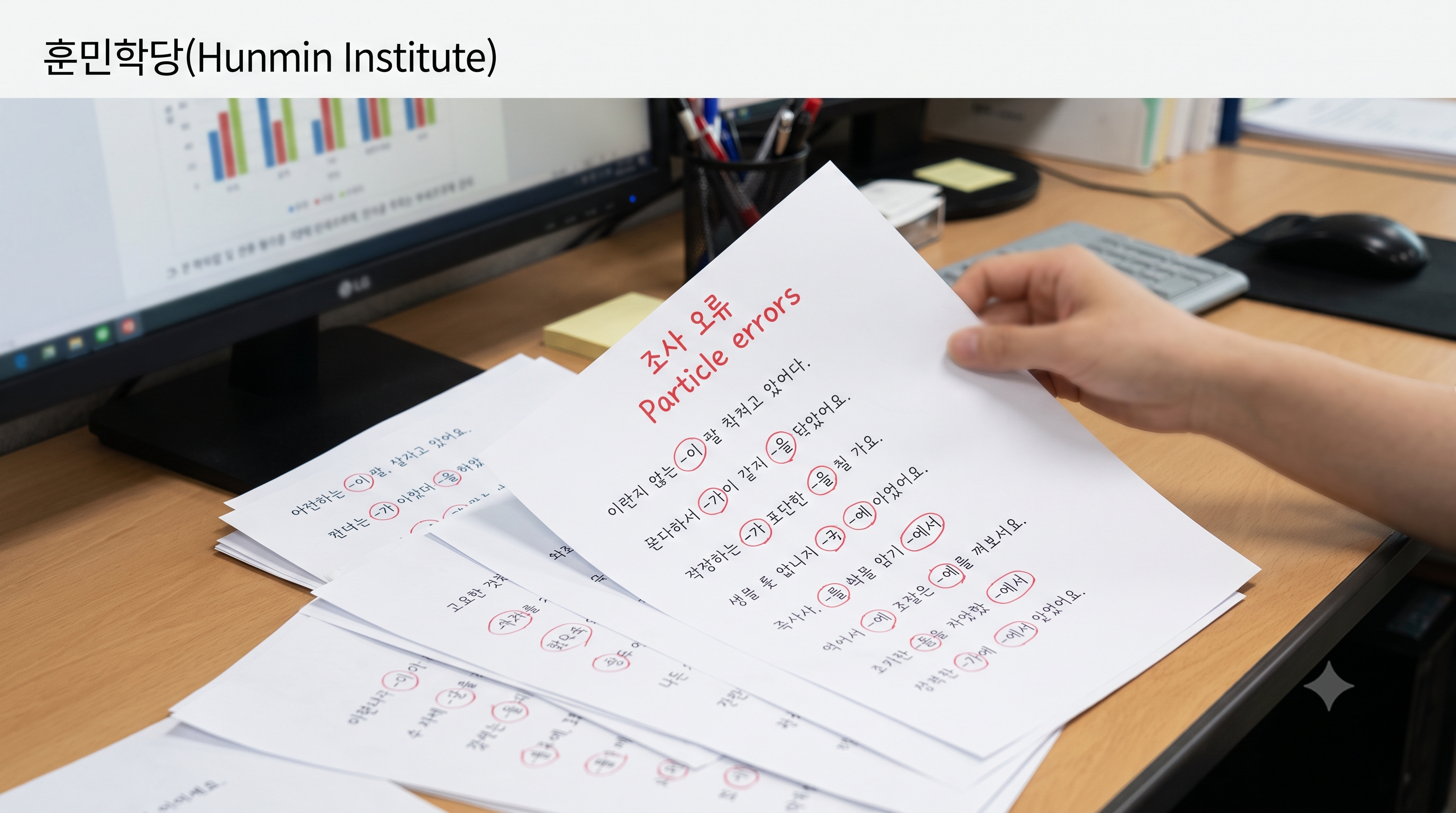
한국어를 가르치는 사람들은 오래전부터 같은 물음을 던져 왔습니다. 학습자는 무엇을 가장 많이 틀리는가. 답을 찾으려고 연구자들은 학습자가 쓴 글과 시험지, 녹음한 발표와 토론을 모아 오류를 하나씩 세었습니다. 이렇게 모은 자료를 학습자 말뭉치라고 부릅니다.
Korean teachers have asked the same question for a long time: what do learners get wrong most? To find out, researchers gathered learner writing, exam papers, and recordings of talks and debates, then counted the errors one by one. Material collected this way is called a learner corpus.
연구자가 다르고 표본이 다르고 조사한 해도 다릅니다. 그런데 결과는 늘 한 곳을 가리킵니다. 조사입니다.
The researchers differ, the samples differ, and the years differ. Yet the results always point to one place: particles.
| 연구 Study |
무엇을 분석했는가 What was analyzed |
결과 Result |
|---|---|---|
| 이정희 2003 | 학습자의 작문과 시험지, 구어 전사 자료를 함께 분석 Analyzed learner essays, exam papers, and speech transcripts |
조사가 1위 Particles ranked first |
| 고석주 외 2004 | 학습자 말뭉치를 구축해 오류를 유형별로 분류 Built a learner corpus and sorted errors by type |
조사가 2위 Particles ranked second |
| 한상미 2014 | 고급 학습자의 토론 담화 8,002개 조사 사용을 분석 Analyzed 8,002 particle uses in advanced learners’ debate discourse |
조사 오류 738건 738 particle errors |
여기서 쓰는 문장부터 배워 봅시다. 어려운 자리를 털어놓을 때 오가는 문장입니다.
Now for the sentences you use here. These go back and forth when you admit what is hard.
| 듣는 문장 Listening |
쓰는 문장 Writing |
|---|---|
| 조사가 제일 어려워요. [josaga jeil eoryeowoyo] Particles are the hardest part. |
저도 조사를 자주 틀려요. [jeodo josareul jaju teullyeoyo] I get particles wrong often too. |
| 배워도 계속 틀려요. [baewodo gyesok teullyeoyo] You keep getting them wrong even after learning them. |
왜 자꾸 틀릴까요? [wae jakku teullilkkayo] Why do I keep getting them wrong? |
응용 Apply It
↳ [명사]가 제일 어려워요
[noun]ga jeil eoryeowoyo
[Noun] is the hardest part.
ex 조사가 제일 어려워요./발음이 제일 어려워요.
ROM josaga jeil eoryeowoyo/bareumi jeil eoryeowoyo
EN Particles are the hardest part./Pronunciation is the hardest part.
▶조사는 몰라서 틀리는 것이 아니라 고를 때 틀립니다.
Particles go wrong at the moment of choosing, not from not knowing them.
수치의 크기를 곧바로 견주지는 마십시오. 표본이 다르고 자료가 글인지 말인지도 다르며 오류를 나누는 기준도 연구마다 조금씩 다릅니다. 이 표가 말하는 것은 순위이지 정확한 격차가 아닙니다.
Do not compare the numbers head to head. Samples differ, some studies use writing and others speech, and each draws the lines between error types a little differently. What the table shows is rank, not an exact gap.
그래도 분명해지는 것이 하나 있습니다. 조사는 배우고 나서도 계속 틀리는 항목이며, 목록을 몰라서가 아니라 그 자리에서 무엇을 고를지 판단하지 못해 틀립니다. 그러므로 외우는 공부로는 줄지 않습니다.
One thing is clear all the same: particles keep going wrong after you have learned them, and they go wrong because of the judgment at the moment, not because the list is unknown. Memorizing does not reduce them.
2. 조사 오류는 두 얼굴을 가지고 있습니다
Particle Errors Have Two Faces

그렇다면 조사를 어떻게 틀릴까요. 틀리는 방식은 생각보다 종류가 적습니다. 고급 학습자의 토론 담화를 분석한 한상미의 2014년 연구에서 조사 오류는 여섯 가지로 나뉘었습니다.
So how do learners get particles wrong? There are fewer ways than you might expect. In Han’s 2014 study of advanced learners’ debate discourse, particle errors fell into six types.
| 오류 유형 Error type |
건수 Count |
비중 Share |
|---|---|---|
| 대치 [daechi] Substitution |
328회 | 44.4% |
| 생략 [saengnyak] Omission |
322회 | 43.6% |
| 첨가 [cheomga] Addition |
47회 | 6.4% |
| 형태 [hyeongtae] Form |
19회 | 2.6% |
| 환언 [hwaneon] Paraphrase |
15회 | 2.0% |
| 발음 [bareum] Pronunciation |
7회 | 1.0% |
앞의 둘이 어떤 상태인지 문장으로 보면 이렇습니다.
Here is what the top two look like in actual sentences.
| 구분 Type |
어떤 상태인가 What happens |
학습자 문장 Learner sentence |
|---|---|---|
| 대치 [daechi] |
조사를 쓰기는 썼는데 다른 조사를 골랐습니다 A particle was used, but the wrong one was chosen |
친구에 선물을 줬어요 에가 아니라 에게여야 합니다 It should be 에게, not 에 |
| 생략 [saengnyak] |
있어야 할 자리에 조사를 넣지 않았습니다 A required particle was left out |
저 커피 좋아해요 저는과 커피를이 빠졌습니다 저는 and 커피를 are missing |
여기서 쓰는 문장부터 배워 봅시다. 어디가 틀렸는지 짚어 줄 때 오가는 문장입니다.
Now for the sentences you use here. These go back and forth when someone points out what went wrong.
| 듣는 문장 Listening |
쓰는 문장 Writing |
|---|---|
| 다른 조사를 골랐어요. [dareun josareul gollasseoyo] You chose a different particle. |
어느 조사를 써야 돼요? [eoneu josareul sseoya dwaeyo] Which particle should I use? |
| 조사를 빼먹었어요. [josareul ppaemeogeosseoyo] You left the particle out. |
여기 조사가 필요해요? [yeogi josaga piryohaeyo] Is a particle needed here? |
▶여섯 가지 가운데 둘이 전체의 88퍼센트를 차지합니다.
Two of the six types account for 88 percent of all particle errors.
첨가와 형태, 환언, 발음 오류를 모두 합쳐도 12퍼센트에 미치지 못합니다. 조사에서 벌어지는 일은 사실상 둘뿐이라는 뜻입니다. 고르는 문제와 빼는 문제입니다.
Addition, form, paraphrase, and pronunciation errors together come to less than 12 percent. In practice, only two things go wrong with particles: choosing and dropping.
이 숫자는 공부 순서를 바꿉니다. 조사 전체를 처음부터 다시 볼 필요가 없습니다. 이 둘만 잡으면 되고, 다음 두 소단락에서 하나씩 봅니다.
That number changes the order of study. You do not need to relearn every particle; fixing these two is enough, and the next two sections take them one at a time.
3. 이, 가와 은, 는이 갈리는 자리
Where 이, 가 and 은, 는 Part Ways

대치 오류가 가장 자주 일어나는 자리는 정해져 있습니다. 이, 가와 은, 는 사이입니다. 영어로 옮기면 둘 다 주어 자리에 오기 때문에 번역만으로는 차이가 보이지 않습니다. 그래서 학습자는 둘 중 아무거나 써도 된다고 여기게 됩니다.
Substitution errors cluster in one place: between 이, 가 and 은, 는. In English both land on the subject, so translation alone hides the difference, and learners come to assume either one will do.
| 문장 Sentence |
이 조사가 하는 일 What the particle does |
|---|---|
| 누가 왔어요? [nuga wasseoyo] |
온 사람이 누구인지 특정해 묻습니다. 답도 이, 가로 받습니다 Asks to identify who came; the answer takes 이, 가 as well |
| 친구가 왔어요. [chinguga wasseoyo] |
상대가 모르던 사실을 새로 알리는 소식입니다 Delivers news the listener did not know |
| 친구는 왔어요. [chinguneun wasseoyo] |
누군가는 오지 않았다는 뜻이 깔린 비교입니다 A contrast implying someone else did not come |
| 밥은 먹었어요? [babeun meogeosseoyo] |
다른 일은 몰라도 밥이라도 먹었는지 챙겨 묻습니다 Whatever else is going on, it asks if you have at least eaten |
| 그건 제가 할게요. [geugeon jega halgeyo] |
여럿 가운데 자기를 지목해 책임을 가져옵니다 Singles yourself out and takes responsibility |
| 저는 김치를 좋아해요. [jeoneun gimchireul joahaeyo] |
자기를 화제로 세우고 그에 대해 말합니다 Sets yourself as the topic and comments on it |
여기서 쓰는 문장부터 배워 봅시다. 누구인지 묻고 답할 때 오가는 문장입니다.
Now for the sentences you use here. These go back and forth when you ask and answer who.
| 듣는 문장 Listening |
쓰는 문장 Writing |
|---|---|
| 누가 왔어요? [nuga wasseoyo] Who came? |
제가 하겠습니다. [jega hagetseumnida] I will do it. |
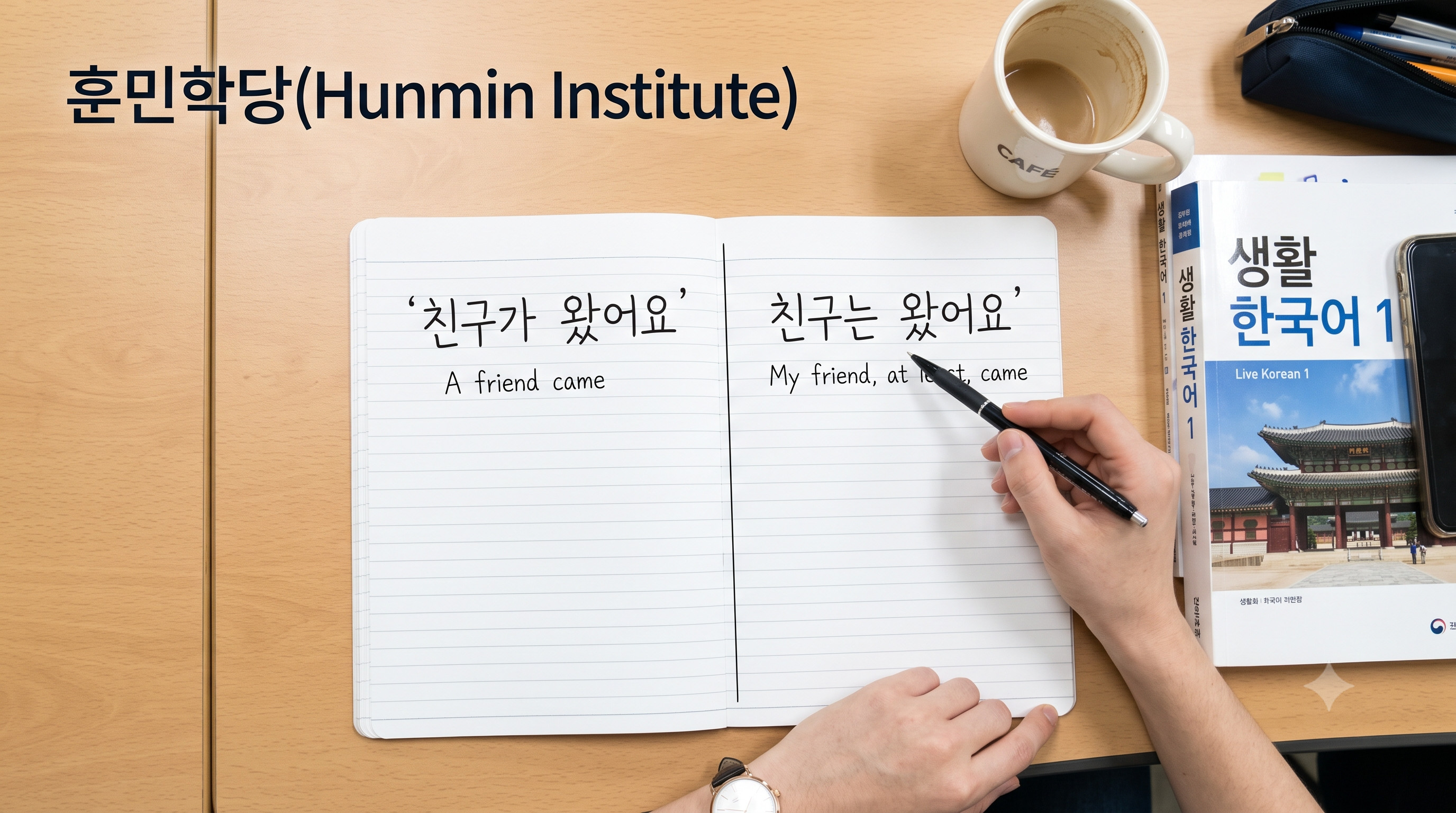
| 친구가 왔어요. [chinguga wasseoyo] A friend came. |
친구는 왔어요. [chinguneun wasseoyo] My friend, at least, came. |
▶이, 가는 무대에 새로 올리고 은, 는은 이미 무대에 있는 것을 가리킵니다.
이, 가 brings something onto the stage; 은, 는 points at what is already on it.
친구가 왔어요와 친구는 왔어요는 영어로 옮기면 거의 같은 문장이 됩니다. 그러나 한국인의 귀에 둘은 서로 다른 상황입니다. 앞은 소식이고 뒤는 비교입니다.
친구가 왔어요 and 친구는 왔어요 come out nearly the same in English. To a Korean ear they are two different situations: the first is news, the second a comparison.
은, 는이 비교의 뜻을 품는다는 사실만 알아도 오류의 절반이 사라집니다. 견줄 대상이 없는데 은, 는을 쓰면 듣는 사람은 없는 대상을 찾게 되고 그 순간 문장이 어색해집니다. 새 소식이면 이, 가를 붙이고 견주는 말이면 은, 는을 붙입니다.
Just knowing that 은, 는 carries contrast removes half of these errors. Use it with nothing to contrast and the listener starts hunting for the missing other side, and the sentence turns awkward on the spot. For news, attach 이, 가; for contrast, attach 은, 는.
4. 을, 를은 왜 문장에서 사라지는가
Why 을, 를 Disappears from Sentences
생략은 성격이 다릅니다. 학습자가 조사를 빼는 까닭은 게을러서가 아니라 확신이 없기 때문입니다. 틀릴 것 같으면 아예 넣지 않는 것이며 연구자들은 이것을 회피라고 부릅니다.
Omission is a different animal. Learners drop particles not from laziness but from doubt: if it might be wrong, they leave it out. Researchers call this avoidance.
| 조사 Particle |
생략 오류율 Omission rate |
어디에서 빠지는가 Where it goes missing |
|---|---|---|
| 목적격 을, 를 Object marker |
54.7% | 오류율이 가장 높습니다 The highest omission rate of all |
| 관형격 의 Possessive marker |
53.3% | 글에서 특히 자주 빠집니다 Dropped especially often in writing |
| 보조사 은, 는 Topic marker |
52.6% | 화제를 세우는 자리에서 빠집니다 Dropped where the topic is being set |
그렇다면 빼도 되는 자리는 어디일까요. 문장으로 견주어 보십시오.
So where may a particle go? Compare these sentences.
| 문장 Sentence |
조사를 빼도 되는가 Can the particle be dropped? |
|---|---|
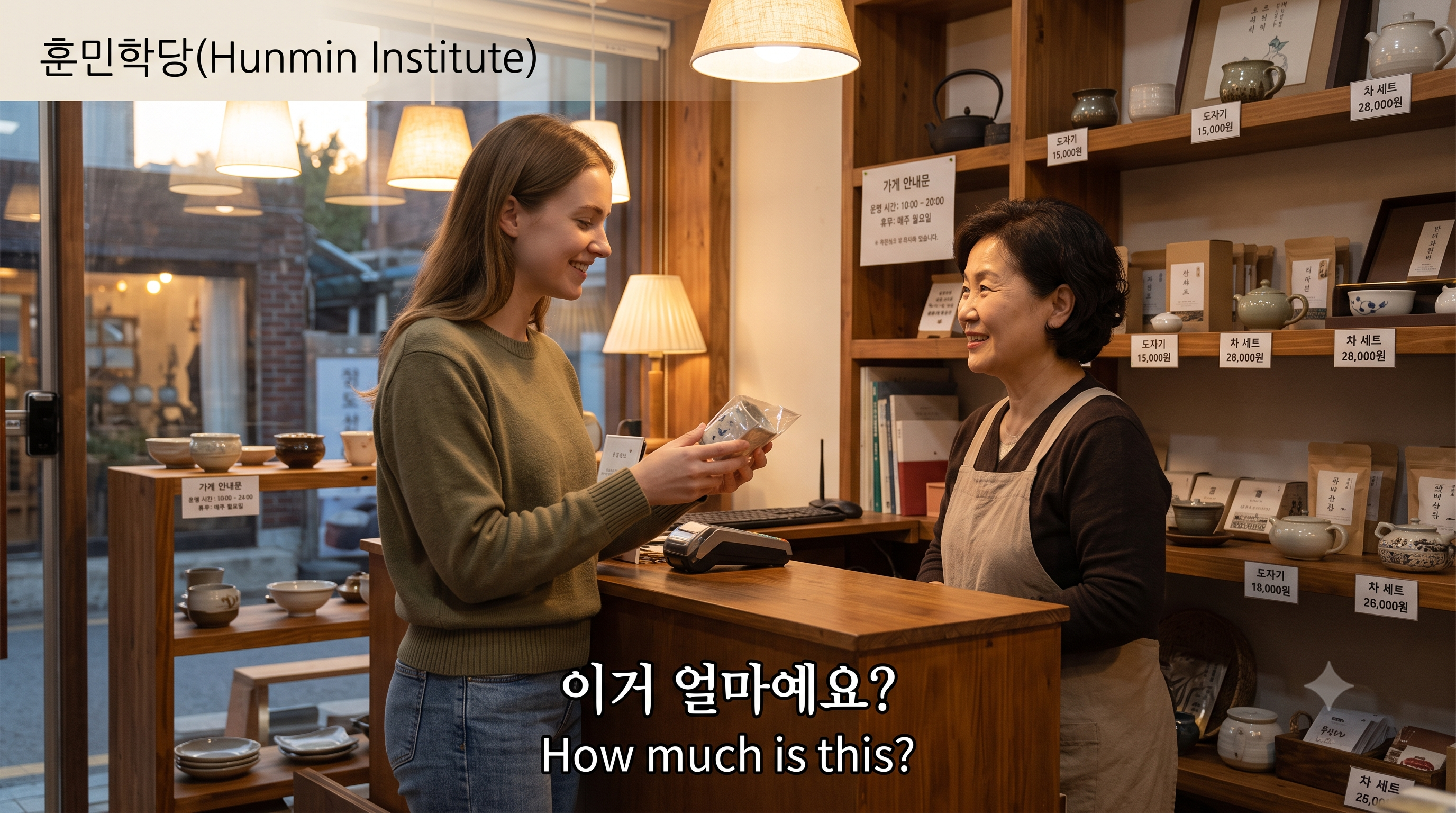
| 이거 얼마예요? [igeo eolmayeyo] |
자연스럽습니다. 짧은 구어에서는 조사를 넣으면 오히려 딱딱합니다 Natural. In short speech, adding the particle sounds stiff |
| 밥 먹었어요? [bap meogeosseoyo] |
자연스럽습니다. 짧은 물음이라 상황이 뜻을 채웁니다 Natural. A short question where the situation fills in the meaning |
| 저 김치 좋아해요 [jeo gimchi joahaeyo] |
어색합니다. 저는과 김치를이 있어야 합니다 Awkward. It needs 저는 and 김치를 |
| 어제 친구 만났어요 [eoje chingu mannasseoyo] |
말로는 통하지만 글로 쓰면 친구를이 있어야 합니다 Fine when spoken, but in writing it needs 친구를 |
여기서 쓰는 문장부터 배워 봅시다. 조사를 빼도 되는지 물을 때 오가는 문장입니다.
Now for the sentences you use here. These go back and forth when you ask whether a particle may go.
| 듣는 문장 Listening |
쓰는 문장 Writing |
|---|---|
| 밥은 먹었어요? [babeun meogeosseoyo] Have you at least eaten? |
이거 얼마예요? [igeo eolmayeyo] How much is this? |
| 말할 때는 빼도 돼요. [malhal ttaeneun ppaedo dwaeyo] You may drop it when speaking. |
글에도 빼도 돼요? [geuredo ppaedo dwaeyo] May I drop it in writing too? |
▶말할 때는 빼도 되고 쓸 때는 넣습니다. 이 한 줄이 기준입니다.
Drop them when speaking, keep them when writing. That one line is the rule.
듣는 사람이 상황만으로 뜻을 채울 수 있으면 조사가 없어도 됩니다. 그러나 문장이 길어지거나 글이 되면 조사가 없을 때 뜻이 흔들리고, 시험 답안과 업무 문장에서는 곧바로 감점으로 이어집니다.
If the listener can fill in the meaning from the situation, the particle can go. But once the sentence grows or moves to the page, meaning starts to wobble without it, and on exam papers and in work writing it costs you points directly.
한 가지 더 눈여겨볼 것이 있습니다. 위 표는 비율이지 횟수가 아닙니다. 같은 연구에서 실제로 가장 많이 빠진 조사는 주격 이, 가로 127회였습니다. 을, 를은 쓸 일이 적지만 쓸 때마다 자주 빠지고, 이, 가는 쓸 일이 워낙 많아 빠지는 횟수가 많습니다. 비율과 횟수는 서로 다른 조사를 가리킵니다.
One more thing to notice: the table shows rates, not counts. In the same study the particle dropped most often was the subject marker 이, 가, at 127 times. 을, 를 comes up less often but goes missing at a high rate, while 이, 가 appears so often that its raw count is highest. Rate and count point to different particles.
5. 급수가 올라가도 조사는 남습니다
Particles Stay With You as Your Level Rises
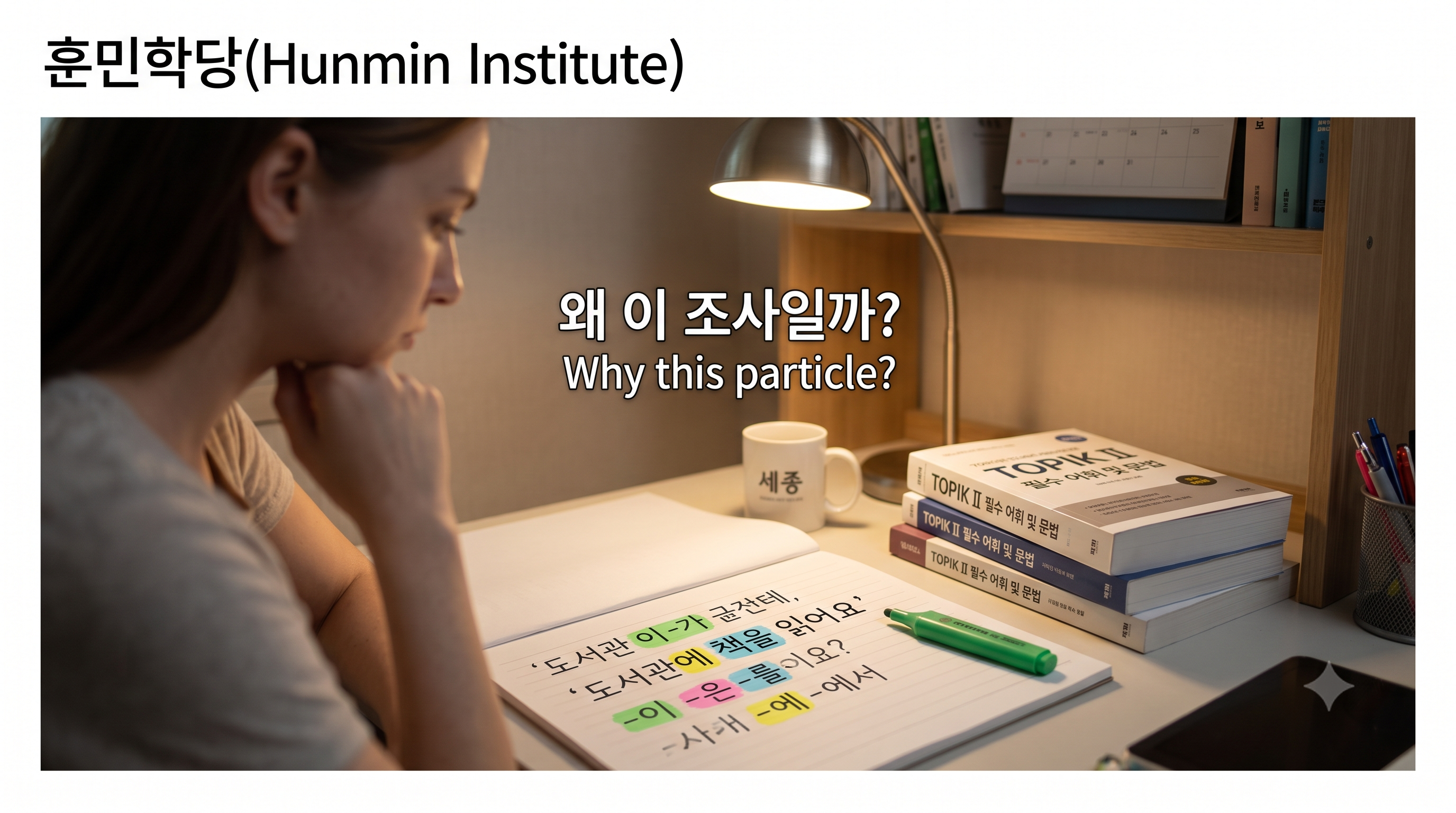
급수가 오르면 조사 오류는 줄어듭니다. 그러나 사라지지는 않습니다. 고급 학습자를 대상으로 한 두 연구의 수치를 보십시오. 자료의 성격이 다르므로 크기를 곧바로 견주지는 마십시오.
As your level rises, particle errors thin out. They do not disappear. Look at the figures from two studies of advanced learners, and do not compare the sizes head to head, since the data types differ.
| 연구 Study |
무엇을 분석했는가 What was analyzed |
조사 오류율 Particle error rate |
|---|---|---|
| 이정희 2003 | 고급 학습자의 문어 자료 Written data, advanced learners |
12.9% |
| 한상미 2014 | 고급 학습자의 구어 담화 Spoken discourse, advanced learners |
9.2% |
그러면 무엇을 해야 할까요. 외우는 대신 고르는 훈련을 세 단계로 두십시오.
So what should you do? Instead of memorizing, set up three steps of choosing practice.
| 단계 Step |
무엇을 합니까 What to do |
|---|---|
| 1단계 Step 1 |
이, 가와 은, 는이 바뀐 문장을 짝지어 소리 내어 읽습니다 Read sentence pairs aloud, swapping 이, 가 for 은, 는 |
| 2단계 Step 2 |
같은 내용을 말로 한 번, 글로 한 번 써 보고 조사를 견줍니다 Say it once, write it once, then compare the particles |
| 3단계 Step 3 |
자기가 쓴 글에서 조사에만 표시하고 하나씩 이유를 댑니다 Mark only the particles in your own writing and justify each one |
여기서 쓰는 문장부터 배워 봅시다. 고른 이유를 확인할 때 오가는 문장입니다.
Now for the sentences you use here. These go back and forth when you check why you chose what you chose.
| 듣는 문장 Listening |
쓰는 문장 Writing |
|---|---|
| 왜 이 조사예요? [wae i josayeyo] Why this particle? |
그건 제가 할게요. [geugeon jega halgeyo] I will take care of that one. |
| 이유를 말해 보세요. [iyureul malhae boseyo] Try saying why. |
아직 감으로 써요. [ajik gameuro sseoyo] I am still going on feel. |
▶조사는 외우는 항목이 아니라 고르는 훈련이 필요한 항목입니다.
Particles are not something to memorize but something to practise choosing.
초급에서 나타난 오류 유형이 고급에서도 그대로 나타난다는 보고가 이어져 왔습니다. 한 번 굳은 습관은 급수가 올려 주지 않는다는 뜻입니다.
Study after study has reported that the error types seen at the beginner stage still appear at the advanced stage. A habit, once set, is not undone by moving up a level.
더 눈여겨볼 것은 대치 오류의 분포입니다. 대치는 초급이 아니라 쓸 수 있는 조사가 늘어나는 중급 구간에서 가장 많아집니다. 아는 것이 늘면 고를 자리도 함께 늘어납니다. 그래서 3단계의 이유 대기가 핵심입니다. 왜 이 조사인지 말로 설명할 수 없다면 아직 감으로 쓰고 있는 것입니다.
The distribution of substitution errors is worth a closer look: they peak not at the beginner stage but in the intermediate range, where the number of usable particles grows. Knowing more creates more places to slip. This is why Step 3 matters most: if you cannot say why you chose a particle, you are still going on feel.
학습자가 가장 많이 틀리는 것은 조사이고 그 오류의 대부분은 잘못 고르거나 빼먹는 둘입니다. 고르는 자리에서는 이, 가가 소식이고 은, 는이 비교라는 것을 잡고, 빼는 자리에서는 말할 때는 빼도 되고 쓸 때는 넣는다는 것을 잡으십시오. 조사는 목록으로 외워지지 않으므로 문장 안에서 고르고 그 이유를 말해 보는 훈련만이 줄여 줍니다.
Particles are what learners get wrong most, and nearly all of those errors are either the wrong choice or a missing particle. For choosing, hold that 이, 가 is news and 은, 는 is contrast; for dropping, hold that they may go in speech and must stay in writing. Particles do not stick as a list, so only choosing them inside sentences and saying why will bring the errors down.
Next: Korean Numbers Part 1: Why Korea Counts in Ten Thousands ↗
토픽 맛보기
TOPIK Preview
유형: TOPIK Ⅰ 읽기 [34~39], 대화문, 빈칸에 알맞은 것 고르기
Type: TOPIK I Reading [34–39], dialogue, choose the correct word for the blank
다음 대화의 빈칸에 알맞은 것을 고르십시오.
Choose the correct answer for the blank in the conversation below.
가: 누가 전화했어요?
나: 동생( ) 전화했어요.
① 은
② 이
③ 가
④ 를
Answer ▾
정답 ③ 가
Answer: ③ 가
누가로 물으면 답도 이, 가로 받습니다. 동생은 모음으로 끝나므로 가를 씁니다. ①은 비교의 뜻이 생겨 누구인지 특정해 묻는 질문에 맞지 않고, ②는 자음으로 끝나는 말에 붙는 형태라 형태가 어긋나며, ④는 목적어 자리에 붙는 조사입니다. 흉내 낸 대문항은 TOPIK Ⅰ 읽기 [34~39] 빈칸에 알맞은 것 고르기입니다.
A question with 누가 is answered with 이, 가, and 동생 ends in a vowel, so 가 is used. ① adds a sense of contrast that does not fit a question asking who. ② is the form used after a consonant. ④ marks an object. The item type modeled here is TOPIK I Reading [34–39].
FAQ
Q1. 조사를 틀려도 한국인이 알아듣던데 꼭 고쳐야 하나요?Answer ▾
Q1. Koreans understand me even when my particles are wrong. Do I really need to fix them?
A1. 처음에는 정확도를 목표로 두지 마십시오. 말의 목적은 통하는 것이고 조사가 조금 어긋나도 한국인은 뜻의 중심을 잡아 거의 다 알아듣습니다. 틀릴까 봐 말을 못 하는 편이 훨씬 큰 손해입니다. 다만 실력을 가늠하는 자리는 다릅니다. 시험과 서류, 업무 문장에서는 조사가 그대로 평가 대상이 됩니다. 초급에서는 마음껏 말하고 중급에 들어서는 시점에 조사를 정면으로 다루십시오.
A1. Do not aim for accuracy at the start. Language exists to get through, and Koreans catch the core meaning even when particles are off. Being afraid to speak costs you far more. Assessment is another matter: on exams, in documents, and in work writing, particles are graded as they stand. Speak freely as a beginner, and take particles head-on when you reach the intermediate stage.
Q2. 판단이 안 설 때 쓸 수 있는 임시 기준이 있나요?Answer ▾
Q2. Is there a quick rule I can use when I cannot decide?
A2. 문장을 소리 내어 읽고 비교하는 느낌이 생기는지 확인해 보십시오. 견줄 대상이 떠오르지 않는데 비교의 느낌이 나면 은, 는이 어긋난 것이므로 이, 가로 바꿉니다. 완벽한 기준은 아니지만 대화 중에 바로 쓸 수 있습니다.
A2. Read the sentence aloud and check whether it feels like a comparison. If that feeling appears with nothing to compare against, 은, 는 is the wrong choice and 이, 가 belongs there. It is not perfect, but you can apply it mid-conversation.
Q3. 이런 오류 자료는 어디에서 직접 볼 수 있나요?Answer ▾
Q3. Where can I look at this error data myself?
A3. 국립국어원이 한국어 학습자 말뭉치를 공개하고 있고 공공데이터포털에서도 내려받을 수 있습니다. 본문의 수치는 이 자료를 분석한 학술 연구에서 나온 것이며 연구마다 표본과 자료 성격이 다르므로 원문을 함께 보시는 편이 좋습니다.
A3. The National Institute of Korean Language publishes its learner corpus, and it can also be downloaded from the Public Data Portal. The figures here come from academic studies of that material, and since samples and data types differ by study, reading the originals alongside helps.
Q4. 조사만 모아 놓은 교재로 공부하면 되나요?Answer ▾
Q4. Should I study from a book that lists all the particles?
A4. 목록은 외우기에 좋지만 고르는 훈련이 되지 않습니다. 대치와 생략은 목록을 몰라서 생기는 오류가 아니기 때문입니다. 조사가 살아 있는 문장 속에서 반복해 눈에 익히는 편이 훨씬 빠릅니다. 같은 글을 여러 번 되읽으면 읽는 동안 조사가 쓰이는 자리를 계속 만나게 됩니다.
A4. A list is easy to memorize but does not train you to choose, since substitution and omission do not come from not knowing the list. Meeting particles again and again inside living sentences is much faster. Reread the same text several times and you keep encountering particles where they actually work.
Q5. 몇 급쯤 되면 조사 오류가 사라지나요?Answer ▾
Q5. At what level do particle errors disappear?
A5. 사라지지 않습니다. 급수가 오르면 줄기는 하지만 고급 학습자의 자료에서도 조사 오류는 남아 있습니다. 오히려 대치 오류는 쓸 수 있는 조사가 늘어나는 중급 구간에서 가장 많아집니다. 아는 것이 늘면 고를 자리도 함께 늘어나기 때문입니다.
A5. They do not. Errors thin out as your level rises, but they remain in advanced learners’ data. Substitution errors actually peak in the intermediate range, where the number of usable particles grows. The more you know, the more places there are to choose wrongly.
Vocabulary and Pronunciation for Foreigners
| No | Korean | Romanisation | Meaning |
|---|---|---|---|
| 1 | 조사 | josa | (n) particle [ˈpɑːrtɪkl] |
| 2 | 오류 | oryu | (n) error [ˈerər] |
| 3 | 대치 | daechi | (n) substitution [ˌsʌbstɪˈtuːʃn] |
| 4 | 생략 | saengnyak | (n) omission [oʊˈmɪʃn] |
| 5 | 말뭉치 | malmungchi | (n) corpus [ˈkɔːrpəs] |
| ▾ 단어 47개 더 보기 Show 47 more ↗ | |||
The blog page has limits of space and function, so only five words are shown here. The rest of the word list, the audio, the sentences and tables, the FAQ, the worksheet, the TOPIK questions and the lesson video are on the Hunmin Institute website ↗, free for blog subscribers.
참고 기관
Official Sources
국립국어원 ↗
National Institute of Korean Language
https://www.korean.go.kr
기관 설명 보기 About this institute ▾
This institute builds and publishes the Korean learner corpus, a body of learner writing and speech with errors tagged, available through the learner corpus service on its site. The studies cited in this post analyzed material of this kind, and standard usage for individual words can be checked in the Korean Basic Dictionary run by the same institute.
공공데이터포털 ↗
Public Data Portal
https://www.data.go.kr
기관 설명 보기 About this institute ▾
A portal for downloading data held by government bodies and public institutions. The learner corpus released by the National Institute of Korean Language can be obtained here, so you can open the tagged source data yourself.
※ 본 콘텐츠(원고, 이미지, 예문 포함)는 저작권법에 의해 보호받는 훈민학당의 저작물입니다. 무단 복제, 전재, 재배포 및 AI 학습 데이터로의 이용을 금합니다.
This content (manuscript, images, and example sentences) is the copyrighted property of Hunmin Institute, protected under copyright law. Unauthorized copying, reproduction, redistribution, and use as AI training data are prohibited.
'Reading Skills' 카테고리의 다른 글
| Korean Numbers Part 1: Why Korea Counts in Ten Thousands (0) | 2026.08.16 |
|---|---|
| Korean Numbers Part 2: How to Read Prices and Time (0) | 2026.08.16 |
| TOPIK Is a Scoring System, Not Just a Test (0) | 2026.07.27 |
| Korean Word Order Explained: Understand Any Sentence (0) | 2026.07.25 |
| How to Read Hangul Part 4: Reading Practice (0) | 2026.07.25 |


