Korean Numbers Part 2: How to Read Prices and Time
화면에는 15:00, 입으로는 오후 세 시입니다
In Korean the number on the screen and the sound in your mouth often part ways.
Here you learn to turn prices, clock faces, and phone numbers into spoken Korean.
한국어에서는 화면에 적힌 숫자와 입에서 나오는 소리가 자주 어긋납니다.
이 글에서 가격표와 시계, 전화번호의 표기를 소리로 옮기는 절차를 익힙니다.
The learning services for the teaching materials published on this blog are free and open to everyone on the Hunmin Institute website ↗, with no account needed.
이 글에서 배우는 핵심 문장
Key Sentences in This Lesson
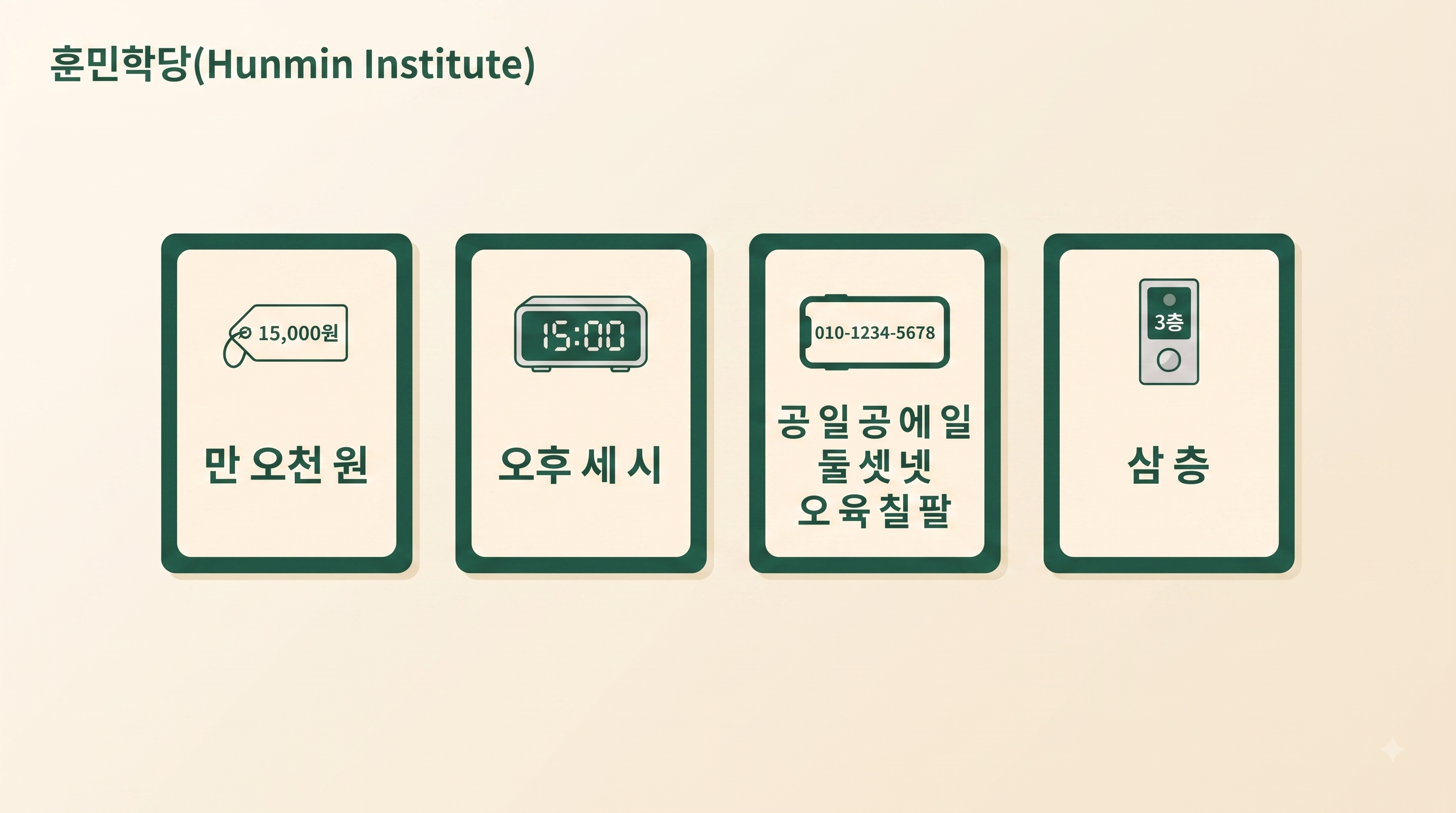
화면에서 본 표기를 입으로 옮기는 자리에서 오가는 말입니다. 좌우는 한 쌍의 대화가 아니라 각각 따로 익히는 문장입니다.
These are the lines exchanged where what you see on a screen has to come out of your mouth. The two columns are not paired dialogue; learn each side on its own.
| 듣는 문장 Listening |
쓰는 문장 Writing |
|---|---|
| 만 오천 원입니다. [man ocheon wonimnida] That is fifteen thousand won. |
얼마예요? [eolmayeyo] How much is it? |
| 오후 세 시예요. [ohu se siyeyo] It is three in the afternoon. |
몇 시에 시작해요? [myeot sie sijakaeyo] What time does it start? |
| 공일공에 일이삼사예요. [gongilgonge irisamsayeyo] It is oh-one-oh, one-two-three-four. |
번호가 어떻게 되세요? [beonhoga eotteoke doeseyo] May I have your number? |
첫째 줄은 소단락 1에서, 둘째 줄은 소단락 2에서, 셋째 줄은 소단락 3에서 각각 다룹니다. 숫자를 읽는 원리는 1부에서 잡았으므로 아직 보지 않으셨다면 그쪽을 먼저 읽으십시오.
The first row is covered in Section 1, the second in Section 2, and the third in Section 3. The reading principle was settled in Part 1, so start there if you have not read it yet.
1. 가격은 자릿수만 끊으면 끝납니다
Prices Are Just a Matter of Where You Cut
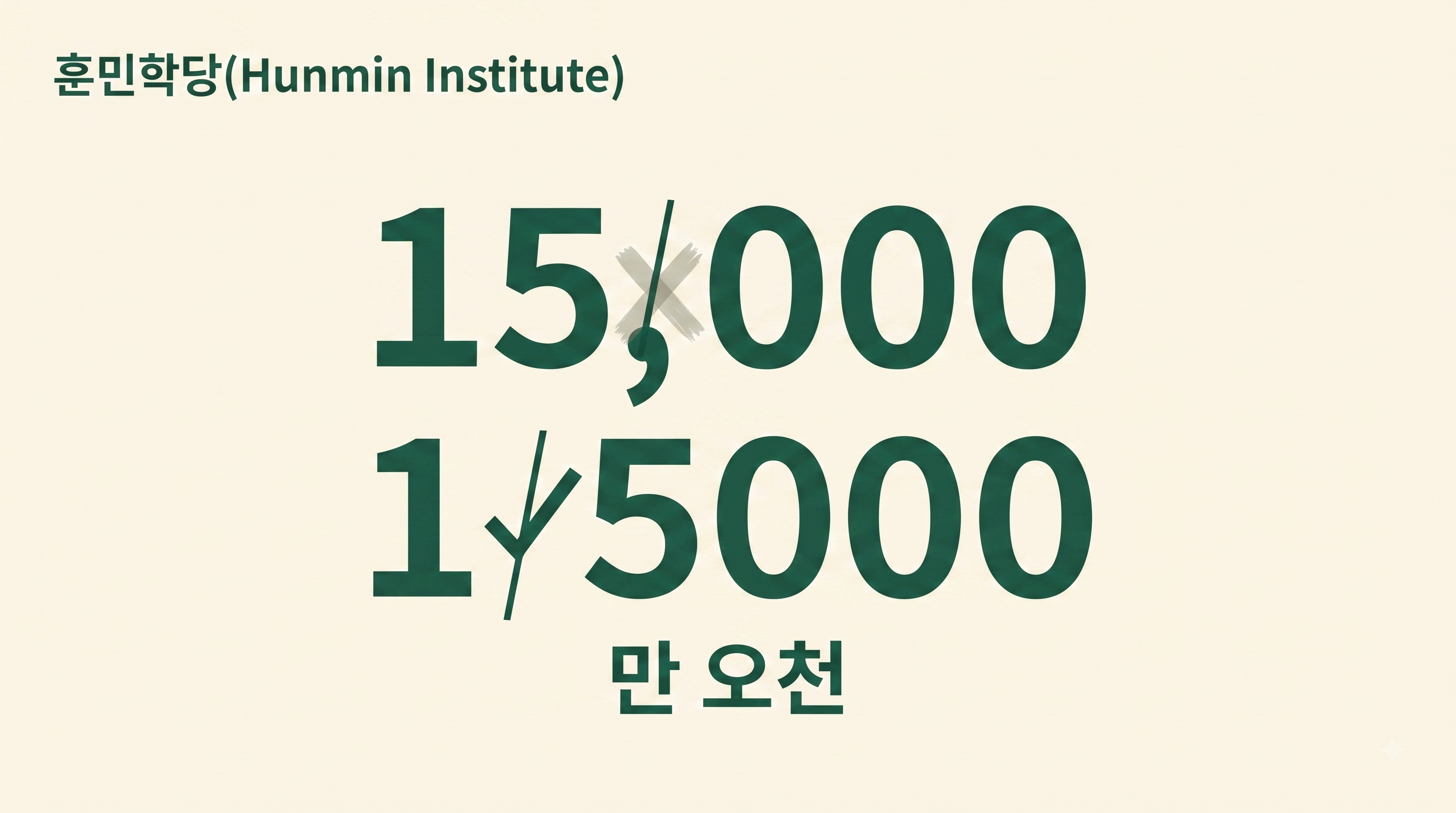
가격은 네 자리 가운데 가장 쉬운 자리입니다. 원 앞에는 한자어 숫자만 오기 때문입니다. 고유어를 쓸지 한자어를 쓸지 고민할 필요가 없고 1부에서 잡은 자릿수 끊기만 그대로 옮기면 됩니다.
Prices are the easiest of the four slots, because only Sino-Korean numbers come before 원. There is no choice to make; you simply carry over the four-digit cut you learned in Part 1.
| 가격표 Price tag |
읽는 소리 Spoken form |
문장 Sentence |
|---|---|---|
| 3,500원 | 삼천오백 원 [samcheon obaek won] |
삼천오백 원입니다. That is 3,500 won. |
| 15,000원 | 만 오천 원 [man ocheon won] |
만 오천 원입니다. That is 15,000 won. |
| 48,000원 | 사만 팔천 원 [saman palcheon won] |
사만 팔천 원이에요. It is 48,000 won. |
| 120,000원 | 십이만 원 [sibiman won] |
십이만 원이에요. It is 120,000 won. |
여기서 쓰는 문장부터 배워 봅시다. 값을 치를 때 오가는 문장입니다.
Now for the sentences you use here. These go back and forth when you pay.
| 듣는 문장 Listening |
쓰는 문장 Writing |
|---|---|
| 만 오천 원입니다. [man ocheon wonimnida] That is fifteen thousand won. |
얼마예요? [eolmayeyo] How much is it? |
| 현금으로 하시겠어요? [hyeongeumeuro hasigesseoyo] Would you like to pay in cash? |
카드로 할게요. [kadeuro halgeyo] I will pay by card. |
응용 Apply It
↳ [숫자] 원입니다
[number] wonimnida
That is [number] won.
ex [만 오천] 원입니다./[사만 팔천] 원입니다.
ROM [man ocheon] wonimnida/[saman palcheon] wonimnida
EN That is fifteen thousand won./That is forty-eight thousand won.
▶눈이 보는 쉼표와 입이 쓰는 칸이 서로 다른 곳에 있습니다.
The comma your eye sees and the cut your mouth makes sit in different places.
15,000은 쉼표가 찍힌 자리에서 15와 000으로 갈라 보입니다. 그러나 한국어는 1과 5000으로 갈라 만 오천이라고 읽습니다. 쉼표는 영어의 세 자리 칸을 따라 찍힌 것이므로 그 자리를 그대로 따라 읽으면 십오천이 되어 버립니다.
The comma splits 15,000 into 15 and 000 to the eye, but Korean splits it into 1 and 5000 and says 만 오천. The comma follows the English three-digit grid, so reading along it produces 십오천, which does not exist.
120,000처럼 만 자리에서 딱 떨어지면 뒤의 0은 읽지 않습니다. 십이만 영천 영백 원이라고 하지 않고 그냥 십이만 원입니다. 자릿수가 비어 있으면 그 자리는 통째로 건너뜁니다.
When a figure lands cleanly on 만, as 120,000 does, the zeros after it are not read at all. No one says 십이만 영천 영백 원; it is simply 십이만 원. Empty places are skipped whole.
2. 시계와 달력은 표기를 그대로 읽지 않습니다
Clocks and Calendars Are Not Read as Printed
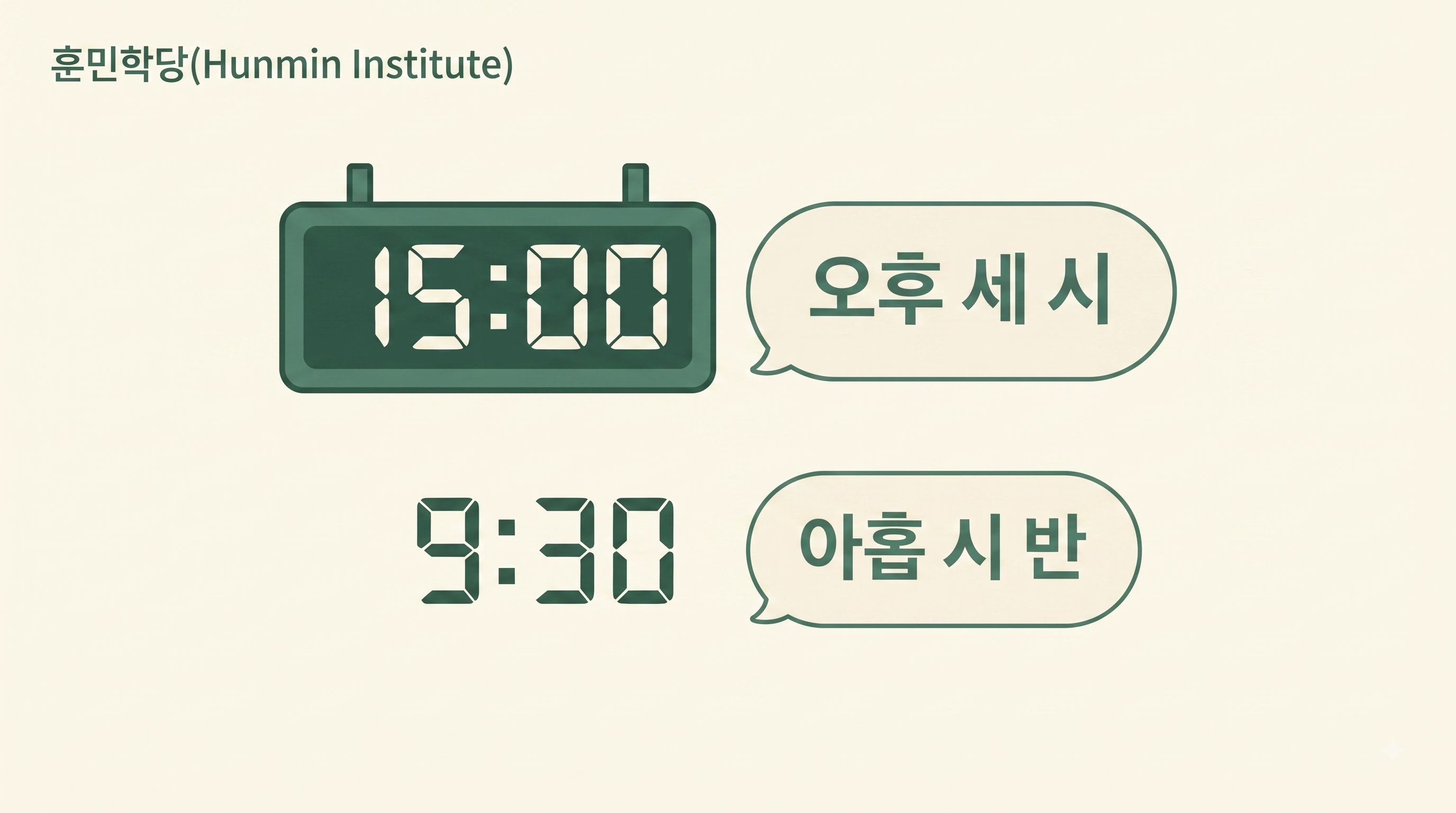
1부 마지막에서 시와 분이 서로 다른 체계를 쓴다고 했습니다. 그 자리를 여기서 마무리합니다. 시는 고유어이고 분은 한자어입니다. 세 시 삼십 분이며 삼 시 삼십 분도 세 시 서른 분도 아닙니다.
Part 1 ended by noting that hours and minutes use different sets, and here that thread is tied off. The hour is native, the minute Sino-Korean: 세 시 삼십 분, never 삼 시 삼십 분 or 세 시 서른 분.
여기에 하나가 더 붙습니다. 화면에 15:00으로 적혀 있어도 열다섯 시라고 말하는 사람은 드뭅니다. 표기는 24시간제이고 입은 12시간제인 셈입니다.
One more layer sits on top. A screen may read 15:00, but few people say 열다섯 시. The writing runs on 24 hours, the mouth on 12.
| 화면 표기 On screen |
일상 대화 In speech |
문장 Sentence |
|---|---|---|
| 9:30 | 아홉 시 반 [ahop si ban] |
아홉 시 반에 열어요. It opens at half past nine. |
| 15:00 | 오후 세 시 [ohu se si] |
오후 세 시에 시작합니다. It starts at three in the afternoon. |
| 20:45 | 저녁 여덟 시 사십오 분 [jeonyeok yeodeol si sasibo bun] |
저녁 여덟 시 사십오 분이에요. It is eight forty-five in the evening. |
| 2026. 6. 16. | 이천이십육 년 유월 십육 일 [icheonisibyuk nyeon yuwol simnyuk il] |
유월 십육 일에 만나요. Let us meet on the sixteenth of June. |
여기서 쓰는 문장부터 배워 봅시다. 시각을 묻고 답할 때 오가는 문장입니다.
Now for the sentences you use here. These go back and forth when the time is asked and given.
| 듣는 문장 Listening |
쓰는 문장 Writing |
|---|---|
| 오후 세 시예요. [ohu se siyeyo] It is three in the afternoon. |
몇 시에 시작해요? [myeot sie sijakaeyo] What time does it start? |
| 아홉 시 반에 열어요. [ahop si bane yeoreoyo] It opens at half past nine. |
몇 시에 열어요? [myeot sie yeoreoyo] What time does it open? |
▶기차표는 열다섯 시라고 적고 사람은 오후 세 시라고 말합니다.
A train ticket prints 열다섯 시; a person says 오후 세 시.
공식 안내 방송이나 승차권에서는 24시간제를 그대로 씁니다. 그러나 일상 대화에서는 오전과 오후를 앞에 붙이고 열둘까지만 세어 말합니다. 어느 쪽이 틀린 것이 아니라 쓰이는 자리가 다릅니다.
Official announcements and tickets keep the 24-hour form. In conversation, though, people attach 오전 or 오후 and count only to twelve. Neither is wrong; they belong to different places.
날짜는 시각과 반대로 처음부터 끝까지 한자어입니다. 년과 월, 일이 모두 한자에서 온 말이기 때문입니다. 다만 6월과 10월만 유월과 시월로 갈리며 이것은 1부 소단락 4에서 다룬 그 예외입니다.
Dates run the other way: Sino-Korean throughout, since 년, 월, and 일 all come from Chinese. Only June and October shift, to 유월 and 시월 — the exception covered in Section 4 of Part 1.
3. 전화번호는 한 자리씩 끊어 읽습니다
Phone Numbers Go One Digit at a Time
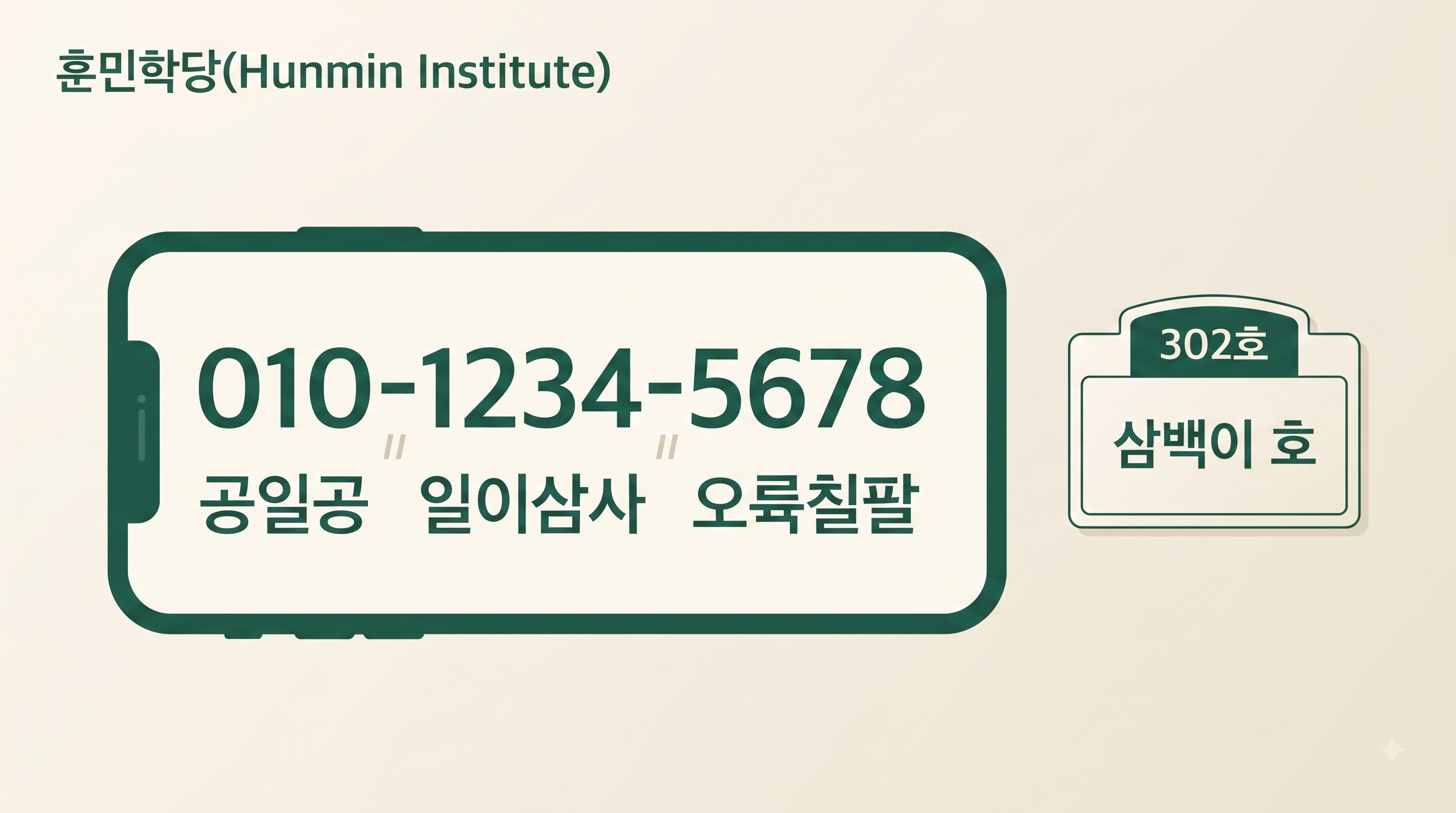
전화번호에는 자릿수 개념이 없습니다. 1234는 천이백삼십사가 아니라 일이삼사입니다. 번호는 수량이 아니라 기호이기 때문입니다. 하이픈이 있는 자리에서 한 박자 쉬고 그 사이는 붙여 읽습니다.
Phone numbers have no place value: 1234 is 일이삼사, not 천이백삼십사, because a number here is a symbol rather than a quantity. Pause a beat at each hyphen and run the digits between them together.
| 표기 Written |
읽는 소리 Spoken form |
문장 Sentence |
|---|---|---|
| 010-1234-5678 | 공일공 일이삼사 오륙칠팔 [gongilgong irisamsa oryukchilpal] |
제 번호는 공일공에 일이삼사 오륙칠팔이에요. My number is 010-1234-5678. |
| 02-345-6789 | 공이 삼사오 육칠팔구 [gongi samsao yukchilpalgu] |
공이에 삼사오 육칠팔구입니다. It is 02-345-6789. |
| 119 | 일일구 [ililgu] |
일일구에 전화하세요. Call 119. |
| 302호 | 삼백이 호 [sambaegi ho] |
삼백이 호로 오세요. Come to room 302. |
여기서 쓰는 문장부터 배워 봅시다. 번호를 주고받을 때 오가는 문장입니다.
Now for the sentences you use here. These go back and forth when numbers are exchanged.
| 듣는 문장 Listening |
쓰는 문장 Writing |
|---|---|
| 공일공에 일이삼사예요. [gongilgonge irisamsayeyo] It is oh-one-oh, one-two-three-four. |
번호가 어떻게 되세요? [beonhoga eotteoke doeseyo] May I have your number? |
| 하나둘셋넷으로 할게요. [hanadulsennesseuro halgeyo] Let me say it with the native numbers. |
다시 한번 불러 주세요. [dasi hanbeon bulleo juseyo] Please read it out once more. |
▶못 알아들으면 같은 번호를 다른 소리로 다시 부릅니다.
When a number does not get through, the same digits are repeated in different sounds.
일이삼사가 안 통하면 한국인은 하나둘셋넷으로 바꿔 부릅니다. 한자어 숫자는 짧고 서로 닮아서 이가 삼으로, 사가 오로 들리기 쉽지만 고유어는 음절이 길어 잘 갈리기 때문입니다. 같은 숫자를 두 벌로 말할 수 있다는 것이 여기서 실전 능력이 됩니다.
If 일이삼사 does not land, a Korean switches to 하나둘셋넷. Sino-Korean numbers are short and resemble one another, so 이 can be heard as 삼 and 사 as 오, while the native forms have longer syllables that separate cleanly. Being able to say the same digits two ways is a practical skill right here.
호실은 전화번호와 다릅니다. 302호는 삼공이 호가 아니라 삼백이 호입니다. 방 번호는 기호가 아니라 순서를 나타내는 수이기 때문입니다. 같은 아라비아 숫자라도 그것이 수량인지 기호인지에 따라 읽는 방식이 갈립니다.
Room numbers work differently: 302호 is 삼백이 호, not 삼공이 호, because a room number marks order rather than acting as a symbol. The same digits are read one way as quantity and another as symbol.
4. 같은 글자라도 세는 순간 달라집니다
The Same Word Shifts the Moment You Count
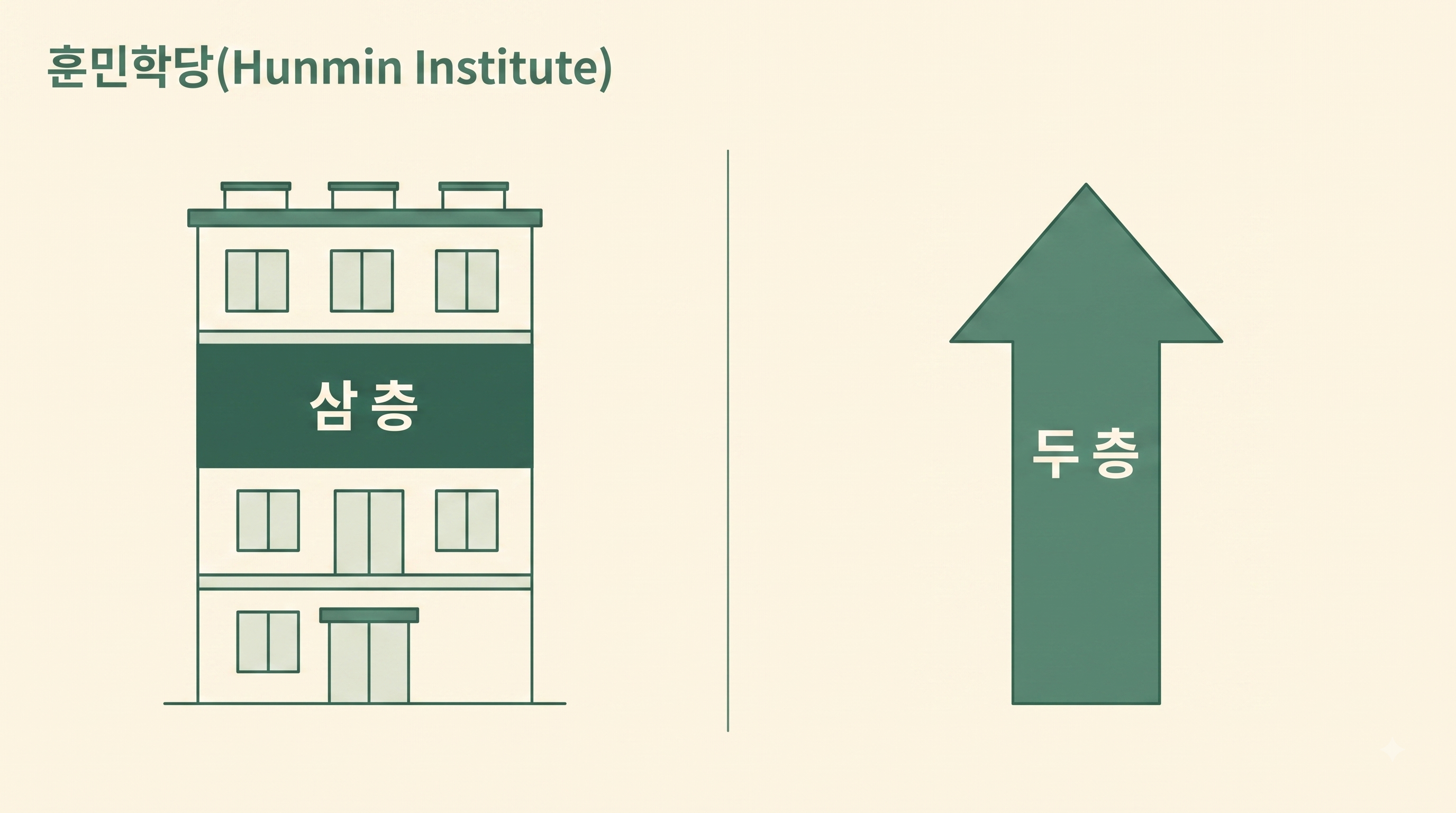
층은 위치를 가리킬 때와 개수를 셀 때가 갈립니다. 3층에 있다고 할 때는 삼 층이지만 위로 두 개 올라간다고 할 때는 두 층입니다. 위치는 순서를 매기는 자리라 한자어가 오고 개수는 세는 자리라 고유어가 옵니다.
층 splits between marking a location and counting a quantity: being on the third floor is 삼 층, but going up two floors is 두 층. Position ranks, so it takes Sino-Korean; quantity counts, so it takes the native set.
| 상황 Situation |
읽는 소리 Spoken form |
문장 Sentence |
|---|---|---|
| 위치를 말할 때 Marking a location |
삼 층 [sam cheung] Sino-Korean set |
삼 층으로 가세요. Go to the third floor. |
| 개수를 셀 때 Counting a quantity |
두 층 [du cheung] Native Korean set |
두 층 올라가세요. Go up two floors. |
| 스물까지 셀 때 Counting up to twenty |
네 개 [ne gae] Native Korean set |
네 개 주세요. Four, please. |
| 스물을 넘을 때 Counting past twenty |
오십 개 [osip gae] Sino-Korean set is more common |
오십 개 주문했어요. I ordered fifty. |
여기서 쓰는 문장부터 배워 봅시다. 층을 묻고 답할 때 오가는 문장입니다.
Now for the sentences you use here. These go back and forth when floors are asked about.
| 듣는 문장 Listening |
쓰는 문장 Writing |
|---|---|
| 삼 층으로 가세요. [sam cheungeuro gaseyo] Go to the third floor. |
몇 층이에요? [myeot cheungieyo] Which floor is it? |
| 두 층 올라가세요. [du cheung ollagaseyo] Go up two floors. |
몇 층 올라가요? [myeot cheung ollagayo] How many floors do I go up? |
▶글자가 아니라 그 자리에서 무엇을 하고 있는지가 체계를 정합니다.
What decides the set is not the word but what it is doing in that slot.
1부 소단락 2에서 시간의 분과 사람을 세는 분이 갈렸던 것과 같은 구조입니다. 거기서는 글자가 같고 뜻이 달랐고, 여기서는 글자도 뜻도 같은데 하는 일이 다릅니다. 순서를 매기고 있으면 한자어, 세고 있으면 고유어라고 잡으시면 됩니다.
This is the same structure as the two 분 in Part 1, though there the word had two meanings while here the meaning holds and only the job changes. Ranking takes Sino-Korean; counting takes the native set.
스물을 넘어가면 한자어 쪽이 흔해집니다. 스무 개도 쓰이지만 이십 개가 더 자주 들리고 수가 커질수록 그 경향이 뚜렷해집니다. 나이도 같은 방식으로 갈려서 일상에서는 스물다섯 살이라고 하고 서류나 병원에서는 이십오 세라고 적습니다. 살은 고유어와, 세는 한자어와 짝을 이룹니다.
Past twenty the Sino-Korean form grows more common: 스무 개 is used, but 이십 개 is heard more often, and the tendency sharpens as the number rises. Age splits the same way — 스물다섯 살 in daily speech, 이십오 세 in documents and hospitals — since 살 pairs with the native set and 세 with the Sino-Korean one.
2부까지 오면서 한국어 숫자의 지도가 완성되었습니다. 1부에서 끊는 자리와 두 체계, 소리가 바뀌는 자리를 잡았고 2부에서 그 규칙이 가격표와 시계, 전화번호, 층수 위에서 어떻게 움직이는지 확인했습니다. 남은 것은 눈에 보이는 표기를 소리로 옮기는 일을 되풀이하는 것뿐입니다. 지하철 요금표나 영수증을 볼 때마다 두 편을 다시 펴 보십시오. 숫자는 외우는 것이 아니라 읽어 보는 만큼 붙습니다.
With Part 2 the map of Korean numbers is complete. Part 1 fixed where to cut, the two systems, and where sound shifts; Part 2 showed those rules at work on price tags, clocks, phone numbers, and floors. What remains is repetition: turning what you see into what you say. Open both parts again whenever a fare chart or a receipt is in front of you. Numbers stick in proportion to how often you read them aloud.
Next: Korean Spacing Rules: Where One Chunk Ends ↗
토픽 맛보기
TOPIK Preview
유형: TOPIK Ⅰ 읽기 [43~45], 설명문, 일치하는 내용 고르기
Type: TOPIK I Reading [43–45], expository text, choose the matching statement
다음의 내용과 같은 것을 고르십시오.
Choose the statement that matches the passage.
한국에서는 3층에 있을 때 삼 층이라고 합니다. 그런데 위로 두 개 올라갈 때는 두 층이라고 합니다. 글자는 같지만 하는 일이 다르기 때문입니다. 자리를 말할 때와 개수를 셀 때가 갈립니다.
In Korea, being on the third floor is 삼 층, but going up two floors is 두 층. The word is the same; what it is doing differs. Marking a position and counting a quantity part ways.
① 층은 언제나 삼 층처럼 읽습니다.
② 개수를 셀 때는 두 층이라고 합니다.
③ 자리를 말할 때와 개수를 셀 때가 같습니다.
④ 층은 글자가 서로 다릅니다.
Answer ▾
정답 ② 개수를 셀 때는 두 층이라고 합니다.
Answer: ② Counting floors gives 두 층.
지문 둘째 문장이 위로 두 개 올라갈 때는 두 층이라고 했으므로 ②가 맞습니다. ①은 언제나라고 못 박아 두 층이 나오는 자리와 어긋나고, ③은 갈린다고 한 마지막 문장과 정반대이며, ④는 글자는 같다고 한 셋째 문장과 맞지 않습니다. 흉내 낸 대문항은 TOPIK Ⅰ 읽기 [43~45] 일치하는 내용 고르기이고 배점은 3점입니다.
The second sentence says going up two floors is 두 층, so ② is correct. ① fixes it as always, which the 두 층 case contradicts. ③ runs against the closing sentence, where the two part ways. ④ is at odds with the third sentence, which says the word is the same. The item type modeled here is TOPIK I Reading [43–45], worth 3 points.
FAQ
Q1. 15:00을 열다섯 시라고 하면 틀린가요?Answer ▾
Q1. Is it wrong to say 열다섯 시 for 15:00?
A1. 틀리지 않습니다. 기차표 안내나 공식 방송에서는 열다섯 시를 그대로 씁니다. 다만 일상 대화에서는 거의 쓰지 않고 오후 세 시로 바꿔 말합니다. 표기는 24시간제이고 입은 12시간제라고 갈라 두시면 편합니다.
A1. Not wrong. Train announcements and official broadcasts use 열다섯 시 as written. In everyday conversation, though, it is rarely said; people switch to 오후 세 시. Keep them apart: the writing runs on 24 hours, the mouth on 12.
Q2. 30분을 반이라고 해도 되나요?Answer ▾
Q2. May I say 반 instead of 삼십 분?
A2. 됩니다. 아홉 시 삼십 분도 맞지만 아홉 시 반이 입에 더 붙습니다. 다만 반은 절반을 뜻하는 말이라 30분에만 쓰고 15분이나 45분에는 쓰지 않습니다.
A2. Yes. 아홉 시 삼십 분 is correct, but 아홉 시 반 sits more naturally. Since 반 means half, it is used only for thirty minutes, never for fifteen or forty-five.
Q3. 전화번호의 0은 영인가요, 공인가요?Answer ▾
Q3. In a phone number, is zero 영 or 공?
A3. 둘 다 쓰입니다. 국립국어원은 두 말을 갈라 어느 쪽이 틀리다고 정하지 않습니다. 다만 전화번호에서는 공이 훨씬 자주 들리고 계산이나 점수에서는 영이 자연스럽습니다. 010을 공일공으로 읽는 것은 규정이 아니라 관용입니다.
A3. Both are used, and the National Institute of Korean Language does not rule either one wrong. In phone numbers 공 is far more common, while 영 fits calculations and scores. Reading 010 as 공일공 is custom, not regulation.
Q4. 302호를 삼공이 호라고 읽어도 되나요?Answer ▾
Q4. May I read 302호 as 삼공이 호?
A4. 어색합니다. 방 번호는 기호가 아니라 순서를 나타내는 수라서 삼백이 호라고 읽습니다. 같은 아라비아 숫자라도 수량이나 순서를 나타내면 자릿수대로 읽고, 기호로 쓰이면 한 자리씩 끊어 읽습니다.
A4. It sounds off. A room number marks order rather than acting as a symbol, so it is read 삼백이 호. The same digits are read by place value when they mark quantity or order, and one at a time when they work as symbols.
Q5. 나이는 어느 쪽으로 말하나요?Answer ▾
Q5. Which set do I use for age?
A5. 뒤에 붙는 글자를 보면 됩니다. 살은 고유어와 짝을 이루어 스물다섯 살이고, 세는 한자어와 짝을 이루어 이십오 세입니다. 일상에서는 살을, 서류나 병원에서는 세를 씁니다.
A5. Look at the word attached: 살 pairs with the native set, giving 스물다섯 살, and 세 with the Sino-Korean set, giving 이십오 세. Everyday speech uses 살; documents and hospitals use 세.
Vocabulary and Pronunciation for Foreigners
| No | Korean | Romanisation | Meaning |
|---|---|---|---|
| 1 | 자릿수 | jarissu | (n) place value [pleɪs ˈvæljuː] |
| 2 | 표기 | pyogi | (n) notation, written form [noʊˈteɪʃn] |
| 3 | 시각 | sigak | (n) the time [ðə taɪm] |
| 4 | 기호 | giho | (n) symbol [ˈsɪmbl] |
| 5 | 수량 | suryang | (n) quantity [ˈkwɑːntəti] |
| ▾ 단어 44개 더 보기 Show 44 more ↗ | |||
The blog page has limits of space and function, so only five words are shown here. The rest of the word list, the audio, the sentences and tables, the FAQ, the worksheet, the TOPIK questions and the lesson video are on the Hunmin Institute website ↗, free and open to everyone, with no account needed.
참고 기관
Official Sources
국립국어원 ↗
National Institute of Korean Language
https://www.korean.go.kr
기관 설명 보기 About this institute ▾
This institute sets Korean orthography and the standard pronunciation rules. Its online Q&A service answers questions about places the norms do not settle cleanly, such as the use of 영 against 공, and word-by-word pronunciations sit in the Korean Basic Dictionary run by the same institute. Check here when you want to tell settled custom from prescribed rule.
※ 본 콘텐츠(원고, 이미지, 예문 포함)는 저작권법에 의해 보호받는 훈민학당의 저작물입니다. 무단 복제, 전재, 재배포 및 AI 학습 데이터로의 이용을 금합니다.
This content (manuscript, images, and example sentences) is the copyrighted property of Hunmin Institute, protected under copyright law. Unauthorized copying, reproduction, redistribution, and use as AI training data are prohibited.
'Reading Skills' 카테고리의 다른 글
| Korean Spacing Rules: Where One Chunk Ends (0) | 2026.08.16 |
|---|---|
| Korean Numbers Part 1: Why Korea Counts in Ten Thousands (0) | 2026.08.16 |
| Korean Particle Errors: What Learner Data Reveals (0) | 2026.08.05 |
| TOPIK Is a Scoring System, Not Just a Test (0) | 2026.07.27 |
| Korean Word Order Explained: Understand Any Sentence (0) | 2026.07.25 |


