Korean Spacing Rules: Where One Chunk Ends
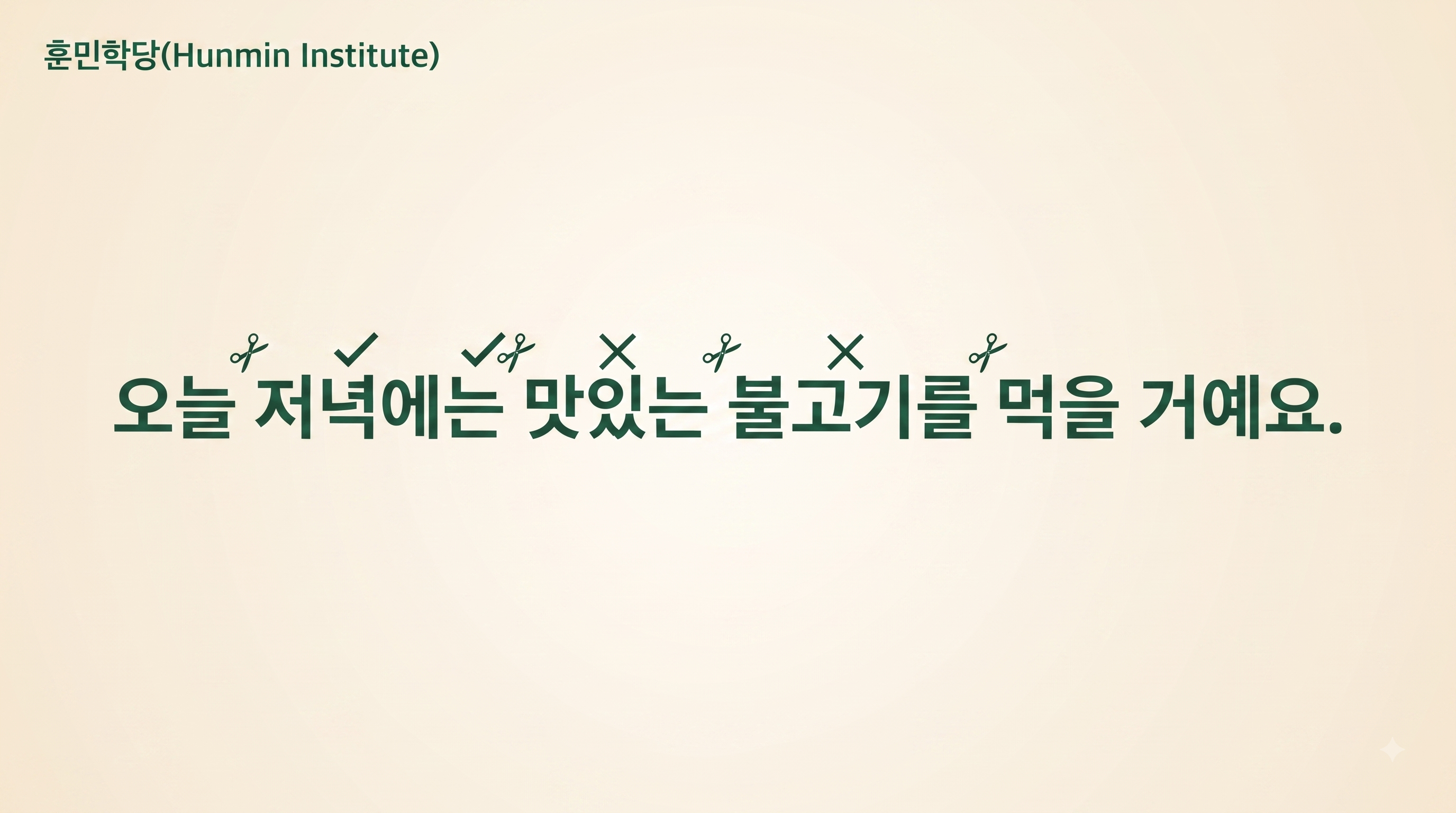
한국어는 단어마다 띄지 않고 덩어리마다 띕니다
학교에 갑니다 is not three chunks. It is two.
This post teaches how to tell where Korean joins and where it separates.
학교에 갑니다는 세 덩어리가 아니라 두 덩어리입니다.
이 글에서 조사와 의존명사가 갈리는 자리를 읽어 내는 법을 익힙니다.
The learning services for the teaching materials published on this blog are free and open to everyone on the Hunmin Institute website ↗, with no account needed.
이 글에서 배우는 핵심 문장
Key Sentences in This Lesson
띄어쓰기를 두고 가장 자주 듣게 되는 문장과 가장 자주 쓰게 되는 문장입니다. 좌우는 한 쌍의 대화가 아니라 각각 따로 익히는 문장입니다.
These are the sentences you hear most often about spacing and the ones you write most often. The two columns are not paired dialogue; learn each side on its own.
| 듣는 문장 Listening |
쓰는 문장 Writing |
|---|---|
| 조사는 붙여 써요. [josaneun buchyeo sseoyo] Particles are written joined. |
학교에 갑니다. [hakgyoe gamnida] I go to school. |
| 띄어 쓰세요. [ttuieo sseuseyo] Put a space there. |
할 수 있어요. [hal su isseoyo] I can do it. |
| 앞을 보세요. [apeul boseyo] Look at what comes before. |
아는 대로 말할게요. [aneun daero malhalgeyo] I will say it as I know it. |
| 둘 다 맞아요. [dul da majayo] Both are correct. |
한 개 주세요. [han gae juseyo] One, please. |
첫째 줄은 소단락 1에서, 둘째 줄은 소단락 2에서, 셋째 줄은 소단락 3에서, 넷째 줄은 소단락 4에서 다룹니다.
The first row is covered in Section 1, the second in Section 2, the third in Section 3, and the fourth in Section 4.
1. 조사는 앞말에 붙어 한 덩어리가 됩니다
Particles Join the Word Before Them
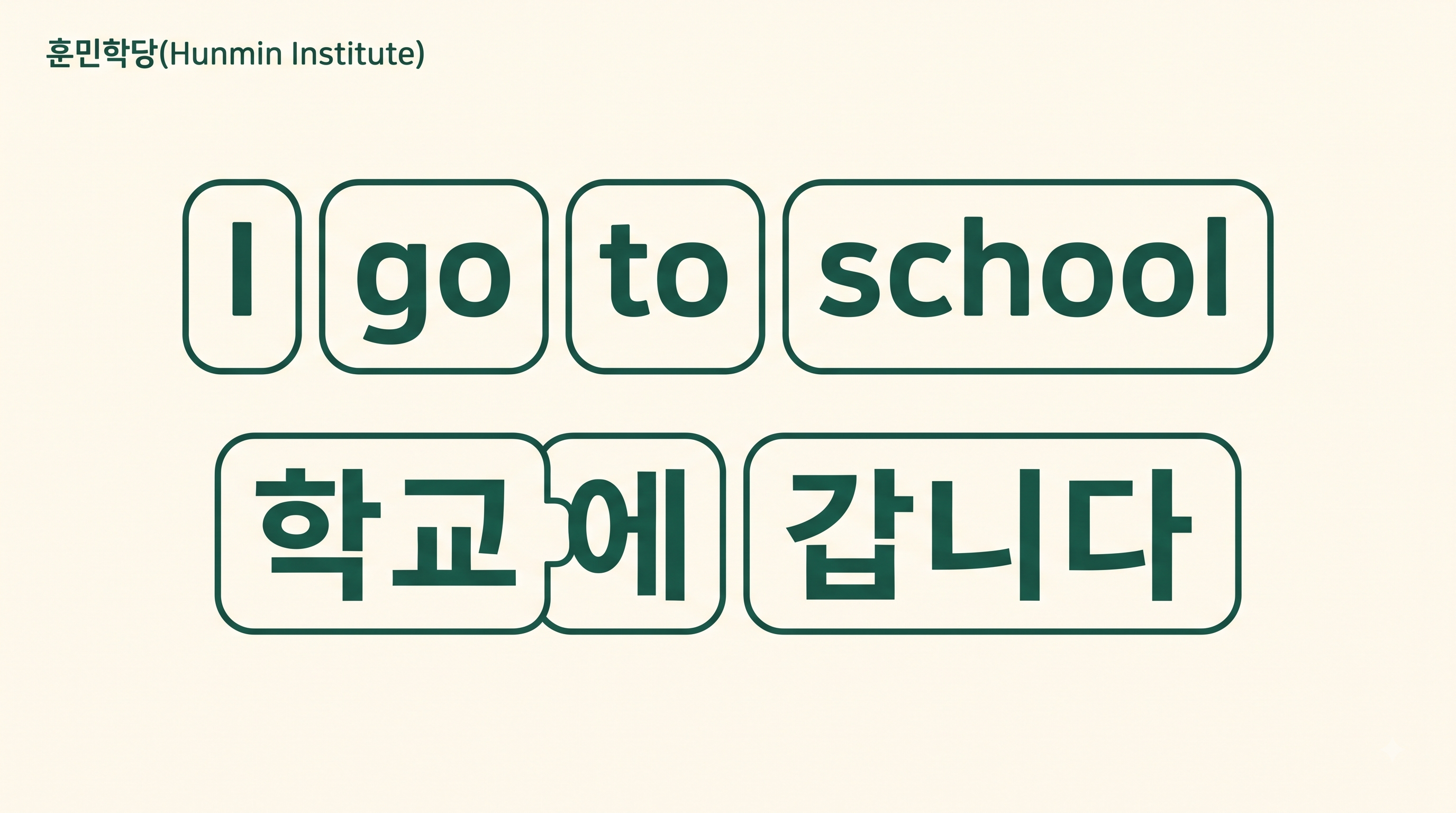
영어는 단어마다 띄어 씁니다. I go to school은 네 덩어리입니다. 한국어는 다릅니다. 학교에 갑니다는 두 덩어리입니다. 영어의 to에 해당하는 “에”가 앞말에 달라붙어 학교에가 통째로 한 마디가 되기 때문입니다.
English spaces between words, so I go to school is four chunks. Korean does not. 학교에 갑니다 is two, because the 에 that answers to "to" attaches to the word before it.
이것을 정한 것이 한글 맞춤법 제41항입니다. 조사는 그 앞말에 붙여 쓴다는 한 문장입니다. 은, 는, 이, 가, 을, 를, 에, 에서, 하고, 부터, 까지가 모두 여기에 해당합니다. 학교 에 갑니다라고 띄어 놓으면 한국인의 눈은 그 자리에서 한 번 걸립니다.
Article 41 of the Korean orthography rules settles it: a particle is written joined to the word before it. Write 학교 에 갑니다 with a space and a Korean reader's eye snags there.
문장이 몇 덩어리로 끊기는지 표로 먼저 보십시오.
See in the table how many chunks each sentence breaks into.
| 문장 Sentence |
덩어리 Chunks |
붙은 조사 Particle |
|---|---|---|
| 학교에 갑니다. [hakgyoe gamnida] I go to school. |
두 덩어리 Two chunks |
에 [e] |
| 저는 학생입니다. [jeoneun haksaengimnida] I am a student. |
두 덩어리 Two chunks |
는 [neun] |
| 친구하고 만나요. [chinguhago mannayo] I am meeting a friend. |
두 덩어리 Two chunks |
하고 [hago] |
| 집에서 회사까지 멀어요. [jibeseo hoesakkaji meoreoyo] It is far from home to the office. |
세 덩어리 Three chunks |
에서, 까지 [eseo, kkaji] |
여기서 쓰는 문장부터 배워 봅시다. 붙는 자리를 두고 오가는 문장입니다.
Now for the sentences you use here. These come up when a joined spot is in question.
| 듣는 문장 Listening |
쓰는 문장 Writing |
|---|---|
| 조사는 붙여 써요. [josaneun buchyeo sseoyo] Particles are written joined. |
학교에 갑니다. [hakgyoe gamnida] I go to school. |
| 한 덩어리로 읽으세요. [han deongeoriro ilgeuseyo] Read it as one chunk. |
집에서 회사까지 멀어요. [jibeseo hoesakkaji meoreoyo] It is far from home to the office. |
| 여기는 띄지 않아요. [yeogineun ttuiji anayo] There is no space here. |
친구하고 만나요. [chinguhago mannayo] I am meeting a friend. |
응용 Apply It
↳ [명사]에 갑니다
[noun]e gamnida
I go to [noun].
ex [학교]에 갑니다./[회사]에 갑니다.
ROM [hakgyo]e gamnida/[hoesa]e gamnida
EN I go to school./I go to the office.
▶조사는 혼자 서지 못하고 언제나 앞말에 얹혀 갑니다.
A particle never stands alone; it always rides on the word before it.
조사가 둘 겹쳐도 마찬가지입니다. 집에서만, 학교에도처럼 이어 붙습니다. 앞말과 조사를 한 마디로 묶어 읽으면 문장의 뼈대가 먼저 보입니다.
Two particles in a row behave the same way, as in 집에서만 or 학교에도. Read a word and its particle as one unit and the frame of the sentence shows up first.
그래서 한국어를 읽을 때 눈이 세어야 할 것은 단어가 아니라 덩어리입니다. 덩어리를 찾으면 어디에서 끊어 읽어야 하는지도 함께 잡힙니다.
So what your eye should count in Korean is chunks, not words. Find the chunks and you find where to pause as well.
2. 의존명사는 혼자 못 서지만 앞말과는 떨어집니다
Bound Nouns Cannot Stand Alone, Yet They Take a Space
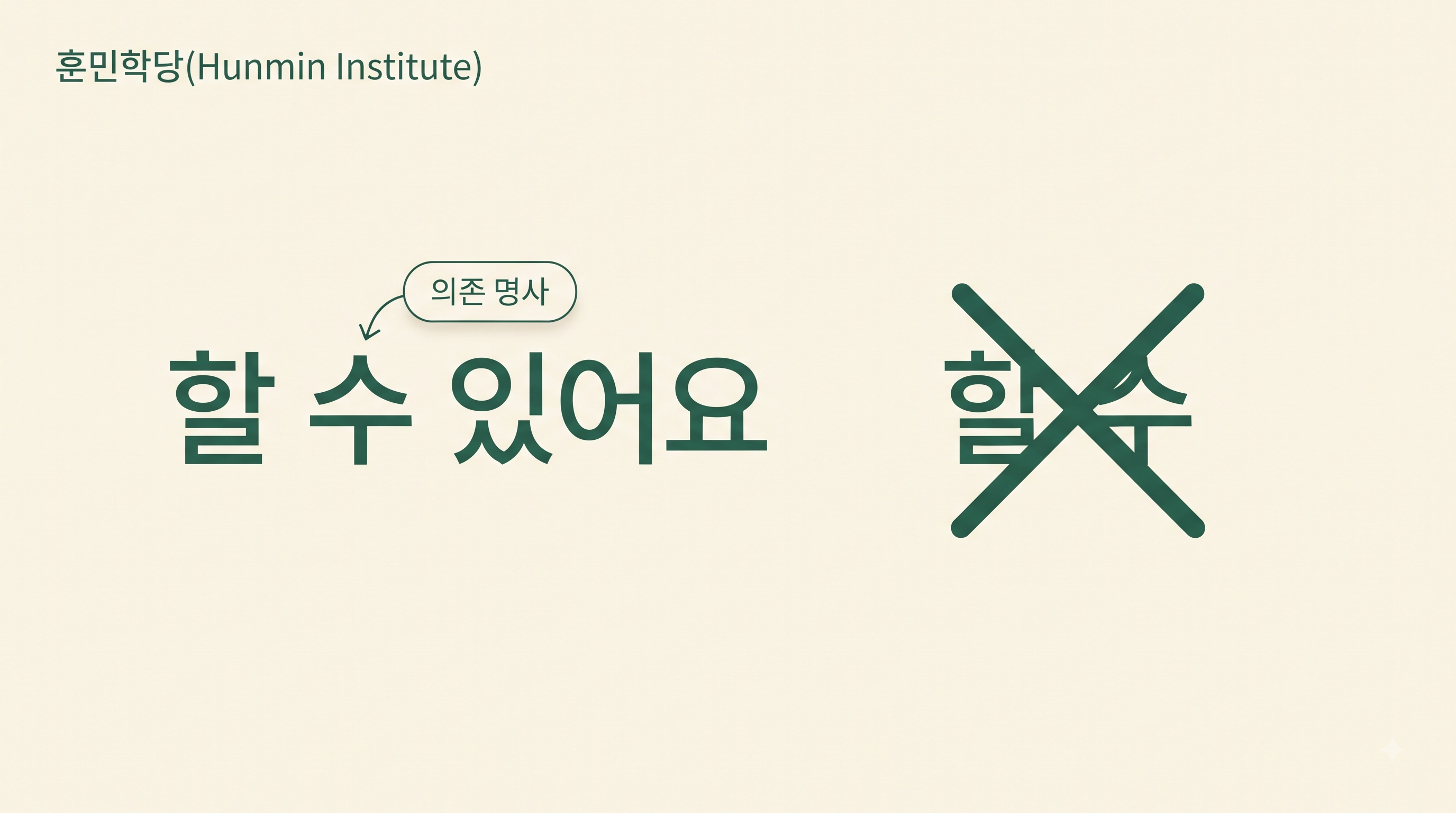
수, 것, 데, 때문 같은 말은 혼자 쓰이지 못합니다. 수만 놓고는 문장이 되지 않고 반드시 앞에 무엇인가가 와야 합니다. 그런데 이 말들은 조사와 달리 앞말과 떨어져 있습니다.
Words like 수, 것, 데 and 때문 cannot be used on their own. 수 by itself makes no sentence; something must come in front of it. Yet unlike particles, these take a space.
한글 맞춤법 제42항이 의존명사는 띄어 쓴다고 정하고 있습니다. 혼자 못 서는 것은 조사와 같은데 붙는지 떨어지는지는 정반대입니다.
Article 42 states that bound nouns are written separately. They share the inability to stand alone with particles, and behave in exactly the opposite way on spacing.
어떤 말이 여기에 드는지 표로 확인하십시오.
Check in the table which words belong here.
| 의존명사 Bound noun |
문장 Sentence |
뜻 Meaning |
|---|---|---|
| 수 [su] |
할 수 있어요. [hal su isseoyo] I can do it. |
할 능력이 있다 Being able to do it |
| 것 [geot] |
갈 것 같아요. [gal geot gatayo] I think I will go. |
갈 듯하다 Seeming likely to go |
| 데 [de] |
볼 데가 많아요. [bol dega manayo] There is a lot to see. |
볼 곳이 많다 Many places to see |
| 때문 [ttaemun] |
비 때문에 늦었어요. [bi ttaemune neujeosseoyo] I was late because of the rain. |
비가 이유다 The rain is the reason |
여기서 쓰는 문장부터 배워 봅시다. 떨어지는 자리를 두고 오가는 문장입니다.
Now for the sentences you use here. These come up when a separated spot is in question.
| 듣는 문장 Listening |
쓰는 문장 Writing |
|---|---|
| 띄어 쓰세요. [ttuieo sseuseyo] Put a space there. |
할 수 있어요. [hal su isseoyo] I can do it. |
| 그건 의존명사예요. [geugeon uijonmyeongsayeyo] That is a bound noun. |
갈 것 같아요. [gal geot gatayo] I think I will go. |
| 혼자서는 못 써요. [honjaseoneun mot sseoyo] It cannot be used on its own. |
비 때문에 늦었어요. [bi ttaemune neujeosseoyo] I was late because of the rain. |
▶의존명사 뒤에는 조사가 다시 붙습니다.
A particle can then attach to the bound noun itself.
“볼 데가”에서 데는 앞말과 떨어지고 가는 데에 붙습니다. 한 마디 안에서 두 규칙이 동시에 작동하는 셈입니다.
In 볼 데가, 데 stands apart from 볼 while 가 joins 데. Both rules work inside a single chunk.
할수 있어요라고 붙여 쓰면 눈이 걸리고 할 수 있어요라고 띄어야 자연스럽게 읽힙니다. 외국인 학습자가 가장 많이 흔들리는 자리가 여기입니다.
Written 할수 있어요 the eye snags; written 할 수 있어요 it reads naturally. This is where learners waver most.
3. 앞을 보면 붙는지 떨어지는지 알 수 있습니다
Look at What Comes Before
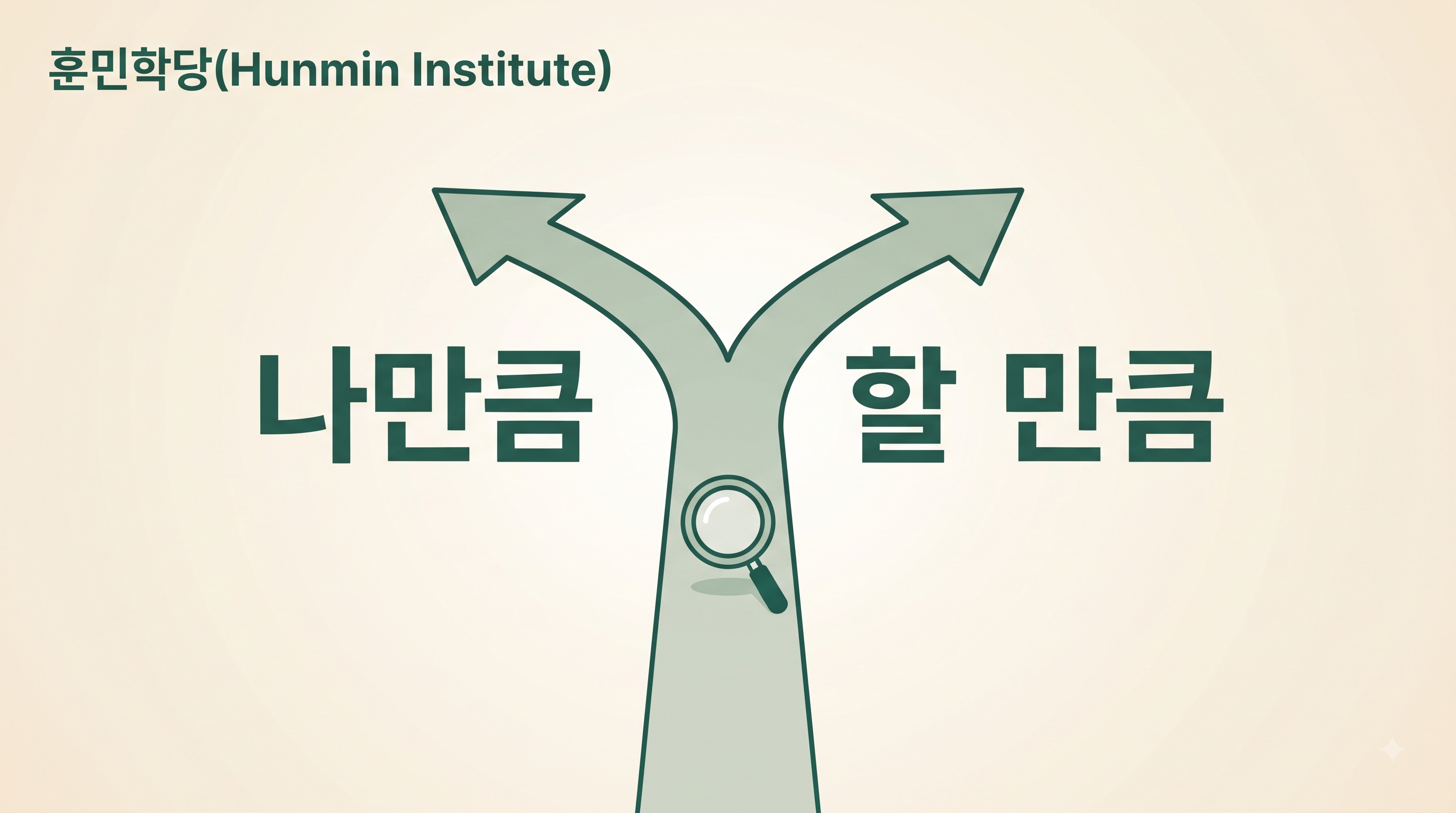
문제는 같은 글자가 양쪽에 다 나온다는 것입니다. 만큼, 대로, 뿐이 그렇습니다. 나만큼은 붙여 쓰고 할 만큼은 띄어 씁니다. 글자만 보면 구분할 방법이 없습니다.
The trouble is that the same syllable appears on both sides. 만큼, 대로 and 뿐 all do. 나만큼 is joined and 할 만큼 is separated, and the syllable alone tells you nothing.
기준은 앞에 있습니다. 앞이 명사면 조사라서 붙고, 앞이 동사나 형용사의 관형형이면 의존명사라서 떨어집니다.
The test lies in front. A noun before it makes it a particle that joins; a modifying form before it makes it a bound noun that separates.
세 글자가 어느 쪽에서 어떻게 서는지 표로 보십시오.
See in the table how the three syllables stand on each side.
| 글자 Syllable |
앞이 명사일 때 After a noun, joined |
앞이 관형형일 때 After a modifier, separated |
|---|---|---|
| 만큼 [mankeum] |
나만큼 하세요. [namankeum haseyo] Do as much as I do. |
할 만큼 했어요. [hal mankeum haesseoyo] I did as much as I could. |
| 대로 [daero] |
법대로 합시다. [beopdaero hapsida] Let us go by the law. |
아는 대로 말하세요. [aneun daero malhaseyo] Tell me what you know. |
| 뿐 [ppun] |
너뿐이에요. [neoppunieyo] There is only you. |
웃을 뿐이었어요. [useul ppunieosseoyo] I could only laugh. |
여기서 쓰는 문장부터 배워 봅시다. 어느 쪽인지 가릴 때 오가는 문장입니다.
Now for the sentences you use here. These come up when you sort out which side it is on.
| 듣는 문장 Listening |
쓰는 문장 Writing |
|---|---|
| 앞을 보세요. [apeul boseyo] Look at what comes before. |
아는 대로 말할게요. [aneun daero malhalgeyo] I will say it as I know it. |
| 앞이 명사면 붙여요. [api myeongsamyeon buchyeoyo] If a noun comes before, join it. |
법대로 하면 돼요? [beopdaero hamyeon dwaeyo] Is going by the law fine? |
| 그 글자만 봐서는 몰라요. [geu geuljaman bwaseoneun mollayo] The syllable alone tells you nothing. |
할 만큼 했어요. [hal mankeum haesseoyo] I did as much as I could. |
▶기준은 글자가 아니라 그 앞에 있습니다.
The test is not the syllable but what sits in front of it.
“나만큼”의 나는 명사이고 “할 만큼”의 할은 하다에서 온 관형형입니다. 이 한 가지만 잡으면 만큼과 대로, 뿐 세 글자가 한꺼번에 정리됩니다.
The 나 in 나만큼 is a noun, and the 할 in 할 만큼 is a modifying form of 하다. Grasp that one test and 만큼, 대로 and 뿐 all fall into place at once.
숫자 편에서도 같은 글자가 자리에 따라 갈리는 장면을 보셨습니다. 그때는 어느 수사 체계를 쓸지가 갈렸고 여기서는 붙일지 뗄지가 갈립니다. 글자만 보지 말고 그 자리에서 무슨 일을 하는지 보라는 원리는 같습니다.
The number posts showed the same syllable splitting by position. There the split was which counting system to use; here it is whether to join or separate. The principle is the same: look at what a word is doing, not at its letters.
4. 어느 쪽이어도 뜻이 같은 자리가 있습니다
Some Spots Mean the Same Either Way

지금까지는 붙느냐 떨어지느냐가 정해져 있었습니다. 그런데 화면에서 두 가지가 다 보이는 자리도 있습니다. 규칙이 흔들리는 것이 아니라 양쪽을 모두 허용하기 때문입니다.
So far the choice has been fixed. But some spots turn up both ways on screen. The rule is not wavering; both forms are permitted.
도와 드리다와 도와드리다가 그렇고, 한 개와 1개가 그렇습니다. 좀 더 큰 것과 좀더 큰것도 둘 다 성립합니다.
도와 드리다 and 도와드리다 are such a pair, and so are 한 개 and 1개. 좀 더 큰 것 and 좀더 큰것 both stand as well.
어느 쪽도 맞는 자리를 표로 확인하십시오.
Check in the table the spots where either form is correct.
| 종류 Type |
떨어진 형태 Separated |
붙은 형태 Joined |
|---|---|---|
| 보조 용언 Auxiliary verb |
도와 드릴게요. [dowa deurilgeyo] I will help you. |
도와드릴게요. [dowadeurilgeyo] I will help you. |
| 단위 명사 Unit noun |
한 개 주세요. [han gae juseyo] One, please. |
1개 주세요. [ilgae juseyo] One, please. |
| 단음절 Single syllables |
좀 더 큰 것 [jom deo keun geot] a bigger one |
좀더 큰것 [jomdeo keungeot] a bigger one |
여기서 쓰는 문장부터 배워 봅시다. 어느 쪽이어도 되는 자리에서 오가는 문장입니다.
Now for the sentences you use here. These come up where either form will do.
| 듣는 문장 Listening |
쓰는 문장 Writing |
|---|---|
| 둘 다 맞아요. [dul da majayo] Both are correct. |
도와 드릴게요. [dowa deurilgeyo] I will help you. |
| 붙여 써도 돼요. [buchyeo sseodo dwaeyo] You may write it joined. |
한 개 주세요. [han gae juseyo] One, please. |
| 어느 쪽이든 같아요. [eoneu jjogideun gatayo] Either way is the same. |
좀 더 큰 걸로 주세요. [jom deo keun geollo juseyo] A bigger one, please. |
▶규칙이 흔들리는 것이 아니라 양쪽을 모두 허용하는 자리입니다.
The rule is not wavering; both forms are permitted here.
도와 드리다와 도와드리다는 제47항, 한 개와 1개는 제43항, 좀 더와 좀더는 제46항이 허용하는 범위입니다. 읽는 쪽에서는 어느 형태를 만나도 같은 뜻으로 받아들이면 됩니다.
도와 드리다 against 도와드리다 falls under Article 47, 한 개 against 1개 under Article 43, and 좀 더 against 좀더 under Article 46. As a reader, take either form as the same meaning.
수를 한글로 적을 때 만 단위로 띄는 것은 제44항입니다. 십이만 오천 원이라고 띄지 십 이만 오 천 원이라고 하지 않습니다. 숫자 1부에서 한국어가 네 자리마다 이름이 바뀐다고 했는데, 띄는 자리도 그 칸을 그대로 따라갑니다.
Article 44 governs numbers written out in Hangul: they are spaced by units of 만, so it is 십이만 오천 원 and never 십 이만 오 천 원. Korean Numbers Part 1 said the name changes every four digits, and the space falls on the same boundary.
한국어를 읽을 때 눈이 해야 할 일은 단어를 세는 것이 아니라 덩어리를 찾는 것입니다. 조사는 앞말에 붙어 한 덩어리가 되고, 의존명사는 혼자 못 서면서도 앞말과 떨어집니다. 둘이 헷갈릴 때는 앞을 보면 되고, 어느 쪽이어도 뜻이 같은 자리가 있다는 것까지 알아 두면 처음 보는 문장에서도 어디에서 끊어야 할지 감이 잡힙니다.
Reading Korean is not counting words but finding chunks. A particle joins the word before it and the two become one chunk; a bound noun cannot stand alone yet takes a space. When the two blur, look at what comes before, and once you also know that some spots mean the same either way, you can feel where to break even in a sentence you have never seen.
The Reading Skills curriculum ends here. From consonants and vowels through final consonants, sound rules, reading practice, word order, particles and numbers, you have finished all ten posts with today's spacing. You can now decide for yourself where to break and how to sound out a Korean sentence you have never seen. Congratulations on finishing.
토픽 맛보기
TOPIK Preview
유형: TOPIK Ⅰ 읽기 [46~48], 설명문, 중심 내용 고르기
Type: TOPIK I Reading [46–48], expository text, choose the main idea
다음 글의 중심 생각을 고르십시오.
Choose the main idea of the following passage.
한국어는 단어마다 띄어 쓰지 않습니다. 조사는 앞말에 붙어서 한 덩어리가 됩니다. 그래서 학교에 갑니다는 두 덩어리입니다. 한국어를 읽을 때는 단어를 세지 말고 덩어리를 찾아야 합니다.
Korean does not put a space between every word. A particle joins the word before it and the two become one chunk. So 학교에 갑니다 is two chunks. When you read Korean, look for chunks instead of counting words.
① 한국어에는 띄어쓰기가 없다.
② 한국어를 읽을 때는 덩어리를 찾아야 한다.
③ 조사는 앞말과 띄어 쓴다.
④ 조사를 알면 한국어를 빨리 읽을 수 있다.
Answer ▾
정답 ② 한국어를 읽을 때는 덩어리를 찾아야 한다
Answer: ② When you read Korean, look for chunks
마지막 문장이 글 전체의 결론이므로 ②가 정답입니다. ①은 단어마다 띄어 쓰지 않는다는 대목만 맞고 띄어쓰기가 아예 없다고 해 일부만 걸리며, ③은 조사가 앞말에 붙는다고 한 지문과 정반대이고, ④는 그럴듯해 보여도 빨리 읽게 된다는 말이 지문에 없습니다. 흉내 낸 대문항은 TOPIK Ⅰ 읽기 [46~48]이고 배점은 3점입니다.
The last sentence is the conclusion of the passage, so ② is correct. ① is only partly right, taking the line about not spacing every word and stretching it into no spacing at all. ③ contradicts the passage, which says a particle joins the word before it. ④ sounds plausible but the passage never mentions reading faster. The item type modeled here is TOPIK I Reading [46–48], worth 3 points.
FAQ
Q1. 띄어쓰기를 틀리면 못 알아듣나요?Answer ▾
Q1. Will I be misunderstood if my spacing is wrong?
A1. 대부분은 알아듣습니다. 다만 큰 집과 큰집처럼 뜻이 갈리는 자리에서는 오해가 생깁니다. 그런 짝은 수가 많지 않으니 나올 때마다 하나씩 익혀 두시면 됩니다.
A1. Usually not. But in pairs like 큰 집 and 큰집, where the meaning splits, misunderstanding does happen. There are not many such pairs, so pick them up one at a time as they come.
Q2. 조사인지 의존명사인지 빨리 구분하는 방법이 있나요?Answer ▾
Q2. Is there a quick way to tell a particle from a bound noun?
A2. 앞을 보십시오. 앞이 명사면 붙는 조사이고, 앞이 관형형이면 떨어지는 의존명사입니다. 이 하나로 만큼과 대로, 뿐이 한꺼번에 풀립니다.
A2. Look at what comes before. A noun before it means a particle that joins; a modifying form means a bound noun that separates. That single test unlocks 만큼, 대로 and 뿐 all at once.
Q3. 인터넷 글은 왜 띄어쓰기가 제각각인가요?Answer ▾
Q3. Why is spacing so inconsistent online?
A3. 허용 범위가 넓은 자리가 있고, 빠르게 쓰다 보니 생략되는 경우도 많습니다. 읽을 때는 덩어리로 묶어 보면 대부분 해결됩니다.
A3. Some spots allow both forms, and fast typing drops spaces. When reading, grouping the text into chunks resolves most of it.
Q4. 도와드리다와 도와 드리다 중 무엇이 맞나요?Answer ▾
Q4. Which is correct, 도와드리다 or 도와 드리다?
A4. 둘 다 됩니다. 보조 용언은 띄어 쓰는 것이 원칙이고 붙여 쓰는 것도 허용됩니다. 시험에서는 원칙인 띄어 쓴 형태를 쓰시는 편이 안전합니다.
A4. Both work. Auxiliary verbs are written separately as the rule, and joined as a permitted option. On an exam, the separated form is the safer choice.
Q5. 띄어쓰기가 헷갈릴 때 확인할 곳이 있나요?Answer ▾
Q5. Where can I check when I am unsure about spacing?
A5. 국립국어원 누리집의 어문 규범 메뉴에 한글 맞춤법 원문이 있고, 온라인 가나다에 물어볼 수도 있습니다. 외국인 학습자는 같은 기관의 한국어기초사전에서 열한 개 언어 뜻풀이를 볼 수 있습니다.
A5. The Language Norms menu on the National Institute of Korean Language site carries the original text of the orthography rules, and you can also post a question to its Online Gana-da service. Learners can use the same institute's Korean Basic Dictionary, which carries definitions in eleven languages.
Vocabulary and Pronunciation for Foreigners
| No | Korean | Romanisation | Meaning |
|---|---|---|---|
| 1 | 띄어쓰기 | ttuieossugi | (n) spacing [ˈspeɪsɪŋ] |
| 2 | 덩어리 | deongeori | (n) chunk [tʃʌŋk] |
| 3 | 조사 | josa | (n) particle [ˈpɑːrtɪkl] |
| 4 | 의존명사 | uijonmyeongsa | (n) bound noun [baʊnd naʊn] |
| 5 | 관형형 | gwanhyeonghyeong | (n) modifying form [ˈmɑːdɪfaɪɪŋ fɔːrm] |
| ▾ 단어 45개 더 보기 Show 45 more ↗ | |||
The blog page has limits of space and function, so only five words are shown here. The rest of the word list, the audio, the sentences and tables, the FAQ, the worksheet, the TOPIK questions and the lesson video are on the Hunmin Institute website ↗, free and open to everyone, with no account needed.
참고 기관
Official Sources
국립국어원 ↗
National Institute of Korean Language
https://www.korean.go.kr/
기관 설명 보기 About this institute ▾
This institute sets Korean orthography and the standard pronunciation rules. The Language Norms menu at the top of the site holds the original text of Articles 41 to 50, which govern spacing, and learners can use the Korean Basic Dictionary run by the same institute, with definitions in eleven languages including English. Norms can be revised, so check here whenever a spelling is unclear.
※ 본 콘텐츠(원고, 이미지, 예문 포함)는 저작권법에 의해 보호받는 훈민학당의 저작물입니다. 무단 복제, 전재, 재배포 및 AI 학습 데이터로의 이용을 금합니다.
This content (manuscript, images, and example sentences) is the copyrighted property of Hunmin Institute, protected under copyright law. Unauthorized copying, reproduction, redistribution, and use as AI training data are prohibited.
'Reading Skills' 카테고리의 다른 글
| Korean Numbers Part 1: Why Korea Counts in Ten Thousands (0) | 2026.08.16 |
|---|---|
| Korean Numbers Part 2: How to Read Prices and Time (0) | 2026.08.16 |
| Korean Particle Errors: What Learner Data Reveals (0) | 2026.08.05 |
| TOPIK Is a Scoring System, Not Just a Test (0) | 2026.07.27 |
| Korean Word Order Explained: Understand Any Sentence (0) | 2026.07.25 |


