Korean Word Order Explained: Understand Any Sentence
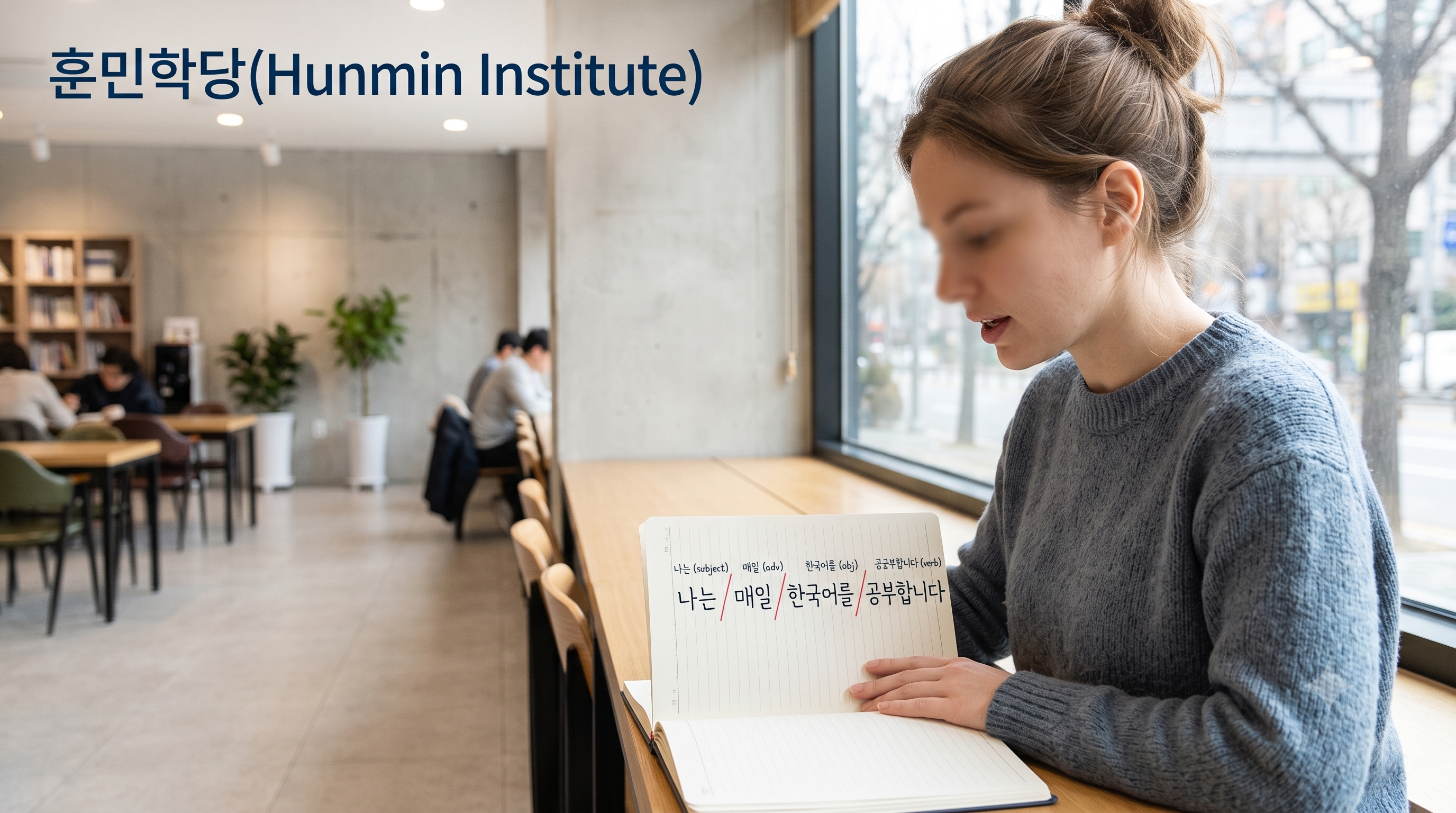
어순으로 문장을 읽는 원리
Korean settles its meaning at the very end, and particles mark every role.
Here you learn the order and the particles that open an unfamiliar sentence.
한국어는 문장의 맨 끝에서 뜻이 정해지고 조사가 낱말마다 역할을 표시합니다.
이 글에서 순서와 조사를 익혀 처음 보는 문장을 읽는 법을 익힙니다.
All learning services for the teaching materials published on this blog are free for blog subscribers on the Hunmin Institute website ↗.
이 글에서 배우는 핵심 문장
Key Sentences in This Lesson
문장의 구조를 두고 오가는 말입니다. 좌우는 한 쌍의 대화가 아니라 각각 따로 익히는 문장입니다.
These are the lines exchanged about how a sentence is built. The two columns are not paired dialogue; learn each side on its own.
| 듣는 문장 Listening |
쓰는 문장 Writing |
|---|---|
| 끝까지 들어야 알아요. [kkeutkkaji deureoya arayo] You only know it once you hear the end. |
마지막을 못 들었어요. [majimageul mot deureosseoyo] I missed the last part. |
| 조사를 보세요. [josareul boseyo] Look at the particles. |
이거 무슨 조사예요? [igeo museun josayeyo] What particle is this? |
| 말끝이 달라요. [malkkeuchi dallayo] The ending is different. |
이거 과거예요? [igeo gwageoyeyo] Is this past tense? |
첫째 줄은 소단락 1에서, 둘째 줄은 소단락 2에서, 셋째 줄은 소단락 3에서 각각 다룹니다.
The first row is covered in Section 1, the second in Section 2, and the third in Section 3.
1. 한국어는 서술어가 맨 끝에 옵니다
Korean Puts the Verb Last
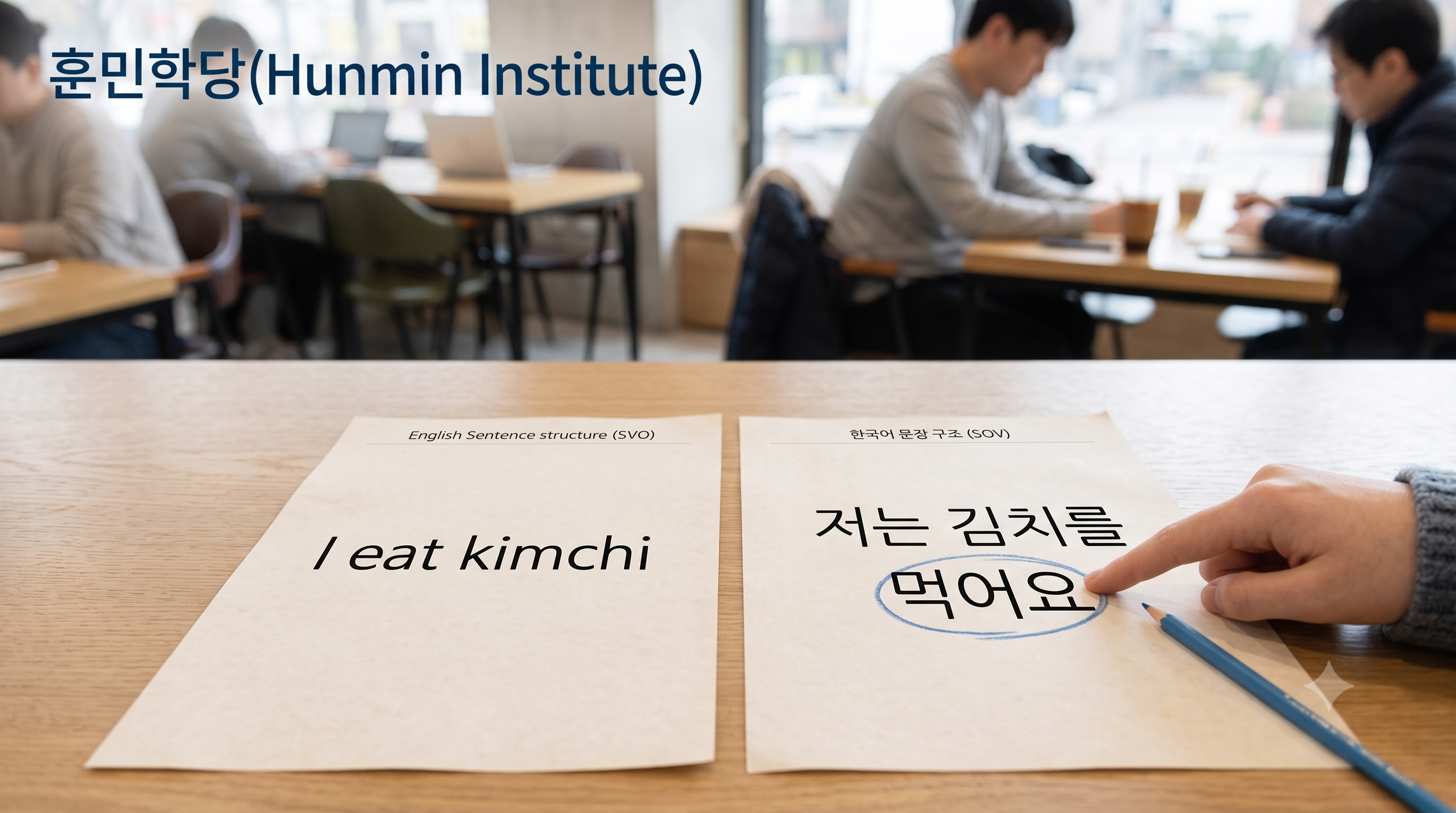
영어와 한국어의 가장 큰 차이는 서술어가 놓이는 자리입니다. 무엇을 하는지가 어느 자리에서 정해지는지가 갈립니다.
The biggest difference between English and Korean is where the verb sits, and with it, at which point the action is decided.
| 언어 Language |
기본 순서 Basic order |
무엇이 달라지는가 What that changes |
|---|---|---|
| 영어 [yeongeo] |
주어 + 서술어 + 목적어 Subject + Verb + Object |
두 번째 자리에서 무엇을 하는지가 정해집니다 The action is settled in the second slot |
| 한국어 [hangugeo] |
주어 + 목적어 + 서술어 Subject + Object + Verb |
맨 끝에서 무엇을 하는지가 정해집니다 The action is settled at the very end |
여기서 쓰는 문장부터 배워 봅시다. 문장의 끝을 놓쳤을 때 오가는 문장입니다.
Now for the sentences you use here. These go back and forth when you miss the end of a sentence.
| 듣는 문장 Listening |
쓰는 문장 Writing |
|---|---|
| 끝까지 들어야 알아요. [kkeutkkaji deureoya arayo] You only know it once you hear the end. |
마지막을 못 들었어요. [majimageul mot deureosseoyo] I missed the last part. |
| 서술어가 끝에 와요. [seosureoga kkeute wayo] The verb comes at the end. |
어디까지 들어야 돼요? [eodikkaji deureoya dwaeyo] How far do I have to listen? |
응용 Apply It
↳ 끝까지 [동사]-어야 알아요
kkeutkkaji [verb]-eoya arayo
You only know it once you [verb] to the end.
ex 끝까지 들어야 알아요./끝까지 읽어야 알아요.
ROM kkeutkkaji deureoya arayo/kkeutkkaji ilgeoya arayo
EN You only know it once you hear the end./You only know it once you read to the end.
▶한국어는 끝까지 들어야 뜻이 정해집니다.
In Korean the meaning is settled only at the end.
영어는 두 번째 자리에서 무엇을 하는지가 정해지지만 한국어는 맨 끝에서 정해집니다. 그래서 마지막 마디를 놓치면 앞을 다 알아들어도 무슨 말인지 모릅니다.
English decides the action in the second slot; Korean decides it at the very end. Miss the last word and you can catch everything before it and still not know what was said.
먹어요와 안 먹어요, 먹었어요와 먹을까요는 앞부분이 모두 같습니다. 갈리는 자리는 마지막 하나뿐인데 뜻은 전혀 달라집니다. 듣기에서 끝을 기다리는 습관이 필요한 이유가 여기 있습니다.
먹어요, 안 먹어요, 먹었어요, and 먹을까요 are identical up front. They part only at the final piece, yet the meanings are entirely different. This is why listening in Korean means waiting for the end.
2. 조사가 낱말의 역할을 정합니다
Particles Decide Each Word’s Role
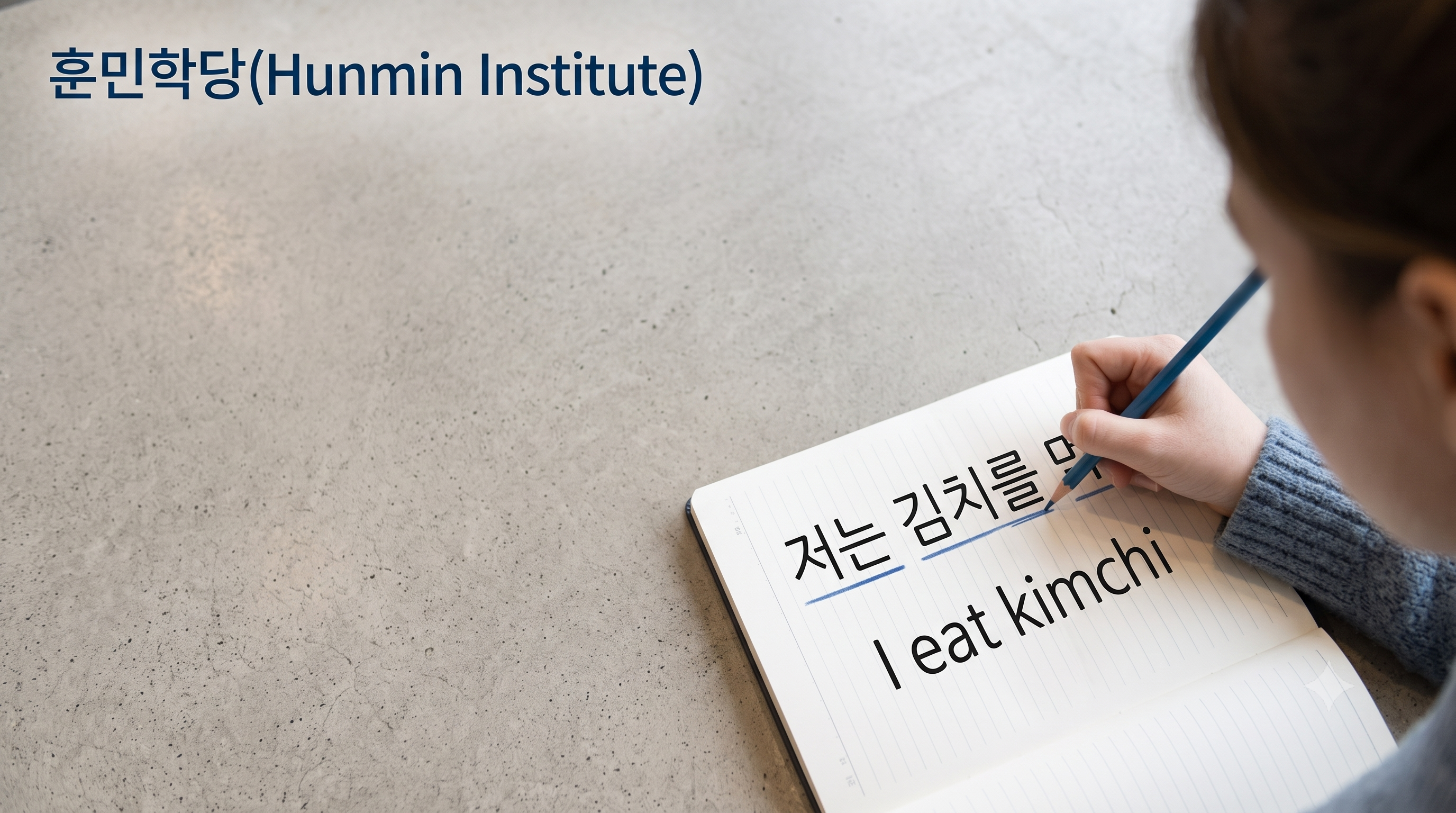
한국어는 낱말 순서를 바꿔도 뜻이 유지되는 경우가 많습니다. 순서가 아니라 조사가 역할을 붙들고 있기 때문입니다. 먼저 자주 쓰는 여섯을 확인하십시오.
Korean often keeps its meaning even when word order changes, because the role is held by the particle rather than the position. Start with the six you will meet most.
| 조사 Particle |
역할 Role |
예문 Examples |
|---|---|---|
| 은, 는 | 주어를 표시하고 화제를 세웁니다 Marks the subject and sets the topic |
저는 학생이에요 / 오늘은 쉬어요 / 한국어는 재미있어요 / 이름은 뭐예요 [jeoneun haksaengieyo] / [oneureun swieoyo] / [hangugeoneun jaemiisseoyo] / [ireumeun mwoyeyo] I am a student / Today I am resting / Korean is fun / What is your name |
| 이, 가 | 주어를 표시하며 새 정보를 가리킵니다 Marks the subject, pointing to new information |
친구가 왔어요 / 비가 와요 / 시간이 없어요 / 값이 비싸요 [chinguga wasseoyo] / [biga wayo] / [sigani eopseoyo] / [gapsi bissayo] A friend came / It is raining / There is no time / It is expensive |
| 을, 를 | 목적어를 표시합니다 Marks the object |
밥을 먹어요 / 책을 읽어요 / 물을 마셔요 / 영화를 봐요 [babeul meogeoyo] / [chaegeul ilgeoyo] / [mureul masyeoyo] / [yeonghwareul bwayo] I eat rice / I read a book / I drink water / I watch a film |
| 에 | 가는 곳이나 때를 표시합니다 Marks a destination or a time |
학교에 가요 / 세 시에 만나요 / 집에 가요 / 서울에 살아요 [hakgyoe gayo] / [se sie mannayo] / [jibe gayo] / [seoure sarayo] I go to school / We meet at three / I go home / I live in Seoul |
| 에서 | 행동이 일어나는 곳을 표시합니다 Marks where an action happens |
집에서 봐요 / 카페에서 공부해요 / 회사에서 일해요 / 여기에서 내려요 [jibeseo bwayo] / [kapeeseo gongbuhaeyo] / [hoesaeseo ilhaeyo] / [yeogieseo naeryeoyo] I watch it at home / I study at a cafe / I work at the company / I get off here |
| 도 | 또한이라는 뜻을 더합니다 Adds the sense of also |
저도 가요 / 물도 주세요 / 저도 몰라요 / 이것도 주세요 [jeodo gayo] / [muldo juseyo] / [jeodo mollayo] / [igeotdo juseyo] I am going too / Water as well, please / I do not know either / This one as well, please |
여기서 쓰는 문장부터 배워 봅시다. 조사를 확인할 때 오가는 문장입니다.
Now for the sentences you use here. These go back and forth when you check a particle.
| 듣는 문장 Listening |
쓰는 문장 Writing |
|---|---|
| 조사를 보세요. [josareul boseyo] Look at the particles. |
이거 무슨 조사예요? [igeo museun josayeyo] What particle is this? |
| 순서를 바꿔도 돼요. [sunseoreul bakkwodo dwaeyo] You may change the order. |
에하고 에서가 달라요? [ehago eseoga dallayo] Are 에 and 에서 different? |
▶순서가 흔들려도 조사가 붙어 있으면 뜻은 흔들리지 않습니다.
Shuffle the order and the meaning holds, as long as the particles stay.
저는 김치를 먹어요와 김치를 저는 먹어요는 순서가 달라도 먹는 사람과 먹히는 것이 그대로입니다. 를이 김치를 목적어로 붙들고 있기 때문입니다. 영어라면 순서를 바꾸는 순간 뜻이 뒤집힙니다.
저는 김치를 먹어요 and 김치를 저는 먹어요 keep the same eater and the same food despite the different order, because 를 pins 김치 as the object. In English, reversing the order would reverse the meaning.
그래서 한국어를 배울 때 조사를 먼저 잡아야 합니다. 조사를 놓치면 누가 무엇을 했는지가 흔들리고, 특히 에와 에서를 바꿔 쓰면 가는 곳과 하는 곳이 뒤집힙니다. 집에 가요와 집에서 봐요를 견주어 두십시오.
So particles come first when learning Korean. Miss them and who did what starts to blur, and swapping 에 for 에서 turns the place you go into the place you act. Hold 집에 가요 and 집에서 봐요 side by side.
3. 문장의 뜻은 말끝에서 갈립니다
The Ending Decides Everything
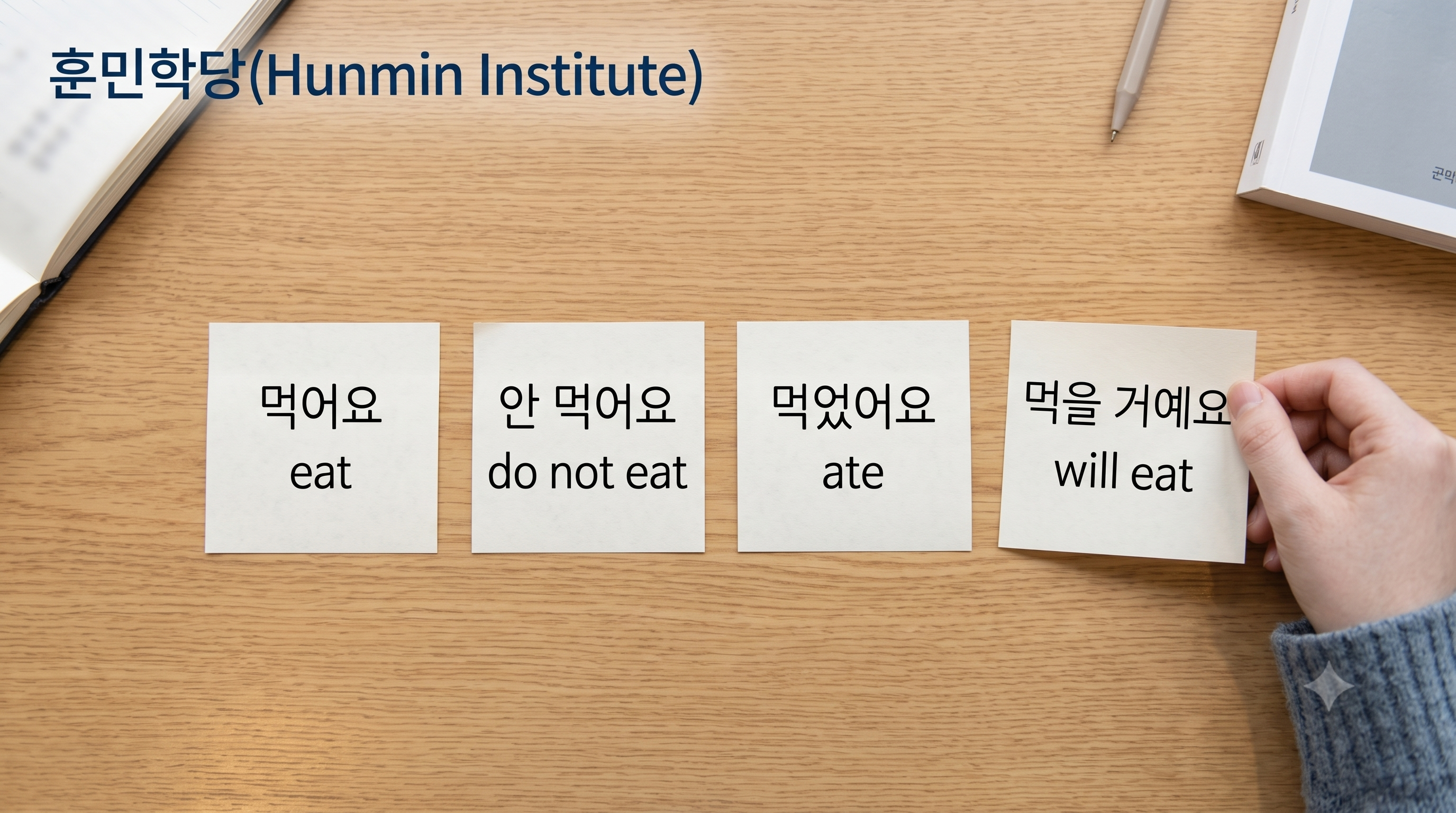
서술어에 붙는 말끝이 시제와 부정, 질문을 한꺼번에 정합니다. 앞의 동사가 무엇이든 붙는 방식은 같습니다.
The ending attached to the verb decides tense, negation, and questions all at once, and it attaches the same way whatever the verb.
| 말끝 Ending |
무엇을 나타내는가 What it shows |
이렇게 바꿔 씁니다 Swap and reuse |
|---|---|---|
| 먹어요 [meogeoyo] |
현재 Present |
가요 / 읽어요 / 봐요 / 자요 [gayo] / [ilgeoyo] / [bwayo] / [jayo] I go / I read / I watch / I sleep |
| 먹었어요 [meogeosseoyo] |
과거 Past |
갔어요 / 만났어요 / 읽었어요 / 잤어요 [gasseoyo] / [mannasseoyo] / [ilgeosseoyo] / [jasseoyo] I went / I met / I read it / I slept |
| 먹을 거예요 [meogeul geoyeyo] |
미래 Future |
갈 거예요 / 볼 거예요 / 만날 거예요 / 잘 거예요 [gal geoyeyo] / [bol geoyeyo] / [mannal geoyeyo] / [jal geoyeyo] I will go / I will watch / I will meet / I will sleep |
| 안 먹어요 [an meogeoyo] |
부정 Negative |
안 가요 / 안 봐요 / 안 읽어요 / 안 자요 [an gayo] / [an bwayo] / [an ilgeoyo] / [an jayo] I do not go / I do not watch / I do not read / I do not sleep |
| 먹어요? [meogeoyo] |
의문 Question |
봤어요? / 와요? / 좋아요? / 매워요? [bwasseoyo] / [wayo] / [joayo] / [maewoyo] Did you watch it / Are you coming / Do you like it / Is it spicy |
여기서 쓰는 문장부터 배워 봅시다. 시제와 질문을 확인할 때 오가는 문장입니다.
Now for the sentences you use here. These go back and forth when you check tense or a question.
| 듣는 문장 Listening |
쓰는 문장 Writing |
|---|---|
| 말끝이 달라요. [malkkeuchi dallayo] The ending is different. |
이거 과거예요? [igeo gwageoyeyo] Is this past tense? |
| 끝을 올리면 질문이에요. [kkeuteul ollimyeon jilmunieyo] Raise the ending and it is a question. |
이거 질문이에요? [igeo jilmunieyo] Is this a question? |
▶었이 들어가면 지난 일이고 앞에 안이 붙으면 아니라는 뜻입니다.
었 inside means it happened; 안 in front means it did not.
이 둘만 잡아도 만나는 문장의 절반이 읽힙니다. 규칙이 동사를 가리지 않으므로 처음 보는 동사를 만나도 시제와 부정은 그대로 읽어 낼 수 있습니다. 갔어요를 보면 갔다는 것을 알고 안 가요를 보면 가지 않는다는 것을 압니다.
These two alone read half of what you meet. The rule does not care which verb it attaches to, so tense and negation stay readable in a verb you have never seen. 갔어요 tells you it happened; 안 가요 tells you it does not.
질문은 따로 낱말을 넣지 않고 끝을 올려 만듭니다. 밥 먹어요는 억양에 따라 서술도 되고 질문도 되므로 듣기에서는 문장의 마지막 음이 올라가는지에 귀를 두십시오. 글에서는 물음표가 그 자리를 대신합니다.
A question needs no extra word, only a rising ending. 밥 먹어요 can be a statement or a question depending on the pitch, so listen for whether the last syllable rises. In writing, the question mark takes that role.
4. 조사를 기준으로 끊어 읽습니다
Break at the Particles as You Read
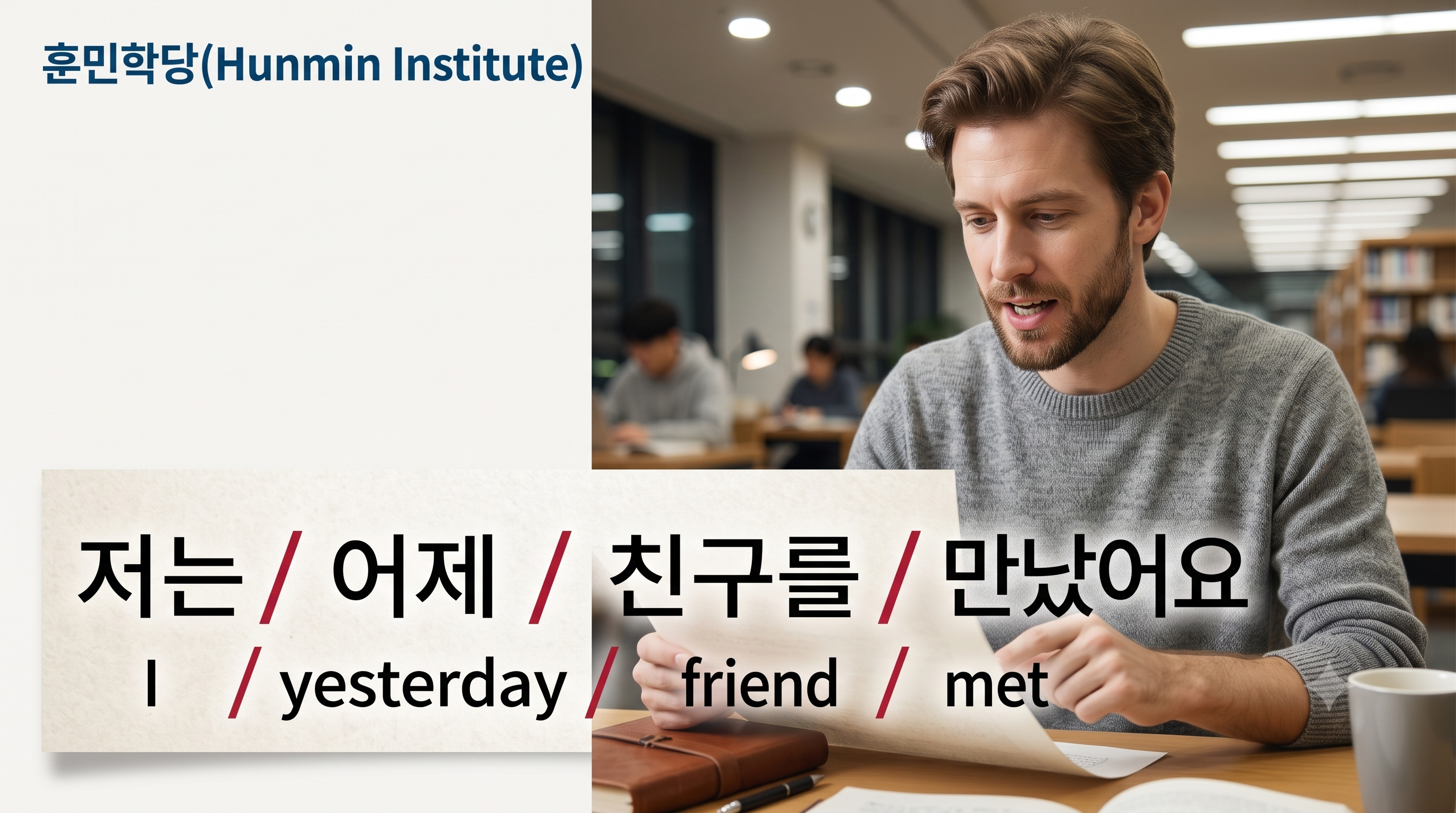
원리를 익혔으면 실제 문장으로 확인합니다. 조사를 기준으로 끊어 읽으면 구조가 그대로 드러납니다.
With the principles in hand, check them on real sentences. Break at the particles and the structure appears on its own.
| 문장 Sentence |
끊어 읽기 Chunked |
확인할 점 What to notice |
|---|---|---|
| 저는 어제 친구를 만났어요 [jeoneun eoje chingureul mannasseoyo] |
저는 / 어제 / 친구를 / 만났어요 | 마지막에서 만났다는 사실이 정해집니다 The meeting is settled at the end |
| 오늘 학교에 안 가요 [oneul hakgyoe an gayo] |
오늘 / 학교에 / 안 가요 | 안을 놓치면 뜻이 뒤집힙니다 Miss 안 and the meaning flips |
| 이거 얼마예요 [igeo eolmayeyo] |
이거 / 얼마 / 예요 | 주어가 빠진 흔한 문장입니다 A common sentence with the subject dropped |
| 친구가 집에서 영화를 봐요 [chinguga jibeseo yeonghwareul bwayo] |
친구가 / 집에서 / 영화를 / 봐요 | 에서라 가는 곳이 아니라 하는 곳입니다 에서 makes it where the action happens, not where they go |
여기서 쓰는 문장부터 배워 봅시다. 주어가 빠진 문장을 만났을 때 오가는 문장입니다.
Now for the sentences you use here. These go back and forth when you hit a sentence with no subject.
| 듣는 문장 Listening |
쓰는 문장 Writing |
|---|---|
| 조사에서 끊어 읽으세요. [josaeseo kkeuneo ilgeuseyo] Break at the particles when you read. |
주어가 없는데요? [jueoga eomneundeyo] But there is no subject here. |
| 앞 문장을 보세요. [ap munjangeul boseyo] Look at the sentence before it. |
누구 이야기예요? [nugu iyagiyeyo] Who are we talking about? |
▶빠진 주어는 문장 안이 아니라 앞뒤 문장에 있습니다.
The dropped subject is not inside the sentence but in the ones around it.
한국어는 주어를 자주 뺍니다. 누구 이야기인지 이미 알고 있으면 저는이나 그 사람은을 아예 넣지 않습니다. 빠진 자리를 문장 안에서 찾으면 아무것도 나오지 않으므로 앞 문장으로 눈을 돌리십시오.
Korean drops the subject often. When it is already clear who is meant, 저는 or 그 사람은 simply does not appear. Searching inside the sentence turns up nothing, so look to the sentence before it.
이것이 듣기에서 가장 자주 막히는 자리입니다. 조사와 함께 익혀 두면 주어가 없는 문장을 만나도 누구 이야기인지 이어서 붙들 수 있습니다.
This is the most common sticking point in listening. Learn it alongside particles and you can keep hold of who is meant even when the subject is gone.
한국어 문장은 끝에서 정해지고 조사가 낱말마다 역할을 붙듭니다. 서술어가 맨 뒤에 온다는 것, 조사가 순서를 대신한다는 것, 말끝이 시제와 부정과 질문을 정한다는 것 셋만 잡으면 처음 보는 문장도 구조가 보입니다. 여기까지 오면 글자를 읽는 눈에 문장을 읽는 눈이 더해집니다.
A Korean sentence is settled at the end, and particles hold each word’s role. Hold three things — the verb comes last, particles do the work of word order, and the ending fixes tense, negation, and questions — and the structure of an unfamiliar sentence becomes visible. From here, reading letters is joined by reading sentences.
Next: TOPIK Is a Scoring System, Not Just a Test ↗
토픽 맛보기
TOPIK Preview
유형: TOPIK Ⅰ 읽기 [43~45], 설명문, 일치하는 내용 고르기
Type: TOPIK I Reading [43–45], expository text, choose the matching statement
다음 글의 내용과 같은 것을 고르십시오.
Choose the statement that matches the following passage.
한국어는 낱말 순서를 바꿔도 뜻이 그대로인 경우가 많습니다. 조사가 낱말마다 역할을 붙들고 있기 때문입니다. 저는 김치를 먹어요와 김치를 저는 먹어요는 먹는 사람과 먹히는 것이 같습니다.
Korean often keeps its meaning even when word order changes, because a particle holds each word’s role in place. 저는 김치를 먹어요 and 김치를 저는 먹어요 have the same eater and the same food.
① 순서를 바꾸면 뜻도 바뀝니다.
② 조사가 낱말의 역할을 붙듭니다.
③ 한국어에는 조사가 없습니다.
④ 김치를 먹는 사람이 달라집니다.
Answer ▾
정답 ② 조사가 낱말의 역할을 붙듭니다.
Answer: ② Particles hold each word’s role.
지문 둘째 문장이 조사가 낱말마다 역할을 붙들고 있다고 했으므로 ②가 맞습니다. ①은 순서가 지문에 나오지만 바뀌어도 뜻이 그대로라고 한 자리라 진술이 어긋나고, ③은 조사를 다루기는 하나 없다는 말은 지문과 정반대이며, ④는 그럴듯해 보여도 먹는 사람이 같다고 한 마지막 문장과 어긋납니다. 흉내 낸 대문항은 TOPIK Ⅰ 읽기 [43~45] 일치하는 내용 고르기이고 배점은 3점입니다.
The second sentence says a particle holds each word’s role, so ② is correct. ① picks up word order from the passage but the passage says the meaning holds, which contradicts it. ③ runs directly against the passage. ④ sounds plausible yet the last sentence says the eater stays the same. The item type modeled here is TOPIK I Reading [43–45], worth 3 points.
FAQ
Q1. 조사를 빼고 말하면 못 알아듣나요?Answer ▾
Q1. Will I be misunderstood if I drop the particles?
A1. 짧은 문장에서는 통하는 경우가 많습니다. 밥 먹어요처럼 조사 없이 말하는 자리도 실제로 흔합니다. 다만 낱말이 셋을 넘어가면 누가 무엇을 했는지가 흔들리므로, 처음에는 붙여서 말하는 편이 안전합니다.
A1. In short sentences it often gets through, and dropping them is common in speech, as in 밥 먹어요. But once a sentence runs past three words, who did what starts to blur, so attach them while you are starting out.
Q2. 은는과 이가는 어떻게 가려 쓰나요?Answer ▾
Q2. How do I choose between 은/는 and 이/가?
A2. 둘 다 주어 자리에 오지만 말하는 사람의 관심이 다릅니다. 은는은 이미 아는 것을 화제로 세울 때 쓰고, 이가는 새로 등장한 것을 가리킬 때 씁니다. 저는 학생이에요는 나에 대해 말하겠다는 뜻이고 친구가 왔어요는 친구의 등장이 새 소식이라는 뜻입니다.
A2. Both sit in the subject slot, but they carry different attention. 은/는 raises something already known as the topic; 이/가 points at something newly introduced. 저는 학생이에요 announces that you are the topic, while 친구가 왔어요 presents the friend’s arrival as news.
Q3. 에와 에서를 자꾸 헷갈립니다.Answer ▾
Q3. I keep mixing up 에 and 에서.
A3. 가는 곳에는 에, 하는 곳에는 에서를 붙인다고 갈라 두십시오. 집에 가요는 집으로 이동하는 것이고 집에서 봐요는 집 안에서 본다는 뜻입니다. 둘을 바꿔 쓰면 가는 곳과 하는 곳이 뒤집힙니다.
A3. Keep them apart this way: 에 for where you go, 에서 for where you do something. 집에 가요 is moving toward home, 집에서 봐요 is watching inside the home. Swap them and destination turns into location.
Q4. 주어가 없는 문장은 어떻게 읽나요?Answer ▾
Q4. How do I read a sentence with no subject?
A4. 한국어는 이미 아는 주어를 자주 뺍니다. 빠진 주어는 문장 안이 아니라 앞뒤 문장에 있으므로 그쪽을 보십시오. 듣기에서 가장 자주 막히는 자리이므로 조사와 함께 익혀 두시는 편이 좋습니다.
A4. Korean drops a subject once it is already clear. The missing subject is not inside the sentence but in the ones around it, so look there. This is the most common sticking point in listening, so learn it alongside particles.
Vocabulary and Pronunciation for Foreigners
| No | Korean | Romanisation | Meaning |
|---|---|---|---|
| 1 | 어순 | eosun | (n) word order [wɜːrd ˈɔːrdər] |
| 2 | 조사 | josa | (n) particle [ˈpɑːrtɪkl] |
| 3 | 서술어 | seosureo | (n) predicate, verb [ˈpredɪkət] |
| 4 | 말끝 | malkkeut | (n) sentence ending [ˈendɪŋ] |
| 5 | 주어 | jueo | (n) subject [ˈsʌbdʒɪkt] |
| ▾ 단어 48개 더 보기 Show 48 more ↗ | |||
The blog page has limits of space and function, so only five words are shown here. The rest of the word list, the audio, the sentences and tables, the FAQ, the worksheet, the TOPIK questions and the lesson video are on the Hunmin Institute website ↗, free for blog subscribers.
참고 기관
Official Sources
국립국어원 ↗
National Institute of Korean Language
https://www.korean.go.kr/
기관 설명 보기 About this institute ▾
This institute provides the standard reference for Korean grammar and vocabulary. Its site lists the uses of particles and endings item by item, and the Korean Basic Dictionary it runs carries a definition and example sentences for each particle in eleven languages including English. For hard choices such as 은/는 against 이/가, comparing the example sentences there sorts them out.
※ 본 콘텐츠(원고, 이미지, 예문 포함)는 저작권법에 의해 보호받는 훈민학당의 저작물입니다. 무단 복제, 전재, 재배포 및 AI 학습 데이터로의 이용을 금합니다.
This content (manuscript, images, and example sentences) is the copyrighted property of Hunmin Institute, protected under copyright law. Unauthorized copying, reproduction, redistribution, and use as AI training data are prohibited.
'Reading Skills' 카테고리의 다른 글
| Korean Particle Errors: What Learner Data Reveals (0) | 2026.08.05 |
|---|---|
| TOPIK Is a Scoring System, Not Just a Test (0) | 2026.07.27 |
| How to Read Hangul Part 4: Reading Practice (0) | 2026.07.25 |
| How to Read Hangul Part 3: Pronunciation Rules (0) | 2026.07.25 |
| How to Read Hangul Part 2: Batchim (0) | 2026.07.23 |


