
Five Questions Stand Between You and Korea
인천공항 입국심사에서 실제로 묻는 질문과 대답
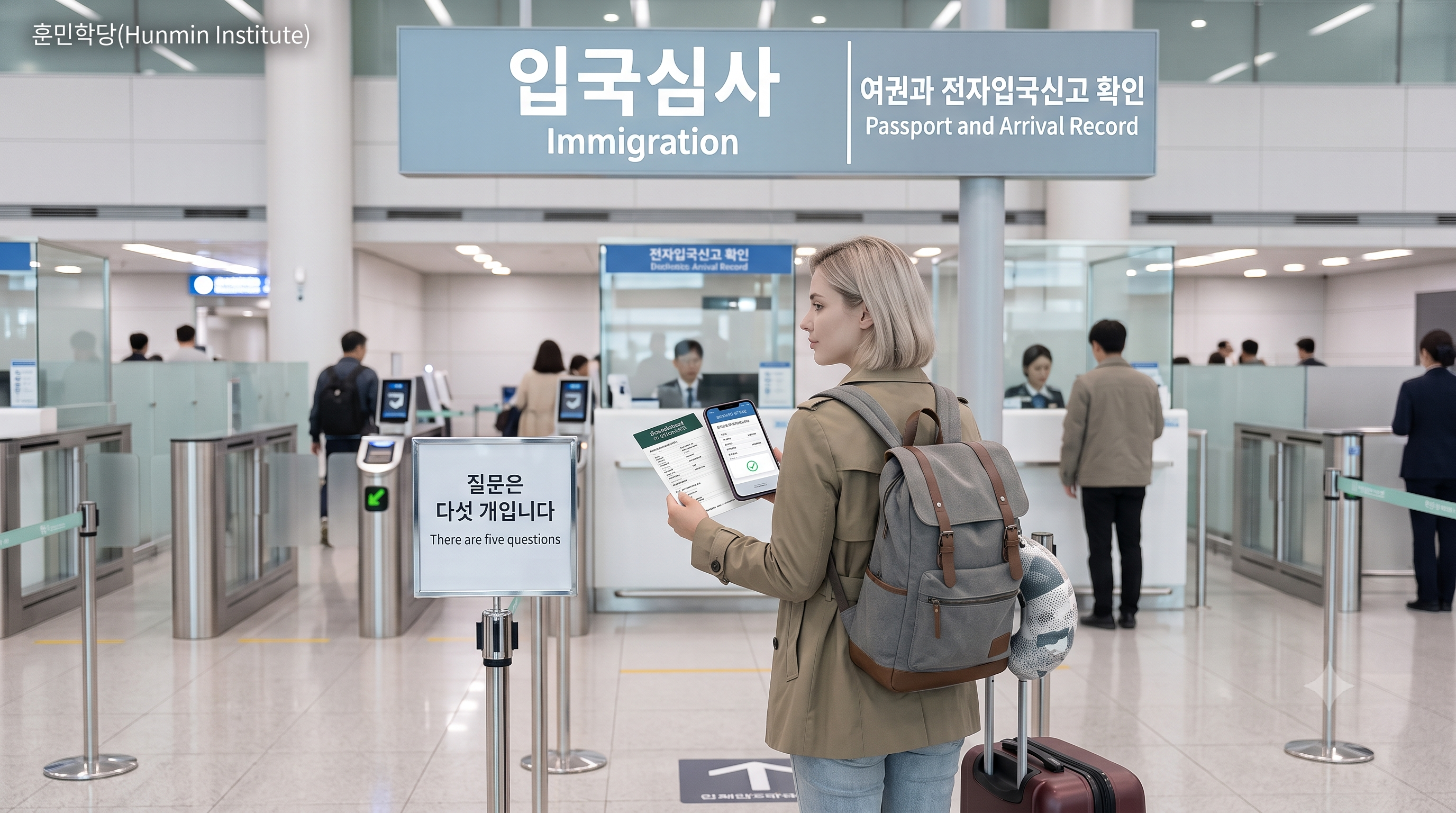
Questions at Incheon immigration can be boiled down to five.
This post teaches the 2026 procedure changes and the Korean for answering all five.
인천공항 입국심사에서 나오는 질문은 다섯 개로 압축할 수 있습니다.
이 글에서 2026년 바뀐 절차와 다섯 질문에 답하는 한국어를 익힙니다.
All learning services for the teaching materials published on this blog are free for blog subscribers on the Hunmin Institute website ↗.
이 글에서 배우는 핵심 회화
Key Expressions in This Lesson
심사대에서 오가는 말은 몇 마디로 정해져 있습니다. 아래 여섯 문장은 좌우가 한 쌍의 대화가 아니라 각각 따로 익히는 문장입니다. 먼저 눈에 담고 본문으로 들어가십시오.
Only a few lines pass across the immigration desk. The two columns are not paired dialogue; each sentence is learned on its own. Take them in first, then move into the main text.
| 듣는 말 Listening | 하는 말 Speaking |
|---|---|
| 무슨 일로 오셨어요? [museun illo osyeosseoyo] What brings you here? | 여행 왔어요. [yeohaeng wasseoyo] I am here to travel. |
| 얼마나 계실 거예요? [eolmana gyesil geoyeyo] How long will you stay? | 일주일이요. [iljuiriyo] One week. |
| 어디에서 머무르세요? [eodieseo meomureuseyo] Where will you be staying? | 서울에 있는 호텔이요. [seoure inneun hoteriyo] At a hotel in Seoul. |
첫째 줄과 둘째 줄, 셋째 줄은 모두 소단락 2에서 다루고, 말이 막혔을 때 쓰는 표현은 소단락 3에서 다룹니다.
All three rows are covered in Section 2, and the lines for when words fail you come in Section 3.
1. 공항에서 통과해야 할 관문은 네 개입니다
There Are Four Gates to Clear at the Airport
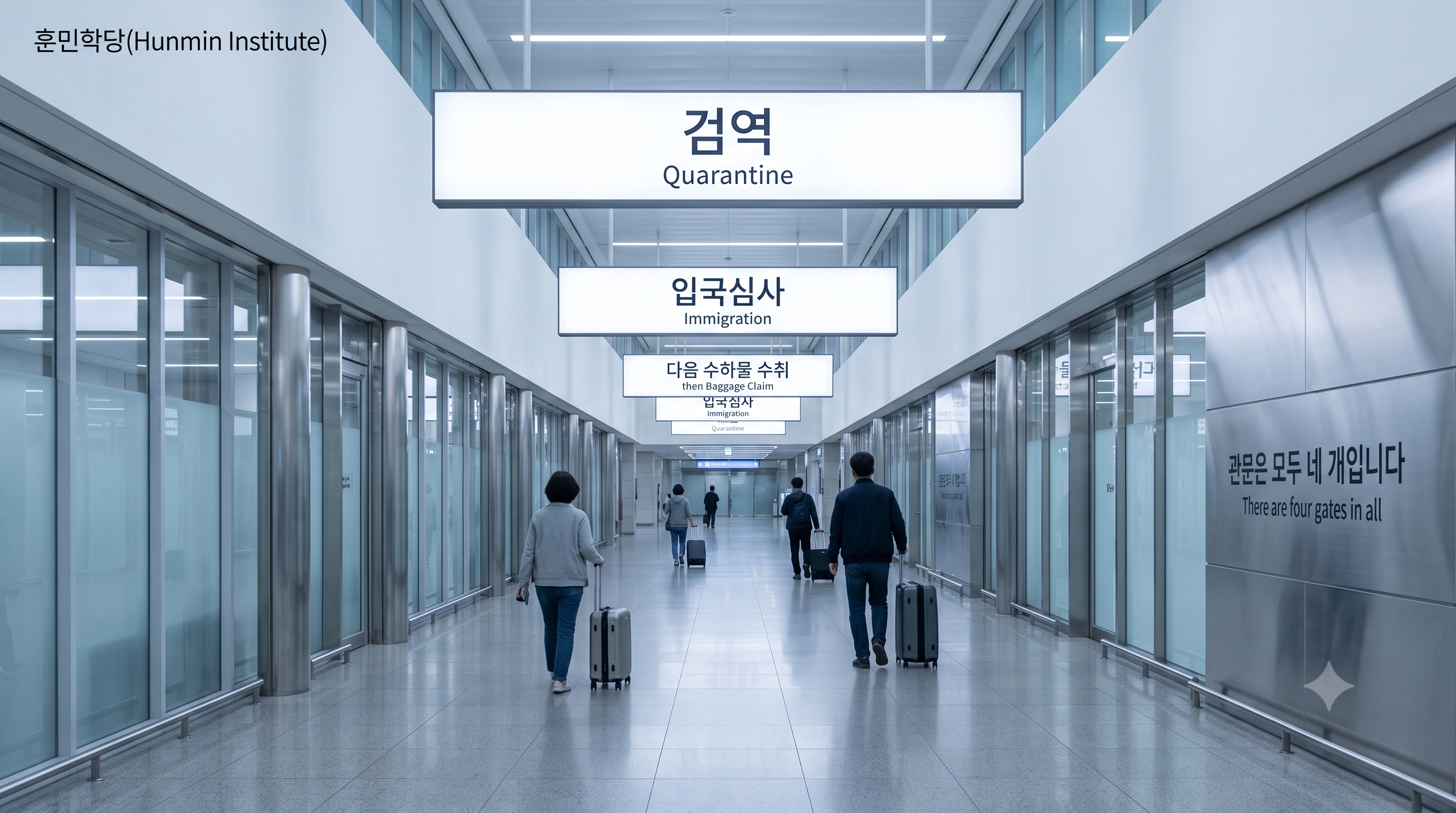
비행기에서 내리는 순간부터 공항 밖으로 나가기까지 순서가 정해져 있습니다. 이 순서를 모르면 엉뚱한 줄에 섭니다.
From the moment you step off the plane until you walk out of the airport, the order is fixed. Not knowing it is how people end up in the wrong queue.
| 단계 Step | 하는 일 What happens | 안내판에서 찾을 말 Signs to look for |
|---|---|---|
| 검역 [geomyeok] Quarantine | 발열 여부를 확인하고, 해당하는 경우 건강상태 질문서를 제출한다 A fever check, plus a health declaration if it applies to you | 검역 / 건강상태 질문서 Quarantine / Health declaration form |
| 입국심사 [ipguksimsa] Immigration | 여권과 전자입국신고를 확인하고 다섯 개의 질문에 답한다 Your passport and digital arrival record are checked, and five questions are asked | 입국심사 / 외국인 Immigration / Foreign nationals |
| 수하물 수취 [suhamul suchwi] Baggage claim | 전광판에서 편명을 확인하고 위탁 수하물을 찾는다 Find your flight on the board and collect your checked bags | 수하물 수취 / 편명 Baggage claim / Flight number |
| 세관 [segwan] Customs | 신고 물품 여부를 확인하고, 없으면 그대로 통과한다 Declare anything required; with nothing to declare you walk straight through | 세관 / 신고 물품 없음 Customs / Nothing to declare |
여기서 쓰는 표현부터 배워봅시다. 줄을 잘못 섰을 때 오가는 말입니다.
Start with the expressions you will use here. These go back and forth when you have joined the wrong queue.
| 듣는 말 Listening | 하는 말 Speaking |
|---|---|
| 저쪽으로 가세요. [jeojjogeuro gaseyo] Please go that way. | 입국심사 어디예요? [ipguksimsa eodiyeyo] Where is immigration? |
| 여기 줄 서세요. [yeogi jul seoseyo] Please queue here. | 여기 서야 하나요? [yeogi seoya hanayo] Should I wait here? |
| 다음 분 오세요. [daeum bun oseyo] Next person, please. | 수하물 어디에서 찾아요? [suhamul eodieseo chajayo] Where do I collect my bags? |
응용 Apply It
↳ [명사] 어디예요?
[noun] eodiyeyo
Where is [noun]?
ex [입국심사] 어디예요?/[세관] 어디예요?/[화장실] 어디예요?
ROM [ipguksimsa] eodiyeyo/[segwan] eodiyeyo/[hwajangsil] eodiyeyo
EN Where is immigration?/Where is customs?/Where is the restroom?
▶입국심사를 지났다고 끝이 아닙니다. 짐을 찾은 다음 세관이 한 번 더 남아 있습니다.
Clearing immigration is not the end. After you collect your bags, customs is still ahead.
가장 흔한 착각이 여기 있습니다. 심사대를 지났다고 긴장을 푸는 순간이 오히려 실수가 나오는 지점입니다.
This is where the most common misunderstanding sits. The moment you relax after the desk is exactly where mistakes happen.
공항 안내판은 한국어와 영어가 나란히 붙어 있지만, 검역과 수하물 수취처럼 한자어로 된 표기는 영어를 먼저 읽고 한국어를 눈에 익히는 편이 빠릅니다. 네 단어만 알아보면 줄을 잘못 설 일이 없습니다.
Airport signs carry Korean and English side by side, but for Sino-Korean words like 검역 and 수하물 수취 it is faster to read the English first and let the Korean sink in. Recognize those four words and you will never join the wrong queue.
2. 질문은 다섯 개뿐입니다
There Are Only Five Questions

입국심사관이 묻는 것은 매번 거의 같습니다. 당신이 누구인지 알아내려는 질문이 아니라, 서류에 적은 내용과 실제가 일치하는지 확인하는 질문이기 때문입니다.
What the officer asks is nearly the same every time. The questions are not there to work out who you are; they check that what you wrote matches what is true.
여기서 쓰는 표현부터 배워봅시다. 다섯 질문과 그 답입니다.
Start with the expressions you will use here. These are the five questions and their answers.
| 듣는 말 Listening | 하는 말 Speaking |
|---|---|
| 무슨 일로 오셨어요? [museun illo osyeosseoyo] What brings you here? | 여행 왔어요./출장 왔어요. [yeohaeng wasseoyo]/[chuljang wasseoyo] I am here to travel./I am here on business. |
| 얼마나 계실 거예요? [eolmana gyesil geoyeyo] How long will you stay? | 일주일이요./한 달이요. [iljuiriyo]/[han dariyo] One week./One month. |
| 어디에서 머무르세요? [eodieseo meomureuseyo] Where will you be staying? | 서울에 있는 호텔이요. [seoure inneun hoteriyo] At a hotel in Seoul. |
| 직업이 뭐예요? [jigeobi mwoyeyo] What is your occupation? | 회사원이에요./학생이에요. [hoesawonieyo]/[haksaengieyo] I am an office worker./I am a student. |
| 돌아가는 항공권 있으세요? [doraganeun hanggonggwon isseuseyo] Do you have a return ticket? | 네, 여기 있어요. [ne yeogi isseoyo] Yes, here it is. |
▶다섯 질문은 세 개의 틀로 줄어듭니다. [왔어요], 이에요, 있어요입니다.
The five questions shrink to three frames: [왔어요], 이에요, 있어요.
[왔어요]는 왔다는 사실만 말하는 짧은 답입니다. 앞의 말만 바꾸면 그대로 쓰입니다. [출장] [왔어요], [공부하러] [왔어요]처럼 씁니다.
[왔어요] states only that you came. Change the word in front and it still works: 출장 [왔어요], 공부하러 [왔어요].
이에요와 예요는 자기 신분을 말하는 틀입니다. 받침이 있으면 이에요, 없으면 예요를 씁니다. 학생이에요, 교사예요처럼 씁니다.
이에요 and 예요 state what you are. Use 이에요 after a final consonant and 예요 after a vowel: 학생이에요, 교사예요.
[있으세요]는 가지고 있는지 묻는 높임말이며 공항 전체에서 반복됩니다. 답은 네 있어요 또는 아니요 없어요 두 가지면 충분합니다. 질문은 대부분 영어로 오지만, 한국어로 한 문장이라도 답하면 그 자리의 공기가 달라집니다.
[있으세요] politely asks whether you have something, and it repeats across the whole airport. 네 있어요 or 아니요 없어요 is all you need. The questions usually come in English, but answering even one line in Korean changes the air in the room.
3. 답변에는 세 가지 원칙이 있습니다
Three Principles for Answering
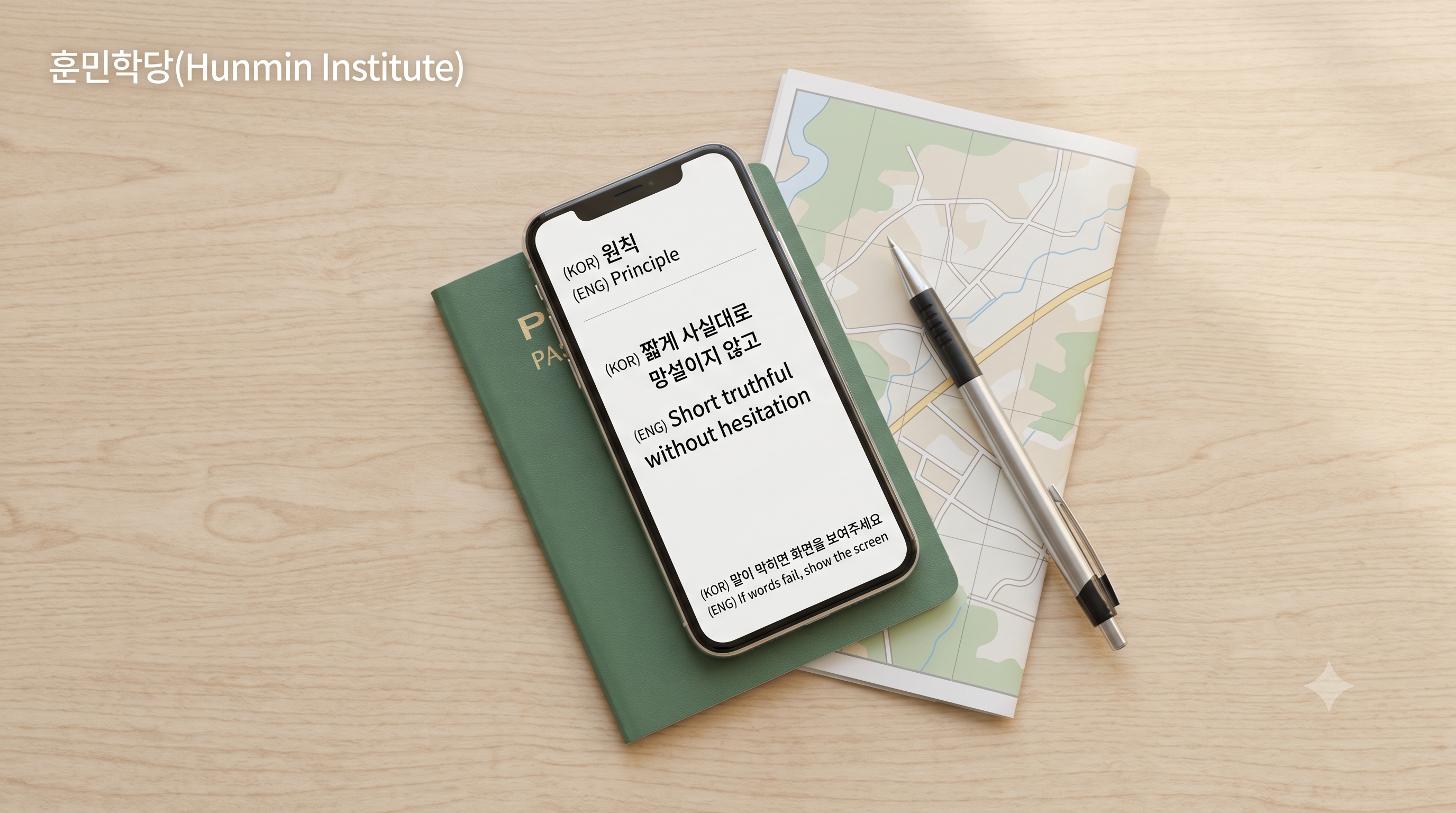
짧게, 사실대로, 망설이지 않고. 이 세 가지가 전부입니다. 말이 막힐 때를 대비해 아래 문장을 휴대폰 메모에 저장해 두십시오.
Short, truthful, without hesitation. These three are everything. For the moment words fail you, keep the lines below in your phone notes.
여기서 쓰는 표현부터 배워봅시다. 말이 막혔을 때 오가는 말입니다.
Start with the expressions you will use here. These go back and forth when words fail you.
| 듣는 말 Listening | 하는 말 Speaking |
|---|---|
| 천천히 말씀드릴게요. [cheoncheonhi malsseumdeurilgeyo] I will speak slowly. | 저는 한국어를 못합니다. [jeoneun hangugeoreul motamnida] I do not speak Korean. |
| 영어로 하시겠어요? [yeongeoro hasigesseoyo] Would you like English? | 영어로 말씀해 주시겠어요? [yeongeoro malsseumhae jusigesseoyo] Could you speak in English? |
| 서류 보여 주세요. [seoryu boyeo juseyo] Please show me the document. | 호텔 예약 확인서와 귀국 항공권입니다. [hotel yeyak hwaginseowa gwiguk hanggonggwonimnida] Here is my hotel booking and return ticket. |
▶말이 막혔을 때 침묵보다 나은 것은 준비된 한 문장입니다.
When words fail, one prepared sentence beats silence.
주시겠어요는 정중하게 부탁하는 틀입니다. 앞의 말만 바꾸면 공항 밖에서도 그대로 쓰입니다. 한국에서 가장 많이 쓰게 될 부탁 표현입니다.
The frame 주시겠어요 makes a polite request, and swapping the word in front carries it far beyond the airport. It is the request form you will use most in Korea.
짧게 답해야 하는 이유는 심사관이 긴 설명을 원하지 않기 때문입니다. [여행] 왔어요면 충분하며, 여행 계획을 설명하기 시작하면 오히려 질문이 늘어납니다.
Answer short because the officer is not looking for a long explanation. 여행 왔어요 is enough; start describing your itinerary and the questions multiply instead.
망설이지 않아야 하는 이유는 조금 다릅니다. 답을 몰라서 망설이는 것과 한국어가 서툴러 망설이는 것을 심사관이 구분하지 못하기 때문입니다. 숙소 주소는 미리 휴대폰에 저장해 두시기 바랍니다.
The reason not to hesitate is a little different: the officer cannot tell hesitation over the answer apart from hesitation over unfamiliar Korean. Save your accommodation address on your phone beforehand.
4. 2026년 1월 1일, 노란 종이가 사라졌습니다
On January 1, 2026, the Yellow Paper Disappeared
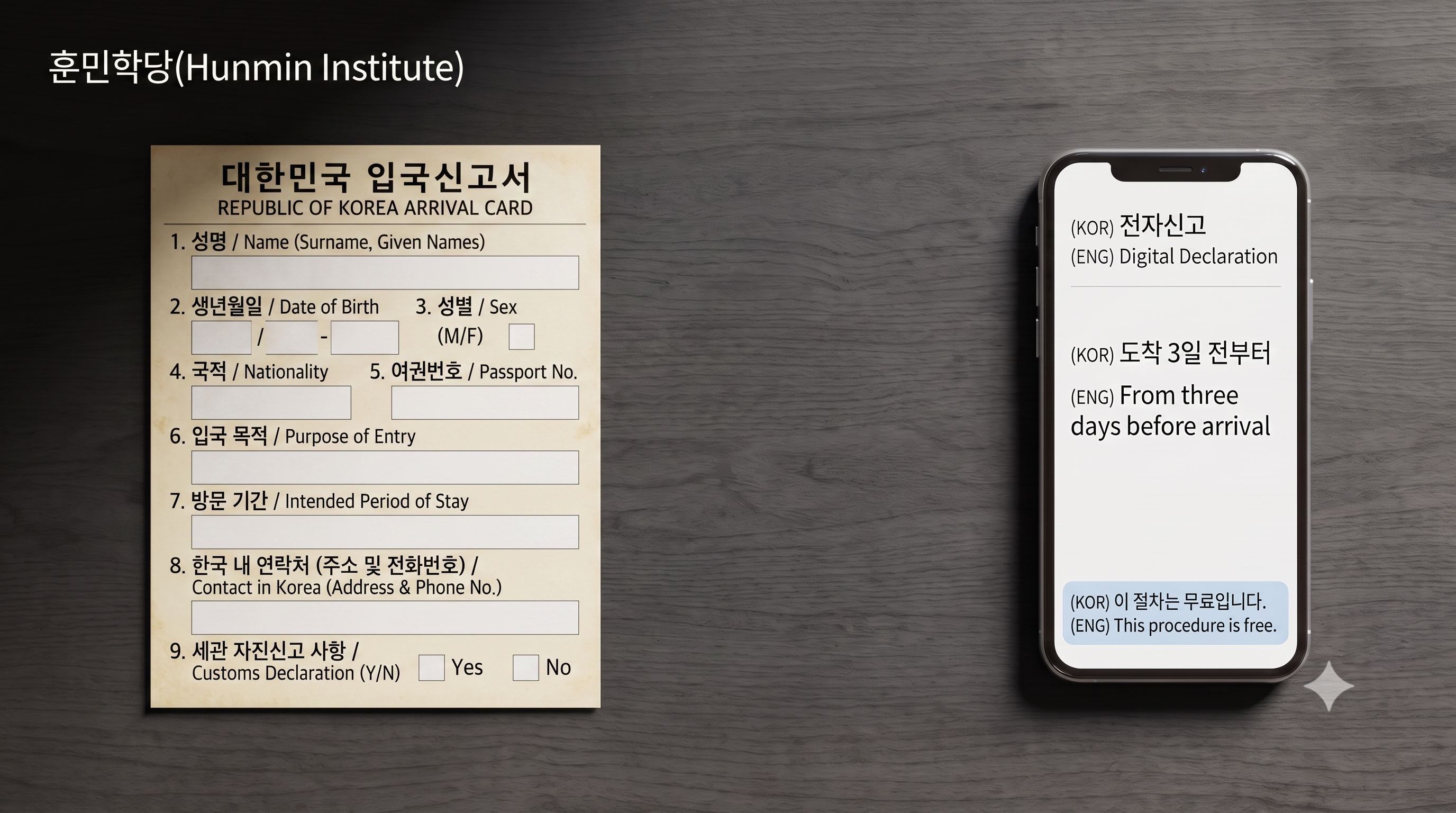
한국을 여러 번 다녀온 사람일수록 이 부분에서 당황합니다. 기내에서 나눠 주던 종이 입국신고서가 없어졌기 때문입니다.
The more often you have visited Korea, the more this part throws you. The paper arrival card once handed out on the plane is gone.
여기서 쓰는 표현부터 배워봅시다. 전자입국신고를 두고 오가는 말입니다.
Start with the expressions you will use here. These come up around the digital arrival declaration.
| 듣는 말 Listening | 하는 말 Speaking |
|---|---|
| 신고서 내셨어요? [singoseo naesyeosseoyo] Did you submit the form? | 전자입국신고 했어요. [jeonja ipguksingo haesseoyo] I completed the digital arrival declaration. |
| 화면 보여 주세요. [hwamyeon boyeo juseyo] Please show me the screen. | 여기 화면 있어요. [yeogi hwamyeon isseoyo] Here is the screen. |
| 종이는 안 받아요. [jongineun an badayo] We do not take paper any more. | 이거 무료예요? [igeo muryoyeyo] Is this free of charge? |
▶돈을 요구하면 공식 창구가 아닙니다. 정부 주소는 go.kr로 끝납니다.
If it asks for money, it is not the official channel. Korean government addresses end in go.kr.
전자 입국신고, 이른바 e-Arrival Card는 2025년 2월 24일에 시작되었고 2025년 12월까지는 종이 신고서와 함께 쓸 수 있었습니다. 2026년 1월 1일부터 종이가 사라져 지금은 전자 제출만 남았습니다. 도착 3일 전부터 공식 사이트에서 제출할 수 있고, 제출한 뒤 72시간이 지나도록 입국하지 않으면 효력이 사라지므로 그 안에 들어와야 합니다.
The digital arrival declaration, known as the e-Arrival Card, began on February 24, 2025 and ran alongside the paper form until December 2025. From January 1, 2026 the paper is gone and only the digital submission remains. You can submit from three days before arrival, and the submission lapses if you have not entered within 72 hours, so you must arrive inside that window.
이 절차는 무료입니다. 공식 주소는 www.e-arrivalcard.go.kr이며, 이와 비슷한 이름의 대행 사이트들이 검색 상단에 올라와 수수료를 받아냅니다. 검색으로 찾지 말고 주소를 직접 입력해 들어가는 편이 안전합니다. 다만 등록외국인과 유효한 K-ETA 소지자는 애초에 제출 대상이 아니므로 이 절차를 밟지 않습니다.
The procedure is free. The official address is www.e-arrivalcard.go.kr, while lookalike agency sites rank high in search results and charge fees. Rather than searching for it, type the address in directly. Registered foreign residents and holders of a valid K-ETA are not subject to the declaration in the first place, so they skip this step.
공항에 도착해서 하려고 하지 마십시오. 장시간 비행 뒤 공항 와이파이로 서류를 작성하는 것만큼 피곤한 일이 없습니다. 출발 하루 전에 끝내 두면 그만입니다.
Do not leave it until you land. Filling out forms on airport wifi after a long flight is as tiring as it gets. Finish it the day before you fly.
5. K-ETA와 e-Arrival Card, 둘 중 하나는 하게 되어 있습니다
K-ETA or e-Arrival Card: You Will Do One of Them
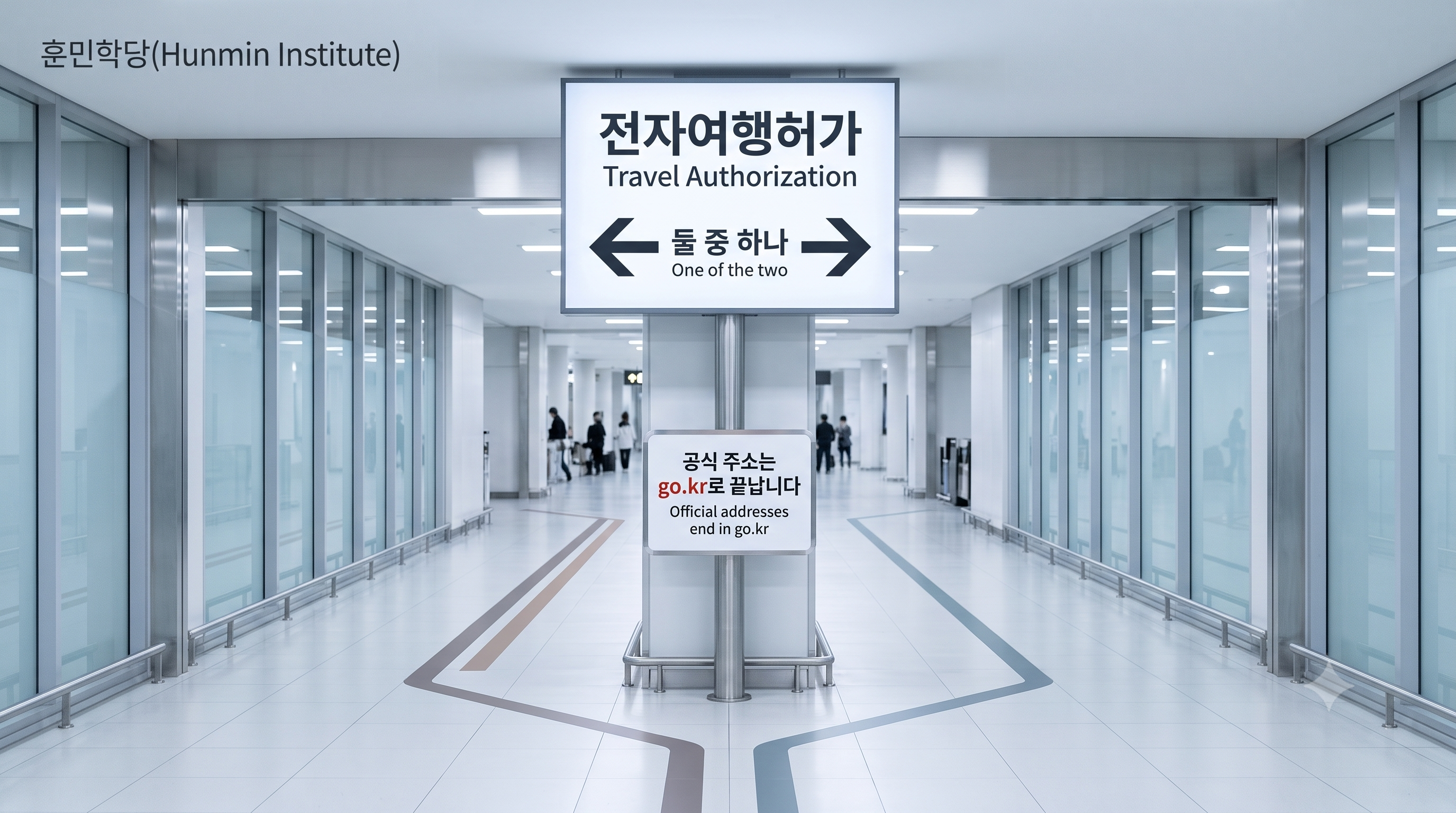
이 두 가지를 헷갈리는 사람이 많습니다. 구조만 이해하면 간단합니다. K-ETA는 비자 없이 들어오는 여행객을 위한 전자여행허가입니다.
Many people confuse these two, but the structure is simple. K-ETA is the electronic travel authorization for visitors entering without a visa.
| 구분 Your case | 무엇이 필요한가 What you need |
|---|---|
| K-ETA가 있는 경우 You hold a valid K-ETA | 전자입국신고는 하지 않아도 됩니다 No e-Arrival Card is required |
| K-ETA가 없는 경우 You are entering without one | 전자입국신고를 제출해야 합니다 You must submit the e-Arrival Card |
| 등록 외국인인 경우 You are a registered resident | 둘 다 해당하지 않습니다 Neither one applies |
여기서 쓰는 표현부터 배워봅시다. 심사대에서 실제로 오가는 말은 짧습니다.
Start with the expressions you will use here. What is actually said at the desk is short.
| 듣는 말 Listening | 하는 말 Speaking |
|---|---|
| 케이이티에이 있으세요? [keiitiei isseuseyo] Do you have a K-ETA? | 네, 여기 화면 있어요. [ne yeogi hwamyeon isseoyo] Yes, here is the screen. |
| 신고서 제출하셨어요? [singoseo jechulhasyeosseoyo] Did you submit the declaration? | 확인서 보여 드릴게요. [hwaginseo boyeo deurilgeyo] Let me show you the confirmation. |
| 등록증 있으세요? [deungnokjeung isseuseyo] Do you have a residence card? | 아니요, 단기 방문이에요. [aniyo dangi bangmunieyo] No, I am here short-term. |
▶K-ETA를 면제받았다는 것은 아무것도 안 해도 된다는 뜻이 아닙니다.
Being exempt from K-ETA does not mean there is nothing to do.
일부 국가 국민에 대해서는 K-ETA 신청 의무가 한시적으로 면제되어 있고, 이 면제는 2026년 1월 1일부터 2026년 12월 31일까지 다시 연장된 상태입니다. 면제 대상 국가 명단은 자료마다 다르게 소개되는 경우가 있으므로 자기 국적을 기준으로 공식 기관에서 직접 확인하시기 바랍니다.
The obligation to apply for K-ETA is temporarily waived for nationals of certain countries, and that waiver has been extended again to run from January 1 to December 31, 2026. The list of eligible countries is reported inconsistently, so check it for your own nationality with the official agency.
면제 대상이라도 K-ETA를 신청할 수는 있습니다. 신청해 두면 입국신고서 작성을 생략할 수 있으며, 이 경우에는 신청 수수료가 붙습니다. 면제와 신청 가운데 무엇이 편한지는 일정에 따라 갈립니다.
Even if you are exempt, you may still apply. Holding a K-ETA lets you skip the arrival declaration, and applying in that case carries a fee. Which is easier depends on your itinerary.
정리하면 이렇습니다. K-ETA가 있으면 e-Arrival Card는 필요 없고, K-ETA가 없으면 e-Arrival Card가 필요합니다. 명단과 적용 기간은 정책에 따라 바뀌므로 인터넷에 남아 있는 오래된 안내를 그대로 믿지 마십시오.
Put simply: with a K-ETA you do not need the e-Arrival Card; without a K-ETA you do. The list and its period change with policy, so do not trust outdated guidance left online.
6. 세관에서 쓰는 문장과 알아야 할 숫자
Customs Lines and the Numbers to Remember
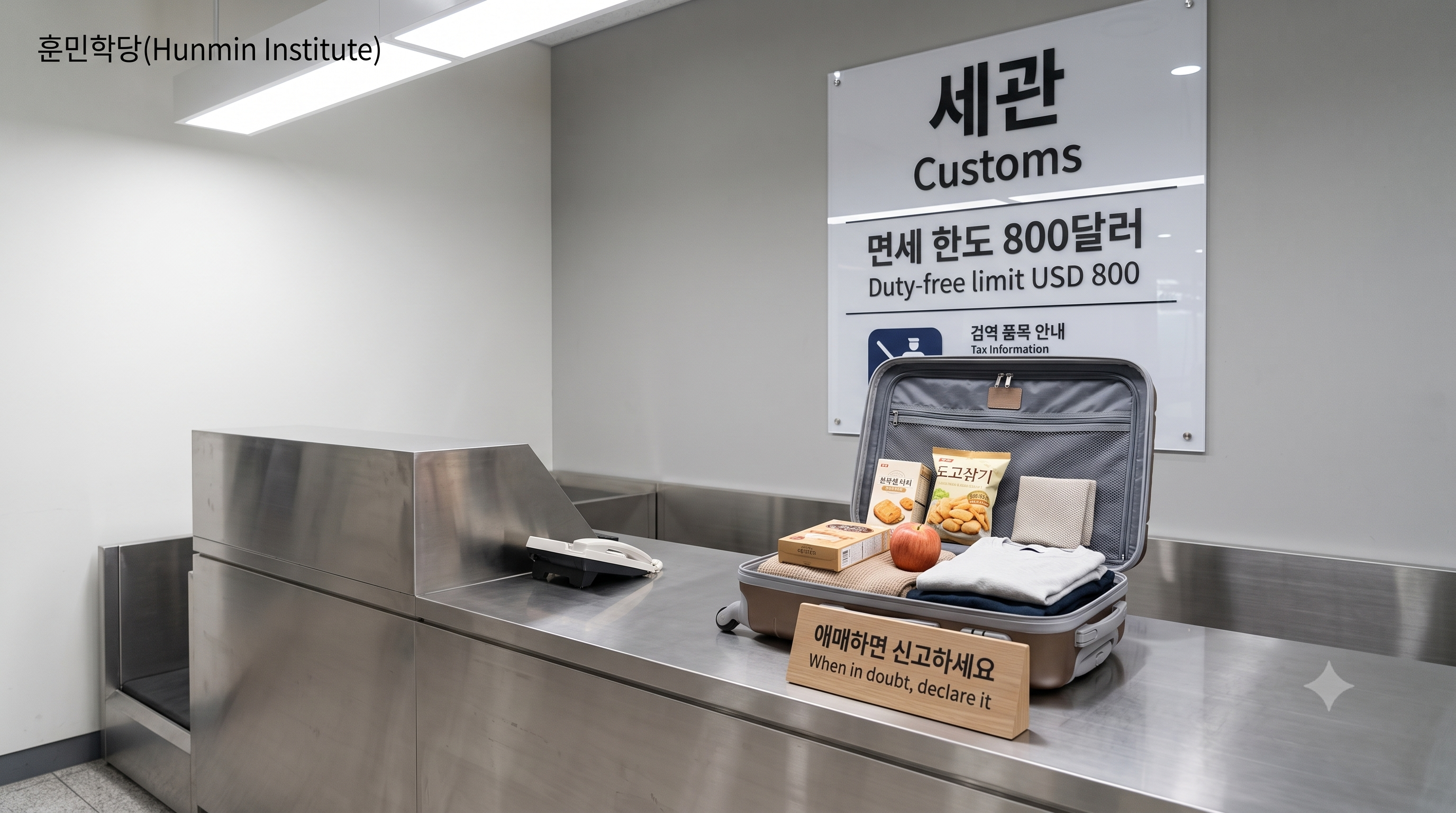
짐을 찾고 나면 마지막 관문입니다. 신고할 물건이 없으면 대부분 그냥 지나갑니다. 하지만 질문을 받았을 때 쓸 문장은 알아 두는 편이 좋습니다.
Once you have your bags, this is the last gate. With nothing to declare, most people walk right through. Still, it helps to know what to say if you are asked.
여기서 쓰는 표현부터 배워봅시다. 세관 창구에서 오가는 말입니다.
Start with the expressions you will use here. These go back and forth at the customs counter.
| 듣는 말 Listening | 하는 말 Speaking |
|---|---|
| 신고할 물건 있으세요? [singohal mulgeon isseuseyo] Do you have anything to declare? | 없어요./네, 있어요. [eopseoyo]/[ne isseoyo] No, nothing./Yes, I do. |
| 이거 뭐예요? [igeo mwoyeyo] What is this? | 선물이에요./제 거예요. [seonmurieyo]/[je geoyeyo] It is a gift./It is mine. |
| 가방 좀 열어 주세요. [gabang jom yeoreo juseyo] Please open your bag. | 네, 알겠습니다./잠시만요. [ne algetseumnida]/[jamsimanyo] Yes, of course./One moment, please. |
| 이건 신고 대상이에요. [igeon singo daesangieyo] This one has to be declared. | 이건 신고해야 하나요? [igeon singohaeya hanayo] Do I need to declare this? |
▶애매하면 신고하는 쪽이 낫습니다. 신고해서 손해 보는 구조가 아닙니다.
When in doubt, declare it. The system is not built to punish you for declaring.
아야 하나요는 그렇게 해야 하는지 묻는 틀입니다. 여기 서야 하나요, 이거 내야 하나요처럼 앞의 동사만 바꾸면 됩니다. 규정을 모를 때 가장 안전한 문장입니다.
The frame 아야 하나요 asks whether something is required: 여기 서야 하나요, 이거 내야 하나요. It is the safest sentence when you do not know a rule.
한국의 기본 면세 한도는 1인당 미화 800달러입니다. 여기에 별도로 주류는 총 용량 2리터 이하이면서 총 가격 400달러 이하, 담배는 궐련 200개비, 향수는 100밀리리터까지 면세됩니다. 주류의 병수 제한은 2025년 3월 21일에 폐지되어 지금은 용량과 가격만 봅니다. 현금을 비롯한 지급수단이 미화 1만 달러를 넘으면 반드시 신고해야 합니다. 한도는 제도 개정에 따라 달라질 수 있으므로 출발 전에 관세청 안내를 확인하십시오.
Korea’s basic duty-free allowance is USD 800 per person. Separately, alcohol is exempt up to two liters in total volume and USD 400 in total value, tobacco up to 200 cigarettes, and perfume up to 100 milliliters. The cap on the number of bottles was removed on March 21, 2025, so only volume and value now matter. Cash and other means of payment exceeding USD 10,000 must be declared. These limits can change with policy, so check the Korea Customs Service notice before you fly.
외국인이 자주 걸리는 품목도 정해져 있습니다. 육류 가공품과 생과일, 씨앗류입니다. 소시지 하나, 사과 한 알이라도 검역 대상이며 자진신고하면 관세의 30퍼센트를 20만 원 한도에서 감면받지만, 신고하지 않았다가 적발되면 납부할 세액의 40퍼센트가 가산세로 붙습니다.
The items travelers get caught with are fairly predictable: processed meat, fresh fruit, and seeds. A single sausage or one apple is still subject to quarantine. Voluntary declaration earns a 30 percent duty reduction capped at KRW 200,000, while an undeclared item found later brings a penalty of 40 percent of the tax due.
7. 줄을 서지 않고 통과하는 방법
How to Get Through Without Queuing
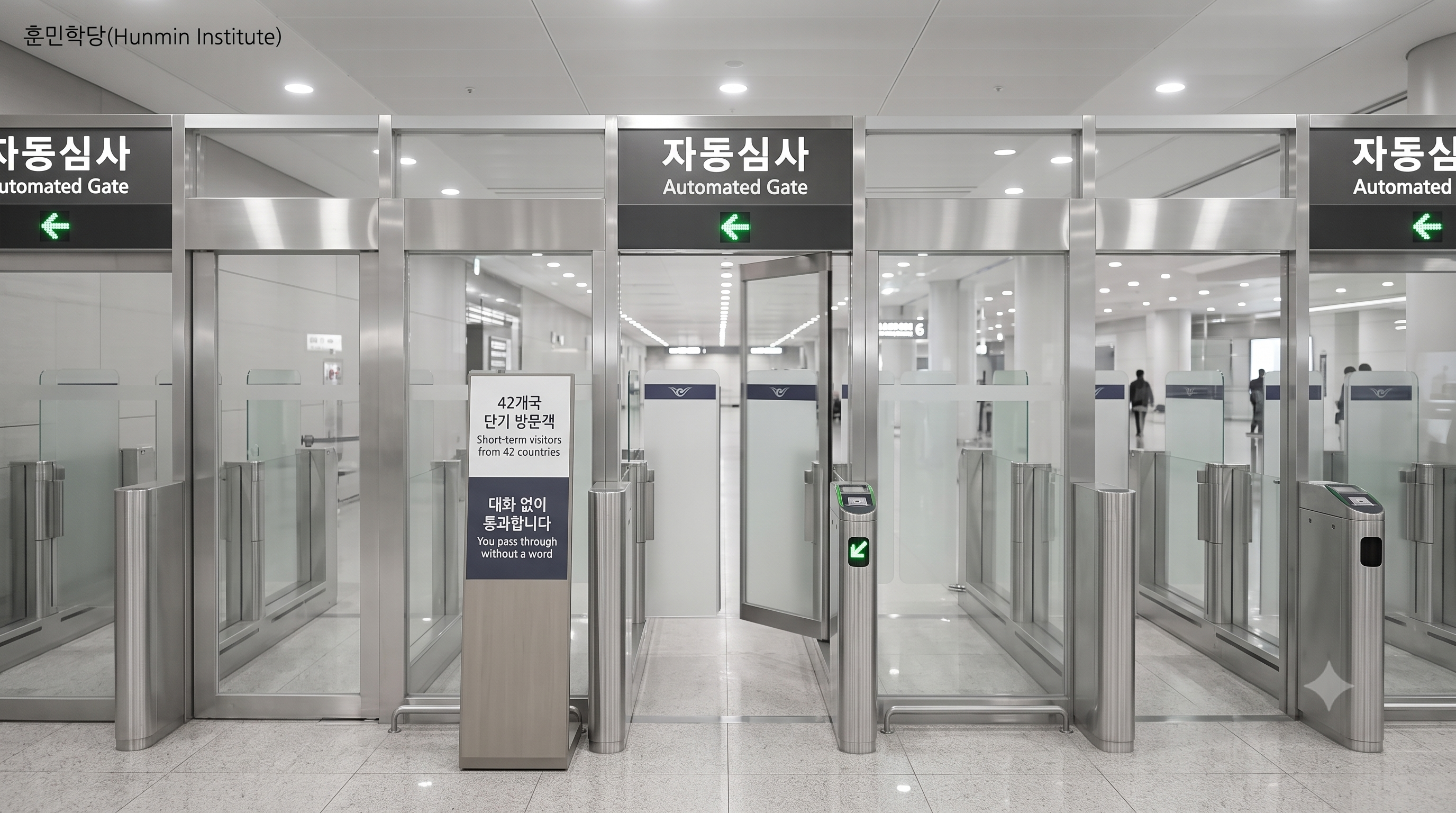
인천공항에는 자동출입국심사대가 있습니다. 대상에 해당하는 단기 방문객은 심사관과 대화 없이 기계로 통과합니다. 이때는 사람 대신 안내판의 한국어를 읽어야 합니다.
Incheon Airport has automated immigration gates. Eligible short-term visitors pass through by machine with no conversation at all, which means reading the Korean on the signs instead of listening to a person.
| 한국어 Korean | 무엇을 하라는 뜻인가 What to do |
|---|---|
| 여권을 올려놓으세요 [yeogwoneul ollyeonoeuseyo] Place your passport | 사진면을 아래로 두고 인식기에 올립니다 Lay it photo side down on the reader |
| 지문을 인식해 주세요 [jimuneul insikae juseyo] Scan your fingerprints | 양쪽 검지를 판에 올립니다 Put both index fingers on the pad |
| 정면을 봐 주세요 [jeongmyeoneul bwa juseyo] Look straight ahead | 모자와 마스크를 벗고 카메라를 봅니다 Remove hat and mask, face the camera |
여기서 쓰는 표현부터 배워봅시다. 기계 앞에서 막혔을 때 오가는 말입니다.
Start with the expressions you will use here. These come up when the machine stops you.
| 듣는 말 Listening | 하는 말 Speaking |
|---|---|
| 다시 해 보세요. [dasi hae boseyo] Please try again. | 자동심사 되나요? [jadongsimsa doenayo] Can I use the automated gate? |
| 저쪽 창구로 가세요. [jeojjok changguro gaseyo] Please go to that counter. | 여기 안 돼요. [yeogi an dwaeyo] It is not working here. |
| 여권 다시 올려 주세요. [yeogwon dasi ollyeo juseyo] Please place your passport again. | 어떻게 해야 하나요? [eotteoke haeya hanayo] What should I do? |
▶사람이 묻지 않으면 기계가 묻습니다. 읽어야 할 한국어가 남습니다.
If a person does not ask, the machine does. There is still Korean to read.
주세요와 세요는 안내판과 기계 화면에서 지시를 내릴 때 쓰는 형태입니다. 올려놓으세요, 봐 주세요처럼 동사 뒤에 붙으며, 이 형태가 보이면 무엇을 하라는 뜻이라고 보면 됩니다.
주세요 and 세요 are the forms signs and machine screens use to give instructions. They attach to verbs, as in 올려놓으세요 and 봐 주세요, and when you see them, something is being asked of you.
이용 대상 국가와 조건은 바뀌므로 출발 전에 확인하십시오. 여기서 재미있는 역설이 생깁니다. 이 글에서 배운 다섯 개의 문답을 한 번도 쓰지 않고 입국할 수도 있습니다. 그래도 준비는 하시기 바랍니다.
The eligible nationalities and conditions change, so check before you fly. A small irony appears here: you may enter without using a single one of the five exchanges you just learned. Prepare anyway.
8. 심사대를 나온 다음 30분
The Thirty Minutes After the Desk
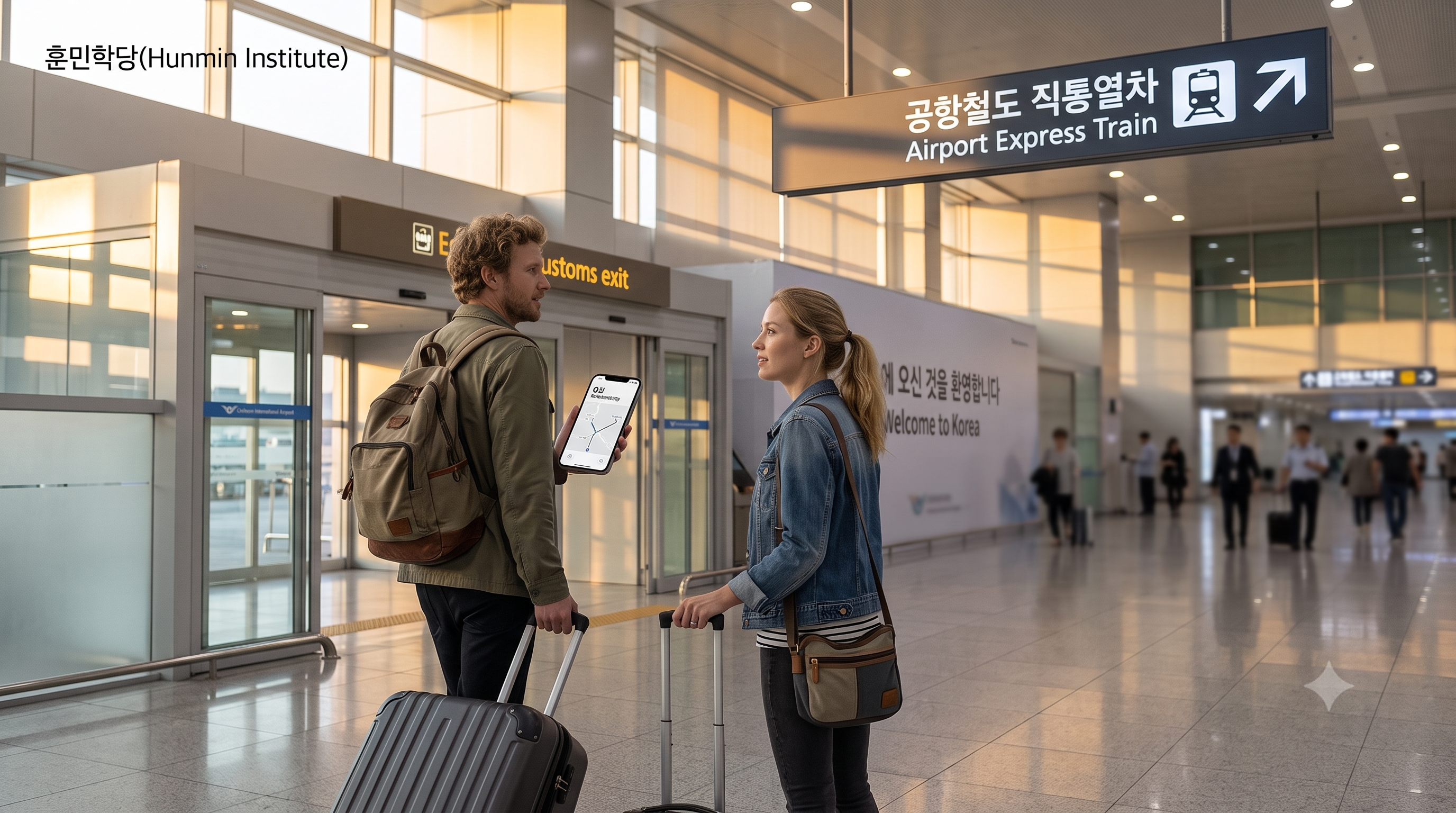
입국심사보다 실제로 더 자주 발이 묶이는 구간이 있습니다. 세관을 지나 문이 열린 다음의 30분입니다. 여기서부터는 한국어를 직접 써야 합니다.
There is a stretch that strands travelers more often than immigration does: the thirty minutes after the doors open past customs. From here on, you use Korean yourself.
여기서 쓰는 표현부터 배워봅시다. 공항을 빠져나갈 때 오가는 말입니다.
Start with the expressions you will use here. These go back and forth as you leave the airport.
| 듣는 말 Listening | 하는 말 Speaking |
|---|---|
| 저쪽에 있어요. [jeojjoge isseoyo] It is over there. | 유심 어디에서 사요? [usim eodieseo sayo] Where can I buy a SIM card? |
| 지하 일층으로 가세요. [jiha ilcheungeuro gaseyo] Go down to level B1. | 공항철도 어디예요? [gonghangcheoldo eodiyeyo] Where is the airport railroad? |
| 한 시간쯤 걸려요. [han siganjjeum geollyeoyo] It takes about an hour. | 서울역까지 얼마나 걸려요? [seoullyeokkaji eolmana geollyeoyo] How long does it take to Seoul Station? |
▶어디예요와 얼마나 걸려요 두 문장이면 공항을 빠져나가는 데 부족하지 않습니다.
어디예요 and 얼마나 걸려요 are enough to get you out of the airport.
가장 먼저 필요한 것은 통신입니다. 지도를 켜고 숙소에 연락하고 교통편을 예약하려면 인터넷이 있어야 합니다. 공항에서 유심을 사려면 줄을 서야 하므로, 출국 전에 eSIM을 준비하거나 포켓 와이파이를 예약해 두는 편이 빠릅니다.
The first thing you need is connectivity. Opening a map, contacting your accommodation, booking a ride: all of it needs internet. Buying a SIM at the airport means another queue, so arranging an eSIM or reserving a pocket wifi before you fly is faster.
다음은 이동입니다. 인천공항에서 서울 도심까지는 공항철도 직통열차가 가장 예측 가능하고, 짐이 많거나 일행이 여럿이면 공항 픽업 차량이 편합니다. 심야 도착이라면 도착 시각 기준으로 운행 여부를 미리 확인해 두셔야 합니다.
Next comes getting into the city. The airport express train is the most predictable route into central Seoul, while a pickup service suits heavy luggage or a group. For a late-night arrival, check in advance what is still running at your landing time.
여기까지 오면 입국은 끝났습니다. 그런데 이 글에서 배운 다섯 개의 문답은 공항을 나선 뒤에도 계속 쓰입니다. 한국에서 만나는 사람들이 당신에게 가장 먼저 묻는 질문이 정확히 이것들이기 때문입니다. 입국심사는 시험이 아니라 한국에서의 첫 대화입니다.
At this point your arrival is complete, yet the five exchanges keep working long after you leave the airport, because these are precisely the first questions people in Korea will ask you. Immigration is not a test but your first conversation in Korea.
Next: Olive Young Skincare Consultation Korean Phrases ↗
토픽 맛보기
TOPIK Preview
유형: TOPIK Ⅰ 읽기 [34~39], 대화, 빈칸에 알맞은 것 고르기
Type: TOPIK I Reading [34–39], dialogue, choose the correct word for the blank
( )에 들어갈 말로 가장 알맞은 것을 고르십시오.
Choose the most appropriate word for the blank.
가: 무슨 일로 오셨어요? 나: 여행 ( ).
A: What brings you here? B: I am here to ( ).
① 왔어요
② 갔어요
③ 했어요
④ 봤어요
Answer ▾
정답 ① 왔어요
Answer: ① 왔어요
왔어요는 이곳으로 온 사실을 말하는 표현이므로 입국심사 자리에 맞습니다. ②는 지문과 같은 이동을 말하면서 방향이 반대라 진술이 어긋나고, ③은 행위를 했다는 뜻만 맞아 일부만 걸리며, ④는 그럴듯해 보여도 보는 행위를 가리켜 지문에 근거가 없습니다. 흉내 낸 대문항은 TOPIK Ⅰ 읽기 [34~39]입니다.
왔어요 states that you came here, which fits the immigration desk. ② names the same kind of movement but points the other way, ③ only carries the sense of having done something, and ④ refers to looking, which the exchange never mentions. The item type modeled here is TOPIK I Reading [34–39].
FAQ
Q1. 한국어를 못 해도 입국심사를 통과할 수 있나요?Answer ▾
Q1. Can I clear immigration without speaking Korean?
A1. 문제없습니다. 영어로 진행되는 경우가 대부분입니다. 한국어 답변은 선택이지 조건이 아닙니다.
A1. No problem at all. It is usually conducted in English. Answering in Korean is a choice, not a requirement.
Q2. 전자입국신고는 언제까지 유효한가요?Answer ▾
Q2. How long does the e-Arrival Card stay valid?
A2. 제출한 뒤 72시간까지입니다. 도착 3일 전부터 낼 수 있으므로 출발 하루 전에 제출하면 시간 안에 들어옵니다. 일정이 밀려 72시간을 넘기면 다시 제출해야 합니다.
A2. For 72 hours after submission. You can submit from three days before arrival, so filing the day before you fly keeps you inside the window. If your schedule slips past 72 hours, submit again.
Q3. 신고 사이트에서 수수료를 요구하는데 정상인가요?Answer ▾
Q3. A declaration site is asking for a fee. Is that normal?
A3. 아닙니다. 전자입국신고는 무료이며 공식 주소가 go.kr로 끝납니다. 수수료 요구는 대행 사이트의 신호입니다. 다만 K-ETA는 원래 유료이므로 둘을 혼동하지 마십시오.
A3. No. The e-Arrival Card is free and the official address ends in go.kr. A fee request signals an agency site. Note that K-ETA itself does carry a fee, so do not confuse the two.
Q4. 여행 중 먹을 간식을 가져가도 되나요?Answer ▾
Q4. Can I bring snacks for the trip?
A4. 육류 가공품과 생과일은 검역 대상입니다. 소량이라도 신고 대상이 될 수 있으니 애매하면 신고하시기 바랍니다. 하이코리아와 관세청 누리집은 모두 영문 화면이 있어 국적과 품목을 넣어 직접 확인할 수 있습니다.
A4. Processed meat and fresh fruit are subject to quarantine. Even small amounts may need declaring, so declare when in doubt. Both the HiKorea and Korea Customs Service sites have English pages where you can check by nationality and by item.
Q5. 숙소를 아직 정하지 않았으면 어떻게 답하나요?Answer ▾
Q5. What if I have not decided where to stay?
A5. 최소한 첫날 묵을 곳의 이름과 주소는 준비해 두시는 편이 좋습니다. 확인 절차가 길어지는 가장 흔한 이유입니다.
A5. At minimum, have the name and address of your first night booked. This is the most common cause of a longer check.
Vocabulary and Pronunciation for Foreigners
| No | Korean | Romanisation | Meaning |
|---|---|---|---|
| 1 | 입국심사 | ipguksimsa | (n) immigration inspection [ˌɪmɪˈɡreɪʃn] |
| 2 | 세관 | segwan | (n) customs [ˈkʌstəmz] |
| 3 | 여권 | yeogwon | (n) passport [ˈpæspɔːrt] |
| 4 | 전자 | jeonja | (n) electronic form [ɪˌlekˈtrɑːnɪk] |
| 5 | 면세 | myeonse | (n) duty free [ˈduːti friː] |
| ▾ 단어 53개 더 보기 Show 53 more ↗ | |||
The blog page has limits of space and function, so only five words are shown here. The rest of the word list, the audio, the sentences and tables, the FAQ, the worksheet, the TOPIK questions and the lesson video are on the Hunmin Institute website ↗, free for blog subscribers.
참고 기관
Official Sources
법무부 출입국·외국인정책본부 하이코리아 ↗
Korea Immigration Service, Ministry of Justice
https://www.hikorea.go.kr
기관 설명 보기 About this institute ▾
This is the agency that runs entry and residence rules. It has an English section where the top menu lets you check K-ETA exemption by nationality and whether the e-Arrival Card applies to you. The exemption period and country list change from time to time, so check before you fly.
관세청 ↗
Korea Customs Service
https://www.customs.go.kr
기관 설명 보기 About this institute ▾
This agency sets duty-free allowances and the list of items subject to quarantine. It offers a page that estimates duty on travelers’ goods, so you can see the cost before you arrive. Allowances and penalty rates change when the notices are revised.
※ 본 콘텐츠(원고, 이미지, 예문 포함)는 저작권법에 의해 보호받는 훈민학당의 저작물입니다. 무단 복제, 전재, 재배포 및 AI 학습 데이터로의 이용을 금합니다.
This content (manuscript, images, and example sentences) is the copyrighted property of Hunmin Institute, protected under copyright law. Unauthorized copying, reproduction, redistribution, and use as AI training data are prohibited.
'Real Talk' 카테고리의 다른 글
| Korean Dentist Phrases: Covered or Not Covered (0) | 2026.08.08 |
|---|---|
| Korean Skin Clinic Phrases: What Staff Actually Ask (0) | 2026.08.08 |
| Korean Clinic Phrases: What the Doctor Actually Asks (0) | 2026.08.02 |
| Korean Hair Salon Lines (0) | 2026.07.25 |
| Olive Young Skincare Consultation Korean Phrases (0) | 2026.07.22 |


