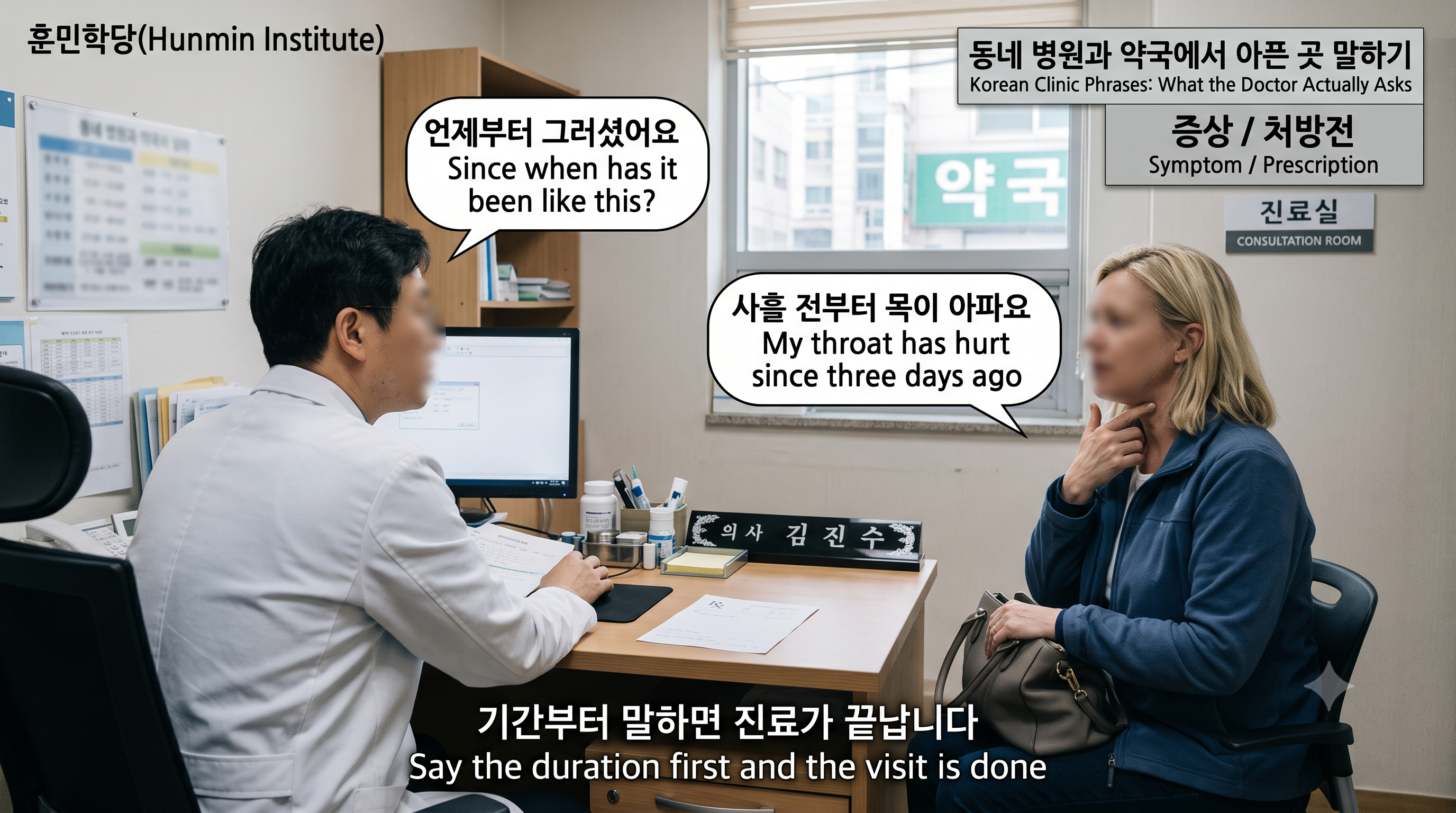
Korean Clinic Phrases: What the Doctor Actually Asks
동네 병원과 약국에서 아픈 곳 말하기
At a Korean clinic the order of what you say matters more than fluency.
You will learn where it hurts, since when, and how to get medicine at a pharmacy.
한국의 동네 의원은 유창함보다 증상을 말하는 순서가 중요합니다.
이 글에서 아픈 곳과 언제부터 아팠는지를 말하고 약국에서 약을 받는 한국어를 익힙니다.
The learning services for the teaching materials published on this blog are free and open to everyone on the Hunmin Institute website ↗, with no account needed.
이 글에서 배우는 핵심 회화
Key Expressions in This Lesson
진료실과 약국에서 오가는 말은 몇 마디로 정해져 있습니다. 아래 여섯 문장은 좌우가 한 쌍의 대화가 아니라 각각 따로 익히는 문장입니다. 먼저 눈에 담고 본문으로 들어가십시오.
Only a few fixed lines go back and forth in the exam room and at the pharmacy. The two columns are not paired dialogue; each sentence is learned on its own. Take them in first, then move into the main text.
| 듣는 말 Listening |
하는 말 Speaking |
|---|---|
| 어디가 불편하세요? [eodiga bulpyeonhaseyo] Where does it bother you? |
사흘 전부터 목이 아파요. [saheul jeonbuteo mogi apayo] My throat has hurt for three days. |
| 큰 병원 가 보셔야겠어요. [keun byeongwon ga bosyeoyagesseoyo] You should go to a bigger hospital. |
진료의뢰서 써 주세요. [jillyouiroeseo sseo juseyo] Please write me a referral letter. |
| 식후 30분에 드세요. [sikhu samsipbune deuseyo] Take it 30 minutes after a meal. |
소화가 안 돼요. 약 좀 주세요. [sohwaga an dwaeyo yak jom juseyo] My stomach feels heavy. Please give me some medicine. |
첫째 줄은 소단락 2에서, 둘째 줄은 소단락 1에서, 셋째 줄은 소단락 3에서 다룹니다.
The first row is covered in Section 2, the second in Section 1, and the third in Section 3.
1. 어디로 갈지부터 정한다
Decide Where to Go First
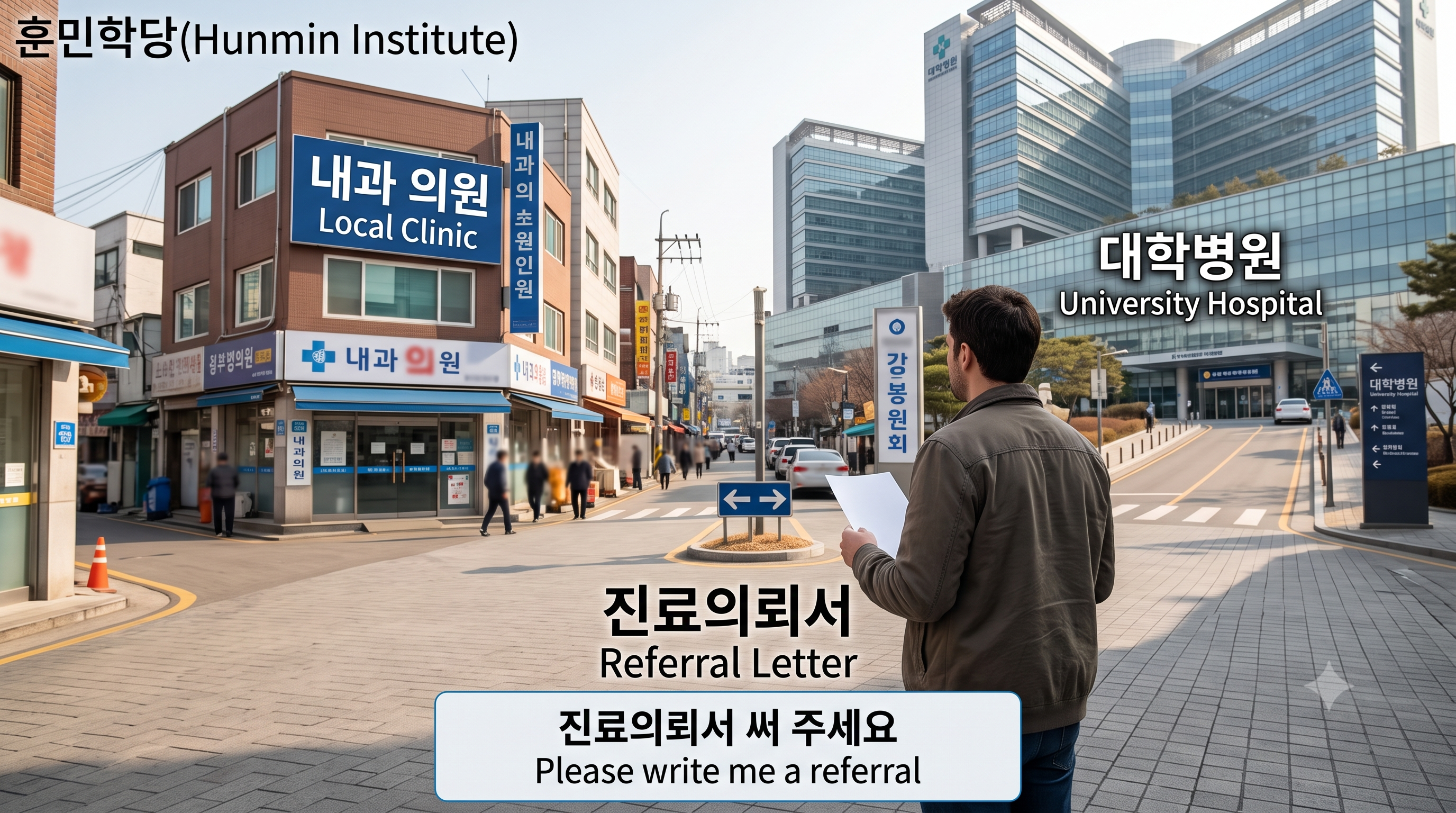
감기와 배탈, 근육통은 집 근처 의원으로 갑니다. 예약 없이 걸어 들어가 접수만 하면 됩니다.
For a cold, an upset stomach, or muscle pain, walk into a local clinic and register at the desk. No appointment is needed.
대학병원은 동네 의원에서 진료의뢰서를 받아야 건강보험이 적용되므로, 이 두 마디가 진료비를 좌우합니다.
A university hospital applies your insurance only with a referral from that clinic, so these two lines decide what you pay.
여기서 쓰는 표현부터 배워봅시다. 접수대와 진료실 문 앞에서 오가는 말입니다.
Start with the expressions you will use here. These pass at the desk and at the exam room door.
| 듣는 말 Listening |
하는 말 Speaking |
|---|---|
| 큰 병원 가 보셔야겠어요. [keun byeongwon ga bosyeoyagesseoyo] You should go to a bigger hospital. |
진료의뢰서 써 주세요. [jillyouiroeseo sseo juseyo] Please write me a referral letter. |
| 접수부터 하고 오세요. [jeopsubuteo hago oseyo] Register at the desk first. |
접수 어디서 해요? [jeopsu eodiseo haeyo] Where do I register? |
| 보험 있으세요? [boheom isseuseyo] Do you have insurance? |
외국인등록증 여기 있어요. [oegugindeungnokjeung yeogi isseoyo] Here is my alien registration card. |
응용 Apply It
↳ [명사] 써 주세요
[noun] sseo juseyo
Please write me a [noun].
ex [진료의뢰서] 써 주세요./[진단서] 써 주세요.
ROM [jillyouiroeseo] sseo juseyo/[jindanseo] sseo juseyo
EN Please write me a referral letter./Please write me a medical certificate.
▶“큰 병원 가 보셔야겠어요”가 나오면 곧바로 진료의뢰서를 요청하십시오.
When you hear 큰 병원 가 보셔야겠어요, ask for the referral right away.
의뢰서 없이 대학병원에 가면 건강보험이 적용되지 않아 진료비를 전액 본인이 냅니다.
Without a referral, insurance does not apply at a university hospital and you pay the full cost yourself.
가 보셔야겠어요는 명령이 아니라 권유의 어미입니다. 부드럽게 들리지만 실제로는 지금 옮기라는 뜻이므로 그 자리에서 의뢰서를 요청해야 합니다.
가 보셔야겠어요 is a suggestion ending, not a command. It sounds soft, but it means move now, so ask for the referral on the spot.
2. 진료실에서 오가는 말
What Passes in the Exam Room
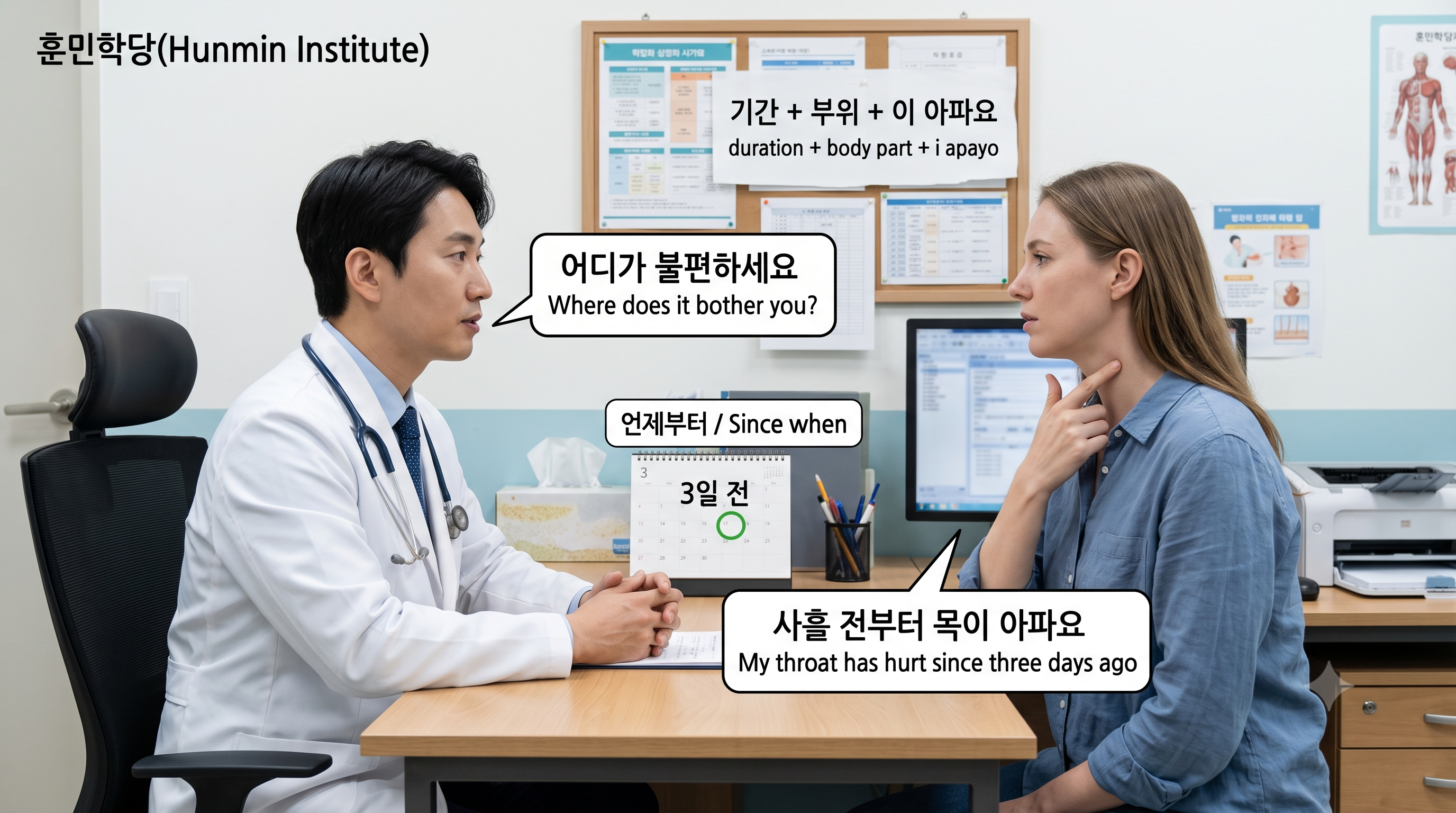
한국의 의원 진료는 짧게 끝나는 경우가 많습니다. 무성의해서가 아니라 환자가 증상을 짧게 정리해 말하는 것을 전제로 돌아가는 구조입니다.
Consultations at Korean clinics often end quickly, not out of carelessness but because the system assumes the patient states the symptoms briefly.
무엇을 묻는 말인지 표로 먼저 보십시오.
See in the table what each line is asking.
| 듣는 말 Listening |
무엇을 묻는가 What is being asked |
|---|---|
| 어디가 불편하세요? [eodiga bulpyeonhaseyo] Where does it bother you? |
어디가 아픈지 묻는 말입니다 Asking where it hurts |
| 언제부터 그러셨어요? [eonjebuteo geureosyeosseoyo] Since when has it been like this? |
증상이 시작된 시점을 묻습니다 Asking when the symptom started |
| 처음 오셨어요? [cheoeum osyeosseoyo] Is this your first visit? |
초진인지 확인하는 말입니다 Checking whether this is your first visit |
| 성함이 어떻게 되세요? [seonghami eotteoke doeseyo] May I have your name? |
이름을 묻는 정중한 표현입니다 A polite way of asking your name |
여기서 쓰는 표현부터 배워봅시다. 증상을 전할 때 오가는 말입니다.
Start with the expressions you will use here. These pass as you describe the symptom.
| 듣는 말 Listening |
하는 말 Speaking |
|---|---|
| 어디가 불편하세요? [eodiga bulpyeonhaseyo] Where does it bother you? |
사흘 전부터 목이 아파요. [saheul jeonbuteo mogi apayo] My throat has hurt for three days. |
| 열도 나세요? [yeoldo naseyo] Do you have a fever as well? |
열이 나고 기침이 나요. [yeori nago gichimi nayo] I have a fever and a cough. |
| 약 알레르기 있으세요? [yak allereugi isseuseyo] Any drug allergies? |
저는 페니실린 알레르기가 있어요. [jeoneun penisillin allereugiga isseoyo] I have a penicillin allergy. |
▶가장 중요한 질문은 “언제부터 그러셨어요”입니다.
The most important question is since when.
사흘 된 기침과 3주 된 기침은 다른 문제이기 때문입니다. 기간을 먼저 준비해 두면 진료가 빨라집니다.
A cough of three days and a cough of three weeks are different problems. Have the duration ready and the visit moves faster.
문장 구조는 하나입니다. 기간 더하기 부터 더하기 부위 더하기 아파요. 단어만 바꿔 끼우면 어떤 증상도 말할 수 있습니다. 사흘 자리에 이틀이나 일주일을, 목 자리에 배나 머리를 넣으면 됩니다.
The structure is one pattern: duration plus 부터 plus body part plus 아파요. By swapping the words you can describe any symptom. Replace 사흘 with 이틀 or 일주일, and 목 with 배 or 머리.
부위 뒤에 오는 조사는 받침이 있으면 이, 없으면 가입니다. 목이 아파요, 머리가 아파요처럼 씁니다. 약 알레르기는 묻지 않아도 먼저 말해 두는 편이 안전합니다.
The particle after the body part is 이 when the word ends in a consonant and 가 when it does not, as in 목이 아파요 and 머리가 아파요. Mention a drug allergy before you are asked; it is the safer habit.
3. 나오는 것은 약이 아니라 종이 한 장
What You Get Is a Sheet of Paper, Not Medicine
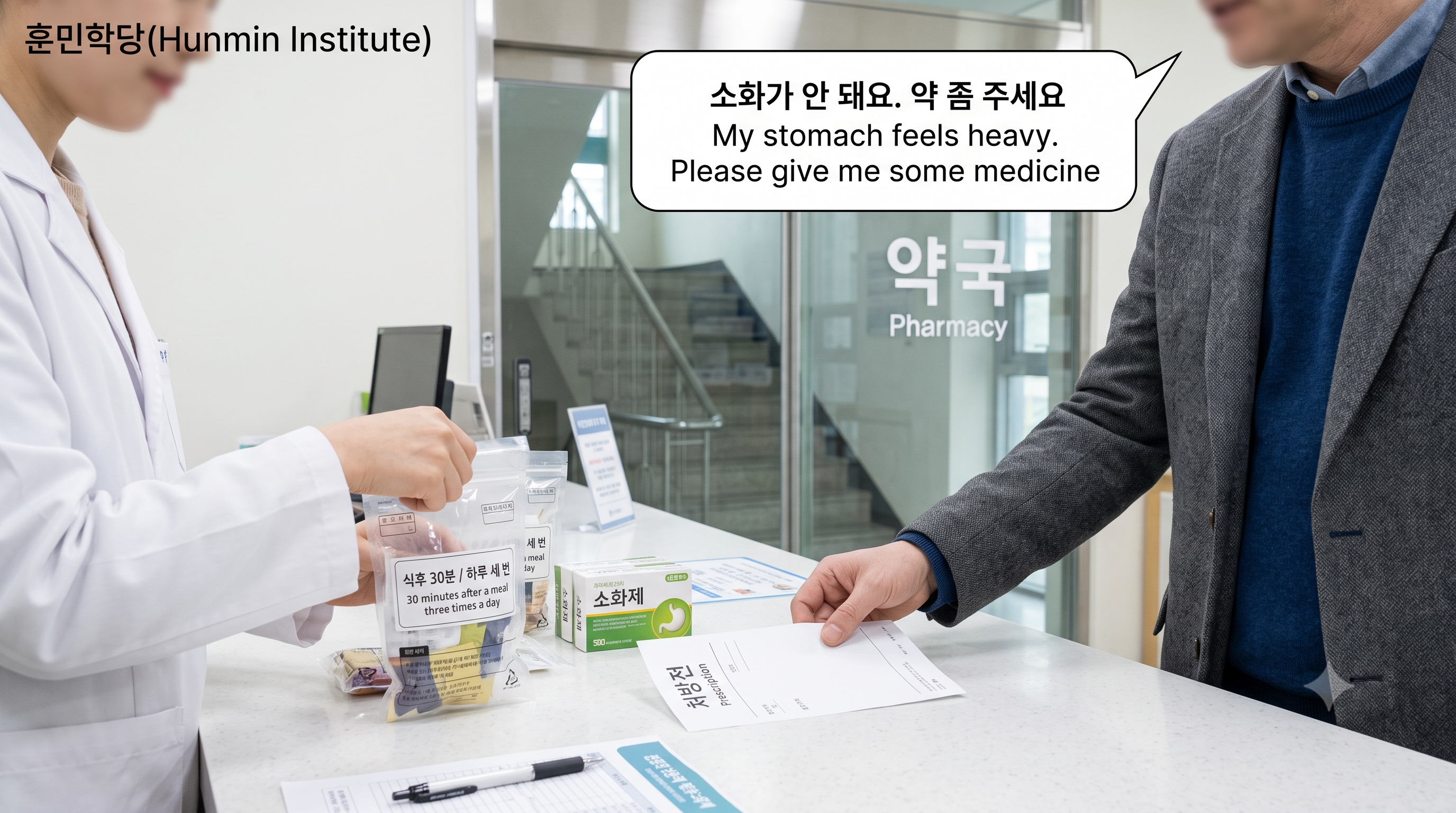
한국은 의사가 진단하고 약사가 약을 짓는 의약분업 구조입니다. 진료가 끝나면 손에 쥐는 것은 약이 아니라 처방전입니다.
Korea separates prescribing from dispensing. When the visit ends, what you hold is not medicine but a prescription.
누가 어디에서 무엇을 하는지 표로 먼저 보십시오.
See in the table who does what, and where.
| 무엇을 합니까 What happens |
어디에서 Where |
|---|---|
| 의사가 진단하고 처방전을 씁니다 The doctor diagnoses and writes a prescription |
진료실 In the exam room |
| 수납 창구에서 진료비를 냅니다 You pay the visit fee at the desk |
병원 접수대 At the clinic reception |
| 약사가 처방전을 받아 약을 짓습니다 The pharmacist takes it and prepares the medicine |
병원 건물 1층이나 바로 옆 약국 A pharmacy on the ground floor or right next door |
여기서 쓰는 표현부터 배워봅시다. 약을 받으며 오가는 말입니다.
Start with the expressions you will use here. These pass as you receive the medicine.
| 듣는 말 Listening |
하는 말 Speaking |
|---|---|
| 처방전 나왔습니다. [cheobangjeon nawatseumnida] Your prescription is ready. |
약국 어디에 있어요? [yakguk eodie isseoyo] Where is the pharmacy? |
| 식후 30분에 드세요. [sikhu samsipbune deuseyo] Take it 30 minutes after a meal. |
하루에 몇 번 먹어요? [harue myeot beon meogeoyo] How many times a day? |
| 졸릴 수 있어요. [jollil su isseoyo] It may make you drowsy. |
소화가 안 돼요. 약 좀 주세요. [sohwaga an dwaeyo yak jom juseyo] My stomach feels heavy. Please give me some medicine. |
▶처방전은 발급일부터 3일 안에 써야 합니다.
A prescription must be used within three days of issue.
마지막 날이 주말이나 공휴일이면 하루 연장됩니다. 다만 약의 종류에 따라 사용 기간이 따로 정해지는 경우가 있으므로 처방전에 적힌 날짜를 확인하십시오.
It is extended by one day if the last day is a weekend or holiday. Some medicines carry a different period, so check the date printed on the sheet.
헤맬 일은 없습니다. 한국의 약국은 대부분 병원 건물 1층이나 바로 옆에 붙어 있어 계단을 내려오면 간판이 보입니다.
You will not get lost. Most Korean pharmacies sit on the ground floor of the clinic building or right next door.
처방전 없이 살 수 있는 약도 있습니다. 소화제와 해열진통제, 파스 같은 일반의약품은 증상만 말하면 되고, 식후 30분과 하루 세 번은 약봉지에도 인쇄되어 나오니 눈으로도 익혀 두십시오.
Some medicines need no prescription: for over-the-counter items such as digestive aids, painkillers, and pain patches you only state the symptom. 식후 30분 and 하루 세 번 are printed on the packet too, so learn to recognize them by sight.
4. 밤과 휴일, 그리고 건강보험
Nights, Holidays, and Health Insurance
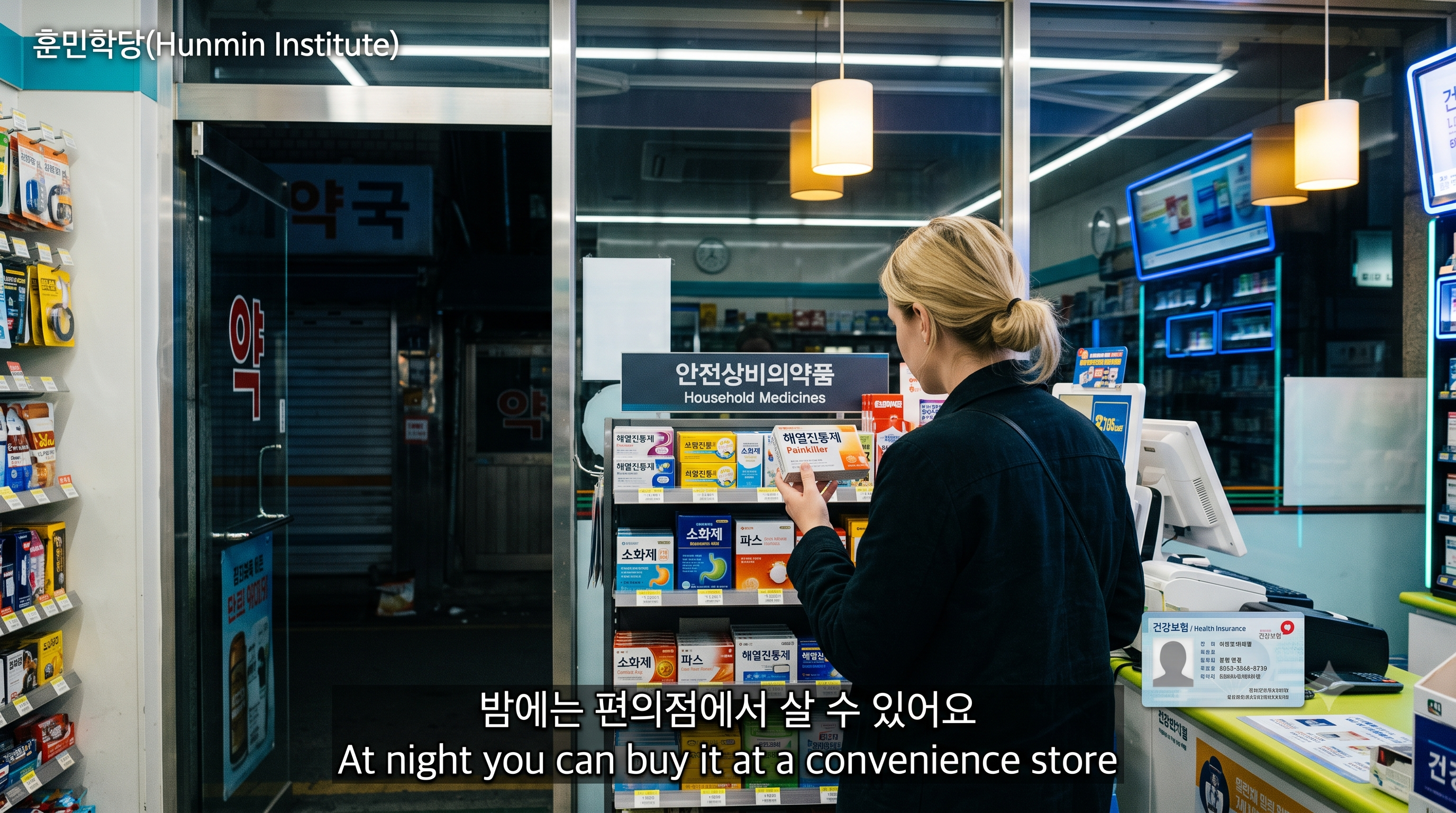
약국이 문을 닫은 뒤에도 방법은 있습니다. 24시간 편의점에서는 안전상비의약품을 살 수 있습니다.
There are still options after the pharmacies close. At 24-hour convenience stores you can buy designated household medicines.
상황별로 어디로 가야 하는지 표로 먼저 보십시오.
See in the table where to go in each situation.
| 상황 Situation |
어디로 갑니까 Where to go |
|---|---|
| 밤에 해열진통제나 감기약이 필요할 때 Needing a painkiller or cold medicine at night |
24시간 편의점의 안전상비의약품 Designated household medicines at a 24-hour convenience store |
| 휴일에 문 연 약국을 찾을 때 Looking for an open pharmacy on a holiday |
휴일지킴이약국 또는 응급의료포털 The Holiday Pharmacy site or the E-Gen portal |
| 진료비 부담을 줄이고 싶을 때 Wanting to reduce medical costs |
국민건강보험 가입 자격 확인 Check your national health insurance eligibility |
여기서 쓰는 표현부터 배워봅시다. 편의점에서 오가는 말입니다.
Start with the expressions you will use here. These pass at a convenience store.
| 듣는 말 Listening |
하는 말 Speaking |
|---|---|
| 상비약은 저쪽에 있어요. [sangbiyageun jeojjoge isseoyo] The household medicines are over there. |
해열제 있어요? [haeyeolje isseoyo] Do you have a fever reducer? |
| 지금은 약국이 문 닫았어요. [jigeumeun yakgugi mun dadasseoyo] The pharmacies are closed now. |
근처에 문 연 약국 있어요? [geuncheoe mun yeon yakguk isseoyo] Is there an open pharmacy nearby? |
| 이건 약국에서 사셔야 해요. [igeon yakgugeseo sasyeoya haeyo] You have to buy this at a pharmacy. |
파스 있어요? [paseu isseoyo] Do you have pain patches? |
▶진료비를 좌우하는 것은 건강보험입니다.
What decides your medical costs is health insurance.
외국인등록을 마치고 6개월 이상 국내에 거주하면 지역가입자로 당연가입되지만, 직장 취업자와 유학 자격 등은 6개월을 기다리지 않고 적용받습니다. 자격과 금액은 체류자격에 따라 갈리므로 국민건강보험공단에서 확인하십시오.
After alien registration and six months of residence you are enrolled automatically, while employed workers and student visa holders are covered without the wait. Eligibility and amounts differ by visa, so confirm them with the National Health Insurance Service.
편의점에서 살 수 있는 품목은 해열진통제와 감기약, 소화제, 파스 정도로 제한되어 있습니다. 지정 목록은 개정될 수 있으므로 보건복지부 공고를 확인하십시오.
What you can buy at a convenience store is limited to painkillers, cold medicine, digestive aids, and pain patches. The designated list can be revised, so check the Ministry of Health and Welfare notices.
한국에서 아플 때 필요한 것은 유창한 한국어가 아닙니다. 어디가 아픈지, 언제부터 그런지, 그리고 약을 달라는 말. 이 셋이면 진료가 끝까지 갑니다. 오늘 나온 문장 가운데 딱 세 개만 외우자면 사흘 전부터 목이 아파요, 진료의뢰서 써 주세요, 소화가 안 돼요 약 좀 주세요입니다.
What you need when you fall ill in Korea is not fluent Korean. Where it hurts, since when, and a request for medicine: those three carry the whole visit. If you memorize only three of today's lines, make them 사흘 전부터 목이 아파요, 진료의뢰서 써 주세요, and 소화가 안 돼요 약 좀 주세요.
Next: Korean Skin Clinic Phrases: What Staff Actually Ask ↗
토픽 맛보기
TOPIK Preview
유형: TOPIK Ⅰ 읽기 [40~42], 안내문, 일치하지 않는 내용 고르기
Type: TOPIK I Reading [40–42], notice, choose the statement that does not match
다음을 읽고 내용이 같지 않은 것을 고르십시오.
Read the following and choose the statement that does not match the content.
복용 안내. 하루 세 번. 식후 30분. 졸릴 수 있습니다.
Dosage instructions. Three times a day. Thirty minutes after a meal. May cause drowsiness.
① 하루에 세 번 먹습니다.
② 밥을 먹기 전에 먹습니다.
③ 졸음이 올 수 있습니다.
④ 밥을 먹고 30분 뒤에 먹습니다.
Answer ▾
정답 ② 밥을 먹기 전에 먹습니다
Answer: ② You take it before eating
식후는 밥을 먹은 뒤를 뜻하므로 먹기 전이라는 ②가 지문과 정반대입니다. ①은 하루 세 번에, ③은 졸릴 수 있습니다에, ④는 식후 30분에 그대로 대응합니다. 흉내 낸 대문항은 TOPIK Ⅰ 읽기 [40~42]이고 배점은 3점입니다.
식후 means after eating, so ② reverses the notice. ① matches 하루 세 번, ③ matches the drowsiness warning, and ④ matches 식후 30분. The item type modeled here is TOPIK I Reading [40–42], worth 3 points.
FAQ
Q1. 병원에 갈 때 무엇을 가져가야 하나요?Answer ▾
Q1. What should I bring to the clinic?
A1. 외국인등록증을 가져갑니다. 발급 전이라면 여권을 냅니다.
A1. Bring your alien registration card. If it has not been issued yet, show your passport.
Q2. 영어가 통하는 병원을 찾을 수 있나요?Answer ▾
Q2. Can I find a clinic where English is spoken?
A2. 대학병원과 외국인이 많은 지역의 의원에는 영어 응대가 가능한 곳이 있습니다. 응급의료포털에서 외국어 진료 가능 기관을 검색할 수도 있습니다.
A2. University hospitals and clinics in areas with many foreign residents often offer English service. The emergency medical portal also lets you search for institutions with foreign language support.
Q3. 처방전을 잃어버리면 다시 받을 수 있나요?Answer ▾
Q3. Can I get a new prescription if I lose mine?
A3. 병원에 연락하면 재발급이 가능합니다. 수수료가 붙거나 방문이 필요할 수 있습니다.
A3. Contact the clinic and reissue is possible. A fee or an in-person visit may be required.
Q4. 비대면 진료도 이용할 수 있나요?Answer ▾
Q4. Can I use telemedicine?
A4. 조건에 따라 가능하지만 대상과 절차가 제한되어 있고 제도가 자주 바뀝니다. 이용 전에 보건복지부 공고를 확인하십시오.
A4. It is possible under certain conditions, but eligibility and procedures are limited and the rules change often. Check the Ministry of Health and Welfare notices before using it.
Q5. 진료비는 어느 정도인가요?Answer ▾
Q5. How much does a visit cost?
A5. 건강보험이 적용되면 동네 의원 초진은 부담이 크지 않은 편이고, 적용되지 않으면 여러 배가 됩니다. 금액은 진료 과목과 검사 여부에 따라 갈리므로 접수할 때 물어보시는 편이 정확합니다.
A5. With health insurance a first visit to a local clinic is not a heavy cost; without it the amount multiplies. The figure varies by department and by whether tests are done, so ask at the desk when you register.
Vocabulary and Pronunciation for Foreigners
| No | Korean | Romanisation | Meaning |
|---|---|---|---|
| 1 | 의원 | uiwon | (n) local clinic [ˈklɪnɪk] |
| 2 | 병원 | byeongwon | (n) hospital [ˈhɑːspɪtl] |
| 3 | 대학병원 | daehakbyeongwon | (n) university hospital [ˌjuːnɪˈvɜːrsəti] |
| 4 | 진료 | jillyo | (n) medical consultation [kənˈsʌltn] |
| 5 | 진료실 | jillyosil | (n) exam room [ɪɡˈzæm ruːm] |
| ▾ 단어 60개 더 보기 Show 60 more ↗ | |||
The blog page has limits of space and function, so only five words are shown here. The rest of the word list, the audio, the sentences and tables, the FAQ, the worksheet, the TOPIK questions and the lesson video are on the Hunmin Institute website ↗, free and open to everyone, with no account needed.
참고 기관
Official Sources
국민건강보험공단 ↗
National Health Insurance Service
https://www.nhis.or.kr
기관 설명 보기 About this institute ▾
This agency runs health insurance eligibility and contributions. You can check enrolment for foreign residents and when coverage starts, by visa status. The rules are revised, so check directly before you go.
중앙응급의료센터 응급의료포털 ↗
National Emergency Medical Center, E-Gen
https://www.e-gen.or.kr
기관 설명 보기 About this institute ▾
This is where you find clinics and pharmacies open at night and on holidays. You can search by area and department, and it also carries emergency guidance.
※ 본 콘텐츠(원고, 이미지, 예문 포함)는 저작권법에 의해 보호받는 훈민학당의 저작물입니다. 무단 복제, 전재, 재배포 및 AI 학습 데이터로의 이용을 금합니다.
This content (manuscript, images, and example sentences) is the copyrighted property of Hunmin Institute, protected under copyright law. Unauthorized copying, reproduction, redistribution, and use as AI training data are prohibited.
'Real Talk' 카테고리의 다른 글
| Korean Dentist Phrases: Covered or Not Covered (0) | 2026.08.08 |
|---|---|
| Korean Skin Clinic Phrases: What Staff Actually Ask (0) | 2026.08.08 |
| Korean Immigration Questions (0) | 2026.07.25 |
| Korean Hair Salon Lines (0) | 2026.07.25 |
| Olive Young Skincare Consultation Korean Phrases (0) | 2026.07.22 |


