TOPIK Is a Scoring System, Not Just a Test (토픽은 실력 시험이 아니라 배점 구조 시험입니다)
TOPIK does not measure ability; it asks whether you reached a fixed score band.
This post teaches the scoring structure and the Korean used on notices and at the test center.
토픽은 실력을 재는 시험이 아니라 정해진 점수 구간에 도달했는지 묻는 시험입니다.
이 글에서 배점 구조와 공고문과 시험장에서 쓰는 한국어를 익힙니다.
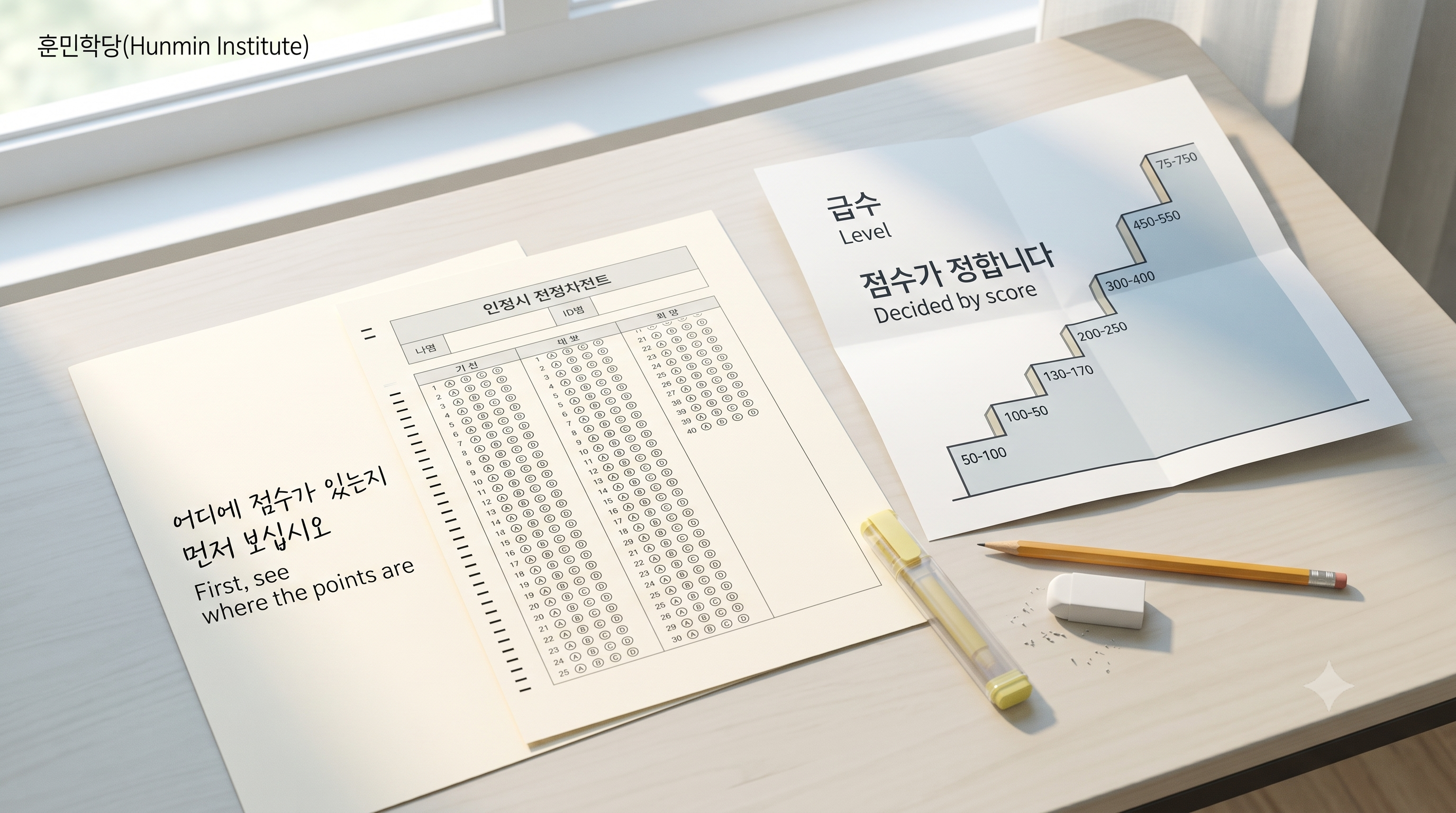
You can check the vocabulary list summarizing today's key words at the bottom of this post.
Key Sentences in This Lesson
이 글을 다 읽고 나면 아래 여섯 문장을 공고문과 시험장에서 그대로 만나게 됩니다.
After reading this post, you will meet these six sentences on notices and at the test center.
| 듣는 문장 Listening |
쓰는 문장 Writing |
|---|---|
| 신분증 꺼내 주세요. Take out your ID, please. |
접수 기간이 언제까지예요? When does registration close? |
| 휴대전화 전원을 꺼 주세요. Please turn off your phone. |
수험표를 다시 출력할 수 있어요? Can I print my admission ticket again? |
| 펜 놓으세요. Put your pen down. |
성적표는 어디에서 발급받아요? Where do I get my score report? |
여섯 문장은 소단락 1과 소단락 10에서 다룹니다.
These six sentences are covered in Sections 1 and 10.
TOPIK Is Not One Test but Three

토픽이라는 이름 아래 서로 다른 시험이 세 개 있습니다. 토픽1은 초급 시험으로 듣기와 읽기 두 영역이며 1급과 2급을 판정합니다. 토픽2는 중고급 시험으로 듣기와 쓰기와 읽기 세 영역이며 3급부터 6급까지를 판정합니다. 말하기 평가는 완전히 별개의 시험이라 따로 신청하고 따로 응시합니다.
Three different tests sit under the name TOPIK. TOPIK I is the beginner test, with listening and reading, determining levels 1 and 2. TOPIK II is the intermediate to advanced test, with listening, writing, and reading, determining levels 3 through 6. The speaking test is entirely separate, registered for and taken on its own.
여기서 첫 번째 판단이 필요합니다. 기준은 목표 급수입니다. 2급까지가 필요하면 토픽1, 3급 이상이 필요하면 토픽2를 봅니다. 토픽1을 아무리 잘 봐도 3급은 나오지 않습니다. 본격적으로 배점을 보기 전에 용어부터 정리하십시오. 공고문과 성적표가 전부 이 말들로 쓰여 있습니다.
This is where your first decision comes, and the criterion is your target level. Level 2 or below means TOPIK I; level 3 or above means TOPIK II. No matter how well you do on TOPIK I, level 3 will not come out of it. Before looking at the scoring, settle the vocabulary. Every notice and score report is written in these words.
| 한국어 Korean |
발음 Pronunciation |
공고문에서 무슨 뜻인가 What it means in a notice |
|---|---|---|
| 급수 Level |
geupsu | 1급에서 6급까지의 등급 The band from level 1 to level 6 |
| 총점 Total score |
chongjeom | 세 영역을 합한 점수 Your three sections added together |
| 커트라인 Cutoff |
keoteurain | 그 급수를 받는 최소 점수 The minimum score for that level |
| 영역 Section |
yeongyeok | 듣기, 쓰기, 읽기 각 부분 Listening, writing, and reading |
| 문항 Question item |
munhang | 시험 문제 한 개 A single question on the paper |
| 접수 Registration |
jeopsu | 시험 신청을 받는 절차 The process of signing up |
| 응시료 Exam fee |
eungsiryo | 시험을 보기 위해 내는 돈 What you pay to sit the test |
▶ 접수와 응시는 짝을 이루는 말입니다.
▶ 접수 and 응시 are a pair.
접수는 신청서를 내는 쪽이고 응시는 시험을 보는 쪽입니다. 접수 기간과 응시 자격은 다른 항목이므로 공고문에서 두 단어를 구분해 읽으셔야 합니다.
접수 is submitting your application, 응시 is sitting the exam. Registration periods and eligibility are different items, so read the two words separately in a notice.
공고문에서 무엇을 물어야 할지도 여기서 정해집니다. 날짜가 궁금하면 접수 기간이 언제까지예요라고 묻고, 자격이 궁금하면 응시 자격이 어떻게 돼요라고 묻습니다. 틀 : [명사] 기간이 언제까지예요.
This also decides what to ask. For dates, ask 접수 기간이 언제까지예요; for eligibility, ask 응시 자격이 어떻게 돼요. Pattern: [noun] 기간이 언제까지예요.
Decide the Level You Need First, Then Look at the Score
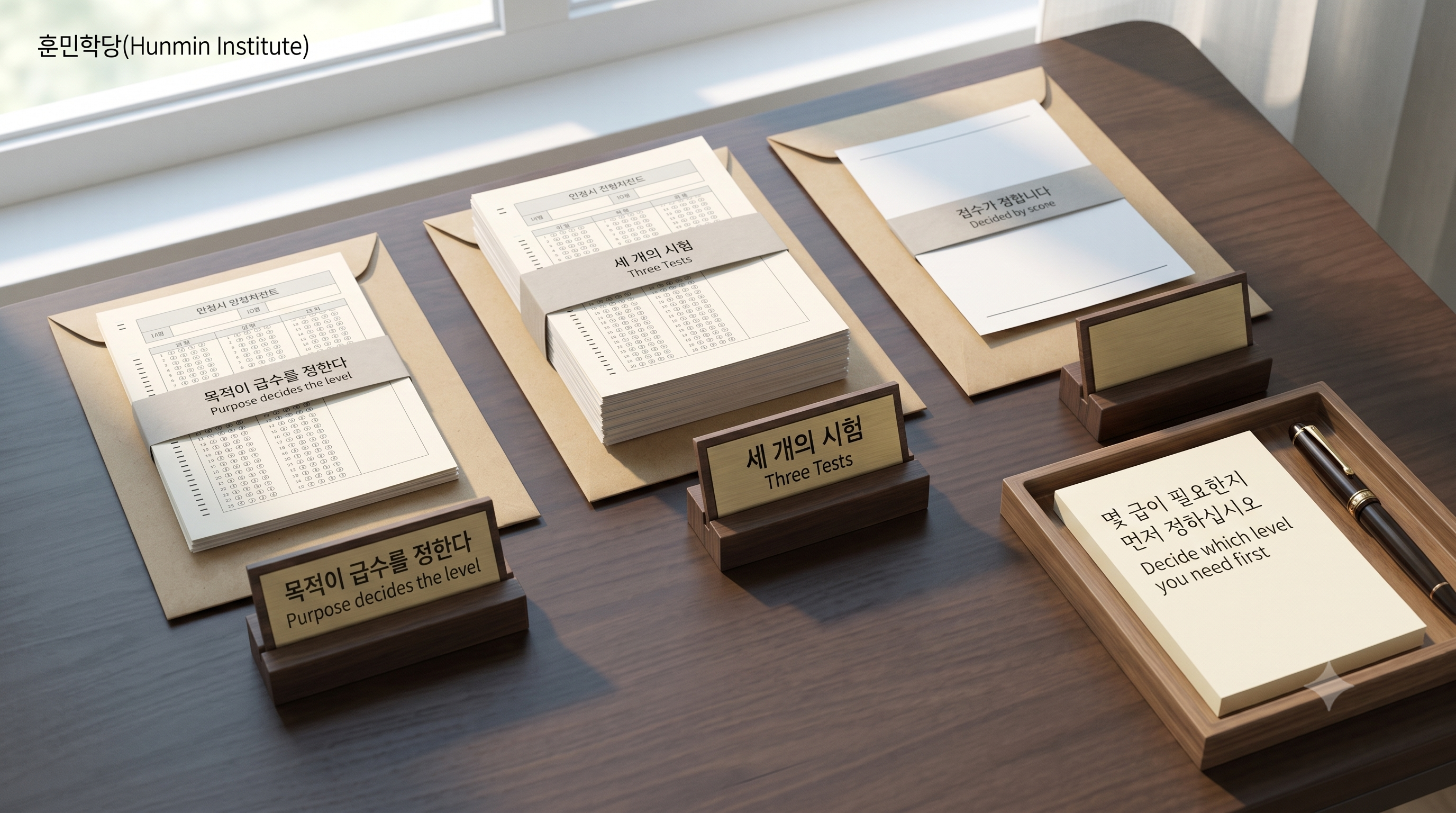
먼저 정할 것은 목표 급수입니다. 몇 급이 필요한지 모르는 상태로 공부를 시작하면 방향이 잡히지 않습니다. 요구 급수는 대학과 기업, 기관마다 다르므로 아래는 일반적인 기준입니다.
The first thing to settle is your target level. Starting without knowing which level you need leaves you without direction. Required levels differ by university, company, and institution, so the table below is a general guide.
| 목적 Purpose |
일반적 요구 급수 Level usually required |
해당 시험 Which test |
|---|---|---|
| 한국어 기초 확인 Confirming basic Korean |
1급에서 2급 Level 1 to 2 |
토픽1 TOPIK I |
| 어학연수 과정 배정 Language course placement |
2급에서 3급 Level 2 to 3 |
토픽1 또는 토픽2 TOPIK I or II |
| 학부 입학 Undergraduate admission |
3급에서 4급 Level 3 to 4 |
토픽2 TOPIK II |
| 학부 졸업 Undergraduate graduation |
4급 Level 4 |
토픽2 TOPIK II |
| 대학원 입학 Graduate admission |
4급에서 5급 Level 4 to 5 |
토픽2 TOPIK II |
| 국내 취업과 전문직 Employment and professional work |
5급에서 6급 Level 5 to 6 |
토픽2 TOPIK II |
목표가 정해졌다면 이제 점수를 봅니다. 여기서 많은 학습자가 오해하는 지점이 있습니다. 토픽은 급수를 지정해서 신청하지 않습니다. 시험을 치고 총점이 어느 구간에 들어가는지에 따라 급수가 자동으로 정해집니다.
Once your target is set, look at the scores. Many learners misunderstand this point: you do not register for a specific level. You sit the test, and your level is set automatically by which band your total falls into.
| 시험 Test |
급수 Level |
필요 점수 Score needed |
만점 Total |
|---|---|---|---|
| 토픽1 TOPIK I |
1급 Level 1 |
80점 이상 80 or above |
200점 200 |
| 토픽1 TOPIK I |
2급 Level 2 |
140점 이상 140 or above |
200점 200 |
| 토픽2 TOPIK II |
3급 Level 3 |
120점 이상 120 or above |
300점 300 |
| 토픽2 TOPIK II |
4급 Level 4 |
150점 이상 150 or above |
300점 300 |
| 토픽2 TOPIK II |
5급 Level 5 |
190점 이상 190 or above |
300점 300 |
| 토픽2 TOPIK II |
6급 Level 6 |
230점 이상 230 or above |
300점 300 |
▶ 4급까지는 완만하지만 5급부터 벽이 생깁니다.
▶ The climb is gentle up to level 4, and a wall appears at level 5.
3급에서 4급은 30점, 4급에서 5급은 40점, 5급에서 6급은 다시 40점입니다. 이 벽을 넘는 곳이 쓰기 영역입니다.
Level 3 to 4 is thirty points, 4 to 5 is forty, and 5 to 6 is forty again. The writing section is where that wall is crossed.
앞서 확인한 목표 급수를 여기 대입해 보십시오. 학부 입학이 목표라면 150점, 취업이 목표라면 190점 이상이 기준선입니다. 이 숫자가 앞으로의 공부 순서를 정합니다.
Place your target level against these numbers. For undergraduate admission the line is 150 points; for employment it is 190 or above. That number decides the order of everything you study from here.
Look at Where the Points Are Concentrated
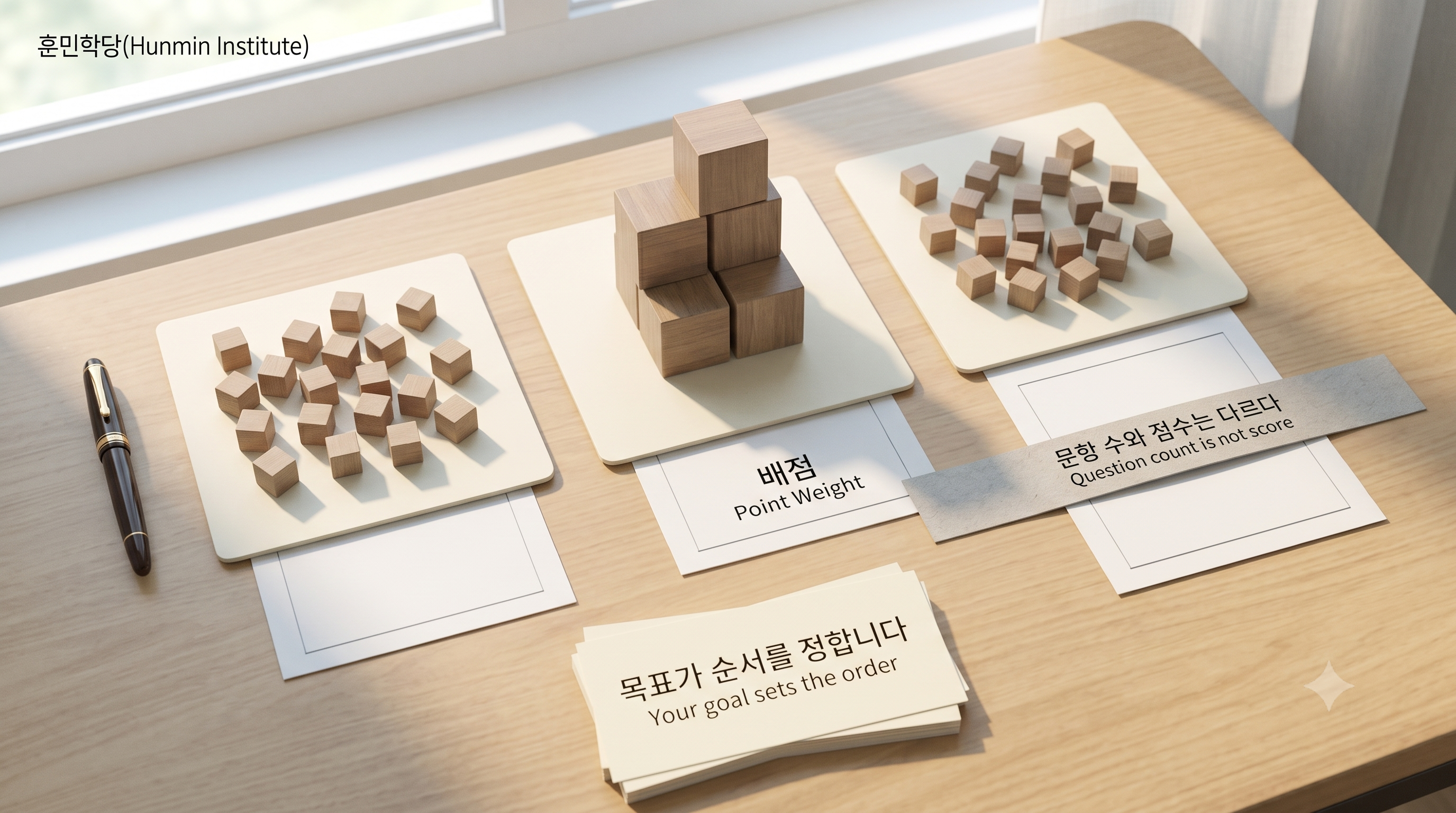
토픽2는 300점 만점이고 듣기 100점, 쓰기 100점, 읽기 100점으로 정확히 삼등분되어 있습니다. 그런데 문항 수는 다릅니다. 듣기 50문항, 읽기 50문항인데 쓰기는 단 4문항입니다. 문항 하나당 배점이 압도적으로 큽니다.
TOPIK II is scored out of 300, split evenly at 100 points each for listening, writing, and reading. The number of questions is not equal, though: listening has 50 and reading has 50, while writing has only four. The value of a single writing question is overwhelmingly high.
| 영역 Section |
배점 Points |
문항 수 Questions |
문항당 배점 Points per question |
|---|---|---|---|
| 듣기 Listening |
100점 100 |
50문항 50 |
2점 2 |
| 읽기 Reading |
100점 100 |
50문항 50 |
2점 2 |
| 쓰기 Writing |
100점 100 |
4문항 4 |
25점 25 |
▶ 쓰기를 버리면 5급은 되지만 6급은 되지 않습니다.
▶ Skip writing and you can reach level 5, but never level 6.
쓰기를 완전히 포기하고 듣기와 읽기에서 만점을 받으면 200점입니다. 5급 커트라인인 190점은 넘지만 6급 230점에는 닿지 못합니다.
Abandon writing entirely and score full marks in listening and reading, and you have 200. That clears the level 5 line of 190 but falls short of level 6 at 230.
현실적으로 듣기와 읽기 만점은 어렵습니다. 두 영역에서 80퍼센트를 받으면 160점이고, 4급 150점은 넘지만 5급에는 30점이 모자랍니다. 결론은 이렇습니다. 4급이 목표라면 듣기와 읽기에 집중해도 되고, 5급 이상이 목표라면 쓰기를 반드시 잡아야 합니다.
Realistically, full marks are out of reach. Eighty percent across those two gives you 160, which passes level 4 at 150 but leaves you thirty points short of level 5. The conclusion: if level 4 is your goal, concentrating on listening and reading is enough; if you are aiming for level 5 or above, writing is not optional.
Your Target Level Sets the Order of Study
앞에서 확인한 목표 급수를 이제 시간표로 바꿀 차례입니다. 같은 시험을 준비하면서도 목표에 따라 전략이 갈립니다.
Now turn that target level into a timetable. Preparing for the same test, learners with different goals need different strategies.
| 목표 Target |
필요 점수 Score |
무엇을 합니까 What to do |
|---|---|---|
| 3급 Level 3 |
120점 120 |
듣기와 읽기에서 각각 절반을 맞히고 쓰기 51번과 52번만 채웁니다. 어려운 문항을 붙잡지 않습니다. Half of listening, half of reading, and questions 51 and 52 in writing. Do not wrestle with the hardest items. |
| 4급 Level 4 |
150점 150 |
듣기와 읽기 정답률을 70퍼센트대로 올립니다. 쓰기는 51번과 52번을 확실히 하고 53번은 부분 점수를 노립니다. Raise listening and reading into the seventy percent range. Secure 51 and 52, aim for partial credit on 53. |
| 5급 Level 5 |
190점 190 |
쓰기가 필수가 됩니다. 53번 도표 서술을 훈련하고 54번은 개요를 잡아 절반 이상 채웁니다. Writing becomes essential. Train on the data description in 53 and outline 54 well enough to fill more than half. |
| 6급 Level 6 |
230점 230 |
세 영역 모두 80퍼센트 이상이 필요합니다. 54번에서 완성도 있는 논술을 써야 합니다. Over eighty percent in all three sections, with a fully realized essay in 54. |
▶ 같은 시험이라도 목표가 다르면 버릴 것이 달라집니다.
▶ Same test, different goals, different things to give up.
3급이 목표인 학습자가 54번 논술에 시간을 쓰는 것은 손해입니다. 반대로 6급이 목표라면 어휘와 문법의 정확성이 마지막 점수를 가릅니다.
A learner aiming for level 3 loses by spending time on the essay in 54. For level 6, precision in vocabulary and grammar decides the final points.
Listening Is a Test You Read First

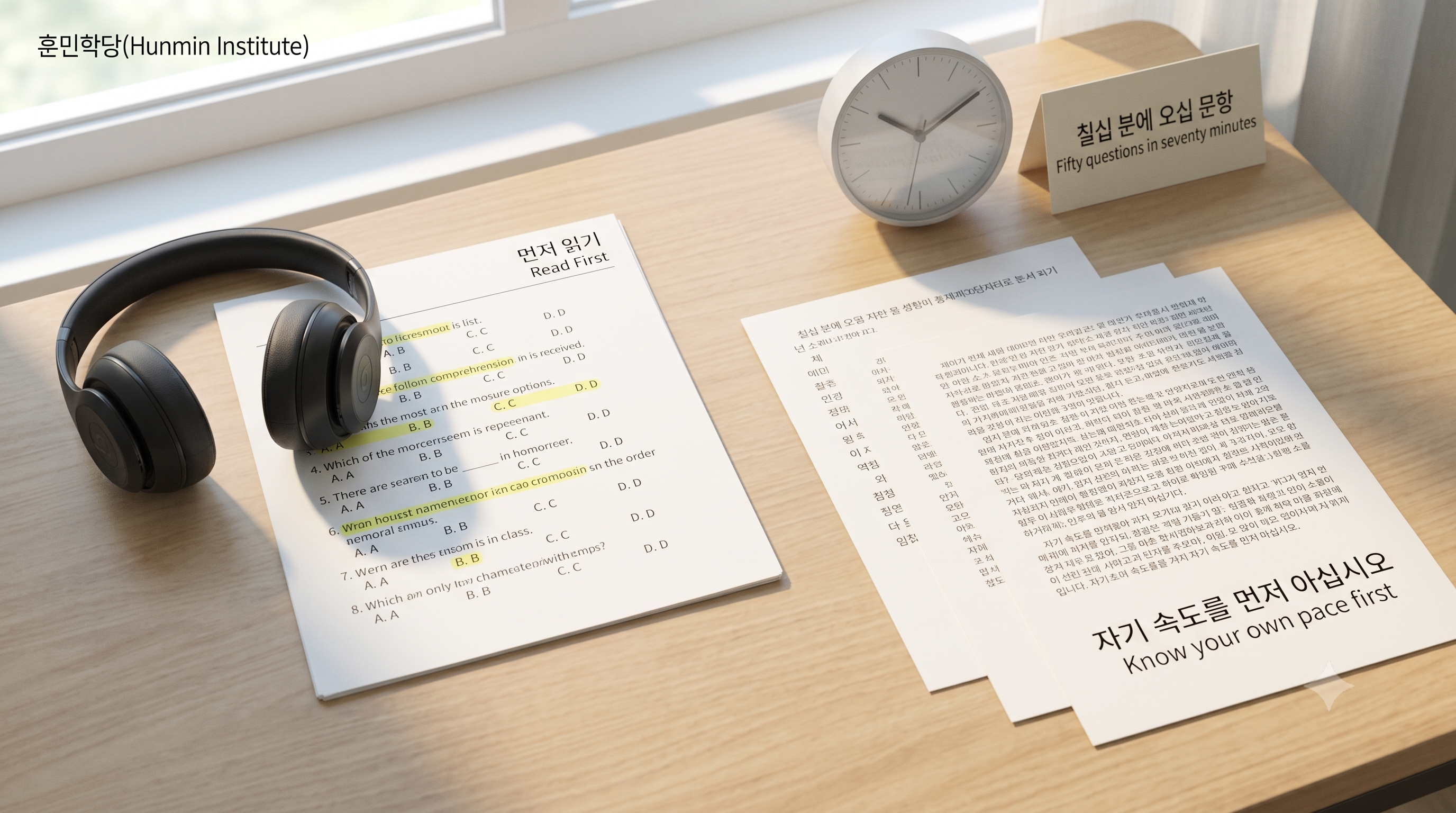
듣기에서 가장 흔한 실수는 소리에만 집중하는 것입니다. 토픽 듣기는 문제지가 함께 주어지고 음성이 나오기 전에 선택지를 읽을 시간이 있습니다. 이 시간을 쓰느냐 버리느냐가 정답률을 바꿉니다.
The most common mistake in listening is focusing only on the sound. You have the question paper in front of you and time to read the choices before the audio begins, and whether you use that time changes your accuracy.
| 순서 Step |
무엇을 합니까 What to do |
|---|---|
| 1 1 |
한 번 듣고 답을 고릅니다. Listen once and answer. |
| 2 2 |
다시 들으면서 놓친 부분을 확인합니다. Listen again to catch what you missed. |
| 3 3 |
대본을 보며 안 들린 이유를 찾습니다. Read the transcript to find why you could not hear it. |
▶ 안 들린 이유는 대개 셋 중 하나입니다.
▶ The reason is usually one of three.
모르는 단어이거나, 발음 변화를 몰랐거나, 속도를 따라가지 못한 것입니다. 이 셋은 해결 방법이 각각 다르므로 원인을 먼저 가려야 합니다.
An unknown word, an unfamiliar sound change, or speed you could not follow. Each has a different remedy, so identify the cause first.
선택지를 먼저 읽으면 무엇을 들어야 하는지 알고 듣게 됩니다. 반대로 아무 준비 없이 들으면 전체를 이해하려다 핵심을 놓칩니다.
Reading the choices first means you listen knowing what to listen for. Listening unprepared, you try to understand everything and miss the point.
In Reading, Timing Is Everything
읽기는 50문항을 70분에 풉니다. 문항당 1분 20초가 조금 넘습니다. 문제는 뒤로 갈수록 지문이 길어진다는 것입니다. 앞에서부터 순서대로 풀면 뒤쪽 긴 지문에서 시간이 모자라는데, 배점은 뒤쪽이 더 높습니다.
Reading gives you seventy minutes for fifty questions, a little over one minute and twenty seconds each. The passages grow longer toward the end, so working straight through leaves you short of time on exactly the questions that carry more points.
▶ 실전 전에 자기 속도를 알아 두어야 합니다.
▶ Know your own pace before test day.
앞부분의 짧은 문항을 빠르게 처리하고 남은 시간을 뒤쪽에 몰아주거나, 뒤에서부터 풀어 긴 지문을 여유 있게 처리한 뒤 앞으로 돌아오는 방식이 있습니다.
You can clear the short early questions quickly and pour the remaining time into the back, or start from the back, handle the long passages with room to breathe, then return to the front.
어느 쪽이든 기출 한 회를 시간을 재며 풀어 보면 자신에게 맞는 순서가 나옵니다.
Either way, time yourself on one past paper and the right order for you will emerge.
Writing Has Four Questions and Four Different Demands

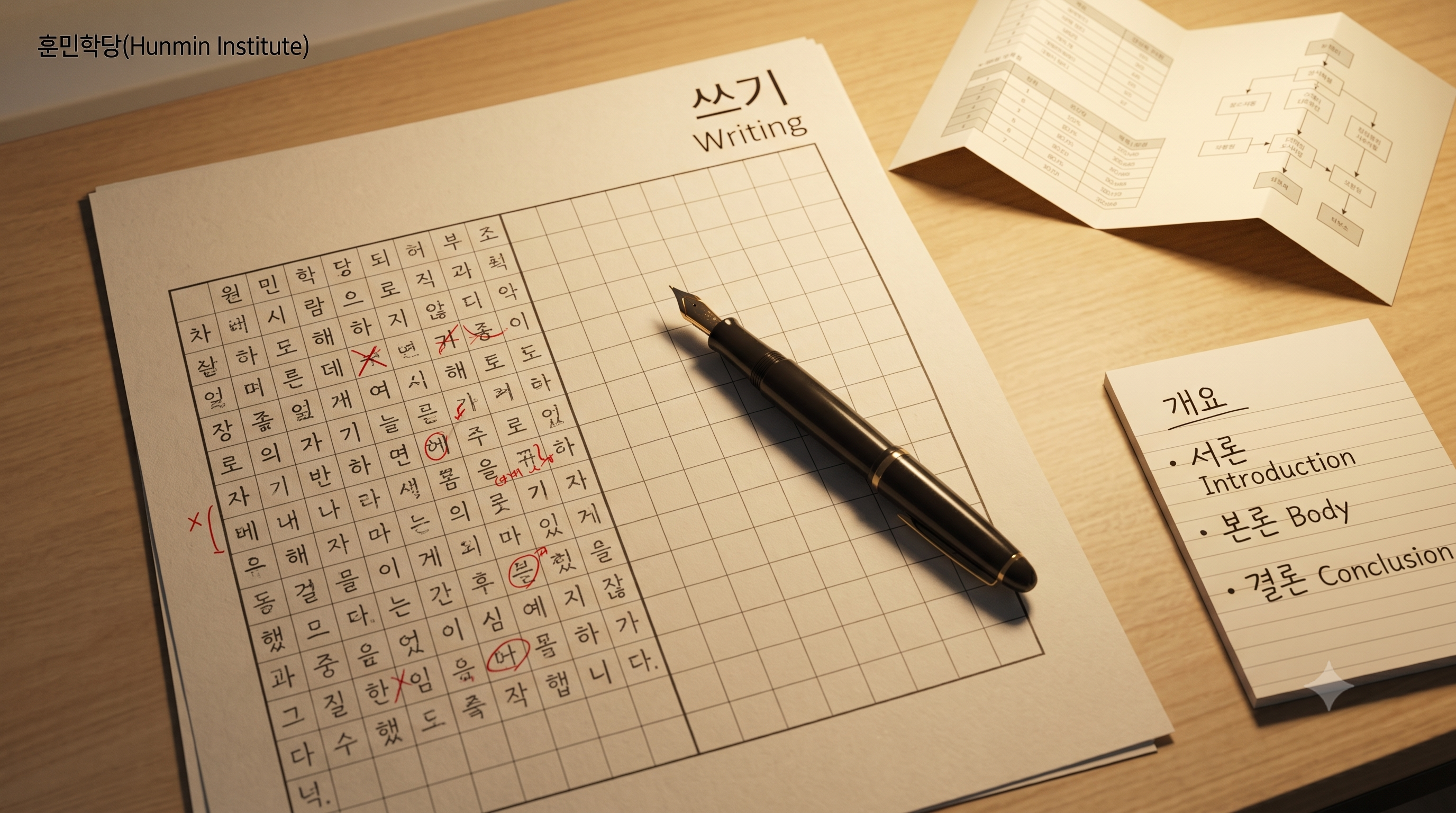
쓰기는 문항이 넷뿐인데 요구하는 능력이 각각 다릅니다. 네 문항을 하나의 영역으로 묶어 공부하면 어느 쪽도 오르지 않습니다.
Writing has only four questions, and each asks for a different ability. Study them as one block and none of them improves.
| 문항 Question |
무엇을 요구합니까 What it asks for |
준비 방법 How to prepare |
|---|---|---|
| 51번과 52번 51 and 52 |
실용문과 설명문의 빈칸에 문맥에 맞는 한 문장을 넣습니다. Supply one sentence fitting the context of a practical or expository text. |
정해진 문형이 반복되므로 유형을 익힙니다. 점수가 가장 빨리 오릅니다. Set patterns repeat, so learn the types. Your score rises fastest here. |
| 53번 53 |
도표나 그래프를 문장으로 옮깁니다. Turn a chart or graph into sentences. |
증가와 감소, 비교를 표현하는 문형을 외워 그대로 씁니다. Memorize the patterns for increase, decrease, and comparison and use them as they are. |
| 54번 54 |
주제를 받고 자기 생각을 논합니다. 분량이 가장 길고 배점도 가장 큽니다. Argue your own view on a given topic. The longest, and worth the most. |
서론과 본론과 결론을 나누고 각 문단의 역할을 정한 뒤 씁니다. Divide introduction, body, and conclusion, assign each paragraph a role, then write. |
▶ 쓰기는 채점자가 사람입니다.
▶ Writing is graded by a human being.
글자를 알아볼 수 있게 쓰는 것, 원고지 사용법을 지키는 것이 생각보다 점수에 영향을 줍니다.
Legible handwriting and correct use of the manuscript grid affect your score more than you would think.
쓰기는 혼자 연습하기 가장 어려운 영역입니다. 틀린 문장을 스스로 알아채기 어렵기 때문입니다. 훈민학당이 이 부분에 콘텐츠를 집중하는 이유도 여기에 있습니다.
Writing is the hardest section to practice alone, because it is difficult to catch your own mistakes. That is exactly why Hunmin Institute concentrates its content here.
How You Divide Your Time Depends on What Is Left
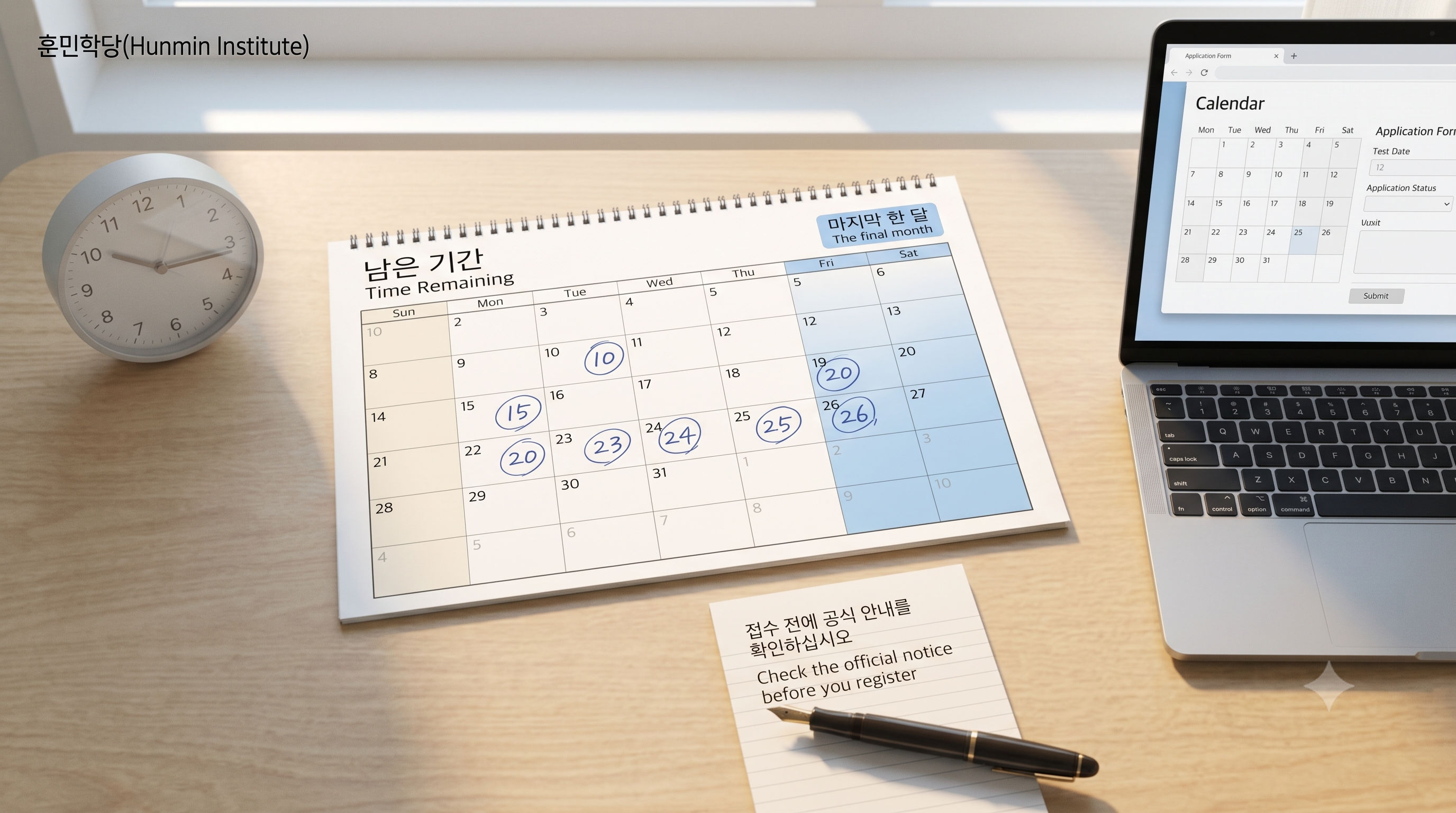
시험까지 남은 시간이 전략을 바꿉니다. 같은 목표라도 3개월과 1년은 공부 순서가 다릅니다.
The time remaining changes the strategy. With the same goal, three months and a year call for different orders.
| 남은 기간 Time left |
어떻게 배분합니까 How to divide it |
|---|---|
| 3개월 3 months |
선택과 집중입니다. 목표 급수의 커트라인을 확인하고 점수가 오르기 쉬운 영역부터 잡습니다. 대개 읽기와 쓰기 51번, 52번입니다. Selection and focus. Check the cutoff and start where points come easiest, usually reading plus writing 51 and 52. |
| 6개월 6 months |
균형입니다. 앞의 3개월은 어휘와 문법으로 기초를 채우고, 뒤의 3개월은 기출 중심으로 실전 감각을 만듭니다. Balance. Spend the first three filling in vocabulary and grammar, the last three building exam instinct through past papers. |
| 1년 1 year |
순서를 지킬 수 있습니다. 한글 읽기와 발음 규칙부터 다시 점검하고, 어휘를 급수별로 쌓은 뒤, 마지막 3개월을 기출에 씁니다. You can follow the proper order: revisit Hangul reading and pronunciation, build vocabulary level by level, and give the final three months to past papers. |
▶ 마지막 한 달은 새로운 것을 배우지 않습니다.
▶ In the final month, you learn nothing new.
이미 아는 것을 시험 형식에 맞춰 꺼내는 훈련만 합니다. 남은 기간이 얼마든 이 원칙은 같습니다.
You only train yourself to produce what you already know in the format the test demands. This holds no matter how much time is left.
The Speaking Test: Should You Take It Now?
말하기 평가는 2023년부터 정식으로 시행되고 있는 별개 시험입니다. 필기 시험과 함께 치는 것이 아니며 따로 신청해야 합니다.
The speaking test has been officially administered as a separate exam since 2023. It is not taken with the written test, and you must register for it separately.
응시 전에 확인할 것이 있습니다. 2026년 현재 이 시험의 결과는 거주 비자 점수 항목에 반영되지 않는 것으로 안내되고 있습니다. 비자를 목적으로 준비하신다면 필기 급수가 우선입니다. 다만 제도는 바뀔 수 있으므로 접수 전에 공식 안내를 확인하십시오.
One thing to check: as of 2026, its results are not counted in the residence visa points system. If a visa is your purpose, the written level comes first. The system can change, so confirm the official notice before registering.
▶ 목적이 분명하지 않다면 필기부터 마치십시오.
▶ If your purpose is not clear, finish the written test first.
봐야 하는 경우는 셋입니다. 취업 과정에서 회화 능력을 증명해야 하는 경우, 대학원 진학에서 요구받는 경우, 자신의 말하기 수준을 객관적으로 확인하고 싶은 경우입니다.
Three cases call for it: proving conversational ability in a hiring process, being asked for it in graduate admissions, and wanting an objective measure of your speaking.
Test Dates and Registration: What to Check
2026년에는 지필 시험 6회, 인터넷 기반 시험 6회, 말하기 평가 3회로 총 15회가 시행됩니다. 접수는 공식 홈페이지에서 진행됩니다.
In 2026 there are six paper-based sittings, six internet-based sittings, and three speaking tests, fifteen in total. Registration is handled on the official website.
접수 방식에 주의하십시오. 국내 시험은 지역별로 접수일을 나누고 마감 시각을 정해 두는 경우가 있으며, 인기 시험장은 접수 시작과 거의 동시에 마감됩니다. 회차마다 방식이 다르므로 공고문에서 자기 지역의 접수일과 마감 시각을 먼저 확인하셔야 합니다.
Pay attention to how registration works. Domestic sittings sometimes split registration days by region with a fixed closing time, and popular centers fill almost as soon as they open. The method differs by sitting, so check your region's date and closing time in the notice first.
| 시험 Test |
지필 응시료 Paper-based fee |
인터넷 기반 응시료 Internet-based fee |
|---|---|---|
| 토픽1 TOPIK I |
4만 원 40,000 won |
7만 원 70,000 won |
| 토픽2 TOPIK II |
5만 5천 원 55,000 won |
9만 5천 원 95,000 won |
| 말하기 평가 Speaking test |
8만 원 80,000 won |
해당 없음 Not applicable |
▶ 해외 응시료는 현지 시행 기관이 따로 정합니다.
▶ Overseas fees are set by the local administering body.
위 금액은 국내 기준이며 일정과 요금, 시행 방식은 해마다 조정됩니다. 접수 전에 공식 홈페이지에서 최신 정보를 확인하시기 바랍니다.
The amounts above are for Korea, and dates, fees, and formats are adjusted each year. Always confirm the latest information on the official website before registering.
마지막으로 시험장에서 실제로 오가는 말입니다. 신분증 확인부터 답안지 회수까지 듣게 되는 말은 정해져 있습니다.
Finally, the lines actually spoken at the test center. From the ID check to the collection of answer sheets, what you hear is fixed.
| 한국어 Korean |
발음 Pronunciation |
실제 의미 What it actually means |
|---|---|---|
| 신분증 꺼내 주세요 Take out your ID, please |
sinbunjeung kkeonae juseyo | 여권이나 외국인등록증을 책상 위에 둡니다 Put your passport or ID card on the desk |
| 수험표 확인하겠습니다 I will check your admission ticket |
suheompyo hwaginhagetseumnida | 출력하거나 저장해 온 수험표를 보여 줍니다 Show the ticket you printed or saved |
| 휴대전화 전원을 꺼 주세요 Please turn off your phone |
hyudaejeonhwa jeonwoneul kkeo juseyo | 무음이 아니라 전원을 끕니다 Power off, not silent mode |
| 시작하겠습니다 We will begin |
sijakhagetseumnida | 이 말과 함께 시간이 흐릅니다 The clock starts with this line |
| 펜 놓으세요 Put your pen down |
pen noeuseyo | 이후 답안 작성은 부정행위가 됩니다 Writing after this counts as cheating |
▶ 꺼내 주세요와 꺼 주세요는 소리가 비슷하지만 다른 말입니다.
▶ 꺼내 주세요 and 꺼 주세요 sound alike but differ.
꺼내다는 밖으로 내놓는다는 뜻이고 끄다는 전원을 내린다는 뜻입니다. 신분증은 꺼내고 휴대전화는 끕니다.
꺼내다 means to take something out; 끄다 means to switch something off. You take out your ID and switch off your phone.
시험장에서 되묻는 것은 실례가 아닙니다. 수험표를 다시 출력할 수 있어요, 성적표는 어디에서 발급받아요처럼 필요한 말은 미리 입에 붙여 두십시오. 틀 : [명사]은는 어디에서 [동사]아요.
Asking again at the test center is not rude. Have the lines you need ready: 수험표를 다시 출력할 수 있어요, 성적표는 어디에서 발급받아요. Pattern: [noun]은는 어디에서 [verb]아요.
토픽은 어려운 시험입니다. 그러나 구조가 분명한 시험이기도 합니다. 어디에 점수가 있고 무엇을 먼저 해야 하는지 알면 남은 것은 시간을 쓰는 일뿐입니다. 아래 단어장에서 오늘의 어휘를 정리하고 가시기 바랍니다.
TOPIK is a difficult test, but it is also one with a clear structure. Once you know where the points are and what to do first, all that remains is putting in the time. Work through the vocabulary list below before you go.
Next: Korean Particle Errors, What Learner Data Reveals
Q1. 토픽1과 토픽2 중 무엇을 봐야 하나요?
Q1. Should I take TOPIK I or TOPIK II?
A1. 목표 급수로 정합니다. 2급까지가 필요하면 토픽1, 3급 이상이 필요하면 토픽2입니다. 토픽1에서는 3급 이상이 나오지 않습니다.
A1. Your target level decides. Level 2 or below means TOPIK I; level 3 or above means TOPIK II. TOPIK I cannot produce a result above level 2.
Q2. 4급을 받으려면 몇 점이 필요한가요?
Q2. How many points do I need for level 4?
A2. 토픽2 300점 만점에 150점입니다. 듣기와 읽기에서 70퍼센트 정도를 확보하고 쓰기에서 51번과 52번을 채우면 현실적으로 도달할 수 있습니다.
A2. 150 out of 300 on TOPIK II. Securing about seventy percent in listening and reading, plus questions 51 and 52 in writing, gets you there realistically.
Q3. 쓰기를 포기하고 급수를 받을 수 있나요?
Q3. Can I get a level while skipping the writing section?
A3. 4급까지는 가능합니다. 다만 5급 이상은 어렵습니다. 듣기와 읽기에서 만점을 받아도 200점이라 6급 230점에는 닿지 않습니다.
A3. Up to level 4, yes. Level 5 and above is another matter. Full marks in listening and reading total 200, which never reaches the 230 needed for level 6.
Q4. 말하기 평가를 꼭 봐야 하나요?
Q4. Do I have to take the speaking test?
A4. 목적에 따라 다릅니다. 2026년 현재 거주 비자 점수에는 반영되지 않는 것으로 안내되고 있으므로, 비자가 목적이라면 필기 급수를 먼저 확보하시는 편이 낫습니다.
A4. It depends on your purpose. As of 2026 it is not counted in residence visa points, so if a visa is your aim, secure your written level first.
Q5. 시험장에 무엇을 가져가야 하나요?
Q5. What do I need to bring to the test center?
A5. 사진이 있는 신분증과 수험표는 필수입니다. 지필 시험은 컴퓨터용 사인펜이 필요하고 인터넷 기반 시험은 시험장 컴퓨터를 쓰므로 별도 준비물이 없습니다. 회차마다 안내가 다를 수 있으니 수험표에 적힌 유의사항을 확인하십시오.
A5. A photo ID and your admission ticket are required. The paper-based test needs a computer-marking pen; the internet-based test uses the center's computer and needs nothing extra. Check the notes on your ticket, since guidance differs by sitting.
1. 한국어능력시험(hangugeoneungnyeoksiheom) : (n) Test of Proficiency in Korean[prəˈfɪʃənsi]
2. 시험(siheom) : (n) test[test]
3. 급수(geupsu) : (n) level, grade[ˈlevəl]
4. 등급(deunggeup) : (n) grade band[ɡreɪd]
5. 점수(jeomsu) : (n) score[skɔːr]
▸ Open the study materials for this post이 글의 학습 자료 열기
한국어능력시험 공식 홈페이지
Test of Proficiency in Korean, Official Website
https://www.topik.go.kr
국립국제교육원
National Institute for International Education
https://www.niied.go.kr
※본 콘텐츠(원고, 이미지, 예문 포함)는 저작권법에 의해 보호받는 훈민학당의 저작물입니다. 무단 복제, 전재, 재배포를 금합니다.
This content (manuscript, images, and example sentences) is the copyrighted property of Hunmin Institute, protected under copyright law. Unauthorized copying, reproduction, or redistribution is prohibited.
TOPIK Is a Scoring System, Not Just a Test (토픽은 실력 시험이 아니라 배점 구조 시험입니다)
TOPIK does not measure ability; it asks whether you reached a fixed score band.
This post teaches the scoring structure and the Korean used on notices and at the test center.
토픽은 실력을 재는 시험이 아니라 정해진 점수 구간에 도달했는지 묻는 시험입니다.
이 글에서 배점 구조와 공고문과 시험장에서 쓰는 한국어를 익힙니다.

You can check the vocabulary list summarizing today's key words at the bottom of this post.
Key Sentences in This Lesson
이 글을 다 읽고 나면 아래 여섯 문장을 공고문과 시험장에서 그대로 만나게 됩니다.
After reading this post, you will meet these six sentences on notices and at the test center.
| 듣는 문장 Listening |
쓰는 문장 Writing |
|---|---|
| 신분증 꺼내 주세요. Take out your ID, please. |
접수 기간이 언제까지예요? When does registration close? |
| 휴대전화 전원을 꺼 주세요. Please turn off your phone. |
수험표를 다시 출력할 수 있어요? Can I print my admission ticket again? |
| 펜 놓으세요. Put your pen down. |
성적표는 어디에서 발급받아요? Where do I get my score report? |
여섯 문장은 소단락 1과 소단락 10에서 다룹니다.
These six sentences are covered in Sections 1 and 10.
TOPIK Is Not One Test but Three

토픽이라는 이름 아래 서로 다른 시험이 세 개 있습니다. 토픽1은 초급 시험으로 듣기와 읽기 두 영역이며 1급과 2급을 판정합니다. 토픽2는 중고급 시험으로 듣기와 쓰기와 읽기 세 영역이며 3급부터 6급까지를 판정합니다. 말하기 평가는 완전히 별개의 시험이라 따로 신청하고 따로 응시합니다.
Three different tests sit under the name TOPIK. TOPIK I is the beginner test, with listening and reading, determining levels 1 and 2. TOPIK II is the intermediate to advanced test, with listening, writing, and reading, determining levels 3 through 6. The speaking test is entirely separate, registered for and taken on its own.
여기서 첫 번째 판단이 필요합니다. 기준은 목표 급수입니다. 2급까지가 필요하면 토픽1, 3급 이상이 필요하면 토픽2를 봅니다. 토픽1을 아무리 잘 봐도 3급은 나오지 않습니다. 본격적으로 배점을 보기 전에 용어부터 정리하십시오. 공고문과 성적표가 전부 이 말들로 쓰여 있습니다.
This is where your first decision comes, and the criterion is your target level. Level 2 or below means TOPIK I; level 3 or above means TOPIK II. No matter how well you do on TOPIK I, level 3 will not come out of it. Before looking at the scoring, settle the vocabulary. Every notice and score report is written in these words.
| 한국어 Korean |
발음 Pronunciation |
공고문에서 무슨 뜻인가 What it means in a notice |
|---|---|---|
| 급수 Level |
geupsu | 1급에서 6급까지의 등급 The band from level 1 to level 6 |
| 총점 Total score |
chongjeom | 세 영역을 합한 점수 Your three sections added together |
| 커트라인 Cutoff |
keoteurain | 그 급수를 받는 최소 점수 The minimum score for that level |
| 영역 Section |
yeongyeok | 듣기, 쓰기, 읽기 각 부분 Listening, writing, and reading |
| 문항 Question item |
munhang | 시험 문제 한 개 A single question on the paper |
| 접수 Registration |
jeopsu | 시험 신청을 받는 절차 The process of signing up |
| 응시료 Exam fee |
eungsiryo | 시험을 보기 위해 내는 돈 What you pay to sit the test |
▶ 접수와 응시는 짝을 이루는 말입니다.
▶ 접수 and 응시 are a pair.
접수는 신청서를 내는 쪽이고 응시는 시험을 보는 쪽입니다. 접수 기간과 응시 자격은 다른 항목이므로 공고문에서 두 단어를 구분해 읽으셔야 합니다.
접수 is submitting your application, 응시 is sitting the exam. Registration periods and eligibility are different items, so read the two words separately in a notice.
공고문에서 무엇을 물어야 할지도 여기서 정해집니다. 날짜가 궁금하면 접수 기간이 언제까지예요라고 묻고, 자격이 궁금하면 응시 자격이 어떻게 돼요라고 묻습니다. 틀 : [명사] 기간이 언제까지예요.
This also decides what to ask. For dates, ask 접수 기간이 언제까지예요; for eligibility, ask 응시 자격이 어떻게 돼요. Pattern: [noun] 기간이 언제까지예요.
Decide the Level You Need First, Then Look at the Score
먼저 정할 것은 목표 급수입니다. 몇 급이 필요한지 모르는 상태로 공부를 시작하면 방향이 잡히지 않습니다. 요구 급수는 대학과 기업, 기관마다 다르므로 아래는 일반적인 기준입니다.
The first thing to settle is your target level. Starting without knowing which level you need leaves you without direction. Required levels differ by university, company, and institution, so the table below is a general guide.
| 목적 Purpose |
일반적 요구 급수 Level usually required |
해당 시험 Which test |
|---|---|---|
| 한국어 기초 확인 Confirming basic Korean |
1급에서 2급 Level 1 to 2 |
토픽1 TOPIK I |
| 어학연수 과정 배정 Language course placement |
2급에서 3급 Level 2 to 3 |
토픽1 또는 토픽2 TOPIK I or II |
| 학부 입학 Undergraduate admission |
3급에서 4급 Level 3 to 4 |
토픽2 TOPIK II |
| 학부 졸업 Undergraduate graduation |
4급 Level 4 |
토픽2 TOPIK II |
| 대학원 입학 Graduate admission |
4급에서 5급 Level 4 to 5 |
토픽2 TOPIK II |
| 국내 취업과 전문직 Employment and professional work |
5급에서 6급 Level 5 to 6 |
토픽2 TOPIK II |
목표가 정해졌다면 이제 점수를 봅니다. 여기서 많은 학습자가 오해하는 지점이 있습니다. 토픽은 급수를 지정해서 신청하지 않습니다. 시험을 치고 총점이 어느 구간에 들어가는지에 따라 급수가 자동으로 정해집니다.
Once your target is set, look at the scores. Many learners misunderstand this point: you do not register for a specific level. You sit the test, and your level is set automatically by which band your total falls into.
| 시험 Test |
급수 Level |
필요 점수 Score needed |
만점 Total |
|---|---|---|---|
| 토픽1 TOPIK I |
1급 Level 1 |
80점 이상 80 or above |
200점 200 |
| 토픽1 TOPIK I |
2급 Level 2 |
140점 이상 140 or above |
200점 200 |
| 토픽2 TOPIK II |
3급 Level 3 |
120점 이상 120 or above |
300점 300 |
| 토픽2 TOPIK II |
4급 Level 4 |
150점 이상 150 or above |
300점 300 |
| 토픽2 TOPIK II |
5급 Level 5 |
190점 이상 190 or above |
300점 300 |
| 토픽2 TOPIK II |
6급 Level 6 |
230점 이상 230 or above |
300점 300 |
▶ 4급까지는 완만하지만 5급부터 벽이 생깁니다.
▶ The climb is gentle up to level 4, and a wall appears at level 5.
3급에서 4급은 30점, 4급에서 5급은 40점, 5급에서 6급은 다시 40점입니다. 이 벽을 넘는 곳이 쓰기 영역입니다.
Level 3 to 4 is thirty points, 4 to 5 is forty, and 5 to 6 is forty again. The writing section is where that wall is crossed.
앞서 확인한 목표 급수를 여기 대입해 보십시오. 학부 입학이 목표라면 150점, 취업이 목표라면 190점 이상이 기준선입니다. 이 숫자가 앞으로의 공부 순서를 정합니다.
Place your target level against these numbers. For undergraduate admission the line is 150 points; for employment it is 190 or above. That number decides the order of everything you study from here.
Look at Where the Points Are Concentrated

토픽2는 300점 만점이고 듣기 100점, 쓰기 100점, 읽기 100점으로 정확히 삼등분되어 있습니다. 그런데 문항 수는 다릅니다. 듣기 50문항, 읽기 50문항인데 쓰기는 단 4문항입니다. 문항 하나당 배점이 압도적으로 큽니다.
TOPIK II is scored out of 300, split evenly at 100 points each for listening, writing, and reading. The number of questions is not equal, though: listening has 50 and reading has 50, while writing has only four. The value of a single writing question is overwhelmingly high.
| 영역 Section |
배점 Points |
문항 수 Questions |
문항당 배점 Points per question |
|---|---|---|---|
| 듣기 Listening |
100점 100 |
50문항 50 |
2점 2 |
| 읽기 Reading |
100점 100 |
50문항 50 |
2점 2 |
| 쓰기 Writing |
100점 100 |
4문항 4 |
25점 25 |
▶ 쓰기를 버리면 5급은 되지만 6급은 되지 않습니다.
▶ Skip writing and you can reach level 5, but never level 6.
쓰기를 완전히 포기하고 듣기와 읽기에서 만점을 받으면 200점입니다. 5급 커트라인인 190점은 넘지만 6급 230점에는 닿지 못합니다.
Abandon writing entirely and score full marks in listening and reading, and you have 200. That clears the level 5 line of 190 but falls short of level 6 at 230.
현실적으로 듣기와 읽기 만점은 어렵습니다. 두 영역에서 80퍼센트를 받으면 160점이고, 4급 150점은 넘지만 5급에는 30점이 모자랍니다. 결론은 이렇습니다. 4급이 목표라면 듣기와 읽기에 집중해도 되고, 5급 이상이 목표라면 쓰기를 반드시 잡아야 합니다.
Realistically, full marks are out of reach. Eighty percent across those two gives you 160, which passes level 4 at 150 but leaves you thirty points short of level 5. The conclusion: if level 4 is your goal, concentrating on listening and reading is enough; if you are aiming for level 5 or above, writing is not optional.
Your Target Level Sets the Order of Study
앞에서 확인한 목표 급수를 이제 시간표로 바꿀 차례입니다. 같은 시험을 준비하면서도 목표에 따라 전략이 갈립니다.
Now turn that target level into a timetable. Preparing for the same test, learners with different goals need different strategies.
| 목표 Target |
필요 점수 Score |
무엇을 합니까 What to do |
|---|---|---|
| 3급 Level 3 |
120점 120 |
듣기와 읽기에서 각각 절반을 맞히고 쓰기 51번과 52번만 채웁니다. 어려운 문항을 붙잡지 않습니다. Half of listening, half of reading, and questions 51 and 52 in writing. Do not wrestle with the hardest items. |
| 4급 Level 4 |
150점 150 |
듣기와 읽기 정답률을 70퍼센트대로 올립니다. 쓰기는 51번과 52번을 확실히 하고 53번은 부분 점수를 노립니다. Raise listening and reading into the seventy percent range. Secure 51 and 52, aim for partial credit on 53. |
| 5급 Level 5 |
190점 190 |
쓰기가 필수가 됩니다. 53번 도표 서술을 훈련하고 54번은 개요를 잡아 절반 이상 채웁니다. Writing becomes essential. Train on the data description in 53 and outline 54 well enough to fill more than half. |
| 6급 Level 6 |
230점 230 |
세 영역 모두 80퍼센트 이상이 필요합니다. 54번에서 완성도 있는 논술을 써야 합니다. Over eighty percent in all three sections, with a fully realized essay in 54. |
▶ 같은 시험이라도 목표가 다르면 버릴 것이 달라집니다.
▶ Same test, different goals, different things to give up.
3급이 목표인 학습자가 54번 논술에 시간을 쓰는 것은 손해입니다. 반대로 6급이 목표라면 어휘와 문법의 정확성이 마지막 점수를 가릅니다.
A learner aiming for level 3 loses by spending time on the essay in 54. For level 6, precision in vocabulary and grammar decides the final points.
Listening Is a Test You Read First

듣기에서 가장 흔한 실수는 소리에만 집중하는 것입니다. 토픽 듣기는 문제지가 함께 주어지고 음성이 나오기 전에 선택지를 읽을 시간이 있습니다. 이 시간을 쓰느냐 버리느냐가 정답률을 바꿉니다.
The most common mistake in listening is focusing only on the sound. You have the question paper in front of you and time to read the choices before the audio begins, and whether you use that time changes your accuracy.
| 순서 Step |
무엇을 합니까 What to do |
|---|---|
| 1 1 |
한 번 듣고 답을 고릅니다. Listen once and answer. |
| 2 2 |
다시 들으면서 놓친 부분을 확인합니다. Listen again to catch what you missed. |
| 3 3 |
대본을 보며 안 들린 이유를 찾습니다. Read the transcript to find why you could not hear it. |
▶ 안 들린 이유는 대개 셋 중 하나입니다.
▶ The reason is usually one of three.
모르는 단어이거나, 발음 변화를 몰랐거나, 속도를 따라가지 못한 것입니다. 이 셋은 해결 방법이 각각 다르므로 원인을 먼저 가려야 합니다.
An unknown word, an unfamiliar sound change, or speed you could not follow. Each has a different remedy, so identify the cause first.
선택지를 먼저 읽으면 무엇을 들어야 하는지 알고 듣게 됩니다. 반대로 아무 준비 없이 들으면 전체를 이해하려다 핵심을 놓칩니다.
Reading the choices first means you listen knowing what to listen for. Listening unprepared, you try to understand everything and miss the point.
In Reading, Timing Is Everything
읽기는 50문항을 70분에 풉니다. 문항당 1분 20초가 조금 넘습니다. 문제는 뒤로 갈수록 지문이 길어진다는 것입니다. 앞에서부터 순서대로 풀면 뒤쪽 긴 지문에서 시간이 모자라는데, 배점은 뒤쪽이 더 높습니다.
Reading gives you seventy minutes for fifty questions, a little over one minute and twenty seconds each. The passages grow longer toward the end, so working straight through leaves you short of time on exactly the questions that carry more points.
▶ 실전 전에 자기 속도를 알아 두어야 합니다.
▶ Know your own pace before test day.
앞부분의 짧은 문항을 빠르게 처리하고 남은 시간을 뒤쪽에 몰아주거나, 뒤에서부터 풀어 긴 지문을 여유 있게 처리한 뒤 앞으로 돌아오는 방식이 있습니다.
You can clear the short early questions quickly and pour the remaining time into the back, or start from the back, handle the long passages with room to breathe, then return to the front.
어느 쪽이든 기출 한 회를 시간을 재며 풀어 보면 자신에게 맞는 순서가 나옵니다.
Either way, time yourself on one past paper and the right order for you will emerge.
Writing Has Four Questions and Four Different Demands

쓰기는 문항이 넷뿐인데 요구하는 능력이 각각 다릅니다. 네 문항을 하나의 영역으로 묶어 공부하면 어느 쪽도 오르지 않습니다.
Writing has only four questions, and each asks for a different ability. Study them as one block and none of them improves.
| 문항 Question |
무엇을 요구합니까 What it asks for |
준비 방법 How to prepare |
|---|---|---|
| 51번과 52번 51 and 52 |
실용문과 설명문의 빈칸에 문맥에 맞는 한 문장을 넣습니다. Supply one sentence fitting the context of a practical or expository text. |
정해진 문형이 반복되므로 유형을 익힙니다. 점수가 가장 빨리 오릅니다. Set patterns repeat, so learn the types. Your score rises fastest here. |
| 53번 53 |
도표나 그래프를 문장으로 옮깁니다. Turn a chart or graph into sentences. |
증가와 감소, 비교를 표현하는 문형을 외워 그대로 씁니다. Memorize the patterns for increase, decrease, and comparison and use them as they are. |
| 54번 54 |
주제를 받고 자기 생각을 논합니다. 분량이 가장 길고 배점도 가장 큽니다. Argue your own view on a given topic. The longest, and worth the most. |
서론과 본론과 결론을 나누고 각 문단의 역할을 정한 뒤 씁니다. Divide introduction, body, and conclusion, assign each paragraph a role, then write. |
▶ 쓰기는 채점자가 사람입니다.
▶ Writing is graded by a human being.
글자를 알아볼 수 있게 쓰는 것, 원고지 사용법을 지키는 것이 생각보다 점수에 영향을 줍니다.
Legible handwriting and correct use of the manuscript grid affect your score more than you would think.
쓰기는 혼자 연습하기 가장 어려운 영역입니다. 틀린 문장을 스스로 알아채기 어렵기 때문입니다. 훈민학당이 이 부분에 콘텐츠를 집중하는 이유도 여기에 있습니다.
Writing is the hardest section to practice alone, because it is difficult to catch your own mistakes. That is exactly why Hunmin Institute concentrates its content here.
How You Divide Your Time Depends on What Is Left

시험까지 남은 시간이 전략을 바꿉니다. 같은 목표라도 3개월과 1년은 공부 순서가 다릅니다.
The time remaining changes the strategy. With the same goal, three months and a year call for different orders.
| 남은 기간 Time left |
어떻게 배분합니까 How to divide it |
|---|---|
| 3개월 3 months |
선택과 집중입니다. 목표 급수의 커트라인을 확인하고 점수가 오르기 쉬운 영역부터 잡습니다. 대개 읽기와 쓰기 51번, 52번입니다. Selection and focus. Check the cutoff and start where points come easiest, usually reading plus writing 51 and 52. |
| 6개월 6 months |
균형입니다. 앞의 3개월은 어휘와 문법으로 기초를 채우고, 뒤의 3개월은 기출 중심으로 실전 감각을 만듭니다. Balance. Spend the first three filling in vocabulary and grammar, the last three building exam instinct through past papers. |
| 1년 1 year |
순서를 지킬 수 있습니다. 한글 읽기와 발음 규칙부터 다시 점검하고, 어휘를 급수별로 쌓은 뒤, 마지막 3개월을 기출에 씁니다. You can follow the proper order: revisit Hangul reading and pronunciation, build vocabulary level by level, and give the final three months to past papers. |
▶ 마지막 한 달은 새로운 것을 배우지 않습니다.
▶ In the final month, you learn nothing new.
이미 아는 것을 시험 형식에 맞춰 꺼내는 훈련만 합니다. 남은 기간이 얼마든 이 원칙은 같습니다.
You only train yourself to produce what you already know in the format the test demands. This holds no matter how much time is left.
The Speaking Test: Should You Take It Now?
말하기 평가는 2023년부터 정식으로 시행되고 있는 별개 시험입니다. 필기 시험과 함께 치는 것이 아니며 따로 신청해야 합니다.
The speaking test has been officially administered as a separate exam since 2023. It is not taken with the written test, and you must register for it separately.
응시 전에 확인할 것이 있습니다. 2026년 현재 이 시험의 결과는 거주 비자 점수 항목에 반영되지 않는 것으로 안내되고 있습니다. 비자를 목적으로 준비하신다면 필기 급수가 우선입니다. 다만 제도는 바뀔 수 있으므로 접수 전에 공식 안내를 확인하십시오.
One thing to check: as of 2026, its results are not counted in the residence visa points system. If a visa is your purpose, the written level comes first. The system can change, so confirm the official notice before registering.
▶ 목적이 분명하지 않다면 필기부터 마치십시오.
▶ If your purpose is not clear, finish the written test first.
봐야 하는 경우는 셋입니다. 취업 과정에서 회화 능력을 증명해야 하는 경우, 대학원 진학에서 요구받는 경우, 자신의 말하기 수준을 객관적으로 확인하고 싶은 경우입니다.
Three cases call for it: proving conversational ability in a hiring process, being asked for it in graduate admissions, and wanting an objective measure of your speaking.
Test Dates and Registration: What to Check
2026년에는 지필 시험 6회, 인터넷 기반 시험 6회, 말하기 평가 3회로 총 15회가 시행됩니다. 접수는 공식 홈페이지에서 진행됩니다.
In 2026 there are six paper-based sittings, six internet-based sittings, and three speaking tests, fifteen in total. Registration is handled on the official website.
접수 방식에 주의하십시오. 국내 시험은 지역별로 접수일을 나누고 마감 시각을 정해 두는 경우가 있으며, 인기 시험장은 접수 시작과 거의 동시에 마감됩니다. 회차마다 방식이 다르므로 공고문에서 자기 지역의 접수일과 마감 시각을 먼저 확인하셔야 합니다.
Pay attention to how registration works. Domestic sittings sometimes split registration days by region with a fixed closing time, and popular centers fill almost as soon as they open. The method differs by sitting, so check your region's date and closing time in the notice first.
| 시험 Test |
지필 응시료 Paper-based fee |
인터넷 기반 응시료 Internet-based fee |
|---|---|---|
| 토픽1 TOPIK I |
4만 원 40,000 won |
7만 원 70,000 won |
| 토픽2 TOPIK II |
5만 5천 원 55,000 won |
9만 5천 원 95,000 won |
| 말하기 평가 Speaking test |
8만 원 80,000 won |
해당 없음 Not applicable |
▶ 해외 응시료는 현지 시행 기관이 따로 정합니다.
▶ Overseas fees are set by the local administering body.
위 금액은 국내 기준이며 일정과 요금, 시행 방식은 해마다 조정됩니다. 접수 전에 공식 홈페이지에서 최신 정보를 확인하시기 바랍니다.
The amounts above are for Korea, and dates, fees, and formats are adjusted each year. Always confirm the latest information on the official website before registering.
마지막으로 시험장에서 실제로 오가는 말입니다. 신분증 확인부터 답안지 회수까지 듣게 되는 말은 정해져 있습니다.
Finally, the lines actually spoken at the test center. From the ID check to the collection of answer sheets, what you hear is fixed.
| 한국어 Korean |
발음 Pronunciation |
실제 의미 What it actually means |
|---|---|---|
| 신분증 꺼내 주세요 Take out your ID, please |
sinbunjeung kkeonae juseyo | 여권이나 외국인등록증을 책상 위에 둡니다 Put your passport or ID card on the desk |
| 수험표 확인하겠습니다 I will check your admission ticket |
suheompyo hwaginhagetseumnida | 출력하거나 저장해 온 수험표를 보여 줍니다 Show the ticket you printed or saved |
| 휴대전화 전원을 꺼 주세요 Please turn off your phone |
hyudaejeonhwa jeonwoneul kkeo juseyo | 무음이 아니라 전원을 끕니다 Power off, not silent mode |
| 시작하겠습니다 We will begin |
sijakhagetseumnida | 이 말과 함께 시간이 흐릅니다 The clock starts with this line |
| 펜 놓으세요 Put your pen down |
pen noeuseyo | 이후 답안 작성은 부정행위가 됩니다 Writing after this counts as cheating |
▶ 꺼내 주세요와 꺼 주세요는 소리가 비슷하지만 다른 말입니다.
▶ 꺼내 주세요 and 꺼 주세요 sound alike but differ.
꺼내다는 밖으로 내놓는다는 뜻이고 끄다는 전원을 내린다는 뜻입니다. 신분증은 꺼내고 휴대전화는 끕니다.
꺼내다 means to take something out; 끄다 means to switch something off. You take out your ID and switch off your phone.
시험장에서 되묻는 것은 실례가 아닙니다. 수험표를 다시 출력할 수 있어요, 성적표는 어디에서 발급받아요처럼 필요한 말은 미리 입에 붙여 두십시오. 틀 : [명사]은는 어디에서 [동사]아요.
Asking again at the test center is not rude. Have the lines you need ready: 수험표를 다시 출력할 수 있어요, 성적표는 어디에서 발급받아요. Pattern: [noun]은는 어디에서 [verb]아요.
토픽은 어려운 시험입니다. 그러나 구조가 분명한 시험이기도 합니다. 어디에 점수가 있고 무엇을 먼저 해야 하는지 알면 남은 것은 시간을 쓰는 일뿐입니다. 아래 단어장에서 오늘의 어휘를 정리하고 가시기 바랍니다.
TOPIK is a difficult test, but it is also one with a clear structure. Once you know where the points are and what to do first, all that remains is putting in the time. Work through the vocabulary list below before you go.
Next: Korean Particle Errors, What Learner Data Reveals
Q1. 토픽1과 토픽2 중 무엇을 봐야 하나요?
Q1. Should I take TOPIK I or TOPIK II?
A1. 목표 급수로 정합니다. 2급까지가 필요하면 토픽1, 3급 이상이 필요하면 토픽2입니다. 토픽1에서는 3급 이상이 나오지 않습니다.
A1. Your target level decides. Level 2 or below means TOPIK I; level 3 or above means TOPIK II. TOPIK I cannot produce a result above level 2.
Q2. 4급을 받으려면 몇 점이 필요한가요?
Q2. How many points do I need for level 4?
A2. 토픽2 300점 만점에 150점입니다. 듣기와 읽기에서 70퍼센트 정도를 확보하고 쓰기에서 51번과 52번을 채우면 현실적으로 도달할 수 있습니다.
A2. 150 out of 300 on TOPIK II. Securing about seventy percent in listening and reading, plus questions 51 and 52 in writing, gets you there realistically.
Q3. 쓰기를 포기하고 급수를 받을 수 있나요?
Q3. Can I get a level while skipping the writing section?
A3. 4급까지는 가능합니다. 다만 5급 이상은 어렵습니다. 듣기와 읽기에서 만점을 받아도 200점이라 6급 230점에는 닿지 않습니다.
A3. Up to level 4, yes. Level 5 and above is another matter. Full marks in listening and reading total 200, which never reaches the 230 needed for level 6.
Q4. 말하기 평가를 꼭 봐야 하나요?
Q4. Do I have to take the speaking test?
A4. 목적에 따라 다릅니다. 2026년 현재 거주 비자 점수에는 반영되지 않는 것으로 안내되고 있으므로, 비자가 목적이라면 필기 급수를 먼저 확보하시는 편이 낫습니다.
A4. It depends on your purpose. As of 2026 it is not counted in residence visa points, so if a visa is your aim, secure your written level first.
Q5. 시험장에 무엇을 가져가야 하나요?
Q5. What do I need to bring to the test center?
A5. 사진이 있는 신분증과 수험표는 필수입니다. 지필 시험은 컴퓨터용 사인펜이 필요하고 인터넷 기반 시험은 시험장 컴퓨터를 쓰므로 별도 준비물이 없습니다. 회차마다 안내가 다를 수 있으니 수험표에 적힌 유의사항을 확인하십시오.
A5. A photo ID and your admission ticket are required. The paper-based test needs a computer-marking pen; the internet-based test uses the center's computer and needs nothing extra. Check the notes on your ticket, since guidance differs by sitting.
1. 한국어능력시험(hangugeoneungnyeoksiheom) : (n) Test of Proficiency in Korean[prəˈfɪʃənsi]
2. 시험(siheom) : (n) test[test]
3. 급수(geupsu) : (n) level, grade[ˈlevəl]
4. 등급(deunggeup) : (n) grade band[ɡreɪd]
5. 점수(jeomsu) : (n) score[skɔːr]
▸ Open the study materials for this post이 글의 학습 자료 열기
한국어능력시험 공식 홈페이지
Test of Proficiency in Korean, Official Website
https://www.topik.go.kr
국립국제교육원
National Institute for International Education
https://www.niied.go.kr
※본 콘텐츠(원고, 이미지, 예문 포함)는 저작권법에 의해 보호받는 훈민학당의 저작물입니다. 무단 복제, 전재, 재배포를 금합니다.
This content (manuscript, images, and example sentences) is the copyrighted property of Hunmin Institute, protected under copyright law. Unauthorized copying, reproduction, or redistribution is prohibited.
TOPIK Is a Scoring System, Not Just a Test (토픽은 실력 시험이 아니라 배점 구조 시험입니다)
TOPIK does not measure ability; it asks whether you reached a fixed score band.
This post teaches the scoring structure and the Korean used on notices and at the test center.
토픽은 실력을 재는 시험이 아니라 정해진 점수 구간에 도달했는지 묻는 시험입니다.
이 글에서 배점 구조와 공고문과 시험장에서 쓰는 한국어를 익힙니다.

You can check the vocabulary list summarizing today's key words at the bottom of this post.
Key Sentences in This Lesson
이 글을 다 읽고 나면 아래 여섯 문장을 공고문과 시험장에서 그대로 만나게 됩니다.
After reading this post, you will meet these six sentences on notices and at the test center.
| 듣는 문장 Listening |
쓰는 문장 Writing |
|---|---|
| 신분증 꺼내 주세요. Take out your ID, please. |
접수 기간이 언제까지예요? When does registration close? |
| 휴대전화 전원을 꺼 주세요. Please turn off your phone. |
수험표를 다시 출력할 수 있어요? Can I print my admission ticket again? |
| 펜 놓으세요. Put your pen down. |
성적표는 어디에서 발급받아요? Where do I get my score report? |
여섯 문장은 소단락 1과 소단락 10에서 다룹니다.
These six sentences are covered in Sections 1 and 10.
TOPIK Is Not One Test but Three

토픽이라는 이름 아래 서로 다른 시험이 세 개 있습니다. 토픽1은 초급 시험으로 듣기와 읽기 두 영역이며 1급과 2급을 판정합니다. 토픽2는 중고급 시험으로 듣기와 쓰기와 읽기 세 영역이며 3급부터 6급까지를 판정합니다. 말하기 평가는 완전히 별개의 시험이라 따로 신청하고 따로 응시합니다.
Three different tests sit under the name TOPIK. TOPIK I is the beginner test, with listening and reading, determining levels 1 and 2. TOPIK II is the intermediate to advanced test, with listening, writing, and reading, determining levels 3 through 6. The speaking test is entirely separate, registered for and taken on its own.
여기서 첫 번째 판단이 필요합니다. 기준은 목표 급수입니다. 2급까지가 필요하면 토픽1, 3급 이상이 필요하면 토픽2를 봅니다. 토픽1을 아무리 잘 봐도 3급은 나오지 않습니다. 본격적으로 배점을 보기 전에 용어부터 정리하십시오. 공고문과 성적표가 전부 이 말들로 쓰여 있습니다.
This is where your first decision comes, and the criterion is your target level. Level 2 or below means TOPIK I; level 3 or above means TOPIK II. No matter how well you do on TOPIK I, level 3 will not come out of it. Before looking at the scoring, settle the vocabulary. Every notice and score report is written in these words.
| 한국어 Korean |
발음 Pronunciation |
공고문에서 무슨 뜻인가 What it means in a notice |
|---|---|---|
| 급수 Level |
geupsu | 1급에서 6급까지의 등급 The band from level 1 to level 6 |
| 총점 Total score |
chongjeom | 세 영역을 합한 점수 Your three sections added together |
| 커트라인 Cutoff |
keoteurain | 그 급수를 받는 최소 점수 The minimum score for that level |
| 영역 Section |
yeongyeok | 듣기, 쓰기, 읽기 각 부분 Listening, writing, and reading |
| 문항 Question item |
munhang | 시험 문제 한 개 A single question on the paper |
| 접수 Registration |
jeopsu | 시험 신청을 받는 절차 The process of signing up |
| 응시료 Exam fee |
eungsiryo | 시험을 보기 위해 내는 돈 What you pay to sit the test |
▶ 접수와 응시는 짝을 이루는 말입니다.
▶ 접수 and 응시 are a pair.
접수는 신청서를 내는 쪽이고 응시는 시험을 보는 쪽입니다. 접수 기간과 응시 자격은 다른 항목이므로 공고문에서 두 단어를 구분해 읽으셔야 합니다.
접수 is submitting your application, 응시 is sitting the exam. Registration periods and eligibility are different items, so read the two words separately in a notice.
공고문에서 무엇을 물어야 할지도 여기서 정해집니다. 날짜가 궁금하면 접수 기간이 언제까지예요라고 묻고, 자격이 궁금하면 응시 자격이 어떻게 돼요라고 묻습니다. 틀 : [명사] 기간이 언제까지예요.
This also decides what to ask. For dates, ask 접수 기간이 언제까지예요; for eligibility, ask 응시 자격이 어떻게 돼요. Pattern: [noun] 기간이 언제까지예요.
Decide the Level You Need First, Then Look at the Score
먼저 정할 것은 목표 급수입니다. 몇 급이 필요한지 모르는 상태로 공부를 시작하면 방향이 잡히지 않습니다. 요구 급수는 대학과 기업, 기관마다 다르므로 아래는 일반적인 기준입니다.
The first thing to settle is your target level. Starting without knowing which level you need leaves you without direction. Required levels differ by university, company, and institution, so the table below is a general guide.
| 목적 Purpose |
일반적 요구 급수 Level usually required |
해당 시험 Which test |
|---|---|---|
| 한국어 기초 확인 Confirming basic Korean |
1급에서 2급 Level 1 to 2 |
토픽1 TOPIK I |
| 어학연수 과정 배정 Language course placement |
2급에서 3급 Level 2 to 3 |
토픽1 또는 토픽2 TOPIK I or II |
| 학부 입학 Undergraduate admission |
3급에서 4급 Level 3 to 4 |
토픽2 TOPIK II |
| 학부 졸업 Undergraduate graduation |
4급 Level 4 |
토픽2 TOPIK II |
| 대학원 입학 Graduate admission |
4급에서 5급 Level 4 to 5 |
토픽2 TOPIK II |
| 국내 취업과 전문직 Employment and professional work |
5급에서 6급 Level 5 to 6 |
토픽2 TOPIK II |
목표가 정해졌다면 이제 점수를 봅니다. 여기서 많은 학습자가 오해하는 지점이 있습니다. 토픽은 급수를 지정해서 신청하지 않습니다. 시험을 치고 총점이 어느 구간에 들어가는지에 따라 급수가 자동으로 정해집니다.
Once your target is set, look at the scores. Many learners misunderstand this point: you do not register for a specific level. You sit the test, and your level is set automatically by which band your total falls into.
| 시험 Test |
급수 Level |
필요 점수 Score needed |
만점 Total |
|---|---|---|---|
| 토픽1 TOPIK I |
1급 Level 1 |
80점 이상 80 or above |
200점 200 |
| 토픽1 TOPIK I |
2급 Level 2 |
140점 이상 140 or above |
200점 200 |
| 토픽2 TOPIK II |
3급 Level 3 |
120점 이상 120 or above |
300점 300 |
| 토픽2 TOPIK II |
4급 Level 4 |
150점 이상 150 or above |
300점 300 |
| 토픽2 TOPIK II |
5급 Level 5 |
190점 이상 190 or above |
300점 300 |
| 토픽2 TOPIK II |
6급 Level 6 |
230점 이상 230 or above |
300점 300 |
▶ 4급까지는 완만하지만 5급부터 벽이 생깁니다.
▶ The climb is gentle up to level 4, and a wall appears at level 5.
3급에서 4급은 30점, 4급에서 5급은 40점, 5급에서 6급은 다시 40점입니다. 이 벽을 넘는 곳이 쓰기 영역입니다.
Level 3 to 4 is thirty points, 4 to 5 is forty, and 5 to 6 is forty again. The writing section is where that wall is crossed.
앞서 확인한 목표 급수를 여기 대입해 보십시오. 학부 입학이 목표라면 150점, 취업이 목표라면 190점 이상이 기준선입니다. 이 숫자가 앞으로의 공부 순서를 정합니다.
Place your target level against these numbers. For undergraduate admission the line is 150 points; for employment it is 190 or above. That number decides the order of everything you study from here.
Look at Where the Points Are Concentrated

토픽2는 300점 만점이고 듣기 100점, 쓰기 100점, 읽기 100점으로 정확히 삼등분되어 있습니다. 그런데 문항 수는 다릅니다. 듣기 50문항, 읽기 50문항인데 쓰기는 단 4문항입니다. 문항 하나당 배점이 압도적으로 큽니다.
TOPIK II is scored out of 300, split evenly at 100 points each for listening, writing, and reading. The number of questions is not equal, though: listening has 50 and reading has 50, while writing has only four. The value of a single writing question is overwhelmingly high.
| 영역 Section |
배점 Points |
문항 수 Questions |
문항당 배점 Points per question |
|---|---|---|---|
| 듣기 Listening |
100점 100 |
50문항 50 |
2점 2 |
| 읽기 Reading |
100점 100 |
50문항 50 |
2점 2 |
| 쓰기 Writing |
100점 100 |
4문항 4 |
25점 25 |
▶ 쓰기를 버리면 5급은 되지만 6급은 되지 않습니다.
▶ Skip writing and you can reach level 5, but never level 6.
쓰기를 완전히 포기하고 듣기와 읽기에서 만점을 받으면 200점입니다. 5급 커트라인인 190점은 넘지만 6급 230점에는 닿지 못합니다.
Abandon writing entirely and score full marks in listening and reading, and you have 200. That clears the level 5 line of 190 but falls short of level 6 at 230.
현실적으로 듣기와 읽기 만점은 어렵습니다. 두 영역에서 80퍼센트를 받으면 160점이고, 4급 150점은 넘지만 5급에는 30점이 모자랍니다. 결론은 이렇습니다. 4급이 목표라면 듣기와 읽기에 집중해도 되고, 5급 이상이 목표라면 쓰기를 반드시 잡아야 합니다.
Realistically, full marks are out of reach. Eighty percent across those two gives you 160, which passes level 4 at 150 but leaves you thirty points short of level 5. The conclusion: if level 4 is your goal, concentrating on listening and reading is enough; if you are aiming for level 5 or above, writing is not optional.
Your Target Level Sets the Order of Study
앞에서 확인한 목표 급수를 이제 시간표로 바꿀 차례입니다. 같은 시험을 준비하면서도 목표에 따라 전략이 갈립니다.
Now turn that target level into a timetable. Preparing for the same test, learners with different goals need different strategies.
| 목표 Target |
필요 점수 Score |
무엇을 합니까 What to do |
|---|---|---|
| 3급 Level 3 |
120점 120 |
듣기와 읽기에서 각각 절반을 맞히고 쓰기 51번과 52번만 채웁니다. 어려운 문항을 붙잡지 않습니다. Half of listening, half of reading, and questions 51 and 52 in writing. Do not wrestle with the hardest items. |
| 4급 Level 4 |
150점 150 |
듣기와 읽기 정답률을 70퍼센트대로 올립니다. 쓰기는 51번과 52번을 확실히 하고 53번은 부분 점수를 노립니다. Raise listening and reading into the seventy percent range. Secure 51 and 52, aim for partial credit on 53. |
| 5급 Level 5 |
190점 190 |
쓰기가 필수가 됩니다. 53번 도표 서술을 훈련하고 54번은 개요를 잡아 절반 이상 채웁니다. Writing becomes essential. Train on the data description in 53 and outline 54 well enough to fill more than half. |
| 6급 Level 6 |
230점 230 |
세 영역 모두 80퍼센트 이상이 필요합니다. 54번에서 완성도 있는 논술을 써야 합니다. Over eighty percent in all three sections, with a fully realized essay in 54. |
▶ 같은 시험이라도 목표가 다르면 버릴 것이 달라집니다.
▶ Same test, different goals, different things to give up.
3급이 목표인 학습자가 54번 논술에 시간을 쓰는 것은 손해입니다. 반대로 6급이 목표라면 어휘와 문법의 정확성이 마지막 점수를 가릅니다.
A learner aiming for level 3 loses by spending time on the essay in 54. For level 6, precision in vocabulary and grammar decides the final points.
Listening Is a Test You Read First

듣기에서 가장 흔한 실수는 소리에만 집중하는 것입니다. 토픽 듣기는 문제지가 함께 주어지고 음성이 나오기 전에 선택지를 읽을 시간이 있습니다. 이 시간을 쓰느냐 버리느냐가 정답률을 바꿉니다.
The most common mistake in listening is focusing only on the sound. You have the question paper in front of you and time to read the choices before the audio begins, and whether you use that time changes your accuracy.
| 순서 Step |
무엇을 합니까 What to do |
|---|---|
| 1 1 |
한 번 듣고 답을 고릅니다. Listen once and answer. |
| 2 2 |
다시 들으면서 놓친 부분을 확인합니다. Listen again to catch what you missed. |
| 3 3 |
대본을 보며 안 들린 이유를 찾습니다. Read the transcript to find why you could not hear it. |
▶ 안 들린 이유는 대개 셋 중 하나입니다.
▶ The reason is usually one of three.
모르는 단어이거나, 발음 변화를 몰랐거나, 속도를 따라가지 못한 것입니다. 이 셋은 해결 방법이 각각 다르므로 원인을 먼저 가려야 합니다.
An unknown word, an unfamiliar sound change, or speed you could not follow. Each has a different remedy, so identify the cause first.
선택지를 먼저 읽으면 무엇을 들어야 하는지 알고 듣게 됩니다. 반대로 아무 준비 없이 들으면 전체를 이해하려다 핵심을 놓칩니다.
Reading the choices first means you listen knowing what to listen for. Listening unprepared, you try to understand everything and miss the point.
In Reading, Timing Is Everything
읽기는 50문항을 70분에 풉니다. 문항당 1분 20초가 조금 넘습니다. 문제는 뒤로 갈수록 지문이 길어진다는 것입니다. 앞에서부터 순서대로 풀면 뒤쪽 긴 지문에서 시간이 모자라는데, 배점은 뒤쪽이 더 높습니다.
Reading gives you seventy minutes for fifty questions, a little over one minute and twenty seconds each. The passages grow longer toward the end, so working straight through leaves you short of time on exactly the questions that carry more points.
▶ 실전 전에 자기 속도를 알아 두어야 합니다.
▶ Know your own pace before test day.
앞부분의 짧은 문항을 빠르게 처리하고 남은 시간을 뒤쪽에 몰아주거나, 뒤에서부터 풀어 긴 지문을 여유 있게 처리한 뒤 앞으로 돌아오는 방식이 있습니다.
You can clear the short early questions quickly and pour the remaining time into the back, or start from the back, handle the long passages with room to breathe, then return to the front.
어느 쪽이든 기출 한 회를 시간을 재며 풀어 보면 자신에게 맞는 순서가 나옵니다.
Either way, time yourself on one past paper and the right order for you will emerge.
Writing Has Four Questions and Four Different Demands

쓰기는 문항이 넷뿐인데 요구하는 능력이 각각 다릅니다. 네 문항을 하나의 영역으로 묶어 공부하면 어느 쪽도 오르지 않습니다.
Writing has only four questions, and each asks for a different ability. Study them as one block and none of them improves.
| 문항 Question |
무엇을 요구합니까 What it asks for |
준비 방법 How to prepare |
|---|---|---|
| 51번과 52번 51 and 52 |
실용문과 설명문의 빈칸에 문맥에 맞는 한 문장을 넣습니다. Supply one sentence fitting the context of a practical or expository text. |
정해진 문형이 반복되므로 유형을 익힙니다. 점수가 가장 빨리 오릅니다. Set patterns repeat, so learn the types. Your score rises fastest here. |
| 53번 53 |
도표나 그래프를 문장으로 옮깁니다. Turn a chart or graph into sentences. |
증가와 감소, 비교를 표현하는 문형을 외워 그대로 씁니다. Memorize the patterns for increase, decrease, and comparison and use them as they are. |
| 54번 54 |
주제를 받고 자기 생각을 논합니다. 분량이 가장 길고 배점도 가장 큽니다. Argue your own view on a given topic. The longest, and worth the most. |
서론과 본론과 결론을 나누고 각 문단의 역할을 정한 뒤 씁니다. Divide introduction, body, and conclusion, assign each paragraph a role, then write. |
▶ 쓰기는 채점자가 사람입니다.
▶ Writing is graded by a human being.
글자를 알아볼 수 있게 쓰는 것, 원고지 사용법을 지키는 것이 생각보다 점수에 영향을 줍니다.
Legible handwriting and correct use of the manuscript grid affect your score more than you would think.
쓰기는 혼자 연습하기 가장 어려운 영역입니다. 틀린 문장을 스스로 알아채기 어렵기 때문입니다. 훈민학당이 이 부분에 콘텐츠를 집중하는 이유도 여기에 있습니다.
Writing is the hardest section to practice alone, because it is difficult to catch your own mistakes. That is exactly why Hunmin Institute concentrates its content here.
How You Divide Your Time Depends on What Is Left

시험까지 남은 시간이 전략을 바꿉니다. 같은 목표라도 3개월과 1년은 공부 순서가 다릅니다.
The time remaining changes the strategy. With the same goal, three months and a year call for different orders.
| 남은 기간 Time left |
어떻게 배분합니까 How to divide it |
|---|---|
| 3개월 3 months |
선택과 집중입니다. 목표 급수의 커트라인을 확인하고 점수가 오르기 쉬운 영역부터 잡습니다. 대개 읽기와 쓰기 51번, 52번입니다. Selection and focus. Check the cutoff and start where points come easiest, usually reading plus writing 51 and 52. |
| 6개월 6 months |
균형입니다. 앞의 3개월은 어휘와 문법으로 기초를 채우고, 뒤의 3개월은 기출 중심으로 실전 감각을 만듭니다. Balance. Spend the first three filling in vocabulary and grammar, the last three building exam instinct through past papers. |
| 1년 1 year |
순서를 지킬 수 있습니다. 한글 읽기와 발음 규칙부터 다시 점검하고, 어휘를 급수별로 쌓은 뒤, 마지막 3개월을 기출에 씁니다. You can follow the proper order: revisit Hangul reading and pronunciation, build vocabulary level by level, and give the final three months to past papers. |
▶ 마지막 한 달은 새로운 것을 배우지 않습니다.
▶ In the final month, you learn nothing new.
이미 아는 것을 시험 형식에 맞춰 꺼내는 훈련만 합니다. 남은 기간이 얼마든 이 원칙은 같습니다.
You only train yourself to produce what you already know in the format the test demands. This holds no matter how much time is left.
The Speaking Test: Should You Take It Now?
말하기 평가는 2023년부터 정식으로 시행되고 있는 별개 시험입니다. 필기 시험과 함께 치는 것이 아니며 따로 신청해야 합니다.
The speaking test has been officially administered as a separate exam since 2023. It is not taken with the written test, and you must register for it separately.
응시 전에 확인할 것이 있습니다. 2026년 현재 이 시험의 결과는 거주 비자 점수 항목에 반영되지 않는 것으로 안내되고 있습니다. 비자를 목적으로 준비하신다면 필기 급수가 우선입니다. 다만 제도는 바뀔 수 있으므로 접수 전에 공식 안내를 확인하십시오.
One thing to check: as of 2026, its results are not counted in the residence visa points system. If a visa is your purpose, the written level comes first. The system can change, so confirm the official notice before registering.
▶ 목적이 분명하지 않다면 필기부터 마치십시오.
▶ If your purpose is not clear, finish the written test first.
봐야 하는 경우는 셋입니다. 취업 과정에서 회화 능력을 증명해야 하는 경우, 대학원 진학에서 요구받는 경우, 자신의 말하기 수준을 객관적으로 확인하고 싶은 경우입니다.
Three cases call for it: proving conversational ability in a hiring process, being asked for it in graduate admissions, and wanting an objective measure of your speaking.
Test Dates and Registration: What to Check
2026년에는 지필 시험 6회, 인터넷 기반 시험 6회, 말하기 평가 3회로 총 15회가 시행됩니다. 접수는 공식 홈페이지에서 진행됩니다.
In 2026 there are six paper-based sittings, six internet-based sittings, and three speaking tests, fifteen in total. Registration is handled on the official website.
접수 방식에 주의하십시오. 국내 시험은 지역별로 접수일을 나누고 마감 시각을 정해 두는 경우가 있으며, 인기 시험장은 접수 시작과 거의 동시에 마감됩니다. 회차마다 방식이 다르므로 공고문에서 자기 지역의 접수일과 마감 시각을 먼저 확인하셔야 합니다.
Pay attention to how registration works. Domestic sittings sometimes split registration days by region with a fixed closing time, and popular centers fill almost as soon as they open. The method differs by sitting, so check your region's date and closing time in the notice first.
| 시험 Test |
지필 응시료 Paper-based fee |
인터넷 기반 응시료 Internet-based fee |
|---|---|---|
| 토픽1 TOPIK I |
4만 원 40,000 won |
7만 원 70,000 won |
| 토픽2 TOPIK II |
5만 5천 원 55,000 won |
9만 5천 원 95,000 won |
| 말하기 평가 Speaking test |
8만 원 80,000 won |
해당 없음 Not applicable |
▶ 해외 응시료는 현지 시행 기관이 따로 정합니다.
▶ Overseas fees are set by the local administering body.
위 금액은 국내 기준이며 일정과 요금, 시행 방식은 해마다 조정됩니다. 접수 전에 공식 홈페이지에서 최신 정보를 확인하시기 바랍니다.
The amounts above are for Korea, and dates, fees, and formats are adjusted each year. Always confirm the latest information on the official website before registering.
마지막으로 시험장에서 실제로 오가는 말입니다. 신분증 확인부터 답안지 회수까지 듣게 되는 말은 정해져 있습니다.
Finally, the lines actually spoken at the test center. From the ID check to the collection of answer sheets, what you hear is fixed.
| 한국어 Korean |
발음 Pronunciation |
실제 의미 What it actually means |
|---|---|---|
| 신분증 꺼내 주세요 Take out your ID, please |
sinbunjeung kkeonae juseyo | 여권이나 외국인등록증을 책상 위에 둡니다 Put your passport or ID card on the desk |
| 수험표 확인하겠습니다 I will check your admission ticket |
suheompyo hwaginhagetseumnida | 출력하거나 저장해 온 수험표를 보여 줍니다 Show the ticket you printed or saved |
| 휴대전화 전원을 꺼 주세요 Please turn off your phone |
hyudaejeonhwa jeonwoneul kkeo juseyo | 무음이 아니라 전원을 끕니다 Power off, not silent mode |
| 시작하겠습니다 We will begin |
sijakhagetseumnida | 이 말과 함께 시간이 흐릅니다 The clock starts with this line |
| 펜 놓으세요 Put your pen down |
pen noeuseyo | 이후 답안 작성은 부정행위가 됩니다 Writing after this counts as cheating |
▶ 꺼내 주세요와 꺼 주세요는 소리가 비슷하지만 다른 말입니다.
▶ 꺼내 주세요 and 꺼 주세요 sound alike but differ.
꺼내다는 밖으로 내놓는다는 뜻이고 끄다는 전원을 내린다는 뜻입니다. 신분증은 꺼내고 휴대전화는 끕니다.
꺼내다 means to take something out; 끄다 means to switch something off. You take out your ID and switch off your phone.
시험장에서 되묻는 것은 실례가 아닙니다. 수험표를 다시 출력할 수 있어요, 성적표는 어디에서 발급받아요처럼 필요한 말은 미리 입에 붙여 두십시오. 틀 : [명사]은는 어디에서 [동사]아요.
Asking again at the test center is not rude. Have the lines you need ready: 수험표를 다시 출력할 수 있어요, 성적표는 어디에서 발급받아요. Pattern: [noun]은는 어디에서 [verb]아요.
토픽은 어려운 시험입니다. 그러나 구조가 분명한 시험이기도 합니다. 어디에 점수가 있고 무엇을 먼저 해야 하는지 알면 남은 것은 시간을 쓰는 일뿐입니다. 아래 단어장에서 오늘의 어휘를 정리하고 가시기 바랍니다.
TOPIK is a difficult test, but it is also one with a clear structure. Once you know where the points are and what to do first, all that remains is putting in the time. Work through the vocabulary list below before you go.
Next: Korean Particle Errors, What Learner Data Reveals
Q1. 토픽1과 토픽2 중 무엇을 봐야 하나요?
Q1. Should I take TOPIK I or TOPIK II?
A1. 목표 급수로 정합니다. 2급까지가 필요하면 토픽1, 3급 이상이 필요하면 토픽2입니다. 토픽1에서는 3급 이상이 나오지 않습니다.
A1. Your target level decides. Level 2 or below means TOPIK I; level 3 or above means TOPIK II. TOPIK I cannot produce a result above level 2.
Q2. 4급을 받으려면 몇 점이 필요한가요?
Q2. How many points do I need for level 4?
A2. 토픽2 300점 만점에 150점입니다. 듣기와 읽기에서 70퍼센트 정도를 확보하고 쓰기에서 51번과 52번을 채우면 현실적으로 도달할 수 있습니다.
A2. 150 out of 300 on TOPIK II. Securing about seventy percent in listening and reading, plus questions 51 and 52 in writing, gets you there realistically.
Q3. 쓰기를 포기하고 급수를 받을 수 있나요?
Q3. Can I get a level while skipping the writing section?
A3. 4급까지는 가능합니다. 다만 5급 이상은 어렵습니다. 듣기와 읽기에서 만점을 받아도 200점이라 6급 230점에는 닿지 않습니다.
A3. Up to level 4, yes. Level 5 and above is another matter. Full marks in listening and reading total 200, which never reaches the 230 needed for level 6.
Q4. 말하기 평가를 꼭 봐야 하나요?
Q4. Do I have to take the speaking test?
A4. 목적에 따라 다릅니다. 2026년 현재 거주 비자 점수에는 반영되지 않는 것으로 안내되고 있으므로, 비자가 목적이라면 필기 급수를 먼저 확보하시는 편이 낫습니다.
A4. It depends on your purpose. As of 2026 it is not counted in residence visa points, so if a visa is your aim, secure your written level first.
Q5. 시험장에 무엇을 가져가야 하나요?
Q5. What do I need to bring to the test center?
A5. 사진이 있는 신분증과 수험표는 필수입니다. 지필 시험은 컴퓨터용 사인펜이 필요하고 인터넷 기반 시험은 시험장 컴퓨터를 쓰므로 별도 준비물이 없습니다. 회차마다 안내가 다를 수 있으니 수험표에 적힌 유의사항을 확인하십시오.
A5. A photo ID and your admission ticket are required. The paper-based test needs a computer-marking pen; the internet-based test uses the center's computer and needs nothing extra. Check the notes on your ticket, since guidance differs by sitting.
1. 한국어능력시험(hangugeoneungnyeoksiheom) : (n) Test of Proficiency in Korean[prəˈfɪʃənsi]
2. 시험(siheom) : (n) test[test]
3. 급수(geupsu) : (n) level, grade[ˈlevəl]
4. 등급(deunggeup) : (n) grade band[ɡreɪd]
5. 점수(jeomsu) : (n) score[skɔːr]
▸ Open the study materials for this post이 글의 학습 자료 열기
한국어능력시험 공식 홈페이지
Test of Proficiency in Korean, Official Website
https://www.topik.go.kr
국립국제교육원
National Institute for International Education
https://www.niied.go.kr
※본 콘텐츠(원고, 이미지, 예문 포함)는 저작권법에 의해 보호받는 훈민학당의 저작물입니다. 무단 복제, 전재, 재배포를 금합니다.
This content (manuscript, images, and example sentences) is the copyrighted property of Hunmin Institute, protected under copyright law. Unauthorized copying, reproduction, or redistribution is prohibited.
TOPIK Is a Scoring System, Not Just a Test (토픽은 실력 시험이 아니라 배점 구조 시험입니다)
TOPIK does not measure ability; it asks whether you reached a fixed score band.
This post teaches the scoring structure and the Korean used on notices and at the test center.
토픽은 실력을 재는 시험이 아니라 정해진 점수 구간에 도달했는지 묻는 시험입니다.
이 글에서 배점 구조와 공고문과 시험장에서 쓰는 한국어를 익힙니다.

You can check the vocabulary list summarizing today's key words at the bottom of this post.
Key Sentences in This Lesson
이 글을 다 읽고 나면 아래 여섯 문장을 공고문과 시험장에서 그대로 만나게 됩니다.
After reading this post, you will meet these six sentences on notices and at the test center.
| 듣는 문장 Listening |
쓰는 문장 Writing |
|---|---|
| 신분증 꺼내 주세요. Take out your ID, please. |
접수 기간이 언제까지예요? When does registration close? |
| 휴대전화 전원을 꺼 주세요. Please turn off your phone. |
수험표를 다시 출력할 수 있어요? Can I print my admission ticket again? |
| 펜 놓으세요. Put your pen down. |
성적표는 어디에서 발급받아요? Where do I get my score report? |
여섯 문장은 소단락 1과 소단락 10에서 다룹니다.
These six sentences are covered in Sections 1 and 10.
TOPIK Is Not One Test but Three

토픽이라는 이름 아래 서로 다른 시험이 세 개 있습니다. 토픽1은 초급 시험으로 듣기와 읽기 두 영역이며 1급과 2급을 판정합니다. 토픽2는 중고급 시험으로 듣기와 쓰기와 읽기 세 영역이며 3급부터 6급까지를 판정합니다. 말하기 평가는 완전히 별개의 시험이라 따로 신청하고 따로 응시합니다.
Three different tests sit under the name TOPIK. TOPIK I is the beginner test, with listening and reading, determining levels 1 and 2. TOPIK II is the intermediate to advanced test, with listening, writing, and reading, determining levels 3 through 6. The speaking test is entirely separate, registered for and taken on its own.
여기서 첫 번째 판단이 필요합니다. 기준은 목표 급수입니다. 2급까지가 필요하면 토픽1, 3급 이상이 필요하면 토픽2를 봅니다. 토픽1을 아무리 잘 봐도 3급은 나오지 않습니다. 본격적으로 배점을 보기 전에 용어부터 정리하십시오. 공고문과 성적표가 전부 이 말들로 쓰여 있습니다.
This is where your first decision comes, and the criterion is your target level. Level 2 or below means TOPIK I; level 3 or above means TOPIK II. No matter how well you do on TOPIK I, level 3 will not come out of it. Before looking at the scoring, settle the vocabulary. Every notice and score report is written in these words.
| 한국어 Korean |
발음 Pronunciation |
공고문에서 무슨 뜻인가 What it means in a notice |
|---|---|---|
| 급수 Level |
geupsu | 1급에서 6급까지의 등급 The band from level 1 to level 6 |
| 총점 Total score |
chongjeom | 세 영역을 합한 점수 Your three sections added together |
| 커트라인 Cutoff |
keoteurain | 그 급수를 받는 최소 점수 The minimum score for that level |
| 영역 Section |
yeongyeok | 듣기, 쓰기, 읽기 각 부분 Listening, writing, and reading |
| 문항 Question item |
munhang | 시험 문제 한 개 A single question on the paper |
| 접수 Registration |
jeopsu | 시험 신청을 받는 절차 The process of signing up |
| 응시료 Exam fee |
eungsiryo | 시험을 보기 위해 내는 돈 What you pay to sit the test |
▶ 접수와 응시는 짝을 이루는 말입니다.
▶ 접수 and 응시 are a pair.
접수는 신청서를 내는 쪽이고 응시는 시험을 보는 쪽입니다. 접수 기간과 응시 자격은 다른 항목이므로 공고문에서 두 단어를 구분해 읽으셔야 합니다.
접수 is submitting your application, 응시 is sitting the exam. Registration periods and eligibility are different items, so read the two words separately in a notice.
공고문에서 무엇을 물어야 할지도 여기서 정해집니다. 날짜가 궁금하면 접수 기간이 언제까지예요라고 묻고, 자격이 궁금하면 응시 자격이 어떻게 돼요라고 묻습니다. 틀 : [명사] 기간이 언제까지예요.
This also decides what to ask. For dates, ask 접수 기간이 언제까지예요; for eligibility, ask 응시 자격이 어떻게 돼요. Pattern: [noun] 기간이 언제까지예요.
Decide the Level You Need First, Then Look at the Score
먼저 정할 것은 목표 급수입니다. 몇 급이 필요한지 모르는 상태로 공부를 시작하면 방향이 잡히지 않습니다. 요구 급수는 대학과 기업, 기관마다 다르므로 아래는 일반적인 기준입니다.
The first thing to settle is your target level. Starting without knowing which level you need leaves you without direction. Required levels differ by university, company, and institution, so the table below is a general guide.
| 목적 Purpose |
일반적 요구 급수 Level usually required |
해당 시험 Which test |
|---|---|---|
| 한국어 기초 확인 Confirming basic Korean |
1급에서 2급 Level 1 to 2 |
토픽1 TOPIK I |
| 어학연수 과정 배정 Language course placement |
2급에서 3급 Level 2 to 3 |
토픽1 또는 토픽2 TOPIK I or II |
| 학부 입학 Undergraduate admission |
3급에서 4급 Level 3 to 4 |
토픽2 TOPIK II |
| 학부 졸업 Undergraduate graduation |
4급 Level 4 |
토픽2 TOPIK II |
| 대학원 입학 Graduate admission |
4급에서 5급 Level 4 to 5 |
토픽2 TOPIK II |
| 국내 취업과 전문직 Employment and professional work |
5급에서 6급 Level 5 to 6 |
토픽2 TOPIK II |
목표가 정해졌다면 이제 점수를 봅니다. 여기서 많은 학습자가 오해하는 지점이 있습니다. 토픽은 급수를 지정해서 신청하지 않습니다. 시험을 치고 총점이 어느 구간에 들어가는지에 따라 급수가 자동으로 정해집니다.
Once your target is set, look at the scores. Many learners misunderstand this point: you do not register for a specific level. You sit the test, and your level is set automatically by which band your total falls into.
| 시험 Test |
급수 Level |
필요 점수 Score needed |
만점 Total |
|---|---|---|---|
| 토픽1 TOPIK I |
1급 Level 1 |
80점 이상 80 or above |
200점 200 |
| 토픽1 TOPIK I |
2급 Level 2 |
140점 이상 140 or above |
200점 200 |
| 토픽2 TOPIK II |
3급 Level 3 |
120점 이상 120 or above |
300점 300 |
| 토픽2 TOPIK II |
4급 Level 4 |
150점 이상 150 or above |
300점 300 |
| 토픽2 TOPIK II |
5급 Level 5 |
190점 이상 190 or above |
300점 300 |
| 토픽2 TOPIK II |
6급 Level 6 |
230점 이상 230 or above |
300점 300 |
▶ 4급까지는 완만하지만 5급부터 벽이 생깁니다.
▶ The climb is gentle up to level 4, and a wall appears at level 5.
3급에서 4급은 30점, 4급에서 5급은 40점, 5급에서 6급은 다시 40점입니다. 이 벽을 넘는 곳이 쓰기 영역입니다.
Level 3 to 4 is thirty points, 4 to 5 is forty, and 5 to 6 is forty again. The writing section is where that wall is crossed.
앞서 확인한 목표 급수를 여기 대입해 보십시오. 학부 입학이 목표라면 150점, 취업이 목표라면 190점 이상이 기준선입니다. 이 숫자가 앞으로의 공부 순서를 정합니다.
Place your target level against these numbers. For undergraduate admission the line is 150 points; for employment it is 190 or above. That number decides the order of everything you study from here.
Look at Where the Points Are Concentrated

토픽2는 300점 만점이고 듣기 100점, 쓰기 100점, 읽기 100점으로 정확히 삼등분되어 있습니다. 그런데 문항 수는 다릅니다. 듣기 50문항, 읽기 50문항인데 쓰기는 단 4문항입니다. 문항 하나당 배점이 압도적으로 큽니다.
TOPIK II is scored out of 300, split evenly at 100 points each for listening, writing, and reading. The number of questions is not equal, though: listening has 50 and reading has 50, while writing has only four. The value of a single writing question is overwhelmingly high.
| 영역 Section |
배점 Points |
문항 수 Questions |
문항당 배점 Points per question |
|---|---|---|---|
| 듣기 Listening |
100점 100 |
50문항 50 |
2점 2 |
| 읽기 Reading |
100점 100 |
50문항 50 |
2점 2 |
| 쓰기 Writing |
100점 100 |
4문항 4 |
25점 25 |
▶ 쓰기를 버리면 5급은 되지만 6급은 되지 않습니다.
▶ Skip writing and you can reach level 5, but never level 6.
쓰기를 완전히 포기하고 듣기와 읽기에서 만점을 받으면 200점입니다. 5급 커트라인인 190점은 넘지만 6급 230점에는 닿지 못합니다.
Abandon writing entirely and score full marks in listening and reading, and you have 200. That clears the level 5 line of 190 but falls short of level 6 at 230.
현실적으로 듣기와 읽기 만점은 어렵습니다. 두 영역에서 80퍼센트를 받으면 160점이고, 4급 150점은 넘지만 5급에는 30점이 모자랍니다. 결론은 이렇습니다. 4급이 목표라면 듣기와 읽기에 집중해도 되고, 5급 이상이 목표라면 쓰기를 반드시 잡아야 합니다.
Realistically, full marks are out of reach. Eighty percent across those two gives you 160, which passes level 4 at 150 but leaves you thirty points short of level 5. The conclusion: if level 4 is your goal, concentrating on listening and reading is enough; if you are aiming for level 5 or above, writing is not optional.
Your Target Level Sets the Order of Study
앞에서 확인한 목표 급수를 이제 시간표로 바꿀 차례입니다. 같은 시험을 준비하면서도 목표에 따라 전략이 갈립니다.
Now turn that target level into a timetable. Preparing for the same test, learners with different goals need different strategies.
| 목표 Target |
필요 점수 Score |
무엇을 합니까 What to do |
|---|---|---|
| 3급 Level 3 |
120점 120 |
듣기와 읽기에서 각각 절반을 맞히고 쓰기 51번과 52번만 채웁니다. 어려운 문항을 붙잡지 않습니다. Half of listening, half of reading, and questions 51 and 52 in writing. Do not wrestle with the hardest items. |
| 4급 Level 4 |
150점 150 |
듣기와 읽기 정답률을 70퍼센트대로 올립니다. 쓰기는 51번과 52번을 확실히 하고 53번은 부분 점수를 노립니다. Raise listening and reading into the seventy percent range. Secure 51 and 52, aim for partial credit on 53. |
| 5급 Level 5 |
190점 190 |
쓰기가 필수가 됩니다. 53번 도표 서술을 훈련하고 54번은 개요를 잡아 절반 이상 채웁니다. Writing becomes essential. Train on the data description in 53 and outline 54 well enough to fill more than half. |
| 6급 Level 6 |
230점 230 |
세 영역 모두 80퍼센트 이상이 필요합니다. 54번에서 완성도 있는 논술을 써야 합니다. Over eighty percent in all three sections, with a fully realized essay in 54. |
▶ 같은 시험이라도 목표가 다르면 버릴 것이 달라집니다.
▶ Same test, different goals, different things to give up.
3급이 목표인 학습자가 54번 논술에 시간을 쓰는 것은 손해입니다. 반대로 6급이 목표라면 어휘와 문법의 정확성이 마지막 점수를 가릅니다.
A learner aiming for level 3 loses by spending time on the essay in 54. For level 6, precision in vocabulary and grammar decides the final points.
Listening Is a Test You Read First

듣기에서 가장 흔한 실수는 소리에만 집중하는 것입니다. 토픽 듣기는 문제지가 함께 주어지고 음성이 나오기 전에 선택지를 읽을 시간이 있습니다. 이 시간을 쓰느냐 버리느냐가 정답률을 바꿉니다.
The most common mistake in listening is focusing only on the sound. You have the question paper in front of you and time to read the choices before the audio begins, and whether you use that time changes your accuracy.
| 순서 Step |
무엇을 합니까 What to do |
|---|---|
| 1 1 |
한 번 듣고 답을 고릅니다. Listen once and answer. |
| 2 2 |
다시 들으면서 놓친 부분을 확인합니다. Listen again to catch what you missed. |
| 3 3 |
대본을 보며 안 들린 이유를 찾습니다. Read the transcript to find why you could not hear it. |
▶ 안 들린 이유는 대개 셋 중 하나입니다.
▶ The reason is usually one of three.
모르는 단어이거나, 발음 변화를 몰랐거나, 속도를 따라가지 못한 것입니다. 이 셋은 해결 방법이 각각 다르므로 원인을 먼저 가려야 합니다.
An unknown word, an unfamiliar sound change, or speed you could not follow. Each has a different remedy, so identify the cause first.
선택지를 먼저 읽으면 무엇을 들어야 하는지 알고 듣게 됩니다. 반대로 아무 준비 없이 들으면 전체를 이해하려다 핵심을 놓칩니다.
Reading the choices first means you listen knowing what to listen for. Listening unprepared, you try to understand everything and miss the point.
In Reading, Timing Is Everything
읽기는 50문항을 70분에 풉니다. 문항당 1분 20초가 조금 넘습니다. 문제는 뒤로 갈수록 지문이 길어진다는 것입니다. 앞에서부터 순서대로 풀면 뒤쪽 긴 지문에서 시간이 모자라는데, 배점은 뒤쪽이 더 높습니다.
Reading gives you seventy minutes for fifty questions, a little over one minute and twenty seconds each. The passages grow longer toward the end, so working straight through leaves you short of time on exactly the questions that carry more points.
▶ 실전 전에 자기 속도를 알아 두어야 합니다.
▶ Know your own pace before test day.
앞부분의 짧은 문항을 빠르게 처리하고 남은 시간을 뒤쪽에 몰아주거나, 뒤에서부터 풀어 긴 지문을 여유 있게 처리한 뒤 앞으로 돌아오는 방식이 있습니다.
You can clear the short early questions quickly and pour the remaining time into the back, or start from the back, handle the long passages with room to breathe, then return to the front.
어느 쪽이든 기출 한 회를 시간을 재며 풀어 보면 자신에게 맞는 순서가 나옵니다.
Either way, time yourself on one past paper and the right order for you will emerge.
Writing Has Four Questions and Four Different Demands

쓰기는 문항이 넷뿐인데 요구하는 능력이 각각 다릅니다. 네 문항을 하나의 영역으로 묶어 공부하면 어느 쪽도 오르지 않습니다.
Writing has only four questions, and each asks for a different ability. Study them as one block and none of them improves.
| 문항 Question |
무엇을 요구합니까 What it asks for |
준비 방법 How to prepare |
|---|---|---|
| 51번과 52번 51 and 52 |
실용문과 설명문의 빈칸에 문맥에 맞는 한 문장을 넣습니다. Supply one sentence fitting the context of a practical or expository text. |
정해진 문형이 반복되므로 유형을 익힙니다. 점수가 가장 빨리 오릅니다. Set patterns repeat, so learn the types. Your score rises fastest here. |
| 53번 53 |
도표나 그래프를 문장으로 옮깁니다. Turn a chart or graph into sentences. |
증가와 감소, 비교를 표현하는 문형을 외워 그대로 씁니다. Memorize the patterns for increase, decrease, and comparison and use them as they are. |
| 54번 54 |
주제를 받고 자기 생각을 논합니다. 분량이 가장 길고 배점도 가장 큽니다. Argue your own view on a given topic. The longest, and worth the most. |
서론과 본론과 결론을 나누고 각 문단의 역할을 정한 뒤 씁니다. Divide introduction, body, and conclusion, assign each paragraph a role, then write. |
▶ 쓰기는 채점자가 사람입니다.
▶ Writing is graded by a human being.
글자를 알아볼 수 있게 쓰는 것, 원고지 사용법을 지키는 것이 생각보다 점수에 영향을 줍니다.
Legible handwriting and correct use of the manuscript grid affect your score more than you would think.
쓰기는 혼자 연습하기 가장 어려운 영역입니다. 틀린 문장을 스스로 알아채기 어렵기 때문입니다. 훈민학당이 이 부분에 콘텐츠를 집중하는 이유도 여기에 있습니다.
Writing is the hardest section to practice alone, because it is difficult to catch your own mistakes. That is exactly why Hunmin Institute concentrates its content here.
How You Divide Your Time Depends on What Is Left

시험까지 남은 시간이 전략을 바꿉니다. 같은 목표라도 3개월과 1년은 공부 순서가 다릅니다.
The time remaining changes the strategy. With the same goal, three months and a year call for different orders.
| 남은 기간 Time left |
어떻게 배분합니까 How to divide it |
|---|---|
| 3개월 3 months |
선택과 집중입니다. 목표 급수의 커트라인을 확인하고 점수가 오르기 쉬운 영역부터 잡습니다. 대개 읽기와 쓰기 51번, 52번입니다. Selection and focus. Check the cutoff and start where points come easiest, usually reading plus writing 51 and 52. |
| 6개월 6 months |
균형입니다. 앞의 3개월은 어휘와 문법으로 기초를 채우고, 뒤의 3개월은 기출 중심으로 실전 감각을 만듭니다. Balance. Spend the first three filling in vocabulary and grammar, the last three building exam instinct through past papers. |
| 1년 1 year |
순서를 지킬 수 있습니다. 한글 읽기와 발음 규칙부터 다시 점검하고, 어휘를 급수별로 쌓은 뒤, 마지막 3개월을 기출에 씁니다. You can follow the proper order: revisit Hangul reading and pronunciation, build vocabulary level by level, and give the final three months to past papers. |
▶ 마지막 한 달은 새로운 것을 배우지 않습니다.
▶ In the final month, you learn nothing new.
이미 아는 것을 시험 형식에 맞춰 꺼내는 훈련만 합니다. 남은 기간이 얼마든 이 원칙은 같습니다.
You only train yourself to produce what you already know in the format the test demands. This holds no matter how much time is left.
The Speaking Test: Should You Take It Now?
말하기 평가는 2023년부터 정식으로 시행되고 있는 별개 시험입니다. 필기 시험과 함께 치는 것이 아니며 따로 신청해야 합니다.
The speaking test has been officially administered as a separate exam since 2023. It is not taken with the written test, and you must register for it separately.
응시 전에 확인할 것이 있습니다. 2026년 현재 이 시험의 결과는 거주 비자 점수 항목에 반영되지 않는 것으로 안내되고 있습니다. 비자를 목적으로 준비하신다면 필기 급수가 우선입니다. 다만 제도는 바뀔 수 있으므로 접수 전에 공식 안내를 확인하십시오.
One thing to check: as of 2026, its results are not counted in the residence visa points system. If a visa is your purpose, the written level comes first. The system can change, so confirm the official notice before registering.
▶ 목적이 분명하지 않다면 필기부터 마치십시오.
▶ If your purpose is not clear, finish the written test first.
봐야 하는 경우는 셋입니다. 취업 과정에서 회화 능력을 증명해야 하는 경우, 대학원 진학에서 요구받는 경우, 자신의 말하기 수준을 객관적으로 확인하고 싶은 경우입니다.
Three cases call for it: proving conversational ability in a hiring process, being asked for it in graduate admissions, and wanting an objective measure of your speaking.
Test Dates and Registration: What to Check
2026년에는 지필 시험 6회, 인터넷 기반 시험 6회, 말하기 평가 3회로 총 15회가 시행됩니다. 접수는 공식 홈페이지에서 진행됩니다.
In 2026 there are six paper-based sittings, six internet-based sittings, and three speaking tests, fifteen in total. Registration is handled on the official website.
접수 방식에 주의하십시오. 국내 시험은 지역별로 접수일을 나누고 마감 시각을 정해 두는 경우가 있으며, 인기 시험장은 접수 시작과 거의 동시에 마감됩니다. 회차마다 방식이 다르므로 공고문에서 자기 지역의 접수일과 마감 시각을 먼저 확인하셔야 합니다.
Pay attention to how registration works. Domestic sittings sometimes split registration days by region with a fixed closing time, and popular centers fill almost as soon as they open. The method differs by sitting, so check your region's date and closing time in the notice first.
| 시험 Test |
지필 응시료 Paper-based fee |
인터넷 기반 응시료 Internet-based fee |
|---|---|---|
| 토픽1 TOPIK I |
4만 원 40,000 won |
7만 원 70,000 won |
| 토픽2 TOPIK II |
5만 5천 원 55,000 won |
9만 5천 원 95,000 won |
| 말하기 평가 Speaking test |
8만 원 80,000 won |
해당 없음 Not applicable |
▶ 해외 응시료는 현지 시행 기관이 따로 정합니다.
▶ Overseas fees are set by the local administering body.
위 금액은 국내 기준이며 일정과 요금, 시행 방식은 해마다 조정됩니다. 접수 전에 공식 홈페이지에서 최신 정보를 확인하시기 바랍니다.
The amounts above are for Korea, and dates, fees, and formats are adjusted each year. Always confirm the latest information on the official website before registering.
마지막으로 시험장에서 실제로 오가는 말입니다. 신분증 확인부터 답안지 회수까지 듣게 되는 말은 정해져 있습니다.
Finally, the lines actually spoken at the test center. From the ID check to the collection of answer sheets, what you hear is fixed.
| 한국어 Korean |
발음 Pronunciation |
실제 의미 What it actually means |
|---|---|---|
| 신분증 꺼내 주세요 Take out your ID, please |
sinbunjeung kkeonae juseyo | 여권이나 외국인등록증을 책상 위에 둡니다 Put your passport or ID card on the desk |
| 수험표 확인하겠습니다 I will check your admission ticket |
suheompyo hwaginhagetseumnida | 출력하거나 저장해 온 수험표를 보여 줍니다 Show the ticket you printed or saved |
| 휴대전화 전원을 꺼 주세요 Please turn off your phone |
hyudaejeonhwa jeonwoneul kkeo juseyo | 무음이 아니라 전원을 끕니다 Power off, not silent mode |
| 시작하겠습니다 We will begin |
sijakhagetseumnida | 이 말과 함께 시간이 흐릅니다 The clock starts with this line |
| 펜 놓으세요 Put your pen down |
pen noeuseyo | 이후 답안 작성은 부정행위가 됩니다 Writing after this counts as cheating |
▶ 꺼내 주세요와 꺼 주세요는 소리가 비슷하지만 다른 말입니다.
▶ 꺼내 주세요 and 꺼 주세요 sound alike but differ.
꺼내다는 밖으로 내놓는다는 뜻이고 끄다는 전원을 내린다는 뜻입니다. 신분증은 꺼내고 휴대전화는 끕니다.
꺼내다 means to take something out; 끄다 means to switch something off. You take out your ID and switch off your phone.
시험장에서 되묻는 것은 실례가 아닙니다. 수험표를 다시 출력할 수 있어요, 성적표는 어디에서 발급받아요처럼 필요한 말은 미리 입에 붙여 두십시오. 틀 : [명사]은는 어디에서 [동사]아요.
Asking again at the test center is not rude. Have the lines you need ready: 수험표를 다시 출력할 수 있어요, 성적표는 어디에서 발급받아요. Pattern: [noun]은는 어디에서 [verb]아요.
토픽은 어려운 시험입니다. 그러나 구조가 분명한 시험이기도 합니다. 어디에 점수가 있고 무엇을 먼저 해야 하는지 알면 남은 것은 시간을 쓰는 일뿐입니다. 아래 단어장에서 오늘의 어휘를 정리하고 가시기 바랍니다.
TOPIK is a difficult test, but it is also one with a clear structure. Once you know where the points are and what to do first, all that remains is putting in the time. Work through the vocabulary list below before you go.
Next: Korean Particle Errors, What Learner Data Reveals
Q1. 토픽1과 토픽2 중 무엇을 봐야 하나요?
Q1. Should I take TOPIK I or TOPIK II?
A1. 목표 급수로 정합니다. 2급까지가 필요하면 토픽1, 3급 이상이 필요하면 토픽2입니다. 토픽1에서는 3급 이상이 나오지 않습니다.
A1. Your target level decides. Level 2 or below means TOPIK I; level 3 or above means TOPIK II. TOPIK I cannot produce a result above level 2.
Q2. 4급을 받으려면 몇 점이 필요한가요?
Q2. How many points do I need for level 4?
A2. 토픽2 300점 만점에 150점입니다. 듣기와 읽기에서 70퍼센트 정도를 확보하고 쓰기에서 51번과 52번을 채우면 현실적으로 도달할 수 있습니다.
A2. 150 out of 300 on TOPIK II. Securing about seventy percent in listening and reading, plus questions 51 and 52 in writing, gets you there realistically.
Q3. 쓰기를 포기하고 급수를 받을 수 있나요?
Q3. Can I get a level while skipping the writing section?
A3. 4급까지는 가능합니다. 다만 5급 이상은 어렵습니다. 듣기와 읽기에서 만점을 받아도 200점이라 6급 230점에는 닿지 않습니다.
A3. Up to level 4, yes. Level 5 and above is another matter. Full marks in listening and reading total 200, which never reaches the 230 needed for level 6.
Q4. 말하기 평가를 꼭 봐야 하나요?
Q4. Do I have to take the speaking test?
A4. 목적에 따라 다릅니다. 2026년 현재 거주 비자 점수에는 반영되지 않는 것으로 안내되고 있으므로, 비자가 목적이라면 필기 급수를 먼저 확보하시는 편이 낫습니다.
A4. It depends on your purpose. As of 2026 it is not counted in residence visa points, so if a visa is your aim, secure your written level first.
Q5. 시험장에 무엇을 가져가야 하나요?
Q5. What do I need to bring to the test center?
A5. 사진이 있는 신분증과 수험표는 필수입니다. 지필 시험은 컴퓨터용 사인펜이 필요하고 인터넷 기반 시험은 시험장 컴퓨터를 쓰므로 별도 준비물이 없습니다. 회차마다 안내가 다를 수 있으니 수험표에 적힌 유의사항을 확인하십시오.
A5. A photo ID and your admission ticket are required. The paper-based test needs a computer-marking pen; the internet-based test uses the center's computer and needs nothing extra. Check the notes on your ticket, since guidance differs by sitting.
1. 한국어능력시험(hangugeoneungnyeoksiheom) : (n) Test of Proficiency in Korean[prəˈfɪʃənsi]
2. 시험(siheom) : (n) test[test]
3. 급수(geupsu) : (n) level, grade[ˈlevəl]
4. 등급(deunggeup) : (n) grade band[ɡreɪd]
5. 점수(jeomsu) : (n) score[skɔːr]
▸ Open the study materials for this post이 글의 학습 자료 열기
한국어능력시험 공식 홈페이지
Test of Proficiency in Korean, Official Website
https://www.topik.go.kr
국립국제교육원
National Institute for International Education
https://www.niied.go.kr
※본 콘텐츠(원고, 이미지, 예문 포함)는 저작권법에 의해 보호받는 훈민학당의 저작물입니다. 무단 복제, 전재, 재배포를 금합니다.
This content (manuscript, images, and example sentences) is the copyrighted property of Hunmin Institute, protected under copyright law. Unauthorized copying, reproduction, or redistribution is prohibited.
TOPIK Is a Scoring System, Not Just a Test (토픽은 실력 시험이 아니라 배점 구조 시험입니다)
TOPIK does not measure ability; it asks whether you reached a fixed score band.
This post teaches the scoring structure and the Korean used on notices and at the test center.
토픽은 실력을 재는 시험이 아니라 정해진 점수 구간에 도달했는지 묻는 시험입니다.
이 글에서 배점 구조와 공고문과 시험장에서 쓰는 한국어를 익힙니다.

You can check the vocabulary list summarizing today's key words at the bottom of this post.
Key Sentences in This Lesson
이 글을 다 읽고 나면 아래 여섯 문장을 공고문과 시험장에서 그대로 만나게 됩니다.
After reading this post, you will meet these six sentences on notices and at the test center.
| 듣는 문장 Listening |
쓰는 문장 Writing |
|---|---|
| 신분증 꺼내 주세요. Take out your ID, please. |
접수 기간이 언제까지예요? When does registration close? |
| 휴대전화 전원을 꺼 주세요. Please turn off your phone. |
수험표를 다시 출력할 수 있어요? Can I print my admission ticket again? |
| 펜 놓으세요. Put your pen down. |
성적표는 어디에서 발급받아요? Where do I get my score report? |
여섯 문장은 소단락 1과 소단락 10에서 다룹니다.
These six sentences are covered in Sections 1 and 10.
TOPIK Is Not One Test but Three

토픽이라는 이름 아래 서로 다른 시험이 세 개 있습니다. 토픽1은 초급 시험으로 듣기와 읽기 두 영역이며 1급과 2급을 판정합니다. 토픽2는 중고급 시험으로 듣기와 쓰기와 읽기 세 영역이며 3급부터 6급까지를 판정합니다. 말하기 평가는 완전히 별개의 시험이라 따로 신청하고 따로 응시합니다.
Three different tests sit under the name TOPIK. TOPIK I is the beginner test, with listening and reading, determining levels 1 and 2. TOPIK II is the intermediate to advanced test, with listening, writing, and reading, determining levels 3 through 6. The speaking test is entirely separate, registered for and taken on its own.
여기서 첫 번째 판단이 필요합니다. 기준은 목표 급수입니다. 2급까지가 필요하면 토픽1, 3급 이상이 필요하면 토픽2를 봅니다. 토픽1을 아무리 잘 봐도 3급은 나오지 않습니다. 본격적으로 배점을 보기 전에 용어부터 정리하십시오. 공고문과 성적표가 전부 이 말들로 쓰여 있습니다.
This is where your first decision comes, and the criterion is your target level. Level 2 or below means TOPIK I; level 3 or above means TOPIK II. No matter how well you do on TOPIK I, level 3 will not come out of it. Before looking at the scoring, settle the vocabulary. Every notice and score report is written in these words.
| 한국어 Korean |
발음 Pronunciation |
공고문에서 무슨 뜻인가 What it means in a notice |
|---|---|---|
| 급수 Level |
geupsu | 1급에서 6급까지의 등급 The band from level 1 to level 6 |
| 총점 Total score |
chongjeom | 세 영역을 합한 점수 Your three sections added together |
| 커트라인 Cutoff |
keoteurain | 그 급수를 받는 최소 점수 The minimum score for that level |
| 영역 Section |
yeongyeok | 듣기, 쓰기, 읽기 각 부분 Listening, writing, and reading |
| 문항 Question item |
munhang | 시험 문제 한 개 A single question on the paper |
| 접수 Registration |
jeopsu | 시험 신청을 받는 절차 The process of signing up |
| 응시료 Exam fee |
eungsiryo | 시험을 보기 위해 내는 돈 What you pay to sit the test |
▶ 접수와 응시는 짝을 이루는 말입니다.
▶ 접수 and 응시 are a pair.
접수는 신청서를 내는 쪽이고 응시는 시험을 보는 쪽입니다. 접수 기간과 응시 자격은 다른 항목이므로 공고문에서 두 단어를 구분해 읽으셔야 합니다.
접수 is submitting your application, 응시 is sitting the exam. Registration periods and eligibility are different items, so read the two words separately in a notice.
공고문에서 무엇을 물어야 할지도 여기서 정해집니다. 날짜가 궁금하면 접수 기간이 언제까지예요라고 묻고, 자격이 궁금하면 응시 자격이 어떻게 돼요라고 묻습니다. 틀 : [명사] 기간이 언제까지예요.
This also decides what to ask. For dates, ask 접수 기간이 언제까지예요; for eligibility, ask 응시 자격이 어떻게 돼요. Pattern: [noun] 기간이 언제까지예요.
Decide the Level You Need First, Then Look at the Score
먼저 정할 것은 목표 급수입니다. 몇 급이 필요한지 모르는 상태로 공부를 시작하면 방향이 잡히지 않습니다. 요구 급수는 대학과 기업, 기관마다 다르므로 아래는 일반적인 기준입니다.
The first thing to settle is your target level. Starting without knowing which level you need leaves you without direction. Required levels differ by university, company, and institution, so the table below is a general guide.
| 목적 Purpose |
일반적 요구 급수 Level usually required |
해당 시험 Which test |
|---|---|---|
| 한국어 기초 확인 Confirming basic Korean |
1급에서 2급 Level 1 to 2 |
토픽1 TOPIK I |
| 어학연수 과정 배정 Language course placement |
2급에서 3급 Level 2 to 3 |
토픽1 또는 토픽2 TOPIK I or II |
| 학부 입학 Undergraduate admission |
3급에서 4급 Level 3 to 4 |
토픽2 TOPIK II |
| 학부 졸업 Undergraduate graduation |
4급 Level 4 |
토픽2 TOPIK II |
| 대학원 입학 Graduate admission |
4급에서 5급 Level 4 to 5 |
토픽2 TOPIK II |
| 국내 취업과 전문직 Employment and professional work |
5급에서 6급 Level 5 to 6 |
토픽2 TOPIK II |
목표가 정해졌다면 이제 점수를 봅니다. 여기서 많은 학습자가 오해하는 지점이 있습니다. 토픽은 급수를 지정해서 신청하지 않습니다. 시험을 치고 총점이 어느 구간에 들어가는지에 따라 급수가 자동으로 정해집니다.
Once your target is set, look at the scores. Many learners misunderstand this point: you do not register for a specific level. You sit the test, and your level is set automatically by which band your total falls into.
| 시험 Test |
급수 Level |
필요 점수 Score needed |
만점 Total |
|---|---|---|---|
| 토픽1 TOPIK I |
1급 Level 1 |
80점 이상 80 or above |
200점 200 |
| 토픽1 TOPIK I |
2급 Level 2 |
140점 이상 140 or above |
200점 200 |
| 토픽2 TOPIK II |
3급 Level 3 |
120점 이상 120 or above |
300점 300 |
| 토픽2 TOPIK II |
4급 Level 4 |
150점 이상 150 or above |
300점 300 |
| 토픽2 TOPIK II |
5급 Level 5 |
190점 이상 190 or above |
300점 300 |
| 토픽2 TOPIK II |
6급 Level 6 |
230점 이상 230 or above |
300점 300 |
▶ 4급까지는 완만하지만 5급부터 벽이 생깁니다.
▶ The climb is gentle up to level 4, and a wall appears at level 5.
3급에서 4급은 30점, 4급에서 5급은 40점, 5급에서 6급은 다시 40점입니다. 이 벽을 넘는 곳이 쓰기 영역입니다.
Level 3 to 4 is thirty points, 4 to 5 is forty, and 5 to 6 is forty again. The writing section is where that wall is crossed.
앞서 확인한 목표 급수를 여기 대입해 보십시오. 학부 입학이 목표라면 150점, 취업이 목표라면 190점 이상이 기준선입니다. 이 숫자가 앞으로의 공부 순서를 정합니다.
Place your target level against these numbers. For undergraduate admission the line is 150 points; for employment it is 190 or above. That number decides the order of everything you study from here.
Look at Where the Points Are Concentrated

토픽2는 300점 만점이고 듣기 100점, 쓰기 100점, 읽기 100점으로 정확히 삼등분되어 있습니다. 그런데 문항 수는 다릅니다. 듣기 50문항, 읽기 50문항인데 쓰기는 단 4문항입니다. 문항 하나당 배점이 압도적으로 큽니다.
TOPIK II is scored out of 300, split evenly at 100 points each for listening, writing, and reading. The number of questions is not equal, though: listening has 50 and reading has 50, while writing has only four. The value of a single writing question is overwhelmingly high.
| 영역 Section |
배점 Points |
문항 수 Questions |
문항당 배점 Points per question |
|---|---|---|---|
| 듣기 Listening |
100점 100 |
50문항 50 |
2점 2 |
| 읽기 Reading |
100점 100 |
50문항 50 |
2점 2 |
| 쓰기 Writing |
100점 100 |
4문항 4 |
25점 25 |
▶ 쓰기를 버리면 5급은 되지만 6급은 되지 않습니다.
▶ Skip writing and you can reach level 5, but never level 6.
쓰기를 완전히 포기하고 듣기와 읽기에서 만점을 받으면 200점입니다. 5급 커트라인인 190점은 넘지만 6급 230점에는 닿지 못합니다.
Abandon writing entirely and score full marks in listening and reading, and you have 200. That clears the level 5 line of 190 but falls short of level 6 at 230.
현실적으로 듣기와 읽기 만점은 어렵습니다. 두 영역에서 80퍼센트를 받으면 160점이고, 4급 150점은 넘지만 5급에는 30점이 모자랍니다. 결론은 이렇습니다. 4급이 목표라면 듣기와 읽기에 집중해도 되고, 5급 이상이 목표라면 쓰기를 반드시 잡아야 합니다.
Realistically, full marks are out of reach. Eighty percent across those two gives you 160, which passes level 4 at 150 but leaves you thirty points short of level 5. The conclusion: if level 4 is your goal, concentrating on listening and reading is enough; if you are aiming for level 5 or above, writing is not optional.
Your Target Level Sets the Order of Study
앞에서 확인한 목표 급수를 이제 시간표로 바꿀 차례입니다. 같은 시험을 준비하면서도 목표에 따라 전략이 갈립니다.
Now turn that target level into a timetable. Preparing for the same test, learners with different goals need different strategies.
| 목표 Target |
필요 점수 Score |
무엇을 합니까 What to do |
|---|---|---|
| 3급 Level 3 |
120점 120 |
듣기와 읽기에서 각각 절반을 맞히고 쓰기 51번과 52번만 채웁니다. 어려운 문항을 붙잡지 않습니다. Half of listening, half of reading, and questions 51 and 52 in writing. Do not wrestle with the hardest items. |
| 4급 Level 4 |
150점 150 |
듣기와 읽기 정답률을 70퍼센트대로 올립니다. 쓰기는 51번과 52번을 확실히 하고 53번은 부분 점수를 노립니다. Raise listening and reading into the seventy percent range. Secure 51 and 52, aim for partial credit on 53. |
| 5급 Level 5 |
190점 190 |
쓰기가 필수가 됩니다. 53번 도표 서술을 훈련하고 54번은 개요를 잡아 절반 이상 채웁니다. Writing becomes essential. Train on the data description in 53 and outline 54 well enough to fill more than half. |
| 6급 Level 6 |
230점 230 |
세 영역 모두 80퍼센트 이상이 필요합니다. 54번에서 완성도 있는 논술을 써야 합니다. Over eighty percent in all three sections, with a fully realized essay in 54. |
▶ 같은 시험이라도 목표가 다르면 버릴 것이 달라집니다.
▶ Same test, different goals, different things to give up.
3급이 목표인 학습자가 54번 논술에 시간을 쓰는 것은 손해입니다. 반대로 6급이 목표라면 어휘와 문법의 정확성이 마지막 점수를 가릅니다.
A learner aiming for level 3 loses by spending time on the essay in 54. For level 6, precision in vocabulary and grammar decides the final points.
Listening Is a Test You Read First

듣기에서 가장 흔한 실수는 소리에만 집중하는 것입니다. 토픽 듣기는 문제지가 함께 주어지고 음성이 나오기 전에 선택지를 읽을 시간이 있습니다. 이 시간을 쓰느냐 버리느냐가 정답률을 바꿉니다.
The most common mistake in listening is focusing only on the sound. You have the question paper in front of you and time to read the choices before the audio begins, and whether you use that time changes your accuracy.
| 순서 Step |
무엇을 합니까 What to do |
|---|---|
| 1 1 |
한 번 듣고 답을 고릅니다. Listen once and answer. |
| 2 2 |
다시 들으면서 놓친 부분을 확인합니다. Listen again to catch what you missed. |
| 3 3 |
대본을 보며 안 들린 이유를 찾습니다. Read the transcript to find why you could not hear it. |
▶ 안 들린 이유는 대개 셋 중 하나입니다.
▶ The reason is usually one of three.
모르는 단어이거나, 발음 변화를 몰랐거나, 속도를 따라가지 못한 것입니다. 이 셋은 해결 방법이 각각 다르므로 원인을 먼저 가려야 합니다.
An unknown word, an unfamiliar sound change, or speed you could not follow. Each has a different remedy, so identify the cause first.
선택지를 먼저 읽으면 무엇을 들어야 하는지 알고 듣게 됩니다. 반대로 아무 준비 없이 들으면 전체를 이해하려다 핵심을 놓칩니다.
Reading the choices first means you listen knowing what to listen for. Listening unprepared, you try to understand everything and miss the point.
In Reading, Timing Is Everything
읽기는 50문항을 70분에 풉니다. 문항당 1분 20초가 조금 넘습니다. 문제는 뒤로 갈수록 지문이 길어진다는 것입니다. 앞에서부터 순서대로 풀면 뒤쪽 긴 지문에서 시간이 모자라는데, 배점은 뒤쪽이 더 높습니다.
Reading gives you seventy minutes for fifty questions, a little over one minute and twenty seconds each. The passages grow longer toward the end, so working straight through leaves you short of time on exactly the questions that carry more points.
▶ 실전 전에 자기 속도를 알아 두어야 합니다.
▶ Know your own pace before test day.
앞부분의 짧은 문항을 빠르게 처리하고 남은 시간을 뒤쪽에 몰아주거나, 뒤에서부터 풀어 긴 지문을 여유 있게 처리한 뒤 앞으로 돌아오는 방식이 있습니다.
You can clear the short early questions quickly and pour the remaining time into the back, or start from the back, handle the long passages with room to breathe, then return to the front.
어느 쪽이든 기출 한 회를 시간을 재며 풀어 보면 자신에게 맞는 순서가 나옵니다.
Either way, time yourself on one past paper and the right order for you will emerge.
Writing Has Four Questions and Four Different Demands

쓰기는 문항이 넷뿐인데 요구하는 능력이 각각 다릅니다. 네 문항을 하나의 영역으로 묶어 공부하면 어느 쪽도 오르지 않습니다.
Writing has only four questions, and each asks for a different ability. Study them as one block and none of them improves.
| 문항 Question |
무엇을 요구합니까 What it asks for |
준비 방법 How to prepare |
|---|---|---|
| 51번과 52번 51 and 52 |
실용문과 설명문의 빈칸에 문맥에 맞는 한 문장을 넣습니다. Supply one sentence fitting the context of a practical or expository text. |
정해진 문형이 반복되므로 유형을 익힙니다. 점수가 가장 빨리 오릅니다. Set patterns repeat, so learn the types. Your score rises fastest here. |
| 53번 53 |
도표나 그래프를 문장으로 옮깁니다. Turn a chart or graph into sentences. |
증가와 감소, 비교를 표현하는 문형을 외워 그대로 씁니다. Memorize the patterns for increase, decrease, and comparison and use them as they are. |
| 54번 54 |
주제를 받고 자기 생각을 논합니다. 분량이 가장 길고 배점도 가장 큽니다. Argue your own view on a given topic. The longest, and worth the most. |
서론과 본론과 결론을 나누고 각 문단의 역할을 정한 뒤 씁니다. Divide introduction, body, and conclusion, assign each paragraph a role, then write. |
▶ 쓰기는 채점자가 사람입니다.
▶ Writing is graded by a human being.
글자를 알아볼 수 있게 쓰는 것, 원고지 사용법을 지키는 것이 생각보다 점수에 영향을 줍니다.
Legible handwriting and correct use of the manuscript grid affect your score more than you would think.
쓰기는 혼자 연습하기 가장 어려운 영역입니다. 틀린 문장을 스스로 알아채기 어렵기 때문입니다. 훈민학당이 이 부분에 콘텐츠를 집중하는 이유도 여기에 있습니다.
Writing is the hardest section to practice alone, because it is difficult to catch your own mistakes. That is exactly why Hunmin Institute concentrates its content here.
How You Divide Your Time Depends on What Is Left

시험까지 남은 시간이 전략을 바꿉니다. 같은 목표라도 3개월과 1년은 공부 순서가 다릅니다.
The time remaining changes the strategy. With the same goal, three months and a year call for different orders.
| 남은 기간 Time left |
어떻게 배분합니까 How to divide it |
|---|---|
| 3개월 3 months |
선택과 집중입니다. 목표 급수의 커트라인을 확인하고 점수가 오르기 쉬운 영역부터 잡습니다. 대개 읽기와 쓰기 51번, 52번입니다. Selection and focus. Check the cutoff and start where points come easiest, usually reading plus writing 51 and 52. |
| 6개월 6 months |
균형입니다. 앞의 3개월은 어휘와 문법으로 기초를 채우고, 뒤의 3개월은 기출 중심으로 실전 감각을 만듭니다. Balance. Spend the first three filling in vocabulary and grammar, the last three building exam instinct through past papers. |
| 1년 1 year |
순서를 지킬 수 있습니다. 한글 읽기와 발음 규칙부터 다시 점검하고, 어휘를 급수별로 쌓은 뒤, 마지막 3개월을 기출에 씁니다. You can follow the proper order: revisit Hangul reading and pronunciation, build vocabulary level by level, and give the final three months to past papers. |
▶ 마지막 한 달은 새로운 것을 배우지 않습니다.
▶ In the final month, you learn nothing new.
이미 아는 것을 시험 형식에 맞춰 꺼내는 훈련만 합니다. 남은 기간이 얼마든 이 원칙은 같습니다.
You only train yourself to produce what you already know in the format the test demands. This holds no matter how much time is left.
The Speaking Test: Should You Take It Now?
말하기 평가는 2023년부터 정식으로 시행되고 있는 별개 시험입니다. 필기 시험과 함께 치는 것이 아니며 따로 신청해야 합니다.
The speaking test has been officially administered as a separate exam since 2023. It is not taken with the written test, and you must register for it separately.
응시 전에 확인할 것이 있습니다. 2026년 현재 이 시험의 결과는 거주 비자 점수 항목에 반영되지 않는 것으로 안내되고 있습니다. 비자를 목적으로 준비하신다면 필기 급수가 우선입니다. 다만 제도는 바뀔 수 있으므로 접수 전에 공식 안내를 확인하십시오.
One thing to check: as of 2026, its results are not counted in the residence visa points system. If a visa is your purpose, the written level comes first. The system can change, so confirm the official notice before registering.
▶ 목적이 분명하지 않다면 필기부터 마치십시오.
▶ If your purpose is not clear, finish the written test first.
봐야 하는 경우는 셋입니다. 취업 과정에서 회화 능력을 증명해야 하는 경우, 대학원 진학에서 요구받는 경우, 자신의 말하기 수준을 객관적으로 확인하고 싶은 경우입니다.
Three cases call for it: proving conversational ability in a hiring process, being asked for it in graduate admissions, and wanting an objective measure of your speaking.
Test Dates and Registration: What to Check
2026년에는 지필 시험 6회, 인터넷 기반 시험 6회, 말하기 평가 3회로 총 15회가 시행됩니다. 접수는 공식 홈페이지에서 진행됩니다.
In 2026 there are six paper-based sittings, six internet-based sittings, and three speaking tests, fifteen in total. Registration is handled on the official website.
접수 방식에 주의하십시오. 국내 시험은 지역별로 접수일을 나누고 마감 시각을 정해 두는 경우가 있으며, 인기 시험장은 접수 시작과 거의 동시에 마감됩니다. 회차마다 방식이 다르므로 공고문에서 자기 지역의 접수일과 마감 시각을 먼저 확인하셔야 합니다.
Pay attention to how registration works. Domestic sittings sometimes split registration days by region with a fixed closing time, and popular centers fill almost as soon as they open. The method differs by sitting, so check your region's date and closing time in the notice first.
| 시험 Test |
지필 응시료 Paper-based fee |
인터넷 기반 응시료 Internet-based fee |
|---|---|---|
| 토픽1 TOPIK I |
4만 원 40,000 won |
7만 원 70,000 won |
| 토픽2 TOPIK II |
5만 5천 원 55,000 won |
9만 5천 원 95,000 won |
| 말하기 평가 Speaking test |
8만 원 80,000 won |
해당 없음 Not applicable |
▶ 해외 응시료는 현지 시행 기관이 따로 정합니다.
▶ Overseas fees are set by the local administering body.
위 금액은 국내 기준이며 일정과 요금, 시행 방식은 해마다 조정됩니다. 접수 전에 공식 홈페이지에서 최신 정보를 확인하시기 바랍니다.
The amounts above are for Korea, and dates, fees, and formats are adjusted each year. Always confirm the latest information on the official website before registering.
마지막으로 시험장에서 실제로 오가는 말입니다. 신분증 확인부터 답안지 회수까지 듣게 되는 말은 정해져 있습니다.
Finally, the lines actually spoken at the test center. From the ID check to the collection of answer sheets, what you hear is fixed.
| 한국어 Korean |
발음 Pronunciation |
실제 의미 What it actually means |
|---|---|---|
| 신분증 꺼내 주세요 Take out your ID, please |
sinbunjeung kkeonae juseyo | 여권이나 외국인등록증을 책상 위에 둡니다 Put your passport or ID card on the desk |
| 수험표 확인하겠습니다 I will check your admission ticket |
suheompyo hwaginhagetseumnida | 출력하거나 저장해 온 수험표를 보여 줍니다 Show the ticket you printed or saved |
| 휴대전화 전원을 꺼 주세요 Please turn off your phone |
hyudaejeonhwa jeonwoneul kkeo juseyo | 무음이 아니라 전원을 끕니다 Power off, not silent mode |
| 시작하겠습니다 We will begin |
sijakhagetseumnida | 이 말과 함께 시간이 흐릅니다 The clock starts with this line |
| 펜 놓으세요 Put your pen down |
pen noeuseyo | 이후 답안 작성은 부정행위가 됩니다 Writing after this counts as cheating |
▶ 꺼내 주세요와 꺼 주세요는 소리가 비슷하지만 다른 말입니다.
▶ 꺼내 주세요 and 꺼 주세요 sound alike but differ.
꺼내다는 밖으로 내놓는다는 뜻이고 끄다는 전원을 내린다는 뜻입니다. 신분증은 꺼내고 휴대전화는 끕니다.
꺼내다 means to take something out; 끄다 means to switch something off. You take out your ID and switch off your phone.
시험장에서 되묻는 것은 실례가 아닙니다. 수험표를 다시 출력할 수 있어요, 성적표는 어디에서 발급받아요처럼 필요한 말은 미리 입에 붙여 두십시오. 틀 : [명사]은는 어디에서 [동사]아요.
Asking again at the test center is not rude. Have the lines you need ready: 수험표를 다시 출력할 수 있어요, 성적표는 어디에서 발급받아요. Pattern: [noun]은는 어디에서 [verb]아요.
토픽은 어려운 시험입니다. 그러나 구조가 분명한 시험이기도 합니다. 어디에 점수가 있고 무엇을 먼저 해야 하는지 알면 남은 것은 시간을 쓰는 일뿐입니다. 아래 단어장에서 오늘의 어휘를 정리하고 가시기 바랍니다.
TOPIK is a difficult test, but it is also one with a clear structure. Once you know where the points are and what to do first, all that remains is putting in the time. Work through the vocabulary list below before you go.
Next: Korean Particle Errors, What Learner Data Reveals
Q1. 토픽1과 토픽2 중 무엇을 봐야 하나요?
Q1. Should I take TOPIK I or TOPIK II?
A1. 목표 급수로 정합니다. 2급까지가 필요하면 토픽1, 3급 이상이 필요하면 토픽2입니다. 토픽1에서는 3급 이상이 나오지 않습니다.
A1. Your target level decides. Level 2 or below means TOPIK I; level 3 or above means TOPIK II. TOPIK I cannot produce a result above level 2.
Q2. 4급을 받으려면 몇 점이 필요한가요?
Q2. How many points do I need for level 4?
A2. 토픽2 300점 만점에 150점입니다. 듣기와 읽기에서 70퍼센트 정도를 확보하고 쓰기에서 51번과 52번을 채우면 현실적으로 도달할 수 있습니다.
A2. 150 out of 300 on TOPIK II. Securing about seventy percent in listening and reading, plus questions 51 and 52 in writing, gets you there realistically.
Q3. 쓰기를 포기하고 급수를 받을 수 있나요?
Q3. Can I get a level while skipping the writing section?
A3. 4급까지는 가능합니다. 다만 5급 이상은 어렵습니다. 듣기와 읽기에서 만점을 받아도 200점이라 6급 230점에는 닿지 않습니다.
A3. Up to level 4, yes. Level 5 and above is another matter. Full marks in listening and reading total 200, which never reaches the 230 needed for level 6.
Q4. 말하기 평가를 꼭 봐야 하나요?
Q4. Do I have to take the speaking test?
A4. 목적에 따라 다릅니다. 2026년 현재 거주 비자 점수에는 반영되지 않는 것으로 안내되고 있으므로, 비자가 목적이라면 필기 급수를 먼저 확보하시는 편이 낫습니다.
A4. It depends on your purpose. As of 2026 it is not counted in residence visa points, so if a visa is your aim, secure your written level first.
Q5. 시험장에 무엇을 가져가야 하나요?
Q5. What do I need to bring to the test center?
A5. 사진이 있는 신분증과 수험표는 필수입니다. 지필 시험은 컴퓨터용 사인펜이 필요하고 인터넷 기반 시험은 시험장 컴퓨터를 쓰므로 별도 준비물이 없습니다. 회차마다 안내가 다를 수 있으니 수험표에 적힌 유의사항을 확인하십시오.
A5. A photo ID and your admission ticket are required. The paper-based test needs a computer-marking pen; the internet-based test uses the center's computer and needs nothing extra. Check the notes on your ticket, since guidance differs by sitting.
1. 한국어능력시험(hangugeoneungnyeoksiheom) : (n) Test of Proficiency in Korean[prəˈfɪʃənsi]
2. 시험(siheom) : (n) test[test]
3. 급수(geupsu) : (n) level, grade[ˈlevəl]
4. 등급(deunggeup) : (n) grade band[ɡreɪd]
5. 점수(jeomsu) : (n) score[skɔːr]
▸ Open the study materials for this post이 글의 학습 자료 열기
한국어능력시험 공식 홈페이지
Test of Proficiency in Korean, Official Website
https://www.topik.go.kr
국립국제교육원
National Institute for International Education
https://www.niied.go.kr
※본 콘텐츠(원고, 이미지, 예문 포함)는 저작권법에 의해 보호받는 훈민학당의 저작물입니다. 무단 복제, 전재, 재배포를 금합니다.
This content (manuscript, images, and example sentences) is the copyrighted property of Hunmin Institute, protected under copyright law. Unauthorized copying, reproduction, or redistribution is prohibited.
TOPIK Is a Scoring System, Not Just a Test (토픽은 실력 시험이 아니라 배점 구조 시험입니다)
TOPIK does not measure ability; it asks whether you reached a fixed score band.
This post teaches the scoring structure and the Korean used on notices and at the test center.
토픽은 실력을 재는 시험이 아니라 정해진 점수 구간에 도달했는지 묻는 시험입니다.
이 글에서 배점 구조와 공고문과 시험장에서 쓰는 한국어를 익힙니다.

You can check the vocabulary list summarizing today's key words at the bottom of this post.
Key Sentences in This Lesson
이 글을 다 읽고 나면 아래 여섯 문장을 공고문과 시험장에서 그대로 만나게 됩니다.
After reading this post, you will meet these six sentences on notices and at the test center.
| 듣는 문장 Listening |
쓰는 문장 Writing |
|---|---|
| 신분증 꺼내 주세요. Take out your ID, please. |
접수 기간이 언제까지예요? When does registration close? |
| 휴대전화 전원을 꺼 주세요. Please turn off your phone. |
수험표를 다시 출력할 수 있어요? Can I print my admission ticket again? |
| 펜 놓으세요. Put your pen down. |
성적표는 어디에서 발급받아요? Where do I get my score report? |
여섯 문장은 소단락 1과 소단락 10에서 다룹니다.
These six sentences are covered in Sections 1 and 10.
TOPIK Is Not One Test but Three

토픽이라는 이름 아래 서로 다른 시험이 세 개 있습니다. 토픽1은 초급 시험으로 듣기와 읽기 두 영역이며 1급과 2급을 판정합니다. 토픽2는 중고급 시험으로 듣기와 쓰기와 읽기 세 영역이며 3급부터 6급까지를 판정합니다. 말하기 평가는 완전히 별개의 시험이라 따로 신청하고 따로 응시합니다.
Three different tests sit under the name TOPIK. TOPIK I is the beginner test, with listening and reading, determining levels 1 and 2. TOPIK II is the intermediate to advanced test, with listening, writing, and reading, determining levels 3 through 6. The speaking test is entirely separate, registered for and taken on its own.
여기서 첫 번째 판단이 필요합니다. 기준은 목표 급수입니다. 2급까지가 필요하면 토픽1, 3급 이상이 필요하면 토픽2를 봅니다. 토픽1을 아무리 잘 봐도 3급은 나오지 않습니다. 본격적으로 배점을 보기 전에 용어부터 정리하십시오. 공고문과 성적표가 전부 이 말들로 쓰여 있습니다.
This is where your first decision comes, and the criterion is your target level. Level 2 or below means TOPIK I; level 3 or above means TOPIK II. No matter how well you do on TOPIK I, level 3 will not come out of it. Before looking at the scoring, settle the vocabulary. Every notice and score report is written in these words.
| 한국어 Korean |
발음 Pronunciation |
공고문에서 무슨 뜻인가 What it means in a notice |
|---|---|---|
| 급수 Level |
geupsu | 1급에서 6급까지의 등급 The band from level 1 to level 6 |
| 총점 Total score |
chongjeom | 세 영역을 합한 점수 Your three sections added together |
| 커트라인 Cutoff |
keoteurain | 그 급수를 받는 최소 점수 The minimum score for that level |
| 영역 Section |
yeongyeok | 듣기, 쓰기, 읽기 각 부분 Listening, writing, and reading |
| 문항 Question item |
munhang | 시험 문제 한 개 A single question on the paper |
| 접수 Registration |
jeopsu | 시험 신청을 받는 절차 The process of signing up |
| 응시료 Exam fee |
eungsiryo | 시험을 보기 위해 내는 돈 What you pay to sit the test |
▶ 접수와 응시는 짝을 이루는 말입니다.
▶ 접수 and 응시 are a pair.
접수는 신청서를 내는 쪽이고 응시는 시험을 보는 쪽입니다. 접수 기간과 응시 자격은 다른 항목이므로 공고문에서 두 단어를 구분해 읽으셔야 합니다.
접수 is submitting your application, 응시 is sitting the exam. Registration periods and eligibility are different items, so read the two words separately in a notice.
공고문에서 무엇을 물어야 할지도 여기서 정해집니다. 날짜가 궁금하면 접수 기간이 언제까지예요라고 묻고, 자격이 궁금하면 응시 자격이 어떻게 돼요라고 묻습니다. 틀 : [명사] 기간이 언제까지예요.
This also decides what to ask. For dates, ask 접수 기간이 언제까지예요; for eligibility, ask 응시 자격이 어떻게 돼요. Pattern: [noun] 기간이 언제까지예요.
Decide the Level You Need First, Then Look at the Score
먼저 정할 것은 목표 급수입니다. 몇 급이 필요한지 모르는 상태로 공부를 시작하면 방향이 잡히지 않습니다. 요구 급수는 대학과 기업, 기관마다 다르므로 아래는 일반적인 기준입니다.
The first thing to settle is your target level. Starting without knowing which level you need leaves you without direction. Required levels differ by university, company, and institution, so the table below is a general guide.
| 목적 Purpose |
일반적 요구 급수 Level usually required |
해당 시험 Which test |
|---|---|---|
| 한국어 기초 확인 Confirming basic Korean |
1급에서 2급 Level 1 to 2 |
토픽1 TOPIK I |
| 어학연수 과정 배정 Language course placement |
2급에서 3급 Level 2 to 3 |
토픽1 또는 토픽2 TOPIK I or II |
| 학부 입학 Undergraduate admission |
3급에서 4급 Level 3 to 4 |
토픽2 TOPIK II |
| 학부 졸업 Undergraduate graduation |
4급 Level 4 |
토픽2 TOPIK II |
| 대학원 입학 Graduate admission |
4급에서 5급 Level 4 to 5 |
토픽2 TOPIK II |
| 국내 취업과 전문직 Employment and professional work |
5급에서 6급 Level 5 to 6 |
토픽2 TOPIK II |
목표가 정해졌다면 이제 점수를 봅니다. 여기서 많은 학습자가 오해하는 지점이 있습니다. 토픽은 급수를 지정해서 신청하지 않습니다. 시험을 치고 총점이 어느 구간에 들어가는지에 따라 급수가 자동으로 정해집니다.
Once your target is set, look at the scores. Many learners misunderstand this point: you do not register for a specific level. You sit the test, and your level is set automatically by which band your total falls into.
| 시험 Test |
급수 Level |
필요 점수 Score needed |
만점 Total |
|---|---|---|---|
| 토픽1 TOPIK I |
1급 Level 1 |
80점 이상 80 or above |
200점 200 |
| 토픽1 TOPIK I |
2급 Level 2 |
140점 이상 140 or above |
200점 200 |
| 토픽2 TOPIK II |
3급 Level 3 |
120점 이상 120 or above |
300점 300 |
| 토픽2 TOPIK II |
4급 Level 4 |
150점 이상 150 or above |
300점 300 |
| 토픽2 TOPIK II |
5급 Level 5 |
190점 이상 190 or above |
300점 300 |
| 토픽2 TOPIK II |
6급 Level 6 |
230점 이상 230 or above |
300점 300 |
▶ 4급까지는 완만하지만 5급부터 벽이 생깁니다.
▶ The climb is gentle up to level 4, and a wall appears at level 5.
3급에서 4급은 30점, 4급에서 5급은 40점, 5급에서 6급은 다시 40점입니다. 이 벽을 넘는 곳이 쓰기 영역입니다.
Level 3 to 4 is thirty points, 4 to 5 is forty, and 5 to 6 is forty again. The writing section is where that wall is crossed.
앞서 확인한 목표 급수를 여기 대입해 보십시오. 학부 입학이 목표라면 150점, 취업이 목표라면 190점 이상이 기준선입니다. 이 숫자가 앞으로의 공부 순서를 정합니다.
Place your target level against these numbers. For undergraduate admission the line is 150 points; for employment it is 190 or above. That number decides the order of everything you study from here.
Look at Where the Points Are Concentrated

토픽2는 300점 만점이고 듣기 100점, 쓰기 100점, 읽기 100점으로 정확히 삼등분되어 있습니다. 그런데 문항 수는 다릅니다. 듣기 50문항, 읽기 50문항인데 쓰기는 단 4문항입니다. 문항 하나당 배점이 압도적으로 큽니다.
TOPIK II is scored out of 300, split evenly at 100 points each for listening, writing, and reading. The number of questions is not equal, though: listening has 50 and reading has 50, while writing has only four. The value of a single writing question is overwhelmingly high.
| 영역 Section |
배점 Points |
문항 수 Questions |
문항당 배점 Points per question |
|---|---|---|---|
| 듣기 Listening |
100점 100 |
50문항 50 |
2점 2 |
| 읽기 Reading |
100점 100 |
50문항 50 |
2점 2 |
| 쓰기 Writing |
100점 100 |
4문항 4 |
25점 25 |
▶ 쓰기를 버리면 5급은 되지만 6급은 되지 않습니다.
▶ Skip writing and you can reach level 5, but never level 6.
쓰기를 완전히 포기하고 듣기와 읽기에서 만점을 받으면 200점입니다. 5급 커트라인인 190점은 넘지만 6급 230점에는 닿지 못합니다.
Abandon writing entirely and score full marks in listening and reading, and you have 200. That clears the level 5 line of 190 but falls short of level 6 at 230.
현실적으로 듣기와 읽기 만점은 어렵습니다. 두 영역에서 80퍼센트를 받으면 160점이고, 4급 150점은 넘지만 5급에는 30점이 모자랍니다. 결론은 이렇습니다. 4급이 목표라면 듣기와 읽기에 집중해도 되고, 5급 이상이 목표라면 쓰기를 반드시 잡아야 합니다.
Realistically, full marks are out of reach. Eighty percent across those two gives you 160, which passes level 4 at 150 but leaves you thirty points short of level 5. The conclusion: if level 4 is your goal, concentrating on listening and reading is enough; if you are aiming for level 5 or above, writing is not optional.
Your Target Level Sets the Order of Study
앞에서 확인한 목표 급수를 이제 시간표로 바꿀 차례입니다. 같은 시험을 준비하면서도 목표에 따라 전략이 갈립니다.
Now turn that target level into a timetable. Preparing for the same test, learners with different goals need different strategies.
| 목표 Target |
필요 점수 Score |
무엇을 합니까 What to do |
|---|---|---|
| 3급 Level 3 |
120점 120 |
듣기와 읽기에서 각각 절반을 맞히고 쓰기 51번과 52번만 채웁니다. 어려운 문항을 붙잡지 않습니다. Half of listening, half of reading, and questions 51 and 52 in writing. Do not wrestle with the hardest items. |
| 4급 Level 4 |
150점 150 |
듣기와 읽기 정답률을 70퍼센트대로 올립니다. 쓰기는 51번과 52번을 확실히 하고 53번은 부분 점수를 노립니다. Raise listening and reading into the seventy percent range. Secure 51 and 52, aim for partial credit on 53. |
| 5급 Level 5 |
190점 190 |
쓰기가 필수가 됩니다. 53번 도표 서술을 훈련하고 54번은 개요를 잡아 절반 이상 채웁니다. Writing becomes essential. Train on the data description in 53 and outline 54 well enough to fill more than half. |
| 6급 Level 6 |
230점 230 |
세 영역 모두 80퍼센트 이상이 필요합니다. 54번에서 완성도 있는 논술을 써야 합니다. Over eighty percent in all three sections, with a fully realized essay in 54. |
▶ 같은 시험이라도 목표가 다르면 버릴 것이 달라집니다.
▶ Same test, different goals, different things to give up.
3급이 목표인 학습자가 54번 논술에 시간을 쓰는 것은 손해입니다. 반대로 6급이 목표라면 어휘와 문법의 정확성이 마지막 점수를 가릅니다.
A learner aiming for level 3 loses by spending time on the essay in 54. For level 6, precision in vocabulary and grammar decides the final points.
Listening Is a Test You Read First

듣기에서 가장 흔한 실수는 소리에만 집중하는 것입니다. 토픽 듣기는 문제지가 함께 주어지고 음성이 나오기 전에 선택지를 읽을 시간이 있습니다. 이 시간을 쓰느냐 버리느냐가 정답률을 바꿉니다.
The most common mistake in listening is focusing only on the sound. You have the question paper in front of you and time to read the choices before the audio begins, and whether you use that time changes your accuracy.
| 순서 Step |
무엇을 합니까 What to do |
|---|---|
| 1 1 |
한 번 듣고 답을 고릅니다. Listen once and answer. |
| 2 2 |
다시 들으면서 놓친 부분을 확인합니다. Listen again to catch what you missed. |
| 3 3 |
대본을 보며 안 들린 이유를 찾습니다. Read the transcript to find why you could not hear it. |
▶ 안 들린 이유는 대개 셋 중 하나입니다.
▶ The reason is usually one of three.
모르는 단어이거나, 발음 변화를 몰랐거나, 속도를 따라가지 못한 것입니다. 이 셋은 해결 방법이 각각 다르므로 원인을 먼저 가려야 합니다.
An unknown word, an unfamiliar sound change, or speed you could not follow. Each has a different remedy, so identify the cause first.
선택지를 먼저 읽으면 무엇을 들어야 하는지 알고 듣게 됩니다. 반대로 아무 준비 없이 들으면 전체를 이해하려다 핵심을 놓칩니다.
Reading the choices first means you listen knowing what to listen for. Listening unprepared, you try to understand everything and miss the point.
In Reading, Timing Is Everything
읽기는 50문항을 70분에 풉니다. 문항당 1분 20초가 조금 넘습니다. 문제는 뒤로 갈수록 지문이 길어진다는 것입니다. 앞에서부터 순서대로 풀면 뒤쪽 긴 지문에서 시간이 모자라는데, 배점은 뒤쪽이 더 높습니다.
Reading gives you seventy minutes for fifty questions, a little over one minute and twenty seconds each. The passages grow longer toward the end, so working straight through leaves you short of time on exactly the questions that carry more points.
▶ 실전 전에 자기 속도를 알아 두어야 합니다.
▶ Know your own pace before test day.
앞부분의 짧은 문항을 빠르게 처리하고 남은 시간을 뒤쪽에 몰아주거나, 뒤에서부터 풀어 긴 지문을 여유 있게 처리한 뒤 앞으로 돌아오는 방식이 있습니다.
You can clear the short early questions quickly and pour the remaining time into the back, or start from the back, handle the long passages with room to breathe, then return to the front.
어느 쪽이든 기출 한 회를 시간을 재며 풀어 보면 자신에게 맞는 순서가 나옵니다.
Either way, time yourself on one past paper and the right order for you will emerge.
Writing Has Four Questions and Four Different Demands

쓰기는 문항이 넷뿐인데 요구하는 능력이 각각 다릅니다. 네 문항을 하나의 영역으로 묶어 공부하면 어느 쪽도 오르지 않습니다.
Writing has only four questions, and each asks for a different ability. Study them as one block and none of them improves.
| 문항 Question |
무엇을 요구합니까 What it asks for |
준비 방법 How to prepare |
|---|---|---|
| 51번과 52번 51 and 52 |
실용문과 설명문의 빈칸에 문맥에 맞는 한 문장을 넣습니다. Supply one sentence fitting the context of a practical or expository text. |
정해진 문형이 반복되므로 유형을 익힙니다. 점수가 가장 빨리 오릅니다. Set patterns repeat, so learn the types. Your score rises fastest here. |
| 53번 53 |
도표나 그래프를 문장으로 옮깁니다. Turn a chart or graph into sentences. |
증가와 감소, 비교를 표현하는 문형을 외워 그대로 씁니다. Memorize the patterns for increase, decrease, and comparison and use them as they are. |
| 54번 54 |
주제를 받고 자기 생각을 논합니다. 분량이 가장 길고 배점도 가장 큽니다. Argue your own view on a given topic. The longest, and worth the most. |
서론과 본론과 결론을 나누고 각 문단의 역할을 정한 뒤 씁니다. Divide introduction, body, and conclusion, assign each paragraph a role, then write. |
▶ 쓰기는 채점자가 사람입니다.
▶ Writing is graded by a human being.
글자를 알아볼 수 있게 쓰는 것, 원고지 사용법을 지키는 것이 생각보다 점수에 영향을 줍니다.
Legible handwriting and correct use of the manuscript grid affect your score more than you would think.
쓰기는 혼자 연습하기 가장 어려운 영역입니다. 틀린 문장을 스스로 알아채기 어렵기 때문입니다. 훈민학당이 이 부분에 콘텐츠를 집중하는 이유도 여기에 있습니다.
Writing is the hardest section to practice alone, because it is difficult to catch your own mistakes. That is exactly why Hunmin Institute concentrates its content here.
How You Divide Your Time Depends on What Is Left

시험까지 남은 시간이 전략을 바꿉니다. 같은 목표라도 3개월과 1년은 공부 순서가 다릅니다.
The time remaining changes the strategy. With the same goal, three months and a year call for different orders.
| 남은 기간 Time left |
어떻게 배분합니까 How to divide it |
|---|---|
| 3개월 3 months |
선택과 집중입니다. 목표 급수의 커트라인을 확인하고 점수가 오르기 쉬운 영역부터 잡습니다. 대개 읽기와 쓰기 51번, 52번입니다. Selection and focus. Check the cutoff and start where points come easiest, usually reading plus writing 51 and 52. |
| 6개월 6 months |
균형입니다. 앞의 3개월은 어휘와 문법으로 기초를 채우고, 뒤의 3개월은 기출 중심으로 실전 감각을 만듭니다. Balance. Spend the first three filling in vocabulary and grammar, the last three building exam instinct through past papers. |
| 1년 1 year |
순서를 지킬 수 있습니다. 한글 읽기와 발음 규칙부터 다시 점검하고, 어휘를 급수별로 쌓은 뒤, 마지막 3개월을 기출에 씁니다. You can follow the proper order: revisit Hangul reading and pronunciation, build vocabulary level by level, and give the final three months to past papers. |
▶ 마지막 한 달은 새로운 것을 배우지 않습니다.
▶ In the final month, you learn nothing new.
이미 아는 것을 시험 형식에 맞춰 꺼내는 훈련만 합니다. 남은 기간이 얼마든 이 원칙은 같습니다.
You only train yourself to produce what you already know in the format the test demands. This holds no matter how much time is left.
The Speaking Test: Should You Take It Now?
말하기 평가는 2023년부터 정식으로 시행되고 있는 별개 시험입니다. 필기 시험과 함께 치는 것이 아니며 따로 신청해야 합니다.
The speaking test has been officially administered as a separate exam since 2023. It is not taken with the written test, and you must register for it separately.
응시 전에 확인할 것이 있습니다. 2026년 현재 이 시험의 결과는 거주 비자 점수 항목에 반영되지 않는 것으로 안내되고 있습니다. 비자를 목적으로 준비하신다면 필기 급수가 우선입니다. 다만 제도는 바뀔 수 있으므로 접수 전에 공식 안내를 확인하십시오.
One thing to check: as of 2026, its results are not counted in the residence visa points system. If a visa is your purpose, the written level comes first. The system can change, so confirm the official notice before registering.
▶ 목적이 분명하지 않다면 필기부터 마치십시오.
▶ If your purpose is not clear, finish the written test first.
봐야 하는 경우는 셋입니다. 취업 과정에서 회화 능력을 증명해야 하는 경우, 대학원 진학에서 요구받는 경우, 자신의 말하기 수준을 객관적으로 확인하고 싶은 경우입니다.
Three cases call for it: proving conversational ability in a hiring process, being asked for it in graduate admissions, and wanting an objective measure of your speaking.
Test Dates and Registration: What to Check
2026년에는 지필 시험 6회, 인터넷 기반 시험 6회, 말하기 평가 3회로 총 15회가 시행됩니다. 접수는 공식 홈페이지에서 진행됩니다.
In 2026 there are six paper-based sittings, six internet-based sittings, and three speaking tests, fifteen in total. Registration is handled on the official website.
접수 방식에 주의하십시오. 국내 시험은 지역별로 접수일을 나누고 마감 시각을 정해 두는 경우가 있으며, 인기 시험장은 접수 시작과 거의 동시에 마감됩니다. 회차마다 방식이 다르므로 공고문에서 자기 지역의 접수일과 마감 시각을 먼저 확인하셔야 합니다.
Pay attention to how registration works. Domestic sittings sometimes split registration days by region with a fixed closing time, and popular centers fill almost as soon as they open. The method differs by sitting, so check your region's date and closing time in the notice first.
| 시험 Test |
지필 응시료 Paper-based fee |
인터넷 기반 응시료 Internet-based fee |
|---|---|---|
| 토픽1 TOPIK I |
4만 원 40,000 won |
7만 원 70,000 won |
| 토픽2 TOPIK II |
5만 5천 원 55,000 won |
9만 5천 원 95,000 won |
| 말하기 평가 Speaking test |
8만 원 80,000 won |
해당 없음 Not applicable |
▶ 해외 응시료는 현지 시행 기관이 따로 정합니다.
▶ Overseas fees are set by the local administering body.
위 금액은 국내 기준이며 일정과 요금, 시행 방식은 해마다 조정됩니다. 접수 전에 공식 홈페이지에서 최신 정보를 확인하시기 바랍니다.
The amounts above are for Korea, and dates, fees, and formats are adjusted each year. Always confirm the latest information on the official website before registering.
마지막으로 시험장에서 실제로 오가는 말입니다. 신분증 확인부터 답안지 회수까지 듣게 되는 말은 정해져 있습니다.
Finally, the lines actually spoken at the test center. From the ID check to the collection of answer sheets, what you hear is fixed.
| 한국어 Korean |
발음 Pronunciation |
실제 의미 What it actually means |
|---|---|---|
| 신분증 꺼내 주세요 Take out your ID, please |
sinbunjeung kkeonae juseyo | 여권이나 외국인등록증을 책상 위에 둡니다 Put your passport or ID card on the desk |
| 수험표 확인하겠습니다 I will check your admission ticket |
suheompyo hwaginhagetseumnida | 출력하거나 저장해 온 수험표를 보여 줍니다 Show the ticket you printed or saved |
| 휴대전화 전원을 꺼 주세요 Please turn off your phone |
hyudaejeonhwa jeonwoneul kkeo juseyo | 무음이 아니라 전원을 끕니다 Power off, not silent mode |
| 시작하겠습니다 We will begin |
sijakhagetseumnida | 이 말과 함께 시간이 흐릅니다 The clock starts with this line |
| 펜 놓으세요 Put your pen down |
pen noeuseyo | 이후 답안 작성은 부정행위가 됩니다 Writing after this counts as cheating |
▶ 꺼내 주세요와 꺼 주세요는 소리가 비슷하지만 다른 말입니다.
▶ 꺼내 주세요 and 꺼 주세요 sound alike but differ.
꺼내다는 밖으로 내놓는다는 뜻이고 끄다는 전원을 내린다는 뜻입니다. 신분증은 꺼내고 휴대전화는 끕니다.
꺼내다 means to take something out; 끄다 means to switch something off. You take out your ID and switch off your phone.
시험장에서 되묻는 것은 실례가 아닙니다. 수험표를 다시 출력할 수 있어요, 성적표는 어디에서 발급받아요처럼 필요한 말은 미리 입에 붙여 두십시오. 틀 : [명사]은는 어디에서 [동사]아요.
Asking again at the test center is not rude. Have the lines you need ready: 수험표를 다시 출력할 수 있어요, 성적표는 어디에서 발급받아요. Pattern: [noun]은는 어디에서 [verb]아요.
토픽은 어려운 시험입니다. 그러나 구조가 분명한 시험이기도 합니다. 어디에 점수가 있고 무엇을 먼저 해야 하는지 알면 남은 것은 시간을 쓰는 일뿐입니다. 아래 단어장에서 오늘의 어휘를 정리하고 가시기 바랍니다.
TOPIK is a difficult test, but it is also one with a clear structure. Once you know where the points are and what to do first, all that remains is putting in the time. Work through the vocabulary list below before you go.
Next: Korean Particle Errors, What Learner Data Reveals
Q1. 토픽1과 토픽2 중 무엇을 봐야 하나요?
Q1. Should I take TOPIK I or TOPIK II?
A1. 목표 급수로 정합니다. 2급까지가 필요하면 토픽1, 3급 이상이 필요하면 토픽2입니다. 토픽1에서는 3급 이상이 나오지 않습니다.
A1. Your target level decides. Level 2 or below means TOPIK I; level 3 or above means TOPIK II. TOPIK I cannot produce a result above level 2.
Q2. 4급을 받으려면 몇 점이 필요한가요?
Q2. How many points do I need for level 4?
A2. 토픽2 300점 만점에 150점입니다. 듣기와 읽기에서 70퍼센트 정도를 확보하고 쓰기에서 51번과 52번을 채우면 현실적으로 도달할 수 있습니다.
A2. 150 out of 300 on TOPIK II. Securing about seventy percent in listening and reading, plus questions 51 and 52 in writing, gets you there realistically.
Q3. 쓰기를 포기하고 급수를 받을 수 있나요?
Q3. Can I get a level while skipping the writing section?
A3. 4급까지는 가능합니다. 다만 5급 이상은 어렵습니다. 듣기와 읽기에서 만점을 받아도 200점이라 6급 230점에는 닿지 않습니다.
A3. Up to level 4, yes. Level 5 and above is another matter. Full marks in listening and reading total 200, which never reaches the 230 needed for level 6.
Q4. 말하기 평가를 꼭 봐야 하나요?
Q4. Do I have to take the speaking test?
A4. 목적에 따라 다릅니다. 2026년 현재 거주 비자 점수에는 반영되지 않는 것으로 안내되고 있으므로, 비자가 목적이라면 필기 급수를 먼저 확보하시는 편이 낫습니다.
A4. It depends on your purpose. As of 2026 it is not counted in residence visa points, so if a visa is your aim, secure your written level first.
Q5. 시험장에 무엇을 가져가야 하나요?
Q5. What do I need to bring to the test center?
A5. 사진이 있는 신분증과 수험표는 필수입니다. 지필 시험은 컴퓨터용 사인펜이 필요하고 인터넷 기반 시험은 시험장 컴퓨터를 쓰므로 별도 준비물이 없습니다. 회차마다 안내가 다를 수 있으니 수험표에 적힌 유의사항을 확인하십시오.
A5. A photo ID and your admission ticket are required. The paper-based test needs a computer-marking pen; the internet-based test uses the center's computer and needs nothing extra. Check the notes on your ticket, since guidance differs by sitting.
1. 한국어능력시험(hangugeoneungnyeoksiheom) : (n) Test of Proficiency in Korean[prəˈfɪʃənsi]
2. 시험(siheom) : (n) test[test]
3. 급수(geupsu) : (n) level, grade[ˈlevəl]
4. 등급(deunggeup) : (n) grade band[ɡreɪd]
5. 점수(jeomsu) : (n) score[skɔːr]
▸ Open the study materials for this post이 글의 학습 자료 열기
한국어능력시험 공식 홈페이지
Test of Proficiency in Korean, Official Website
https://www.topik.go.kr
국립국제교육원
National Institute for International Education
https://www.niied.go.kr
※본 콘텐츠(원고, 이미지, 예문 포함)는 저작권법에 의해 보호받는 훈민학당의 저작물입니다. 무단 복제, 전재, 재배포를 금합니다.
This content (manuscript, images, and example sentences) is the copyrighted property of Hunmin Institute, protected under copyright law. Unauthorized copying, reproduction, or redistribution is prohibited.
TOPIK Is a Scoring System, Not Just a Test (토픽은 실력 시험이 아니라 배점 구조 시험입니다)
TOPIK does not measure ability; it asks whether you reached a fixed score band.
This post teaches the scoring structure and the Korean used on notices and at the test center.
토픽은 실력을 재는 시험이 아니라 정해진 점수 구간에 도달했는지 묻는 시험입니다.
이 글에서 배점 구조와 공고문과 시험장에서 쓰는 한국어를 익힙니다.

You can check the vocabulary list summarizing today's key words at the bottom of this post.
Key Sentences in This Lesson
이 글을 다 읽고 나면 아래 여섯 문장을 공고문과 시험장에서 그대로 만나게 됩니다.
After reading this post, you will meet these six sentences on notices and at the test center.
| 듣는 문장 Listening |
쓰는 문장 Writing |
|---|---|
| 신분증 꺼내 주세요. Take out your ID, please. |
접수 기간이 언제까지예요? When does registration close? |
| 휴대전화 전원을 꺼 주세요. Please turn off your phone. |
수험표를 다시 출력할 수 있어요? Can I print my admission ticket again? |
| 펜 놓으세요. Put your pen down. |
성적표는 어디에서 발급받아요? Where do I get my score report? |
여섯 문장은 소단락 1과 소단락 10에서 다룹니다.
These six sentences are covered in Sections 1 and 10.
TOPIK Is Not One Test but Three

토픽이라는 이름 아래 서로 다른 시험이 세 개 있습니다. 토픽1은 초급 시험으로 듣기와 읽기 두 영역이며 1급과 2급을 판정합니다. 토픽2는 중고급 시험으로 듣기와 쓰기와 읽기 세 영역이며 3급부터 6급까지를 판정합니다. 말하기 평가는 완전히 별개의 시험이라 따로 신청하고 따로 응시합니다.
Three different tests sit under the name TOPIK. TOPIK I is the beginner test, with listening and reading, determining levels 1 and 2. TOPIK II is the intermediate to advanced test, with listening, writing, and reading, determining levels 3 through 6. The speaking test is entirely separate, registered for and taken on its own.
여기서 첫 번째 판단이 필요합니다. 기준은 목표 급수입니다. 2급까지가 필요하면 토픽1, 3급 이상이 필요하면 토픽2를 봅니다. 토픽1을 아무리 잘 봐도 3급은 나오지 않습니다. 본격적으로 배점을 보기 전에 용어부터 정리하십시오. 공고문과 성적표가 전부 이 말들로 쓰여 있습니다.
This is where your first decision comes, and the criterion is your target level. Level 2 or below means TOPIK I; level 3 or above means TOPIK II. No matter how well you do on TOPIK I, level 3 will not come out of it. Before looking at the scoring, settle the vocabulary. Every notice and score report is written in these words.
| 한국어 Korean |
발음 Pronunciation |
공고문에서 무슨 뜻인가 What it means in a notice |
|---|---|---|
| 급수 Level |
geupsu | 1급에서 6급까지의 등급 The band from level 1 to level 6 |
| 총점 Total score |
chongjeom | 세 영역을 합한 점수 Your three sections added together |
| 커트라인 Cutoff |
keoteurain | 그 급수를 받는 최소 점수 The minimum score for that level |
| 영역 Section |
yeongyeok | 듣기, 쓰기, 읽기 각 부분 Listening, writing, and reading |
| 문항 Question item |
munhang | 시험 문제 한 개 A single question on the paper |
| 접수 Registration |
jeopsu | 시험 신청을 받는 절차 The process of signing up |
| 응시료 Exam fee |
eungsiryo | 시험을 보기 위해 내는 돈 What you pay to sit the test |
▶ 접수와 응시는 짝을 이루는 말입니다.
▶ 접수 and 응시 are a pair.
접수는 신청서를 내는 쪽이고 응시는 시험을 보는 쪽입니다. 접수 기간과 응시 자격은 다른 항목이므로 공고문에서 두 단어를 구분해 읽으셔야 합니다.
접수 is submitting your application, 응시 is sitting the exam. Registration periods and eligibility are different items, so read the two words separately in a notice.
공고문에서 무엇을 물어야 할지도 여기서 정해집니다. 날짜가 궁금하면 접수 기간이 언제까지예요라고 묻고, 자격이 궁금하면 응시 자격이 어떻게 돼요라고 묻습니다. 틀 : [명사] 기간이 언제까지예요.
This also decides what to ask. For dates, ask 접수 기간이 언제까지예요; for eligibility, ask 응시 자격이 어떻게 돼요. Pattern: [noun] 기간이 언제까지예요.
Decide the Level You Need First, Then Look at the Score
먼저 정할 것은 목표 급수입니다. 몇 급이 필요한지 모르는 상태로 공부를 시작하면 방향이 잡히지 않습니다. 요구 급수는 대학과 기업, 기관마다 다르므로 아래는 일반적인 기준입니다.
The first thing to settle is your target level. Starting without knowing which level you need leaves you without direction. Required levels differ by university, company, and institution, so the table below is a general guide.
| 목적 Purpose |
일반적 요구 급수 Level usually required |
해당 시험 Which test |
|---|---|---|
| 한국어 기초 확인 Confirming basic Korean |
1급에서 2급 Level 1 to 2 |
토픽1 TOPIK I |
| 어학연수 과정 배정 Language course placement |
2급에서 3급 Level 2 to 3 |
토픽1 또는 토픽2 TOPIK I or II |
| 학부 입학 Undergraduate admission |
3급에서 4급 Level 3 to 4 |
토픽2 TOPIK II |
| 학부 졸업 Undergraduate graduation |
4급 Level 4 |
토픽2 TOPIK II |
| 대학원 입학 Graduate admission |
4급에서 5급 Level 4 to 5 |
토픽2 TOPIK II |
| 국내 취업과 전문직 Employment and professional work |
5급에서 6급 Level 5 to 6 |
토픽2 TOPIK II |
목표가 정해졌다면 이제 점수를 봅니다. 여기서 많은 학습자가 오해하는 지점이 있습니다. 토픽은 급수를 지정해서 신청하지 않습니다. 시험을 치고 총점이 어느 구간에 들어가는지에 따라 급수가 자동으로 정해집니다.
Once your target is set, look at the scores. Many learners misunderstand this point: you do not register for a specific level. You sit the test, and your level is set automatically by which band your total falls into.
| 시험 Test |
급수 Level |
필요 점수 Score needed |
만점 Total |
|---|---|---|---|
| 토픽1 TOPIK I |
1급 Level 1 |
80점 이상 80 or above |
200점 200 |
| 토픽1 TOPIK I |
2급 Level 2 |
140점 이상 140 or above |
200점 200 |
| 토픽2 TOPIK II |
3급 Level 3 |
120점 이상 120 or above |
300점 300 |
| 토픽2 TOPIK II |
4급 Level 4 |
150점 이상 150 or above |
300점 300 |
| 토픽2 TOPIK II |
5급 Level 5 |
190점 이상 190 or above |
300점 300 |
| 토픽2 TOPIK II |
6급 Level 6 |
230점 이상 230 or above |
300점 300 |
▶ 4급까지는 완만하지만 5급부터 벽이 생깁니다.
▶ The climb is gentle up to level 4, and a wall appears at level 5.
3급에서 4급은 30점, 4급에서 5급은 40점, 5급에서 6급은 다시 40점입니다. 이 벽을 넘는 곳이 쓰기 영역입니다.
Level 3 to 4 is thirty points, 4 to 5 is forty, and 5 to 6 is forty again. The writing section is where that wall is crossed.
앞서 확인한 목표 급수를 여기 대입해 보십시오. 학부 입학이 목표라면 150점, 취업이 목표라면 190점 이상이 기준선입니다. 이 숫자가 앞으로의 공부 순서를 정합니다.
Place your target level against these numbers. For undergraduate admission the line is 150 points; for employment it is 190 or above. That number decides the order of everything you study from here.
Look at Where the Points Are Concentrated

토픽2는 300점 만점이고 듣기 100점, 쓰기 100점, 읽기 100점으로 정확히 삼등분되어 있습니다. 그런데 문항 수는 다릅니다. 듣기 50문항, 읽기 50문항인데 쓰기는 단 4문항입니다. 문항 하나당 배점이 압도적으로 큽니다.
TOPIK II is scored out of 300, split evenly at 100 points each for listening, writing, and reading. The number of questions is not equal, though: listening has 50 and reading has 50, while writing has only four. The value of a single writing question is overwhelmingly high.
| 영역 Section |
배점 Points |
문항 수 Questions |
문항당 배점 Points per question |
|---|---|---|---|
| 듣기 Listening |
100점 100 |
50문항 50 |
2점 2 |
| 읽기 Reading |
100점 100 |
50문항 50 |
2점 2 |
| 쓰기 Writing |
100점 100 |
4문항 4 |
25점 25 |
▶ 쓰기를 버리면 5급은 되지만 6급은 되지 않습니다.
▶ Skip writing and you can reach level 5, but never level 6.
쓰기를 완전히 포기하고 듣기와 읽기에서 만점을 받으면 200점입니다. 5급 커트라인인 190점은 넘지만 6급 230점에는 닿지 못합니다.
Abandon writing entirely and score full marks in listening and reading, and you have 200. That clears the level 5 line of 190 but falls short of level 6 at 230.
현실적으로 듣기와 읽기 만점은 어렵습니다. 두 영역에서 80퍼센트를 받으면 160점이고, 4급 150점은 넘지만 5급에는 30점이 모자랍니다. 결론은 이렇습니다. 4급이 목표라면 듣기와 읽기에 집중해도 되고, 5급 이상이 목표라면 쓰기를 반드시 잡아야 합니다.
Realistically, full marks are out of reach. Eighty percent across those two gives you 160, which passes level 4 at 150 but leaves you thirty points short of level 5. The conclusion: if level 4 is your goal, concentrating on listening and reading is enough; if you are aiming for level 5 or above, writing is not optional.
Your Target Level Sets the Order of Study
앞에서 확인한 목표 급수를 이제 시간표로 바꿀 차례입니다. 같은 시험을 준비하면서도 목표에 따라 전략이 갈립니다.
Now turn that target level into a timetable. Preparing for the same test, learners with different goals need different strategies.
| 목표 Target |
필요 점수 Score |
무엇을 합니까 What to do |
|---|---|---|
| 3급 Level 3 |
120점 120 |
듣기와 읽기에서 각각 절반을 맞히고 쓰기 51번과 52번만 채웁니다. 어려운 문항을 붙잡지 않습니다. Half of listening, half of reading, and questions 51 and 52 in writing. Do not wrestle with the hardest items. |
| 4급 Level 4 |
150점 150 |
듣기와 읽기 정답률을 70퍼센트대로 올립니다. 쓰기는 51번과 52번을 확실히 하고 53번은 부분 점수를 노립니다. Raise listening and reading into the seventy percent range. Secure 51 and 52, aim for partial credit on 53. |
| 5급 Level 5 |
190점 190 |
쓰기가 필수가 됩니다. 53번 도표 서술을 훈련하고 54번은 개요를 잡아 절반 이상 채웁니다. Writing becomes essential. Train on the data description in 53 and outline 54 well enough to fill more than half. |
| 6급 Level 6 |
230점 230 |
세 영역 모두 80퍼센트 이상이 필요합니다. 54번에서 완성도 있는 논술을 써야 합니다. Over eighty percent in all three sections, with a fully realized essay in 54. |
▶ 같은 시험이라도 목표가 다르면 버릴 것이 달라집니다.
▶ Same test, different goals, different things to give up.
3급이 목표인 학습자가 54번 논술에 시간을 쓰는 것은 손해입니다. 반대로 6급이 목표라면 어휘와 문법의 정확성이 마지막 점수를 가릅니다.
A learner aiming for level 3 loses by spending time on the essay in 54. For level 6, precision in vocabulary and grammar decides the final points.
Listening Is a Test You Read First

듣기에서 가장 흔한 실수는 소리에만 집중하는 것입니다. 토픽 듣기는 문제지가 함께 주어지고 음성이 나오기 전에 선택지를 읽을 시간이 있습니다. 이 시간을 쓰느냐 버리느냐가 정답률을 바꿉니다.
The most common mistake in listening is focusing only on the sound. You have the question paper in front of you and time to read the choices before the audio begins, and whether you use that time changes your accuracy.
| 순서 Step |
무엇을 합니까 What to do |
|---|---|
| 1 1 |
한 번 듣고 답을 고릅니다. Listen once and answer. |
| 2 2 |
다시 들으면서 놓친 부분을 확인합니다. Listen again to catch what you missed. |
| 3 3 |
대본을 보며 안 들린 이유를 찾습니다. Read the transcript to find why you could not hear it. |
▶ 안 들린 이유는 대개 셋 중 하나입니다.
▶ The reason is usually one of three.
모르는 단어이거나, 발음 변화를 몰랐거나, 속도를 따라가지 못한 것입니다. 이 셋은 해결 방법이 각각 다르므로 원인을 먼저 가려야 합니다.
An unknown word, an unfamiliar sound change, or speed you could not follow. Each has a different remedy, so identify the cause first.
선택지를 먼저 읽으면 무엇을 들어야 하는지 알고 듣게 됩니다. 반대로 아무 준비 없이 들으면 전체를 이해하려다 핵심을 놓칩니다.
Reading the choices first means you listen knowing what to listen for. Listening unprepared, you try to understand everything and miss the point.
In Reading, Timing Is Everything
읽기는 50문항을 70분에 풉니다. 문항당 1분 20초가 조금 넘습니다. 문제는 뒤로 갈수록 지문이 길어진다는 것입니다. 앞에서부터 순서대로 풀면 뒤쪽 긴 지문에서 시간이 모자라는데, 배점은 뒤쪽이 더 높습니다.
Reading gives you seventy minutes for fifty questions, a little over one minute and twenty seconds each. The passages grow longer toward the end, so working straight through leaves you short of time on exactly the questions that carry more points.
▶ 실전 전에 자기 속도를 알아 두어야 합니다.
▶ Know your own pace before test day.
앞부분의 짧은 문항을 빠르게 처리하고 남은 시간을 뒤쪽에 몰아주거나, 뒤에서부터 풀어 긴 지문을 여유 있게 처리한 뒤 앞으로 돌아오는 방식이 있습니다.
You can clear the short early questions quickly and pour the remaining time into the back, or start from the back, handle the long passages with room to breathe, then return to the front.
어느 쪽이든 기출 한 회를 시간을 재며 풀어 보면 자신에게 맞는 순서가 나옵니다.
Either way, time yourself on one past paper and the right order for you will emerge.
Writing Has Four Questions and Four Different Demands

쓰기는 문항이 넷뿐인데 요구하는 능력이 각각 다릅니다. 네 문항을 하나의 영역으로 묶어 공부하면 어느 쪽도 오르지 않습니다.
Writing has only four questions, and each asks for a different ability. Study them as one block and none of them improves.
| 문항 Question |
무엇을 요구합니까 What it asks for |
준비 방법 How to prepare |
|---|---|---|
| 51번과 52번 51 and 52 |
실용문과 설명문의 빈칸에 문맥에 맞는 한 문장을 넣습니다. Supply one sentence fitting the context of a practical or expository text. |
정해진 문형이 반복되므로 유형을 익힙니다. 점수가 가장 빨리 오릅니다. Set patterns repeat, so learn the types. Your score rises fastest here. |
| 53번 53 |
도표나 그래프를 문장으로 옮깁니다. Turn a chart or graph into sentences. |
증가와 감소, 비교를 표현하는 문형을 외워 그대로 씁니다. Memorize the patterns for increase, decrease, and comparison and use them as they are. |
| 54번 54 |
주제를 받고 자기 생각을 논합니다. 분량이 가장 길고 배점도 가장 큽니다. Argue your own view on a given topic. The longest, and worth the most. |
서론과 본론과 결론을 나누고 각 문단의 역할을 정한 뒤 씁니다. Divide introduction, body, and conclusion, assign each paragraph a role, then write. |
▶ 쓰기는 채점자가 사람입니다.
▶ Writing is graded by a human being.
글자를 알아볼 수 있게 쓰는 것, 원고지 사용법을 지키는 것이 생각보다 점수에 영향을 줍니다.
Legible handwriting and correct use of the manuscript grid affect your score more than you would think.
쓰기는 혼자 연습하기 가장 어려운 영역입니다. 틀린 문장을 스스로 알아채기 어렵기 때문입니다. 훈민학당이 이 부분에 콘텐츠를 집중하는 이유도 여기에 있습니다.
Writing is the hardest section to practice alone, because it is difficult to catch your own mistakes. That is exactly why Hunmin Institute concentrates its content here.
How You Divide Your Time Depends on What Is Left

시험까지 남은 시간이 전략을 바꿉니다. 같은 목표라도 3개월과 1년은 공부 순서가 다릅니다.
The time remaining changes the strategy. With the same goal, three months and a year call for different orders.
| 남은 기간 Time left |
어떻게 배분합니까 How to divide it |
|---|---|
| 3개월 3 months |
선택과 집중입니다. 목표 급수의 커트라인을 확인하고 점수가 오르기 쉬운 영역부터 잡습니다. 대개 읽기와 쓰기 51번, 52번입니다. Selection and focus. Check the cutoff and start where points come easiest, usually reading plus writing 51 and 52. |
| 6개월 6 months |
균형입니다. 앞의 3개월은 어휘와 문법으로 기초를 채우고, 뒤의 3개월은 기출 중심으로 실전 감각을 만듭니다. Balance. Spend the first three filling in vocabulary and grammar, the last three building exam instinct through past papers. |
| 1년 1 year |
순서를 지킬 수 있습니다. 한글 읽기와 발음 규칙부터 다시 점검하고, 어휘를 급수별로 쌓은 뒤, 마지막 3개월을 기출에 씁니다. You can follow the proper order: revisit Hangul reading and pronunciation, build vocabulary level by level, and give the final three months to past papers. |
▶ 마지막 한 달은 새로운 것을 배우지 않습니다.
▶ In the final month, you learn nothing new.
이미 아는 것을 시험 형식에 맞춰 꺼내는 훈련만 합니다. 남은 기간이 얼마든 이 원칙은 같습니다.
You only train yourself to produce what you already know in the format the test demands. This holds no matter how much time is left.
The Speaking Test: Should You Take It Now?
말하기 평가는 2023년부터 정식으로 시행되고 있는 별개 시험입니다. 필기 시험과 함께 치는 것이 아니며 따로 신청해야 합니다.
The speaking test has been officially administered as a separate exam since 2023. It is not taken with the written test, and you must register for it separately.
응시 전에 확인할 것이 있습니다. 2026년 현재 이 시험의 결과는 거주 비자 점수 항목에 반영되지 않는 것으로 안내되고 있습니다. 비자를 목적으로 준비하신다면 필기 급수가 우선입니다. 다만 제도는 바뀔 수 있으므로 접수 전에 공식 안내를 확인하십시오.
One thing to check: as of 2026, its results are not counted in the residence visa points system. If a visa is your purpose, the written level comes first. The system can change, so confirm the official notice before registering.
▶ 목적이 분명하지 않다면 필기부터 마치십시오.
▶ If your purpose is not clear, finish the written test first.
봐야 하는 경우는 셋입니다. 취업 과정에서 회화 능력을 증명해야 하는 경우, 대학원 진학에서 요구받는 경우, 자신의 말하기 수준을 객관적으로 확인하고 싶은 경우입니다.
Three cases call for it: proving conversational ability in a hiring process, being asked for it in graduate admissions, and wanting an objective measure of your speaking.
Test Dates and Registration: What to Check
2026년에는 지필 시험 6회, 인터넷 기반 시험 6회, 말하기 평가 3회로 총 15회가 시행됩니다. 접수는 공식 홈페이지에서 진행됩니다.
In 2026 there are six paper-based sittings, six internet-based sittings, and three speaking tests, fifteen in total. Registration is handled on the official website.
접수 방식에 주의하십시오. 국내 시험은 지역별로 접수일을 나누고 마감 시각을 정해 두는 경우가 있으며, 인기 시험장은 접수 시작과 거의 동시에 마감됩니다. 회차마다 방식이 다르므로 공고문에서 자기 지역의 접수일과 마감 시각을 먼저 확인하셔야 합니다.
Pay attention to how registration works. Domestic sittings sometimes split registration days by region with a fixed closing time, and popular centers fill almost as soon as they open. The method differs by sitting, so check your region's date and closing time in the notice first.
| 시험 Test |
지필 응시료 Paper-based fee |
인터넷 기반 응시료 Internet-based fee |
|---|---|---|
| 토픽1 TOPIK I |
4만 원 40,000 won |
7만 원 70,000 won |
| 토픽2 TOPIK II |
5만 5천 원 55,000 won |
9만 5천 원 95,000 won |
| 말하기 평가 Speaking test |
8만 원 80,000 won |
해당 없음 Not applicable |
▶ 해외 응시료는 현지 시행 기관이 따로 정합니다.
▶ Overseas fees are set by the local administering body.
위 금액은 국내 기준이며 일정과 요금, 시행 방식은 해마다 조정됩니다. 접수 전에 공식 홈페이지에서 최신 정보를 확인하시기 바랍니다.
The amounts above are for Korea, and dates, fees, and formats are adjusted each year. Always confirm the latest information on the official website before registering.
마지막으로 시험장에서 실제로 오가는 말입니다. 신분증 확인부터 답안지 회수까지 듣게 되는 말은 정해져 있습니다.
Finally, the lines actually spoken at the test center. From the ID check to the collection of answer sheets, what you hear is fixed.
| 한국어 Korean |
발음 Pronunciation |
실제 의미 What it actually means |
|---|---|---|
| 신분증 꺼내 주세요 Take out your ID, please |
sinbunjeung kkeonae juseyo | 여권이나 외국인등록증을 책상 위에 둡니다 Put your passport or ID card on the desk |
| 수험표 확인하겠습니다 I will check your admission ticket |
suheompyo hwaginhagetseumnida | 출력하거나 저장해 온 수험표를 보여 줍니다 Show the ticket you printed or saved |
| 휴대전화 전원을 꺼 주세요 Please turn off your phone |
hyudaejeonhwa jeonwoneul kkeo juseyo | 무음이 아니라 전원을 끕니다 Power off, not silent mode |
| 시작하겠습니다 We will begin |
sijakhagetseumnida | 이 말과 함께 시간이 흐릅니다 The clock starts with this line |
| 펜 놓으세요 Put your pen down |
pen noeuseyo | 이후 답안 작성은 부정행위가 됩니다 Writing after this counts as cheating |
▶ 꺼내 주세요와 꺼 주세요는 소리가 비슷하지만 다른 말입니다.
▶ 꺼내 주세요 and 꺼 주세요 sound alike but differ.
꺼내다는 밖으로 내놓는다는 뜻이고 끄다는 전원을 내린다는 뜻입니다. 신분증은 꺼내고 휴대전화는 끕니다.
꺼내다 means to take something out; 끄다 means to switch something off. You take out your ID and switch off your phone.
시험장에서 되묻는 것은 실례가 아닙니다. 수험표를 다시 출력할 수 있어요, 성적표는 어디에서 발급받아요처럼 필요한 말은 미리 입에 붙여 두십시오. 틀 : [명사]은는 어디에서 [동사]아요.
Asking again at the test center is not rude. Have the lines you need ready: 수험표를 다시 출력할 수 있어요, 성적표는 어디에서 발급받아요. Pattern: [noun]은는 어디에서 [verb]아요.
토픽은 어려운 시험입니다. 그러나 구조가 분명한 시험이기도 합니다. 어디에 점수가 있고 무엇을 먼저 해야 하는지 알면 남은 것은 시간을 쓰는 일뿐입니다. 아래 단어장에서 오늘의 어휘를 정리하고 가시기 바랍니다.
TOPIK is a difficult test, but it is also one with a clear structure. Once you know where the points are and what to do first, all that remains is putting in the time. Work through the vocabulary list below before you go.
Next: Korean Particle Errors, What Learner Data Reveals
Q1. 토픽1과 토픽2 중 무엇을 봐야 하나요?
Q1. Should I take TOPIK I or TOPIK II?
A1. 목표 급수로 정합니다. 2급까지가 필요하면 토픽1, 3급 이상이 필요하면 토픽2입니다. 토픽1에서는 3급 이상이 나오지 않습니다.
A1. Your target level decides. Level 2 or below means TOPIK I; level 3 or above means TOPIK II. TOPIK I cannot produce a result above level 2.
Q2. 4급을 받으려면 몇 점이 필요한가요?
Q2. How many points do I need for level 4?
A2. 토픽2 300점 만점에 150점입니다. 듣기와 읽기에서 70퍼센트 정도를 확보하고 쓰기에서 51번과 52번을 채우면 현실적으로 도달할 수 있습니다.
A2. 150 out of 300 on TOPIK II. Securing about seventy percent in listening and reading, plus questions 51 and 52 in writing, gets you there realistically.
Q3. 쓰기를 포기하고 급수를 받을 수 있나요?
Q3. Can I get a level while skipping the writing section?
A3. 4급까지는 가능합니다. 다만 5급 이상은 어렵습니다. 듣기와 읽기에서 만점을 받아도 200점이라 6급 230점에는 닿지 않습니다.
A3. Up to level 4, yes. Level 5 and above is another matter. Full marks in listening and reading total 200, which never reaches the 230 needed for level 6.
Q4. 말하기 평가를 꼭 봐야 하나요?
Q4. Do I have to take the speaking test?
A4. 목적에 따라 다릅니다. 2026년 현재 거주 비자 점수에는 반영되지 않는 것으로 안내되고 있으므로, 비자가 목적이라면 필기 급수를 먼저 확보하시는 편이 낫습니다.
A4. It depends on your purpose. As of 2026 it is not counted in residence visa points, so if a visa is your aim, secure your written level first.
Q5. 시험장에 무엇을 가져가야 하나요?
Q5. What do I need to bring to the test center?
A5. 사진이 있는 신분증과 수험표는 필수입니다. 지필 시험은 컴퓨터용 사인펜이 필요하고 인터넷 기반 시험은 시험장 컴퓨터를 쓰므로 별도 준비물이 없습니다. 회차마다 안내가 다를 수 있으니 수험표에 적힌 유의사항을 확인하십시오.
A5. A photo ID and your admission ticket are required. The paper-based test needs a computer-marking pen; the internet-based test uses the center's computer and needs nothing extra. Check the notes on your ticket, since guidance differs by sitting.
1. 한국어능력시험(hangugeoneungnyeoksiheom) : (n) Test of Proficiency in Korean[prəˈfɪʃənsi]
2. 시험(siheom) : (n) test[test]
3. 급수(geupsu) : (n) level, grade[ˈlevəl]
4. 등급(deunggeup) : (n) grade band[ɡreɪd]
5. 점수(jeomsu) : (n) score[skɔːr]
▸ Open the study materials for this post이 글의 학습 자료 열기
한국어능력시험 공식 홈페이지
Test of Proficiency in Korean, Official Website
https://www.topik.go.kr
국립국제교육원
National Institute for International Education
https://www.niied.go.kr
※본 콘텐츠(원고, 이미지, 예문 포함)는 저작권법에 의해 보호받는 훈민학당의 저작물입니다. 무단 복제, 전재, 재배포를 금합니다.
This content (manuscript, images, and example sentences) is the copyrighted property of Hunmin Institute, protected under copyright law. Unauthorized copying, reproduction, or redistribution is prohibited.
TOPIK Is a Scoring System, Not Just a Test (토픽은 실력 시험이 아니라 배점 구조 시험입니다)
TOPIK does not measure ability; it asks whether you reached a fixed score band.
This post teaches the scoring structure and the Korean used on notices and at the test center.
토픽은 실력을 재는 시험이 아니라 정해진 점수 구간에 도달했는지 묻는 시험입니다.
이 글에서 배점 구조와 공고문과 시험장에서 쓰는 한국어를 익힙니다.

You can check the vocabulary list summarizing today's key words at the bottom of this post.
Key Sentences in This Lesson
이 글을 다 읽고 나면 아래 여섯 문장을 공고문과 시험장에서 그대로 만나게 됩니다.
After reading this post, you will meet these six sentences on notices and at the test center.
| 듣는 문장 Listening |
쓰는 문장 Writing |
|---|---|
| 신분증 꺼내 주세요. Take out your ID, please. |
접수 기간이 언제까지예요? When does registration close? |
| 휴대전화 전원을 꺼 주세요. Please turn off your phone. |
수험표를 다시 출력할 수 있어요? Can I print my admission ticket again? |
| 펜 놓으세요. Put your pen down. |
성적표는 어디에서 발급받아요? Where do I get my score report? |
여섯 문장은 소단락 1과 소단락 10에서 다룹니다.
These six sentences are covered in Sections 1 and 10.
TOPIK Is Not One Test but Three

토픽이라는 이름 아래 서로 다른 시험이 세 개 있습니다. 토픽1은 초급 시험으로 듣기와 읽기 두 영역이며 1급과 2급을 판정합니다. 토픽2는 중고급 시험으로 듣기와 쓰기와 읽기 세 영역이며 3급부터 6급까지를 판정합니다. 말하기 평가는 완전히 별개의 시험이라 따로 신청하고 따로 응시합니다.
Three different tests sit under the name TOPIK. TOPIK I is the beginner test, with listening and reading, determining levels 1 and 2. TOPIK II is the intermediate to advanced test, with listening, writing, and reading, determining levels 3 through 6. The speaking test is entirely separate, registered for and taken on its own.
여기서 첫 번째 판단이 필요합니다. 기준은 목표 급수입니다. 2급까지가 필요하면 토픽1, 3급 이상이 필요하면 토픽2를 봅니다. 토픽1을 아무리 잘 봐도 3급은 나오지 않습니다. 본격적으로 배점을 보기 전에 용어부터 정리하십시오. 공고문과 성적표가 전부 이 말들로 쓰여 있습니다.
This is where your first decision comes, and the criterion is your target level. Level 2 or below means TOPIK I; level 3 or above means TOPIK II. No matter how well you do on TOPIK I, level 3 will not come out of it. Before looking at the scoring, settle the vocabulary. Every notice and score report is written in these words.
| 한국어 Korean |
발음 Pronunciation |
공고문에서 무슨 뜻인가 What it means in a notice |
|---|---|---|
| 급수 Level |
geupsu | 1급에서 6급까지의 등급 The band from level 1 to level 6 |
| 총점 Total score |
chongjeom | 세 영역을 합한 점수 Your three sections added together |
| 커트라인 Cutoff |
keoteurain | 그 급수를 받는 최소 점수 The minimum score for that level |
| 영역 Section |
yeongyeok | 듣기, 쓰기, 읽기 각 부분 Listening, writing, and reading |
| 문항 Question item |
munhang | 시험 문제 한 개 A single question on the paper |
| 접수 Registration |
jeopsu | 시험 신청을 받는 절차 The process of signing up |
| 응시료 Exam fee |
eungsiryo | 시험을 보기 위해 내는 돈 What you pay to sit the test |
▶ 접수와 응시는 짝을 이루는 말입니다.
▶ 접수 and 응시 are a pair.
접수는 신청서를 내는 쪽이고 응시는 시험을 보는 쪽입니다. 접수 기간과 응시 자격은 다른 항목이므로 공고문에서 두 단어를 구분해 읽으셔야 합니다.
접수 is submitting your application, 응시 is sitting the exam. Registration periods and eligibility are different items, so read the two words separately in a notice.
공고문에서 무엇을 물어야 할지도 여기서 정해집니다. 날짜가 궁금하면 접수 기간이 언제까지예요라고 묻고, 자격이 궁금하면 응시 자격이 어떻게 돼요라고 묻습니다. 틀 : [명사] 기간이 언제까지예요.
This also decides what to ask. For dates, ask 접수 기간이 언제까지예요; for eligibility, ask 응시 자격이 어떻게 돼요. Pattern: [noun] 기간이 언제까지예요.
Decide the Level You Need First, Then Look at the Score
먼저 정할 것은 목표 급수입니다. 몇 급이 필요한지 모르는 상태로 공부를 시작하면 방향이 잡히지 않습니다. 요구 급수는 대학과 기업, 기관마다 다르므로 아래는 일반적인 기준입니다.
The first thing to settle is your target level. Starting without knowing which level you need leaves you without direction. Required levels differ by university, company, and institution, so the table below is a general guide.
| 목적 Purpose |
일반적 요구 급수 Level usually required |
해당 시험 Which test |
|---|---|---|
| 한국어 기초 확인 Confirming basic Korean |
1급에서 2급 Level 1 to 2 |
토픽1 TOPIK I |
| 어학연수 과정 배정 Language course placement |
2급에서 3급 Level 2 to 3 |
토픽1 또는 토픽2 TOPIK I or II |
| 학부 입학 Undergraduate admission |
3급에서 4급 Level 3 to 4 |
토픽2 TOPIK II |
| 학부 졸업 Undergraduate graduation |
4급 Level 4 |
토픽2 TOPIK II |
| 대학원 입학 Graduate admission |
4급에서 5급 Level 4 to 5 |
토픽2 TOPIK II |
| 국내 취업과 전문직 Employment and professional work |
5급에서 6급 Level 5 to 6 |
토픽2 TOPIK II |
목표가 정해졌다면 이제 점수를 봅니다. 여기서 많은 학습자가 오해하는 지점이 있습니다. 토픽은 급수를 지정해서 신청하지 않습니다. 시험을 치고 총점이 어느 구간에 들어가는지에 따라 급수가 자동으로 정해집니다.
Once your target is set, look at the scores. Many learners misunderstand this point: you do not register for a specific level. You sit the test, and your level is set automatically by which band your total falls into.
| 시험 Test |
급수 Level |
필요 점수 Score needed |
만점 Total |
|---|---|---|---|
| 토픽1 TOPIK I |
1급 Level 1 |
80점 이상 80 or above |
200점 200 |
| 토픽1 TOPIK I |
2급 Level 2 |
140점 이상 140 or above |
200점 200 |
| 토픽2 TOPIK II |
3급 Level 3 |
120점 이상 120 or above |
300점 300 |
| 토픽2 TOPIK II |
4급 Level 4 |
150점 이상 150 or above |
300점 300 |
| 토픽2 TOPIK II |
5급 Level 5 |
190점 이상 190 or above |
300점 300 |
| 토픽2 TOPIK II |
6급 Level 6 |
230점 이상 230 or above |
300점 300 |
▶ 4급까지는 완만하지만 5급부터 벽이 생깁니다.
▶ The climb is gentle up to level 4, and a wall appears at level 5.
3급에서 4급은 30점, 4급에서 5급은 40점, 5급에서 6급은 다시 40점입니다. 이 벽을 넘는 곳이 쓰기 영역입니다.
Level 3 to 4 is thirty points, 4 to 5 is forty, and 5 to 6 is forty again. The writing section is where that wall is crossed.
앞서 확인한 목표 급수를 여기 대입해 보십시오. 학부 입학이 목표라면 150점, 취업이 목표라면 190점 이상이 기준선입니다. 이 숫자가 앞으로의 공부 순서를 정합니다.
Place your target level against these numbers. For undergraduate admission the line is 150 points; for employment it is 190 or above. That number decides the order of everything you study from here.
Look at Where the Points Are Concentrated

토픽2는 300점 만점이고 듣기 100점, 쓰기 100점, 읽기 100점으로 정확히 삼등분되어 있습니다. 그런데 문항 수는 다릅니다. 듣기 50문항, 읽기 50문항인데 쓰기는 단 4문항입니다. 문항 하나당 배점이 압도적으로 큽니다.
TOPIK II is scored out of 300, split evenly at 100 points each for listening, writing, and reading. The number of questions is not equal, though: listening has 50 and reading has 50, while writing has only four. The value of a single writing question is overwhelmingly high.
| 영역 Section |
배점 Points |
문항 수 Questions |
문항당 배점 Points per question |
|---|---|---|---|
| 듣기 Listening |
100점 100 |
50문항 50 |
2점 2 |
| 읽기 Reading |
100점 100 |
50문항 50 |
2점 2 |
| 쓰기 Writing |
100점 100 |
4문항 4 |
25점 25 |
▶ 쓰기를 버리면 5급은 되지만 6급은 되지 않습니다.
▶ Skip writing and you can reach level 5, but never level 6.
쓰기를 완전히 포기하고 듣기와 읽기에서 만점을 받으면 200점입니다. 5급 커트라인인 190점은 넘지만 6급 230점에는 닿지 못합니다.
Abandon writing entirely and score full marks in listening and reading, and you have 200. That clears the level 5 line of 190 but falls short of level 6 at 230.
현실적으로 듣기와 읽기 만점은 어렵습니다. 두 영역에서 80퍼센트를 받으면 160점이고, 4급 150점은 넘지만 5급에는 30점이 모자랍니다. 결론은 이렇습니다. 4급이 목표라면 듣기와 읽기에 집중해도 되고, 5급 이상이 목표라면 쓰기를 반드시 잡아야 합니다.
Realistically, full marks are out of reach. Eighty percent across those two gives you 160, which passes level 4 at 150 but leaves you thirty points short of level 5. The conclusion: if level 4 is your goal, concentrating on listening and reading is enough; if you are aiming for level 5 or above, writing is not optional.
Your Target Level Sets the Order of Study
앞에서 확인한 목표 급수를 이제 시간표로 바꿀 차례입니다. 같은 시험을 준비하면서도 목표에 따라 전략이 갈립니다.
Now turn that target level into a timetable. Preparing for the same test, learners with different goals need different strategies.
| 목표 Target |
필요 점수 Score |
무엇을 합니까 What to do |
|---|---|---|
| 3급 Level 3 |
120점 120 |
듣기와 읽기에서 각각 절반을 맞히고 쓰기 51번과 52번만 채웁니다. 어려운 문항을 붙잡지 않습니다. Half of listening, half of reading, and questions 51 and 52 in writing. Do not wrestle with the hardest items. |
| 4급 Level 4 |
150점 150 |
듣기와 읽기 정답률을 70퍼센트대로 올립니다. 쓰기는 51번과 52번을 확실히 하고 53번은 부분 점수를 노립니다. Raise listening and reading into the seventy percent range. Secure 51 and 52, aim for partial credit on 53. |
| 5급 Level 5 |
190점 190 |
쓰기가 필수가 됩니다. 53번 도표 서술을 훈련하고 54번은 개요를 잡아 절반 이상 채웁니다. Writing becomes essential. Train on the data description in 53 and outline 54 well enough to fill more than half. |
| 6급 Level 6 |
230점 230 |
세 영역 모두 80퍼센트 이상이 필요합니다. 54번에서 완성도 있는 논술을 써야 합니다. Over eighty percent in all three sections, with a fully realized essay in 54. |
▶ 같은 시험이라도 목표가 다르면 버릴 것이 달라집니다.
▶ Same test, different goals, different things to give up.
3급이 목표인 학습자가 54번 논술에 시간을 쓰는 것은 손해입니다. 반대로 6급이 목표라면 어휘와 문법의 정확성이 마지막 점수를 가릅니다.
A learner aiming for level 3 loses by spending time on the essay in 54. For level 6, precision in vocabulary and grammar decides the final points.
Listening Is a Test You Read First

듣기에서 가장 흔한 실수는 소리에만 집중하는 것입니다. 토픽 듣기는 문제지가 함께 주어지고 음성이 나오기 전에 선택지를 읽을 시간이 있습니다. 이 시간을 쓰느냐 버리느냐가 정답률을 바꿉니다.
The most common mistake in listening is focusing only on the sound. You have the question paper in front of you and time to read the choices before the audio begins, and whether you use that time changes your accuracy.
| 순서 Step |
무엇을 합니까 What to do |
|---|---|
| 1 1 |
한 번 듣고 답을 고릅니다. Listen once and answer. |
| 2 2 |
다시 들으면서 놓친 부분을 확인합니다. Listen again to catch what you missed. |
| 3 3 |
대본을 보며 안 들린 이유를 찾습니다. Read the transcript to find why you could not hear it. |
▶ 안 들린 이유는 대개 셋 중 하나입니다.
▶ The reason is usually one of three.
모르는 단어이거나, 발음 변화를 몰랐거나, 속도를 따라가지 못한 것입니다. 이 셋은 해결 방법이 각각 다르므로 원인을 먼저 가려야 합니다.
An unknown word, an unfamiliar sound change, or speed you could not follow. Each has a different remedy, so identify the cause first.
선택지를 먼저 읽으면 무엇을 들어야 하는지 알고 듣게 됩니다. 반대로 아무 준비 없이 들으면 전체를 이해하려다 핵심을 놓칩니다.
Reading the choices first means you listen knowing what to listen for. Listening unprepared, you try to understand everything and miss the point.
In Reading, Timing Is Everything
읽기는 50문항을 70분에 풉니다. 문항당 1분 20초가 조금 넘습니다. 문제는 뒤로 갈수록 지문이 길어진다는 것입니다. 앞에서부터 순서대로 풀면 뒤쪽 긴 지문에서 시간이 모자라는데, 배점은 뒤쪽이 더 높습니다.
Reading gives you seventy minutes for fifty questions, a little over one minute and twenty seconds each. The passages grow longer toward the end, so working straight through leaves you short of time on exactly the questions that carry more points.
▶ 실전 전에 자기 속도를 알아 두어야 합니다.
▶ Know your own pace before test day.
앞부분의 짧은 문항을 빠르게 처리하고 남은 시간을 뒤쪽에 몰아주거나, 뒤에서부터 풀어 긴 지문을 여유 있게 처리한 뒤 앞으로 돌아오는 방식이 있습니다.
You can clear the short early questions quickly and pour the remaining time into the back, or start from the back, handle the long passages with room to breathe, then return to the front.
어느 쪽이든 기출 한 회를 시간을 재며 풀어 보면 자신에게 맞는 순서가 나옵니다.
Either way, time yourself on one past paper and the right order for you will emerge.
Writing Has Four Questions and Four Different Demands

쓰기는 문항이 넷뿐인데 요구하는 능력이 각각 다릅니다. 네 문항을 하나의 영역으로 묶어 공부하면 어느 쪽도 오르지 않습니다.
Writing has only four questions, and each asks for a different ability. Study them as one block and none of them improves.
| 문항 Question |
무엇을 요구합니까 What it asks for |
준비 방법 How to prepare |
|---|---|---|
| 51번과 52번 51 and 52 |
실용문과 설명문의 빈칸에 문맥에 맞는 한 문장을 넣습니다. Supply one sentence fitting the context of a practical or expository text. |
정해진 문형이 반복되므로 유형을 익힙니다. 점수가 가장 빨리 오릅니다. Set patterns repeat, so learn the types. Your score rises fastest here. |
| 53번 53 |
도표나 그래프를 문장으로 옮깁니다. Turn a chart or graph into sentences. |
증가와 감소, 비교를 표현하는 문형을 외워 그대로 씁니다. Memorize the patterns for increase, decrease, and comparison and use them as they are. |
| 54번 54 |
주제를 받고 자기 생각을 논합니다. 분량이 가장 길고 배점도 가장 큽니다. Argue your own view on a given topic. The longest, and worth the most. |
서론과 본론과 결론을 나누고 각 문단의 역할을 정한 뒤 씁니다. Divide introduction, body, and conclusion, assign each paragraph a role, then write. |
▶ 쓰기는 채점자가 사람입니다.
▶ Writing is graded by a human being.
글자를 알아볼 수 있게 쓰는 것, 원고지 사용법을 지키는 것이 생각보다 점수에 영향을 줍니다.
Legible handwriting and correct use of the manuscript grid affect your score more than you would think.
쓰기는 혼자 연습하기 가장 어려운 영역입니다. 틀린 문장을 스스로 알아채기 어렵기 때문입니다. 훈민학당이 이 부분에 콘텐츠를 집중하는 이유도 여기에 있습니다.
Writing is the hardest section to practice alone, because it is difficult to catch your own mistakes. That is exactly why Hunmin Institute concentrates its content here.
How You Divide Your Time Depends on What Is Left

시험까지 남은 시간이 전략을 바꿉니다. 같은 목표라도 3개월과 1년은 공부 순서가 다릅니다.
The time remaining changes the strategy. With the same goal, three months and a year call for different orders.
| 남은 기간 Time left |
어떻게 배분합니까 How to divide it |
|---|---|
| 3개월 3 months |
선택과 집중입니다. 목표 급수의 커트라인을 확인하고 점수가 오르기 쉬운 영역부터 잡습니다. 대개 읽기와 쓰기 51번, 52번입니다. Selection and focus. Check the cutoff and start where points come easiest, usually reading plus writing 51 and 52. |
| 6개월 6 months |
균형입니다. 앞의 3개월은 어휘와 문법으로 기초를 채우고, 뒤의 3개월은 기출 중심으로 실전 감각을 만듭니다. Balance. Spend the first three filling in vocabulary and grammar, the last three building exam instinct through past papers. |
| 1년 1 year |
순서를 지킬 수 있습니다. 한글 읽기와 발음 규칙부터 다시 점검하고, 어휘를 급수별로 쌓은 뒤, 마지막 3개월을 기출에 씁니다. You can follow the proper order: revisit Hangul reading and pronunciation, build vocabulary level by level, and give the final three months to past papers. |
▶ 마지막 한 달은 새로운 것을 배우지 않습니다.
▶ In the final month, you learn nothing new.
이미 아는 것을 시험 형식에 맞춰 꺼내는 훈련만 합니다. 남은 기간이 얼마든 이 원칙은 같습니다.
You only train yourself to produce what you already know in the format the test demands. This holds no matter how much time is left.
The Speaking Test: Should You Take It Now?
말하기 평가는 2023년부터 정식으로 시행되고 있는 별개 시험입니다. 필기 시험과 함께 치는 것이 아니며 따로 신청해야 합니다.
The speaking test has been officially administered as a separate exam since 2023. It is not taken with the written test, and you must register for it separately.
응시 전에 확인할 것이 있습니다. 2026년 현재 이 시험의 결과는 거주 비자 점수 항목에 반영되지 않는 것으로 안내되고 있습니다. 비자를 목적으로 준비하신다면 필기 급수가 우선입니다. 다만 제도는 바뀔 수 있으므로 접수 전에 공식 안내를 확인하십시오.
One thing to check: as of 2026, its results are not counted in the residence visa points system. If a visa is your purpose, the written level comes first. The system can change, so confirm the official notice before registering.
▶ 목적이 분명하지 않다면 필기부터 마치십시오.
▶ If your purpose is not clear, finish the written test first.
봐야 하는 경우는 셋입니다. 취업 과정에서 회화 능력을 증명해야 하는 경우, 대학원 진학에서 요구받는 경우, 자신의 말하기 수준을 객관적으로 확인하고 싶은 경우입니다.
Three cases call for it: proving conversational ability in a hiring process, being asked for it in graduate admissions, and wanting an objective measure of your speaking.
Test Dates and Registration: What to Check
2026년에는 지필 시험 6회, 인터넷 기반 시험 6회, 말하기 평가 3회로 총 15회가 시행됩니다. 접수는 공식 홈페이지에서 진행됩니다.
In 2026 there are six paper-based sittings, six internet-based sittings, and three speaking tests, fifteen in total. Registration is handled on the official website.
접수 방식에 주의하십시오. 국내 시험은 지역별로 접수일을 나누고 마감 시각을 정해 두는 경우가 있으며, 인기 시험장은 접수 시작과 거의 동시에 마감됩니다. 회차마다 방식이 다르므로 공고문에서 자기 지역의 접수일과 마감 시각을 먼저 확인하셔야 합니다.
Pay attention to how registration works. Domestic sittings sometimes split registration days by region with a fixed closing time, and popular centers fill almost as soon as they open. The method differs by sitting, so check your region's date and closing time in the notice first.
| 시험 Test |
지필 응시료 Paper-based fee |
인터넷 기반 응시료 Internet-based fee |
|---|---|---|
| 토픽1 TOPIK I |
4만 원 40,000 won |
7만 원 70,000 won |
| 토픽2 TOPIK II |
5만 5천 원 55,000 won |
9만 5천 원 95,000 won |
| 말하기 평가 Speaking test |
8만 원 80,000 won |
해당 없음 Not applicable |
▶ 해외 응시료는 현지 시행 기관이 따로 정합니다.
▶ Overseas fees are set by the local administering body.
위 금액은 국내 기준이며 일정과 요금, 시행 방식은 해마다 조정됩니다. 접수 전에 공식 홈페이지에서 최신 정보를 확인하시기 바랍니다.
The amounts above are for Korea, and dates, fees, and formats are adjusted each year. Always confirm the latest information on the official website before registering.
마지막으로 시험장에서 실제로 오가는 말입니다. 신분증 확인부터 답안지 회수까지 듣게 되는 말은 정해져 있습니다.
Finally, the lines actually spoken at the test center. From the ID check to the collection of answer sheets, what you hear is fixed.
| 한국어 Korean |
발음 Pronunciation |
실제 의미 What it actually means |
|---|---|---|
| 신분증 꺼내 주세요 Take out your ID, please |
sinbunjeung kkeonae juseyo | 여권이나 외국인등록증을 책상 위에 둡니다 Put your passport or ID card on the desk |
| 수험표 확인하겠습니다 I will check your admission ticket |
suheompyo hwaginhagetseumnida | 출력하거나 저장해 온 수험표를 보여 줍니다 Show the ticket you printed or saved |
| 휴대전화 전원을 꺼 주세요 Please turn off your phone |
hyudaejeonhwa jeonwoneul kkeo juseyo | 무음이 아니라 전원을 끕니다 Power off, not silent mode |
| 시작하겠습니다 We will begin |
sijakhagetseumnida | 이 말과 함께 시간이 흐릅니다 The clock starts with this line |
| 펜 놓으세요 Put your pen down |
pen noeuseyo | 이후 답안 작성은 부정행위가 됩니다 Writing after this counts as cheating |
▶ 꺼내 주세요와 꺼 주세요는 소리가 비슷하지만 다른 말입니다.
▶ 꺼내 주세요 and 꺼 주세요 sound alike but differ.
꺼내다는 밖으로 내놓는다는 뜻이고 끄다는 전원을 내린다는 뜻입니다. 신분증은 꺼내고 휴대전화는 끕니다.
꺼내다 means to take something out; 끄다 means to switch something off. You take out your ID and switch off your phone.
시험장에서 되묻는 것은 실례가 아닙니다. 수험표를 다시 출력할 수 있어요, 성적표는 어디에서 발급받아요처럼 필요한 말은 미리 입에 붙여 두십시오. 틀 : [명사]은는 어디에서 [동사]아요.
Asking again at the test center is not rude. Have the lines you need ready: 수험표를 다시 출력할 수 있어요, 성적표는 어디에서 발급받아요. Pattern: [noun]은는 어디에서 [verb]아요.
토픽은 어려운 시험입니다. 그러나 구조가 분명한 시험이기도 합니다. 어디에 점수가 있고 무엇을 먼저 해야 하는지 알면 남은 것은 시간을 쓰는 일뿐입니다. 아래 단어장에서 오늘의 어휘를 정리하고 가시기 바랍니다.
TOPIK is a difficult test, but it is also one with a clear structure. Once you know where the points are and what to do first, all that remains is putting in the time. Work through the vocabulary list below before you go.
Next: Korean Particle Errors, What Learner Data Reveals
Q1. 토픽1과 토픽2 중 무엇을 봐야 하나요?
Q1. Should I take TOPIK I or TOPIK II?
A1. 목표 급수로 정합니다. 2급까지가 필요하면 토픽1, 3급 이상이 필요하면 토픽2입니다. 토픽1에서는 3급 이상이 나오지 않습니다.
A1. Your target level decides. Level 2 or below means TOPIK I; level 3 or above means TOPIK II. TOPIK I cannot produce a result above level 2.
Q2. 4급을 받으려면 몇 점이 필요한가요?
Q2. How many points do I need for level 4?
A2. 토픽2 300점 만점에 150점입니다. 듣기와 읽기에서 70퍼센트 정도를 확보하고 쓰기에서 51번과 52번을 채우면 현실적으로 도달할 수 있습니다.
A2. 150 out of 300 on TOPIK II. Securing about seventy percent in listening and reading, plus questions 51 and 52 in writing, gets you there realistically.
Q3. 쓰기를 포기하고 급수를 받을 수 있나요?
Q3. Can I get a level while skipping the writing section?
A3. 4급까지는 가능합니다. 다만 5급 이상은 어렵습니다. 듣기와 읽기에서 만점을 받아도 200점이라 6급 230점에는 닿지 않습니다.
A3. Up to level 4, yes. Level 5 and above is another matter. Full marks in listening and reading total 200, which never reaches the 230 needed for level 6.
Q4. 말하기 평가를 꼭 봐야 하나요?
Q4. Do I have to take the speaking test?
A4. 목적에 따라 다릅니다. 2026년 현재 거주 비자 점수에는 반영되지 않는 것으로 안내되고 있으므로, 비자가 목적이라면 필기 급수를 먼저 확보하시는 편이 낫습니다.
A4. It depends on your purpose. As of 2026 it is not counted in residence visa points, so if a visa is your aim, secure your written level first.
Q5. 시험장에 무엇을 가져가야 하나요?
Q5. What do I need to bring to the test center?
A5. 사진이 있는 신분증과 수험표는 필수입니다. 지필 시험은 컴퓨터용 사인펜이 필요하고 인터넷 기반 시험은 시험장 컴퓨터를 쓰므로 별도 준비물이 없습니다. 회차마다 안내가 다를 수 있으니 수험표에 적힌 유의사항을 확인하십시오.
A5. A photo ID and your admission ticket are required. The paper-based test needs a computer-marking pen; the internet-based test uses the center's computer and needs nothing extra. Check the notes on your ticket, since guidance differs by sitting.
1. 한국어능력시험(hangugeoneungnyeoksiheom) : (n) Test of Proficiency in Korean[prəˈfɪʃənsi]
2. 시험(siheom) : (n) test[test]
3. 급수(geupsu) : (n) level, grade[ˈlevəl]
4. 등급(deunggeup) : (n) grade band[ɡreɪd]
5. 점수(jeomsu) : (n) score[skɔːr]
▸ Open the study materials for this post이 글의 학습 자료 열기
한국어능력시험 공식 홈페이지
Test of Proficiency in Korean, Official Website
https://www.topik.go.kr
국립국제교육원
National Institute for International Education
https://www.niied.go.kr
※본 콘텐츠(원고, 이미지, 예문 포함)는 저작권법에 의해 보호받는 훈민학당의 저작물입니다. 무단 복제, 전재, 재배포를 금합니다.
This content (manuscript, images, and example sentences) is the copyrighted property of Hunmin Institute, protected under copyright law. Unauthorized copying, reproduction, or redistribution is prohibited.
TOPIK Is a Scoring System, Not Just a Test (토픽은 실력 시험이 아니라 배점 구조 시험입니다)
TOPIK does not measure ability; it asks whether you reached a fixed score band.
This post teaches the scoring structure and the Korean used on notices and at the test center.
토픽은 실력을 재는 시험이 아니라 정해진 점수 구간에 도달했는지 묻는 시험입니다.
이 글에서 배점 구조와 공고문과 시험장에서 쓰는 한국어를 익힙니다.

You can check the vocabulary list summarizing today's key words at the bottom of this post.
Key Sentences in This Lesson
이 글을 다 읽고 나면 아래 여섯 문장을 공고문과 시험장에서 그대로 만나게 됩니다.
After reading this post, you will meet these six sentences on notices and at the test center.
| 듣는 문장 Listening |
쓰는 문장 Writing |
|---|---|
| 신분증 꺼내 주세요. Take out your ID, please. |
접수 기간이 언제까지예요? When does registration close? |
| 휴대전화 전원을 꺼 주세요. Please turn off your phone. |
수험표를 다시 출력할 수 있어요? Can I print my admission ticket again? |
| 펜 놓으세요. Put your pen down. |
성적표는 어디에서 발급받아요? Where do I get my score report? |
여섯 문장은 소단락 1과 소단락 10에서 다룹니다.
These six sentences are covered in Sections 1 and 10.
TOPIK Is Not One Test but Three

토픽이라는 이름 아래 서로 다른 시험이 세 개 있습니다. 토픽1은 초급 시험으로 듣기와 읽기 두 영역이며 1급과 2급을 판정합니다. 토픽2는 중고급 시험으로 듣기와 쓰기와 읽기 세 영역이며 3급부터 6급까지를 판정합니다. 말하기 평가는 완전히 별개의 시험이라 따로 신청하고 따로 응시합니다.
Three different tests sit under the name TOPIK. TOPIK I is the beginner test, with listening and reading, determining levels 1 and 2. TOPIK II is the intermediate to advanced test, with listening, writing, and reading, determining levels 3 through 6. The speaking test is entirely separate, registered for and taken on its own.
여기서 첫 번째 판단이 필요합니다. 기준은 목표 급수입니다. 2급까지가 필요하면 토픽1, 3급 이상이 필요하면 토픽2를 봅니다. 토픽1을 아무리 잘 봐도 3급은 나오지 않습니다. 본격적으로 배점을 보기 전에 용어부터 정리하십시오. 공고문과 성적표가 전부 이 말들로 쓰여 있습니다.
This is where your first decision comes, and the criterion is your target level. Level 2 or below means TOPIK I; level 3 or above means TOPIK II. No matter how well you do on TOPIK I, level 3 will not come out of it. Before looking at the scoring, settle the vocabulary. Every notice and score report is written in these words.
| 한국어 Korean |
발음 Pronunciation |
공고문에서 무슨 뜻인가 What it means in a notice |
|---|---|---|
| 급수 Level |
geupsu | 1급에서 6급까지의 등급 The band from level 1 to level 6 |
| 총점 Total score |
chongjeom | 세 영역을 합한 점수 Your three sections added together |
| 커트라인 Cutoff |
keoteurain | 그 급수를 받는 최소 점수 The minimum score for that level |
| 영역 Section |
yeongyeok | 듣기, 쓰기, 읽기 각 부분 Listening, writing, and reading |
| 문항 Question item |
munhang | 시험 문제 한 개 A single question on the paper |
| 접수 Registration |
jeopsu | 시험 신청을 받는 절차 The process of signing up |
| 응시료 Exam fee |
eungsiryo | 시험을 보기 위해 내는 돈 What you pay to sit the test |
▶ 접수와 응시는 짝을 이루는 말입니다.
▶ 접수 and 응시 are a pair.
접수는 신청서를 내는 쪽이고 응시는 시험을 보는 쪽입니다. 접수 기간과 응시 자격은 다른 항목이므로 공고문에서 두 단어를 구분해 읽으셔야 합니다.
접수 is submitting your application, 응시 is sitting the exam. Registration periods and eligibility are different items, so read the two words separately in a notice.
공고문에서 무엇을 물어야 할지도 여기서 정해집니다. 날짜가 궁금하면 접수 기간이 언제까지예요라고 묻고, 자격이 궁금하면 응시 자격이 어떻게 돼요라고 묻습니다. 틀 : [명사] 기간이 언제까지예요.
This also decides what to ask. For dates, ask 접수 기간이 언제까지예요; for eligibility, ask 응시 자격이 어떻게 돼요. Pattern: [noun] 기간이 언제까지예요.
Decide the Level You Need First, Then Look at the Score
먼저 정할 것은 목표 급수입니다. 몇 급이 필요한지 모르는 상태로 공부를 시작하면 방향이 잡히지 않습니다. 요구 급수는 대학과 기업, 기관마다 다르므로 아래는 일반적인 기준입니다.
The first thing to settle is your target level. Starting without knowing which level you need leaves you without direction. Required levels differ by university, company, and institution, so the table below is a general guide.
| 목적 Purpose |
일반적 요구 급수 Level usually required |
해당 시험 Which test |
|---|---|---|
| 한국어 기초 확인 Confirming basic Korean |
1급에서 2급 Level 1 to 2 |
토픽1 TOPIK I |
| 어학연수 과정 배정 Language course placement |
2급에서 3급 Level 2 to 3 |
토픽1 또는 토픽2 TOPIK I or II |
| 학부 입학 Undergraduate admission |
3급에서 4급 Level 3 to 4 |
토픽2 TOPIK II |
| 학부 졸업 Undergraduate graduation |
4급 Level 4 |
토픽2 TOPIK II |
| 대학원 입학 Graduate admission |
4급에서 5급 Level 4 to 5 |
토픽2 TOPIK II |
| 국내 취업과 전문직 Employment and professional work |
5급에서 6급 Level 5 to 6 |
토픽2 TOPIK II |
목표가 정해졌다면 이제 점수를 봅니다. 여기서 많은 학습자가 오해하는 지점이 있습니다. 토픽은 급수를 지정해서 신청하지 않습니다. 시험을 치고 총점이 어느 구간에 들어가는지에 따라 급수가 자동으로 정해집니다.
Once your target is set, look at the scores. Many learners misunderstand this point: you do not register for a specific level. You sit the test, and your level is set automatically by which band your total falls into.
| 시험 Test |
급수 Level |
필요 점수 Score needed |
만점 Total |
|---|---|---|---|
| 토픽1 TOPIK I |
1급 Level 1 |
80점 이상 80 or above |
200점 200 |
| 토픽1 TOPIK I |
2급 Level 2 |
140점 이상 140 or above |
200점 200 |
| 토픽2 TOPIK II |
3급 Level 3 |
120점 이상 120 or above |
300점 300 |
| 토픽2 TOPIK II |
4급 Level 4 |
150점 이상 150 or above |
300점 300 |
| 토픽2 TOPIK II |
5급 Level 5 |
190점 이상 190 or above |
300점 300 |
| 토픽2 TOPIK II |
6급 Level 6 |
230점 이상 230 or above |
300점 300 |
▶ 4급까지는 완만하지만 5급부터 벽이 생깁니다.
▶ The climb is gentle up to level 4, and a wall appears at level 5.
3급에서 4급은 30점, 4급에서 5급은 40점, 5급에서 6급은 다시 40점입니다. 이 벽을 넘는 곳이 쓰기 영역입니다.
Level 3 to 4 is thirty points, 4 to 5 is forty, and 5 to 6 is forty again. The writing section is where that wall is crossed.
앞서 확인한 목표 급수를 여기 대입해 보십시오. 학부 입학이 목표라면 150점, 취업이 목표라면 190점 이상이 기준선입니다. 이 숫자가 앞으로의 공부 순서를 정합니다.
Place your target level against these numbers. For undergraduate admission the line is 150 points; for employment it is 190 or above. That number decides the order of everything you study from here.
Look at Where the Points Are Concentrated

토픽2는 300점 만점이고 듣기 100점, 쓰기 100점, 읽기 100점으로 정확히 삼등분되어 있습니다. 그런데 문항 수는 다릅니다. 듣기 50문항, 읽기 50문항인데 쓰기는 단 4문항입니다. 문항 하나당 배점이 압도적으로 큽니다.
TOPIK II is scored out of 300, split evenly at 100 points each for listening, writing, and reading. The number of questions is not equal, though: listening has 50 and reading has 50, while writing has only four. The value of a single writing question is overwhelmingly high.
| 영역 Section |
배점 Points |
문항 수 Questions |
문항당 배점 Points per question |
|---|---|---|---|
| 듣기 Listening |
100점 100 |
50문항 50 |
2점 2 |
| 읽기 Reading |
100점 100 |
50문항 50 |
2점 2 |
| 쓰기 Writing |
100점 100 |
4문항 4 |
25점 25 |
▶ 쓰기를 버리면 5급은 되지만 6급은 되지 않습니다.
▶ Skip writing and you can reach level 5, but never level 6.
쓰기를 완전히 포기하고 듣기와 읽기에서 만점을 받으면 200점입니다. 5급 커트라인인 190점은 넘지만 6급 230점에는 닿지 못합니다.
Abandon writing entirely and score full marks in listening and reading, and you have 200. That clears the level 5 line of 190 but falls short of level 6 at 230.
현실적으로 듣기와 읽기 만점은 어렵습니다. 두 영역에서 80퍼센트를 받으면 160점이고, 4급 150점은 넘지만 5급에는 30점이 모자랍니다. 결론은 이렇습니다. 4급이 목표라면 듣기와 읽기에 집중해도 되고, 5급 이상이 목표라면 쓰기를 반드시 잡아야 합니다.
Realistically, full marks are out of reach. Eighty percent across those two gives you 160, which passes level 4 at 150 but leaves you thirty points short of level 5. The conclusion: if level 4 is your goal, concentrating on listening and reading is enough; if you are aiming for level 5 or above, writing is not optional.
Your Target Level Sets the Order of Study
앞에서 확인한 목표 급수를 이제 시간표로 바꿀 차례입니다. 같은 시험을 준비하면서도 목표에 따라 전략이 갈립니다.
Now turn that target level into a timetable. Preparing for the same test, learners with different goals need different strategies.
| 목표 Target |
필요 점수 Score |
무엇을 합니까 What to do |
|---|---|---|
| 3급 Level 3 |
120점 120 |
듣기와 읽기에서 각각 절반을 맞히고 쓰기 51번과 52번만 채웁니다. 어려운 문항을 붙잡지 않습니다. Half of listening, half of reading, and questions 51 and 52 in writing. Do not wrestle with the hardest items. |
| 4급 Level 4 |
150점 150 |
듣기와 읽기 정답률을 70퍼센트대로 올립니다. 쓰기는 51번과 52번을 확실히 하고 53번은 부분 점수를 노립니다. Raise listening and reading into the seventy percent range. Secure 51 and 52, aim for partial credit on 53. |
| 5급 Level 5 |
190점 190 |
쓰기가 필수가 됩니다. 53번 도표 서술을 훈련하고 54번은 개요를 잡아 절반 이상 채웁니다. Writing becomes essential. Train on the data description in 53 and outline 54 well enough to fill more than half. |
| 6급 Level 6 |
230점 230 |
세 영역 모두 80퍼센트 이상이 필요합니다. 54번에서 완성도 있는 논술을 써야 합니다. Over eighty percent in all three sections, with a fully realized essay in 54. |
▶ 같은 시험이라도 목표가 다르면 버릴 것이 달라집니다.
▶ Same test, different goals, different things to give up.
3급이 목표인 학습자가 54번 논술에 시간을 쓰는 것은 손해입니다. 반대로 6급이 목표라면 어휘와 문법의 정확성이 마지막 점수를 가릅니다.
A learner aiming for level 3 loses by spending time on the essay in 54. For level 6, precision in vocabulary and grammar decides the final points.
Listening Is a Test You Read First

듣기에서 가장 흔한 실수는 소리에만 집중하는 것입니다. 토픽 듣기는 문제지가 함께 주어지고 음성이 나오기 전에 선택지를 읽을 시간이 있습니다. 이 시간을 쓰느냐 버리느냐가 정답률을 바꿉니다.
The most common mistake in listening is focusing only on the sound. You have the question paper in front of you and time to read the choices before the audio begins, and whether you use that time changes your accuracy.
| 순서 Step |
무엇을 합니까 What to do |
|---|---|
| 1 1 |
한 번 듣고 답을 고릅니다. Listen once and answer. |
| 2 2 |
다시 들으면서 놓친 부분을 확인합니다. Listen again to catch what you missed. |
| 3 3 |
대본을 보며 안 들린 이유를 찾습니다. Read the transcript to find why you could not hear it. |
▶ 안 들린 이유는 대개 셋 중 하나입니다.
▶ The reason is usually one of three.
모르는 단어이거나, 발음 변화를 몰랐거나, 속도를 따라가지 못한 것입니다. 이 셋은 해결 방법이 각각 다르므로 원인을 먼저 가려야 합니다.
An unknown word, an unfamiliar sound change, or speed you could not follow. Each has a different remedy, so identify the cause first.
선택지를 먼저 읽으면 무엇을 들어야 하는지 알고 듣게 됩니다. 반대로 아무 준비 없이 들으면 전체를 이해하려다 핵심을 놓칩니다.
Reading the choices first means you listen knowing what to listen for. Listening unprepared, you try to understand everything and miss the point.
In Reading, Timing Is Everything
읽기는 50문항을 70분에 풉니다. 문항당 1분 20초가 조금 넘습니다. 문제는 뒤로 갈수록 지문이 길어진다는 것입니다. 앞에서부터 순서대로 풀면 뒤쪽 긴 지문에서 시간이 모자라는데, 배점은 뒤쪽이 더 높습니다.
Reading gives you seventy minutes for fifty questions, a little over one minute and twenty seconds each. The passages grow longer toward the end, so working straight through leaves you short of time on exactly the questions that carry more points.
▶ 실전 전에 자기 속도를 알아 두어야 합니다.
▶ Know your own pace before test day.
앞부분의 짧은 문항을 빠르게 처리하고 남은 시간을 뒤쪽에 몰아주거나, 뒤에서부터 풀어 긴 지문을 여유 있게 처리한 뒤 앞으로 돌아오는 방식이 있습니다.
You can clear the short early questions quickly and pour the remaining time into the back, or start from the back, handle the long passages with room to breathe, then return to the front.
어느 쪽이든 기출 한 회를 시간을 재며 풀어 보면 자신에게 맞는 순서가 나옵니다.
Either way, time yourself on one past paper and the right order for you will emerge.
Writing Has Four Questions and Four Different Demands

쓰기는 문항이 넷뿐인데 요구하는 능력이 각각 다릅니다. 네 문항을 하나의 영역으로 묶어 공부하면 어느 쪽도 오르지 않습니다.
Writing has only four questions, and each asks for a different ability. Study them as one block and none of them improves.
| 문항 Question |
무엇을 요구합니까 What it asks for |
준비 방법 How to prepare |
|---|---|---|
| 51번과 52번 51 and 52 |
실용문과 설명문의 빈칸에 문맥에 맞는 한 문장을 넣습니다. Supply one sentence fitting the context of a practical or expository text. |
정해진 문형이 반복되므로 유형을 익힙니다. 점수가 가장 빨리 오릅니다. Set patterns repeat, so learn the types. Your score rises fastest here. |
| 53번 53 |
도표나 그래프를 문장으로 옮깁니다. Turn a chart or graph into sentences. |
증가와 감소, 비교를 표현하는 문형을 외워 그대로 씁니다. Memorize the patterns for increase, decrease, and comparison and use them as they are. |
| 54번 54 |
주제를 받고 자기 생각을 논합니다. 분량이 가장 길고 배점도 가장 큽니다. Argue your own view on a given topic. The longest, and worth the most. |
서론과 본론과 결론을 나누고 각 문단의 역할을 정한 뒤 씁니다. Divide introduction, body, and conclusion, assign each paragraph a role, then write. |
▶ 쓰기는 채점자가 사람입니다.
▶ Writing is graded by a human being.
글자를 알아볼 수 있게 쓰는 것, 원고지 사용법을 지키는 것이 생각보다 점수에 영향을 줍니다.
Legible handwriting and correct use of the manuscript grid affect your score more than you would think.
쓰기는 혼자 연습하기 가장 어려운 영역입니다. 틀린 문장을 스스로 알아채기 어렵기 때문입니다. 훈민학당이 이 부분에 콘텐츠를 집중하는 이유도 여기에 있습니다.
Writing is the hardest section to practice alone, because it is difficult to catch your own mistakes. That is exactly why Hunmin Institute concentrates its content here.
How You Divide Your Time Depends on What Is Left

시험까지 남은 시간이 전략을 바꿉니다. 같은 목표라도 3개월과 1년은 공부 순서가 다릅니다.
The time remaining changes the strategy. With the same goal, three months and a year call for different orders.
| 남은 기간 Time left |
어떻게 배분합니까 How to divide it |
|---|---|
| 3개월 3 months |
선택과 집중입니다. 목표 급수의 커트라인을 확인하고 점수가 오르기 쉬운 영역부터 잡습니다. 대개 읽기와 쓰기 51번, 52번입니다. Selection and focus. Check the cutoff and start where points come easiest, usually reading plus writing 51 and 52. |
| 6개월 6 months |
균형입니다. 앞의 3개월은 어휘와 문법으로 기초를 채우고, 뒤의 3개월은 기출 중심으로 실전 감각을 만듭니다. Balance. Spend the first three filling in vocabulary and grammar, the last three building exam instinct through past papers. |
| 1년 1 year |
순서를 지킬 수 있습니다. 한글 읽기와 발음 규칙부터 다시 점검하고, 어휘를 급수별로 쌓은 뒤, 마지막 3개월을 기출에 씁니다. You can follow the proper order: revisit Hangul reading and pronunciation, build vocabulary level by level, and give the final three months to past papers. |
▶ 마지막 한 달은 새로운 것을 배우지 않습니다.
▶ In the final month, you learn nothing new.
이미 아는 것을 시험 형식에 맞춰 꺼내는 훈련만 합니다. 남은 기간이 얼마든 이 원칙은 같습니다.
You only train yourself to produce what you already know in the format the test demands. This holds no matter how much time is left.
The Speaking Test: Should You Take It Now?
말하기 평가는 2023년부터 정식으로 시행되고 있는 별개 시험입니다. 필기 시험과 함께 치는 것이 아니며 따로 신청해야 합니다.
The speaking test has been officially administered as a separate exam since 2023. It is not taken with the written test, and you must register for it separately.
응시 전에 확인할 것이 있습니다. 2026년 현재 이 시험의 결과는 거주 비자 점수 항목에 반영되지 않는 것으로 안내되고 있습니다. 비자를 목적으로 준비하신다면 필기 급수가 우선입니다. 다만 제도는 바뀔 수 있으므로 접수 전에 공식 안내를 확인하십시오.
One thing to check: as of 2026, its results are not counted in the residence visa points system. If a visa is your purpose, the written level comes first. The system can change, so confirm the official notice before registering.
▶ 목적이 분명하지 않다면 필기부터 마치십시오.
▶ If your purpose is not clear, finish the written test first.
봐야 하는 경우는 셋입니다. 취업 과정에서 회화 능력을 증명해야 하는 경우, 대학원 진학에서 요구받는 경우, 자신의 말하기 수준을 객관적으로 확인하고 싶은 경우입니다.
Three cases call for it: proving conversational ability in a hiring process, being asked for it in graduate admissions, and wanting an objective measure of your speaking.
Test Dates and Registration: What to Check
2026년에는 지필 시험 6회, 인터넷 기반 시험 6회, 말하기 평가 3회로 총 15회가 시행됩니다. 접수는 공식 홈페이지에서 진행됩니다.
In 2026 there are six paper-based sittings, six internet-based sittings, and three speaking tests, fifteen in total. Registration is handled on the official website.
접수 방식에 주의하십시오. 국내 시험은 지역별로 접수일을 나누고 마감 시각을 정해 두는 경우가 있으며, 인기 시험장은 접수 시작과 거의 동시에 마감됩니다. 회차마다 방식이 다르므로 공고문에서 자기 지역의 접수일과 마감 시각을 먼저 확인하셔야 합니다.
Pay attention to how registration works. Domestic sittings sometimes split registration days by region with a fixed closing time, and popular centers fill almost as soon as they open. The method differs by sitting, so check your region's date and closing time in the notice first.
| 시험 Test |
지필 응시료 Paper-based fee |
인터넷 기반 응시료 Internet-based fee |
|---|---|---|
| 토픽1 TOPIK I |
4만 원 40,000 won |
7만 원 70,000 won |
| 토픽2 TOPIK II |
5만 5천 원 55,000 won |
9만 5천 원 95,000 won |
| 말하기 평가 Speaking test |
8만 원 80,000 won |
해당 없음 Not applicable |
▶ 해외 응시료는 현지 시행 기관이 따로 정합니다.
▶ Overseas fees are set by the local administering body.
위 금액은 국내 기준이며 일정과 요금, 시행 방식은 해마다 조정됩니다. 접수 전에 공식 홈페이지에서 최신 정보를 확인하시기 바랍니다.
The amounts above are for Korea, and dates, fees, and formats are adjusted each year. Always confirm the latest information on the official website before registering.
마지막으로 시험장에서 실제로 오가는 말입니다. 신분증 확인부터 답안지 회수까지 듣게 되는 말은 정해져 있습니다.
Finally, the lines actually spoken at the test center. From the ID check to the collection of answer sheets, what you hear is fixed.
| 한국어 Korean |
발음 Pronunciation |
실제 의미 What it actually means |
|---|---|---|
| 신분증 꺼내 주세요 Take out your ID, please |
sinbunjeung kkeonae juseyo | 여권이나 외국인등록증을 책상 위에 둡니다 Put your passport or ID card on the desk |
| 수험표 확인하겠습니다 I will check your admission ticket |
suheompyo hwaginhagetseumnida | 출력하거나 저장해 온 수험표를 보여 줍니다 Show the ticket you printed or saved |
| 휴대전화 전원을 꺼 주세요 Please turn off your phone |
hyudaejeonhwa jeonwoneul kkeo juseyo | 무음이 아니라 전원을 끕니다 Power off, not silent mode |
| 시작하겠습니다 We will begin |
sijakhagetseumnida | 이 말과 함께 시간이 흐릅니다 The clock starts with this line |
| 펜 놓으세요 Put your pen down |
pen noeuseyo | 이후 답안 작성은 부정행위가 됩니다 Writing after this counts as cheating |
▶ 꺼내 주세요와 꺼 주세요는 소리가 비슷하지만 다른 말입니다.
▶ 꺼내 주세요 and 꺼 주세요 sound alike but differ.
꺼내다는 밖으로 내놓는다는 뜻이고 끄다는 전원을 내린다는 뜻입니다. 신분증은 꺼내고 휴대전화는 끕니다.
꺼내다 means to take something out; 끄다 means to switch something off. You take out your ID and switch off your phone.
시험장에서 되묻는 것은 실례가 아닙니다. 수험표를 다시 출력할 수 있어요, 성적표는 어디에서 발급받아요처럼 필요한 말은 미리 입에 붙여 두십시오. 틀 : [명사]은는 어디에서 [동사]아요.
Asking again at the test center is not rude. Have the lines you need ready: 수험표를 다시 출력할 수 있어요, 성적표는 어디에서 발급받아요. Pattern: [noun]은는 어디에서 [verb]아요.
토픽은 어려운 시험입니다. 그러나 구조가 분명한 시험이기도 합니다. 어디에 점수가 있고 무엇을 먼저 해야 하는지 알면 남은 것은 시간을 쓰는 일뿐입니다. 아래 단어장에서 오늘의 어휘를 정리하고 가시기 바랍니다.
TOPIK is a difficult test, but it is also one with a clear structure. Once you know where the points are and what to do first, all that remains is putting in the time. Work through the vocabulary list below before you go.
Next: Korean Particle Errors, What Learner Data Reveals
Q1. 토픽1과 토픽2 중 무엇을 봐야 하나요?
Q1. Should I take TOPIK I or TOPIK II?
A1. 목표 급수로 정합니다. 2급까지가 필요하면 토픽1, 3급 이상이 필요하면 토픽2입니다. 토픽1에서는 3급 이상이 나오지 않습니다.
A1. Your target level decides. Level 2 or below means TOPIK I; level 3 or above means TOPIK II. TOPIK I cannot produce a result above level 2.
Q2. 4급을 받으려면 몇 점이 필요한가요?
Q2. How many points do I need for level 4?
A2. 토픽2 300점 만점에 150점입니다. 듣기와 읽기에서 70퍼센트 정도를 확보하고 쓰기에서 51번과 52번을 채우면 현실적으로 도달할 수 있습니다.
A2. 150 out of 300 on TOPIK II. Securing about seventy percent in listening and reading, plus questions 51 and 52 in writing, gets you there realistically.
Q3. 쓰기를 포기하고 급수를 받을 수 있나요?
Q3. Can I get a level while skipping the writing section?
A3. 4급까지는 가능합니다. 다만 5급 이상은 어렵습니다. 듣기와 읽기에서 만점을 받아도 200점이라 6급 230점에는 닿지 않습니다.
A3. Up to level 4, yes. Level 5 and above is another matter. Full marks in listening and reading total 200, which never reaches the 230 needed for level 6.
Q4. 말하기 평가를 꼭 봐야 하나요?
Q4. Do I have to take the speaking test?
A4. 목적에 따라 다릅니다. 2026년 현재 거주 비자 점수에는 반영되지 않는 것으로 안내되고 있으므로, 비자가 목적이라면 필기 급수를 먼저 확보하시는 편이 낫습니다.
A4. It depends on your purpose. As of 2026 it is not counted in residence visa points, so if a visa is your aim, secure your written level first.
Q5. 시험장에 무엇을 가져가야 하나요?
Q5. What do I need to bring to the test center?
A5. 사진이 있는 신분증과 수험표는 필수입니다. 지필 시험은 컴퓨터용 사인펜이 필요하고 인터넷 기반 시험은 시험장 컴퓨터를 쓰므로 별도 준비물이 없습니다. 회차마다 안내가 다를 수 있으니 수험표에 적힌 유의사항을 확인하십시오.
A5. A photo ID and your admission ticket are required. The paper-based test needs a computer-marking pen; the internet-based test uses the center's computer and needs nothing extra. Check the notes on your ticket, since guidance differs by sitting.
1. 한국어능력시험(hangugeoneungnyeoksiheom) : (n) Test of Proficiency in Korean[prəˈfɪʃənsi]
2. 시험(siheom) : (n) test[test]
3. 급수(geupsu) : (n) level, grade[ˈlevəl]
4. 등급(deunggeup) : (n) grade band[ɡreɪd]
5. 점수(jeomsu) : (n) score[skɔːr]
▸ Open the study materials for this post이 글의 학습 자료 열기
한국어능력시험 공식 홈페이지
Test of Proficiency in Korean, Official Website
https://www.topik.go.kr
국립국제교육원
National Institute for International Education
https://www.niied.go.kr
※본 콘텐츠(원고, 이미지, 예문 포함)는 저작권법에 의해 보호받는 훈민학당의 저작물입니다. 무단 복제, 전재, 재배포를 금합니다.
This content (manuscript, images, and example sentences) is the copyrighted property of Hunmin Institute, protected under copyright law. Unauthorized copying, reproduction, or redistribution is prohibited.
TOPIK Is a Scoring System, Not Just a Test (토픽은 실력 시험이 아니라 배점 구조 시험입니다)
TOPIK does not measure ability; it asks whether you reached a fixed score band.
This post teaches the scoring structure and the Korean used on notices and at the test center.
토픽은 실력을 재는 시험이 아니라 정해진 점수 구간에 도달했는지 묻는 시험입니다.
이 글에서 배점 구조와 공고문과 시험장에서 쓰는 한국어를 익힙니다.

You can check the vocabulary list summarizing today's key words at the bottom of this post.
Key Sentences in This Lesson
이 글을 다 읽고 나면 아래 여섯 문장을 공고문과 시험장에서 그대로 만나게 됩니다.
After reading this post, you will meet these six sentences on notices and at the test center.
| 듣는 문장 Listening |
쓰는 문장 Writing |
|---|---|
| 신분증 꺼내 주세요. Take out your ID, please. |
접수 기간이 언제까지예요? When does registration close? |
| 휴대전화 전원을 꺼 주세요. Please turn off your phone. |
수험표를 다시 출력할 수 있어요? Can I print my admission ticket again? |
| 펜 놓으세요. Put your pen down. |
성적표는 어디에서 발급받아요? Where do I get my score report? |
여섯 문장은 소단락 1과 소단락 10에서 다룹니다.
These six sentences are covered in Sections 1 and 10.
TOPIK Is Not One Test but Three

토픽이라는 이름 아래 서로 다른 시험이 세 개 있습니다. 토픽1은 초급 시험으로 듣기와 읽기 두 영역이며 1급과 2급을 판정합니다. 토픽2는 중고급 시험으로 듣기와 쓰기와 읽기 세 영역이며 3급부터 6급까지를 판정합니다. 말하기 평가는 완전히 별개의 시험이라 따로 신청하고 따로 응시합니다.
Three different tests sit under the name TOPIK. TOPIK I is the beginner test, with listening and reading, determining levels 1 and 2. TOPIK II is the intermediate to advanced test, with listening, writing, and reading, determining levels 3 through 6. The speaking test is entirely separate, registered for and taken on its own.
여기서 첫 번째 판단이 필요합니다. 기준은 목표 급수입니다. 2급까지가 필요하면 토픽1, 3급 이상이 필요하면 토픽2를 봅니다. 토픽1을 아무리 잘 봐도 3급은 나오지 않습니다. 본격적으로 배점을 보기 전에 용어부터 정리하십시오. 공고문과 성적표가 전부 이 말들로 쓰여 있습니다.
This is where your first decision comes, and the criterion is your target level. Level 2 or below means TOPIK I; level 3 or above means TOPIK II. No matter how well you do on TOPIK I, level 3 will not come out of it. Before looking at the scoring, settle the vocabulary. Every notice and score report is written in these words.
| 한국어 Korean |
발음 Pronunciation |
공고문에서 무슨 뜻인가 What it means in a notice |
|---|---|---|
| 급수 Level |
geupsu | 1급에서 6급까지의 등급 The band from level 1 to level 6 |
| 총점 Total score |
chongjeom | 세 영역을 합한 점수 Your three sections added together |
| 커트라인 Cutoff |
keoteurain | 그 급수를 받는 최소 점수 The minimum score for that level |
| 영역 Section |
yeongyeok | 듣기, 쓰기, 읽기 각 부분 Listening, writing, and reading |
| 문항 Question item |
munhang | 시험 문제 한 개 A single question on the paper |
| 접수 Registration |
jeopsu | 시험 신청을 받는 절차 The process of signing up |
| 응시료 Exam fee |
eungsiryo | 시험을 보기 위해 내는 돈 What you pay to sit the test |
▶ 접수와 응시는 짝을 이루는 말입니다.
▶ 접수 and 응시 are a pair.
접수는 신청서를 내는 쪽이고 응시는 시험을 보는 쪽입니다. 접수 기간과 응시 자격은 다른 항목이므로 공고문에서 두 단어를 구분해 읽으셔야 합니다.
접수 is submitting your application, 응시 is sitting the exam. Registration periods and eligibility are different items, so read the two words separately in a notice.
공고문에서 무엇을 물어야 할지도 여기서 정해집니다. 날짜가 궁금하면 접수 기간이 언제까지예요라고 묻고, 자격이 궁금하면 응시 자격이 어떻게 돼요라고 묻습니다. 틀 : [명사] 기간이 언제까지예요.
This also decides what to ask. For dates, ask 접수 기간이 언제까지예요; for eligibility, ask 응시 자격이 어떻게 돼요. Pattern: [noun] 기간이 언제까지예요.
Decide the Level You Need First, Then Look at the Score
먼저 정할 것은 목표 급수입니다. 몇 급이 필요한지 모르는 상태로 공부를 시작하면 방향이 잡히지 않습니다. 요구 급수는 대학과 기업, 기관마다 다르므로 아래는 일반적인 기준입니다.
The first thing to settle is your target level. Starting without knowing which level you need leaves you without direction. Required levels differ by university, company, and institution, so the table below is a general guide.
| 목적 Purpose |
일반적 요구 급수 Level usually required |
해당 시험 Which test |
|---|---|---|
| 한국어 기초 확인 Confirming basic Korean |
1급에서 2급 Level 1 to 2 |
토픽1 TOPIK I |
| 어학연수 과정 배정 Language course placement |
2급에서 3급 Level 2 to 3 |
토픽1 또는 토픽2 TOPIK I or II |
| 학부 입학 Undergraduate admission |
3급에서 4급 Level 3 to 4 |
토픽2 TOPIK II |
| 학부 졸업 Undergraduate graduation |
4급 Level 4 |
토픽2 TOPIK II |
| 대학원 입학 Graduate admission |
4급에서 5급 Level 4 to 5 |
토픽2 TOPIK II |
| 국내 취업과 전문직 Employment and professional work |
5급에서 6급 Level 5 to 6 |
토픽2 TOPIK II |
목표가 정해졌다면 이제 점수를 봅니다. 여기서 많은 학습자가 오해하는 지점이 있습니다. 토픽은 급수를 지정해서 신청하지 않습니다. 시험을 치고 총점이 어느 구간에 들어가는지에 따라 급수가 자동으로 정해집니다.
Once your target is set, look at the scores. Many learners misunderstand this point: you do not register for a specific level. You sit the test, and your level is set automatically by which band your total falls into.
| 시험 Test |
급수 Level |
필요 점수 Score needed |
만점 Total |
|---|---|---|---|
| 토픽1 TOPIK I |
1급 Level 1 |
80점 이상 80 or above |
200점 200 |
| 토픽1 TOPIK I |
2급 Level 2 |
140점 이상 140 or above |
200점 200 |
| 토픽2 TOPIK II |
3급 Level 3 |
120점 이상 120 or above |
300점 300 |
| 토픽2 TOPIK II |
4급 Level 4 |
150점 이상 150 or above |
300점 300 |
| 토픽2 TOPIK II |
5급 Level 5 |
190점 이상 190 or above |
300점 300 |
| 토픽2 TOPIK II |
6급 Level 6 |
230점 이상 230 or above |
300점 300 |
▶ 4급까지는 완만하지만 5급부터 벽이 생깁니다.
▶ The climb is gentle up to level 4, and a wall appears at level 5.
3급에서 4급은 30점, 4급에서 5급은 40점, 5급에서 6급은 다시 40점입니다. 이 벽을 넘는 곳이 쓰기 영역입니다.
Level 3 to 4 is thirty points, 4 to 5 is forty, and 5 to 6 is forty again. The writing section is where that wall is crossed.
앞서 확인한 목표 급수를 여기 대입해 보십시오. 학부 입학이 목표라면 150점, 취업이 목표라면 190점 이상이 기준선입니다. 이 숫자가 앞으로의 공부 순서를 정합니다.
Place your target level against these numbers. For undergraduate admission the line is 150 points; for employment it is 190 or above. That number decides the order of everything you study from here.
Look at Where the Points Are Concentrated

토픽2는 300점 만점이고 듣기 100점, 쓰기 100점, 읽기 100점으로 정확히 삼등분되어 있습니다. 그런데 문항 수는 다릅니다. 듣기 50문항, 읽기 50문항인데 쓰기는 단 4문항입니다. 문항 하나당 배점이 압도적으로 큽니다.
TOPIK II is scored out of 300, split evenly at 100 points each for listening, writing, and reading. The number of questions is not equal, though: listening has 50 and reading has 50, while writing has only four. The value of a single writing question is overwhelmingly high.
| 영역 Section |
배점 Points |
문항 수 Questions |
문항당 배점 Points per question |
|---|---|---|---|
| 듣기 Listening |
100점 100 |
50문항 50 |
2점 2 |
| 읽기 Reading |
100점 100 |
50문항 50 |
2점 2 |
| 쓰기 Writing |
100점 100 |
4문항 4 |
25점 25 |
▶ 쓰기를 버리면 5급은 되지만 6급은 되지 않습니다.
▶ Skip writing and you can reach level 5, but never level 6.
쓰기를 완전히 포기하고 듣기와 읽기에서 만점을 받으면 200점입니다. 5급 커트라인인 190점은 넘지만 6급 230점에는 닿지 못합니다.
Abandon writing entirely and score full marks in listening and reading, and you have 200. That clears the level 5 line of 190 but falls short of level 6 at 230.
현실적으로 듣기와 읽기 만점은 어렵습니다. 두 영역에서 80퍼센트를 받으면 160점이고, 4급 150점은 넘지만 5급에는 30점이 모자랍니다. 결론은 이렇습니다. 4급이 목표라면 듣기와 읽기에 집중해도 되고, 5급 이상이 목표라면 쓰기를 반드시 잡아야 합니다.
Realistically, full marks are out of reach. Eighty percent across those two gives you 160, which passes level 4 at 150 but leaves you thirty points short of level 5. The conclusion: if level 4 is your goal, concentrating on listening and reading is enough; if you are aiming for level 5 or above, writing is not optional.
Your Target Level Sets the Order of Study
앞에서 확인한 목표 급수를 이제 시간표로 바꿀 차례입니다. 같은 시험을 준비하면서도 목표에 따라 전략이 갈립니다.
Now turn that target level into a timetable. Preparing for the same test, learners with different goals need different strategies.
| 목표 Target |
필요 점수 Score |
무엇을 합니까 What to do |
|---|---|---|
| 3급 Level 3 |
120점 120 |
듣기와 읽기에서 각각 절반을 맞히고 쓰기 51번과 52번만 채웁니다. 어려운 문항을 붙잡지 않습니다. Half of listening, half of reading, and questions 51 and 52 in writing. Do not wrestle with the hardest items. |
| 4급 Level 4 |
150점 150 |
듣기와 읽기 정답률을 70퍼센트대로 올립니다. 쓰기는 51번과 52번을 확실히 하고 53번은 부분 점수를 노립니다. Raise listening and reading into the seventy percent range. Secure 51 and 52, aim for partial credit on 53. |
| 5급 Level 5 |
190점 190 |
쓰기가 필수가 됩니다. 53번 도표 서술을 훈련하고 54번은 개요를 잡아 절반 이상 채웁니다. Writing becomes essential. Train on the data description in 53 and outline 54 well enough to fill more than half. |
| 6급 Level 6 |
230점 230 |
세 영역 모두 80퍼센트 이상이 필요합니다. 54번에서 완성도 있는 논술을 써야 합니다. Over eighty percent in all three sections, with a fully realized essay in 54. |
▶ 같은 시험이라도 목표가 다르면 버릴 것이 달라집니다.
▶ Same test, different goals, different things to give up.
3급이 목표인 학습자가 54번 논술에 시간을 쓰는 것은 손해입니다. 반대로 6급이 목표라면 어휘와 문법의 정확성이 마지막 점수를 가릅니다.
A learner aiming for level 3 loses by spending time on the essay in 54. For level 6, precision in vocabulary and grammar decides the final points.
Listening Is a Test You Read First

듣기에서 가장 흔한 실수는 소리에만 집중하는 것입니다. 토픽 듣기는 문제지가 함께 주어지고 음성이 나오기 전에 선택지를 읽을 시간이 있습니다. 이 시간을 쓰느냐 버리느냐가 정답률을 바꿉니다.
The most common mistake in listening is focusing only on the sound. You have the question paper in front of you and time to read the choices before the audio begins, and whether you use that time changes your accuracy.
| 순서 Step |
무엇을 합니까 What to do |
|---|---|
| 1 1 |
한 번 듣고 답을 고릅니다. Listen once and answer. |
| 2 2 |
다시 들으면서 놓친 부분을 확인합니다. Listen again to catch what you missed. |
| 3 3 |
대본을 보며 안 들린 이유를 찾습니다. Read the transcript to find why you could not hear it. |
▶ 안 들린 이유는 대개 셋 중 하나입니다.
▶ The reason is usually one of three.
모르는 단어이거나, 발음 변화를 몰랐거나, 속도를 따라가지 못한 것입니다. 이 셋은 해결 방법이 각각 다르므로 원인을 먼저 가려야 합니다.
An unknown word, an unfamiliar sound change, or speed you could not follow. Each has a different remedy, so identify the cause first.
선택지를 먼저 읽으면 무엇을 들어야 하는지 알고 듣게 됩니다. 반대로 아무 준비 없이 들으면 전체를 이해하려다 핵심을 놓칩니다.
Reading the choices first means you listen knowing what to listen for. Listening unprepared, you try to understand everything and miss the point.
In Reading, Timing Is Everything
읽기는 50문항을 70분에 풉니다. 문항당 1분 20초가 조금 넘습니다. 문제는 뒤로 갈수록 지문이 길어진다는 것입니다. 앞에서부터 순서대로 풀면 뒤쪽 긴 지문에서 시간이 모자라는데, 배점은 뒤쪽이 더 높습니다.
Reading gives you seventy minutes for fifty questions, a little over one minute and twenty seconds each. The passages grow longer toward the end, so working straight through leaves you short of time on exactly the questions that carry more points.
▶ 실전 전에 자기 속도를 알아 두어야 합니다.
▶ Know your own pace before test day.
앞부분의 짧은 문항을 빠르게 처리하고 남은 시간을 뒤쪽에 몰아주거나, 뒤에서부터 풀어 긴 지문을 여유 있게 처리한 뒤 앞으로 돌아오는 방식이 있습니다.
You can clear the short early questions quickly and pour the remaining time into the back, or start from the back, handle the long passages with room to breathe, then return to the front.
어느 쪽이든 기출 한 회를 시간을 재며 풀어 보면 자신에게 맞는 순서가 나옵니다.
Either way, time yourself on one past paper and the right order for you will emerge.
Writing Has Four Questions and Four Different Demands

쓰기는 문항이 넷뿐인데 요구하는 능력이 각각 다릅니다. 네 문항을 하나의 영역으로 묶어 공부하면 어느 쪽도 오르지 않습니다.
Writing has only four questions, and each asks for a different ability. Study them as one block and none of them improves.
| 문항 Question |
무엇을 요구합니까 What it asks for |
준비 방법 How to prepare |
|---|---|---|
| 51번과 52번 51 and 52 |
실용문과 설명문의 빈칸에 문맥에 맞는 한 문장을 넣습니다. Supply one sentence fitting the context of a practical or expository text. |
정해진 문형이 반복되므로 유형을 익힙니다. 점수가 가장 빨리 오릅니다. Set patterns repeat, so learn the types. Your score rises fastest here. |
| 53번 53 |
도표나 그래프를 문장으로 옮깁니다. Turn a chart or graph into sentences. |
증가와 감소, 비교를 표현하는 문형을 외워 그대로 씁니다. Memorize the patterns for increase, decrease, and comparison and use them as they are. |
| 54번 54 |
주제를 받고 자기 생각을 논합니다. 분량이 가장 길고 배점도 가장 큽니다. Argue your own view on a given topic. The longest, and worth the most. |
서론과 본론과 결론을 나누고 각 문단의 역할을 정한 뒤 씁니다. Divide introduction, body, and conclusion, assign each paragraph a role, then write. |
▶ 쓰기는 채점자가 사람입니다.
▶ Writing is graded by a human being.
글자를 알아볼 수 있게 쓰는 것, 원고지 사용법을 지키는 것이 생각보다 점수에 영향을 줍니다.
Legible handwriting and correct use of the manuscript grid affect your score more than you would think.
쓰기는 혼자 연습하기 가장 어려운 영역입니다. 틀린 문장을 스스로 알아채기 어렵기 때문입니다. 훈민학당이 이 부분에 콘텐츠를 집중하는 이유도 여기에 있습니다.
Writing is the hardest section to practice alone, because it is difficult to catch your own mistakes. That is exactly why Hunmin Institute concentrates its content here.
How You Divide Your Time Depends on What Is Left

시험까지 남은 시간이 전략을 바꿉니다. 같은 목표라도 3개월과 1년은 공부 순서가 다릅니다.
The time remaining changes the strategy. With the same goal, three months and a year call for different orders.
| 남은 기간 Time left |
어떻게 배분합니까 How to divide it |
|---|---|
| 3개월 3 months |
선택과 집중입니다. 목표 급수의 커트라인을 확인하고 점수가 오르기 쉬운 영역부터 잡습니다. 대개 읽기와 쓰기 51번, 52번입니다. Selection and focus. Check the cutoff and start where points come easiest, usually reading plus writing 51 and 52. |
| 6개월 6 months |
균형입니다. 앞의 3개월은 어휘와 문법으로 기초를 채우고, 뒤의 3개월은 기출 중심으로 실전 감각을 만듭니다. Balance. Spend the first three filling in vocabulary and grammar, the last three building exam instinct through past papers. |
| 1년 1 year |
순서를 지킬 수 있습니다. 한글 읽기와 발음 규칙부터 다시 점검하고, 어휘를 급수별로 쌓은 뒤, 마지막 3개월을 기출에 씁니다. You can follow the proper order: revisit Hangul reading and pronunciation, build vocabulary level by level, and give the final three months to past papers. |
▶ 마지막 한 달은 새로운 것을 배우지 않습니다.
▶ In the final month, you learn nothing new.
이미 아는 것을 시험 형식에 맞춰 꺼내는 훈련만 합니다. 남은 기간이 얼마든 이 원칙은 같습니다.
You only train yourself to produce what you already know in the format the test demands. This holds no matter how much time is left.
The Speaking Test: Should You Take It Now?
말하기 평가는 2023년부터 정식으로 시행되고 있는 별개 시험입니다. 필기 시험과 함께 치는 것이 아니며 따로 신청해야 합니다.
The speaking test has been officially administered as a separate exam since 2023. It is not taken with the written test, and you must register for it separately.
응시 전에 확인할 것이 있습니다. 2026년 현재 이 시험의 결과는 거주 비자 점수 항목에 반영되지 않는 것으로 안내되고 있습니다. 비자를 목적으로 준비하신다면 필기 급수가 우선입니다. 다만 제도는 바뀔 수 있으므로 접수 전에 공식 안내를 확인하십시오.
One thing to check: as of 2026, its results are not counted in the residence visa points system. If a visa is your purpose, the written level comes first. The system can change, so confirm the official notice before registering.
▶ 목적이 분명하지 않다면 필기부터 마치십시오.
▶ If your purpose is not clear, finish the written test first.
봐야 하는 경우는 셋입니다. 취업 과정에서 회화 능력을 증명해야 하는 경우, 대학원 진학에서 요구받는 경우, 자신의 말하기 수준을 객관적으로 확인하고 싶은 경우입니다.
Three cases call for it: proving conversational ability in a hiring process, being asked for it in graduate admissions, and wanting an objective measure of your speaking.
Test Dates and Registration: What to Check
2026년에는 지필 시험 6회, 인터넷 기반 시험 6회, 말하기 평가 3회로 총 15회가 시행됩니다. 접수는 공식 홈페이지에서 진행됩니다.
In 2026 there are six paper-based sittings, six internet-based sittings, and three speaking tests, fifteen in total. Registration is handled on the official website.
접수 방식에 주의하십시오. 국내 시험은 지역별로 접수일을 나누고 마감 시각을 정해 두는 경우가 있으며, 인기 시험장은 접수 시작과 거의 동시에 마감됩니다. 회차마다 방식이 다르므로 공고문에서 자기 지역의 접수일과 마감 시각을 먼저 확인하셔야 합니다.
Pay attention to how registration works. Domestic sittings sometimes split registration days by region with a fixed closing time, and popular centers fill almost as soon as they open. The method differs by sitting, so check your region's date and closing time in the notice first.
| 시험 Test |
지필 응시료 Paper-based fee |
인터넷 기반 응시료 Internet-based fee |
|---|---|---|
| 토픽1 TOPIK I |
4만 원 40,000 won |
7만 원 70,000 won |
| 토픽2 TOPIK II |
5만 5천 원 55,000 won |
9만 5천 원 95,000 won |
| 말하기 평가 Speaking test |
8만 원 80,000 won |
해당 없음 Not applicable |
▶ 해외 응시료는 현지 시행 기관이 따로 정합니다.
▶ Overseas fees are set by the local administering body.
위 금액은 국내 기준이며 일정과 요금, 시행 방식은 해마다 조정됩니다. 접수 전에 공식 홈페이지에서 최신 정보를 확인하시기 바랍니다.
The amounts above are for Korea, and dates, fees, and formats are adjusted each year. Always confirm the latest information on the official website before registering.
마지막으로 시험장에서 실제로 오가는 말입니다. 신분증 확인부터 답안지 회수까지 듣게 되는 말은 정해져 있습니다.
Finally, the lines actually spoken at the test center. From the ID check to the collection of answer sheets, what you hear is fixed.
| 한국어 Korean |
발음 Pronunciation |
실제 의미 What it actually means |
|---|---|---|
| 신분증 꺼내 주세요 Take out your ID, please |
sinbunjeung kkeonae juseyo | 여권이나 외국인등록증을 책상 위에 둡니다 Put your passport or ID card on the desk |
| 수험표 확인하겠습니다 I will check your admission ticket |
suheompyo hwaginhagetseumnida | 출력하거나 저장해 온 수험표를 보여 줍니다 Show the ticket you printed or saved |
| 휴대전화 전원을 꺼 주세요 Please turn off your phone |
hyudaejeonhwa jeonwoneul kkeo juseyo | 무음이 아니라 전원을 끕니다 Power off, not silent mode |
| 시작하겠습니다 We will begin |
sijakhagetseumnida | 이 말과 함께 시간이 흐릅니다 The clock starts with this line |
| 펜 놓으세요 Put your pen down |
pen noeuseyo | 이후 답안 작성은 부정행위가 됩니다 Writing after this counts as cheating |
▶ 꺼내 주세요와 꺼 주세요는 소리가 비슷하지만 다른 말입니다.
▶ 꺼내 주세요 and 꺼 주세요 sound alike but differ.
꺼내다는 밖으로 내놓는다는 뜻이고 끄다는 전원을 내린다는 뜻입니다. 신분증은 꺼내고 휴대전화는 끕니다.
꺼내다 means to take something out; 끄다 means to switch something off. You take out your ID and switch off your phone.
시험장에서 되묻는 것은 실례가 아닙니다. 수험표를 다시 출력할 수 있어요, 성적표는 어디에서 발급받아요처럼 필요한 말은 미리 입에 붙여 두십시오. 틀 : [명사]은는 어디에서 [동사]아요.
Asking again at the test center is not rude. Have the lines you need ready: 수험표를 다시 출력할 수 있어요, 성적표는 어디에서 발급받아요. Pattern: [noun]은는 어디에서 [verb]아요.
토픽은 어려운 시험입니다. 그러나 구조가 분명한 시험이기도 합니다. 어디에 점수가 있고 무엇을 먼저 해야 하는지 알면 남은 것은 시간을 쓰는 일뿐입니다. 아래 단어장에서 오늘의 어휘를 정리하고 가시기 바랍니다.
TOPIK is a difficult test, but it is also one with a clear structure. Once you know where the points are and what to do first, all that remains is putting in the time. Work through the vocabulary list below before you go.
Next: Korean Particle Errors, What Learner Data Reveals
Q1. 토픽1과 토픽2 중 무엇을 봐야 하나요?
Q1. Should I take TOPIK I or TOPIK II?
A1. 목표 급수로 정합니다. 2급까지가 필요하면 토픽1, 3급 이상이 필요하면 토픽2입니다. 토픽1에서는 3급 이상이 나오지 않습니다.
A1. Your target level decides. Level 2 or below means TOPIK I; level 3 or above means TOPIK II. TOPIK I cannot produce a result above level 2.
Q2. 4급을 받으려면 몇 점이 필요한가요?
Q2. How many points do I need for level 4?
A2. 토픽2 300점 만점에 150점입니다. 듣기와 읽기에서 70퍼센트 정도를 확보하고 쓰기에서 51번과 52번을 채우면 현실적으로 도달할 수 있습니다.
A2. 150 out of 300 on TOPIK II. Securing about seventy percent in listening and reading, plus questions 51 and 52 in writing, gets you there realistically.
Q3. 쓰기를 포기하고 급수를 받을 수 있나요?
Q3. Can I get a level while skipping the writing section?
A3. 4급까지는 가능합니다. 다만 5급 이상은 어렵습니다. 듣기와 읽기에서 만점을 받아도 200점이라 6급 230점에는 닿지 않습니다.
A3. Up to level 4, yes. Level 5 and above is another matter. Full marks in listening and reading total 200, which never reaches the 230 needed for level 6.
Q4. 말하기 평가를 꼭 봐야 하나요?
Q4. Do I have to take the speaking test?
A4. 목적에 따라 다릅니다. 2026년 현재 거주 비자 점수에는 반영되지 않는 것으로 안내되고 있으므로, 비자가 목적이라면 필기 급수를 먼저 확보하시는 편이 낫습니다.
A4. It depends on your purpose. As of 2026 it is not counted in residence visa points, so if a visa is your aim, secure your written level first.
Q5. 시험장에 무엇을 가져가야 하나요?
Q5. What do I need to bring to the test center?
A5. 사진이 있는 신분증과 수험표는 필수입니다. 지필 시험은 컴퓨터용 사인펜이 필요하고 인터넷 기반 시험은 시험장 컴퓨터를 쓰므로 별도 준비물이 없습니다. 회차마다 안내가 다를 수 있으니 수험표에 적힌 유의사항을 확인하십시오.
A5. A photo ID and your admission ticket are required. The paper-based test needs a computer-marking pen; the internet-based test uses the center's computer and needs nothing extra. Check the notes on your ticket, since guidance differs by sitting.
1. 한국어능력시험(hangugeoneungnyeoksiheom) : (n) Test of Proficiency in Korean[prəˈfɪʃənsi]
2. 시험(siheom) : (n) test[test]
3. 급수(geupsu) : (n) level, grade[ˈlevəl]
4. 등급(deunggeup) : (n) grade band[ɡreɪd]
5. 점수(jeomsu) : (n) score[skɔːr]
▸ Open the study materials for this post이 글의 학습 자료 열기
한국어능력시험 공식 홈페이지
Test of Proficiency in Korean, Official Website
https://www.topik.go.kr
국립국제교육원
National Institute for International Education
https://www.niied.go.kr
※본 콘텐츠(원고, 이미지, 예문 포함)는 저작권법에 의해 보호받는 훈민학당의 저작물입니다. 무단 복제, 전재, 재배포를 금합니다.
This content (manuscript, images, and example sentences) is the copyrighted property of Hunmin Institute, protected under copyright law. Unauthorized copying, reproduction, or redistribution is prohibited.
TOPIK Is a Scoring System, Not Just a Test (토픽은 실력 시험이 아니라 배점 구조 시험입니다)
TOPIK does not measure ability; it asks whether you reached a fixed score band.
This post teaches the scoring structure and the Korean used on notices and at the test center.
토픽은 실력을 재는 시험이 아니라 정해진 점수 구간에 도달했는지 묻는 시험입니다.
이 글에서 배점 구조와 공고문과 시험장에서 쓰는 한국어를 익힙니다.

You can check the vocabulary list summarizing today's key words at the bottom of this post.
Key Sentences in This Lesson
이 글을 다 읽고 나면 아래 여섯 문장을 공고문과 시험장에서 그대로 만나게 됩니다.
After reading this post, you will meet these six sentences on notices and at the test center.
| 듣는 문장 Listening |
쓰는 문장 Writing |
|---|---|
| 신분증 꺼내 주세요. Take out your ID, please. |
접수 기간이 언제까지예요? When does registration close? |
| 휴대전화 전원을 꺼 주세요. Please turn off your phone. |
수험표를 다시 출력할 수 있어요? Can I print my admission ticket again? |
| 펜 놓으세요. Put your pen down. |
성적표는 어디에서 발급받아요? Where do I get my score report? |
여섯 문장은 소단락 1과 소단락 10에서 다룹니다.
These six sentences are covered in Sections 1 and 10.
TOPIK Is Not One Test but Three

토픽이라는 이름 아래 서로 다른 시험이 세 개 있습니다. 토픽1은 초급 시험으로 듣기와 읽기 두 영역이며 1급과 2급을 판정합니다. 토픽2는 중고급 시험으로 듣기와 쓰기와 읽기 세 영역이며 3급부터 6급까지를 판정합니다. 말하기 평가는 완전히 별개의 시험이라 따로 신청하고 따로 응시합니다.
Three different tests sit under the name TOPIK. TOPIK I is the beginner test, with listening and reading, determining levels 1 and 2. TOPIK II is the intermediate to advanced test, with listening, writing, and reading, determining levels 3 through 6. The speaking test is entirely separate, registered for and taken on its own.
여기서 첫 번째 판단이 필요합니다. 기준은 목표 급수입니다. 2급까지가 필요하면 토픽1, 3급 이상이 필요하면 토픽2를 봅니다. 토픽1을 아무리 잘 봐도 3급은 나오지 않습니다. 본격적으로 배점을 보기 전에 용어부터 정리하십시오. 공고문과 성적표가 전부 이 말들로 쓰여 있습니다.
This is where your first decision comes, and the criterion is your target level. Level 2 or below means TOPIK I; level 3 or above means TOPIK II. No matter how well you do on TOPIK I, level 3 will not come out of it. Before looking at the scoring, settle the vocabulary. Every notice and score report is written in these words.
| 한국어 Korean |
발음 Pronunciation |
공고문에서 무슨 뜻인가 What it means in a notice |
|---|---|---|
| 급수 Level |
geupsu | 1급에서 6급까지의 등급 The band from level 1 to level 6 |
| 총점 Total score |
chongjeom | 세 영역을 합한 점수 Your three sections added together |
| 커트라인 Cutoff |
keoteurain | 그 급수를 받는 최소 점수 The minimum score for that level |
| 영역 Section |
yeongyeok | 듣기, 쓰기, 읽기 각 부분 Listening, writing, and reading |
| 문항 Question item |
munhang | 시험 문제 한 개 A single question on the paper |
| 접수 Registration |
jeopsu | 시험 신청을 받는 절차 The process of signing up |
| 응시료 Exam fee |
eungsiryo | 시험을 보기 위해 내는 돈 What you pay to sit the test |
▶ 접수와 응시는 짝을 이루는 말입니다.
▶ 접수 and 응시 are a pair.
접수는 신청서를 내는 쪽이고 응시는 시험을 보는 쪽입니다. 접수 기간과 응시 자격은 다른 항목이므로 공고문에서 두 단어를 구분해 읽으셔야 합니다.
접수 is submitting your application, 응시 is sitting the exam. Registration periods and eligibility are different items, so read the two words separately in a notice.
공고문에서 무엇을 물어야 할지도 여기서 정해집니다. 날짜가 궁금하면 접수 기간이 언제까지예요라고 묻고, 자격이 궁금하면 응시 자격이 어떻게 돼요라고 묻습니다. 틀 : [명사] 기간이 언제까지예요.
This also decides what to ask. For dates, ask 접수 기간이 언제까지예요; for eligibility, ask 응시 자격이 어떻게 돼요. Pattern: [noun] 기간이 언제까지예요.
Decide the Level You Need First, Then Look at the Score
먼저 정할 것은 목표 급수입니다. 몇 급이 필요한지 모르는 상태로 공부를 시작하면 방향이 잡히지 않습니다. 요구 급수는 대학과 기업, 기관마다 다르므로 아래는 일반적인 기준입니다.
The first thing to settle is your target level. Starting without knowing which level you need leaves you without direction. Required levels differ by university, company, and institution, so the table below is a general guide.
| 목적 Purpose |
일반적 요구 급수 Level usually required |
해당 시험 Which test |
|---|---|---|
| 한국어 기초 확인 Confirming basic Korean |
1급에서 2급 Level 1 to 2 |
토픽1 TOPIK I |
| 어학연수 과정 배정 Language course placement |
2급에서 3급 Level 2 to 3 |
토픽1 또는 토픽2 TOPIK I or II |
| 학부 입학 Undergraduate admission |
3급에서 4급 Level 3 to 4 |
토픽2 TOPIK II |
| 학부 졸업 Undergraduate graduation |
4급 Level 4 |
토픽2 TOPIK II |
| 대학원 입학 Graduate admission |
4급에서 5급 Level 4 to 5 |
토픽2 TOPIK II |
| 국내 취업과 전문직 Employment and professional work |
5급에서 6급 Level 5 to 6 |
토픽2 TOPIK II |
목표가 정해졌다면 이제 점수를 봅니다. 여기서 많은 학습자가 오해하는 지점이 있습니다. 토픽은 급수를 지정해서 신청하지 않습니다. 시험을 치고 총점이 어느 구간에 들어가는지에 따라 급수가 자동으로 정해집니다.
Once your target is set, look at the scores. Many learners misunderstand this point: you do not register for a specific level. You sit the test, and your level is set automatically by which band your total falls into.
| 시험 Test |
급수 Level |
필요 점수 Score needed |
만점 Total |
|---|---|---|---|
| 토픽1 TOPIK I |
1급 Level 1 |
80점 이상 80 or above |
200점 200 |
| 토픽1 TOPIK I |
2급 Level 2 |
140점 이상 140 or above |
200점 200 |
| 토픽2 TOPIK II |
3급 Level 3 |
120점 이상 120 or above |
300점 300 |
| 토픽2 TOPIK II |
4급 Level 4 |
150점 이상 150 or above |
300점 300 |
| 토픽2 TOPIK II |
5급 Level 5 |
190점 이상 190 or above |
300점 300 |
| 토픽2 TOPIK II |
6급 Level 6 |
230점 이상 230 or above |
300점 300 |
▶ 4급까지는 완만하지만 5급부터 벽이 생깁니다.
▶ The climb is gentle up to level 4, and a wall appears at level 5.
3급에서 4급은 30점, 4급에서 5급은 40점, 5급에서 6급은 다시 40점입니다. 이 벽을 넘는 곳이 쓰기 영역입니다.
Level 3 to 4 is thirty points, 4 to 5 is forty, and 5 to 6 is forty again. The writing section is where that wall is crossed.
앞서 확인한 목표 급수를 여기 대입해 보십시오. 학부 입학이 목표라면 150점, 취업이 목표라면 190점 이상이 기준선입니다. 이 숫자가 앞으로의 공부 순서를 정합니다.
Place your target level against these numbers. For undergraduate admission the line is 150 points; for employment it is 190 or above. That number decides the order of everything you study from here.
Look at Where the Points Are Concentrated

토픽2는 300점 만점이고 듣기 100점, 쓰기 100점, 읽기 100점으로 정확히 삼등분되어 있습니다. 그런데 문항 수는 다릅니다. 듣기 50문항, 읽기 50문항인데 쓰기는 단 4문항입니다. 문항 하나당 배점이 압도적으로 큽니다.
TOPIK II is scored out of 300, split evenly at 100 points each for listening, writing, and reading. The number of questions is not equal, though: listening has 50 and reading has 50, while writing has only four. The value of a single writing question is overwhelmingly high.
| 영역 Section |
배점 Points |
문항 수 Questions |
문항당 배점 Points per question |
|---|---|---|---|
| 듣기 Listening |
100점 100 |
50문항 50 |
2점 2 |
| 읽기 Reading |
100점 100 |
50문항 50 |
2점 2 |
| 쓰기 Writing |
100점 100 |
4문항 4 |
25점 25 |
▶ 쓰기를 버리면 5급은 되지만 6급은 되지 않습니다.
▶ Skip writing and you can reach level 5, but never level 6.
쓰기를 완전히 포기하고 듣기와 읽기에서 만점을 받으면 200점입니다. 5급 커트라인인 190점은 넘지만 6급 230점에는 닿지 못합니다.
Abandon writing entirely and score full marks in listening and reading, and you have 200. That clears the level 5 line of 190 but falls short of level 6 at 230.
현실적으로 듣기와 읽기 만점은 어렵습니다. 두 영역에서 80퍼센트를 받으면 160점이고, 4급 150점은 넘지만 5급에는 30점이 모자랍니다. 결론은 이렇습니다. 4급이 목표라면 듣기와 읽기에 집중해도 되고, 5급 이상이 목표라면 쓰기를 반드시 잡아야 합니다.
Realistically, full marks are out of reach. Eighty percent across those two gives you 160, which passes level 4 at 150 but leaves you thirty points short of level 5. The conclusion: if level 4 is your goal, concentrating on listening and reading is enough; if you are aiming for level 5 or above, writing is not optional.
Your Target Level Sets the Order of Study
앞에서 확인한 목표 급수를 이제 시간표로 바꿀 차례입니다. 같은 시험을 준비하면서도 목표에 따라 전략이 갈립니다.
Now turn that target level into a timetable. Preparing for the same test, learners with different goals need different strategies.
| 목표 Target |
필요 점수 Score |
무엇을 합니까 What to do |
|---|---|---|
| 3급 Level 3 |
120점 120 |
듣기와 읽기에서 각각 절반을 맞히고 쓰기 51번과 52번만 채웁니다. 어려운 문항을 붙잡지 않습니다. Half of listening, half of reading, and questions 51 and 52 in writing. Do not wrestle with the hardest items. |
| 4급 Level 4 |
150점 150 |
듣기와 읽기 정답률을 70퍼센트대로 올립니다. 쓰기는 51번과 52번을 확실히 하고 53번은 부분 점수를 노립니다. Raise listening and reading into the seventy percent range. Secure 51 and 52, aim for partial credit on 53. |
| 5급 Level 5 |
190점 190 |
쓰기가 필수가 됩니다. 53번 도표 서술을 훈련하고 54번은 개요를 잡아 절반 이상 채웁니다. Writing becomes essential. Train on the data description in 53 and outline 54 well enough to fill more than half. |
| 6급 Level 6 |
230점 230 |
세 영역 모두 80퍼센트 이상이 필요합니다. 54번에서 완성도 있는 논술을 써야 합니다. Over eighty percent in all three sections, with a fully realized essay in 54. |
▶ 같은 시험이라도 목표가 다르면 버릴 것이 달라집니다.
▶ Same test, different goals, different things to give up.
3급이 목표인 학습자가 54번 논술에 시간을 쓰는 것은 손해입니다. 반대로 6급이 목표라면 어휘와 문법의 정확성이 마지막 점수를 가릅니다.
A learner aiming for level 3 loses by spending time on the essay in 54. For level 6, precision in vocabulary and grammar decides the final points.
Listening Is a Test You Read First

듣기에서 가장 흔한 실수는 소리에만 집중하는 것입니다. 토픽 듣기는 문제지가 함께 주어지고 음성이 나오기 전에 선택지를 읽을 시간이 있습니다. 이 시간을 쓰느냐 버리느냐가 정답률을 바꿉니다.
The most common mistake in listening is focusing only on the sound. You have the question paper in front of you and time to read the choices before the audio begins, and whether you use that time changes your accuracy.
| 순서 Step |
무엇을 합니까 What to do |
|---|---|
| 1 1 |
한 번 듣고 답을 고릅니다. Listen once and answer. |
| 2 2 |
다시 들으면서 놓친 부분을 확인합니다. Listen again to catch what you missed. |
| 3 3 |
대본을 보며 안 들린 이유를 찾습니다. Read the transcript to find why you could not hear it. |
▶ 안 들린 이유는 대개 셋 중 하나입니다.
▶ The reason is usually one of three.
모르는 단어이거나, 발음 변화를 몰랐거나, 속도를 따라가지 못한 것입니다. 이 셋은 해결 방법이 각각 다르므로 원인을 먼저 가려야 합니다.
An unknown word, an unfamiliar sound change, or speed you could not follow. Each has a different remedy, so identify the cause first.
선택지를 먼저 읽으면 무엇을 들어야 하는지 알고 듣게 됩니다. 반대로 아무 준비 없이 들으면 전체를 이해하려다 핵심을 놓칩니다.
Reading the choices first means you listen knowing what to listen for. Listening unprepared, you try to understand everything and miss the point.
In Reading, Timing Is Everything
읽기는 50문항을 70분에 풉니다. 문항당 1분 20초가 조금 넘습니다. 문제는 뒤로 갈수록 지문이 길어진다는 것입니다. 앞에서부터 순서대로 풀면 뒤쪽 긴 지문에서 시간이 모자라는데, 배점은 뒤쪽이 더 높습니다.
Reading gives you seventy minutes for fifty questions, a little over one minute and twenty seconds each. The passages grow longer toward the end, so working straight through leaves you short of time on exactly the questions that carry more points.
▶ 실전 전에 자기 속도를 알아 두어야 합니다.
▶ Know your own pace before test day.
앞부분의 짧은 문항을 빠르게 처리하고 남은 시간을 뒤쪽에 몰아주거나, 뒤에서부터 풀어 긴 지문을 여유 있게 처리한 뒤 앞으로 돌아오는 방식이 있습니다.
You can clear the short early questions quickly and pour the remaining time into the back, or start from the back, handle the long passages with room to breathe, then return to the front.
어느 쪽이든 기출 한 회를 시간을 재며 풀어 보면 자신에게 맞는 순서가 나옵니다.
Either way, time yourself on one past paper and the right order for you will emerge.
Writing Has Four Questions and Four Different Demands

쓰기는 문항이 넷뿐인데 요구하는 능력이 각각 다릅니다. 네 문항을 하나의 영역으로 묶어 공부하면 어느 쪽도 오르지 않습니다.
Writing has only four questions, and each asks for a different ability. Study them as one block and none of them improves.
| 문항 Question |
무엇을 요구합니까 What it asks for |
준비 방법 How to prepare |
|---|---|---|
| 51번과 52번 51 and 52 |
실용문과 설명문의 빈칸에 문맥에 맞는 한 문장을 넣습니다. Supply one sentence fitting the context of a practical or expository text. |
정해진 문형이 반복되므로 유형을 익힙니다. 점수가 가장 빨리 오릅니다. Set patterns repeat, so learn the types. Your score rises fastest here. |
| 53번 53 |
도표나 그래프를 문장으로 옮깁니다. Turn a chart or graph into sentences. |
증가와 감소, 비교를 표현하는 문형을 외워 그대로 씁니다. Memorize the patterns for increase, decrease, and comparison and use them as they are. |
| 54번 54 |
주제를 받고 자기 생각을 논합니다. 분량이 가장 길고 배점도 가장 큽니다. Argue your own view on a given topic. The longest, and worth the most. |
서론과 본론과 결론을 나누고 각 문단의 역할을 정한 뒤 씁니다. Divide introduction, body, and conclusion, assign each paragraph a role, then write. |
▶ 쓰기는 채점자가 사람입니다.
▶ Writing is graded by a human being.
글자를 알아볼 수 있게 쓰는 것, 원고지 사용법을 지키는 것이 생각보다 점수에 영향을 줍니다.
Legible handwriting and correct use of the manuscript grid affect your score more than you would think.
쓰기는 혼자 연습하기 가장 어려운 영역입니다. 틀린 문장을 스스로 알아채기 어렵기 때문입니다. 훈민학당이 이 부분에 콘텐츠를 집중하는 이유도 여기에 있습니다.
Writing is the hardest section to practice alone, because it is difficult to catch your own mistakes. That is exactly why Hunmin Institute concentrates its content here.
How You Divide Your Time Depends on What Is Left

시험까지 남은 시간이 전략을 바꿉니다. 같은 목표라도 3개월과 1년은 공부 순서가 다릅니다.
The time remaining changes the strategy. With the same goal, three months and a year call for different orders.
| 남은 기간 Time left |
어떻게 배분합니까 How to divide it |
|---|---|
| 3개월 3 months |
선택과 집중입니다. 목표 급수의 커트라인을 확인하고 점수가 오르기 쉬운 영역부터 잡습니다. 대개 읽기와 쓰기 51번, 52번입니다. Selection and focus. Check the cutoff and start where points come easiest, usually reading plus writing 51 and 52. |
| 6개월 6 months |
균형입니다. 앞의 3개월은 어휘와 문법으로 기초를 채우고, 뒤의 3개월은 기출 중심으로 실전 감각을 만듭니다. Balance. Spend the first three filling in vocabulary and grammar, the last three building exam instinct through past papers. |
| 1년 1 year |
순서를 지킬 수 있습니다. 한글 읽기와 발음 규칙부터 다시 점검하고, 어휘를 급수별로 쌓은 뒤, 마지막 3개월을 기출에 씁니다. You can follow the proper order: revisit Hangul reading and pronunciation, build vocabulary level by level, and give the final three months to past papers. |
▶ 마지막 한 달은 새로운 것을 배우지 않습니다.
▶ In the final month, you learn nothing new.
이미 아는 것을 시험 형식에 맞춰 꺼내는 훈련만 합니다. 남은 기간이 얼마든 이 원칙은 같습니다.
You only train yourself to produce what you already know in the format the test demands. This holds no matter how much time is left.
The Speaking Test: Should You Take It Now?
말하기 평가는 2023년부터 정식으로 시행되고 있는 별개 시험입니다. 필기 시험과 함께 치는 것이 아니며 따로 신청해야 합니다.
The speaking test has been officially administered as a separate exam since 2023. It is not taken with the written test, and you must register for it separately.
응시 전에 확인할 것이 있습니다. 2026년 현재 이 시험의 결과는 거주 비자 점수 항목에 반영되지 않는 것으로 안내되고 있습니다. 비자를 목적으로 준비하신다면 필기 급수가 우선입니다. 다만 제도는 바뀔 수 있으므로 접수 전에 공식 안내를 확인하십시오.
One thing to check: as of 2026, its results are not counted in the residence visa points system. If a visa is your purpose, the written level comes first. The system can change, so confirm the official notice before registering.
▶ 목적이 분명하지 않다면 필기부터 마치십시오.
▶ If your purpose is not clear, finish the written test first.
봐야 하는 경우는 셋입니다. 취업 과정에서 회화 능력을 증명해야 하는 경우, 대학원 진학에서 요구받는 경우, 자신의 말하기 수준을 객관적으로 확인하고 싶은 경우입니다.
Three cases call for it: proving conversational ability in a hiring process, being asked for it in graduate admissions, and wanting an objective measure of your speaking.
Test Dates and Registration: What to Check
2026년에는 지필 시험 6회, 인터넷 기반 시험 6회, 말하기 평가 3회로 총 15회가 시행됩니다. 접수는 공식 홈페이지에서 진행됩니다.
In 2026 there are six paper-based sittings, six internet-based sittings, and three speaking tests, fifteen in total. Registration is handled on the official website.
접수 방식에 주의하십시오. 국내 시험은 지역별로 접수일을 나누고 마감 시각을 정해 두는 경우가 있으며, 인기 시험장은 접수 시작과 거의 동시에 마감됩니다. 회차마다 방식이 다르므로 공고문에서 자기 지역의 접수일과 마감 시각을 먼저 확인하셔야 합니다.
Pay attention to how registration works. Domestic sittings sometimes split registration days by region with a fixed closing time, and popular centers fill almost as soon as they open. The method differs by sitting, so check your region's date and closing time in the notice first.
| 시험 Test |
지필 응시료 Paper-based fee |
인터넷 기반 응시료 Internet-based fee |
|---|---|---|
| 토픽1 TOPIK I |
4만 원 40,000 won |
7만 원 70,000 won |
| 토픽2 TOPIK II |
5만 5천 원 55,000 won |
9만 5천 원 95,000 won |
| 말하기 평가 Speaking test |
8만 원 80,000 won |
해당 없음 Not applicable |
▶ 해외 응시료는 현지 시행 기관이 따로 정합니다.
▶ Overseas fees are set by the local administering body.
위 금액은 국내 기준이며 일정과 요금, 시행 방식은 해마다 조정됩니다. 접수 전에 공식 홈페이지에서 최신 정보를 확인하시기 바랍니다.
The amounts above are for Korea, and dates, fees, and formats are adjusted each year. Always confirm the latest information on the official website before registering.
마지막으로 시험장에서 실제로 오가는 말입니다. 신분증 확인부터 답안지 회수까지 듣게 되는 말은 정해져 있습니다.
Finally, the lines actually spoken at the test center. From the ID check to the collection of answer sheets, what you hear is fixed.
| 한국어 Korean |
발음 Pronunciation |
실제 의미 What it actually means |
|---|---|---|
| 신분증 꺼내 주세요 Take out your ID, please |
sinbunjeung kkeonae juseyo | 여권이나 외국인등록증을 책상 위에 둡니다 Put your passport or ID card on the desk |
| 수험표 확인하겠습니다 I will check your admission ticket |
suheompyo hwaginhagetseumnida | 출력하거나 저장해 온 수험표를 보여 줍니다 Show the ticket you printed or saved |
| 휴대전화 전원을 꺼 주세요 Please turn off your phone |
hyudaejeonhwa jeonwoneul kkeo juseyo | 무음이 아니라 전원을 끕니다 Power off, not silent mode |
| 시작하겠습니다 We will begin |
sijakhagetseumnida | 이 말과 함께 시간이 흐릅니다 The clock starts with this line |
| 펜 놓으세요 Put your pen down |
pen noeuseyo | 이후 답안 작성은 부정행위가 됩니다 Writing after this counts as cheating |
▶ 꺼내 주세요와 꺼 주세요는 소리가 비슷하지만 다른 말입니다.
▶ 꺼내 주세요 and 꺼 주세요 sound alike but differ.
꺼내다는 밖으로 내놓는다는 뜻이고 끄다는 전원을 내린다는 뜻입니다. 신분증은 꺼내고 휴대전화는 끕니다.
꺼내다 means to take something out; 끄다 means to switch something off. You take out your ID and switch off your phone.
시험장에서 되묻는 것은 실례가 아닙니다. 수험표를 다시 출력할 수 있어요, 성적표는 어디에서 발급받아요처럼 필요한 말은 미리 입에 붙여 두십시오. 틀 : [명사]은는 어디에서 [동사]아요.
Asking again at the test center is not rude. Have the lines you need ready: 수험표를 다시 출력할 수 있어요, 성적표는 어디에서 발급받아요. Pattern: [noun]은는 어디에서 [verb]아요.
토픽은 어려운 시험입니다. 그러나 구조가 분명한 시험이기도 합니다. 어디에 점수가 있고 무엇을 먼저 해야 하는지 알면 남은 것은 시간을 쓰는 일뿐입니다. 아래 단어장에서 오늘의 어휘를 정리하고 가시기 바랍니다.
TOPIK is a difficult test, but it is also one with a clear structure. Once you know where the points are and what to do first, all that remains is putting in the time. Work through the vocabulary list below before you go.
Next: Korean Particle Errors, What Learner Data Reveals
Q1. 토픽1과 토픽2 중 무엇을 봐야 하나요?
Q1. Should I take TOPIK I or TOPIK II?
A1. 목표 급수로 정합니다. 2급까지가 필요하면 토픽1, 3급 이상이 필요하면 토픽2입니다. 토픽1에서는 3급 이상이 나오지 않습니다.
A1. Your target level decides. Level 2 or below means TOPIK I; level 3 or above means TOPIK II. TOPIK I cannot produce a result above level 2.
Q2. 4급을 받으려면 몇 점이 필요한가요?
Q2. How many points do I need for level 4?
A2. 토픽2 300점 만점에 150점입니다. 듣기와 읽기에서 70퍼센트 정도를 확보하고 쓰기에서 51번과 52번을 채우면 현실적으로 도달할 수 있습니다.
A2. 150 out of 300 on TOPIK II. Securing about seventy percent in listening and reading, plus questions 51 and 52 in writing, gets you there realistically.
Q3. 쓰기를 포기하고 급수를 받을 수 있나요?
Q3. Can I get a level while skipping the writing section?
A3. 4급까지는 가능합니다. 다만 5급 이상은 어렵습니다. 듣기와 읽기에서 만점을 받아도 200점이라 6급 230점에는 닿지 않습니다.
A3. Up to level 4, yes. Level 5 and above is another matter. Full marks in listening and reading total 200, which never reaches the 230 needed for level 6.
Q4. 말하기 평가를 꼭 봐야 하나요?
Q4. Do I have to take the speaking test?
A4. 목적에 따라 다릅니다. 2026년 현재 거주 비자 점수에는 반영되지 않는 것으로 안내되고 있으므로, 비자가 목적이라면 필기 급수를 먼저 확보하시는 편이 낫습니다.
A4. It depends on your purpose. As of 2026 it is not counted in residence visa points, so if a visa is your aim, secure your written level first.
Q5. 시험장에 무엇을 가져가야 하나요?
Q5. What do I need to bring to the test center?
A5. 사진이 있는 신분증과 수험표는 필수입니다. 지필 시험은 컴퓨터용 사인펜이 필요하고 인터넷 기반 시험은 시험장 컴퓨터를 쓰므로 별도 준비물이 없습니다. 회차마다 안내가 다를 수 있으니 수험표에 적힌 유의사항을 확인하십시오.
A5. A photo ID and your admission ticket are required. The paper-based test needs a computer-marking pen; the internet-based test uses the center's computer and needs nothing extra. Check the notes on your ticket, since guidance differs by sitting.
1. 한국어능력시험(hangugeoneungnyeoksiheom) : (n) Test of Proficiency in Korean[prəˈfɪʃənsi]
2. 시험(siheom) : (n) test[test]
3. 급수(geupsu) : (n) level, grade[ˈlevəl]
4. 등급(deunggeup) : (n) grade band[ɡreɪd]
5. 점수(jeomsu) : (n) score[skɔːr]
▸ Open the study materials for this post이 글의 학습 자료 열기
한국어능력시험 공식 홈페이지
Test of Proficiency in Korean, Official Website
https://www.topik.go.kr
국립국제교육원
National Institute for International Education
https://www.niied.go.kr
※본 콘텐츠(원고, 이미지, 예문 포함)는 저작권법에 의해 보호받는 훈민학당의 저작물입니다. 무단 복제, 전재, 재배포를 금합니다.
This content (manuscript, images, and example sentences) is the copyrighted property of Hunmin Institute, protected under copyright law. Unauthorized copying, reproduction, or redistribution is prohibited.
TOPIK Is a Scoring System, Not Just a Test (토픽은 실력 시험이 아니라 배점 구조 시험입니다)
TOPIK does not measure ability; it asks whether you reached a fixed score band.
This post teaches the scoring structure and the Korean used on notices and at the test center.
토픽은 실력을 재는 시험이 아니라 정해진 점수 구간에 도달했는지 묻는 시험입니다.
이 글에서 배점 구조와 공고문과 시험장에서 쓰는 한국어를 익힙니다.

You can check the vocabulary list summarizing today's key words at the bottom of this post.
Key Sentences in This Lesson
이 글을 다 읽고 나면 아래 여섯 문장을 공고문과 시험장에서 그대로 만나게 됩니다.
After reading this post, you will meet these six sentences on notices and at the test center.
| 듣는 문장 Listening |
쓰는 문장 Writing |
|---|---|
| 신분증 꺼내 주세요. Take out your ID, please. |
접수 기간이 언제까지예요? When does registration close? |
| 휴대전화 전원을 꺼 주세요. Please turn off your phone. |
수험표를 다시 출력할 수 있어요? Can I print my admission ticket again? |
| 펜 놓으세요. Put your pen down. |
성적표는 어디에서 발급받아요? Where do I get my score report? |
여섯 문장은 소단락 1과 소단락 10에서 다룹니다.
These six sentences are covered in Sections 1 and 10.
TOPIK Is Not One Test but Three

토픽이라는 이름 아래 서로 다른 시험이 세 개 있습니다. 토픽1은 초급 시험으로 듣기와 읽기 두 영역이며 1급과 2급을 판정합니다. 토픽2는 중고급 시험으로 듣기와 쓰기와 읽기 세 영역이며 3급부터 6급까지를 판정합니다. 말하기 평가는 완전히 별개의 시험이라 따로 신청하고 따로 응시합니다.
Three different tests sit under the name TOPIK. TOPIK I is the beginner test, with listening and reading, determining levels 1 and 2. TOPIK II is the intermediate to advanced test, with listening, writing, and reading, determining levels 3 through 6. The speaking test is entirely separate, registered for and taken on its own.
여기서 첫 번째 판단이 필요합니다. 기준은 목표 급수입니다. 2급까지가 필요하면 토픽1, 3급 이상이 필요하면 토픽2를 봅니다. 토픽1을 아무리 잘 봐도 3급은 나오지 않습니다. 본격적으로 배점을 보기 전에 용어부터 정리하십시오. 공고문과 성적표가 전부 이 말들로 쓰여 있습니다.
This is where your first decision comes, and the criterion is your target level. Level 2 or below means TOPIK I; level 3 or above means TOPIK II. No matter how well you do on TOPIK I, level 3 will not come out of it. Before looking at the scoring, settle the vocabulary. Every notice and score report is written in these words.
| 한국어 Korean |
발음 Pronunciation |
공고문에서 무슨 뜻인가 What it means in a notice |
|---|---|---|
| 급수 Level |
geupsu | 1급에서 6급까지의 등급 The band from level 1 to level 6 |
| 총점 Total score |
chongjeom | 세 영역을 합한 점수 Your three sections added together |
| 커트라인 Cutoff |
keoteurain | 그 급수를 받는 최소 점수 The minimum score for that level |
| 영역 Section |
yeongyeok | 듣기, 쓰기, 읽기 각 부분 Listening, writing, and reading |
| 문항 Question item |
munhang | 시험 문제 한 개 A single question on the paper |
| 접수 Registration |
jeopsu | 시험 신청을 받는 절차 The process of signing up |
| 응시료 Exam fee |
eungsiryo | 시험을 보기 위해 내는 돈 What you pay to sit the test |
▶ 접수와 응시는 짝을 이루는 말입니다.
▶ 접수 and 응시 are a pair.
접수는 신청서를 내는 쪽이고 응시는 시험을 보는 쪽입니다. 접수 기간과 응시 자격은 다른 항목이므로 공고문에서 두 단어를 구분해 읽으셔야 합니다.
접수 is submitting your application, 응시 is sitting the exam. Registration periods and eligibility are different items, so read the two words separately in a notice.
공고문에서 무엇을 물어야 할지도 여기서 정해집니다. 날짜가 궁금하면 접수 기간이 언제까지예요라고 묻고, 자격이 궁금하면 응시 자격이 어떻게 돼요라고 묻습니다. 틀 : [명사] 기간이 언제까지예요.
This also decides what to ask. For dates, ask 접수 기간이 언제까지예요; for eligibility, ask 응시 자격이 어떻게 돼요. Pattern: [noun] 기간이 언제까지예요.
Decide the Level You Need First, Then Look at the Score
먼저 정할 것은 목표 급수입니다. 몇 급이 필요한지 모르는 상태로 공부를 시작하면 방향이 잡히지 않습니다. 요구 급수는 대학과 기업, 기관마다 다르므로 아래는 일반적인 기준입니다.
The first thing to settle is your target level. Starting without knowing which level you need leaves you without direction. Required levels differ by university, company, and institution, so the table below is a general guide.
| 목적 Purpose |
일반적 요구 급수 Level usually required |
해당 시험 Which test |
|---|---|---|
| 한국어 기초 확인 Confirming basic Korean |
1급에서 2급 Level 1 to 2 |
토픽1 TOPIK I |
| 어학연수 과정 배정 Language course placement |
2급에서 3급 Level 2 to 3 |
토픽1 또는 토픽2 TOPIK I or II |
| 학부 입학 Undergraduate admission |
3급에서 4급 Level 3 to 4 |
토픽2 TOPIK II |
| 학부 졸업 Undergraduate graduation |
4급 Level 4 |
토픽2 TOPIK II |
| 대학원 입학 Graduate admission |
4급에서 5급 Level 4 to 5 |
토픽2 TOPIK II |
| 국내 취업과 전문직 Employment and professional work |
5급에서 6급 Level 5 to 6 |
토픽2 TOPIK II |
목표가 정해졌다면 이제 점수를 봅니다. 여기서 많은 학습자가 오해하는 지점이 있습니다. 토픽은 급수를 지정해서 신청하지 않습니다. 시험을 치고 총점이 어느 구간에 들어가는지에 따라 급수가 자동으로 정해집니다.
Once your target is set, look at the scores. Many learners misunderstand this point: you do not register for a specific level. You sit the test, and your level is set automatically by which band your total falls into.
| 시험 Test |
급수 Level |
필요 점수 Score needed |
만점 Total |
|---|---|---|---|
| 토픽1 TOPIK I |
1급 Level 1 |
80점 이상 80 or above |
200점 200 |
| 토픽1 TOPIK I |
2급 Level 2 |
140점 이상 140 or above |
200점 200 |
| 토픽2 TOPIK II |
3급 Level 3 |
120점 이상 120 or above |
300점 300 |
| 토픽2 TOPIK II |
4급 Level 4 |
150점 이상 150 or above |
300점 300 |
| 토픽2 TOPIK II |
5급 Level 5 |
190점 이상 190 or above |
300점 300 |
| 토픽2 TOPIK II |
6급 Level 6 |
230점 이상 230 or above |
300점 300 |
▶ 4급까지는 완만하지만 5급부터 벽이 생깁니다.
▶ The climb is gentle up to level 4, and a wall appears at level 5.
3급에서 4급은 30점, 4급에서 5급은 40점, 5급에서 6급은 다시 40점입니다. 이 벽을 넘는 곳이 쓰기 영역입니다.
Level 3 to 4 is thirty points, 4 to 5 is forty, and 5 to 6 is forty again. The writing section is where that wall is crossed.
앞서 확인한 목표 급수를 여기 대입해 보십시오. 학부 입학이 목표라면 150점, 취업이 목표라면 190점 이상이 기준선입니다. 이 숫자가 앞으로의 공부 순서를 정합니다.
Place your target level against these numbers. For undergraduate admission the line is 150 points; for employment it is 190 or above. That number decides the order of everything you study from here.
Look at Where the Points Are Concentrated

토픽2는 300점 만점이고 듣기 100점, 쓰기 100점, 읽기 100점으로 정확히 삼등분되어 있습니다. 그런데 문항 수는 다릅니다. 듣기 50문항, 읽기 50문항인데 쓰기는 단 4문항입니다. 문항 하나당 배점이 압도적으로 큽니다.
TOPIK II is scored out of 300, split evenly at 100 points each for listening, writing, and reading. The number of questions is not equal, though: listening has 50 and reading has 50, while writing has only four. The value of a single writing question is overwhelmingly high.
| 영역 Section |
배점 Points |
문항 수 Questions |
문항당 배점 Points per question |
|---|---|---|---|
| 듣기 Listening |
100점 100 |
50문항 50 |
2점 2 |
| 읽기 Reading |
100점 100 |
50문항 50 |
2점 2 |
| 쓰기 Writing |
100점 100 |
4문항 4 |
25점 25 |
▶ 쓰기를 버리면 5급은 되지만 6급은 되지 않습니다.
▶ Skip writing and you can reach level 5, but never level 6.
쓰기를 완전히 포기하고 듣기와 읽기에서 만점을 받으면 200점입니다. 5급 커트라인인 190점은 넘지만 6급 230점에는 닿지 못합니다.
Abandon writing entirely and score full marks in listening and reading, and you have 200. That clears the level 5 line of 190 but falls short of level 6 at 230.
현실적으로 듣기와 읽기 만점은 어렵습니다. 두 영역에서 80퍼센트를 받으면 160점이고, 4급 150점은 넘지만 5급에는 30점이 모자랍니다. 결론은 이렇습니다. 4급이 목표라면 듣기와 읽기에 집중해도 되고, 5급 이상이 목표라면 쓰기를 반드시 잡아야 합니다.
Realistically, full marks are out of reach. Eighty percent across those two gives you 160, which passes level 4 at 150 but leaves you thirty points short of level 5. The conclusion: if level 4 is your goal, concentrating on listening and reading is enough; if you are aiming for level 5 or above, writing is not optional.
Your Target Level Sets the Order of Study
앞에서 확인한 목표 급수를 이제 시간표로 바꿀 차례입니다. 같은 시험을 준비하면서도 목표에 따라 전략이 갈립니다.
Now turn that target level into a timetable. Preparing for the same test, learners with different goals need different strategies.
| 목표 Target |
필요 점수 Score |
무엇을 합니까 What to do |
|---|---|---|
| 3급 Level 3 |
120점 120 |
듣기와 읽기에서 각각 절반을 맞히고 쓰기 51번과 52번만 채웁니다. 어려운 문항을 붙잡지 않습니다. Half of listening, half of reading, and questions 51 and 52 in writing. Do not wrestle with the hardest items. |
| 4급 Level 4 |
150점 150 |
듣기와 읽기 정답률을 70퍼센트대로 올립니다. 쓰기는 51번과 52번을 확실히 하고 53번은 부분 점수를 노립니다. Raise listening and reading into the seventy percent range. Secure 51 and 52, aim for partial credit on 53. |
| 5급 Level 5 |
190점 190 |
쓰기가 필수가 됩니다. 53번 도표 서술을 훈련하고 54번은 개요를 잡아 절반 이상 채웁니다. Writing becomes essential. Train on the data description in 53 and outline 54 well enough to fill more than half. |
| 6급 Level 6 |
230점 230 |
세 영역 모두 80퍼센트 이상이 필요합니다. 54번에서 완성도 있는 논술을 써야 합니다. Over eighty percent in all three sections, with a fully realized essay in 54. |
▶ 같은 시험이라도 목표가 다르면 버릴 것이 달라집니다.
▶ Same test, different goals, different things to give up.
3급이 목표인 학습자가 54번 논술에 시간을 쓰는 것은 손해입니다. 반대로 6급이 목표라면 어휘와 문법의 정확성이 마지막 점수를 가릅니다.
A learner aiming for level 3 loses by spending time on the essay in 54. For level 6, precision in vocabulary and grammar decides the final points.
Listening Is a Test You Read First

듣기에서 가장 흔한 실수는 소리에만 집중하는 것입니다. 토픽 듣기는 문제지가 함께 주어지고 음성이 나오기 전에 선택지를 읽을 시간이 있습니다. 이 시간을 쓰느냐 버리느냐가 정답률을 바꿉니다.
The most common mistake in listening is focusing only on the sound. You have the question paper in front of you and time to read the choices before the audio begins, and whether you use that time changes your accuracy.
| 순서 Step |
무엇을 합니까 What to do |
|---|---|
| 1 1 |
한 번 듣고 답을 고릅니다. Listen once and answer. |
| 2 2 |
다시 들으면서 놓친 부분을 확인합니다. Listen again to catch what you missed. |
| 3 3 |
대본을 보며 안 들린 이유를 찾습니다. Read the transcript to find why you could not hear it. |
▶ 안 들린 이유는 대개 셋 중 하나입니다.
▶ The reason is usually one of three.
모르는 단어이거나, 발음 변화를 몰랐거나, 속도를 따라가지 못한 것입니다. 이 셋은 해결 방법이 각각 다르므로 원인을 먼저 가려야 합니다.
An unknown word, an unfamiliar sound change, or speed you could not follow. Each has a different remedy, so identify the cause first.
선택지를 먼저 읽으면 무엇을 들어야 하는지 알고 듣게 됩니다. 반대로 아무 준비 없이 들으면 전체를 이해하려다 핵심을 놓칩니다.
Reading the choices first means you listen knowing what to listen for. Listening unprepared, you try to understand everything and miss the point.
In Reading, Timing Is Everything
읽기는 50문항을 70분에 풉니다. 문항당 1분 20초가 조금 넘습니다. 문제는 뒤로 갈수록 지문이 길어진다는 것입니다. 앞에서부터 순서대로 풀면 뒤쪽 긴 지문에서 시간이 모자라는데, 배점은 뒤쪽이 더 높습니다.
Reading gives you seventy minutes for fifty questions, a little over one minute and twenty seconds each. The passages grow longer toward the end, so working straight through leaves you short of time on exactly the questions that carry more points.
▶ 실전 전에 자기 속도를 알아 두어야 합니다.
▶ Know your own pace before test day.
앞부분의 짧은 문항을 빠르게 처리하고 남은 시간을 뒤쪽에 몰아주거나, 뒤에서부터 풀어 긴 지문을 여유 있게 처리한 뒤 앞으로 돌아오는 방식이 있습니다.
You can clear the short early questions quickly and pour the remaining time into the back, or start from the back, handle the long passages with room to breathe, then return to the front.
어느 쪽이든 기출 한 회를 시간을 재며 풀어 보면 자신에게 맞는 순서가 나옵니다.
Either way, time yourself on one past paper and the right order for you will emerge.
Writing Has Four Questions and Four Different Demands

쓰기는 문항이 넷뿐인데 요구하는 능력이 각각 다릅니다. 네 문항을 하나의 영역으로 묶어 공부하면 어느 쪽도 오르지 않습니다.
Writing has only four questions, and each asks for a different ability. Study them as one block and none of them improves.
| 문항 Question |
무엇을 요구합니까 What it asks for |
준비 방법 How to prepare |
|---|---|---|
| 51번과 52번 51 and 52 |
실용문과 설명문의 빈칸에 문맥에 맞는 한 문장을 넣습니다. Supply one sentence fitting the context of a practical or expository text. |
정해진 문형이 반복되므로 유형을 익힙니다. 점수가 가장 빨리 오릅니다. Set patterns repeat, so learn the types. Your score rises fastest here. |
| 53번 53 |
도표나 그래프를 문장으로 옮깁니다. Turn a chart or graph into sentences. |
증가와 감소, 비교를 표현하는 문형을 외워 그대로 씁니다. Memorize the patterns for increase, decrease, and comparison and use them as they are. |
| 54번 54 |
주제를 받고 자기 생각을 논합니다. 분량이 가장 길고 배점도 가장 큽니다. Argue your own view on a given topic. The longest, and worth the most. |
서론과 본론과 결론을 나누고 각 문단의 역할을 정한 뒤 씁니다. Divide introduction, body, and conclusion, assign each paragraph a role, then write. |
▶ 쓰기는 채점자가 사람입니다.
▶ Writing is graded by a human being.
글자를 알아볼 수 있게 쓰는 것, 원고지 사용법을 지키는 것이 생각보다 점수에 영향을 줍니다.
Legible handwriting and correct use of the manuscript grid affect your score more than you would think.
쓰기는 혼자 연습하기 가장 어려운 영역입니다. 틀린 문장을 스스로 알아채기 어렵기 때문입니다. 훈민학당이 이 부분에 콘텐츠를 집중하는 이유도 여기에 있습니다.
Writing is the hardest section to practice alone, because it is difficult to catch your own mistakes. That is exactly why Hunmin Institute concentrates its content here.
How You Divide Your Time Depends on What Is Left

시험까지 남은 시간이 전략을 바꿉니다. 같은 목표라도 3개월과 1년은 공부 순서가 다릅니다.
The time remaining changes the strategy. With the same goal, three months and a year call for different orders.
| 남은 기간 Time left |
어떻게 배분합니까 How to divide it |
|---|---|
| 3개월 3 months |
선택과 집중입니다. 목표 급수의 커트라인을 확인하고 점수가 오르기 쉬운 영역부터 잡습니다. 대개 읽기와 쓰기 51번, 52번입니다. Selection and focus. Check the cutoff and start where points come easiest, usually reading plus writing 51 and 52. |
| 6개월 6 months |
균형입니다. 앞의 3개월은 어휘와 문법으로 기초를 채우고, 뒤의 3개월은 기출 중심으로 실전 감각을 만듭니다. Balance. Spend the first three filling in vocabulary and grammar, the last three building exam instinct through past papers. |
| 1년 1 year |
순서를 지킬 수 있습니다. 한글 읽기와 발음 규칙부터 다시 점검하고, 어휘를 급수별로 쌓은 뒤, 마지막 3개월을 기출에 씁니다. You can follow the proper order: revisit Hangul reading and pronunciation, build vocabulary level by level, and give the final three months to past papers. |
▶ 마지막 한 달은 새로운 것을 배우지 않습니다.
▶ In the final month, you learn nothing new.
이미 아는 것을 시험 형식에 맞춰 꺼내는 훈련만 합니다. 남은 기간이 얼마든 이 원칙은 같습니다.
You only train yourself to produce what you already know in the format the test demands. This holds no matter how much time is left.
The Speaking Test: Should You Take It Now?
말하기 평가는 2023년부터 정식으로 시행되고 있는 별개 시험입니다. 필기 시험과 함께 치는 것이 아니며 따로 신청해야 합니다.
The speaking test has been officially administered as a separate exam since 2023. It is not taken with the written test, and you must register for it separately.
응시 전에 확인할 것이 있습니다. 2026년 현재 이 시험의 결과는 거주 비자 점수 항목에 반영되지 않는 것으로 안내되고 있습니다. 비자를 목적으로 준비하신다면 필기 급수가 우선입니다. 다만 제도는 바뀔 수 있으므로 접수 전에 공식 안내를 확인하십시오.
One thing to check: as of 2026, its results are not counted in the residence visa points system. If a visa is your purpose, the written level comes first. The system can change, so confirm the official notice before registering.
▶ 목적이 분명하지 않다면 필기부터 마치십시오.
▶ If your purpose is not clear, finish the written test first.
봐야 하는 경우는 셋입니다. 취업 과정에서 회화 능력을 증명해야 하는 경우, 대학원 진학에서 요구받는 경우, 자신의 말하기 수준을 객관적으로 확인하고 싶은 경우입니다.
Three cases call for it: proving conversational ability in a hiring process, being asked for it in graduate admissions, and wanting an objective measure of your speaking.
Test Dates and Registration: What to Check
2026년에는 지필 시험 6회, 인터넷 기반 시험 6회, 말하기 평가 3회로 총 15회가 시행됩니다. 접수는 공식 홈페이지에서 진행됩니다.
In 2026 there are six paper-based sittings, six internet-based sittings, and three speaking tests, fifteen in total. Registration is handled on the official website.
접수 방식에 주의하십시오. 국내 시험은 지역별로 접수일을 나누고 마감 시각을 정해 두는 경우가 있으며, 인기 시험장은 접수 시작과 거의 동시에 마감됩니다. 회차마다 방식이 다르므로 공고문에서 자기 지역의 접수일과 마감 시각을 먼저 확인하셔야 합니다.
Pay attention to how registration works. Domestic sittings sometimes split registration days by region with a fixed closing time, and popular centers fill almost as soon as they open. The method differs by sitting, so check your region's date and closing time in the notice first.
| 시험 Test |
지필 응시료 Paper-based fee |
인터넷 기반 응시료 Internet-based fee |
|---|---|---|
| 토픽1 TOPIK I |
4만 원 40,000 won |
7만 원 70,000 won |
| 토픽2 TOPIK II |
5만 5천 원 55,000 won |
9만 5천 원 95,000 won |
| 말하기 평가 Speaking test |
8만 원 80,000 won |
해당 없음 Not applicable |
▶ 해외 응시료는 현지 시행 기관이 따로 정합니다.
▶ Overseas fees are set by the local administering body.
위 금액은 국내 기준이며 일정과 요금, 시행 방식은 해마다 조정됩니다. 접수 전에 공식 홈페이지에서 최신 정보를 확인하시기 바랍니다.
The amounts above are for Korea, and dates, fees, and formats are adjusted each year. Always confirm the latest information on the official website before registering.
마지막으로 시험장에서 실제로 오가는 말입니다. 신분증 확인부터 답안지 회수까지 듣게 되는 말은 정해져 있습니다.
Finally, the lines actually spoken at the test center. From the ID check to the collection of answer sheets, what you hear is fixed.
| 한국어 Korean |
발음 Pronunciation |
실제 의미 What it actually means |
|---|---|---|
| 신분증 꺼내 주세요 Take out your ID, please |
sinbunjeung kkeonae juseyo | 여권이나 외국인등록증을 책상 위에 둡니다 Put your passport or ID card on the desk |
| 수험표 확인하겠습니다 I will check your admission ticket |
suheompyo hwaginhagetseumnida | 출력하거나 저장해 온 수험표를 보여 줍니다 Show the ticket you printed or saved |
| 휴대전화 전원을 꺼 주세요 Please turn off your phone |
hyudaejeonhwa jeonwoneul kkeo juseyo | 무음이 아니라 전원을 끕니다 Power off, not silent mode |
| 시작하겠습니다 We will begin |
sijakhagetseumnida | 이 말과 함께 시간이 흐릅니다 The clock starts with this line |
| 펜 놓으세요 Put your pen down |
pen noeuseyo | 이후 답안 작성은 부정행위가 됩니다 Writing after this counts as cheating |
▶ 꺼내 주세요와 꺼 주세요는 소리가 비슷하지만 다른 말입니다.
▶ 꺼내 주세요 and 꺼 주세요 sound alike but differ.
꺼내다는 밖으로 내놓는다는 뜻이고 끄다는 전원을 내린다는 뜻입니다. 신분증은 꺼내고 휴대전화는 끕니다.
꺼내다 means to take something out; 끄다 means to switch something off. You take out your ID and switch off your phone.
시험장에서 되묻는 것은 실례가 아닙니다. 수험표를 다시 출력할 수 있어요, 성적표는 어디에서 발급받아요처럼 필요한 말은 미리 입에 붙여 두십시오. 틀 : [명사]은는 어디에서 [동사]아요.
Asking again at the test center is not rude. Have the lines you need ready: 수험표를 다시 출력할 수 있어요, 성적표는 어디에서 발급받아요. Pattern: [noun]은는 어디에서 [verb]아요.
토픽은 어려운 시험입니다. 그러나 구조가 분명한 시험이기도 합니다. 어디에 점수가 있고 무엇을 먼저 해야 하는지 알면 남은 것은 시간을 쓰는 일뿐입니다. 아래 단어장에서 오늘의 어휘를 정리하고 가시기 바랍니다.
TOPIK is a difficult test, but it is also one with a clear structure. Once you know where the points are and what to do first, all that remains is putting in the time. Work through the vocabulary list below before you go.
Next: Korean Particle Errors, What Learner Data Reveals
Q1. 토픽1과 토픽2 중 무엇을 봐야 하나요?
Q1. Should I take TOPIK I or TOPIK II?
A1. 목표 급수로 정합니다. 2급까지가 필요하면 토픽1, 3급 이상이 필요하면 토픽2입니다. 토픽1에서는 3급 이상이 나오지 않습니다.
A1. Your target level decides. Level 2 or below means TOPIK I; level 3 or above means TOPIK II. TOPIK I cannot produce a result above level 2.
Q2. 4급을 받으려면 몇 점이 필요한가요?
Q2. How many points do I need for level 4?
A2. 토픽2 300점 만점에 150점입니다. 듣기와 읽기에서 70퍼센트 정도를 확보하고 쓰기에서 51번과 52번을 채우면 현실적으로 도달할 수 있습니다.
A2. 150 out of 300 on TOPIK II. Securing about seventy percent in listening and reading, plus questions 51 and 52 in writing, gets you there realistically.
Q3. 쓰기를 포기하고 급수를 받을 수 있나요?
Q3. Can I get a level while skipping the writing section?
A3. 4급까지는 가능합니다. 다만 5급 이상은 어렵습니다. 듣기와 읽기에서 만점을 받아도 200점이라 6급 230점에는 닿지 않습니다.
A3. Up to level 4, yes. Level 5 and above is another matter. Full marks in listening and reading total 200, which never reaches the 230 needed for level 6.
Q4. 말하기 평가를 꼭 봐야 하나요?
Q4. Do I have to take the speaking test?
A4. 목적에 따라 다릅니다. 2026년 현재 거주 비자 점수에는 반영되지 않는 것으로 안내되고 있으므로, 비자가 목적이라면 필기 급수를 먼저 확보하시는 편이 낫습니다.
A4. It depends on your purpose. As of 2026 it is not counted in residence visa points, so if a visa is your aim, secure your written level first.
Q5. 시험장에 무엇을 가져가야 하나요?
Q5. What do I need to bring to the test center?
A5. 사진이 있는 신분증과 수험표는 필수입니다. 지필 시험은 컴퓨터용 사인펜이 필요하고 인터넷 기반 시험은 시험장 컴퓨터를 쓰므로 별도 준비물이 없습니다. 회차마다 안내가 다를 수 있으니 수험표에 적힌 유의사항을 확인하십시오.
A5. A photo ID and your admission ticket are required. The paper-based test needs a computer-marking pen; the internet-based test uses the center's computer and needs nothing extra. Check the notes on your ticket, since guidance differs by sitting.
1. 한국어능력시험(hangugeoneungnyeoksiheom) : (n) Test of Proficiency in Korean[prəˈfɪʃənsi]
2. 시험(siheom) : (n) test[test]
3. 급수(geupsu) : (n) level, grade[ˈlevəl]
4. 등급(deunggeup) : (n) grade band[ɡreɪd]
5. 점수(jeomsu) : (n) score[skɔːr]
▸ Open the study materials for this post이 글의 학습 자료 열기
한국어능력시험 공식 홈페이지
Test of Proficiency in Korean, Official Website
https://www.topik.go.kr
국립국제교육원
National Institute for International Education
https://www.niied.go.kr
※본 콘텐츠(원고, 이미지, 예문 포함)는 저작권법에 의해 보호받는 훈민학당의 저작물입니다. 무단 복제, 전재, 재배포를 금합니다.
This content (manuscript, images, and example sentences) is the copyrighted property of Hunmin Institute, protected under copyright law. Unauthorized copying, reproduction, or redistribution is prohibited.
TOPIK Is a Scoring System, Not Just a Test (토픽은 실력 시험이 아니라 배점 구조 시험입니다)
TOPIK does not measure ability; it asks whether you reached a fixed score band.
This post teaches the scoring structure and the Korean used on notices and at the test center.
토픽은 실력을 재는 시험이 아니라 정해진 점수 구간에 도달했는지 묻는 시험입니다.
이 글에서 배점 구조와 공고문과 시험장에서 쓰는 한국어를 익힙니다.

You can check the vocabulary list summarizing today's key words at the bottom of this post.
Key Sentences in This Lesson
이 글을 다 읽고 나면 아래 여섯 문장을 공고문과 시험장에서 그대로 만나게 됩니다.
After reading this post, you will meet these six sentences on notices and at the test center.
| 듣는 문장 Listening |
쓰는 문장 Writing |
|---|---|
| 신분증 꺼내 주세요. Take out your ID, please. |
접수 기간이 언제까지예요? When does registration close? |
| 휴대전화 전원을 꺼 주세요. Please turn off your phone. |
수험표를 다시 출력할 수 있어요? Can I print my admission ticket again? |
| 펜 놓으세요. Put your pen down. |
성적표는 어디에서 발급받아요? Where do I get my score report? |
여섯 문장은 소단락 1과 소단락 10에서 다룹니다.
These six sentences are covered in Sections 1 and 10.
TOPIK Is Not One Test but Three

토픽이라는 이름 아래 서로 다른 시험이 세 개 있습니다. 토픽1은 초급 시험으로 듣기와 읽기 두 영역이며 1급과 2급을 판정합니다. 토픽2는 중고급 시험으로 듣기와 쓰기와 읽기 세 영역이며 3급부터 6급까지를 판정합니다. 말하기 평가는 완전히 별개의 시험이라 따로 신청하고 따로 응시합니다.
Three different tests sit under the name TOPIK. TOPIK I is the beginner test, with listening and reading, determining levels 1 and 2. TOPIK II is the intermediate to advanced test, with listening, writing, and reading, determining levels 3 through 6. The speaking test is entirely separate, registered for and taken on its own.
여기서 첫 번째 판단이 필요합니다. 기준은 목표 급수입니다. 2급까지가 필요하면 토픽1, 3급 이상이 필요하면 토픽2를 봅니다. 토픽1을 아무리 잘 봐도 3급은 나오지 않습니다. 본격적으로 배점을 보기 전에 용어부터 정리하십시오. 공고문과 성적표가 전부 이 말들로 쓰여 있습니다.
This is where your first decision comes, and the criterion is your target level. Level 2 or below means TOPIK I; level 3 or above means TOPIK II. No matter how well you do on TOPIK I, level 3 will not come out of it. Before looking at the scoring, settle the vocabulary. Every notice and score report is written in these words.
| 한국어 Korean |
발음 Pronunciation |
공고문에서 무슨 뜻인가 What it means in a notice |
|---|---|---|
| 급수 Level |
geupsu | 1급에서 6급까지의 등급 The band from level 1 to level 6 |
| 총점 Total score |
chongjeom | 세 영역을 합한 점수 Your three sections added together |
| 커트라인 Cutoff |
keoteurain | 그 급수를 받는 최소 점수 The minimum score for that level |
| 영역 Section |
yeongyeok | 듣기, 쓰기, 읽기 각 부분 Listening, writing, and reading |
| 문항 Question item |
munhang | 시험 문제 한 개 A single question on the paper |
| 접수 Registration |
jeopsu | 시험 신청을 받는 절차 The process of signing up |
| 응시료 Exam fee |
eungsiryo | 시험을 보기 위해 내는 돈 What you pay to sit the test |
▶ 접수와 응시는 짝을 이루는 말입니다.
▶ 접수 and 응시 are a pair.
접수는 신청서를 내는 쪽이고 응시는 시험을 보는 쪽입니다. 접수 기간과 응시 자격은 다른 항목이므로 공고문에서 두 단어를 구분해 읽으셔야 합니다.
접수 is submitting your application, 응시 is sitting the exam. Registration periods and eligibility are different items, so read the two words separately in a notice.
공고문에서 무엇을 물어야 할지도 여기서 정해집니다. 날짜가 궁금하면 접수 기간이 언제까지예요라고 묻고, 자격이 궁금하면 응시 자격이 어떻게 돼요라고 묻습니다. 틀 : [명사] 기간이 언제까지예요.
This also decides what to ask. For dates, ask 접수 기간이 언제까지예요; for eligibility, ask 응시 자격이 어떻게 돼요. Pattern: [noun] 기간이 언제까지예요.
Decide the Level You Need First, Then Look at the Score
먼저 정할 것은 목표 급수입니다. 몇 급이 필요한지 모르는 상태로 공부를 시작하면 방향이 잡히지 않습니다. 요구 급수는 대학과 기업, 기관마다 다르므로 아래는 일반적인 기준입니다.
The first thing to settle is your target level. Starting without knowing which level you need leaves you without direction. Required levels differ by university, company, and institution, so the table below is a general guide.
| 목적 Purpose |
일반적 요구 급수 Level usually required |
해당 시험 Which test |
|---|---|---|
| 한국어 기초 확인 Confirming basic Korean |
1급에서 2급 Level 1 to 2 |
토픽1 TOPIK I |
| 어학연수 과정 배정 Language course placement |
2급에서 3급 Level 2 to 3 |
토픽1 또는 토픽2 TOPIK I or II |
| 학부 입학 Undergraduate admission |
3급에서 4급 Level 3 to 4 |
토픽2 TOPIK II |
| 학부 졸업 Undergraduate graduation |
4급 Level 4 |
토픽2 TOPIK II |
| 대학원 입학 Graduate admission |
4급에서 5급 Level 4 to 5 |
토픽2 TOPIK II |
| 국내 취업과 전문직 Employment and professional work |
5급에서 6급 Level 5 to 6 |
토픽2 TOPIK II |
목표가 정해졌다면 이제 점수를 봅니다. 여기서 많은 학습자가 오해하는 지점이 있습니다. 토픽은 급수를 지정해서 신청하지 않습니다. 시험을 치고 총점이 어느 구간에 들어가는지에 따라 급수가 자동으로 정해집니다.
Once your target is set, look at the scores. Many learners misunderstand this point: you do not register for a specific level. You sit the test, and your level is set automatically by which band your total falls into.
| 시험 Test |
급수 Level |
필요 점수 Score needed |
만점 Total |
|---|---|---|---|
| 토픽1 TOPIK I |
1급 Level 1 |
80점 이상 80 or above |
200점 200 |
| 토픽1 TOPIK I |
2급 Level 2 |
140점 이상 140 or above |
200점 200 |
| 토픽2 TOPIK II |
3급 Level 3 |
120점 이상 120 or above |
300점 300 |
| 토픽2 TOPIK II |
4급 Level 4 |
150점 이상 150 or above |
300점 300 |
| 토픽2 TOPIK II |
5급 Level 5 |
190점 이상 190 or above |
300점 300 |
| 토픽2 TOPIK II |
6급 Level 6 |
230점 이상 230 or above |
300점 300 |
▶ 4급까지는 완만하지만 5급부터 벽이 생깁니다.
▶ The climb is gentle up to level 4, and a wall appears at level 5.
3급에서 4급은 30점, 4급에서 5급은 40점, 5급에서 6급은 다시 40점입니다. 이 벽을 넘는 곳이 쓰기 영역입니다.
Level 3 to 4 is thirty points, 4 to 5 is forty, and 5 to 6 is forty again. The writing section is where that wall is crossed.
앞서 확인한 목표 급수를 여기 대입해 보십시오. 학부 입학이 목표라면 150점, 취업이 목표라면 190점 이상이 기준선입니다. 이 숫자가 앞으로의 공부 순서를 정합니다.
Place your target level against these numbers. For undergraduate admission the line is 150 points; for employment it is 190 or above. That number decides the order of everything you study from here.
Look at Where the Points Are Concentrated

토픽2는 300점 만점이고 듣기 100점, 쓰기 100점, 읽기 100점으로 정확히 삼등분되어 있습니다. 그런데 문항 수는 다릅니다. 듣기 50문항, 읽기 50문항인데 쓰기는 단 4문항입니다. 문항 하나당 배점이 압도적으로 큽니다.
TOPIK II is scored out of 300, split evenly at 100 points each for listening, writing, and reading. The number of questions is not equal, though: listening has 50 and reading has 50, while writing has only four. The value of a single writing question is overwhelmingly high.
| 영역 Section |
배점 Points |
문항 수 Questions |
문항당 배점 Points per question |
|---|---|---|---|
| 듣기 Listening |
100점 100 |
50문항 50 |
2점 2 |
| 읽기 Reading |
100점 100 |
50문항 50 |
2점 2 |
| 쓰기 Writing |
100점 100 |
4문항 4 |
25점 25 |
▶ 쓰기를 버리면 5급은 되지만 6급은 되지 않습니다.
▶ Skip writing and you can reach level 5, but never level 6.
쓰기를 완전히 포기하고 듣기와 읽기에서 만점을 받으면 200점입니다. 5급 커트라인인 190점은 넘지만 6급 230점에는 닿지 못합니다.
Abandon writing entirely and score full marks in listening and reading, and you have 200. That clears the level 5 line of 190 but falls short of level 6 at 230.
현실적으로 듣기와 읽기 만점은 어렵습니다. 두 영역에서 80퍼센트를 받으면 160점이고, 4급 150점은 넘지만 5급에는 30점이 모자랍니다. 결론은 이렇습니다. 4급이 목표라면 듣기와 읽기에 집중해도 되고, 5급 이상이 목표라면 쓰기를 반드시 잡아야 합니다.
Realistically, full marks are out of reach. Eighty percent across those two gives you 160, which passes level 4 at 150 but leaves you thirty points short of level 5. The conclusion: if level 4 is your goal, concentrating on listening and reading is enough; if you are aiming for level 5 or above, writing is not optional.
Your Target Level Sets the Order of Study
앞에서 확인한 목표 급수를 이제 시간표로 바꿀 차례입니다. 같은 시험을 준비하면서도 목표에 따라 전략이 갈립니다.
Now turn that target level into a timetable. Preparing for the same test, learners with different goals need different strategies.
| 목표 Target |
필요 점수 Score |
무엇을 합니까 What to do |
|---|---|---|
| 3급 Level 3 |
120점 120 |
듣기와 읽기에서 각각 절반을 맞히고 쓰기 51번과 52번만 채웁니다. 어려운 문항을 붙잡지 않습니다. Half of listening, half of reading, and questions 51 and 52 in writing. Do not wrestle with the hardest items. |
| 4급 Level 4 |
150점 150 |
듣기와 읽기 정답률을 70퍼센트대로 올립니다. 쓰기는 51번과 52번을 확실히 하고 53번은 부분 점수를 노립니다. Raise listening and reading into the seventy percent range. Secure 51 and 52, aim for partial credit on 53. |
| 5급 Level 5 |
190점 190 |
쓰기가 필수가 됩니다. 53번 도표 서술을 훈련하고 54번은 개요를 잡아 절반 이상 채웁니다. Writing becomes essential. Train on the data description in 53 and outline 54 well enough to fill more than half. |
| 6급 Level 6 |
230점 230 |
세 영역 모두 80퍼센트 이상이 필요합니다. 54번에서 완성도 있는 논술을 써야 합니다. Over eighty percent in all three sections, with a fully realized essay in 54. |
▶ 같은 시험이라도 목표가 다르면 버릴 것이 달라집니다.
▶ Same test, different goals, different things to give up.
3급이 목표인 학습자가 54번 논술에 시간을 쓰는 것은 손해입니다. 반대로 6급이 목표라면 어휘와 문법의 정확성이 마지막 점수를 가릅니다.
A learner aiming for level 3 loses by spending time on the essay in 54. For level 6, precision in vocabulary and grammar decides the final points.
Listening Is a Test You Read First

듣기에서 가장 흔한 실수는 소리에만 집중하는 것입니다. 토픽 듣기는 문제지가 함께 주어지고 음성이 나오기 전에 선택지를 읽을 시간이 있습니다. 이 시간을 쓰느냐 버리느냐가 정답률을 바꿉니다.
The most common mistake in listening is focusing only on the sound. You have the question paper in front of you and time to read the choices before the audio begins, and whether you use that time changes your accuracy.
| 순서 Step |
무엇을 합니까 What to do |
|---|---|
| 1 1 |
한 번 듣고 답을 고릅니다. Listen once and answer. |
| 2 2 |
다시 들으면서 놓친 부분을 확인합니다. Listen again to catch what you missed. |
| 3 3 |
대본을 보며 안 들린 이유를 찾습니다. Read the transcript to find why you could not hear it. |
▶ 안 들린 이유는 대개 셋 중 하나입니다.
▶ The reason is usually one of three.
모르는 단어이거나, 발음 변화를 몰랐거나, 속도를 따라가지 못한 것입니다. 이 셋은 해결 방법이 각각 다르므로 원인을 먼저 가려야 합니다.
An unknown word, an unfamiliar sound change, or speed you could not follow. Each has a different remedy, so identify the cause first.
선택지를 먼저 읽으면 무엇을 들어야 하는지 알고 듣게 됩니다. 반대로 아무 준비 없이 들으면 전체를 이해하려다 핵심을 놓칩니다.
Reading the choices first means you listen knowing what to listen for. Listening unprepared, you try to understand everything and miss the point.
In Reading, Timing Is Everything
읽기는 50문항을 70분에 풉니다. 문항당 1분 20초가 조금 넘습니다. 문제는 뒤로 갈수록 지문이 길어진다는 것입니다. 앞에서부터 순서대로 풀면 뒤쪽 긴 지문에서 시간이 모자라는데, 배점은 뒤쪽이 더 높습니다.
Reading gives you seventy minutes for fifty questions, a little over one minute and twenty seconds each. The passages grow longer toward the end, so working straight through leaves you short of time on exactly the questions that carry more points.
▶ 실전 전에 자기 속도를 알아 두어야 합니다.
▶ Know your own pace before test day.
앞부분의 짧은 문항을 빠르게 처리하고 남은 시간을 뒤쪽에 몰아주거나, 뒤에서부터 풀어 긴 지문을 여유 있게 처리한 뒤 앞으로 돌아오는 방식이 있습니다.
You can clear the short early questions quickly and pour the remaining time into the back, or start from the back, handle the long passages with room to breathe, then return to the front.
어느 쪽이든 기출 한 회를 시간을 재며 풀어 보면 자신에게 맞는 순서가 나옵니다.
Either way, time yourself on one past paper and the right order for you will emerge.
Writing Has Four Questions and Four Different Demands

쓰기는 문항이 넷뿐인데 요구하는 능력이 각각 다릅니다. 네 문항을 하나의 영역으로 묶어 공부하면 어느 쪽도 오르지 않습니다.
Writing has only four questions, and each asks for a different ability. Study them as one block and none of them improves.
| 문항 Question |
무엇을 요구합니까 What it asks for |
준비 방법 How to prepare |
|---|---|---|
| 51번과 52번 51 and 52 |
실용문과 설명문의 빈칸에 문맥에 맞는 한 문장을 넣습니다. Supply one sentence fitting the context of a practical or expository text. |
정해진 문형이 반복되므로 유형을 익힙니다. 점수가 가장 빨리 오릅니다. Set patterns repeat, so learn the types. Your score rises fastest here. |
| 53번 53 |
도표나 그래프를 문장으로 옮깁니다. Turn a chart or graph into sentences. |
증가와 감소, 비교를 표현하는 문형을 외워 그대로 씁니다. Memorize the patterns for increase, decrease, and comparison and use them as they are. |
| 54번 54 |
주제를 받고 자기 생각을 논합니다. 분량이 가장 길고 배점도 가장 큽니다. Argue your own view on a given topic. The longest, and worth the most. |
서론과 본론과 결론을 나누고 각 문단의 역할을 정한 뒤 씁니다. Divide introduction, body, and conclusion, assign each paragraph a role, then write. |
▶ 쓰기는 채점자가 사람입니다.
▶ Writing is graded by a human being.
글자를 알아볼 수 있게 쓰는 것, 원고지 사용법을 지키는 것이 생각보다 점수에 영향을 줍니다.
Legible handwriting and correct use of the manuscript grid affect your score more than you would think.
쓰기는 혼자 연습하기 가장 어려운 영역입니다. 틀린 문장을 스스로 알아채기 어렵기 때문입니다. 훈민학당이 이 부분에 콘텐츠를 집중하는 이유도 여기에 있습니다.
Writing is the hardest section to practice alone, because it is difficult to catch your own mistakes. That is exactly why Hunmin Institute concentrates its content here.
How You Divide Your Time Depends on What Is Left

시험까지 남은 시간이 전략을 바꿉니다. 같은 목표라도 3개월과 1년은 공부 순서가 다릅니다.
The time remaining changes the strategy. With the same goal, three months and a year call for different orders.
| 남은 기간 Time left |
어떻게 배분합니까 How to divide it |
|---|---|
| 3개월 3 months |
선택과 집중입니다. 목표 급수의 커트라인을 확인하고 점수가 오르기 쉬운 영역부터 잡습니다. 대개 읽기와 쓰기 51번, 52번입니다. Selection and focus. Check the cutoff and start where points come easiest, usually reading plus writing 51 and 52. |
| 6개월 6 months |
균형입니다. 앞의 3개월은 어휘와 문법으로 기초를 채우고, 뒤의 3개월은 기출 중심으로 실전 감각을 만듭니다. Balance. Spend the first three filling in vocabulary and grammar, the last three building exam instinct through past papers. |
| 1년 1 year |
순서를 지킬 수 있습니다. 한글 읽기와 발음 규칙부터 다시 점검하고, 어휘를 급수별로 쌓은 뒤, 마지막 3개월을 기출에 씁니다. You can follow the proper order: revisit Hangul reading and pronunciation, build vocabulary level by level, and give the final three months to past papers. |
▶ 마지막 한 달은 새로운 것을 배우지 않습니다.
▶ In the final month, you learn nothing new.
이미 아는 것을 시험 형식에 맞춰 꺼내는 훈련만 합니다. 남은 기간이 얼마든 이 원칙은 같습니다.
You only train yourself to produce what you already know in the format the test demands. This holds no matter how much time is left.
The Speaking Test: Should You Take It Now?
말하기 평가는 2023년부터 정식으로 시행되고 있는 별개 시험입니다. 필기 시험과 함께 치는 것이 아니며 따로 신청해야 합니다.
The speaking test has been officially administered as a separate exam since 2023. It is not taken with the written test, and you must register for it separately.
응시 전에 확인할 것이 있습니다. 2026년 현재 이 시험의 결과는 거주 비자 점수 항목에 반영되지 않는 것으로 안내되고 있습니다. 비자를 목적으로 준비하신다면 필기 급수가 우선입니다. 다만 제도는 바뀔 수 있으므로 접수 전에 공식 안내를 확인하십시오.
One thing to check: as of 2026, its results are not counted in the residence visa points system. If a visa is your purpose, the written level comes first. The system can change, so confirm the official notice before registering.
▶ 목적이 분명하지 않다면 필기부터 마치십시오.
▶ If your purpose is not clear, finish the written test first.
봐야 하는 경우는 셋입니다. 취업 과정에서 회화 능력을 증명해야 하는 경우, 대학원 진학에서 요구받는 경우, 자신의 말하기 수준을 객관적으로 확인하고 싶은 경우입니다.
Three cases call for it: proving conversational ability in a hiring process, being asked for it in graduate admissions, and wanting an objective measure of your speaking.
Test Dates and Registration: What to Check
2026년에는 지필 시험 6회, 인터넷 기반 시험 6회, 말하기 평가 3회로 총 15회가 시행됩니다. 접수는 공식 홈페이지에서 진행됩니다.
In 2026 there are six paper-based sittings, six internet-based sittings, and three speaking tests, fifteen in total. Registration is handled on the official website.
접수 방식에 주의하십시오. 국내 시험은 지역별로 접수일을 나누고 마감 시각을 정해 두는 경우가 있으며, 인기 시험장은 접수 시작과 거의 동시에 마감됩니다. 회차마다 방식이 다르므로 공고문에서 자기 지역의 접수일과 마감 시각을 먼저 확인하셔야 합니다.
Pay attention to how registration works. Domestic sittings sometimes split registration days by region with a fixed closing time, and popular centers fill almost as soon as they open. The method differs by sitting, so check your region's date and closing time in the notice first.
| 시험 Test |
지필 응시료 Paper-based fee |
인터넷 기반 응시료 Internet-based fee |
|---|---|---|
| 토픽1 TOPIK I |
4만 원 40,000 won |
7만 원 70,000 won |
| 토픽2 TOPIK II |
5만 5천 원 55,000 won |
9만 5천 원 95,000 won |
| 말하기 평가 Speaking test |
8만 원 80,000 won |
해당 없음 Not applicable |
▶ 해외 응시료는 현지 시행 기관이 따로 정합니다.
▶ Overseas fees are set by the local administering body.
위 금액은 국내 기준이며 일정과 요금, 시행 방식은 해마다 조정됩니다. 접수 전에 공식 홈페이지에서 최신 정보를 확인하시기 바랍니다.
The amounts above are for Korea, and dates, fees, and formats are adjusted each year. Always confirm the latest information on the official website before registering.
마지막으로 시험장에서 실제로 오가는 말입니다. 신분증 확인부터 답안지 회수까지 듣게 되는 말은 정해져 있습니다.
Finally, the lines actually spoken at the test center. From the ID check to the collection of answer sheets, what you hear is fixed.
| 한국어 Korean |
발음 Pronunciation |
실제 의미 What it actually means |
|---|---|---|
| 신분증 꺼내 주세요 Take out your ID, please |
sinbunjeung kkeonae juseyo | 여권이나 외국인등록증을 책상 위에 둡니다 Put your passport or ID card on the desk |
| 수험표 확인하겠습니다 I will check your admission ticket |
suheompyo hwaginhagetseumnida | 출력하거나 저장해 온 수험표를 보여 줍니다 Show the ticket you printed or saved |
| 휴대전화 전원을 꺼 주세요 Please turn off your phone |
hyudaejeonhwa jeonwoneul kkeo juseyo | 무음이 아니라 전원을 끕니다 Power off, not silent mode |
| 시작하겠습니다 We will begin |
sijakhagetseumnida | 이 말과 함께 시간이 흐릅니다 The clock starts with this line |
| 펜 놓으세요 Put your pen down |
pen noeuseyo | 이후 답안 작성은 부정행위가 됩니다 Writing after this counts as cheating |
▶ 꺼내 주세요와 꺼 주세요는 소리가 비슷하지만 다른 말입니다.
▶ 꺼내 주세요 and 꺼 주세요 sound alike but differ.
꺼내다는 밖으로 내놓는다는 뜻이고 끄다는 전원을 내린다는 뜻입니다. 신분증은 꺼내고 휴대전화는 끕니다.
꺼내다 means to take something out; 끄다 means to switch something off. You take out your ID and switch off your phone.
시험장에서 되묻는 것은 실례가 아닙니다. 수험표를 다시 출력할 수 있어요, 성적표는 어디에서 발급받아요처럼 필요한 말은 미리 입에 붙여 두십시오. 틀 : [명사]은는 어디에서 [동사]아요.
Asking again at the test center is not rude. Have the lines you need ready: 수험표를 다시 출력할 수 있어요, 성적표는 어디에서 발급받아요. Pattern: [noun]은는 어디에서 [verb]아요.
토픽은 어려운 시험입니다. 그러나 구조가 분명한 시험이기도 합니다. 어디에 점수가 있고 무엇을 먼저 해야 하는지 알면 남은 것은 시간을 쓰는 일뿐입니다. 아래 단어장에서 오늘의 어휘를 정리하고 가시기 바랍니다.
TOPIK is a difficult test, but it is also one with a clear structure. Once you know where the points are and what to do first, all that remains is putting in the time. Work through the vocabulary list below before you go.
Next: Korean Particle Errors, What Learner Data Reveals
Q1. 토픽1과 토픽2 중 무엇을 봐야 하나요?
Q1. Should I take TOPIK I or TOPIK II?
A1. 목표 급수로 정합니다. 2급까지가 필요하면 토픽1, 3급 이상이 필요하면 토픽2입니다. 토픽1에서는 3급 이상이 나오지 않습니다.
A1. Your target level decides. Level 2 or below means TOPIK I; level 3 or above means TOPIK II. TOPIK I cannot produce a result above level 2.
Q2. 4급을 받으려면 몇 점이 필요한가요?
Q2. How many points do I need for level 4?
A2. 토픽2 300점 만점에 150점입니다. 듣기와 읽기에서 70퍼센트 정도를 확보하고 쓰기에서 51번과 52번을 채우면 현실적으로 도달할 수 있습니다.
A2. 150 out of 300 on TOPIK II. Securing about seventy percent in listening and reading, plus questions 51 and 52 in writing, gets you there realistically.
Q3. 쓰기를 포기하고 급수를 받을 수 있나요?
Q3. Can I get a level while skipping the writing section?
A3. 4급까지는 가능합니다. 다만 5급 이상은 어렵습니다. 듣기와 읽기에서 만점을 받아도 200점이라 6급 230점에는 닿지 않습니다.
A3. Up to level 4, yes. Level 5 and above is another matter. Full marks in listening and reading total 200, which never reaches the 230 needed for level 6.
Q4. 말하기 평가를 꼭 봐야 하나요?
Q4. Do I have to take the speaking test?
A4. 목적에 따라 다릅니다. 2026년 현재 거주 비자 점수에는 반영되지 않는 것으로 안내되고 있으므로, 비자가 목적이라면 필기 급수를 먼저 확보하시는 편이 낫습니다.
A4. It depends on your purpose. As of 2026 it is not counted in residence visa points, so if a visa is your aim, secure your written level first.
Q5. 시험장에 무엇을 가져가야 하나요?
Q5. What do I need to bring to the test center?
A5. 사진이 있는 신분증과 수험표는 필수입니다. 지필 시험은 컴퓨터용 사인펜이 필요하고 인터넷 기반 시험은 시험장 컴퓨터를 쓰므로 별도 준비물이 없습니다. 회차마다 안내가 다를 수 있으니 수험표에 적힌 유의사항을 확인하십시오.
A5. A photo ID and your admission ticket are required. The paper-based test needs a computer-marking pen; the internet-based test uses the center's computer and needs nothing extra. Check the notes on your ticket, since guidance differs by sitting.
1. 한국어능력시험(hangugeoneungnyeoksiheom) : (n) Test of Proficiency in Korean[prəˈfɪʃənsi]
2. 시험(siheom) : (n) test[test]
3. 급수(geupsu) : (n) level, grade[ˈlevəl]
4. 등급(deunggeup) : (n) grade band[ɡreɪd]
5. 점수(jeomsu) : (n) score[skɔːr]
▸ Open the study materials for this post이 글의 학습 자료 열기
한국어능력시험 공식 홈페이지
Test of Proficiency in Korean, Official Website
https://www.topik.go.kr
국립국제교육원
National Institute for International Education
https://www.niied.go.kr
※본 콘텐츠(원고, 이미지, 예문 포함)는 저작권법에 의해 보호받는 훈민학당의 저작물입니다. 무단 복제, 전재, 재배포를 금합니다.
This content (manuscript, images, and example sentences) is the copyrighted property of Hunmin Institute, protected under copyright law. Unauthorized copying, reproduction, or redistribution is prohibited.
TOPIK Is a Scoring System, Not Just a Test (토픽은 실력 시험이 아니라 배점 구조 시험입니다)
TOPIK does not measure ability; it asks whether you reached a fixed score band.
This post teaches the scoring structure and the Korean used on notices and at the test center.
토픽은 실력을 재는 시험이 아니라 정해진 점수 구간에 도달했는지 묻는 시험입니다.
이 글에서 배점 구조와 공고문과 시험장에서 쓰는 한국어를 익힙니다.

You can check the vocabulary list summarizing today's key words at the bottom of this post.
Key Sentences in This Lesson
이 글을 다 읽고 나면 아래 여섯 문장을 공고문과 시험장에서 그대로 만나게 됩니다.
After reading this post, you will meet these six sentences on notices and at the test center.
| 듣는 문장 Listening |
쓰는 문장 Writing |
|---|---|
| 신분증 꺼내 주세요. Take out your ID, please. |
접수 기간이 언제까지예요? When does registration close? |
| 휴대전화 전원을 꺼 주세요. Please turn off your phone. |
수험표를 다시 출력할 수 있어요? Can I print my admission ticket again? |
| 펜 놓으세요. Put your pen down. |
성적표는 어디에서 발급받아요? Where do I get my score report? |
여섯 문장은 소단락 1과 소단락 10에서 다룹니다.
These six sentences are covered in Sections 1 and 10.
TOPIK Is Not One Test but Three

토픽이라는 이름 아래 서로 다른 시험이 세 개 있습니다. 토픽1은 초급 시험으로 듣기와 읽기 두 영역이며 1급과 2급을 판정합니다. 토픽2는 중고급 시험으로 듣기와 쓰기와 읽기 세 영역이며 3급부터 6급까지를 판정합니다. 말하기 평가는 완전히 별개의 시험이라 따로 신청하고 따로 응시합니다.
Three different tests sit under the name TOPIK. TOPIK I is the beginner test, with listening and reading, determining levels 1 and 2. TOPIK II is the intermediate to advanced test, with listening, writing, and reading, determining levels 3 through 6. The speaking test is entirely separate, registered for and taken on its own.
여기서 첫 번째 판단이 필요합니다. 기준은 목표 급수입니다. 2급까지가 필요하면 토픽1, 3급 이상이 필요하면 토픽2를 봅니다. 토픽1을 아무리 잘 봐도 3급은 나오지 않습니다. 본격적으로 배점을 보기 전에 용어부터 정리하십시오. 공고문과 성적표가 전부 이 말들로 쓰여 있습니다.
This is where your first decision comes, and the criterion is your target level. Level 2 or below means TOPIK I; level 3 or above means TOPIK II. No matter how well you do on TOPIK I, level 3 will not come out of it. Before looking at the scoring, settle the vocabulary. Every notice and score report is written in these words.
| 한국어 Korean |
발음 Pronunciation |
공고문에서 무슨 뜻인가 What it means in a notice |
|---|---|---|
| 급수 Level |
geupsu | 1급에서 6급까지의 등급 The band from level 1 to level 6 |
| 총점 Total score |
chongjeom | 세 영역을 합한 점수 Your three sections added together |
| 커트라인 Cutoff |
keoteurain | 그 급수를 받는 최소 점수 The minimum score for that level |
| 영역 Section |
yeongyeok | 듣기, 쓰기, 읽기 각 부분 Listening, writing, and reading |
| 문항 Question item |
munhang | 시험 문제 한 개 A single question on the paper |
| 접수 Registration |
jeopsu | 시험 신청을 받는 절차 The process of signing up |
| 응시료 Exam fee |
eungsiryo | 시험을 보기 위해 내는 돈 What you pay to sit the test |
▶ 접수와 응시는 짝을 이루는 말입니다.
▶ 접수 and 응시 are a pair.
접수는 신청서를 내는 쪽이고 응시는 시험을 보는 쪽입니다. 접수 기간과 응시 자격은 다른 항목이므로 공고문에서 두 단어를 구분해 읽으셔야 합니다.
접수 is submitting your application, 응시 is sitting the exam. Registration periods and eligibility are different items, so read the two words separately in a notice.
공고문에서 무엇을 물어야 할지도 여기서 정해집니다. 날짜가 궁금하면 접수 기간이 언제까지예요라고 묻고, 자격이 궁금하면 응시 자격이 어떻게 돼요라고 묻습니다. 틀 : [명사] 기간이 언제까지예요.
This also decides what to ask. For dates, ask 접수 기간이 언제까지예요; for eligibility, ask 응시 자격이 어떻게 돼요. Pattern: [noun] 기간이 언제까지예요.
Decide the Level You Need First, Then Look at the Score
먼저 정할 것은 목표 급수입니다. 몇 급이 필요한지 모르는 상태로 공부를 시작하면 방향이 잡히지 않습니다. 요구 급수는 대학과 기업, 기관마다 다르므로 아래는 일반적인 기준입니다.
The first thing to settle is your target level. Starting without knowing which level you need leaves you without direction. Required levels differ by university, company, and institution, so the table below is a general guide.
| 목적 Purpose |
일반적 요구 급수 Level usually required |
해당 시험 Which test |
|---|---|---|
| 한국어 기초 확인 Confirming basic Korean |
1급에서 2급 Level 1 to 2 |
토픽1 TOPIK I |
| 어학연수 과정 배정 Language course placement |
2급에서 3급 Level 2 to 3 |
토픽1 또는 토픽2 TOPIK I or II |
| 학부 입학 Undergraduate admission |
3급에서 4급 Level 3 to 4 |
토픽2 TOPIK II |
| 학부 졸업 Undergraduate graduation |
4급 Level 4 |
토픽2 TOPIK II |
| 대학원 입학 Graduate admission |
4급에서 5급 Level 4 to 5 |
토픽2 TOPIK II |
| 국내 취업과 전문직 Employment and professional work |
5급에서 6급 Level 5 to 6 |
토픽2 TOPIK II |
목표가 정해졌다면 이제 점수를 봅니다. 여기서 많은 학습자가 오해하는 지점이 있습니다. 토픽은 급수를 지정해서 신청하지 않습니다. 시험을 치고 총점이 어느 구간에 들어가는지에 따라 급수가 자동으로 정해집니다.
Once your target is set, look at the scores. Many learners misunderstand this point: you do not register for a specific level. You sit the test, and your level is set automatically by which band your total falls into.
| 시험 Test |
급수 Level |
필요 점수 Score needed |
만점 Total |
|---|---|---|---|
| 토픽1 TOPIK I |
1급 Level 1 |
80점 이상 80 or above |
200점 200 |
| 토픽1 TOPIK I |
2급 Level 2 |
140점 이상 140 or above |
200점 200 |
| 토픽2 TOPIK II |
3급 Level 3 |
120점 이상 120 or above |
300점 300 |
| 토픽2 TOPIK II |
4급 Level 4 |
150점 이상 150 or above |
300점 300 |
| 토픽2 TOPIK II |
5급 Level 5 |
190점 이상 190 or above |
300점 300 |
| 토픽2 TOPIK II |
6급 Level 6 |
230점 이상 230 or above |
300점 300 |
▶ 4급까지는 완만하지만 5급부터 벽이 생깁니다.
▶ The climb is gentle up to level 4, and a wall appears at level 5.
3급에서 4급은 30점, 4급에서 5급은 40점, 5급에서 6급은 다시 40점입니다. 이 벽을 넘는 곳이 쓰기 영역입니다.
Level 3 to 4 is thirty points, 4 to 5 is forty, and 5 to 6 is forty again. The writing section is where that wall is crossed.
앞서 확인한 목표 급수를 여기 대입해 보십시오. 학부 입학이 목표라면 150점, 취업이 목표라면 190점 이상이 기준선입니다. 이 숫자가 앞으로의 공부 순서를 정합니다.
Place your target level against these numbers. For undergraduate admission the line is 150 points; for employment it is 190 or above. That number decides the order of everything you study from here.
Look at Where the Points Are Concentrated

토픽2는 300점 만점이고 듣기 100점, 쓰기 100점, 읽기 100점으로 정확히 삼등분되어 있습니다. 그런데 문항 수는 다릅니다. 듣기 50문항, 읽기 50문항인데 쓰기는 단 4문항입니다. 문항 하나당 배점이 압도적으로 큽니다.
TOPIK II is scored out of 300, split evenly at 100 points each for listening, writing, and reading. The number of questions is not equal, though: listening has 50 and reading has 50, while writing has only four. The value of a single writing question is overwhelmingly high.
| 영역 Section |
배점 Points |
문항 수 Questions |
문항당 배점 Points per question |
|---|---|---|---|
| 듣기 Listening |
100점 100 |
50문항 50 |
2점 2 |
| 읽기 Reading |
100점 100 |
50문항 50 |
2점 2 |
| 쓰기 Writing |
100점 100 |
4문항 4 |
25점 25 |
▶ 쓰기를 버리면 5급은 되지만 6급은 되지 않습니다.
▶ Skip writing and you can reach level 5, but never level 6.
쓰기를 완전히 포기하고 듣기와 읽기에서 만점을 받으면 200점입니다. 5급 커트라인인 190점은 넘지만 6급 230점에는 닿지 못합니다.
Abandon writing entirely and score full marks in listening and reading, and you have 200. That clears the level 5 line of 190 but falls short of level 6 at 230.
현실적으로 듣기와 읽기 만점은 어렵습니다. 두 영역에서 80퍼센트를 받으면 160점이고, 4급 150점은 넘지만 5급에는 30점이 모자랍니다. 결론은 이렇습니다. 4급이 목표라면 듣기와 읽기에 집중해도 되고, 5급 이상이 목표라면 쓰기를 반드시 잡아야 합니다.
Realistically, full marks are out of reach. Eighty percent across those two gives you 160, which passes level 4 at 150 but leaves you thirty points short of level 5. The conclusion: if level 4 is your goal, concentrating on listening and reading is enough; if you are aiming for level 5 or above, writing is not optional.
Your Target Level Sets the Order of Study
앞에서 확인한 목표 급수를 이제 시간표로 바꿀 차례입니다. 같은 시험을 준비하면서도 목표에 따라 전략이 갈립니다.
Now turn that target level into a timetable. Preparing for the same test, learners with different goals need different strategies.
| 목표 Target |
필요 점수 Score |
무엇을 합니까 What to do |
|---|---|---|
| 3급 Level 3 |
120점 120 |
듣기와 읽기에서 각각 절반을 맞히고 쓰기 51번과 52번만 채웁니다. 어려운 문항을 붙잡지 않습니다. Half of listening, half of reading, and questions 51 and 52 in writing. Do not wrestle with the hardest items. |
| 4급 Level 4 |
150점 150 |
듣기와 읽기 정답률을 70퍼센트대로 올립니다. 쓰기는 51번과 52번을 확실히 하고 53번은 부분 점수를 노립니다. Raise listening and reading into the seventy percent range. Secure 51 and 52, aim for partial credit on 53. |
| 5급 Level 5 |
190점 190 |
쓰기가 필수가 됩니다. 53번 도표 서술을 훈련하고 54번은 개요를 잡아 절반 이상 채웁니다. Writing becomes essential. Train on the data description in 53 and outline 54 well enough to fill more than half. |
| 6급 Level 6 |
230점 230 |
세 영역 모두 80퍼센트 이상이 필요합니다. 54번에서 완성도 있는 논술을 써야 합니다. Over eighty percent in all three sections, with a fully realized essay in 54. |
▶ 같은 시험이라도 목표가 다르면 버릴 것이 달라집니다.
▶ Same test, different goals, different things to give up.
3급이 목표인 학습자가 54번 논술에 시간을 쓰는 것은 손해입니다. 반대로 6급이 목표라면 어휘와 문법의 정확성이 마지막 점수를 가릅니다.
A learner aiming for level 3 loses by spending time on the essay in 54. For level 6, precision in vocabulary and grammar decides the final points.
Listening Is a Test You Read First

듣기에서 가장 흔한 실수는 소리에만 집중하는 것입니다. 토픽 듣기는 문제지가 함께 주어지고 음성이 나오기 전에 선택지를 읽을 시간이 있습니다. 이 시간을 쓰느냐 버리느냐가 정답률을 바꿉니다.
The most common mistake in listening is focusing only on the sound. You have the question paper in front of you and time to read the choices before the audio begins, and whether you use that time changes your accuracy.
| 순서 Step |
무엇을 합니까 What to do |
|---|---|
| 1 1 |
한 번 듣고 답을 고릅니다. Listen once and answer. |
| 2 2 |
다시 들으면서 놓친 부분을 확인합니다. Listen again to catch what you missed. |
| 3 3 |
대본을 보며 안 들린 이유를 찾습니다. Read the transcript to find why you could not hear it. |
▶ 안 들린 이유는 대개 셋 중 하나입니다.
▶ The reason is usually one of three.
모르는 단어이거나, 발음 변화를 몰랐거나, 속도를 따라가지 못한 것입니다. 이 셋은 해결 방법이 각각 다르므로 원인을 먼저 가려야 합니다.
An unknown word, an unfamiliar sound change, or speed you could not follow. Each has a different remedy, so identify the cause first.
선택지를 먼저 읽으면 무엇을 들어야 하는지 알고 듣게 됩니다. 반대로 아무 준비 없이 들으면 전체를 이해하려다 핵심을 놓칩니다.
Reading the choices first means you listen knowing what to listen for. Listening unprepared, you try to understand everything and miss the point.
In Reading, Timing Is Everything
읽기는 50문항을 70분에 풉니다. 문항당 1분 20초가 조금 넘습니다. 문제는 뒤로 갈수록 지문이 길어진다는 것입니다. 앞에서부터 순서대로 풀면 뒤쪽 긴 지문에서 시간이 모자라는데, 배점은 뒤쪽이 더 높습니다.
Reading gives you seventy minutes for fifty questions, a little over one minute and twenty seconds each. The passages grow longer toward the end, so working straight through leaves you short of time on exactly the questions that carry more points.
▶ 실전 전에 자기 속도를 알아 두어야 합니다.
▶ Know your own pace before test day.
앞부분의 짧은 문항을 빠르게 처리하고 남은 시간을 뒤쪽에 몰아주거나, 뒤에서부터 풀어 긴 지문을 여유 있게 처리한 뒤 앞으로 돌아오는 방식이 있습니다.
You can clear the short early questions quickly and pour the remaining time into the back, or start from the back, handle the long passages with room to breathe, then return to the front.
어느 쪽이든 기출 한 회를 시간을 재며 풀어 보면 자신에게 맞는 순서가 나옵니다.
Either way, time yourself on one past paper and the right order for you will emerge.
Writing Has Four Questions and Four Different Demands

쓰기는 문항이 넷뿐인데 요구하는 능력이 각각 다릅니다. 네 문항을 하나의 영역으로 묶어 공부하면 어느 쪽도 오르지 않습니다.
Writing has only four questions, and each asks for a different ability. Study them as one block and none of them improves.
| 문항 Question |
무엇을 요구합니까 What it asks for |
준비 방법 How to prepare |
|---|---|---|
| 51번과 52번 51 and 52 |
실용문과 설명문의 빈칸에 문맥에 맞는 한 문장을 넣습니다. Supply one sentence fitting the context of a practical or expository text. |
정해진 문형이 반복되므로 유형을 익힙니다. 점수가 가장 빨리 오릅니다. Set patterns repeat, so learn the types. Your score rises fastest here. |
| 53번 53 |
도표나 그래프를 문장으로 옮깁니다. Turn a chart or graph into sentences. |
증가와 감소, 비교를 표현하는 문형을 외워 그대로 씁니다. Memorize the patterns for increase, decrease, and comparison and use them as they are. |
| 54번 54 |
주제를 받고 자기 생각을 논합니다. 분량이 가장 길고 배점도 가장 큽니다. Argue your own view on a given topic. The longest, and worth the most. |
서론과 본론과 결론을 나누고 각 문단의 역할을 정한 뒤 씁니다. Divide introduction, body, and conclusion, assign each paragraph a role, then write. |
▶ 쓰기는 채점자가 사람입니다.
▶ Writing is graded by a human being.
글자를 알아볼 수 있게 쓰는 것, 원고지 사용법을 지키는 것이 생각보다 점수에 영향을 줍니다.
Legible handwriting and correct use of the manuscript grid affect your score more than you would think.
쓰기는 혼자 연습하기 가장 어려운 영역입니다. 틀린 문장을 스스로 알아채기 어렵기 때문입니다. 훈민학당이 이 부분에 콘텐츠를 집중하는 이유도 여기에 있습니다.
Writing is the hardest section to practice alone, because it is difficult to catch your own mistakes. That is exactly why Hunmin Institute concentrates its content here.
How You Divide Your Time Depends on What Is Left

시험까지 남은 시간이 전략을 바꿉니다. 같은 목표라도 3개월과 1년은 공부 순서가 다릅니다.
The time remaining changes the strategy. With the same goal, three months and a year call for different orders.
| 남은 기간 Time left |
어떻게 배분합니까 How to divide it |
|---|---|
| 3개월 3 months |
선택과 집중입니다. 목표 급수의 커트라인을 확인하고 점수가 오르기 쉬운 영역부터 잡습니다. 대개 읽기와 쓰기 51번, 52번입니다. Selection and focus. Check the cutoff and start where points come easiest, usually reading plus writing 51 and 52. |
| 6개월 6 months |
균형입니다. 앞의 3개월은 어휘와 문법으로 기초를 채우고, 뒤의 3개월은 기출 중심으로 실전 감각을 만듭니다. Balance. Spend the first three filling in vocabulary and grammar, the last three building exam instinct through past papers. |
| 1년 1 year |
순서를 지킬 수 있습니다. 한글 읽기와 발음 규칙부터 다시 점검하고, 어휘를 급수별로 쌓은 뒤, 마지막 3개월을 기출에 씁니다. You can follow the proper order: revisit Hangul reading and pronunciation, build vocabulary level by level, and give the final three months to past papers. |
▶ 마지막 한 달은 새로운 것을 배우지 않습니다.
▶ In the final month, you learn nothing new.
이미 아는 것을 시험 형식에 맞춰 꺼내는 훈련만 합니다. 남은 기간이 얼마든 이 원칙은 같습니다.
You only train yourself to produce what you already know in the format the test demands. This holds no matter how much time is left.
The Speaking Test: Should You Take It Now?
말하기 평가는 2023년부터 정식으로 시행되고 있는 별개 시험입니다. 필기 시험과 함께 치는 것이 아니며 따로 신청해야 합니다.
The speaking test has been officially administered as a separate exam since 2023. It is not taken with the written test, and you must register for it separately.
응시 전에 확인할 것이 있습니다. 2026년 현재 이 시험의 결과는 거주 비자 점수 항목에 반영되지 않는 것으로 안내되고 있습니다. 비자를 목적으로 준비하신다면 필기 급수가 우선입니다. 다만 제도는 바뀔 수 있으므로 접수 전에 공식 안내를 확인하십시오.
One thing to check: as of 2026, its results are not counted in the residence visa points system. If a visa is your purpose, the written level comes first. The system can change, so confirm the official notice before registering.
▶ 목적이 분명하지 않다면 필기부터 마치십시오.
▶ If your purpose is not clear, finish the written test first.
봐야 하는 경우는 셋입니다. 취업 과정에서 회화 능력을 증명해야 하는 경우, 대학원 진학에서 요구받는 경우, 자신의 말하기 수준을 객관적으로 확인하고 싶은 경우입니다.
Three cases call for it: proving conversational ability in a hiring process, being asked for it in graduate admissions, and wanting an objective measure of your speaking.
Test Dates and Registration: What to Check
2026년에는 지필 시험 6회, 인터넷 기반 시험 6회, 말하기 평가 3회로 총 15회가 시행됩니다. 접수는 공식 홈페이지에서 진행됩니다.
In 2026 there are six paper-based sittings, six internet-based sittings, and three speaking tests, fifteen in total. Registration is handled on the official website.
접수 방식에 주의하십시오. 국내 시험은 지역별로 접수일을 나누고 마감 시각을 정해 두는 경우가 있으며, 인기 시험장은 접수 시작과 거의 동시에 마감됩니다. 회차마다 방식이 다르므로 공고문에서 자기 지역의 접수일과 마감 시각을 먼저 확인하셔야 합니다.
Pay attention to how registration works. Domestic sittings sometimes split registration days by region with a fixed closing time, and popular centers fill almost as soon as they open. The method differs by sitting, so check your region's date and closing time in the notice first.
| 시험 Test |
지필 응시료 Paper-based fee |
인터넷 기반 응시료 Internet-based fee |
|---|---|---|
| 토픽1 TOPIK I |
4만 원 40,000 won |
7만 원 70,000 won |
| 토픽2 TOPIK II |
5만 5천 원 55,000 won |
9만 5천 원 95,000 won |
| 말하기 평가 Speaking test |
8만 원 80,000 won |
해당 없음 Not applicable |
▶ 해외 응시료는 현지 시행 기관이 따로 정합니다.
▶ Overseas fees are set by the local administering body.
위 금액은 국내 기준이며 일정과 요금, 시행 방식은 해마다 조정됩니다. 접수 전에 공식 홈페이지에서 최신 정보를 확인하시기 바랍니다.
The amounts above are for Korea, and dates, fees, and formats are adjusted each year. Always confirm the latest information on the official website before registering.
마지막으로 시험장에서 실제로 오가는 말입니다. 신분증 확인부터 답안지 회수까지 듣게 되는 말은 정해져 있습니다.
Finally, the lines actually spoken at the test center. From the ID check to the collection of answer sheets, what you hear is fixed.
| 한국어 Korean |
발음 Pronunciation |
실제 의미 What it actually means |
|---|---|---|
| 신분증 꺼내 주세요 Take out your ID, please |
sinbunjeung kkeonae juseyo | 여권이나 외국인등록증을 책상 위에 둡니다 Put your passport or ID card on the desk |
| 수험표 확인하겠습니다 I will check your admission ticket |
suheompyo hwaginhagetseumnida | 출력하거나 저장해 온 수험표를 보여 줍니다 Show the ticket you printed or saved |
| 휴대전화 전원을 꺼 주세요 Please turn off your phone |
hyudaejeonhwa jeonwoneul kkeo juseyo | 무음이 아니라 전원을 끕니다 Power off, not silent mode |
| 시작하겠습니다 We will begin |
sijakhagetseumnida | 이 말과 함께 시간이 흐릅니다 The clock starts with this line |
| 펜 놓으세요 Put your pen down |
pen noeuseyo | 이후 답안 작성은 부정행위가 됩니다 Writing after this counts as cheating |
▶ 꺼내 주세요와 꺼 주세요는 소리가 비슷하지만 다른 말입니다.
▶ 꺼내 주세요 and 꺼 주세요 sound alike but differ.
꺼내다는 밖으로 내놓는다는 뜻이고 끄다는 전원을 내린다는 뜻입니다. 신분증은 꺼내고 휴대전화는 끕니다.
꺼내다 means to take something out; 끄다 means to switch something off. You take out your ID and switch off your phone.
시험장에서 되묻는 것은 실례가 아닙니다. 수험표를 다시 출력할 수 있어요, 성적표는 어디에서 발급받아요처럼 필요한 말은 미리 입에 붙여 두십시오. 틀 : [명사]은는 어디에서 [동사]아요.
Asking again at the test center is not rude. Have the lines you need ready: 수험표를 다시 출력할 수 있어요, 성적표는 어디에서 발급받아요. Pattern: [noun]은는 어디에서 [verb]아요.
토픽은 어려운 시험입니다. 그러나 구조가 분명한 시험이기도 합니다. 어디에 점수가 있고 무엇을 먼저 해야 하는지 알면 남은 것은 시간을 쓰는 일뿐입니다. 아래 단어장에서 오늘의 어휘를 정리하고 가시기 바랍니다.
TOPIK is a difficult test, but it is also one with a clear structure. Once you know where the points are and what to do first, all that remains is putting in the time. Work through the vocabulary list below before you go.
Next: Korean Particle Errors, What Learner Data Reveals
Q1. 토픽1과 토픽2 중 무엇을 봐야 하나요?
Q1. Should I take TOPIK I or TOPIK II?
A1. 목표 급수로 정합니다. 2급까지가 필요하면 토픽1, 3급 이상이 필요하면 토픽2입니다. 토픽1에서는 3급 이상이 나오지 않습니다.
A1. Your target level decides. Level 2 or below means TOPIK I; level 3 or above means TOPIK II. TOPIK I cannot produce a result above level 2.
Q2. 4급을 받으려면 몇 점이 필요한가요?
Q2. How many points do I need for level 4?
A2. 토픽2 300점 만점에 150점입니다. 듣기와 읽기에서 70퍼센트 정도를 확보하고 쓰기에서 51번과 52번을 채우면 현실적으로 도달할 수 있습니다.
A2. 150 out of 300 on TOPIK II. Securing about seventy percent in listening and reading, plus questions 51 and 52 in writing, gets you there realistically.
Q3. 쓰기를 포기하고 급수를 받을 수 있나요?
Q3. Can I get a level while skipping the writing section?
A3. 4급까지는 가능합니다. 다만 5급 이상은 어렵습니다. 듣기와 읽기에서 만점을 받아도 200점이라 6급 230점에는 닿지 않습니다.
A3. Up to level 4, yes. Level 5 and above is another matter. Full marks in listening and reading total 200, which never reaches the 230 needed for level 6.
Q4. 말하기 평가를 꼭 봐야 하나요?
Q4. Do I have to take the speaking test?
A4. 목적에 따라 다릅니다. 2026년 현재 거주 비자 점수에는 반영되지 않는 것으로 안내되고 있으므로, 비자가 목적이라면 필기 급수를 먼저 확보하시는 편이 낫습니다.
A4. It depends on your purpose. As of 2026 it is not counted in residence visa points, so if a visa is your aim, secure your written level first.
Q5. 시험장에 무엇을 가져가야 하나요?
Q5. What do I need to bring to the test center?
A5. 사진이 있는 신분증과 수험표는 필수입니다. 지필 시험은 컴퓨터용 사인펜이 필요하고 인터넷 기반 시험은 시험장 컴퓨터를 쓰므로 별도 준비물이 없습니다. 회차마다 안내가 다를 수 있으니 수험표에 적힌 유의사항을 확인하십시오.
A5. A photo ID and your admission ticket are required. The paper-based test needs a computer-marking pen; the internet-based test uses the center's computer and needs nothing extra. Check the notes on your ticket, since guidance differs by sitting.
1. 한국어능력시험(hangugeoneungnyeoksiheom) : (n) Test of Proficiency in Korean[prəˈfɪʃənsi]
2. 시험(siheom) : (n) test[test]
3. 급수(geupsu) : (n) level, grade[ˈlevəl]
4. 등급(deunggeup) : (n) grade band[ɡreɪd]
5. 점수(jeomsu) : (n) score[skɔːr]
▸ Open the study materials for this post이 글의 학습 자료 열기
한국어능력시험 공식 홈페이지
Test of Proficiency in Korean, Official Website
https://www.topik.go.kr
국립국제교육원
National Institute for International Education
https://www.niied.go.kr
※본 콘텐츠(원고, 이미지, 예문 포함)는 저작권법에 의해 보호받는 훈민학당의 저작물입니다. 무단 복제, 전재, 재배포를 금합니다.
This content (manuscript, images, and example sentences) is the copyrighted property of Hunmin Institute, protected under copyright law. Unauthorized copying, reproduction, or redistribution is prohibited.
TOPIK Is a Scoring System, Not Just a Test (토픽은 실력 시험이 아니라 배점 구조 시험입니다)
TOPIK does not measure ability; it asks whether you reached a fixed score band.
This post teaches the scoring structure and the Korean used on notices and at the test center.
토픽은 실력을 재는 시험이 아니라 정해진 점수 구간에 도달했는지 묻는 시험입니다.
이 글에서 배점 구조와 공고문과 시험장에서 쓰는 한국어를 익힙니다.

You can check the vocabulary list summarizing today's key words at the bottom of this post.
Key Sentences in This Lesson
이 글을 다 읽고 나면 아래 여섯 문장을 공고문과 시험장에서 그대로 만나게 됩니다.
After reading this post, you will meet these six sentences on notices and at the test center.
| 듣는 문장 Listening |
쓰는 문장 Writing |
|---|---|
| 신분증 꺼내 주세요. Take out your ID, please. |
접수 기간이 언제까지예요? When does registration close? |
| 휴대전화 전원을 꺼 주세요. Please turn off your phone. |
수험표를 다시 출력할 수 있어요? Can I print my admission ticket again? |
| 펜 놓으세요. Put your pen down. |
성적표는 어디에서 발급받아요? Where do I get my score report? |
여섯 문장은 소단락 1과 소단락 10에서 다룹니다.
These six sentences are covered in Sections 1 and 10.
TOPIK Is Not One Test but Three

토픽이라는 이름 아래 서로 다른 시험이 세 개 있습니다. 토픽1은 초급 시험으로 듣기와 읽기 두 영역이며 1급과 2급을 판정합니다. 토픽2는 중고급 시험으로 듣기와 쓰기와 읽기 세 영역이며 3급부터 6급까지를 판정합니다. 말하기 평가는 완전히 별개의 시험이라 따로 신청하고 따로 응시합니다.
Three different tests sit under the name TOPIK. TOPIK I is the beginner test, with listening and reading, determining levels 1 and 2. TOPIK II is the intermediate to advanced test, with listening, writing, and reading, determining levels 3 through 6. The speaking test is entirely separate, registered for and taken on its own.
여기서 첫 번째 판단이 필요합니다. 기준은 목표 급수입니다. 2급까지가 필요하면 토픽1, 3급 이상이 필요하면 토픽2를 봅니다. 토픽1을 아무리 잘 봐도 3급은 나오지 않습니다. 본격적으로 배점을 보기 전에 용어부터 정리하십시오. 공고문과 성적표가 전부 이 말들로 쓰여 있습니다.
This is where your first decision comes, and the criterion is your target level. Level 2 or below means TOPIK I; level 3 or above means TOPIK II. No matter how well you do on TOPIK I, level 3 will not come out of it. Before looking at the scoring, settle the vocabulary. Every notice and score report is written in these words.
| 한국어 Korean |
발음 Pronunciation |
공고문에서 무슨 뜻인가 What it means in a notice |
|---|---|---|
| 급수 Level |
geupsu | 1급에서 6급까지의 등급 The band from level 1 to level 6 |
| 총점 Total score |
chongjeom | 세 영역을 합한 점수 Your three sections added together |
| 커트라인 Cutoff |
keoteurain | 그 급수를 받는 최소 점수 The minimum score for that level |
| 영역 Section |
yeongyeok | 듣기, 쓰기, 읽기 각 부분 Listening, writing, and reading |
| 문항 Question item |
munhang | 시험 문제 한 개 A single question on the paper |
| 접수 Registration |
jeopsu | 시험 신청을 받는 절차 The process of signing up |
| 응시료 Exam fee |
eungsiryo | 시험을 보기 위해 내는 돈 What you pay to sit the test |
▶ 접수와 응시는 짝을 이루는 말입니다.
▶ 접수 and 응시 are a pair.
접수는 신청서를 내는 쪽이고 응시는 시험을 보는 쪽입니다. 접수 기간과 응시 자격은 다른 항목이므로 공고문에서 두 단어를 구분해 읽으셔야 합니다.
접수 is submitting your application, 응시 is sitting the exam. Registration periods and eligibility are different items, so read the two words separately in a notice.
공고문에서 무엇을 물어야 할지도 여기서 정해집니다. 날짜가 궁금하면 접수 기간이 언제까지예요라고 묻고, 자격이 궁금하면 응시 자격이 어떻게 돼요라고 묻습니다. 틀 : [명사] 기간이 언제까지예요.
This also decides what to ask. For dates, ask 접수 기간이 언제까지예요; for eligibility, ask 응시 자격이 어떻게 돼요. Pattern: [noun] 기간이 언제까지예요.
Decide the Level You Need First, Then Look at the Score
먼저 정할 것은 목표 급수입니다. 몇 급이 필요한지 모르는 상태로 공부를 시작하면 방향이 잡히지 않습니다. 요구 급수는 대학과 기업, 기관마다 다르므로 아래는 일반적인 기준입니다.
The first thing to settle is your target level. Starting without knowing which level you need leaves you without direction. Required levels differ by university, company, and institution, so the table below is a general guide.
| 목적 Purpose |
일반적 요구 급수 Level usually required |
해당 시험 Which test |
|---|---|---|
| 한국어 기초 확인 Confirming basic Korean |
1급에서 2급 Level 1 to 2 |
토픽1 TOPIK I |
| 어학연수 과정 배정 Language course placement |
2급에서 3급 Level 2 to 3 |
토픽1 또는 토픽2 TOPIK I or II |
| 학부 입학 Undergraduate admission |
3급에서 4급 Level 3 to 4 |
토픽2 TOPIK II |
| 학부 졸업 Undergraduate graduation |
4급 Level 4 |
토픽2 TOPIK II |
| 대학원 입학 Graduate admission |
4급에서 5급 Level 4 to 5 |
토픽2 TOPIK II |
| 국내 취업과 전문직 Employment and professional work |
5급에서 6급 Level 5 to 6 |
토픽2 TOPIK II |
목표가 정해졌다면 이제 점수를 봅니다. 여기서 많은 학습자가 오해하는 지점이 있습니다. 토픽은 급수를 지정해서 신청하지 않습니다. 시험을 치고 총점이 어느 구간에 들어가는지에 따라 급수가 자동으로 정해집니다.
Once your target is set, look at the scores. Many learners misunderstand this point: you do not register for a specific level. You sit the test, and your level is set automatically by which band your total falls into.
| 시험 Test |
급수 Level |
필요 점수 Score needed |
만점 Total |
|---|---|---|---|
| 토픽1 TOPIK I |
1급 Level 1 |
80점 이상 80 or above |
200점 200 |
| 토픽1 TOPIK I |
2급 Level 2 |
140점 이상 140 or above |
200점 200 |
| 토픽2 TOPIK II |
3급 Level 3 |
120점 이상 120 or above |
300점 300 |
| 토픽2 TOPIK II |
4급 Level 4 |
150점 이상 150 or above |
300점 300 |
| 토픽2 TOPIK II |
5급 Level 5 |
190점 이상 190 or above |
300점 300 |
| 토픽2 TOPIK II |
6급 Level 6 |
230점 이상 230 or above |
300점 300 |
▶ 4급까지는 완만하지만 5급부터 벽이 생깁니다.
▶ The climb is gentle up to level 4, and a wall appears at level 5.
3급에서 4급은 30점, 4급에서 5급은 40점, 5급에서 6급은 다시 40점입니다. 이 벽을 넘는 곳이 쓰기 영역입니다.
Level 3 to 4 is thirty points, 4 to 5 is forty, and 5 to 6 is forty again. The writing section is where that wall is crossed.
앞서 확인한 목표 급수를 여기 대입해 보십시오. 학부 입학이 목표라면 150점, 취업이 목표라면 190점 이상이 기준선입니다. 이 숫자가 앞으로의 공부 순서를 정합니다.
Place your target level against these numbers. For undergraduate admission the line is 150 points; for employment it is 190 or above. That number decides the order of everything you study from here.
Look at Where the Points Are Concentrated

토픽2는 300점 만점이고 듣기 100점, 쓰기 100점, 읽기 100점으로 정확히 삼등분되어 있습니다. 그런데 문항 수는 다릅니다. 듣기 50문항, 읽기 50문항인데 쓰기는 단 4문항입니다. 문항 하나당 배점이 압도적으로 큽니다.
TOPIK II is scored out of 300, split evenly at 100 points each for listening, writing, and reading. The number of questions is not equal, though: listening has 50 and reading has 50, while writing has only four. The value of a single writing question is overwhelmingly high.
| 영역 Section |
배점 Points |
문항 수 Questions |
문항당 배점 Points per question |
|---|---|---|---|
| 듣기 Listening |
100점 100 |
50문항 50 |
2점 2 |
| 읽기 Reading |
100점 100 |
50문항 50 |
2점 2 |
| 쓰기 Writing |
100점 100 |
4문항 4 |
25점 25 |
▶ 쓰기를 버리면 5급은 되지만 6급은 되지 않습니다.
▶ Skip writing and you can reach level 5, but never level 6.
쓰기를 완전히 포기하고 듣기와 읽기에서 만점을 받으면 200점입니다. 5급 커트라인인 190점은 넘지만 6급 230점에는 닿지 못합니다.
Abandon writing entirely and score full marks in listening and reading, and you have 200. That clears the level 5 line of 190 but falls short of level 6 at 230.
현실적으로 듣기와 읽기 만점은 어렵습니다. 두 영역에서 80퍼센트를 받으면 160점이고, 4급 150점은 넘지만 5급에는 30점이 모자랍니다. 결론은 이렇습니다. 4급이 목표라면 듣기와 읽기에 집중해도 되고, 5급 이상이 목표라면 쓰기를 반드시 잡아야 합니다.
Realistically, full marks are out of reach. Eighty percent across those two gives you 160, which passes level 4 at 150 but leaves you thirty points short of level 5. The conclusion: if level 4 is your goal, concentrating on listening and reading is enough; if you are aiming for level 5 or above, writing is not optional.
Your Target Level Sets the Order of Study
앞에서 확인한 목표 급수를 이제 시간표로 바꿀 차례입니다. 같은 시험을 준비하면서도 목표에 따라 전략이 갈립니다.
Now turn that target level into a timetable. Preparing for the same test, learners with different goals need different strategies.
| 목표 Target |
필요 점수 Score |
무엇을 합니까 What to do |
|---|---|---|
| 3급 Level 3 |
120점 120 |
듣기와 읽기에서 각각 절반을 맞히고 쓰기 51번과 52번만 채웁니다. 어려운 문항을 붙잡지 않습니다. Half of listening, half of reading, and questions 51 and 52 in writing. Do not wrestle with the hardest items. |
| 4급 Level 4 |
150점 150 |
듣기와 읽기 정답률을 70퍼센트대로 올립니다. 쓰기는 51번과 52번을 확실히 하고 53번은 부분 점수를 노립니다. Raise listening and reading into the seventy percent range. Secure 51 and 52, aim for partial credit on 53. |
| 5급 Level 5 |
190점 190 |
쓰기가 필수가 됩니다. 53번 도표 서술을 훈련하고 54번은 개요를 잡아 절반 이상 채웁니다. Writing becomes essential. Train on the data description in 53 and outline 54 well enough to fill more than half. |
| 6급 Level 6 |
230점 230 |
세 영역 모두 80퍼센트 이상이 필요합니다. 54번에서 완성도 있는 논술을 써야 합니다. Over eighty percent in all three sections, with a fully realized essay in 54. |
▶ 같은 시험이라도 목표가 다르면 버릴 것이 달라집니다.
▶ Same test, different goals, different things to give up.
3급이 목표인 학습자가 54번 논술에 시간을 쓰는 것은 손해입니다. 반대로 6급이 목표라면 어휘와 문법의 정확성이 마지막 점수를 가릅니다.
A learner aiming for level 3 loses by spending time on the essay in 54. For level 6, precision in vocabulary and grammar decides the final points.
Listening Is a Test You Read First

듣기에서 가장 흔한 실수는 소리에만 집중하는 것입니다. 토픽 듣기는 문제지가 함께 주어지고 음성이 나오기 전에 선택지를 읽을 시간이 있습니다. 이 시간을 쓰느냐 버리느냐가 정답률을 바꿉니다.
The most common mistake in listening is focusing only on the sound. You have the question paper in front of you and time to read the choices before the audio begins, and whether you use that time changes your accuracy.
| 순서 Step |
무엇을 합니까 What to do |
|---|---|
| 1 1 |
한 번 듣고 답을 고릅니다. Listen once and answer. |
| 2 2 |
다시 들으면서 놓친 부분을 확인합니다. Listen again to catch what you missed. |
| 3 3 |
대본을 보며 안 들린 이유를 찾습니다. Read the transcript to find why you could not hear it. |
▶ 안 들린 이유는 대개 셋 중 하나입니다.
▶ The reason is usually one of three.
모르는 단어이거나, 발음 변화를 몰랐거나, 속도를 따라가지 못한 것입니다. 이 셋은 해결 방법이 각각 다르므로 원인을 먼저 가려야 합니다.
An unknown word, an unfamiliar sound change, or speed you could not follow. Each has a different remedy, so identify the cause first.
선택지를 먼저 읽으면 무엇을 들어야 하는지 알고 듣게 됩니다. 반대로 아무 준비 없이 들으면 전체를 이해하려다 핵심을 놓칩니다.
Reading the choices first means you listen knowing what to listen for. Listening unprepared, you try to understand everything and miss the point.
In Reading, Timing Is Everything
읽기는 50문항을 70분에 풉니다. 문항당 1분 20초가 조금 넘습니다. 문제는 뒤로 갈수록 지문이 길어진다는 것입니다. 앞에서부터 순서대로 풀면 뒤쪽 긴 지문에서 시간이 모자라는데, 배점은 뒤쪽이 더 높습니다.
Reading gives you seventy minutes for fifty questions, a little over one minute and twenty seconds each. The passages grow longer toward the end, so working straight through leaves you short of time on exactly the questions that carry more points.
▶ 실전 전에 자기 속도를 알아 두어야 합니다.
▶ Know your own pace before test day.
앞부분의 짧은 문항을 빠르게 처리하고 남은 시간을 뒤쪽에 몰아주거나, 뒤에서부터 풀어 긴 지문을 여유 있게 처리한 뒤 앞으로 돌아오는 방식이 있습니다.
You can clear the short early questions quickly and pour the remaining time into the back, or start from the back, handle the long passages with room to breathe, then return to the front.
어느 쪽이든 기출 한 회를 시간을 재며 풀어 보면 자신에게 맞는 순서가 나옵니다.
Either way, time yourself on one past paper and the right order for you will emerge.
Writing Has Four Questions and Four Different Demands

쓰기는 문항이 넷뿐인데 요구하는 능력이 각각 다릅니다. 네 문항을 하나의 영역으로 묶어 공부하면 어느 쪽도 오르지 않습니다.
Writing has only four questions, and each asks for a different ability. Study them as one block and none of them improves.
| 문항 Question |
무엇을 요구합니까 What it asks for |
준비 방법 How to prepare |
|---|---|---|
| 51번과 52번 51 and 52 |
실용문과 설명문의 빈칸에 문맥에 맞는 한 문장을 넣습니다. Supply one sentence fitting the context of a practical or expository text. |
정해진 문형이 반복되므로 유형을 익힙니다. 점수가 가장 빨리 오릅니다. Set patterns repeat, so learn the types. Your score rises fastest here. |
| 53번 53 |
도표나 그래프를 문장으로 옮깁니다. Turn a chart or graph into sentences. |
증가와 감소, 비교를 표현하는 문형을 외워 그대로 씁니다. Memorize the patterns for increase, decrease, and comparison and use them as they are. |
| 54번 54 |
주제를 받고 자기 생각을 논합니다. 분량이 가장 길고 배점도 가장 큽니다. Argue your own view on a given topic. The longest, and worth the most. |
서론과 본론과 결론을 나누고 각 문단의 역할을 정한 뒤 씁니다. Divide introduction, body, and conclusion, assign each paragraph a role, then write. |
▶ 쓰기는 채점자가 사람입니다.
▶ Writing is graded by a human being.
글자를 알아볼 수 있게 쓰는 것, 원고지 사용법을 지키는 것이 생각보다 점수에 영향을 줍니다.
Legible handwriting and correct use of the manuscript grid affect your score more than you would think.
쓰기는 혼자 연습하기 가장 어려운 영역입니다. 틀린 문장을 스스로 알아채기 어렵기 때문입니다. 훈민학당이 이 부분에 콘텐츠를 집중하는 이유도 여기에 있습니다.
Writing is the hardest section to practice alone, because it is difficult to catch your own mistakes. That is exactly why Hunmin Institute concentrates its content here.
How You Divide Your Time Depends on What Is Left

시험까지 남은 시간이 전략을 바꿉니다. 같은 목표라도 3개월과 1년은 공부 순서가 다릅니다.
The time remaining changes the strategy. With the same goal, three months and a year call for different orders.
| 남은 기간 Time left |
어떻게 배분합니까 How to divide it |
|---|---|
| 3개월 3 months |
선택과 집중입니다. 목표 급수의 커트라인을 확인하고 점수가 오르기 쉬운 영역부터 잡습니다. 대개 읽기와 쓰기 51번, 52번입니다. Selection and focus. Check the cutoff and start where points come easiest, usually reading plus writing 51 and 52. |
| 6개월 6 months |
균형입니다. 앞의 3개월은 어휘와 문법으로 기초를 채우고, 뒤의 3개월은 기출 중심으로 실전 감각을 만듭니다. Balance. Spend the first three filling in vocabulary and grammar, the last three building exam instinct through past papers. |
| 1년 1 year |
순서를 지킬 수 있습니다. 한글 읽기와 발음 규칙부터 다시 점검하고, 어휘를 급수별로 쌓은 뒤, 마지막 3개월을 기출에 씁니다. You can follow the proper order: revisit Hangul reading and pronunciation, build vocabulary level by level, and give the final three months to past papers. |
▶ 마지막 한 달은 새로운 것을 배우지 않습니다.
▶ In the final month, you learn nothing new.
이미 아는 것을 시험 형식에 맞춰 꺼내는 훈련만 합니다. 남은 기간이 얼마든 이 원칙은 같습니다.
You only train yourself to produce what you already know in the format the test demands. This holds no matter how much time is left.
The Speaking Test: Should You Take It Now?
말하기 평가는 2023년부터 정식으로 시행되고 있는 별개 시험입니다. 필기 시험과 함께 치는 것이 아니며 따로 신청해야 합니다.
The speaking test has been officially administered as a separate exam since 2023. It is not taken with the written test, and you must register for it separately.
응시 전에 확인할 것이 있습니다. 2026년 현재 이 시험의 결과는 거주 비자 점수 항목에 반영되지 않는 것으로 안내되고 있습니다. 비자를 목적으로 준비하신다면 필기 급수가 우선입니다. 다만 제도는 바뀔 수 있으므로 접수 전에 공식 안내를 확인하십시오.
One thing to check: as of 2026, its results are not counted in the residence visa points system. If a visa is your purpose, the written level comes first. The system can change, so confirm the official notice before registering.
▶ 목적이 분명하지 않다면 필기부터 마치십시오.
▶ If your purpose is not clear, finish the written test first.
봐야 하는 경우는 셋입니다. 취업 과정에서 회화 능력을 증명해야 하는 경우, 대학원 진학에서 요구받는 경우, 자신의 말하기 수준을 객관적으로 확인하고 싶은 경우입니다.
Three cases call for it: proving conversational ability in a hiring process, being asked for it in graduate admissions, and wanting an objective measure of your speaking.
Test Dates and Registration: What to Check
2026년에는 지필 시험 6회, 인터넷 기반 시험 6회, 말하기 평가 3회로 총 15회가 시행됩니다. 접수는 공식 홈페이지에서 진행됩니다.
In 2026 there are six paper-based sittings, six internet-based sittings, and three speaking tests, fifteen in total. Registration is handled on the official website.
접수 방식에 주의하십시오. 국내 시험은 지역별로 접수일을 나누고 마감 시각을 정해 두는 경우가 있으며, 인기 시험장은 접수 시작과 거의 동시에 마감됩니다. 회차마다 방식이 다르므로 공고문에서 자기 지역의 접수일과 마감 시각을 먼저 확인하셔야 합니다.
Pay attention to how registration works. Domestic sittings sometimes split registration days by region with a fixed closing time, and popular centers fill almost as soon as they open. The method differs by sitting, so check your region's date and closing time in the notice first.
| 시험 Test |
지필 응시료 Paper-based fee |
인터넷 기반 응시료 Internet-based fee |
|---|---|---|
| 토픽1 TOPIK I |
4만 원 40,000 won |
7만 원 70,000 won |
| 토픽2 TOPIK II |
5만 5천 원 55,000 won |
9만 5천 원 95,000 won |
| 말하기 평가 Speaking test |
8만 원 80,000 won |
해당 없음 Not applicable |
▶ 해외 응시료는 현지 시행 기관이 따로 정합니다.
▶ Overseas fees are set by the local administering body.
위 금액은 국내 기준이며 일정과 요금, 시행 방식은 해마다 조정됩니다. 접수 전에 공식 홈페이지에서 최신 정보를 확인하시기 바랍니다.
The amounts above are for Korea, and dates, fees, and formats are adjusted each year. Always confirm the latest information on the official website before registering.
마지막으로 시험장에서 실제로 오가는 말입니다. 신분증 확인부터 답안지 회수까지 듣게 되는 말은 정해져 있습니다.
Finally, the lines actually spoken at the test center. From the ID check to the collection of answer sheets, what you hear is fixed.
| 한국어 Korean |
발음 Pronunciation |
실제 의미 What it actually means |
|---|---|---|
| 신분증 꺼내 주세요 Take out your ID, please |
sinbunjeung kkeonae juseyo | 여권이나 외국인등록증을 책상 위에 둡니다 Put your passport or ID card on the desk |
| 수험표 확인하겠습니다 I will check your admission ticket |
suheompyo hwaginhagetseumnida | 출력하거나 저장해 온 수험표를 보여 줍니다 Show the ticket you printed or saved |
| 휴대전화 전원을 꺼 주세요 Please turn off your phone |
hyudaejeonhwa jeonwoneul kkeo juseyo | 무음이 아니라 전원을 끕니다 Power off, not silent mode |
| 시작하겠습니다 We will begin |
sijakhagetseumnida | 이 말과 함께 시간이 흐릅니다 The clock starts with this line |
| 펜 놓으세요 Put your pen down |
pen noeuseyo | 이후 답안 작성은 부정행위가 됩니다 Writing after this counts as cheating |
▶ 꺼내 주세요와 꺼 주세요는 소리가 비슷하지만 다른 말입니다.
▶ 꺼내 주세요 and 꺼 주세요 sound alike but differ.
꺼내다는 밖으로 내놓는다는 뜻이고 끄다는 전원을 내린다는 뜻입니다. 신분증은 꺼내고 휴대전화는 끕니다.
꺼내다 means to take something out; 끄다 means to switch something off. You take out your ID and switch off your phone.
시험장에서 되묻는 것은 실례가 아닙니다. 수험표를 다시 출력할 수 있어요, 성적표는 어디에서 발급받아요처럼 필요한 말은 미리 입에 붙여 두십시오. 틀 : [명사]은는 어디에서 [동사]아요.
Asking again at the test center is not rude. Have the lines you need ready: 수험표를 다시 출력할 수 있어요, 성적표는 어디에서 발급받아요. Pattern: [noun]은는 어디에서 [verb]아요.
토픽은 어려운 시험입니다. 그러나 구조가 분명한 시험이기도 합니다. 어디에 점수가 있고 무엇을 먼저 해야 하는지 알면 남은 것은 시간을 쓰는 일뿐입니다. 아래 단어장에서 오늘의 어휘를 정리하고 가시기 바랍니다.
TOPIK is a difficult test, but it is also one with a clear structure. Once you know where the points are and what to do first, all that remains is putting in the time. Work through the vocabulary list below before you go.
Next: Korean Particle Errors, What Learner Data Reveals
Q1. 토픽1과 토픽2 중 무엇을 봐야 하나요?
Q1. Should I take TOPIK I or TOPIK II?
A1. 목표 급수로 정합니다. 2급까지가 필요하면 토픽1, 3급 이상이 필요하면 토픽2입니다. 토픽1에서는 3급 이상이 나오지 않습니다.
A1. Your target level decides. Level 2 or below means TOPIK I; level 3 or above means TOPIK II. TOPIK I cannot produce a result above level 2.
Q2. 4급을 받으려면 몇 점이 필요한가요?
Q2. How many points do I need for level 4?
A2. 토픽2 300점 만점에 150점입니다. 듣기와 읽기에서 70퍼센트 정도를 확보하고 쓰기에서 51번과 52번을 채우면 현실적으로 도달할 수 있습니다.
A2. 150 out of 300 on TOPIK II. Securing about seventy percent in listening and reading, plus questions 51 and 52 in writing, gets you there realistically.
Q3. 쓰기를 포기하고 급수를 받을 수 있나요?
Q3. Can I get a level while skipping the writing section?
A3. 4급까지는 가능합니다. 다만 5급 이상은 어렵습니다. 듣기와 읽기에서 만점을 받아도 200점이라 6급 230점에는 닿지 않습니다.
A3. Up to level 4, yes. Level 5 and above is another matter. Full marks in listening and reading total 200, which never reaches the 230 needed for level 6.
Q4. 말하기 평가를 꼭 봐야 하나요?
Q4. Do I have to take the speaking test?
A4. 목적에 따라 다릅니다. 2026년 현재 거주 비자 점수에는 반영되지 않는 것으로 안내되고 있으므로, 비자가 목적이라면 필기 급수를 먼저 확보하시는 편이 낫습니다.
A4. It depends on your purpose. As of 2026 it is not counted in residence visa points, so if a visa is your aim, secure your written level first.
Q5. 시험장에 무엇을 가져가야 하나요?
Q5. What do I need to bring to the test center?
A5. 사진이 있는 신분증과 수험표는 필수입니다. 지필 시험은 컴퓨터용 사인펜이 필요하고 인터넷 기반 시험은 시험장 컴퓨터를 쓰므로 별도 준비물이 없습니다. 회차마다 안내가 다를 수 있으니 수험표에 적힌 유의사항을 확인하십시오.
A5. A photo ID and your admission ticket are required. The paper-based test needs a computer-marking pen; the internet-based test uses the center's computer and needs nothing extra. Check the notes on your ticket, since guidance differs by sitting.
1. 한국어능력시험(hangugeoneungnyeoksiheom) : (n) Test of Proficiency in Korean[prəˈfɪʃənsi]
2. 시험(siheom) : (n) test[test]
3. 급수(geupsu) : (n) level, grade[ˈlevəl]
4. 등급(deunggeup) : (n) grade band[ɡreɪd]
5. 점수(jeomsu) : (n) score[skɔːr]
▸ Open the study materials for this post이 글의 학습 자료 열기
TOPIK Is a Scoring System, Not Just a Test (토픽은 실력 시험이 아니라 배점 구조 시험입니다) | Hunmin Institu
What the test actually rewards, and why studying harder is not the same as scoring higher.
hunmininstitute.com
한국어능력시험 공식 홈페이지
Test of Proficiency in Korean, Official Website
https://www.topik.go.kr
국립국제교육원
National Institute for International Education
https://www.niied.go.kr
※본 콘텐츠(원고, 이미지, 예문 포함)는 저작권법에 의해 보호받는 훈민학당의 저작물입니다. 무단 복제, 전재, 재배포를 금합니다.
This content (manuscript, images, and example sentences) is the copyrighted property of Hunmin Institute, protected under copyright law. Unauthorized copying, reproduction, or redistribution is prohibited.
'Reading Skills' 카테고리의 다른 글
| Korean Numbers Part 2: How to Read Prices and Time (0) | 2026.08.16 |
|---|---|
| Korean Particle Errors: What Learner Data Reveals (1) | 2026.08.05 |
| Korean Word Order Explained: Understand Any Sentence (0) | 2026.07.25 |
| How to Read Hangul Part 4: Reading Practice (0) | 2026.07.25 |
| How to Read Hangul Part 3: Pronunciation Rules (0) | 2026.07.25 |