
How to Read Hangul Part 4: Reading Practice
외국인 한글 공부 4부, 한글 읽기 실전 연습
Knowing the letters and reading them at speed are two different things.
Here you train reading aloud, from the syllable chart to whole sentences.
글자를 아는 것과 그 글자를 막힘없이 읽는 것은 서로 다른 일입니다.
이 글에서 조합표부터 문장까지 소리 내어 읽는 훈련을 익힙니다.
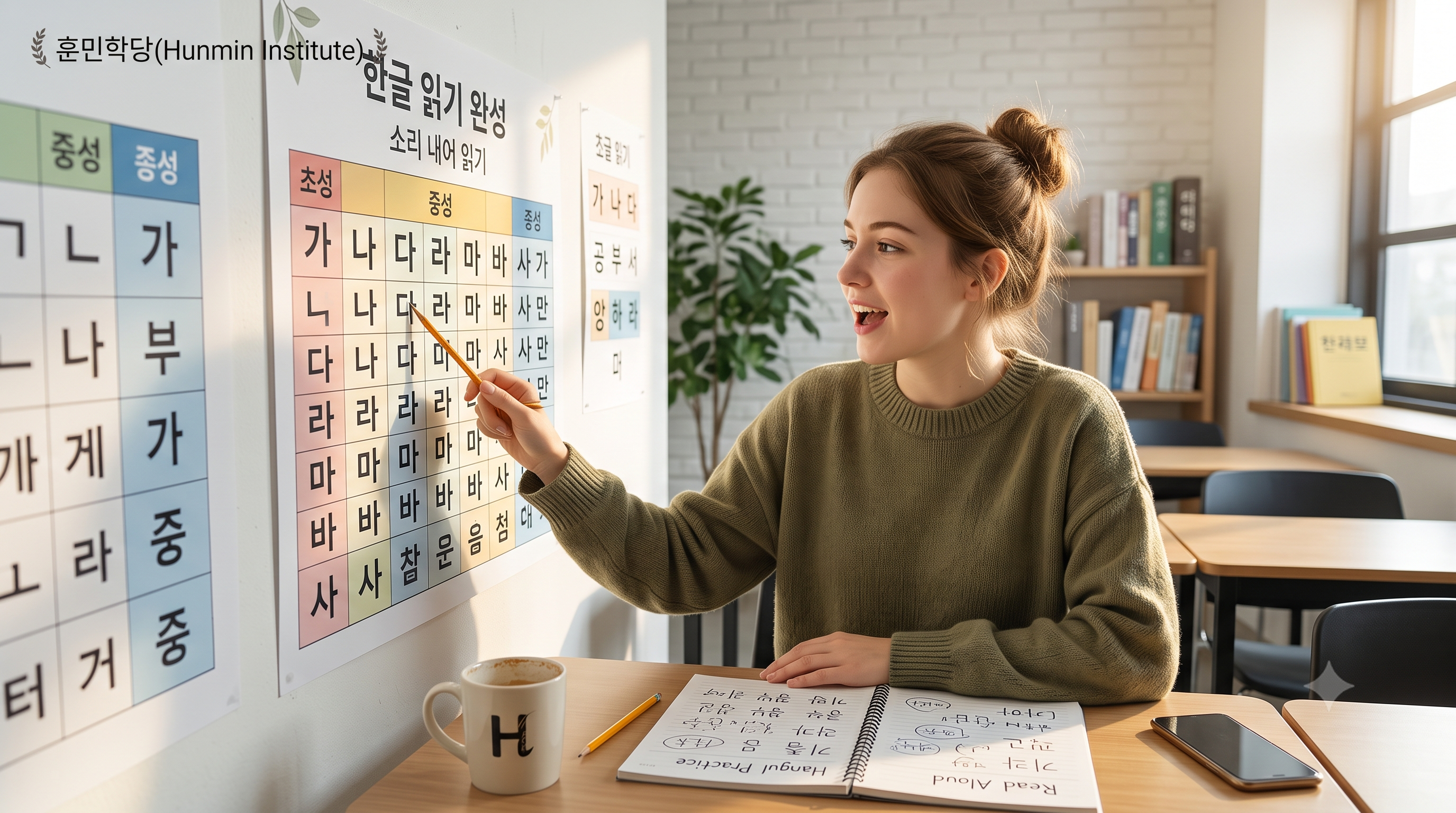
The learning services for the teaching materials published on this blog are free and open to everyone on the Hunmin Institute website ↗, with no account needed.
이 글에서 배우는 핵심 문장
Key Sentences in This Lesson
이 글은 소리를 만드는 훈련이므로 읽고 확인받는 말이 오갑니다. 좌우는 한 쌍의 대화가 아니라 각각 따로 익히는 문장입니다.
This lesson trains sound, so the lines here are about reading and being checked. The two columns are not paired dialogue; learn each side on its own.
| 듣는 문장 Listening |
쓰는 문장 Writing |
|---|---|
| 소리 내어 읽으세요. [sori naeeo ilgeuseyo] Read it aloud. |
이제 읽어 볼게요. [ije ilgeo bolgeyo] Let me read it now. |
| 한 글자씩 나눠 보세요. [han geuljassik nanwo boseyo] Try splitting it one syllable at a time. |
이 글자 어떻게 나눠요? [i geulja eotteoke nanwoyo] How do I split this syllable? |
| 낱말씩 넘어가세요. [natmalssik neomeogaseyo] Move on word by word. |
조금만 천천히 할게요. [jogeumman cheoncheonhi halgeyo] Let me go just a bit slower. |
첫째 줄은 소단락 1에서, 둘째 줄은 소단락 2에서, 셋째 줄은 소단락 4에서 각각 다룹니다.
The first row is covered in Section 1, the second in Section 2, and the third in Section 4.
1. 자모 조합표를 소리 내어 읽습니다
Read the Syllable Chart Aloud
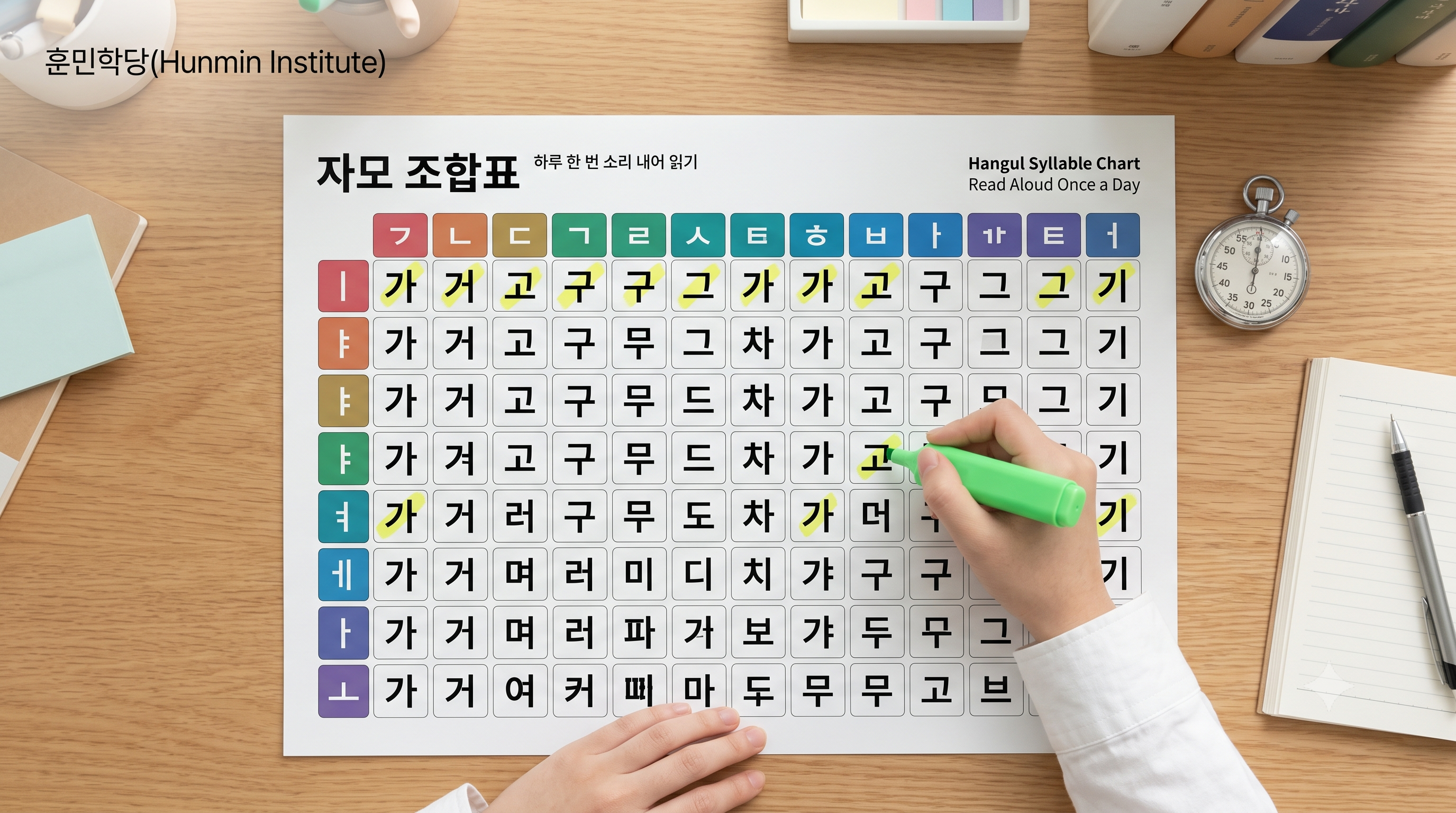
읽기 속도를 만드는 가장 확실한 도구는 자모 조합표입니다. 자음 열넷을 세로에 두고 모음 열을 가로에 두면 받침 없는 음절이 한 장에 모두 정리됩니다. 표가 길어 모음 다섯씩 둘로 나누어 실었습니다.
The surest tool for reading speed is the syllable chart. Fourteen consonants down the side, ten vowels across the top, and every syllable without a batchim fits on one sheet. It is split into two tables of five vowels each for length.
| 자음 Consonant |
ㅏ a |
ㅑ ya |
ㅓ eo |
ㅕ yeo |
ㅗ o |
|---|---|---|---|---|---|
| ㄱ (g) | 가 [ga] |
갸 [gya] |
거 [geo] |
겨 [gyeo] |
고 [go] |
| ㄴ (n) | 나 [na] |
냐 [nya] |
너 [neo] |
녀 [nyeo] |
노 [no] |
| ㄷ (d) | 다 [da] |
댜 [dya] |
더 [deo] |
뎌 [dyeo] |
도 [do] |
| ㄹ (r) | 라 [ra] |
랴 [rya] |
러 [reo] |
려 [ryeo] |
로 [ro] |
| ㅁ (m) | 마 [ma] |
먀 [mya] |
머 [meo] |
며 [myeo] |
모 [mo] |
| ㅂ (b) | 바 [ba] |
뱌 [bya] |
버 [beo] |
벼 [byeo] |
보 [bo] |
| ㅅ (s) | 사 [sa] |
샤 [sya] |
서 [seo] |
셔 [syeo] |
소 [so] |
| ㅇ (-) | 아 [a] |
야 [ya] |
어 [eo] |
여 [yeo] |
오 [o] |
| ㅈ (j) | 자 [ja] |
쟈 [jya] |
저 [jeo] |
져 [jyeo] |
조 [jo] |
| ㅊ (ch) | 차 [cha] |
챠 [chya] |
처 [cheo] |
쳐 [chyeo] |
초 [cho] |
| ㅋ (k) | 카 [ka] |
캬 [kya] |
커 [keo] |
켜 [kyeo] |
코 [ko] |
| ㅌ (t) | 타 [ta] |
탸 [tya] |
터 [teo] |
텨 [tyeo] |
토 [to] |
| ㅍ (p) | 파 [pa] |
퍄 [pya] |
퍼 [peo] |
펴 [pyeo] |
포 [po] |
| ㅎ (h) | 하 [ha] |
햐 [hya] |
허 [heo] |
혀 [hyeo] |
호 [ho] |
| 자음 Consonant |
ㅛ yo |
ㅜ u |
ㅠ yu |
ㅡ eu |
ㅣ i |
|---|---|---|---|---|---|
| ㄱ (g) | 교 [gyo] |
구 [gu] |
규 [gyu] |
그 [geu] |
기 [gi] |
| ㄴ (n) | 뇨 [nyo] |
누 [nu] |
뉴 [nyu] |
느 [neu] |
니 [ni] |
| ㄷ (d) | 됴 [dyo] |
두 [du] |
듀 [dyu] |
드 [deu] |
디 [di] |
| ㄹ (r) | 료 [ryo] |
루 [ru] |
류 [ryu] |
르 [reu] |
리 [ri] |
| ㅁ (m) | 묘 [myo] |
무 [mu] |
뮤 [myu] |
므 [meu] |
미 [mi] |
| ㅂ (b) | 뵤 [byo] |
부 [bu] |
뷰 [byu] |
브 [beu] |
비 [bi] |
| ㅅ (s) | 쇼 [syo] |
수 [su] |
슈 [syu] |
스 [seu] |
시 [si] |
| ㅇ (-) | 요 [yo] |
우 [u] |
유 [yu] |
으 [eu] |
이 [i] |
| ㅈ (j) | 죠 [jyo] |
주 [ju] |
쥬 [jyu] |
즈 [jeu] |
지 [ji] |
| ㅊ (ch) | 쵸 [chyo] |
추 [chu] |
츄 [chyu] |
츠 [cheu] |
치 [chi] |
| ㅋ (k) | 쿄 [kyo] |
쿠 [ku] |
큐 [kyu] |
크 [keu] |
키 [ki] |
| ㅌ (t) | 툐 [tyo] |
투 [tu] |
튜 [tyu] |
트 [teu] |
티 [ti] |
| ㅍ (p) | 표 [pyo] |
푸 [pu] |
퓨 [pyu] |
프 [peu] |
피 [pi] |
| ㅎ (h) | 효 [hyo] |
후 [hu] |
휴 [hyu] |
흐 [heu] |
히 [hi] |
여기서 쓰는 문장부터 배워 봅시다. 읽기를 시작하고 시간을 잴 때 오가는 문장입니다.
Now for the sentences you use here. These go back and forth when you start reading and time yourself.
| 듣는 문장 Listening |
쓰는 문장 Writing |
|---|---|
| 소리 내어 읽으세요. [sori naeeo ilgeuseyo] Read it aloud. |
이제 읽어 볼게요. [ije ilgeo bolgeyo] Let me read it now. |
| 시간을 재 보세요. [siganeul jae boseyo] Try timing yourself. |
얼마나 걸렸어요? [eolmana geollyeosseoyo] How long did that take? |
응용 Apply It
↳ 이제 [동사]-어 볼게요
ije [verb]-eo bolgeyo
Let me try [verb]-ing now.
ex 이제 읽어 볼게요./이제 세어 볼게요.
ROM ije ilgeo bolgeyo/ije seeo bolgeyo
EN Let me try reading it now./Let me try counting it now.
▶눈으로 훑지 말고 반드시 소리 내어 읽으십시오.
Do not scan it with your eyes. Read it aloud.
가로로 읽으면 가나다라마바사가 되고 세로로 읽으면 가거고구그기가 됩니다. 두 방향을 번갈아 읽으면 자음과 모음이 각각 따로 정리되므로 어느 쪽에서 막히는지도 함께 드러납니다.
Read across and you get 가나다라마바사; read down and you get 가거고구그기. Alternating the two directions sorts the consonants and the vowels separately, and it also shows which of the two is tripping you.
하루 한 번, 처음부터 끝까지 막힘없이 읽는 시간을 재 보십시오. 처음에 삼 분 걸리던 표가 한 주 뒤에는 일 분 안에 끝납니다. 바로 읽히는 글자에 표시해 두면 남은 자리가 눈에 보입니다.
Once a day, time yourself reading it through without stumbling. What takes three minutes at first drops under one within a week. Mark the syllables that already come easily and what is left becomes visible.
2. 낱말을 나눴다가 다시 합칩니다
Split a Word Apart, Then Put It Back
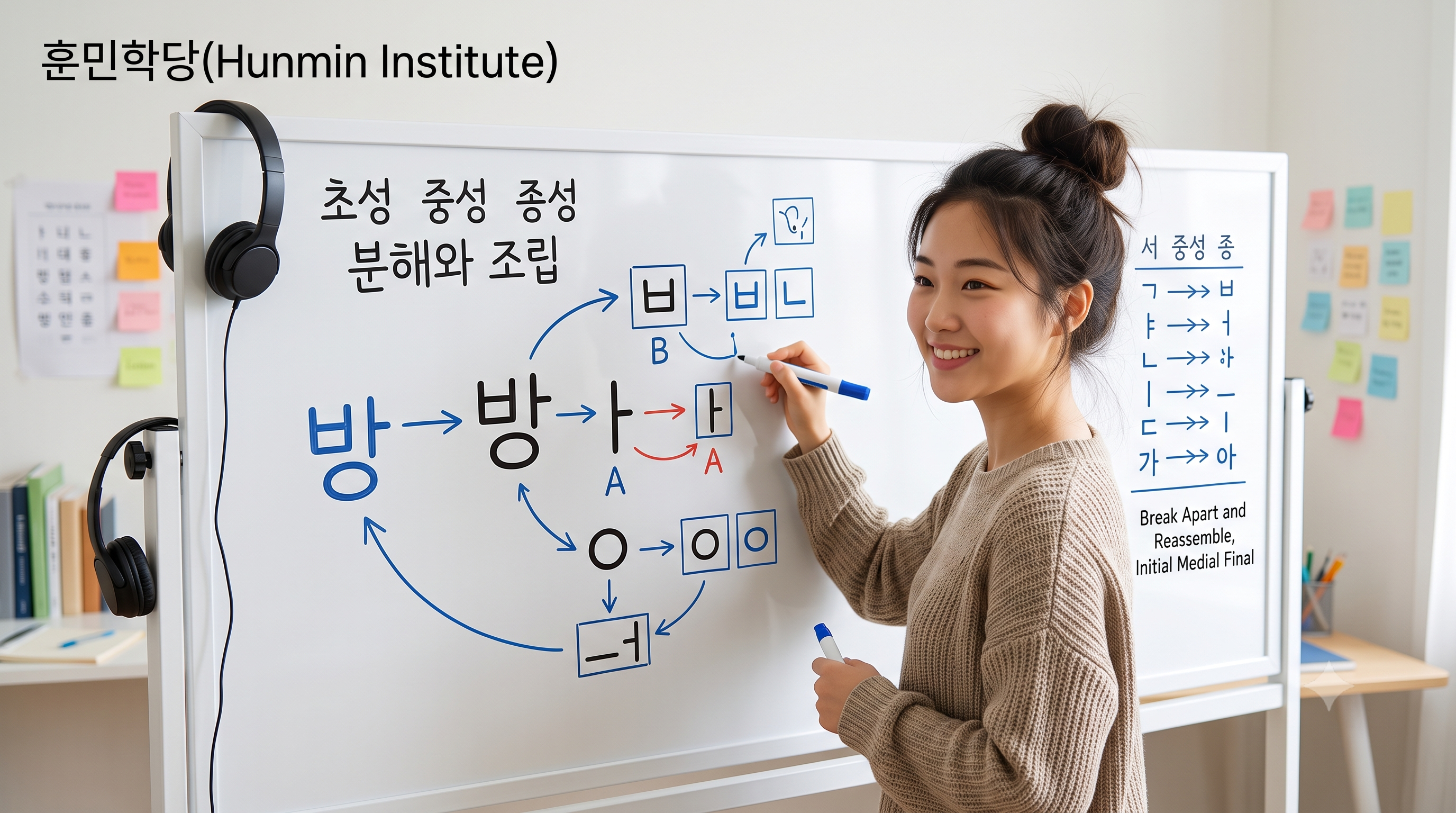
조합표가 읽히면 곧바로 실제 낱말로 넘어갑니다. 좋은 재료는 이미 뜻을 아는 일상 낱말입니다. 뜻을 아는 낱말이라 스스로 맞고 틀림을 가릴 수 있습니다.
Once the chart reads smoothly, move straight to real words. Everyday words whose meaning you already know work best, because knowing the word lets you judge your own reading.
| 낱말 Word |
이렇게 나눕니다 Split it like this |
뜻 Meaning |
|---|---|---|
| 선생님 [seonsaengnim] |
선 = ㅅ + ㅓ + ㄴ, 생 = ㅅ + ㅐ + ㅇ | teacher |
| 도서관 [doseogwan] |
도 = ㄷ + ㅗ, 관 = ㄱ + ㅘ + ㄴ | library |
| 지하철 [jihacheol] |
하 = ㅎ + ㅏ, 철 = ㅊ + ㅓ + ㄹ | subway |
| 냉장고 [naengjanggo] |
냉 = ㄴ + ㅐ + ㅇ, 장 = ㅈ + ㅏ + ㅇ | refrigerator |
| 컴퓨터 [keompyuteo] |
컴 = ㅋ + ㅓ + ㅁ, 퓨 = ㅍ + ㅠ | computer |
여기서 쓰는 문장부터 배워 봅시다. 글자를 나누고 합칠 때 오가는 문장입니다.
Now for the sentences you use here. These go back and forth as you split syllables and join them again.
| 듣는 문장 Listening |
쓰는 문장 Writing |
|---|---|
| 한 글자씩 나눠 보세요. [han geuljassik nanwo boseyo] Try splitting it one syllable at a time. |
이 글자 어떻게 나눠요? [i geulja eotteoke nanwoyo] How do I split this syllable? |
| 다시 합쳐 보세요. [dasi hapchyeo boseyo] Now put it back together. |
받침을 나중에 붙일게요. [batchimeul najunge buchilgeyo] Let me add the batchim last. |
▶뜻을 아는 낱말이라 스스로 채점이 됩니다.
Because you already know the word, you can grade yourself.
방법은 나누기와 합치기입니다. 한 글자를 초성과 중성, 종성으로 나눈 뒤 다시 붙여 소리 내어 읽습니다. 답을 아는 상태에서 하는 연습이라 틀린 자리가 바로 드러나고 교정도 빠릅니다.
The method is split and join: break a syllable into initial, medial, and final, then put it back and read it aloud. Practising with the answer already in hand exposes the wrong spot at once and corrects it fast.
받침이 붙은 글자에서 막히면 초성과 중성까지만 먼저 읽고 마지막에 종성을 얹으십시오. 방을 읽을 때 바에서 한 번 멈춘 뒤 ㅇ을 붙이는 식이며, 몇 번 반복하면 멈추는 자리가 사라집니다.
When a syllable with a final trips you, read only the initial and the medial first, then put the final on top. To read 방, stop at 바 and add ㅇ. After a few passes the pause is gone.
3. 긴 외래어로 호흡을 늘립니다
Stretch Your Breath with Long Loanwords
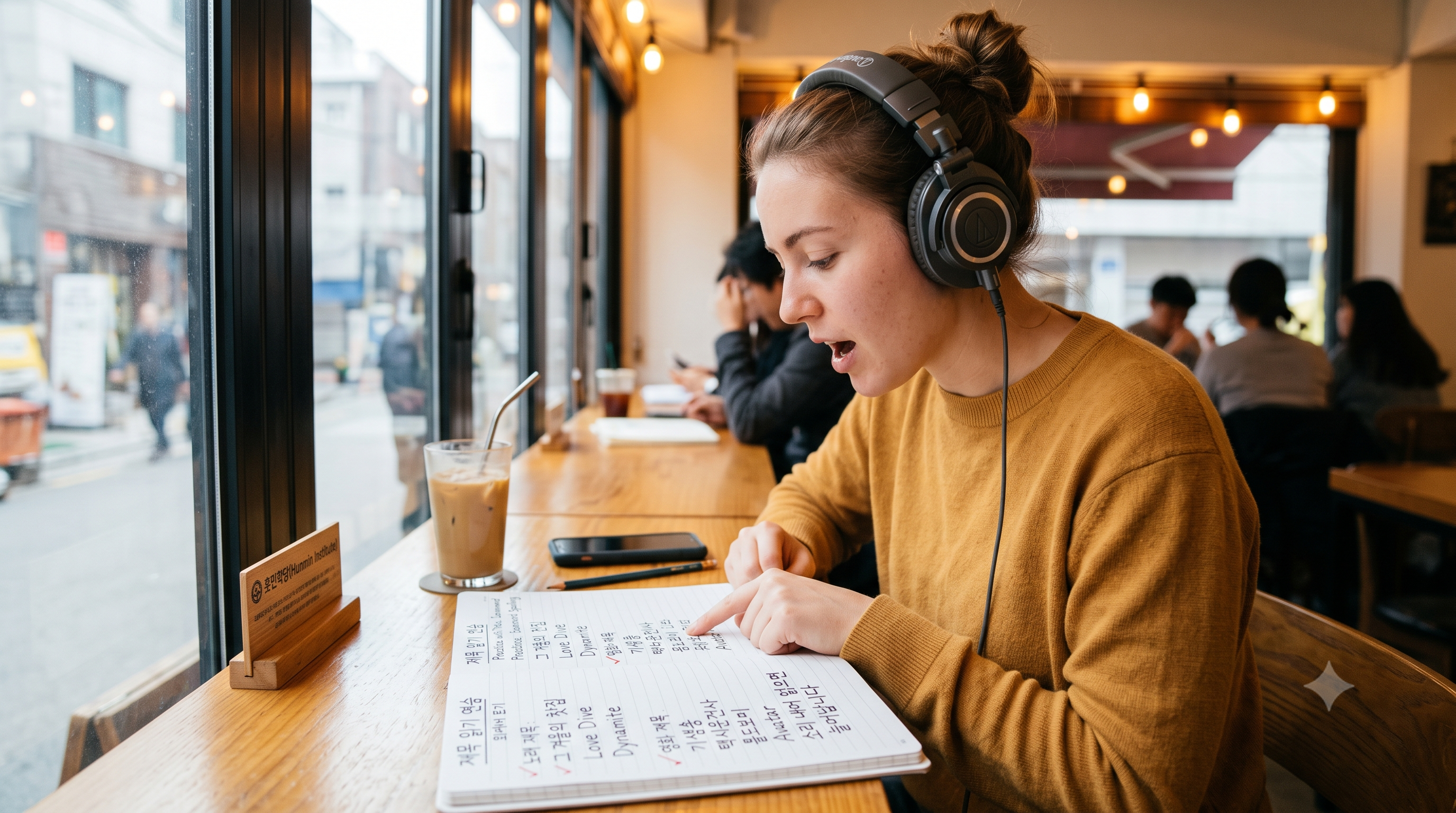
짧은 낱말이 읽히면 글자 수를 늘립니다. 외래어가 좋은 재료인데, 영어 한 소리가 한글 두세 글자로 늘어나 자연히 호흡이 길어지기 때문입니다.
Once short words read smoothly, raise the syllable count. Loanwords work well here: one English sound stretches into two or three Hangul syllables, so your reading breath lengthens on its own.
| 외래어 Loanword |
길이 Length |
확인할 점 What to check |
|---|---|---|
| 아이스크림 [aiseukeurim] ice cream |
다섯 글자 Five syllables |
한 소리가 두 글자로 늘어납니다 One sound stretches into two syllables |
| 초콜릿 [chokollit] chocolate |
세 글자 Three syllables |
받침 ㄹ과 ㅅ이 이어집니다 A ㄹ final is followed by a ㅅ final |
| 텔레비전 [tellebijeon] television |
네 글자 Four syllables |
받침 ㄹ이 뒤로 이어집니다 The ㄹ final carries into the next syllable |
| 엘리베이터 [ellibeiteo] elevator |
다섯 글자 Five syllables |
긴 낱말이라 호흡이 늘어납니다 A long word stretches your reading breath |
| 샌드위치 [saendeuwichi] sandwich |
네 글자 Four syllables |
자음 사이에 ㅡ가 들어갑니다 ㅡ is inserted between the consonants |
여기서 쓰는 문장부터 배워 봅시다. 긴 낱말에서 막힐 때 오가는 문장입니다.
Now for the sentences you use here. These go back and forth when a long word stalls you.
| 듣는 문장 Listening |
쓰는 문장 Writing |
|---|---|
| 조금 길어졌어요. [jogeum gireojyeosseoyo] It got a little longer. |
한 번에 읽기 어려워요. [han beone ikgi eoryeowoyo] It is hard to read in one go. |
| 끝까지 읽어 보세요. [kkeutkkaji ilgeo boseyo] Try reading it to the end. |
다시 해 볼게요. [dasi hae bolgeyo] Let me try again. |
▶외래어 표기를 함께 익히는 것이 또 하나의 이득입니다.
Learning how foreign words are written in Hangul is a second gain.
영어를 한글로 옮긴 말은 간판과 차림표, 안내문 곳곳에 나옵니다. 아이스크림처럼 한 소리가 여러 글자로 늘어나는 방식에 익숙해지면 처음 보는 외래어도 그 자리에서 읽힙니다.
Words carried from English into Hangul appear on signs, menus, and notices everywhere. Get used to the way one sound stretches into several syllables, as in 아이스크림, and unfamiliar loanwords open up on the spot.
틀렸다고 느낀 글자만 모아 조합표로 돌아가 확인하십시오. 전부 다시 읽는 것보다 막힌 자리만 짚는 편이 훨씬 빠르며, 그 자리가 대개 몇 개로 정해져 있습니다.
Collect only the syllables that felt wrong and check them back on the chart. Pointing at the spots where you stalled beats rereading everything, and those spots usually turn out to be only a handful.
4. 짧은 문장으로 마무리합니다
Finish with Short Sentences
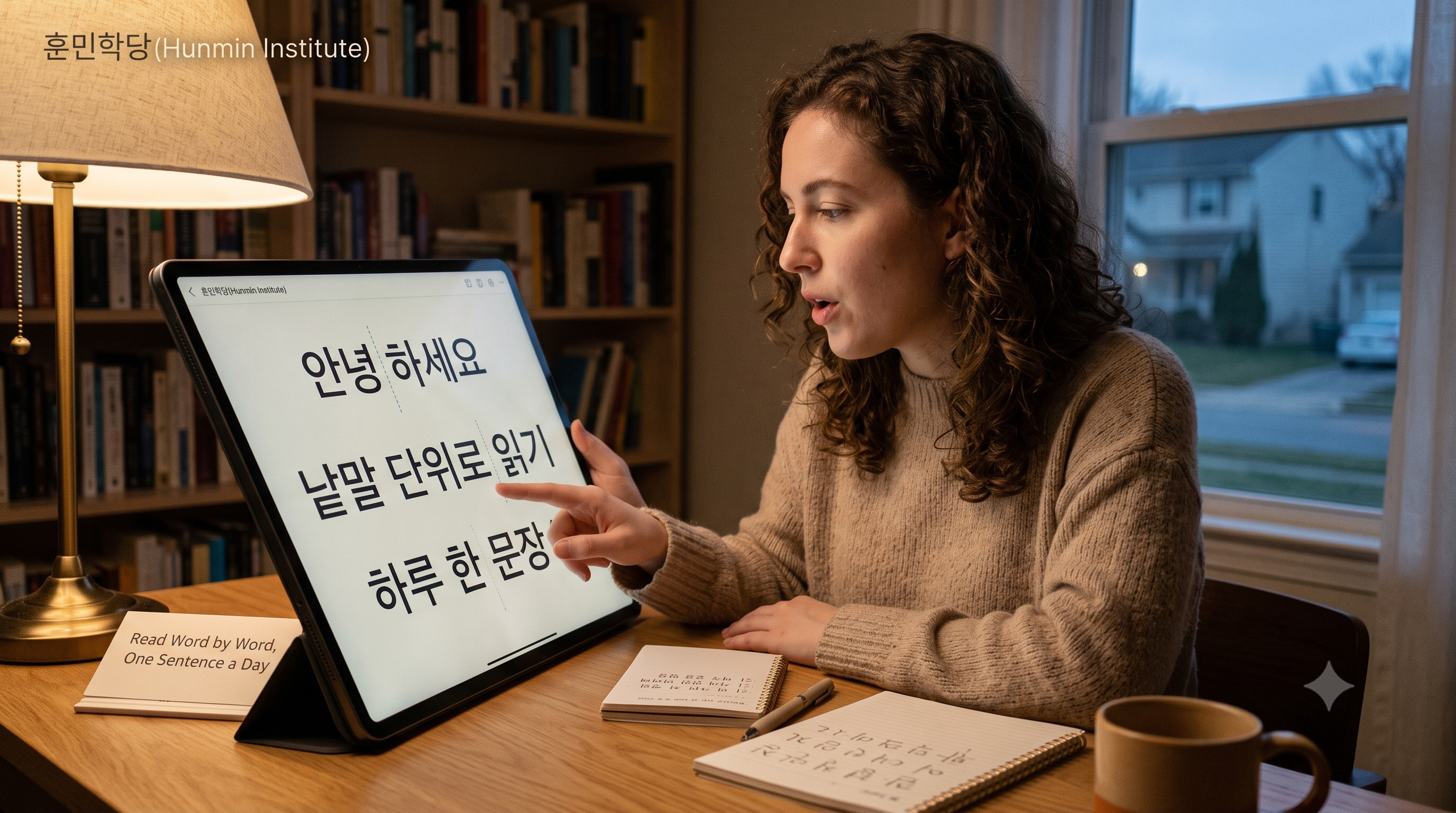
마지막 단계는 문장입니다. 목표는 분명합니다. 글자마다 멈추지 않고 낱말 단위로 넘어가는 것입니다. 3부에서 익힌 발음 규칙이 여기서 한꺼번에 나타납니다.
The last stage is sentences, and the goal is clear: stop pausing at every syllable and move word by word. The pronunciation rules from Part 3 all show up here at once.
| 문장 Sentence |
확인할 점 What to check |
뜻 Meaning |
|---|---|---|
| 안녕하세요 [annyeonghaseyo] |
다섯 글자를 한 덩어리로 읽습니다 Read all five syllables as one piece |
Hello |
| 저는 학생이에요 [jeoneun haksaengieyo] |
띄어쓰기에서 한 번 쉽니다 Pause once at the space |
I am a student |
| 한국어를 공부해요 [hangugeoreul gongbuhaeyo] |
한국어를 한구거로 이어 읽습니다 한국어 is read joined as 한구거 |
I study Korean |
| 오늘 날씨가 좋아요 [oneul nalssiga joayo] |
좋아요를 조아요로 읽습니다 좋아요 is read as 조아요 |
The weather is nice today |
| 감사합니다 [gamsahamnida] |
감사합니다를 감사함니다로 읽습니다 감사합니다 is read as 감사함니다 |
Thank you |
여기서 쓰는 문장부터 배워 봅시다. 속도를 조절하고 확인받을 때 오가는 문장입니다.
Now for the sentences you use here. These go back and forth as you adjust your pace and ask to be checked.
| 듣는 문장 Listening |
쓰는 문장 Writing |
|---|---|
| 낱말씩 넘어가세요. [natmalssik neomeogaseyo] Move on word by word. |
조금만 천천히 할게요. [jogeumman cheoncheonhi halgeyo] Let me go just a bit slower. |
| 잘 읽으셨어요. [jal ilgeusyeosseoyo] You read that well. |
매일 연습할게요. [maeil yeonseupalgeyo] I will practise every day. |
▶글자마다 멈추면 규칙이 일어날 자리가 사라집니다.
Pause at every syllable and the rules lose the place where they happen.
한국어를 한 글자씩 끊어 읽으면 한 국 어가 되지만 이어 읽으면 한구거가 됩니다. 감사합니다도 마찬가지로 감사함니다가 됩니다. 낱말 단위로 넘어가는 것만으로 3부의 규칙이 저절로 일어납니다.
Read 한국어 syllable by syllable and you get 한 국 어; read it joined and you get 한구거. 감사합니다 likewise becomes 감사함니다. Simply moving word by word makes the Part 3 rules happen on their own.
띄어쓰기가 있는 자리에서만 쉬십시오. 저는 학생이에요는 저는에서 한 번 쉬고 학생이에요를 한 덩어리로 냅니다. 쉬는 자리를 정해 두면 읽는 속도가 눈에 띄게 고릅니다.
Pause only where there is a space. In 저는 학생이에요, break once after 저는 and deliver 학생이에요 as one piece. Fixing where you pause makes your pace noticeably even.
읽기는 아는 것이 아니라 붙는 것입니다. 조합표를 소리 내어 읽어 자음과 모음이 만나는 자리를 몸에 붙이고, 낱말을 나눴다 합치며 받침을 다루고, 긴 외래어로 호흡을 늘린 다음, 문장을 낱말 단위로 넘어가면 됩니다. 여기까지 오면 한글은 다 읽힙니다. 다음은 읽은 문장이 무슨 뜻인지 잡는 자리입니다.
Reading is not something you know but something that settles in. Read the chart aloud until the meeting point of consonant and vowel is in your body, handle finals by splitting words and joining them, stretch your breath on long loanwords, then move through sentences word by word. Get here and Hangul reads. Next comes catching what the sentence you just read actually means.
Next: Korean Word Order Explained: Understand Any Sentence ↗
토픽 맛보기
TOPIK Preview
유형: TOPIK Ⅰ 읽기 [46~48], 설명문, 중심 내용 고르기
Type: TOPIK I Reading [46–48], expository text, choose the main idea
다음 글의 중심 생각을 고르십시오.
Choose the main idea of the following passage.
글자를 안다고 바로 읽히지는 않습니다. 조합표를 소리 내어 읽고, 낱말을 나눴다가 합치고, 문장을 낱말 단위로 넘어가는 연습이 있어야 속도가 붙습니다.
Knowing the letters does not by itself make you able to read. Speed comes from reading the chart aloud, splitting words apart and joining them again, and moving through sentences word by word.
① 글자를 알면 바로 읽을 수 있습니다.
② 읽기 속도는 연습에서 나옵니다.
③ 조합표는 눈으로 보면 됩니다.
④ 문장은 글자마다 멈춰야 합니다.
Answer ▾
정답 ② 읽기 속도는 연습에서 나옵니다.
Answer: ② Reading speed comes from practice.
지문이 글자를 아는 것만으로는 읽히지 않는다고 하고 연습이 있어야 속도가 붙는다고 맺으므로 ②가 중심 생각입니다. ①은 지문의 첫 문장과 정반대이고, ③은 조합표가 지문에 나오지만 소리 내어 읽으라고 한 자리라 일부만 맞으며, ④는 그럴듯해 보여도 낱말 단위로 넘어가라는 지문과 어긋납니다. 흉내 낸 대문항은 TOPIK Ⅰ 읽기 [46~48] 중심 내용 고르기이고 배점은 3점입니다.
The passage says knowing the letters is not enough and closes by tying speed to practice, so ② is the main idea. ① contradicts the opening sentence. ③ picks up the chart from the passage but the passage says to read it aloud, so it is only partly right. ④ sounds plausible yet runs against moving word by word. The item type modeled here is TOPIK I Reading [46–48], worth 3 points.
FAQ
Q1. 조합표는 하루에 몇 번 읽어야 하나요?Answer ▾
Q1. How many times a day should I read the chart?
A1. 하루 한 번이면 충분합니다. 대신 처음부터 끝까지 막힘없이 읽고 시간을 재 보십시오. 횟수보다 막히지 않고 끝까지 가는 것이 중요하며, 처음 삼 분 걸리던 표가 한 주 뒤에는 일 분 안에 끝납니다.
A1. Once a day is enough, but read it straight through without stumbling and time yourself. Getting to the end unbroken matters more than repetition; what takes three minutes at first drops under one within a week.
Q2. 안 쓰는 글자까지 읽어야 하나요?Answer ▾
Q2. Do I have to read syllables that are never used?
A2. 조합표에는 실제로 잘 쓰이지 않는 글자도 들어 있습니다. 그래도 건너뛰지 마십시오. 목표는 낱말을 외우는 것이 아니라 자음과 모음이 만나는 자리를 눈과 입에 붙이는 것이므로 쓰임이 적은 글자도 훈련에는 그대로 쓸모가 있습니다.
A2. The chart holds syllables that rarely appear in real words. Do not skip them. The goal is not to memorize words but to fix the meeting point of consonant and vowel in your eye and mouth, so rare syllables still do their work.
Q3. 받침이 붙은 글자에서 자꾸 막힙니다.Answer ▾
Q3. I keep stalling on syllables with a batchim.
A3. 초성과 중성까지만 먼저 읽고 마지막에 종성을 얹으십시오. 방을 읽을 때 바에서 한 번 멈춘 뒤 ㅇ을 붙이는 식입니다. 몇 번 반복하면 멈추는 자리가 사라집니다.
A3. Read only the initial and the medial first, then put the final on top. To read 방, stop at 바 and add ㅇ. After a few passes the pause disappears.
Q4. 외래어는 왜 따로 연습하나요?Answer ▾
Q4. Why practise loanwords separately?
A4. 영어 한 소리가 한글 두세 글자로 늘어나기 때문입니다. 아이스크림이나 엘리베이터처럼 글자 수가 갑자기 늘어나는 규칙에 익숙해지면 처음 보는 외래어도 읽힙니다. 한국어 콘텐츠 곳곳에 나오므로 이득이 큽니다.
A4. One English sound stretches into two or three Hangul syllables. Get used to that sudden growth in words like 아이스크림 and 엘리베이터 and new loanwords open up. They appear everywhere in Korean content, so the return is large.
Vocabulary and Pronunciation for Foreigners
| No | Korean | Romanisation | Meaning |
|---|---|---|---|
| 1 | 조합표 | johaptyo | (n) syllable chart [ˈsɪləbl tʃɑːrt] |
| 2 | 낱말 | natmal | (n) word [wɜːrd] |
| 3 | 외래어 | oeraeeo | (n) loanword [ˈloʊnwɜːrd] |
| 4 | 연습 | yeonseup | (n) practice [ˈpræktɪs] |
| 5 | 띄어쓰기 | ttuieossugi | (n) spacing [ˈspeɪsɪŋ] |
| ▾ 단어 47개 더 보기 Show 47 more ↗ | |||
The blog page has limits of space and function, so only five words are shown here. The rest of the word list, the audio, the sentences and tables, the FAQ, the worksheet, the TOPIK questions and the lesson video are on the Hunmin Institute website ↗, free and open to everyone, with no account needed.
참고 기관
Official Sources
국립국어원 ↗
National Institute of Korean Language
https://www.korean.go.kr/
기관 설명 보기 About this institute ▾
This institute sets Korean orthography, the standard pronunciation rules, and the rules for writing loanwords. The Language Norms menu at the top of the site holds the full text of the loanword rules, so you can check why an English word is spelled the way it is in Hangul. Word-by-word standard pronunciations sit in the Korean Basic Dictionary run by the same institute. Norms can be revised, so check here whenever a spelling is unclear.
※ 본 콘텐츠(원고, 이미지, 예문 포함)는 저작권법에 의해 보호받는 훈민학당의 저작물입니다. 무단 복제, 전재, 재배포 및 AI 학습 데이터로의 이용을 금합니다.
This content (manuscript, images, and example sentences) is the copyrighted property of Hunmin Institute, protected under copyright law. Unauthorized copying, reproduction, redistribution, and use as AI training data are prohibited.
'Reading Skills' 카테고리의 다른 글
| TOPIK Is a Scoring System, Not Just a Test (0) | 2026.07.27 |
|---|---|
| Korean Word Order Explained: Understand Any Sentence (0) | 2026.07.25 |
| How to Read Hangul Part 3: Pronunciation Rules (0) | 2026.07.25 |
| How to Read Hangul Part 2: Batchim (0) | 2026.07.23 |
| How to Read Hangul Part 1: Consonants and Vowels (0) | 2026.07.22 |


