
How to Read Hangul Part 1: Consonants and Vowels
외국인 한글 공부 1부, 한글 자음 모음 읽는 법
Korean consonants and vowels join into syllables even without batchim.
Here you learn how to assemble them and read those syllables yourself.
한글 자음과 모음은 받침 없이도 결합해 하나의 음절이 됩니다.
이 글에서 자음과 모음을 조립해 받침 없는 글자를 읽는 원리를 익힙니다.
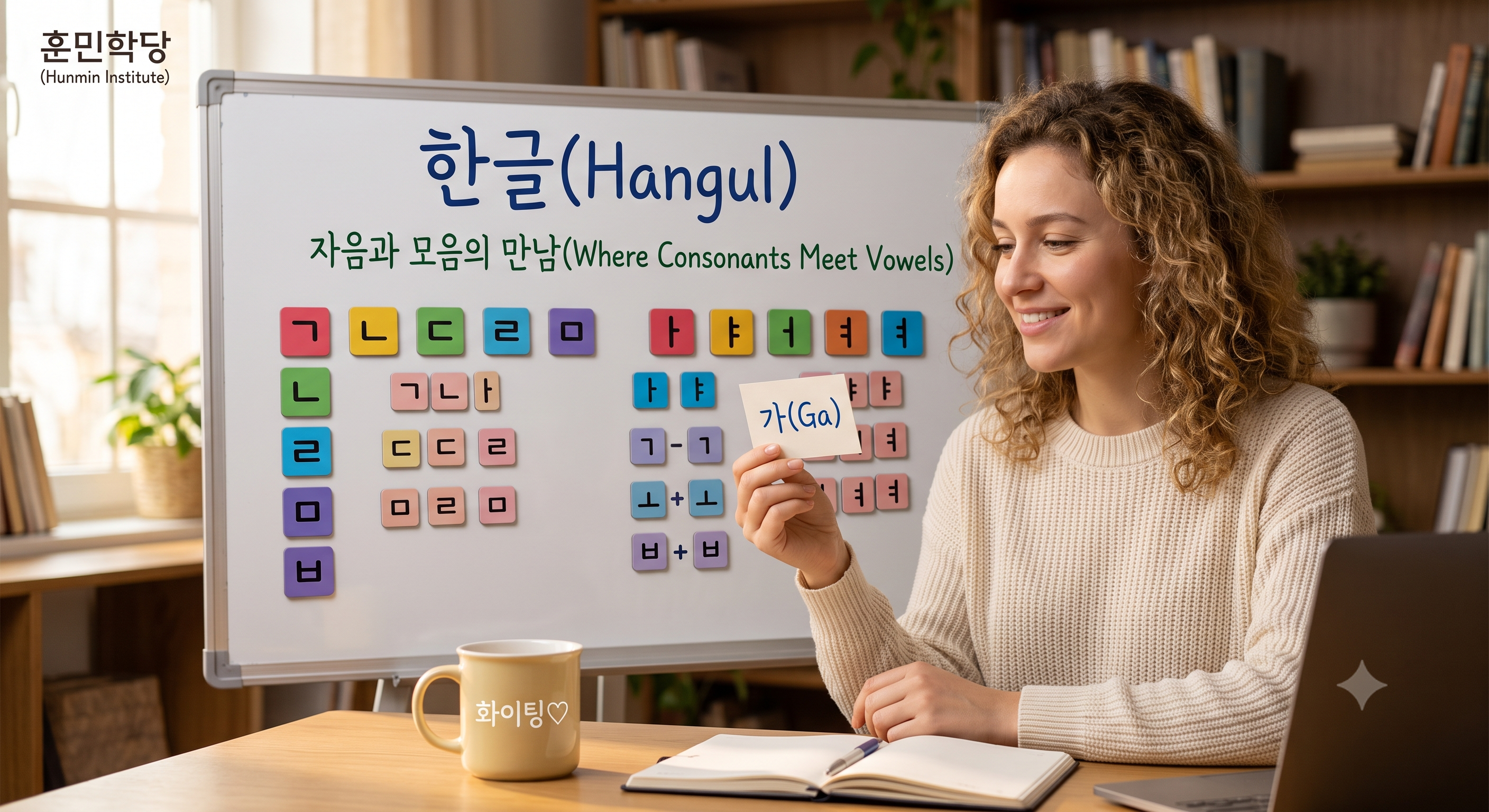
The learning services for the teaching materials published on this blog are free and open to everyone on the Hunmin Institute website ↗, with no account needed.
이 글에서 배우는 핵심 문장
Key Sentences in This Lesson
글자를 익히면 그 글자에 대해 묻고 답하는 말도 함께 필요해집니다. 좌우는 한 쌍의 대화가 아니라 각각 따로 익히는 문장입니다.
Once you learn the letters, you also need the lines for asking and answering about them. The two columns are not paired dialogue; learn each side on its own.
| 듣는 문장 Listening |
쓰는 문장 Writing |
|---|---|
| 기역에 아, 가예요. [giyeoge a gayeyo] It is 기역 plus 아, so 가. |
철자가 어떻게 되나요? [cheoljaga eotteoke doenayo] How is it spelled? |
| 이름 말고 소리로 읽으세요. [ireum malgo soriro ilgeuseyo] Read it by its sound, not its name. |
이 글자 어떻게 읽어요? [i geulja eotteoke ilgeoyo] How do I read this letter? |
| 소리 내어 읽어 보세요. [sori naeeo ilgeo boseyo] Try reading it aloud. |
제가 맞게 읽었어요? [jega matge ilgeosseoyo] Did I read that correctly? |
첫째 줄은 소단락 1에서, 둘째 줄은 소단락 3에서, 셋째 줄은 소단락 4에서 각각 다룹니다.
The first row is covered in Section 1, the second in Section 3, and the third in Section 4.
1. 자음 열넷은 이름과 소리값이 따로 있습니다
Fourteen Consonants Have a Name and a Sound Value
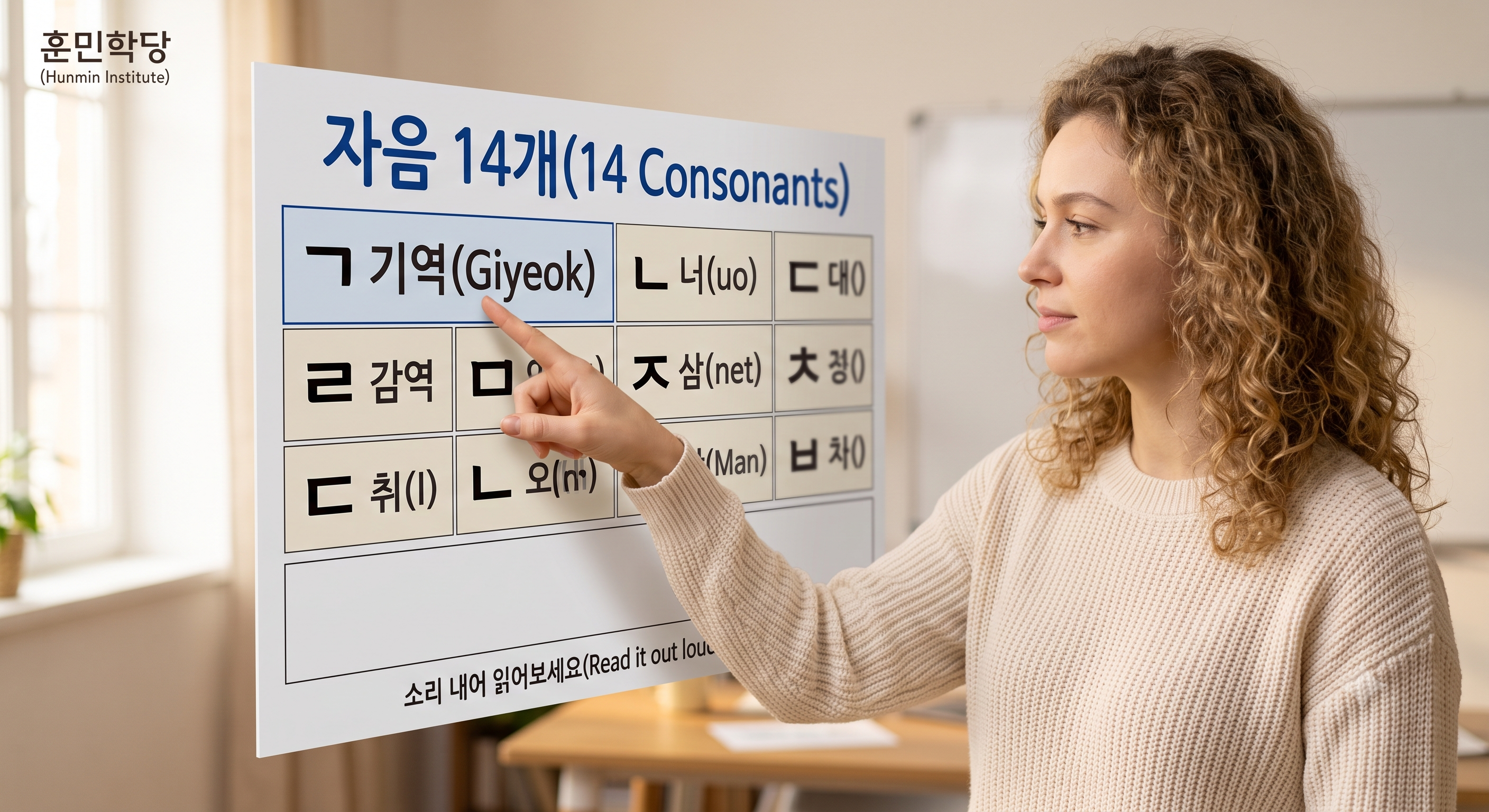
한글 자음은 낱자마다 이름이 정해져 있고, 그 이름과 실제로 내는 소리값이 다릅니다. 이 둘을 갈라 두지 않으면 글자를 읽을 때마다 이름을 소리로 읽어 버립니다.
Each Hangul consonant has a fixed name, and that name differs from the sound it actually makes. Keep the two apart, or you will read the name instead of the sound every time.
먼저 표로 확인하십시오. 왼쪽 칸의 대괄호 안이 그 낱자의 이름이고, 가운데 칸이 글자를 만들 때 앞에 오는 소리값입니다.
Check the table first. The bracket in the left column holds the letter name, and the middle column holds the sound value that comes first when you build a syllable.
| 자음 Consonant |
소리값 Sound value |
예시 Example |
|---|---|---|
| ㄱ [giyeok] |
g, k | 거미 / 고래 / 구두 / 기타 [geomi] / [gorae] / [gudu] / [gita] spider / whale / dress shoes / guitar |
| ㄴ [nieun] |
n | 나비 / 노래 / 누나 / 니트 [nabi] / [norae] / [nuna] / [niteu] butterfly / song / older sister / knitwear |
| ㄷ [digeut] |
d, t | 도로 / 두부 / 드라마 / 디저트 [doro] / [dubu] / [deurama] / [dijeoteu] road / tofu / drama / dessert |
| ㄹ [rieul] |
r, l | 로비 / 루비 / 리조트 / 레몬 [robi] / [rubi] / [rijoteu] / [remon] lobby / ruby / resort / lemon |
| ㅁ [mieum] |
m | 머리 / 모자 / 무지개 / 미소 [meori] / [moja] / [mujigae] / [miso] head / hat / rainbow / smile |
| ㅂ [bieup] |
b, p | 버스 / 보리 / 비누 / 부채 [beoseu] / [bori] / [binu] / [buchae] bus / barley / soap / folding fan |
| ㅅ [siot] |
s | 소나기 / 수도 / 시계 / 서리 [sonagi] / [sudo] / [sigye] / [seori] shower / tap water / clock / frost |
| ㅇ [ieung] |
무음 silent | 오이 / 우리 / 이사 / 어제 [oi] / [uri] / [isa] / [eoje] cucumber / we / moving house / yesterday |
| ㅈ [jieut] |
j | 지도 / 주스 / 조기 / 지우개 [jido] / [juseu] / [jogi] / [jiugae] map / juice / croaker / eraser |
| ㅊ [chieut] |
ch | 치즈 / 치마 / 초대 / 처마 [chijeu] / [chima] / [chodae] / [cheoma] cheese / skirt / invitation / eaves |
| ㅋ [kieuk] |
k | 커피 / 코 / 키위 / 쿠키 [keopi] / [ko] / [kiwi] / [kuki] coffee / nose / kiwi / cookie |
| ㅌ [tieut] |
t | 토마토 / 티셔츠 / 투수 / 트로피 [tomato] / [tisyeocheu] / [tusu] / [teuropi] tomato / T-shirt / pitcher / trophy |
| ㅍ [pieup] |
p | 피자 / 포도 / 피부 / 표지 [pija] / [podo] / [pibu] / [pyoji] pizza / grape / skin / cover |
| ㅎ [hieut] |
h | 호수 / 후추 / 허리 / 휴가 [hosu] / [huchu] / [heori] / [hyuga] lake / pepper / waist / holiday |
여기서 쓰는 문장부터 배워 봅시다. 낱자의 이름과 소리를 물을 때 오가는 문장입니다.
Now for the sentences you use here. These go back and forth when you ask about a letter’s name and sound.
| 듣는 문장 Listening |
쓰는 문장 Writing |
|---|---|
| 기역에 아, 가예요. [giyeoge a gayeyo] It is 기역 plus 아, so 가. |
철자가 어떻게 되나요? [cheoljaga eotteoke doenayo] How is it spelled? |
| 이응은 소리가 안 나요. [ieungeun soriga an nayo] 이응 makes no sound. |
이거 무슨 소리예요? [igeo museun soriyeyo] What sound is this? |
응용 Apply It
↳ 이거 무슨 [명사]예요?
igeo museun [noun]yeyo
What [noun] is this?
ex 이거 무슨 [소리]예요?/이거 무슨 [글자]예요?
ROM igeo museun [sori]yeyo/igeo museun [geulja]yeyo
EN What sound is this?/What letter is this?
▶이응은 초성 자리에서 소리를 내지 않습니다.
The consonant 이응 makes no sound in the initial position.
아, 오, 우처럼 첫소리 없이 모음만 읽는 자리를 표시할 뿐입니다. 이 점을 놓치면 이응이 들어간 글자마다 없는 소리를 찾게 되므로 여기서 못 박아 두십시오.
It simply marks where only the vowel is read, as in 아, 오, and 우. Miss this and you will hunt for a sound that is not there in every syllable containing it, so pin it down here.
한국인에게 철자를 물으면 이름으로 답이 돌아옵니다. 기역에 아, 가예요처럼 이름과 모음을 나눠 알려 주므로, 이름을 알아 두어야 그 답이 들립니다.
Ask a Korean how a word is spelled and the answer comes back in letter names. They split it into the name and the vowel, as in 기역에 아, 가예요, so knowing the names lets you catch it.
2. 모음 열은 붙는 자리가 모양에 적혀 있습니다
Ten Vowels Carry Their Position in Their Shape
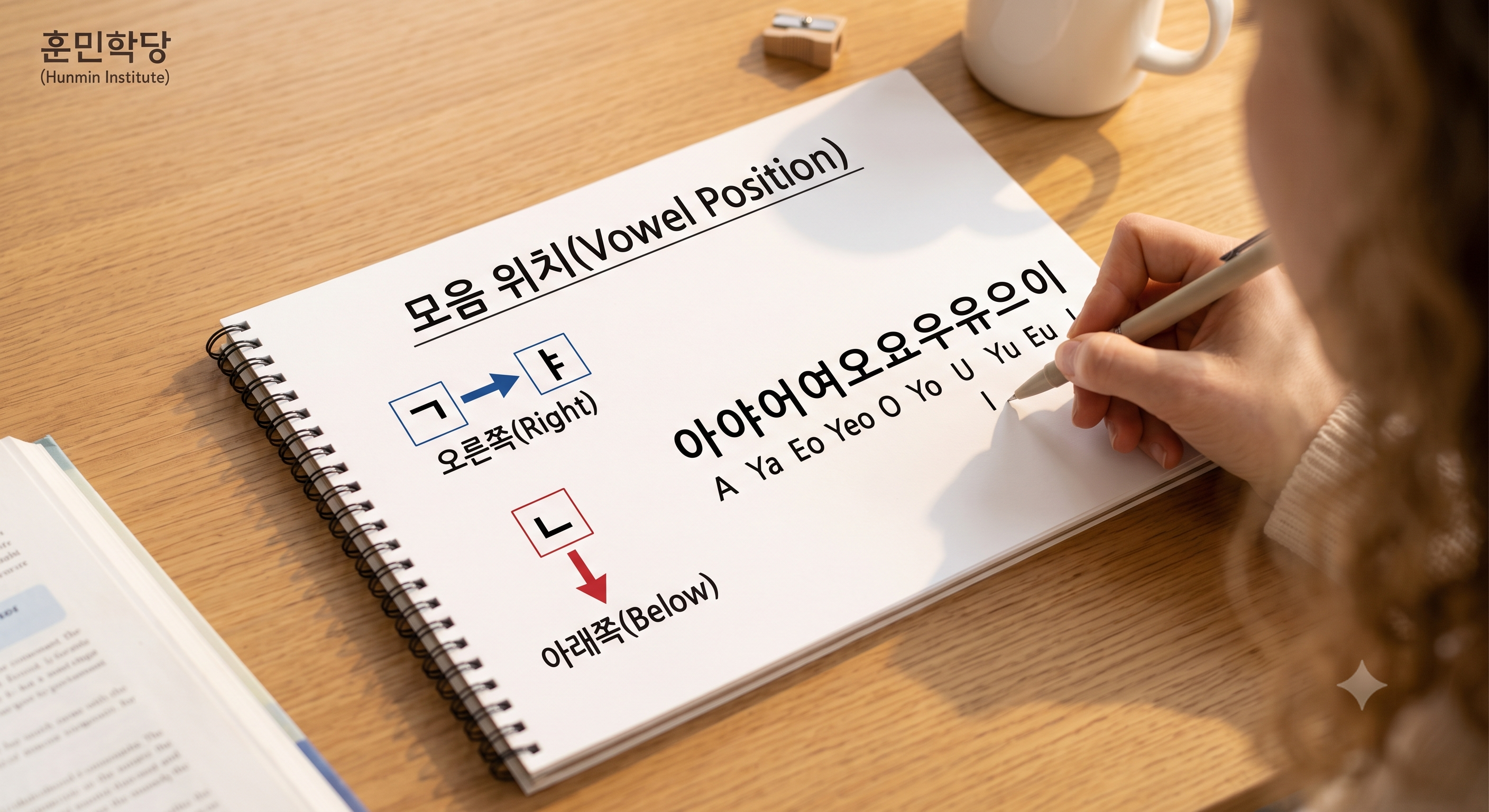
모음은 소리만 외워서는 글자를 만들지 못합니다. 자음의 어느 쪽에 붙는지가 함께 정해져 있기 때문입니다.
Memorizing vowel sounds alone will not build a syllable. Where each vowel attaches to the consonant is fixed too.
외울 것은 없습니다. 모양을 보면 자리가 보입니다. 표에서 확인하십시오.
There is nothing to memorize. The shape shows you the position. Check it in the table.
| 모음 Vowel |
붙는 자리 Position |
예시 Example |
|---|---|---|
| ㅏ [a] |
오른쪽 Right |
가수 / 바나나 / 마차 / 사다리 [gasu] / [banana] / [macha] / [sadari] singer / banana / carriage / ladder |
| ㅑ [ya] |
오른쪽 Right |
야구 / 야채 / 야자 / 향수 [yagu] / [yachae] / [yaja] / [hyangsu] baseball / vegetable / palm / perfume |
| ㅓ [eo] |
오른쪽 Right |
어머니 / 서로 / 너구리 / 저고리 [eomeoni] / [seoro] / [neoguri] / [jeogori] mother / each other / raccoon dog / jeogori jacket |
| ㅕ [yeo] |
오른쪽 Right |
겨울 / 여자 / 여우 / 벼 [gyeoul] / [yeoja] / [yeou] / [byeo] winter / woman / fox / rice plant |
| ㅣ [i] |
오른쪽 Right |
이마 / 지구 / 미나리 / 비디오 [ima] / [jigu] / [minari] / [bidio] forehead / the earth / water parsley / video |
| ㅗ [o] |
아래쪽 Below |
오리 / 도토리 / 소나무 / 고구마 [ori] / [dotori] / [sonamu] / [goguma] duck / acorn / pine tree / sweet potato |
| ㅛ [yo] |
아래쪽 Below |
요리 / 교사 / 표 / 효자 [yori] / [gyosa] / [pyo] / [hyoja] cooking / teacher / ticket / devoted son |
| ㅜ [u] |
아래쪽 Below |
우유 / 부부 / 수수 / 무 [uyu] / [bubu] / [susu] / [mu] milk / married couple / sorghum / radish |
| ㅠ [yu] |
아래쪽 Below |
휴지 / 유리 / 유자 / 규모 [hyuji] / [yuri] / [yuja] / [gyumo] tissue / glass / citron / scale |
| ㅡ [eu] |
아래쪽 Below |
그림 / 스키 / 느리다 / 흐리다 [geurim] / [seuki] / [neurida] / [heurida] picture / ski / to be slow / to be cloudy |
여기서 쓰는 문장부터 배워 봅시다. 모음이 붙는 자리를 물을 때 오가는 문장입니다.
Now for the sentences you use here. These go back and forth when you ask where a vowel attaches.
| 듣는 문장 Listening |
쓰는 문장 Writing |
|---|---|
| 모음은 오른쪽에 붙어요. [moeumeun oreunjjoge buteoyo] The vowel attaches on the right. |
이 모음은 어디에 붙어요? [i moeumeun eodie buteoyo] Where does this vowel attach? |
| 이건 아래에 쓰세요. [igeon araee sseuseyo] Write this one underneath. |
오른쪽이에요, 아래예요? [oreunjjogieyo araeyeyo] On the right, or underneath? |
▶세로로 선 모음은 오른쪽에, 가로로 누운 모음은 아래쪽에 붙습니다.
Upright vowels attach to the right, and flat vowels attach below.
ㅏ, ㅑ, ㅓ, ㅕ, ㅣ는 세로줄이 길어 자음 오른쪽에 서고, ㅗ, ㅛ, ㅜ, ㅠ, ㅡ는 가로줄이 길어 자음 아래에 깔립니다. 자리를 따로 외울 필요가 없다는 뜻입니다.
ㅏ, ㅑ, ㅓ, ㅕ, and ㅣ have a long vertical line and stand to the right of the consonant, while ㅗ, ㅛ, ㅜ, ㅠ, and ㅡ have a long horizontal line and lie below it. That means you never memorize positions separately.
한 가지만 덧붙입니다. 여기 실은 열 개는 기본 모음이고, ㅐ나 ㅚ처럼 둘을 겹쳐 만든 모음은 받침과 발음 규칙을 익힌 뒤에 다룹니다. 기본 열 개로도 받침 없는 글자는 대부분 읽힙니다.
One addition. The ten here are the basic vowels; compound ones such as ㅐ and ㅚ come after batchim and the pronunciation rules. These ten alone already open up most syllables without batchim.
3. 초성과 중성을 붙이면 글자가 완성됩니다
Initial Consonant Plus Vowel Completes a Syllable

이제 둘을 붙여 봅니다. 모음 ㅏ를 고정하고 초성만 바꾸면 자음 열넷이 그대로 열네 글자가 됩니다.
Now put the two together. Fix the vowel ㅏ, change only the initial consonant, and the fourteen consonants become fourteen syllables.
| 음절 Syllable |
결합 Combination |
예시 Example |
|---|---|---|
| 가 [ga] |
ㄱ + ㅏ | 가방 / 가지 / 가위 / 가게 [gabang] / [gaji] / [gawi] / [gage] bag / eggplant / scissors / shop |
| 나 [na] |
ㄴ + ㅏ | 나무 / 나이 / 나사 / 나라 [namu] / [nai] / [nasa] / [nara] tree / age / screw / country |
| 다 [da] |
ㄷ + ㅏ | 다리 / 다리미 / 다시마 / 다투다 [dari] / [darimi] / [dasima] / [datuda] bridge / iron / kelp / to quarrel |
| 라 [ra] |
ㄹ + ㅏ | 라면 / 라디오 / 라마 / 라이터 [ramyeon] / [radio] / [rama] / [raiteo] ramyeon / radio / llama / lighter |
| 마 [ma] |
ㅁ + ㅏ | 마음 / 마루 / 마시다 / 마디 [maeum] / [maru] / [masida] / [madi] heart / wooden floor / to drink / joint |
| 바 [ba] |
ㅂ + ㅏ | 바지 / 바구니 / 바보 / 바위 [baji] / [baguni] / [babo] / [bawi] trousers / basket / fool / rock |
| 사 [sa] |
ㅅ + ㅏ | 사자 / 사과 / 사이 / 사무 [saja] / [sagwa] / [sai] / [samu] lion / apple / relation / office work |
| 아 [a] |
ㅇ + ㅏ | 아기 / 아이 / 아버지 / 아우 [agi] / [ai] / [abeoji] / [au] baby / child / father / younger sibling |
| 자 [ja] |
ㅈ + ㅏ | 자유 / 자리 / 자두 / 자기 [jayu] / [jari] / [jadu] / [jagi] freedom / seat / plum / oneself |
| 차 [cha] |
ㅊ + ㅏ | 차 / 차표 / 차도 / 차이 [cha] / [chapyo] / [chado] / [chai] tea / ticket / roadway / difference |
| 카 [ka] |
ㅋ + ㅏ | 카메라 / 카드 / 카레 / 카누 [kamera] / [kadeu] / [kare] / [kanu] camera / card / curry / canoe |
| 타 [ta] |
ㅌ + ㅏ | 타조 / 타자 / 타이어 / 타다 [tajo] / [taja] / [taieo] / [tada] ostrich / batter / tyre / to ride |
| 파 [pa] |
ㅍ + ㅏ | 파도 / 파리 / 파티 / 파자마 [pado] / [pari] / [pati] / [pajama] wave / fly / party / pyjamas |
| 하 [ha] |
ㅎ + ㅏ | 하마 / 하나 / 하수 / 하루 [hama] / [hana] / [hasu] / [haru] hippo / one / sewage / one day |
여기서 쓰는 문장부터 배워 봅시다. 막히는 글자를 만났을 때 오가는 문장입니다.
Now for the sentences you use here. These go back and forth when you hit a syllable you cannot read.
| 듣는 문장 Listening |
쓰는 문장 Writing |
|---|---|
| 이름 말고 소리로 읽으세요. [ireum malgo soriro ilgeuseyo] Read it by its sound, not its name. |
이 글자 어떻게 읽어요? [i geulja eotteoke ilgeoyo] How do I read this letter? |
| 기역에 아를 붙이면 가예요. [giyeoge areul buchimyeon gayeyo] Put 아 after 기역 and you get 가. |
이거 맞게 읽은 거예요? [igeo matge ilgeun geoyeyo] Did I read this the right way? |
▶앞에 오는 것은 이름이 아니라 소리값입니다.
What comes in front is the sound value, not the letter name.
ㄱ에 ㅏ를 붙일 때 기역아라고 읽지 않습니다. 기역의 소리값 g를 앞에 두어 가가 됩니다. 이름과 소리값을 섞는 순간 글자가 읽히지 않으므로, 소단락 1의 표를 이 자리에서 한 번 더 확인하십시오.
Joining ㅏ to ㄱ does not give 기역아. You put the sound value g of 기역 in front and get 가. The moment you mix the name with the sound value the syllable stops coming out, so check the table in Section 1 once more right here.
읽지 못하는 글자를 만나면 그 자리에서 물으면 됩니다. 이 글자 어떻게 읽어요라고 물으면 한국인은 대개 자음 이름과 모음으로 나눠 다시 알려 줍니다.
When you meet a syllable you cannot read, just ask on the spot. Say 이 글자 어떻게 읽어요 and Koreans will usually break it back into the consonant name and the vowel for you.
4. 초성을 두고 모음만 바꿔 읽습니다
Keep the Consonant, Change Only the Vowel
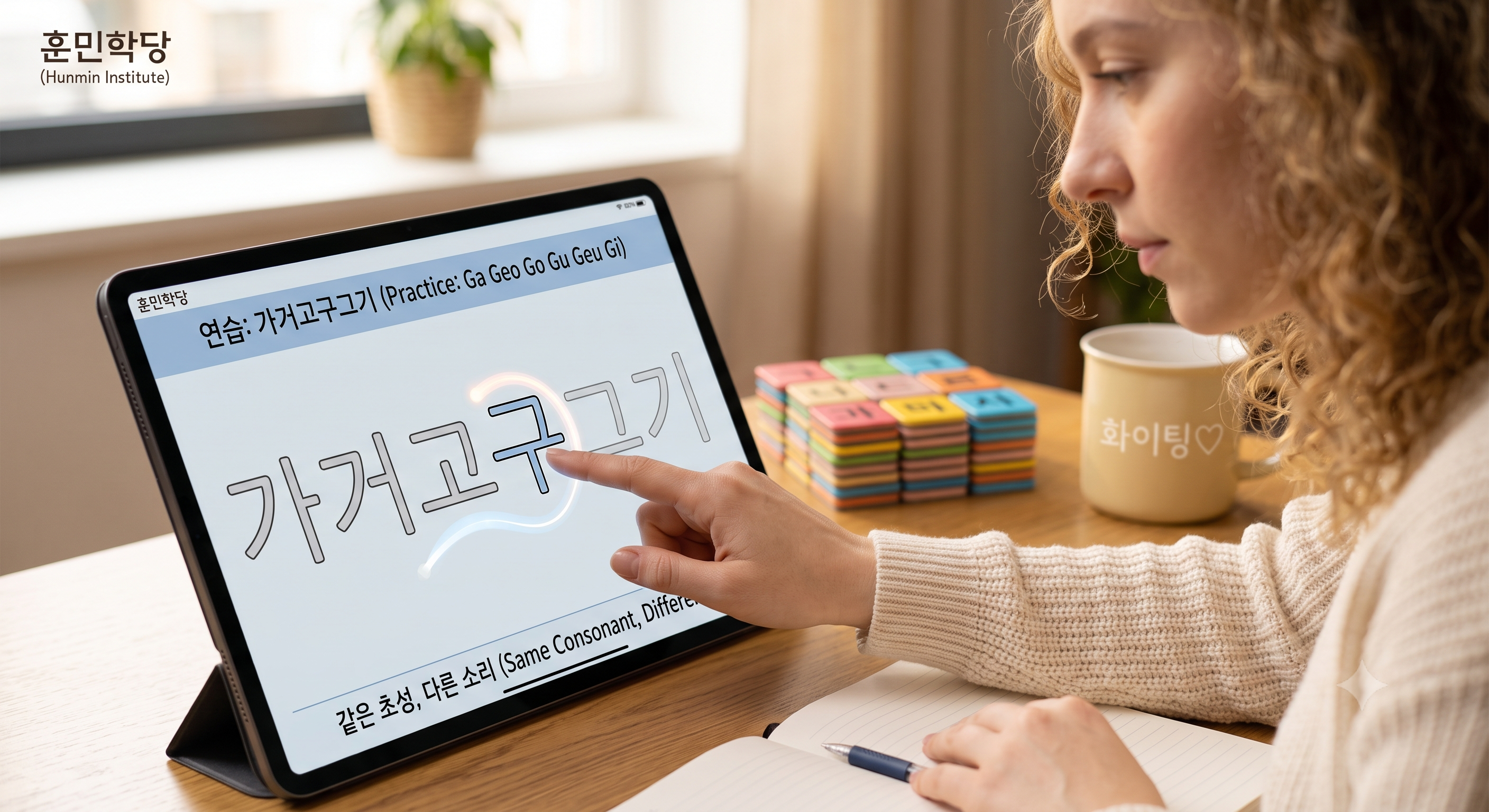
이번에는 반대로 갑니다. 초성 ㄱ을 고정하고 모음 열 개를 차례로 갈아 끼웁니다.
Now go the other way. Fix the initial consonant ㄱ and swap through all ten vowels in turn.
| 음절 Syllable |
결합 Combination |
예시 Example |
|---|---|---|
| 가 [ga] |
ㄱ + ㅏ | 가구 / 가루 / 가시 / 가마 [gagu] / [garu] / [gasi] / [gama] furniture / powder / thorn / kiln |
| 갸 [gya] |
ㄱ + ㅑ | 갸름하다 / 갸웃하다 / 갸륵하다 [gyareumhada] / [gyautada] / [gyareukada] to be slender / to tilt one’s head / to be admirable |
| 거 [geo] |
ㄱ + ㅓ | 거리 / 거위 / 거지 / 거기 [geori] / [geowi] / [geoji] / [geogi] street / goose / beggar / there |
| 겨 [gyeo] |
ㄱ + ㅕ | 겨자 / 겨우 / 겨레 / 겨루다 [gyeoja] / [gyeou] / [gyeore] / [gyeoruda] mustard / barely / kinsfolk / to compete |
| 고 [go] |
ㄱ + ㅗ | 고기 / 고모 / 고추 / 고사리 [gogi] / [gomo] / [gochu] / [gosari] meat / paternal aunt / chilli / bracken |
| 교 [gyo] |
ㄱ + ㅛ | 교실 / 교회 / 교수 / 교대 [gyosil] / [gyohoe] / [gyosu] / [gyodae] classroom / church / professor / shift change |
| 구 [gu] |
ㄱ + ㅜ | 구름 / 구슬 / 구조 / 구기 [gureum] / [guseul] / [gujo] / [gugi] cloud / marble / structure / ball game |
| 규 [gyu] |
ㄱ + ㅠ | 규칙 / 규정 / 규격 / 규수 [gyuchik] / [gyujeong] / [gyugyeok] / [gyusu] rule / regulation / standard / young lady |
| 그 [geu] |
ㄱ + ㅡ | 그네 / 그늘 / 그릇 / 그리고 [geune] / [geuneul] / [geureut] / [geurigo] swing / shade / bowl / and |
| 기 [gi] |
ㄱ + ㅣ | 기차 / 기자 / 기린 / 기지개 [gicha] / [gija] / [girin] / [gijigae] train / reporter / giraffe / a stretch |
여기서 쓰는 문장부터 배워 봅시다. 소리 내어 읽고 확인받을 때 오가는 문장입니다.
Now for the sentences you use here. These go back and forth when you read aloud and ask to be checked.
| 듣는 문장 Listening |
쓰는 문장 Writing |
|---|---|
| 소리 내어 읽어 보세요. [sori naeeo ilgeo boseyo] Try reading it aloud. |
제가 맞게 읽었어요? [jega matge ilgeosseoyo] Did I read that correctly? |
| 모음만 바꿔서 읽어 보세요. [moeumman bakkwoseo ilgeo boseyo] Change only the vowel and read it. |
한 번 더 읽어 볼게요. [han beon deo ilgeo bolgeyo] Let me read it one more time. |
▶초성이 같아도 모음이 갈리면 전혀 다른 글자가 됩니다.
Even with the same initial consonant, a different vowel makes a completely different syllable.
가와 고와 기는 모두 ㄱ으로 시작하지만 서로 다른 말입니다. 이 원리를 잡으면 처음 보는 글자도 조합해 읽힙니다. 지금 배운 것으로 아래 다섯 단어를 소리 내어 읽어 보십시오. 가수, 나비, 다리, 바다, 아이.
가, 고, and 기 all start with ㄱ yet are entirely different words. Grasp this and unfamiliar syllables open up by assembly. Using what you have just learned, read these five words aloud: 가수, 나비, 다리, 바다, 아이.
한글은 외우는 글자가 아니라 조립하는 글자입니다. 자음 열넷의 이름과 소리값을 갈라 두고, 모음 열의 붙는 자리를 모양에서 읽어 내면, 그 둘을 붙이는 것만으로 받침 없는 글자가 전부 열립니다. 다음은 그 아래에 한 칸이 더 붙는 받침입니다.
Hangul is not a script you memorize but one you assemble. Keep the names and sound values of the fourteen consonants apart, read each of the ten vowels’ position off its shape, and simply joining the two opens every syllable without batchim. Next comes batchim, one more slot underneath.
Next: How to Read Hangul Part 2: Batchim ↗
토픽 맛보기
TOPIK Preview
유형: TOPIK Ⅰ 읽기 [34~39], 설명문, 빈칸에 알맞은 것 고르기
Type: TOPIK I Reading [34–39], expository text, choose the word for the blank
( )에 들어갈 말로 가장 알맞은 것을 고르십시오.
Choose the word that best fits in the blank.
한글은 자음과 모음을 붙여 한 글자를 만듭니다. ㅏ와 ㅓ처럼 세로로 선 모음은 자음의 오른쪽에 붙습니다. ㅗ와 ㅜ처럼 가로로 누운 모음은 자음의 ( ) 붙습니다.
Hangul builds one syllable by joining a consonant and a vowel. Upright vowels such as ㅏ and ㅓ attach to the right of the consonant. Flat vowels such as ㅗ and ㅜ attach ( ) the consonant.
① 위에
② 아래에
③ 오른쪽에
④ 앞에
Answer ▾
정답 ② 아래에
Answer: ② below
지문이 가로로 누운 모음을 ㅗ와 ㅜ로 들고 그 자리를 묻고 있으므로 아래에가 맞습니다. ③ 오른쪽에는 지문에 나오지만 세로로 선 모음의 자리라 진술이 어긋나고, ① 위에는 세로와 가로를 가르는 지문의 기준 가운데 위아래라는 한쪽만 맞으며, ④ 앞에는 그럴듯해 보여도 지문에 나오지 않습니다. 흉내 낸 대문항은 TOPIK Ⅰ 읽기 [34~39] 빈칸에 알맞은 것 고르기입니다.
The passage names ㅗ and ㅜ as flat vowels and asks where they go, so below is correct. ③ appears in the passage but belongs to the upright vowels, which contradicts the statement. ① is partly right in using the vertical axis the passage sets up but picks the wrong end of it. ④ sounds plausible yet never appears. The item type modeled here is TOPIK I Reading [34–39], choosing the word for the blank.
FAQ
Q1. 자음과 모음을 낱개로 다 외워야 하나요?Answer ▾
Q1. Do I have to memorize every consonant and vowel one by one?
A1. 낱개로 외우는 것보다 조합해서 읽는 편이 빠릅니다. 가나다라마바사처럼 초성을 훑고, 가거고구그기처럼 모음을 훑는 두 줄을 매일 소리 내어 읽으면 이름과 소리값이 함께 붙습니다.
A1. Reading them in combination beats memorizing them singly. Run 가나다라마바사 for the consonants and 가거고구그기 for the vowels aloud every day, and the names and sound values settle together.
Q2. 자음 이름을 몰라도 읽을 수 있나요?Answer ▾
Q2. Can I read without knowing the consonant names?
A2. 읽기만 하려면 소리값으로 충분합니다. 다만 한국인은 철자를 이름으로 알려 주므로, 이름을 모르면 기역에 아, 가예요라는 답을 듣고도 무슨 말인지 알 수 없습니다.
A2. For reading alone, the sound value is enough. But Koreans give spellings in letter names, so without them you will hear 기역에 아, 가예요 and still not know what was said.
Q3. ㅐ나 ㅚ 같은 모음은 왜 이 글에 없나요?Answer ▾
Q3. Why are vowels like ㅐ and ㅚ not in this post?
A3. 둘 이상을 겹쳐 만든 모음이라 기본 열 개를 먼저 세운 뒤에 다룹니다. 받침과 발음 규칙을 익힌 다음에 배우는 편이 빠르며, 기본 스물넷을 자기 것으로 만드는 것이 먼저입니다.
A3. They are built by combining two vowels, so they come after the basic ten are in place. Learning them after batchim and the pronunciation rules is faster, and making the basic twenty-four yours comes first.
Q4. 읽기는 되는데 발음이 어색합니다. 지금 고쳐야 하나요?Answer ▾
Q4. I can read but my pronunciation sounds off. Should I fix it now?
A4. 지금은 글자와 소리를 잇는 단계이므로 정확한 발음보다 소리 내어 읽는 횟수가 중요합니다. 표준 발음이 궁금하면 국립국어원 누리집의 표준 발음법에서 확인할 수 있고, 발음 규칙 자체는 이 커리큘럼 3부에서 따로 다룹니다.
A4. At this stage you are linking letters to sounds, so how often you read aloud matters more than accuracy. For the standard forms, see the Standard Pronunciation Rules on the National Institute of Korean Language site; the rules themselves are covered separately in Part 3 of this curriculum.
Vocabulary and Pronunciation for Foreigners
| No | Korean | Romanisation | Meaning |
|---|---|---|---|
| 1 | 글자 | geulja | (n) written syllable block [ˈsɪləbl blɑːk] |
| 2 | 단어 | daneo | (n) word [wɜːrd] |
| 3 | 자음 | jaeum | (n) consonant [ˈkɑːnsənənt] |
| 4 | 모음 | moeum | (n) vowel [ˈvaʊəl] |
| 5 | 소리 | sori | (n) sound [saʊnd] |
| ▾ 단어 73개 더 보기 Show 73 more ↗ | |||
The blog page has limits of space and function, so only five words are shown here. The rest of the word list, the audio, the sentences and tables, the FAQ, the worksheet, the TOPIK questions and the lesson video are on the Hunmin Institute website ↗, free and open to everyone, with no account needed.
참고 기관
Official Sources
국립국어원 ↗
National Institute of Korean Language
https://www.korean.go.kr/
기관 설명 보기 About this institute ▾
This institute sets Korean orthography, the standard pronunciation rules, and the Romanization system. The Language Norms menu at the top of the site holds the original text fixing the names and order of the letters, and learners can use the Korean Basic Dictionary run by the same institute, which carries definitions in eleven languages including English. Norms can be revised, so check here whenever a letter name or spelling is unclear.
※ 본 콘텐츠(원고, 이미지, 예문 포함)는 저작권법에 의해 보호받는 훈민학당의 저작물입니다. 무단 복제, 전재, 재배포 및 AI 학습 데이터로의 이용을 금합니다.
This content (manuscript, images, and example sentences) is the copyrighted property of Hunmin Institute, protected under copyright law. Unauthorized copying, reproduction, redistribution, and use as AI training data are prohibited.
'Reading Skills' 카테고리의 다른 글
| TOPIK Is a Scoring System, Not Just a Test (0) | 2026.07.27 |
|---|---|
| Korean Word Order Explained: Understand Any Sentence (0) | 2026.07.25 |
| How to Read Hangul Part 4: Reading Practice (0) | 2026.07.25 |
| How to Read Hangul Part 3: Pronunciation Rules (0) | 2026.07.25 |
| How to Read Hangul Part 2: Batchim (0) | 2026.07.23 |


