
Korean Taxi Phrases: Speak, Watch the Meter, Pay
택시는 말하지 않으면 출발하지 않습니다
A taxi is not a subway or a bus: it starts when you speak and stops when you ask.
Learn how to name a place, read the meter, and pay in Korean.
택시는 지하철이나 버스와 다릅니다. 목적지를 말해야 출발하고 세워 달라고 말해야 섭니다.
이 글에서 목적지를 말하는 법과 미터기를 읽는 법, 세우고 계산하는 한국어를 익힙니다.
The learning services for the teaching materials published on this blog are free and open to everyone on the Hunmin Institute website ↗, with no account needed.
이 글에서 배우는 핵심 회화
Key Expressions in This Lesson
택시 안에서 오가는 말은 타는 자리부터 내리는 자리까지 순서가 정해져 있습니다. 아래 여덟 문장은 좌우가 한 쌍의 대화가 아니라 각각 따로 익히는 문장입니다.
The lines spoken in a taxi follow a fixed order, from getting in to getting out. The two columns are not paired dialogue; each sentence is learned on its own.
| 듣는 말 Listening |
하는 말 Speaking |
|---|---|
| 어디로 모실까요? [eodiro mosilkkayo] Where would you like to go? |
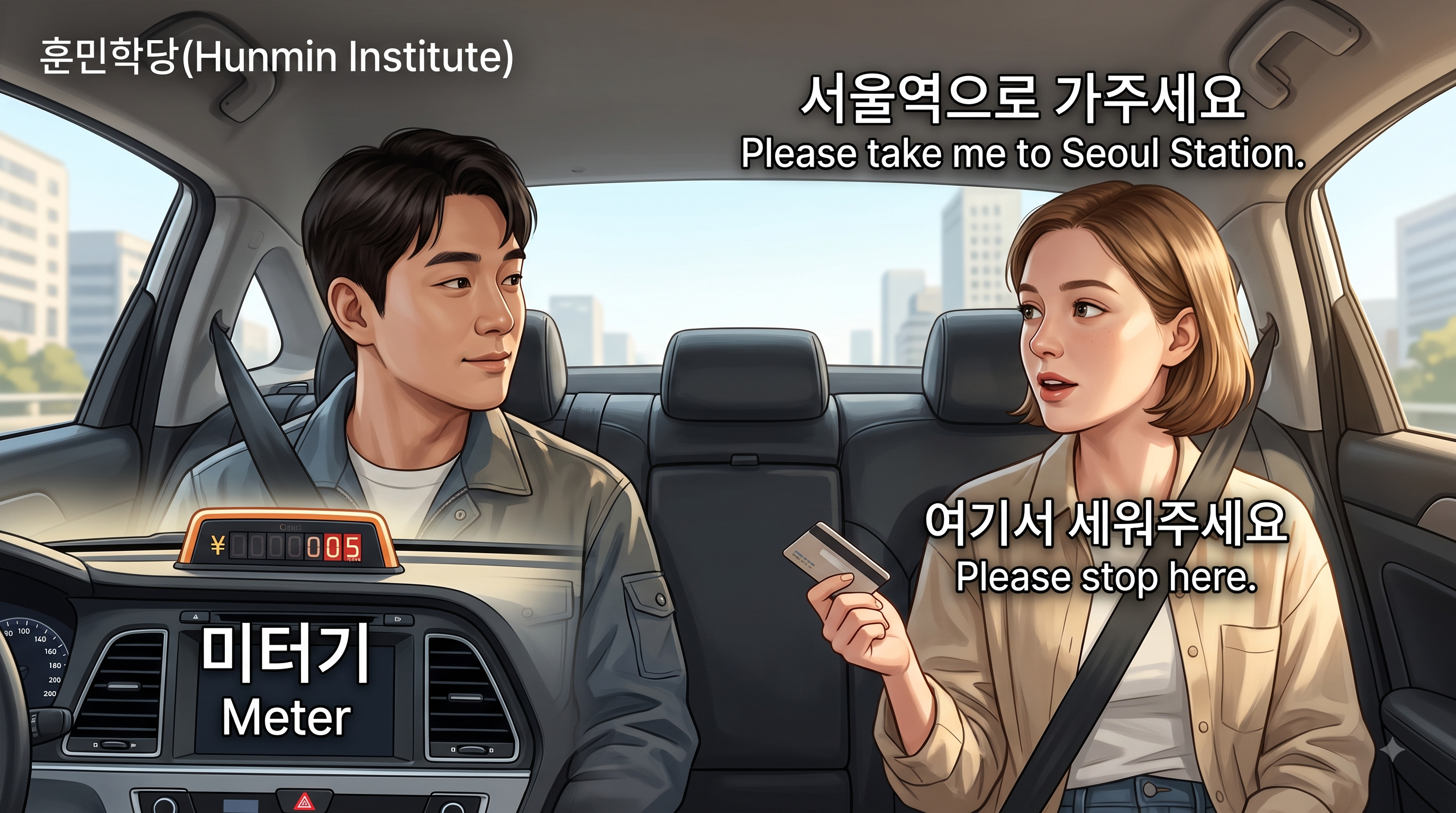
서울역으로 가주세요. [seoullyeogeuro gajuseyo] Please take me to Seoul Station. |
| 미터기 켰습니다. [miteogi kyeotseumnida] The meter is on. |
지금 할증 시간이에요? [jigeum haljjeung siganieyo] Is this the surcharge time? |
| 어느 쪽으로 갈까요? [eoneu jjogeuro galkkayo] Which way should I go? |
에어컨 좀 켜주세요. [eeokeon jom kyeojuseyo] Could you turn on the air conditioner? |
| 카드로 하시겠어요? [kadeuro hasigesseoyo] Would you like to pay by card? |
여기서 세워주세요. [yeogiseo sewojuseyo] Please stop here. |
첫째 줄은 소단락 1에서, 둘째 줄은 소단락 2에서, 셋째 줄은 소단락 3에서, 넷째 줄은 소단락 4에서 다룹니다.
The first row is covered in Section 1, the second in Section 2, the third in Section 3, and the fourth in Section 4.
1. 목적지를 말해야 출발합니다
A Taxi Starts Only After You Name the Place
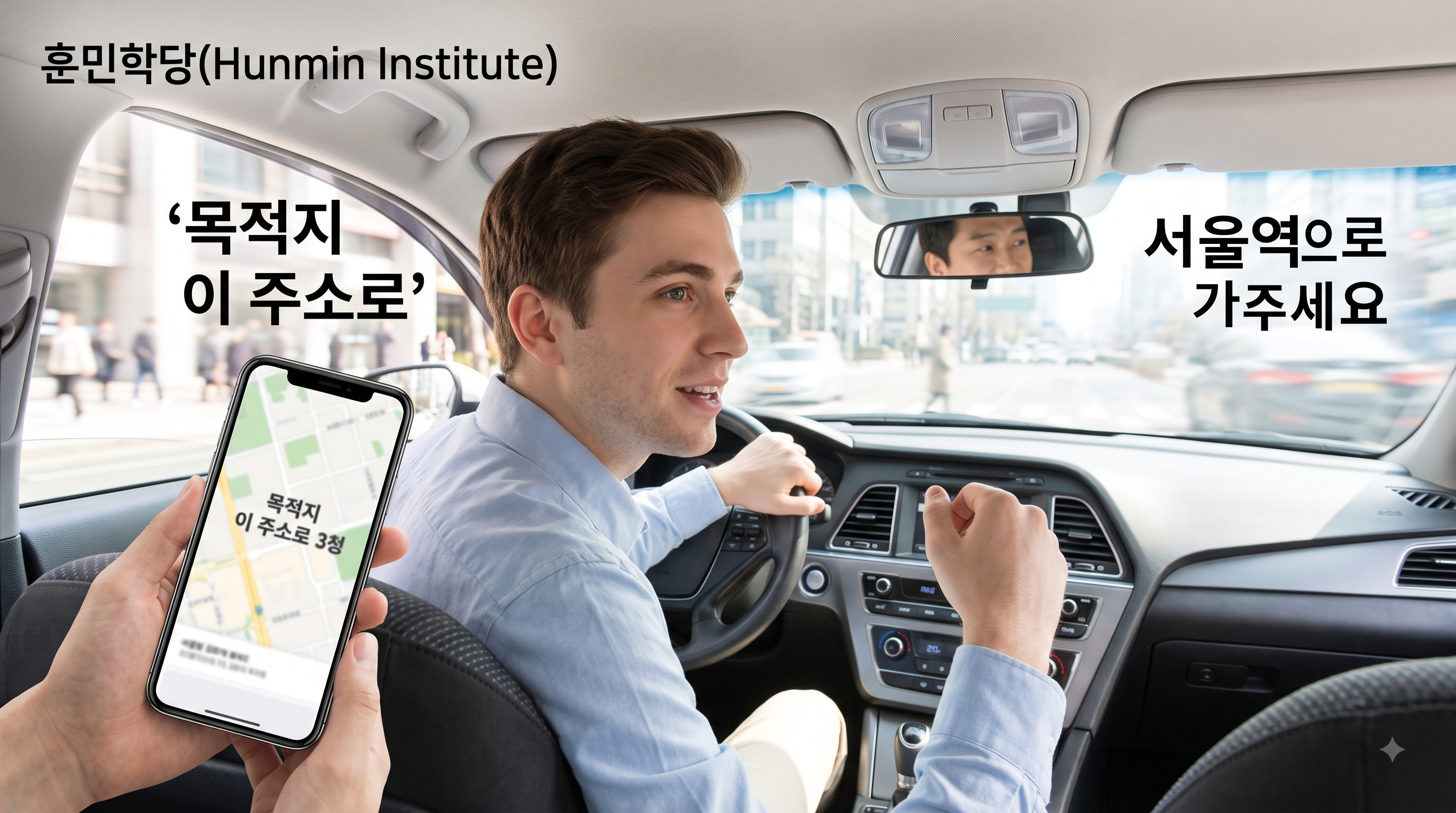
지하철은 노선이 정해져 있고 버스는 정류장이 정해져 있습니다. 택시만 승객이 어디로 갈지 말해야 움직입니다. 문을 열고 앉는 순간 기사가 먼저 묻습니다. 어디로 모실까요.
A subway has fixed lines and a bus has fixed stops. Only a taxi moves after the passenger says where to go. The moment you open the door and sit down, the driver asks first: 어디로 모실까요.
답하는 방법은 두 가지입니다. 목적지 이름을 말하거나 주소를 보여주는 것입니다. 지명 발음에 자신이 없으면 두 번째가 안전합니다. 다만 화면만 내밀고 아무 말도 하지 않으면 기사가 다시 묻게 되므로, 화면을 보여주면서 이 주소로 가주세요 한마디를 얹습니다.
There are two ways to answer: say the name of the place, or show the address. If you are unsure of the pronunciation, the second is safer. But holding out a screen without saying anything makes the driver ask again, so show the screen and add one line, 이 주소로 가주세요.
여기서 쓰는 표현부터 배워봅시다. 타면서 오가는 말입니다.
Start with the expressions you will use here. These go back and forth as you get in.
| 듣는 말 Listening |
하는 말 Speaking |
|---|---|
| 어디로 모실까요? [eodiro mosilkkayo] Where would you like to go? |
서울역으로 가주세요. [seoullyeogeuro gajuseyo] Please take me to Seoul Station. |
| 어디 가세요? [eodi gaseyo] Where are you going? |
이 주소로 가주세요. [i jusoro gajuseyo] Please take me to this address. |
| 주소 한 번만 보여주세요. [juso han beonman boyeojuseyo] Could you show me the address once? |
여기요, 화면 보세요. [yeogiyo, hwamyeon boseyo] Here, look at the screen. |
| 거기 어디쯤이에요? [geogi eodijjeumieyo] Whereabouts is that? |
강남역 근처예요. [gangnamyeok geuncheoyeyo] It is near Gangnam Station. |
응용 Apply It
↳ [장소]으로 가주세요
[place]euro gajuseyo
Please take me to [place].
ex [서울역]으로 가주세요./[강남]으로 가주세요./이 주소로 가주세요.
ROM [seoullyeog]euro gajuseyo/[gangnam]euro gajuseyo/i jusoro gajuseyo
EN Please take me to Seoul Station./Please take me to Gangnam./Please take me to this address.
▶목적지 뒤에 붙는 으로는 방향을 가리키는 조사입니다.
The particle euro after a place points to a direction.
서울역으로 가주세요는 서울역 쪽으로 데려다 달라는 뜻입니다. 서울역을 가주세요라고 하지 않습니다.
서울역으로 가주세요 means take me toward Seoul Station. You do not say 서울역을 가주세요.
받침이 있으면 으로, 받침이 없으면 로를 붙여 강남으로, 홍대로처럼 씁니다. 받침이 ㄹ일 때만 예외로 서울로처럼 로를 씁니다.
Add 으로 after a final consonant and 로 when there is none, as in 강남으로 and 홍대로. The one exception is a final ㄹ, which takes 로, as in 서울로.
지명을 소리 내어 말하기 어려우면 지도 앱의 주소 화면을 띄워 두는 편이 빠릅니다. 다만 말없이 화면만 내밀지 말고 이 주소로 가주세요를 함께 말하십시오.
If the place name is hard to say aloud, having the address open in a map app is faster. Just do not hold out the screen in silence: say 이 주소로 가주세요 with it.
2. 미터기가 켜졌는지 봅니다
Check That the Meter Is Running
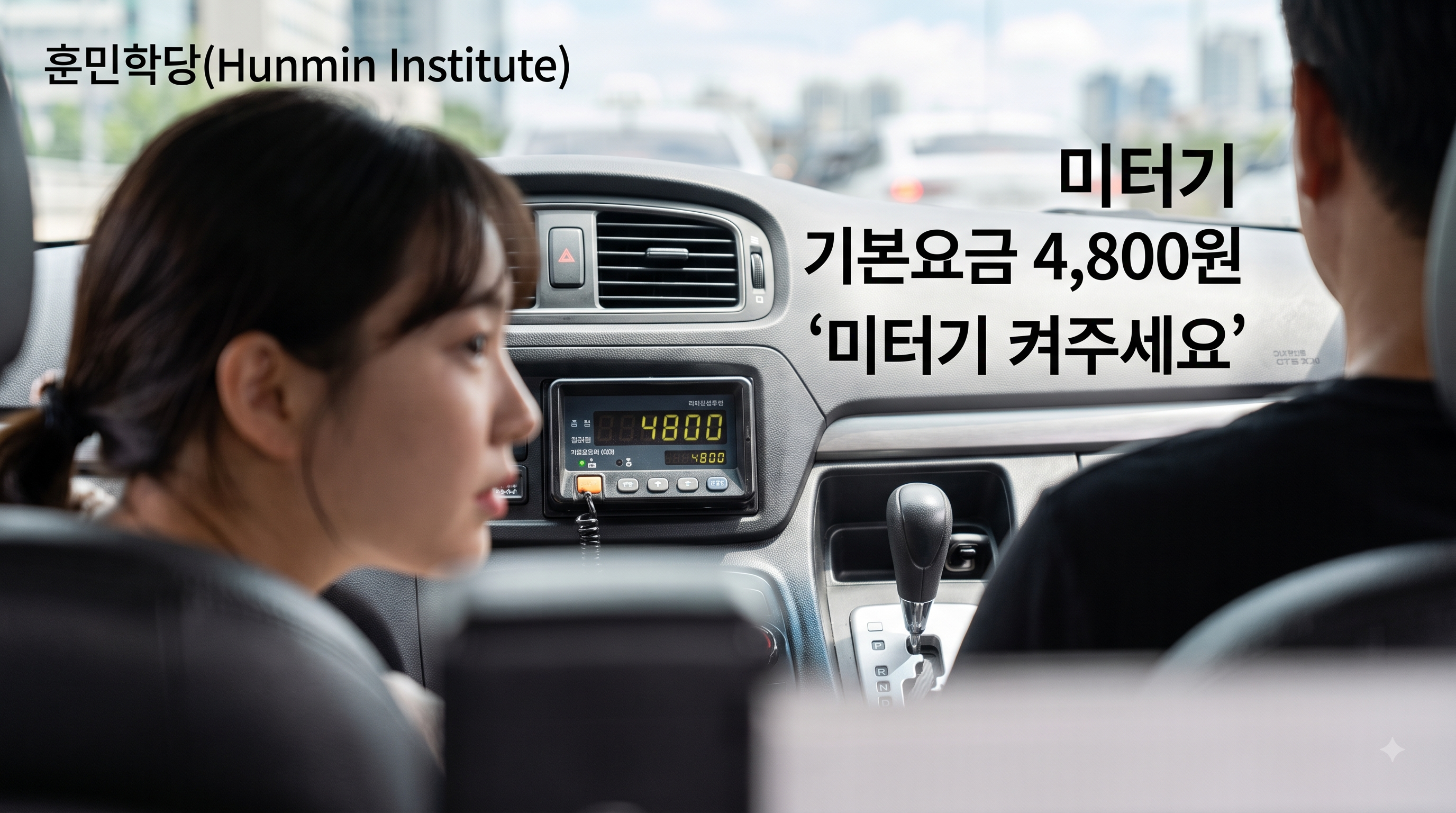
앉은 다음 가장 먼저 볼 것은 미터기 화면입니다. 서울의 일반 중형택시는 미터기에 찍힌 요금만 받게 되어 있고, 어기면 행정처분 대상입니다. 미터기를 켜지 않고 얼마라고 값을 부르면 그 자체가 정상이 아닙니다.
The first thing to look at after sitting down is the meter. A regular mid-size taxi in Seoul may charge only what the meter shows, and breaking that rule is subject to administrative penalty. If the meter is off and a price is quoted out loud, that itself is not normal.
같은 거리인데 값이 달라지는 이유도 미터기 안에 있습니다. 밤에는 기본요금부터 올라가고 서울을 벗어나면 할증이 붙습니다. 아래가 서울 기준 요금 구조입니다.
The reason the same distance costs different amounts is also inside the meter. At night the base fare itself goes up, and leaving Seoul adds a surcharge. Below is the fare structure for Seoul.
| 구분 Type |
내용 Details |
|---|---|
| 기본요금 [gibonyogeum] Base fare |
1.6킬로미터까지 4,800원 4,800 won for the first 1.6 km |
| 심야 할증 [simya haljjeung] Late-night surcharge |
밤 10시부터 11시와 새벽 2시부터 4시는 20퍼센트, 밤 11시부터 새벽 2시는 40퍼센트 20% from 22:00 to 23:00 and 02:00 to 04:00, 40% from 23:00 to 02:00 |
| 시계외 할증 [sigyeoe haljjeung] Out-of-city surcharge |
서울 경계를 벗어나는 구간부터 20퍼센트 20% from the point you cross the Seoul boundary |
| 중복 할증 [jungbok haljjeung] Combined surcharge |
심야와 시계외가 겹쳐도 최대 60퍼센트까지 Up to 60% even when the two overlap |
| 호출료 [hochullyo] Call fee |
사업자가 신고한 금액이 붙으며 호출 화면에 표시됩니다 Set by the operator’s filed rate and shown on the booking screen |
여기 적은 값은 2026년 8월 기준 서울시 중형택시 요금입니다. 여기서 쓰는 표현부터 배워봅시다. 미터기를 두고 오가는 말입니다.
The figures above are Seoul mid-size taxi fares as of August 2026. Start with the expressions you will use here. These go back and forth about the meter.
| 듣는 말 Listening |
하는 말 Speaking |
|---|---|
| 미터기 켰습니다. [miteogi kyeotseumnida] The meter is on. |
미터기 켜주세요. [miteogi kyeojuseyo] Please turn on the meter. |
| 지금은 할증 시간입니다. [jigeumeun haljjeung siganimnida] It is surcharge time now. |
지금 할증 시간이에요? [jigeum haljjeung siganieyo] Is this the surcharge time? |
| 서울 밖으로 나갑니다. [seoul bakkeuro nagamnida] We are leaving Seoul. |
시계외 할증 붙어요? [sigyeoe haljjeung butteoyo] Does the out-of-city surcharge apply? |
| 호출료가 붙습니다. [hochullyoga butseumnida] A call fee applies. |
호출료 얼마예요? [hochullyo eolmayeyo] How much is the call fee? |
▶할증은 따지는 말이 아니라 확인하는 말로 묻습니다.
Ask about the surcharge as a check, not as a complaint.
지금 할증 시간이에요는 값이 왜 이러냐는 항의가 아니라 지금이 그 시간대인지 확인하는 질문입니다. 할증은 [할쯩]으로 읽습니다.
지금 할증 시간이에요 is not a protest about the price but a question asking whether this is that time of day. 할증 is pronounced [할쯩].
화면에 할증 표시가 떠 있으므로 지금 어떤 요금으로 가고 있는지 눈으로 확인할 수 있습니다. 밤늦게 서울 밖으로 나가면 심야와 시계외가 함께 붙지만 상한이 정해져 있습니다.
The surcharge shows on the meter, so you can see with your own eyes which rate you are travelling on. Going outside Seoul late at night adds both, but there is a ceiling.
공항에는 예외가 하나 있습니다. 서울시 기준으로 인천국제공항은 서울시와 경기도 광명, 부천, 김포, 고양, 인천시까지 시계외 할증이 붙지 않고 그 바깥 경계부터 적용됩니다. 어느 지역 택시를 타느냐에 따라 안내가 다를 수 있으므로 승차장 안내판을 한 번 보고 타는 편이 확실합니다.
The airport is one exception. Under Seoul city rules, Incheon International Airport carries no out-of-city surcharge as far as Seoul, the Gyeonggi cities of Gwangmyeong, Bucheon, Gimpo and Goyang, and Incheon, and it applies only beyond that boundary. The notice can differ by the taxi’s home region, so check the sign at the stand before getting in.
3. 기사가 묻는 말에 답합니다
Answering the Driver on the Way
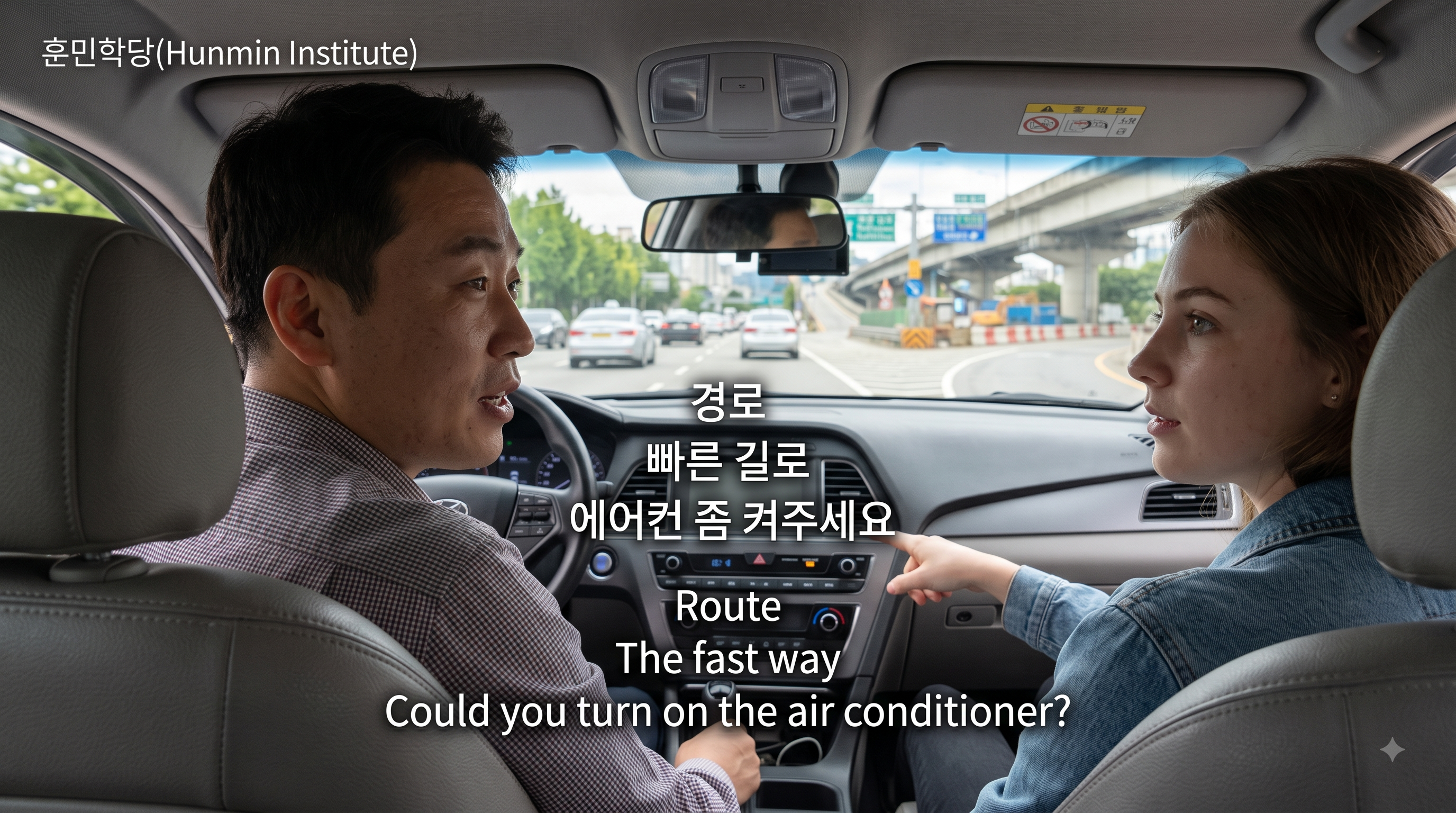
출발하고 나면 기사가 한두 마디를 겁니다. 대부분은 경로 확인입니다. 어느 쪽으로 갈지, 고속도로를 탈지를 묻는데, 이 질문에 답을 하지 않으면 기사가 판단해 길을 정합니다. 길이 달라지면 요금도 달라지므로 이 자리에서는 짧게라도 대답하는 편이 낫습니다.
Once you set off, the driver says a word or two. Most of it is about the route. He asks which way to go or whether to take the expressway, and if you do not answer he decides the road himself. A different road means a different fare, so it is better to answer here, even briefly.
경로를 모르면 아무 길이나 고르지 말고 빠른 길로 가주세요 한 문장이면 충분합니다. 차 안이 덥거나 음악이 크면 그것도 이 구간에서 말합니다.
If you do not know the route, do not pick a road at random; one sentence, 빠른 길로 가주세요, is enough. If the car is hot or the music is loud, this is also the stretch where you say so.
여기서 쓰는 표현부터 배워봅시다. 가는 동안 오가는 말입니다.
Start with the expressions you will use here. These go back and forth while you ride.
| 듣는 말 Listening |
하는 말 Speaking |
|---|---|
| 어느 쪽으로 갈까요? [eoneu jjogeuro galkkayo] Which way should I go? |
빠른 길로 가주세요. [ppareun gillo gajuseyo] Please take the fast route. |
| 고속도로로 갈까요? [gosokdororo galkkayo] Shall I take the expressway? |
고속도로로 가주세요. [gosokdororo gajuseyo] Please take the expressway. |
| 더우세요? [deouseyo] Are you hot? |
에어컨 좀 켜주세요. [eeokeon jom kyeojuseyo] Could you turn on the air conditioner? |
| 음악 좀 줄일까요? [eumak jom jurilkkayo] Shall I turn the music down? |
창문 좀 열어주세요. [changmun jom yeoreojuseyo] Could you open the window? |
▶좀은 양을 줄이라는 말이 아니라 부탁을 부드럽게 만드는 말입니다.
Jom does not ask for less; it softens the request.
에어컨 좀 켜주세요는 조금만 켜 달라는 뜻이 아니라 켜 주시겠느냐는 부탁입니다. 좀을 빼고 에어컨 켜주세요라고 해도 틀리지 않지만 명령처럼 들립니다.
에어컨 좀 켜주세요 does not ask for a little cooling; it is a polite request to turn it on. 에어컨 켜주세요 without 좀 is not wrong, but it sounds like an order.
창문, 히터, 라디오도 같은 자리에 넣어 쓸 수 있습니다. 버스 편에서 익힌 문 좀 열어주세요와 같은 틀입니다.
창문, 히터 and 라디오 fit the same slot. It is the same pattern as 문 좀 열어주세요 from the bus post.
경로를 고르기 어려우면 빠른 길로 가주세요 한 문장이 가장 무난합니다. 요금이 걱정되면 미터기를 보면서 가면 됩니다.
If choosing a route is hard, 빠른 길로 가주세요 is the safest single sentence, and you can watch the meter as you go if the fare worries you.
4. 세워 달라고 말해야 섭니다
Stopping and Paying
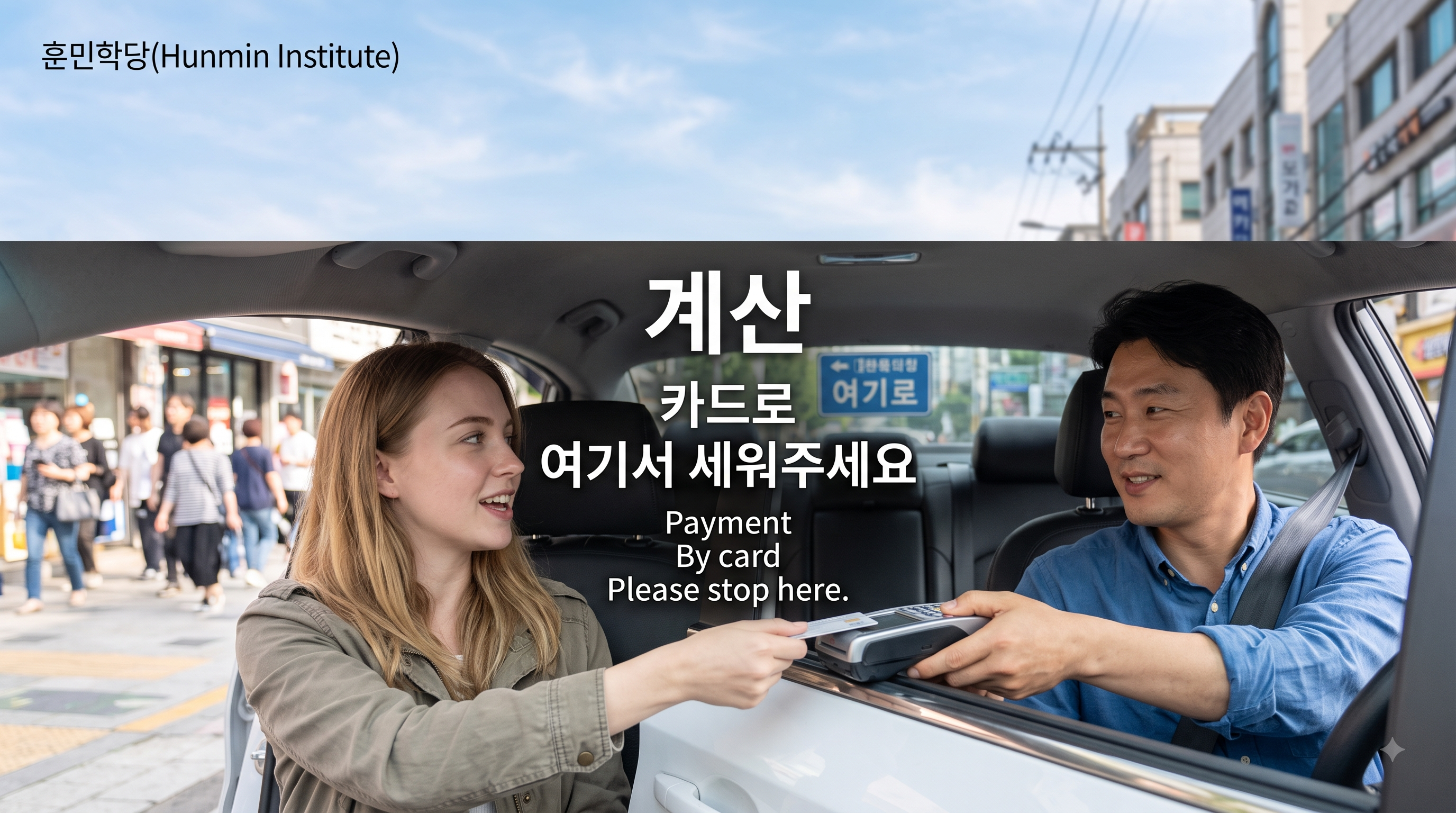
목적지 근처에 오면 어디서 내릴지를 다시 정해야 합니다. 택시는 정류장이 없어서 승객이 말한 자리에 섭니다. 건물 앞이 막혀 있으면 조금 더 가 달라고 하고, 신호 앞이면 지나서 세워 달라고 합니다.
As you near the destination, you have to decide again where to get out. A taxi has no stops, so it pulls over where the passenger says. If the front of the building is blocked, ask to go a little farther; if you are at a light, ask to stop past it.
계산은 대부분 카드로 합니다. 기사가 결제 수단을 먼저 묻는 경우가 많고, 묻지 않으면 승객이 먼저 말합니다.
Most people pay by card. The driver often asks about the payment method first, and if he does not, the passenger says it first.
여기서 쓰는 표현부터 배워봅시다. 내리면서 오가는 말입니다.
Start with the expressions you will use here. These go back and forth as you get out.
| 듣는 말 Listening |
하는 말 Speaking |
|---|---|
| 여기서 세워 드릴까요? [yeogiseo sewo deurilkkayo] Shall I stop here? |
여기서 세워주세요. [yeogiseo sewojuseyo] Please stop here. |
| 다 왔습니다. [da watseumnida] We have arrived. |
조금만 더 가주세요. [jogeumman deo gajuseyo] Please go a little farther. |
| 만 이천 원입니다. [man icheon wonimnida] It is twelve thousand won. |
얼마 나왔어요? [eolma nawasseoyo] How much is it? |
| 카드로 하시겠어요? [kadeuro hasigesseoyo] Would you like to pay by card? |
카드로 할게요. [kadeuro halgeyo] I will pay by card. |
▶여기서 세워주세요는 자리를 정하는 말이고, 카드로 할게요는 방법을 정하는 말입니다.
One line fixes the spot; the other fixes the method.
여기서 [동사]아 주세요 자리에는 세워, 내려, 기다려가 들어가 여기서 내려주세요, 여기서 기다려주세요로 벌어집니다.
The slot 여기서 [verb]아 주세요 takes 세워, 내려 and 기다려, opening into 여기서 내려주세요 and 여기서 기다려주세요.
계산할 때는 [명사]로 할게요를 써서 카드로 할게요, 현금으로 할게요처럼 말하며 식당에서도 같은 자리에 그대로 쓰입니다.
For payment, [noun]로 할게요 gives 카드로 할게요 and 현금으로 할게요, and the same line works in a restaurant.
얼마 나왔어요는 금액을 묻는 말이며, 미터기에 이미 떠 있어도 확인 삼아 묻는 경우가 많습니다.
얼마 나왔어요 asks the amount, and people often ask it as a check even when the meter already shows it.
택시는 목적지를 말해야 출발하고, 미터기를 봐야 요금을 알고, 세워 달라고 말해야 섭니다. 이 세 자리에서 쓸 문장을 익히면 택시 안에서 할 일은 끝납니다.
A taxi starts when you name the place, tells you the fare through the meter, and stops when you ask. Learn the sentences for those three points and there is nothing else to do inside a taxi.
That completes all fifteen Real Talk lessons. You began at immigration and came through restaurants and cafes, delivery, the subway and the bus, all the way to the taxi. You now have a sentence ready for every place a day in Korea takes you. Congratulations.
토픽 맛보기
TOPIK Preview
유형: TOPIK Ⅰ 읽기 [43~45], 설명문, 일치하는 내용 고르기
Type: TOPIK I Reading [43–45], expository text, choose the statement that matches
다음 글의 내용과 같은 것을 고르십시오.
Choose the statement that matches the passage.
서울에서 택시를 타면 미터기에 나온 요금만 냅니다. 밤 열한 시부터 새벽 두 시까지는 요금이 40퍼센트 더 붙습니다. 서울 밖으로 나가면 20퍼센트가 더 붙지만, 두 가지가 겹쳐도 60퍼센트를 넘지 않습니다.
In Seoul you pay only the fare shown on the meter. From 23:00 to 02:00 the fare is 40 percent higher. Going outside Seoul adds 20 percent, but even together they never exceed 60 percent.
① 서울 택시는 요금을 미리 정해서 냅니다.
② 밤에는 언제나 요금이 40퍼센트 올라갑니다.
③ 할증이 겹쳐도 60퍼센트까지만 붙습니다.
④ 서울 밖으로 나가면 할증이 없습니다.
Answer ▾
정답 ③ 할증이 겹쳐도 60퍼센트까지만 붙습니다
Answer: ③ 할증이 겹쳐도 60퍼센트까지만 붙습니다
지문 끝이 두 가지가 겹쳐도 60퍼센트를 넘지 않는다고 밝혔으므로 ③이 맞습니다. ①은 미터기에 나온 요금만 낸다는 첫 문장과 어긋나고, ②는 40퍼센트가 붙는 시간을 밤 열한 시부터 새벽 두 시까지로 한정했으므로 일부만 맞으며, ④는 그럴듯해 보여도 서울 밖에서 20퍼센트가 붙는다는 문장과 반대입니다. 흉내 낸 대문항은 TOPIK Ⅰ 읽기 [43~45]입니다.
The last line says the two together never exceed 60 percent, so ③ matches. ① contradicts the opening line about paying only the meter fare, ② is only partly right since the 40 percent band runs from 23:00 to 02:00, and ④ is the opposite of the line about the 20 percent outside Seoul. The item type modeled here is TOPIK I Reading [43–45].
FAQ
Q1. 짐이 많으면 요금이 더 나오나요?Answer ▾
Q1. Does a lot of luggage cost extra?
A1. 트렁크에 넣는 짐에 따로 붙는 요금은 없습니다. 다만 짐이 많으면 대형택시를 부르는 편이 편하고, 이 경우 기본요금이 3킬로미터까지 7,000원인 다른 요금표가 적용됩니다.
A1. There is no separate charge for luggage in the trunk. With a lot of bags a large taxi is easier, and that car follows a different table, 7,000 won for the first 3 km.
Q2. 팁을 줘야 하나요?Answer ▾
Q2. Do I need to tip?
A2. 한국 택시에는 팁 문화가 없습니다. 미터기에 나온 금액만 내면 되고, 잔돈을 받지 않겠다고 말할 필요도 없습니다.
A2. Korean taxis have no tipping culture. Pay only the amount on the meter; you do not have to tell the driver to keep the change.
Q3. 외국인이라고 요금이 더 붙는 경우가 있나요?Answer ▾
Q3. Is there an extra charge for foreigners?
A3. 길에서 잡는 일반 택시는 미터기에 나온 요금으로 갑니다. 다만 통역 서비스가 붙는 외국인관광택시는 별도 제도로 운영되어 요금 체계가 다르므로, 공항이나 관광지에서 이 차를 이용할 때는 요금 안내를 먼저 확인합니다.
A3. A regular taxi hailed on the street runs on the meter fare. The International Taxi, which comes with interpretation, is a separate scheme with its own fare structure, so check the fare notice first when you use one at an airport or a tourist area.
Q4. 서울 밖에서 타는 택시도 요금이 같나요?Answer ▾
Q4. Is the fare the same outside Seoul?
A4. 다릅니다. 택시 요금은 지역마다 따로 정해지므로 부산과 대구, 제주가 각각 다릅니다. 이 글의 금액은 서울 기준이며, 다른 지역은 그 지역 시청이나 도청 자료에서 확인합니다.
A4. No. Taxi fares are set region by region, so Busan, Daegu and Jeju all differ. The amounts here are for Seoul; for other regions, check the city or provincial government material.
Vocabulary and Pronunciation for Foreigners
| No | Korean | Romanisation | Meaning |
|---|---|---|---|
| 1 | 목적지 | mokjeokji | (n) destination [ˌdestɪˈneɪʃn] |
| 2 | 미터기 | miteogi | (n) taxi meter [ˈmiːtər] |
| 3 | 할증 | haljjeung | (n) surcharge [ˈsɜːrtʃɑːrdʒ] |
| 4 | 호출료 | hochullyo | (n) call fee [kɔːl fiː] |
| 5 | 현금 | hyeongeum | (n) cash [kæʃ] |
| ▾ 단어 50개 더 보기 Show 50 more ↗ | |||
The blog page has limits of space and function, so only five words are shown here. The rest of the word list, the audio, the sentences and tables, the FAQ, the worksheet, the TOPIK questions and the lesson video are on the Hunmin Institute website ↗, free and open to everyone, with no account needed.
참고 기관
Official Sources
서울특별시 택시요금 ↗
Seoul Metropolitan Government, Taxi Fares
https://news.seoul.go.kr/traffic/archives/1659
기관 설명 보기 About this institute ▾
This is where the amounts in this post come from. The page is in Korean, but the fare table is numbers and time bands, so the table alone is readable. When fares rise, this page changes first, so check before you ride.
국토교통부 ↗
Ministry of Land, Infrastructure and Transport
https://www.molit.go.kr
기관 설명 보기 About this institute ▾
This is the ministry where app call fees are filed. It has English pages, but individual app fees are not searchable there, so check the call fee on the amount shown on your booking screen.
※ 본 콘텐츠(원고, 이미지, 예문 포함)는 저작권법에 의해 보호받는 훈민학당의 저작물입니다. 무단 복제, 전재, 재배포 및 AI 학습 데이터로의 이용을 금합니다.
This content (manuscript, images, and example sentences) is the copyrighted property of Hunmin Institute, protected under copyright law. Unauthorized copying, reproduction, redistribution, and use as AI training data are prohibited.
'Real Talk' 카테고리의 다른 글
| Korean Bus Phrases: Read the Color, Signal Twice (0) | 2026.08.18 |
|---|---|
| Korean Subway Phrases: From the Gate to the Right Exit (0) | 2026.08.18 |
| Korean Food Delivery Phrases: What to Write in the Request Box (0) | 2026.08.18 |
| How to Order Coffee in Korean: From Counter to Buzzer (0) | 2026.08.17 |
| How to Order in a Korean Restaurant: Call, Ask, Pay (0) | 2026.08.16 |


