
Korean Bus Phrases: Read the Color, Signal Twice
버스는 손을 들어야 서고 벨을 눌러야 섭니다
A Korean bus stops only if you signal: a hand to board, a bell to get off.
Learn the route colors and the Korean spoken at each of those signals.
한국 버스는 정류장에 서 있다고 저절로 서지 않습니다. 탈 때는 손을 들고 내릴 때는 벨을 눌러야 섭니다.
이 글에서 색과 번호로 노선을 읽는 법과, 버스를 세우는 두 신호에 오가는 한국어를 익힙니다.
The learning services for the teaching materials published on this blog are free and open to everyone on the Hunmin Institute website ↗, with no account needed.
이 글에서 배우는 핵심 회화
Key Expressions in This Lesson
버스에서 오가는 말은 몇 마디로 정해져 있습니다. 아래 여덟 문장은 좌우가 한 쌍의 대화가 아니라 각각 따로 익히는 문장이며, 왼쪽은 기사의 말과 안내 방송이 섞여 있습니다.
Only a few lines pass on a bus. The two columns are not paired dialogue; each sentence is learned on its own, and the left-hand side mixes the driver’s words with the announcements.
| 듣는 말 Listening |
하는 말 Speaking |
|---|---|
| 잠시 후 273번 버스가 도착합니다. [jamsi hu ibaekchilsipsam beon beoseuga dochakhamnida] Bus number 273 is arriving shortly. |
273번 맞아요? [ibaekchilsipsam beon majayo] Is this number 273? |
| 안쪽으로 들어가 주세요. [anjjogeuro deureoga juseyo] Please move to the back. |
이거 서울역 가요? [igeo seoullyeok gayo] Does this bus go to Seoul Station? |
| 다음 정류장은 남대문시장입니다. [daeum jeongnyujangeun namdaemunsijangimnida] The next stop is Namdaemun Market. |
벨 눌렀어요. [bel nulleosseoyo] I already pressed the bell. |
| 뒷문으로 내리세요. [dwinmuneuro naeriseyo] Please exit through the rear door. |
문 좀 열어주세요. [mun jom yeoreojuseyo] Could you open the door, please? |
첫째 줄은 소단락 1에서, 둘째 줄은 소단락 2에서, 셋째 줄은 소단락 3에서, 넷째 줄은 소단락 4에서 다룹니다.
The first row is covered in Section 1, the second in Section 2, the third in Section 3, and the fourth in Section 4.
1. 색과 번호가 노선을 말해 줍니다
The Color and Number Tell You the Route
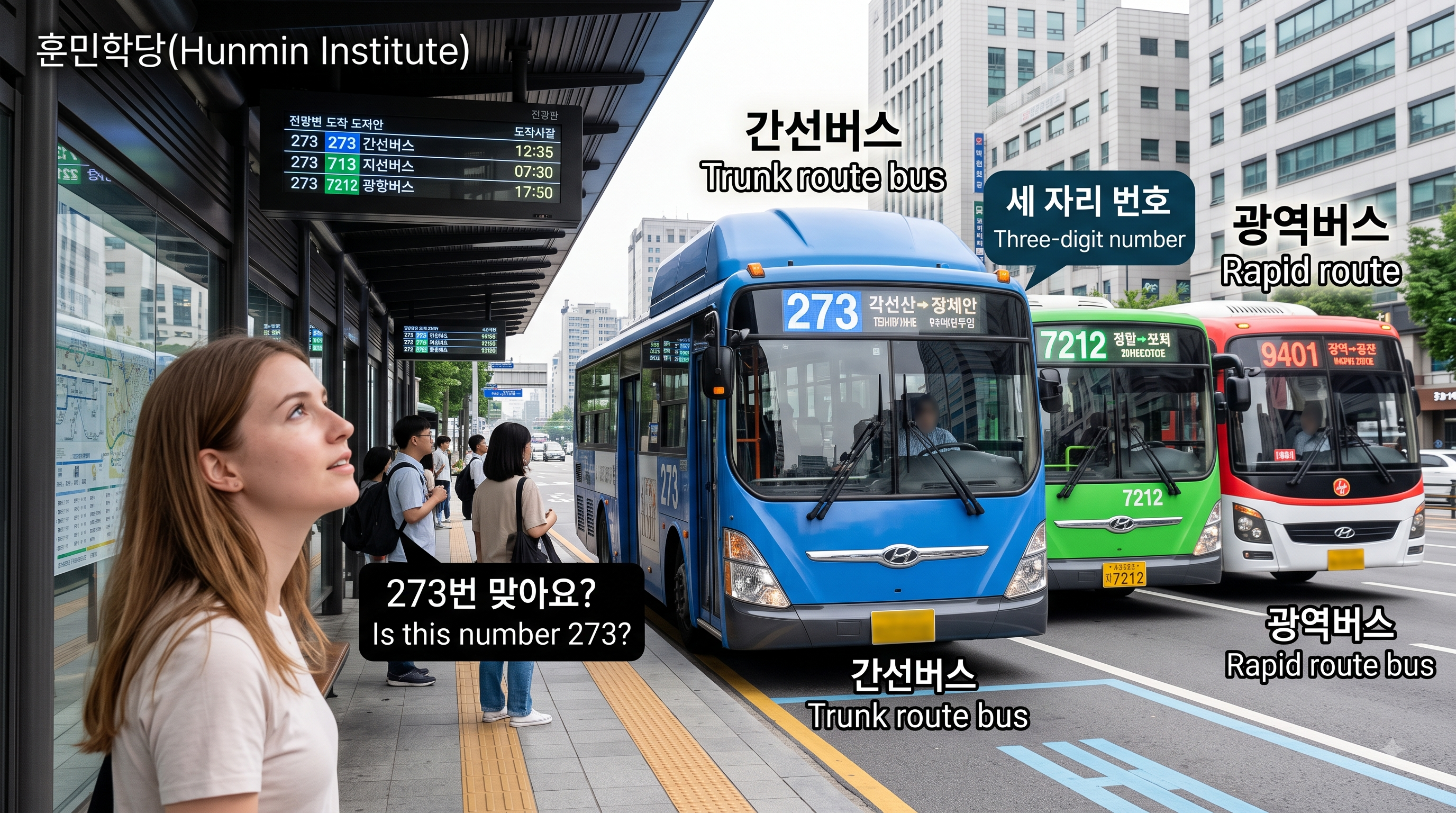
서울에서 버스를 기다릴 때 가장 먼저 눈에 들어오는 것은 번호가 아니라 색입니다. 파랑은 도심과 외곽을 길게 잇는 간선, 초록은 동네와 지하철역을 잇는 지선, 빨강은 수도권과 서울을 오가는 광역, 노랑은 도심을 도는 순환입니다.
When you wait for a bus in Seoul, the first thing you notice is not the number but the color. Blue is a trunk route running long distances between downtown and the outskirts, green is a branch route linking neighborhoods to subway stations, red is a wide-area route between Seoul and the surrounding region, and yellow circles the city center.
마을버스는 여기서 한 번 걸립니다. 마을버스도 초록이라 지선과 색이 같습니다. 가르는 것은 번호이며, 마을버스에는 서초07이나 종로08처럼 지역 이름이 앞에 붙습니다.
Village buses are the one catch. They are green as well, the same color as branch routes. What separates them is the number: a village bus carries a district name in front, such as Seocho 07 or Jongno 08.
색을 요금과 함께 봐야 하는 이유가 있습니다. 같은 정류장에 서는 버스라도 빨간 버스는 요금이 두 배입니다.
There is a reason to read the color together with the fare. Even among buses that stop at the same place, a red one costs twice as much.
| 색 Color |
노선 Route |
성격 What it does |
기본요금 Base fare |
|---|---|---|---|
| 파랑 [parang] Blue |
간선 [ganseon] Trunk |
도심과 외곽을 잇는 장거리 Long routes between downtown and the outskirts |
1,500원 1,500 won |
| 초록 [chorok] Green |
지선 [jiseon] Branch |
동네와 지하철역 연결 Links neighborhoods to subway stations |
1,500원 1,500 won |
| 빨강 [ppalgang] Red |
광역 [gwangyeok] Wide-area |
수도권과 서울 사이 Between Seoul and the wider region |
3,000원 3,000 won |
| 노랑 [norang] Yellow |
순환 [sunhwan] Circular |
도심 순환 Loops around the city center |
1,400원 1,400 won |
| 초록 [chorok] Green with a district name |
마을버스 [maeulbeoseu] Village |
동네 안쪽 골목 Small streets inside a neighborhood |
1,200원 1,200 won |
여기 적은 값은 2026년 8월 기준 서울시 교통카드 요금입니다. 여기서 쓰는 표현부터 배워봅시다. 번호를 확인할 때 오가는 말입니다.
The figures above are Seoul transit card fares as of August 2026. Start with the expressions you will use here. These go back and forth as you check the number.
| 듣는 말 Listening |
하는 말 Speaking |
|---|---|
| 잠시 후 273번 버스가 도착합니다. [jamsi hu ibaekchilsipsam beon beoseuga dochakhamnida] Bus number 273 is arriving shortly. |
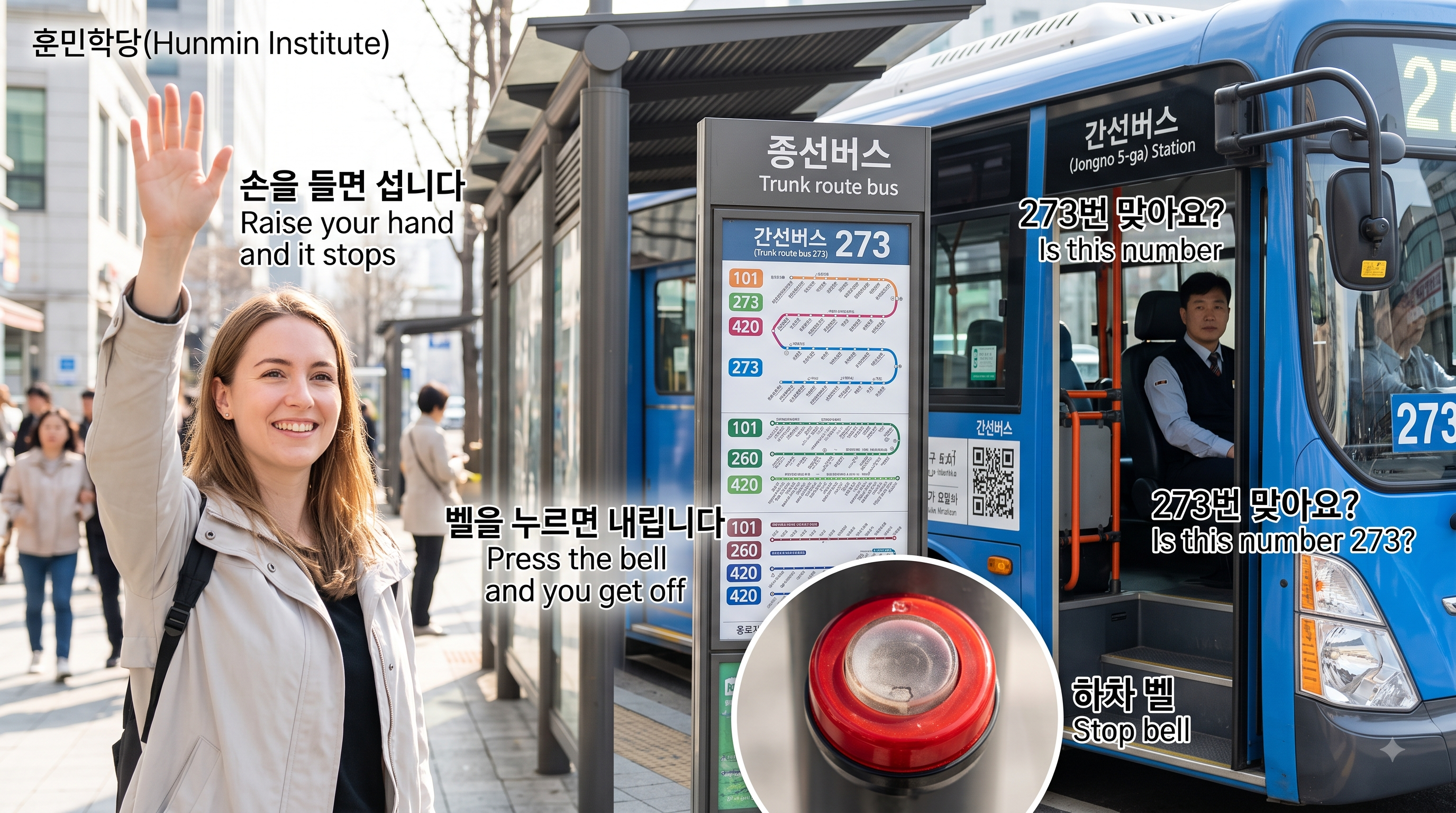
273번 맞아요? [ibaekchilsipsam beon majayo] Is this number 273? |
| 이 차는 광역버스입니다. [i chaneun gwangyeokbeoseuimnida] This is a wide-area bus. |
요금 얼마예요? [yogeum eolmayeyo] How much is the fare? |
| 마을버스는 저쪽에서 타세요. [maeulbeoseuneun jeojjogeseo taseyo] Take the village bus over there. |
마을버스 어디서 타요? [maeulbeoseu eodiseo tayo] Where do I catch the village bus? |
| 이 정류장은 273번이 안 서요. [i jeongnyujangeun ibaekchilsipsam beoni an seoyo] Number 273 does not stop here. |
여기 서요? [yeogi seoyo] Does it stop here? |
응용 Apply It
↳ [명사] 맞아요?
[noun] majayo
Is this the right [noun]?
ex [273번] 맞아요?/[간선] 맞아요?/[이 정류장] 맞아요?
ROM [ibaekchilsipsam beon] majayo/[ganseon] majayo/[i jeongnyujang] majayo
EN Is this number 273?/Is this a trunk route?/Is this the right stop?
▶번호는 한 자리씩 끊어 읽지 않습니다.
Route numbers are not read digit by digit.
273번은 이백칠십삼 번입니다. 둘 일곱 셋처럼 끊어 읽지 않으므로 자릿수째로 듣는 연습이 필요합니다. 확신이 서지 않으면 버스 앞쪽 번호판을 가리키며 273번 맞아요라고 물으면 됩니다.
273 is read ibaekchilsipsam, not as two-seven-three, so you have to train your ear to whole place values. When you are unsure, point at the number panel on the front of the bus and ask 273번 맞아요.
번호 자릿수도 함께 읽으면 정확해집니다. 간선은 세 자리, 지선은 네 자리, 광역은 9로 시작하는 네 자리, 순환은 두 자리입니다.
The number of digits makes it exact: trunk routes have three digits, branch routes four, wide-area routes four beginning with 9, and circular routes two.
첫차부터 오전 6시 30분까지 그날 처음 타는 대중교통에 교통카드를 대면 요금의 20퍼센트가 깎입니다. 간선과 지선은 1,500원이 1,200원이 되며, 기준은 승차 시각이므로 6시 30분이 지나 내려도 할인은 그대로입니다. 이 체계는 서울시 버스 기준이고 경기와 인천은 자체 체계를 쓰므로 같은 색이라도 성격이 다를 수 있습니다.
From the first bus until 6:30 a.m., tapping a transit card on your first ride of the day takes 20 percent off. On trunk and branch routes 1,500 won becomes 1,200 won, and the discount is set by boarding time, so it stands even if you get off later. This system is Seoul’s; Gyeonggi and Incheon run their own, so the same color can mean something different.
2. 손을 들지 않으면 그냥 지나갑니다
If You Do Not Raise Your Hand, It Drives Past
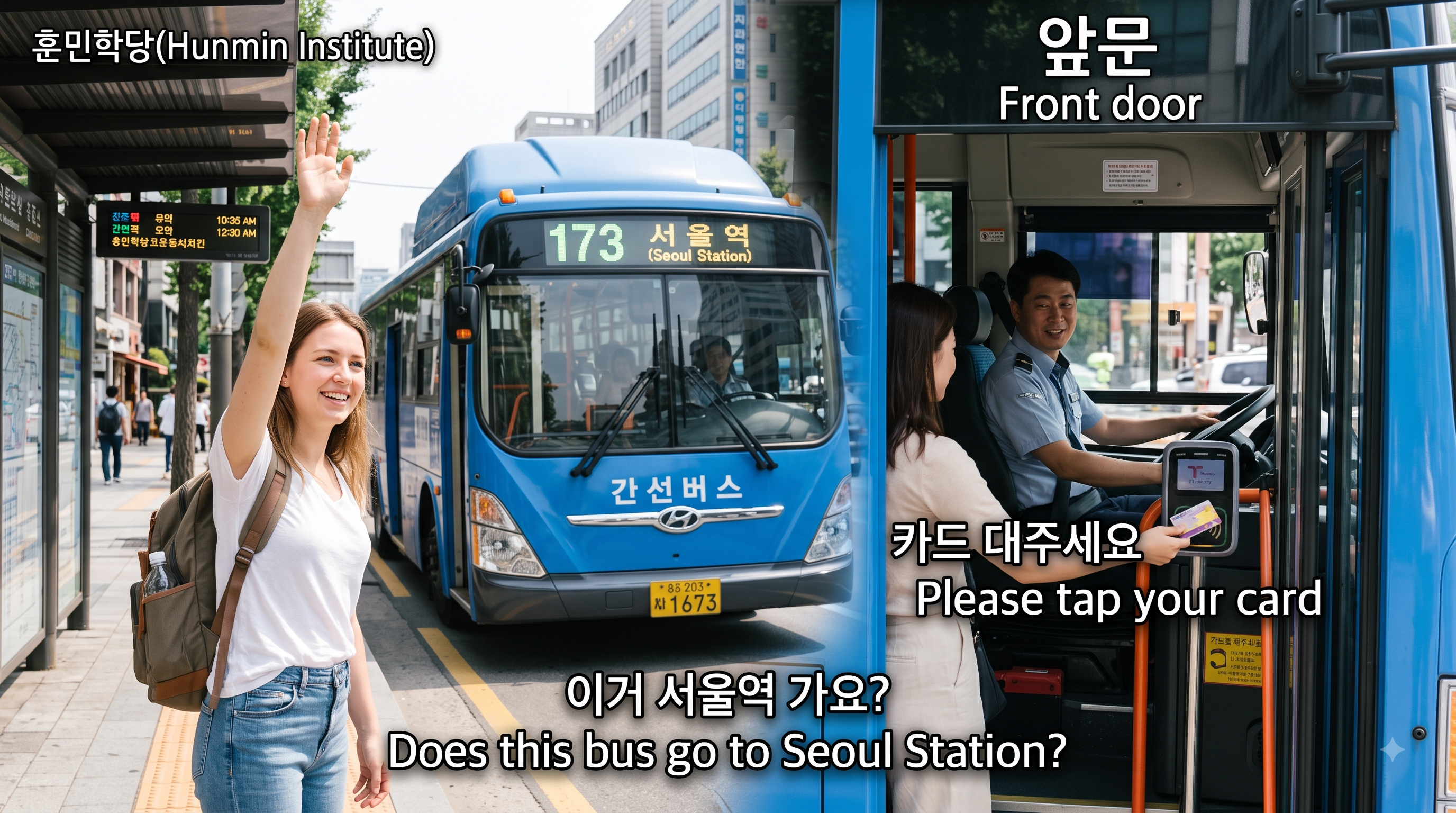
한 정류장에는 보통 여러 노선이 함께 섭니다. 그래서 기사는 이번에 오는 버스를 탈 사람이 누구인지 알 수 없습니다. 손을 들지 않고 내릴 사람도 없으면 버스는 서지 않고 지나갑니다. 정류장에 서 있는 것만으로는 신호가 되지 않습니다.
Several routes usually share one stop, so the driver cannot tell who is waiting for the bus that is arriving. If nobody raises a hand and nobody is getting off, the bus drives past. Simply standing at the stop is not a signal.
버스는 앞문으로 타고 뒷문으로 내립니다. 앞문에 오르면서 곧바로 단말기에 카드를 댑니다. 뒤에 사람이 이어 오르므로 카드를 찾느라 문 앞에 서 있으면 줄이 멈춥니다. 다만 마을버스처럼 문이 하나뿐인 버스도 있고, 그때는 앞문으로 타고 앞문으로 내립니다.
You board through the front door and get off through the rear one, tapping your card as you step in. Others are boarding right behind you, so hunting for your card in the doorway holds up the line. Some buses, usually village buses, have only one door, and on those you board and get off at the front.
여기서 쓰는 표현부터 배워봅시다. 앞문에서 오가는 말입니다.
Start with the expressions you will use here. These go back and forth at the front door.
| 듣는 말 Listening |
하는 말 Speaking |
|---|---|
| 카드 대주세요. [kadeu daejuseyo] Please tap your card. |
이거 서울역 가요? [igeo seoullyeok gayo] Does this bus go to Seoul Station? |
| 안쪽으로 들어가 주세요. [anjjogeuro deureoga juseyo] Please move to the back. |
잠깐만요. [jamkkanmanyo] Excuse me, one moment. |
| 잔액이 부족합니다. [janaegi bujokhamnida] Insufficient balance. |
현금도 돼요? [hyeongeumdo dwaeyo] Can I pay in cash? |
| 다음 차 타세요. [daeum cha taseyo] Please take the next one. |
몇 정거장 가요? [myeot jeonggeojang gayo] How many stops is it? |
▶이거는 이 버스라는 뜻입니다.
Igeo here means this bus.
한국어에서는 눈앞에 있는 것을 이거로 가리키고 명사를 생략합니다. 이 버스 서울역에 갑니까라고 길게 말하지 않아도 됩니다.
Korean points at whatever is in front of you with 이거 and drops the noun, so there is no need for the longer 이 버스 서울역에 갑니까.
가요는 평서문과 의문문의 형태가 같으므로 끝을 올려 물으십시오. 억양 하나가 묻는 말과 알리는 말을 가릅니다.
Since 가요 looks the same as a statement, raise your tone at the end to make it a question. Intonation alone separates asking from telling.
통로가 막혀 있을 때는 잠깐만요 한 마디면 길이 열립니다. 뒷사람에게 밀려 서 있지 말고 안쪽으로 들어가는 편이 좋습니다.
When the aisle is blocked, a single 잠깐만요 clears the way. Rather than standing where you boarded, move down inside the bus.
3. 벨을 누르지 않으면 내리지 못합니다
Without the Bell, You Do Not Get Off
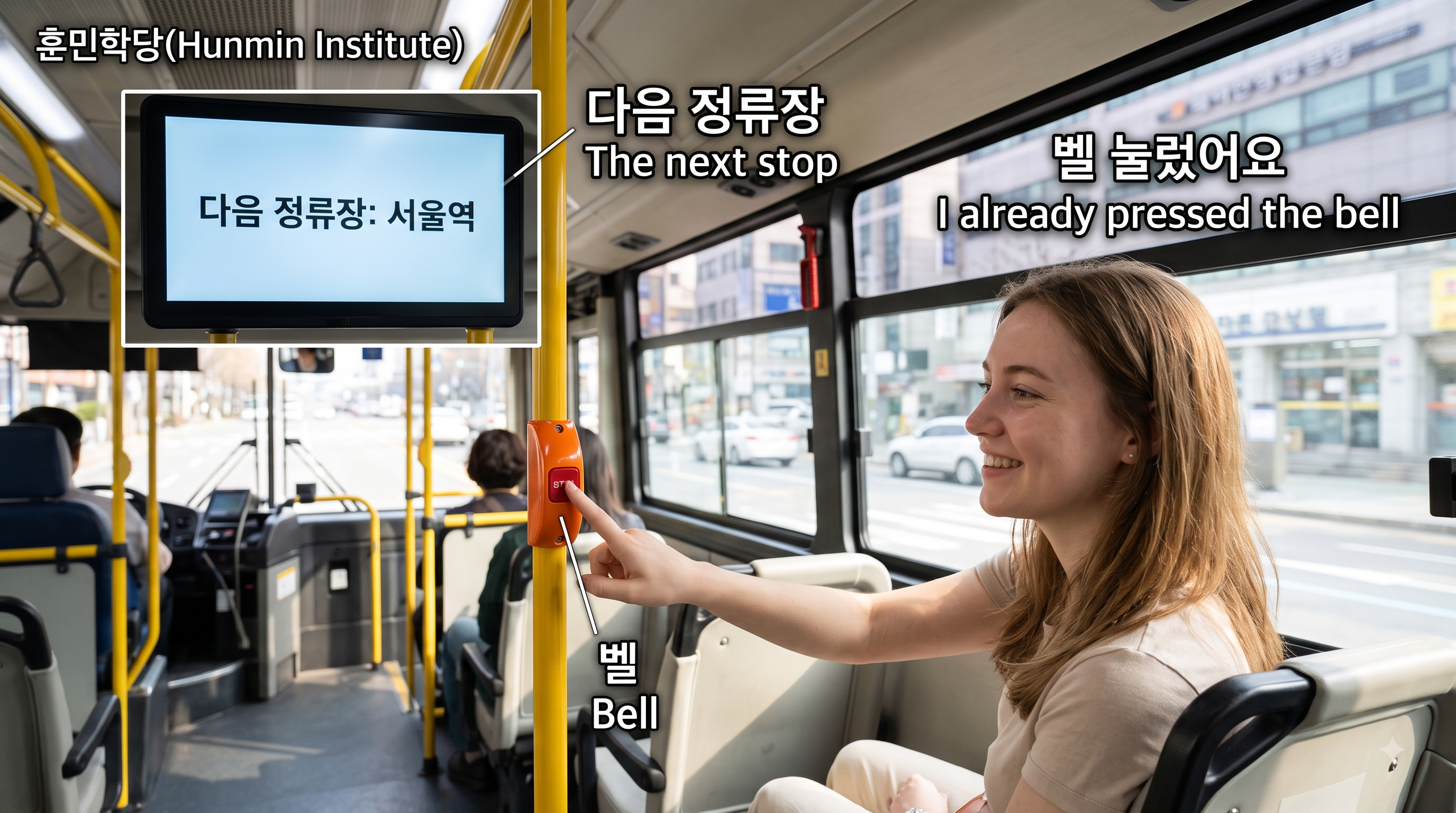
버스 방송은 한 번에 두 가지를 알려 줍니다. 지금 서는 곳과 그다음에 설 곳입니다. 앞이 이번 정류장이고 뒤가 다음 정류장이며, 이 둘이 벨을 누르는 시점을 가릅니다.
One announcement tells you two things: where the bus is stopping now and where it will stop next. The first is 이번 정류장 and the second is 다음 정류장, and the difference decides when you press the bell.
내릴 곳이 남대문시장이라면 다음 정류장은 남대문시장입니다라는 말이 나온 뒤에 벨을 누릅니다. 너무 일찍 누르면 앞 정류장에 서고, 늦게 누르면 이미 문이 닫힌 뒤입니다. 벨은 좌석 옆 기둥과 천장 손잡이 근처에 있습니다.
If you are getting off at Namdaemun Market, press the bell after you hear 다음 정류장은 남대문시장입니다. Press too early and the bus stops one stop short; press too late and the doors have already closed. The buttons sit on the poles beside the seats and near the ceiling handles.
여기서 쓰는 표현부터 배워봅시다. 내릴 때 오가는 말입니다.
Start with the expressions you will use here. These go back and forth as you get off.
| 듣는 말 Listening |
하는 말 Speaking |
|---|---|
| 다음 정류장은 남대문시장입니다. [daeum jeongnyujangeun namdaemunsijangimnida] The next stop is Namdaemun Market. |
벨 눌렀어요. [bel nulleosseoyo] I already pressed the bell. |
| 이번 정류장은 서울역입니다. [ibeon jeongnyujangeun seoullyeogimnida] This stop is Seoul Station. |
여기서 내려요. [yeogiseo naeryeoyo] I am getting off here. |
| 하차하시겠습니까? [hachahasigetseumnikka] Stop requested. |
네, 내려요. [ne, naeryeoyo] Yes, I am getting off. |
| 내리실 분 계세요? [naerisil bun gyeseyo] Anyone getting off? |
저 내려요. [jeo naeryeoyo] I am getting off. |
▶벨 눌렀어요는 두 방향으로 쓰입니다.
Bel nulleosseoyo works in two directions.
누가 벨을 누르려 할 때 이미 눌렀다고 알리는 말이면서, 문이 열리지 않을 때 기사에게 알리는 말이기도 합니다. 같은 문장이 옆 사람에게도 기사에게도 통합니다.
It tells another passenger reaching for the button that the bell is already pressed, and it tells the driver when the door does not open. The same sentence works in both directions.
자리에서 일어설 때 쓰는 여기서 내려요는 지하철 편에서 익힌 틀을 그대로 옮겨 쓴 것입니다. 장소만 바꾸면 어디서든 쓰입니다.
여기서 내려요, used as you rise from your seat, is the same pattern you learned in the subway post. Change the place and it works anywhere.
벨은 좌석 옆 기둥과 천장 손잡이 근처에 여러 개가 붙어 있습니다. 자리에서 손이 닿는 곳에 하나는 있으므로 일어서서 찾아다니지 않아도 됩니다.
Bells are fitted along the poles and near the ceiling handles, so there is one within reach of your seat. You do not need to stand up and go looking.
4. 버스도 내릴 때 카드를 댑니다
On the Bus Too, You Tap Again on the Way Out
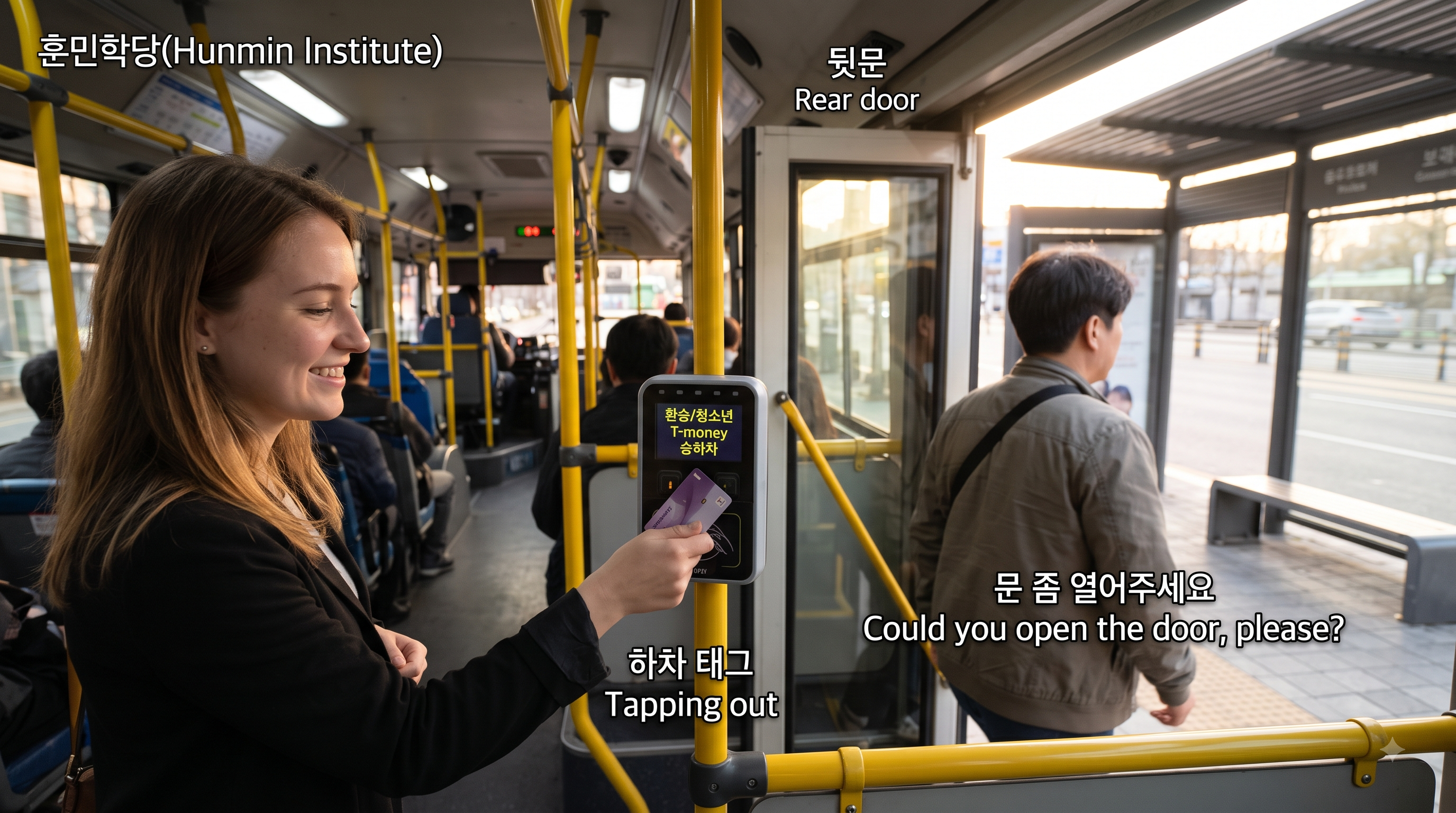
뒷문에도 단말기가 있습니다. 내릴 때 카드를 대지 않으면 그 자리에서 돈이 더 나가지는 않지만, 다음 버스나 지하철로 갈아탈 때 환승 할인을 받지 못합니다. 지하철의 하차 미태그 페널티와는 다른 제도이며, 버스에서 잃는 것은 다음 차의 할인입니다.
There is a reader at the rear door as well. Skipping the tap costs you nothing on the spot, but you lose the transfer discount on your next bus or subway ride. This is not the same as the subway exit-tag penalty; on a bus, what you lose is the discount on the next ride.
마을버스를 먼저 타고 시내버스로 갈아타는 경우에는 기본요금 차액 300원이 더해집니다. 마을버스가 1,200원, 시내버스가 1,500원이므로 그 차이만큼 붙는 것이며 새로 요금을 내는 것은 아닙니다. 반대로 시내버스를 먼저 타고 마을버스로 갈아탈 때는 차액이 붙지 않습니다.
If you ride a village bus first and transfer to a city bus, 300 won is added as the difference in base fares, 1,200 won against 1,500 won. It is the gap, not a whole new fare. Going the other way, from a city bus to a village bus, nothing extra is charged.
여기서 쓰는 표현부터 배워봅시다. 뒷문에서 오가는 말입니다.
Start with the expressions you will use here. These go back and forth at the rear door.
| 듣는 말 Listening |
하는 말 Speaking |
|---|---|
| 뒷문으로 내리세요. [dwinmuneuro naeriseyo] Please exit through the rear door. |
문 좀 열어주세요. [mun jom yeoreojuseyo] Could you open the door, please? |
| 환승입니다. [hwanseungimnida] Transfer. |
카드 댔어요. [kadeu daesseoyo] I tapped my card. |
| 한 분씩 내리세요. [han bunssik naeriseyo] One at a time, please. |
잠깐만요. [jamkkanmanyo] Excuse me, one moment. |
| 환승 안 됩니다. [hwanseung an doemnida] No transfer credit. |
환승 되나요? [hwanseung doenayo] Does the transfer apply? |
▶좀은 부탁을 부드럽게 만드는 말입니다.
Jom is what turns a demand into a request.
문 열어주세요만 써도 뜻은 통하지만 요구처럼 들립니다. 좀을 넣으면 부탁이 됩니다. 창문 좀 닫아주세요, 자리 좀 비켜주세요처럼 명사만 바꾸면 그대로 쓰입니다.
문 열어주세요 gets the meaning across but lands like an order. Adding 좀 makes it a request, and you can swap the noun freely, as in 창문 좀 닫아주세요 or 자리 좀 비켜주세요.
환승입니다는 단말기가 내는 소리이며, 이 말이 들리면 다음 차의 할인이 살아 있다는 뜻입니다. 아무 소리도 나지 않으면 카드가 닿지 않은 것이니 한 번 더 대십시오.
환승입니다 is the sound the reader makes, and hearing it means your discount on the next ride is alive. If you hear nothing, the card did not register, so tap again.
환승 할인은 내린 뒤 정해진 시간 안에 다음 차를 타야 적용됩니다. 같은 번호 버스로 되돌아 타는 경우에는 환승으로 인정되지 않는 일이 있습니다.
The transfer discount applies only if you board the next vehicle within a set window, and riding the same route number back may not count as a transfer at all.
버스는 두 번의 신호로 움직입니다. 손을 들어 세우고, 벨을 눌러 내립니다. 색과 번호로 노선을 읽고 이 두 동작과 그 사이의 여덟 문장을 익혔다면 정류장에서 버스를 그냥 보내는 일은 없습니다.
A bus moves on two signals: a raised hand to stop it and a bell to get off. Read the route from its color and number, take hold of those two actions and the eight sentences between them, and you will not watch another bus drive past you.
Next: Korean Taxi Phrases: Speak, Watch the Meter, Pay ↗
토픽 맛보기
TOPIK Preview
유형: TOPIK Ⅰ 읽기 [34~39], 설명문, 빈칸에 알맞은 것 고르기
Type: TOPIK I Reading [34–39], expository text, choose the correct phrase for the blank
( )에 들어갈 말로 가장 알맞은 것을 고르십시오.
Choose the most appropriate phrase for the blank.
한국에서 버스를 탈 때는 손을 들어야 합니다. 한 정류장에 여러 노선이 함께 서기 때문에 기사는 누가 어느 버스를 타는지 알 수 없습니다. 그래서 ( ) 버스는 서지 않고 지나갑니다.
In Korea you raise a hand to catch a bus. Several routes share one stop, so the driver cannot tell who is waiting for which bus. That is why the bus drives past if ( ).
① 요금을 내지 않으면
② 아무도 신호를 보내지 않으면
③ 뒷문이 열리지 않으면
④ 정류장에 사람이 많으면
Answer ▾
정답 ② 아무도 신호를 보내지 않으면
Answer: ② 아무도 신호를 보내지 않으면
지문이 기사는 누가 어느 버스를 타는지 알 수 없다고 했으므로 빈칸에는 아무도 신호를 보내지 않으면이 들어갑니다. ①은 지문이 요금 이야기를 하지 않아 근거가 없고, ③은 뒷문이 지문에 나오지 않으며, ④는 여러 노선이 선다는 말만 걸리고 사람 수를 정차 조건으로 들지 않았습니다. 흉내 낸 대문항은 TOPIK Ⅰ 읽기 [34~39]입니다.
The passage says the driver cannot tell who is waiting for which bus, so the blank takes the phrase about nobody signalling. ① has no basis, since fares are never mentioned, ③ names a rear door the passage does not raise, and ④ borrows the several-routes detail but the passage never treats crowd size as the condition. The item type modeled here is TOPIK I Reading [34–39].
FAQ
Q1. 현금으로도 버스를 탈 수 있나요?Answer ▾
Q1. Can I pay for the bus in cash?
A1. 탈 수 있지만 권하지 않습니다. 현금을 아예 받지 않는 노선이 늘고 있어 탈 수 없는 경우도 있습니다. 현금은 요금이 더 비싸고 거스름돈이 나오지 않는 경우가 많으며, 하차 태그를 할 수 없어 환승 할인도 받지 못합니다.
A1. You can, but it is not advised. More and more routes accept no cash at all, so on some buses you simply cannot board. Cash fares run higher, change is often unavailable, and without a tap out you lose the transfer discount.
Q2. 정류장에 사람이 여럿 서 있으면 저는 손을 들지 않아도 되나요?Answer ▾
Q2. If other people are waiting, do I still need to raise my hand?
A2. 다른 사람이 손을 들면 버스는 섭니다. 다만 그 사람이 다른 노선을 기다리는 중일 수 있으므로, 타야 할 버스가 보이면 직접 손을 드는 편이 안전합니다.
A2. The bus stops if someone else signals. But that person may be waiting for a different route, so when your bus comes into view it is safer to raise your own hand.
Q3. 내릴 정류장을 지나쳤으면 어떻게 하나요?Answer ▾
Q3. What if I miss my stop?
A3. 다음 정류장에서 내려 반대편으로 건너가 되돌아오는 버스를 타면 됩니다. 다만 같은 번호 버스로 되돌아오면 환승으로 인정되지 않아 요금을 다시 낼 수 있습니다. 한두 정거장이라면 걸어가는 편이 빠를 때가 많습니다.
A3. Get off at the next stop, cross to the other side and take a bus back. Boarding the same route number again may not count as a transfer, so you could pay twice. For one or two stops, walking is often faster.
Q4. 짐이 클 때 뒷문으로 타도 되나요?Answer ▾
Q4. With large luggage, can I board through the rear door?
A4. 뒷문 승차는 원칙적으로 되지 않습니다. 뒷문 단말기는 하차 태그용이라 승차로 처리되지 않으므로 무임승차가 됩니다. 짐이 크면 앞문으로 타고 기사에게 양해를 구한 뒤 통로 뒤쪽으로 옮기십시오.
A4. As a rule, no. The rear reader records exits, not entries, so boarding there counts as riding without paying. Board at the front, say a word to the driver, and move your bag down the aisle.
Q5. 버스 두 대가 겹쳐 서면 어디로 가야 하나요?Answer ▾
Q5. When two buses stop at once, where should I go?
A5. 정류장 표지판 앞이 아니라 실제로 문이 열린 자리로 이동해야 합니다. 뒤차 기사는 앞차가 출발한 뒤 정차선까지 다시 오지 않는 경우가 많으므로, 번호를 확인하고 그 차 쪽으로 걸어가십시오.
A5. Walk to where the door actually opens rather than standing at the sign. The second driver often will not pull forward to the marked spot after the first bus leaves, so check the number and go to that vehicle.
Vocabulary and Pronunciation for Foreigners
| No | Korean | Romanisation | Meaning |
|---|---|---|---|
| 1 | 정류장 | jeongnyujang | (n) bus stop [stɑːp] |
| 2 | 간선 | ganseon | (n) trunk route [trʌŋk ruːt] |
| 3 | 벨 | bel | (n) stop bell [bel] |
| 4 | 뒷문 | dwinmun | (n) rear door [rɪr dɔːr] |
| 5 | 환승 | hwanseung | (n) transfer [ˈtrænsfɜːr] |
| ▾ 단어 50개 더 보기 Show 50 more ↗ | |||
The blog page has limits of space and function, so only five words are shown here. The rest of the word list, the audio, the sentences and tables, the FAQ, the worksheet, the TOPIK questions and the lesson video are on the Hunmin Institute website ↗, free and open to everyone, with no account needed.
참고 기관
Official Sources
서울특별시 ↗
Seoul Metropolitan Government
https://news.seoul.go.kr/traffic/traffic_price
기관 설명 보기 About this institute ▾
This is where bus fares, transfer discounts and the early-morning discount are published. The fare table is mostly numbers and route types, so it is readable even on the Korean page. Fares can be revised, so check before you ride.
티머니 ↗
T-money
https://www.t-money.co.kr
기관 설명 보기 About this institute ▾
This is the transit card issuer, where you can also check your usage history. It has English pages covering card purchase, top-ups and transfer conditions.
※ 본 콘텐츠(원고, 이미지, 예문 포함)는 저작권법에 의해 보호받는 훈민학당의 저작물입니다. 무단 복제, 전재, 재배포 및 AI 학습 데이터로의 이용을 금합니다.
This content (manuscript, images, and example sentences) is the copyrighted property of Hunmin Institute, protected under copyright law. Unauthorized copying, reproduction, redistribution, and use as AI training data are prohibited.
'Real Talk' 카테고리의 다른 글
| Korean Taxi Phrases: Speak, Watch the Meter, Pay (0) | 2026.08.18 |
|---|---|
| Korean Subway Phrases: From the Gate to the Right Exit (0) | 2026.08.18 |
| Korean Food Delivery Phrases: What to Write in the Request Box (0) | 2026.08.18 |
| How to Order Coffee in Korean: From Counter to Buzzer (0) | 2026.08.17 |
| How to Order in a Korean Restaurant: Call, Ask, Pay (0) | 2026.08.16 |


