Korean Restaurant Ordering Phrases
한국 식당에서는 부르지 않으면 아무도 오지 않습니다
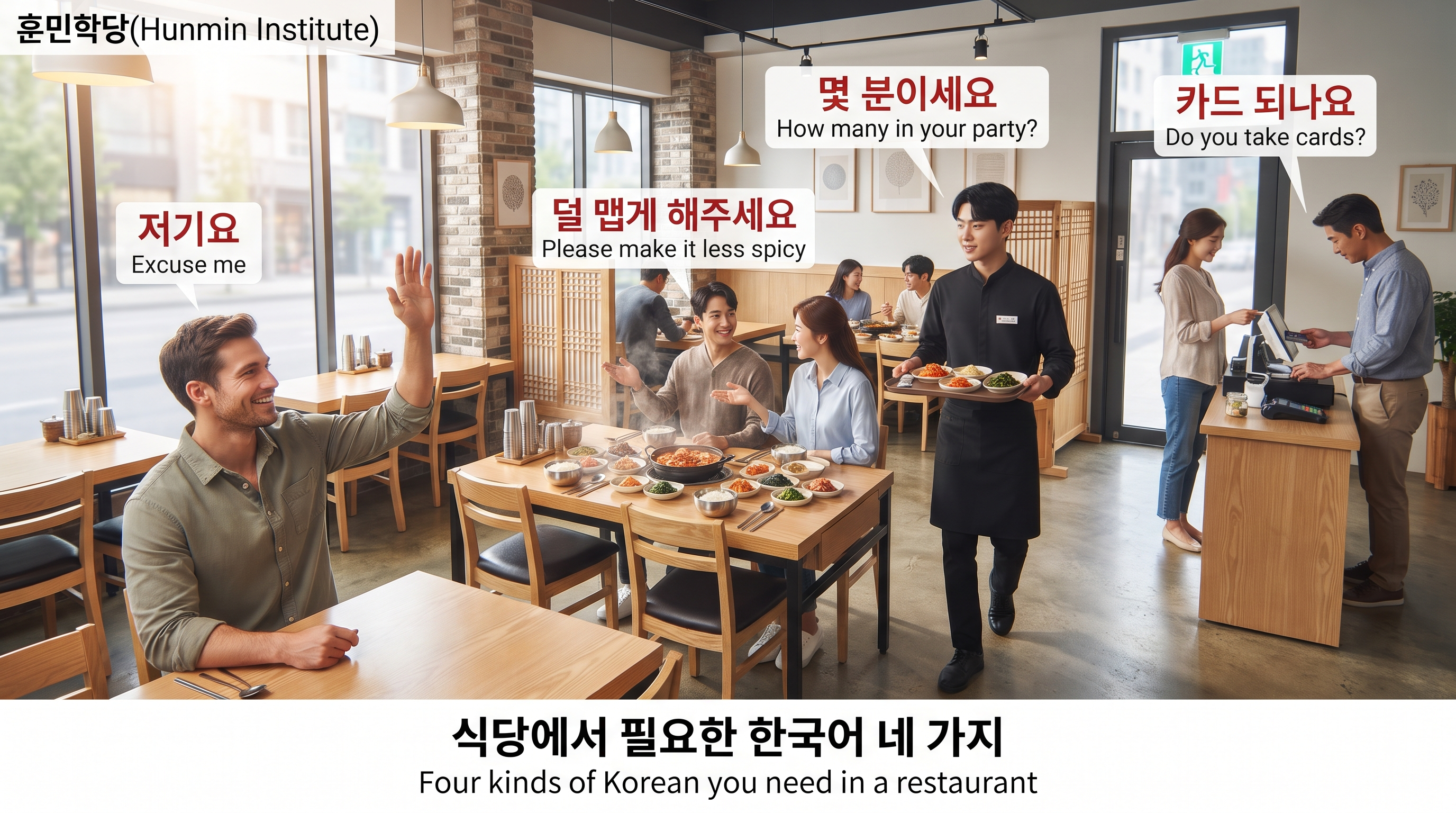
Four moments in a Korean restaurant require you to speak first: calling, seating, requesting, paying.
This post teaches what is said at each of the four, rather than a hundred separate phrases.
한국 식당에는 손님이 먼저 말을 걸어야 하는 순간이 네 번 있습니다. 부를 때와 인원을 확인할 때, 요청할 때, 계산할 때입니다.
이 글에서 그 네 자리에서 오가는 한국어를 익힙니다.
The learning services for the teaching materials published on this blog are free and open to everyone on the Hunmin Institute website ↗, with no account needed.
이 글에서 배우는 핵심 회화
Key Expressions in This Lesson
식당에서 오가는 말은 자리마다 정해져 있습니다. 아래 여섯 문장은 좌우가 한 쌍의 대화가 아니라 각각 따로 익히는 문장입니다. 먼저 눈에 담고 본문으로 들어가십시오.
The lines in a restaurant are fixed, and they change with where you are. The two columns are not paired dialogue; each sentence is learned on its own. Take them in first, then move into the main text.
| 듣는 말 Listening |
하는 말 Speaking |
|---|---|
| 주문하시겠어요? [jumunhasigesseoyo] Are you ready to order? |
저기요. [jeogiyo] Excuse me. |
| 이건 2인분부터 되세요. [igeon i-inbunbuteo doeseyo] This one starts at two portions. |
1인분 되나요? [irinbun doenayo] Can I order one portion? |
| 계산은 저쪽에서 하시면 돼요. [gyesaneun jeojjogeseo hasimyeon dwaeyo] You can pay over there. |
덜 맵게 해 주세요. [deol maepge hae juseyo] Please make it less spicy. |
첫째 줄은 소단락 1에서, 둘째 줄은 소단락 2에서, 셋째 줄은 소단락 3과 4에서 다룹니다.
The first row is covered in Section 1, the second in Section 2, and the third in Sections 3 and 4.
1. 부르지 않으면 오지 않습니다
No One Comes Until You Call
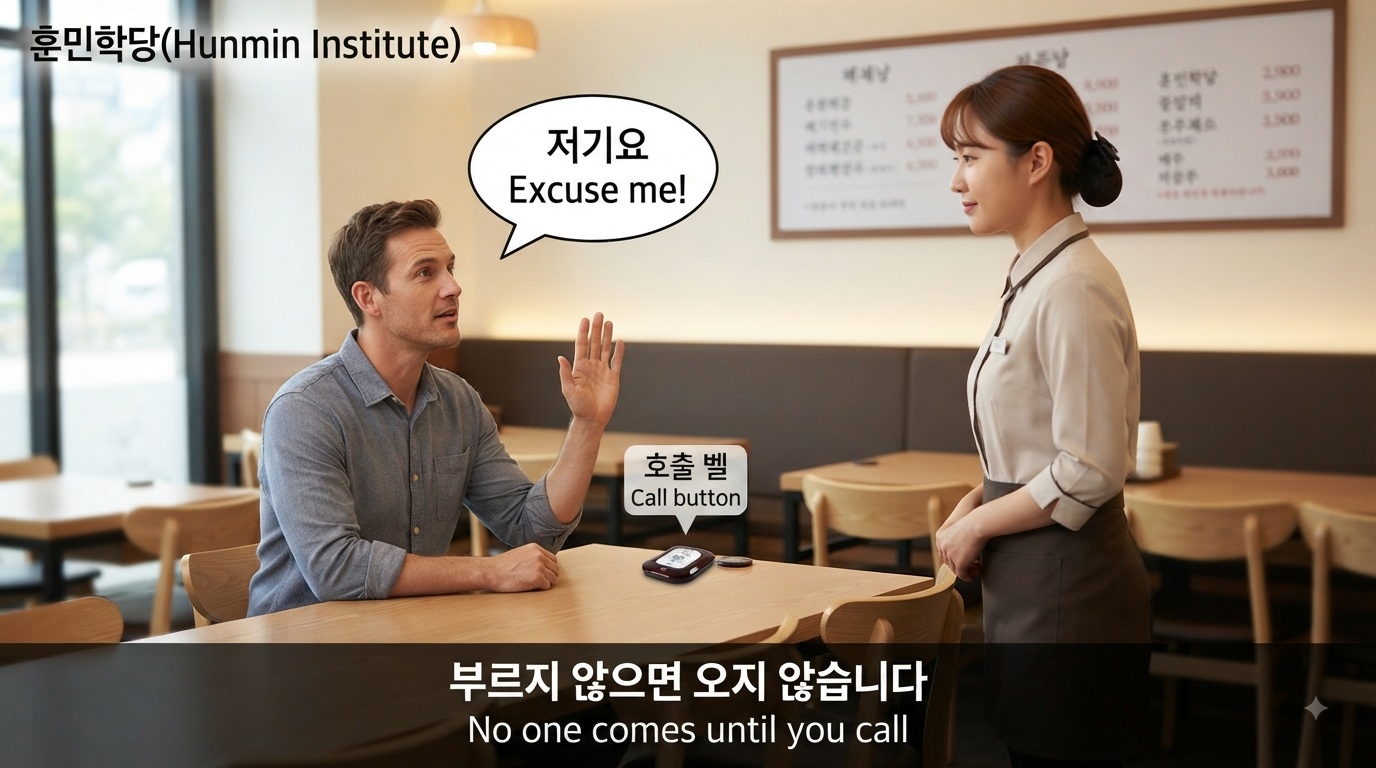
한국 식당에 앉으면 처음 겪는 일은 대개 같습니다. 자리에 앉았는데 아무도 오지 않습니다. 종업원이 먼저 다가오지 않는 경우가 많고, 그래서 자리마다 호출 벨이 놓여 있습니다.
The first experience in a Korean restaurant is usually the same. You sit down and nobody comes. In many places the server does not approach on their own, which is why there is a call button at each table.
부르는 말이 거리에 따라 어떻게 갈리는지 표로 먼저 보십시오.
See in the table how the calling words change with distance.
| 한국어 Korean |
언제 쓰는가 When to use it |
|---|---|
| 저기요 [jeogiyo] Excuse me |
종업원이 멀리 있을 때 부르는 말입니다 Calls to a server across the room |
| 여기요 [yeogiyo] Over here |
옆을 지나갈 때 붙잡는 말입니다 Stops a server passing your table |
| 사장님 [sajangnim] Boss |
작은 가게에서 쓰는 친근한 호칭입니다 A warmer form of address in small shops |
| 호출 벨 [hochul bel] Call button |
조용한 가게에서는 이쪽이 자연스럽습니다 The natural choice in a quiet place |
여기서 쓰는 표현부터 배워봅시다. 종업원을 부를 때 오가는 말입니다.
Start with the expressions you will use here. These pass as you call a server over.
| 듣는 말 Listening |
하는 말 Speaking |
|---|---|
| 네, 잠시만요. [ne jamsimanyo] Yes, one moment. |
저기요. [jeogiyo] Excuse me. |
| 네, 말씀하세요. [ne malsseumhaseyo] Yes, go ahead. |
메뉴판 좀 주세요. [menyupan jom juseyo] Could I have a menu, please? |
| 주문하시겠어요? [jumunhasigesseoyo] Are you ready to order? |
주문할게요. [jumunhalgeyo] I would like to order. |
응용 Apply It
↳ [명사] 좀 주세요
[noun] jom juseyo
Could I have [noun], please?
ex [메뉴판] 좀 주세요./[물] 좀 주세요.
ROM [menyupan] jom juseyo/[mul] jom juseyo
EN Could I have a menu, please?/Could I have some water, please?
▶조용히 앉아 눈만 마주치려 하면 주문은 시작되지 않습니다.
Sitting silently and hoping for eye contact will not start your order.
떠들썩한 고깃집이나 국밥집에서는 큰 소리로 불러도 무례하지 않습니다. 조용한 가게에서는 손을 들거나 자리의 호출 벨을 쓰는 편이 자연스럽습니다.
In a lively barbecue or soup restaurant, calling out loudly is not rude. In a quiet place, raising a hand or using the call button fits better.
사장님과 이모님은 한 단계 더 친근한 호칭입니다. 작은 식당에서 자주 쓰이며 처음 가는 곳에서는 저기요가 안전합니다.
사장님 and 이모님 are warmer forms of address, common in small local restaurants. On a first visit, 저기요 is the safe choice.
2. 인원과 인분, 두 가지를 확인합니다
Party Size and Portions
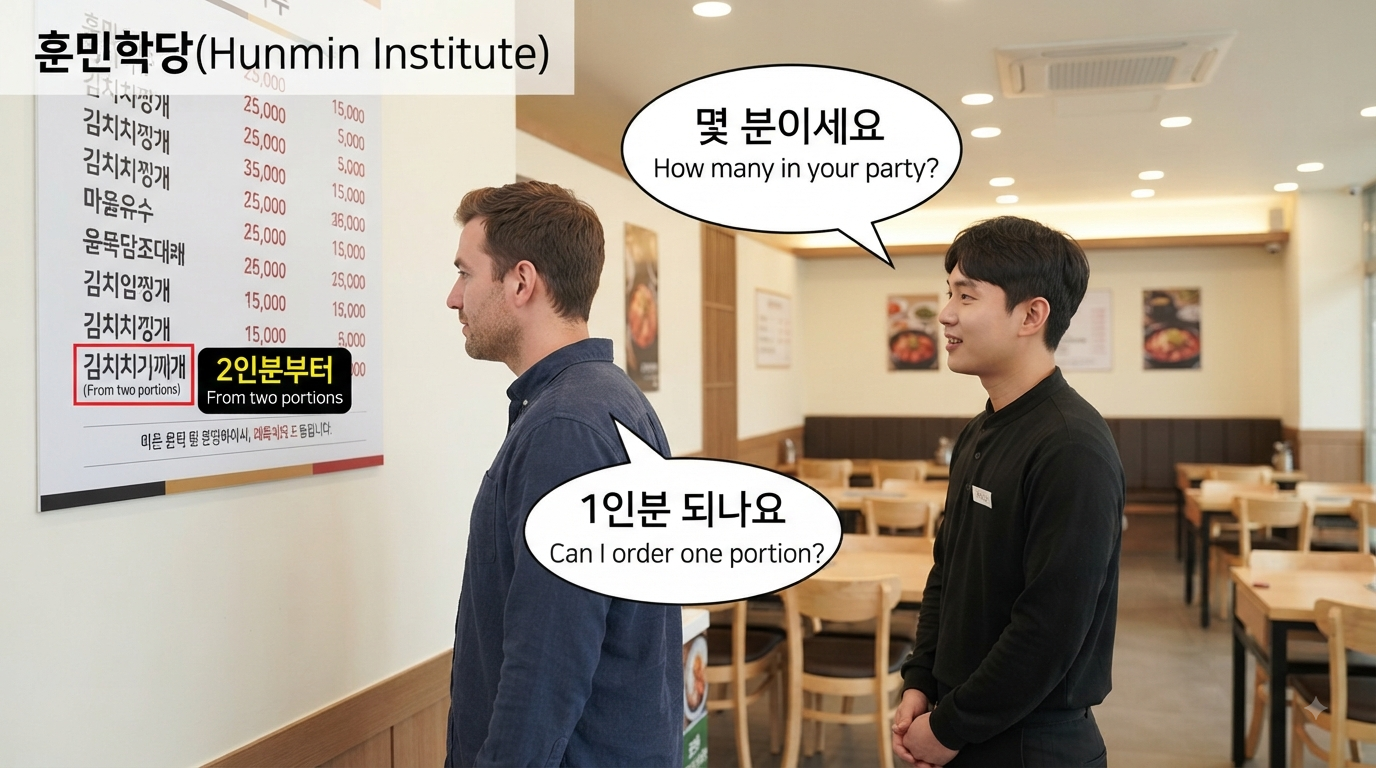
식당에서 가장 먼저 듣는 말은 문을 열자마자 나옵니다. 몇 분이세요. 인원을 묻는 말이며 대답에 따라 자리가 정해집니다.
The very first thing you hear comes as you open the door: 몇 분이세요. It asks how many of you there are, and your answer decides the table.
무엇을 어떻게 세는지 표로 먼저 보십시오.
See in the table what each counter counts.
| 단위 Counter |
무엇을 세는가 What it counts |
|---|---|
| 명 [myeong] People |
사람을 셀 때 씁니다. 두 명이요처럼 말합니다 Counts people, as in 두 명이요 |
| 인분 [inbun] Portions |
음식의 몫을 셉니다. 2인분부터라는 조건이 붙습니다 Counts servings; menus set a minimum |
| 개 [gae] Items |
그릇이나 물건을 셉니다. 이거 하나 주세요처럼 씁니다 Counts dishes and objects |
| 인원과 인분 [inwon gwa inbun] The two together |
같을 필요가 없습니다. 두 명이 3인분을 시켜도 됩니다 They need not match; two diners may order three portions |
여기서 쓰는 표현부터 배워봅시다. 들어서면서 오가는 말입니다.
Start with the expressions you will use here. These pass as you walk in.
| 듣는 말 Listening |
하는 말 Speaking |
|---|---|
| 몇 분이세요? [myeot buniseyo] How many in your party? |
두 명이요. [du myeongiyo] Two, please. |
| 혼자세요? [honjaseyo] Just you? |
혼자예요. 1인분 되나요? [honjayeyo irinbun doenayo] Just me. Can I order one portion? |
| 이건 2인분부터 되세요. [igeon i-inbunbuteo doeseyo] This one starts at two portions. |
그럼 2인분 주세요. [geureom i-inbun juseyo] Two portions, then. |
▶“인분”은 값이 아니라 주문 단위입니다.
인분 is an ordering unit, not a price.
2인분부터라는 말은 값이 두 배라는 뜻이 아니라 두 사람 몫부터 조리한다는 뜻입니다. 혼자여도 2인분을 시키면 되는 곳이 있고 인원 자체를 받지 않는 곳도 있습니다.
From two portions does not mean double the price. It means the kitchen cooks two servings at minimum. Some places let a solo diner order two portions; a few will not seat one person at all.
모든 식당이 그런 것은 아니며 1인분을 파는 곳도 많으므로 규칙이 아니라 확인할 항목으로 두는 편이 정확합니다. 그래서 1인분 되나요 한 문장이 필요합니다.
Not every restaurant works this way and many do serve single portions, so treat it as something to check rather than a rule. That is why the single line 1인분 되나요 matters.
이건 2인분부터 되세요의 되세요는 사물을 높인 말이라 문법에는 어긋납니다. 그래도 식당에서 실제로 자주 들리므로 알아듣기는 해야 하고, 직접 말할 때는 쓰지 않는 편이 좋습니다.
The 되세요 in 이건 2인분부터 되세요 honors an object, which is grammatically wrong. It is common in shops, so you should recognize it, but do not use it yourself.
3. 기계가 받아도 요청은 사람이 받습니다
Machines Take Orders, People Take Requests
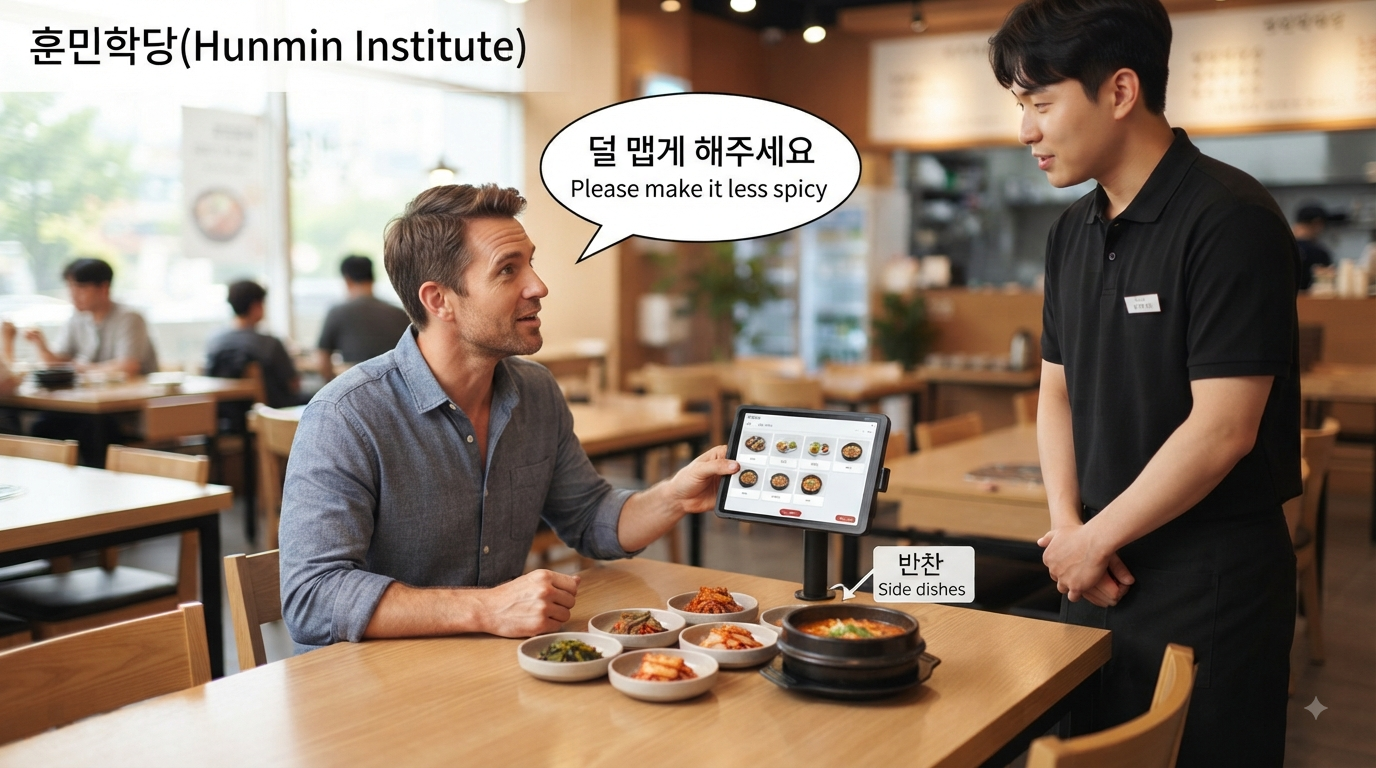
한국 식당에 키오스크가 늘었다는 말은 자주 들리지만 실제 수치는 생각보다 낮습니다. 농림축산식품부 2024년 조사에 따르면 무인주문기를 쓰는 외식업체는 전체의 12.9퍼센트입니다.
You often hear that kiosks have taken over Korean restaurants, but the figure is lower than expected. According to the Ministry of Agriculture, Food and Rural Affairs 2024 survey, 12.9 percent use self-order machines.
그 12.9퍼센트 안에서도 유형이 갈립니다. 표로 보십시오.
Within that 12.9 percent the types split further. See the table.
| 유형 Type |
무인주문기를 쓰는 곳 가운데 비중 Share among those using machines |
|---|---|
| 키오스크 [kioseukeu] Kiosk |
54.8퍼센트 54.8 percent |
| 손님 휴대폰 [sonnim hyudaepon] Customer's phone |
35.6퍼센트 35.6 percent |
| 테이블 태블릿 [teibeul taebeullit] Table tablet |
9.2퍼센트 9.2 percent |
여기서 쓰는 표현부터 배워봅시다. 화면 밖에서 필요한 말입니다.
Start with the expressions you will use here. These are the words you need off-screen.
| 듣는 말 Listening |
하는 말 Speaking |
|---|---|
| 많이 맵진 않아요. [mani maepjin anayo] It is not very spicy. |
덜 맵게 해 주세요. [deol maepge hae juseyo] Please make it less spicy. |
| 네, 갖다드릴게요. [ne gatdadeurilgeyo] Sure, I will bring some. |
김치 더 주세요. [gimchi deo juseyo] More kimchi, please. |
| 그건 빼기 어려워요. [geugeon ppaegi eoryeowoyo] That one is hard to leave out. |
고기 빼 주세요. [gogi ppae juseyo] Please leave out the meat. |
▶주문은 기계가 받아도 요청은 여전히 사람이 받습니다.
Machines take the order; people still take the request.
키오스크 화면에는 대개 메뉴와 수량만 있고, 조리를 바꾸는 요청은 어느 화면에도 거의 없습니다. 그래서 덜 맵게 해 주세요 같은 문장은 사람에게 직접 말해야 합니다.
A kiosk screen usually shows only dishes and quantities, and a request that changes the cooking is almost never on any screen. Lines like 덜 맵게 해 주세요 have to be said to a person.
한국 식당의 반찬은 주문한 음식에 딸려 나오고 추가 요청도 대체로 무료입니다. 다만 고기와 회, 특정 반찬은 유료로 받는 곳이 있으므로 처음 가는 식당에서는 값을 물어 두는 편이 안전합니다.
Side dishes come with your order and refills are usually free. Some places do charge for meat, sashimi, or particular items, so on a first visit it is safer to check the price.
빼 주세요는 넣지 말라는 요청입니다. 이미 조리된 음식에서는 어렵고 주문 시점에 말해야 반영됩니다. 맵게는 [맵께], 갖다드릴게요는 [갇따드릴께요]로 소리 납니다.
빼 주세요 asks them to leave something out. It is hard once the dish is cooked, so say it when you order. 맵게 sounds like [맵께] and 갖다드릴게요 like [갇따드릴께요].
4. 계산은 대개 카운터에서 합니다
You Usually Pay at the Counter
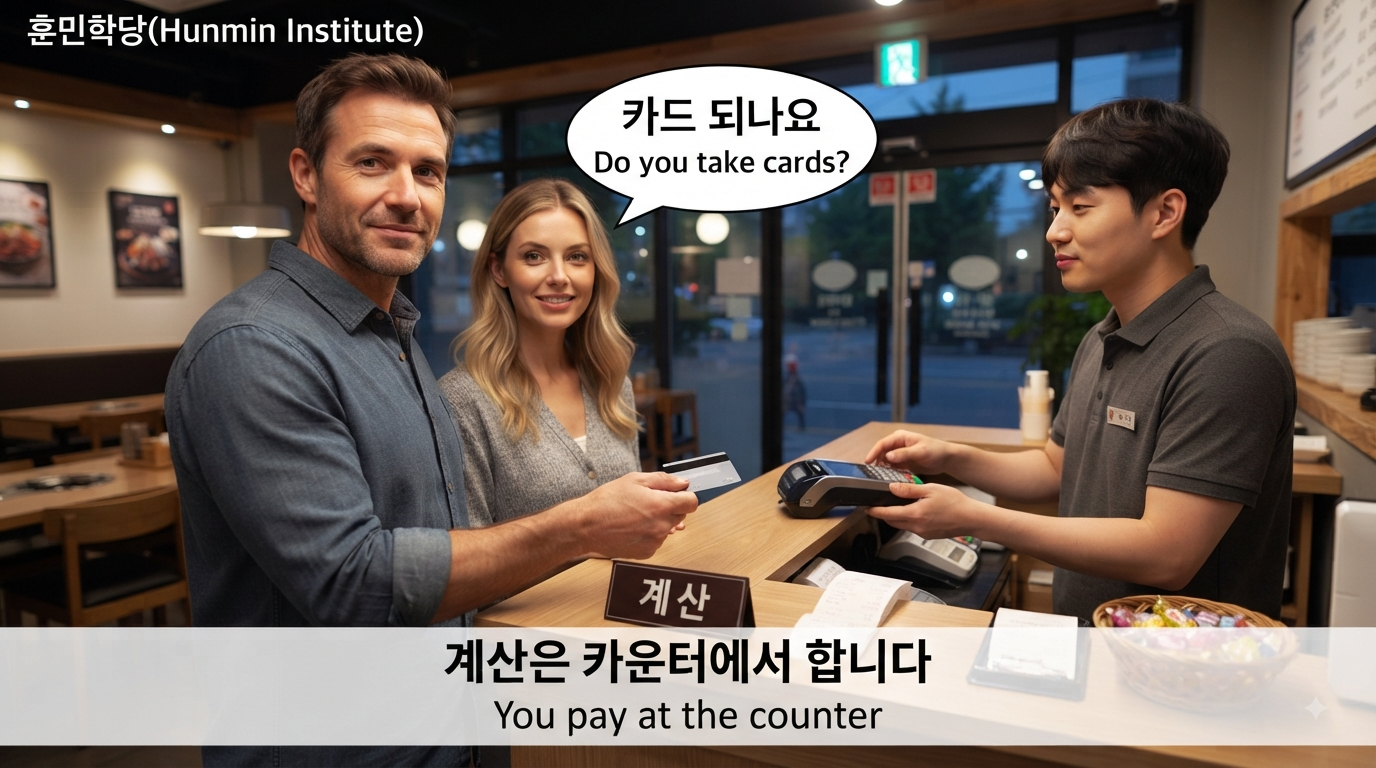
식사를 마치고 카드를 꺼내 들고 앉아 있으면 아무도 오지 않습니다. 한국 식당은 대체로 출구 옆 카운터에서 계산합니다. 손님이 일어나 카운터로 가는 방식입니다.
Finish your meal, take out your card, and sit waiting, and nobody comes. In most Korean restaurants you pay at a counter by the exit; you get up and go to it.
여기서 쓰는 표현부터 배워봅시다. 카운터에서 오가는 말입니다.
Start with the expressions you will use here. These pass at the counter.
| 듣는 말 Listening |
하는 말 Speaking |
|---|---|
| 계산은 저쪽에서 하시면 돼요. [gyesaneun jeojjogeseo hasimyeon dwaeyo] You can pay over there. |
계산할게요. [gyesanhalgeyo] I would like to pay. |
| 현금만 받아요. [hyeongeumman badayo] Cash only. |
카드 되나요? [kadeu doenayo] Do you take cards? |
| 모두 삼만 이천 원입니다. [modu samman icheon wonimnida] That is 32,000 won altogether. |
따로 계산해 주세요. [ttaro gyesanhae juseyo] Separate checks, please. |
▶한국 식당에는 팁 문화가 없습니다.
There is no tipping culture in Korean restaurants.
메뉴판에 적힌 값이 최종 금액이며 봉사료가 따로 붙지 않습니다. 팁을 놓고 나오면 오히려 종업원이 두고 간 물건으로 알고 쫓아옵니다.
The menu price is the final price and no service charge is added. Leave money on the table and the server will chase you down thinking you forgot it.
계산은 한 사람이 몰아서 하는 경우가 많지만 나눠 내는 것도 얼마든지 가능합니다. 따로 계산해 주세요는 각자 먹은 만큼 나눠 내겠다는 뜻이며 주문이 섞여 있으면 미리 말해 두는 편이 좋습니다.
One person often pays for everyone, but splitting is perfectly normal. 따로 계산해 주세요 means each person pays for what they had; if the orders are mixed, mention it in advance.
한국 식당에서 필요한 한국어는 네 가지입니다. 부르는 말, 조건을 확인하는 말, 요청하는 말, 계산하는 말입니다. 문장을 통째로 외우기보다 네 개의 틀을 쥐고 들어가면 어느 식당에서든 통합니다. 오늘 나온 문장 가운데 딱 세 개만 외우자면 저기요, 1인분 되나요, 덜 맵게 해 주세요입니다.
The Korean you need in a restaurant comes down to four things: calling, checking conditions, requesting, and paying. Rather than memorizing whole sentences, walk in holding the four patterns and they will carry you anywhere. If you memorize only three of today's lines, make them 저기요, 1인분 되나요, and 덜 맵게 해 주세요.
Next: Korean Cafe Ordering Phrases ↗
토픽 맛보기
TOPIK Preview
유형: TOPIK Ⅰ 읽기 [40~42], 안내문, 일치하지 않는 내용 고르기
Type: TOPIK I Reading [40–42], notice, choose the statement that does not match
다음을 읽고 내용이 같지 않은 것을 고르십시오.
Read the following and choose the statement that does not match the content.
우리 식당 안내. 감자탕은 2인분부터 주문하실 수 있습니다. 반찬은 더 드립니다. 계산은 나가실 때 카운터에서 해 주세요.
Restaurant notice. Gamjatang is available from two portions. Side dishes are refilled. Please pay at the counter on your way out.
① 감자탕은 혼자 한 그릇만 시킬 수 없습니다.
② 반찬은 더 달라고 할 수 있습니다.
③ 계산은 앉은 자리에서 합니다.
④ 감자탕은 두 사람 몫부터 나옵니다.
Answer ▾
정답 ③ 계산은 앉은 자리에서 합니다
Answer: ③ You pay at your table
안내문 마지막 줄이 나가실 때 카운터에서 하라고 했으므로 자리에서 계산한다는 ③이 내용과 다릅니다. ①과 ④는 2인분부터라는 첫 줄에, ②는 반찬을 더 준다는 둘째 줄에 그대로 대응합니다. 흉내 낸 대문항은 TOPIK Ⅰ 읽기 [40~42]이고 배점은 3점입니다.
The last line says to pay at the counter on the way out, so ③ contradicts the notice. ① and ④ match the two-portion line and ② matches the refill line. The item type modeled here is TOPIK I Reading [40–42], worth 3 points.
FAQ
Q1. 호출 벨을 눌렀는데도 오지 않으면 어떻게 하나요?Answer ▾
Q1. What if I press the call button and nobody comes?
A1. 벨이 고장 났거나 주방이 바쁜 경우입니다. 잠시 기다렸다가 저기요라고 소리 내어 부르십시오. 벨보다 목소리가 빠를 때가 많습니다.
A1. Either the button is broken or the kitchen is swamped. Wait a moment, then call out 저기요. Your voice is often faster than the bell.
Q2. 물과 물티슈는 왜 아무도 가져다주지 않나요?Answer ▾
Q2. Why does nobody bring water or wet wipes?
A2. 대부분의 식당에서 물은 셀프입니다. 입구나 벽 쪽에 정수기와 컵이 놓여 있으니 직접 가져다 드시면 됩니다. 수저도 테이블 서랍 안에 들어 있는 경우가 많습니다.
A2. In most restaurants water is self-serve. There is a dispenser and cups by the entrance or along the wall, so help yourself. Spoons and chopsticks are often in a drawer under the table.
Q3. 고기를 빼 달라고 했는데도 국물에 고기 맛이 나는 이유가 뭔가요?Answer ▾
Q3. I asked them to leave out the meat, so why does the broth still taste of it?
A3. 한국 음식은 국물에 고기나 멸치로 낸 육수를 쓰는 경우가 많아 건더기를 빼도 맛이 남습니다. 주문할 때 고기 육수도 안 되나요라고 미리 물으면 확인해 줍니다.
A3. Korean dishes often use a stock made from meat or anchovies, so removing the solid pieces leaves the flavor behind. Ask 고기 육수도 안 되나요 when you order and they will check for you.
Q4. 팁을 줘야 하나요?Answer ▾
Q4. Should I tip?
A4. 한국 식당에는 팁 문화가 없습니다. 메뉴판에 적힌 값이 최종 금액이며 봉사료가 따로 붙지 않습니다. 팁을 놓고 나오면 오히려 종업원이 두고 간 물건으로 알고 쫓아옵니다.
A4. There is no tipping culture in Korean restaurants. The menu price is the final price and no service charge is added. Leave money on the table and the server will chase you down thinking you forgot it.
Q5. 반찬을 더 달라고 하면 값을 더 내야 하나요?Answer ▾
Q5. Do refills of the side dishes cost extra?
A5. 대체로 무료입니다. 다만 고기와 회, 특정 반찬은 유료로 받는 곳이 있으므로 처음 가는 식당에서는 더 달라고 말한 뒤 값을 물어 두는 편이 안전합니다.
A5. Usually free. Some places do charge for meat, sashimi, or particular items, so on a first visit it is safer to ask for more and then check the price.
Vocabulary and Pronunciation for Foreigners
| No | Korean | Romanisation | Meaning |
|---|---|---|---|
| 1 | 식당 | sikdang | (n) restaurant [ˈrestrɑːnt] |
| 2 | 종업원 | jongeobwon | (n) server, staff [ˈsɜːrvər] |
| 3 | 사장님 | sajangnim | (n) the owner, boss [ˈoʊnər] |
| 4 | 이모님 | imonim | (n) auntie, familiar address [ˈɑːnti] |
| 5 | 손님 | sonnim | (n) customer, guest [ˈkʌstəmər] |
| ▾ 단어 54개 더 보기 Show 54 more ↗ | |||
The blog page has limits of space and function, so only five words are shown here. The rest of the word list, the audio, the sentences and tables, the FAQ, the worksheet, the TOPIK questions and the lesson video are on the Hunmin Institute website ↗, free and open to everyone, with no account needed.
참고 기관
Official Sources
농림축산식품부 ↗
Ministry of Agriculture, Food and Rural Affairs
https://www.mafra.go.kr
기관 설명 보기 About this institute ▾
This ministry publishes the survey of food service businesses that reports how far self-order machines have spread. The 12.9 percent figure in this post comes from the 2024 round. The survey is updated yearly, so check the current release.
한국농촌경제연구원 ↗
Korea Rural Economic Institute
https://www.krei.re.kr
기관 설명 보기 About this institute ▾
This institute analyses food service statistics and consumption patterns. It is where you can check the detailed figures, such as the share held by kiosks and table tablets.
※ 본 콘텐츠(원고, 이미지, 예문 포함)는 저작권법에 의해 보호받는 훈민학당의 저작물입니다. 무단 복제, 전재, 재배포 및 AI 학습 데이터로의 이용을 금합니다.
This content (manuscript, images, and example sentences) is the copyrighted property of Hunmin Institute, protected under copyright law. Unauthorized copying, reproduction, redistribution, and use as AI training data are prohibited.
'Real Talk' 카테고리의 다른 글
| Korean Food Delivery Phrases: What to Write in the Request Box (0) | 2026.08.18 |
|---|---|
| How to Order Coffee in Korean: From Counter to Buzzer (0) | 2026.08.17 |
| Korean Delivery Phrases: Parcels and Convenience Stores (0) | 2026.08.11 |
| Korean Part-Time Job Interview Phrases for Foreigners (0) | 2026.08.11 |
| Korean Optician Phrases: No Prescription Needed (0) | 2026.08.09 |


