
How to Order Coffee in Korean: From Counter to Buzzer
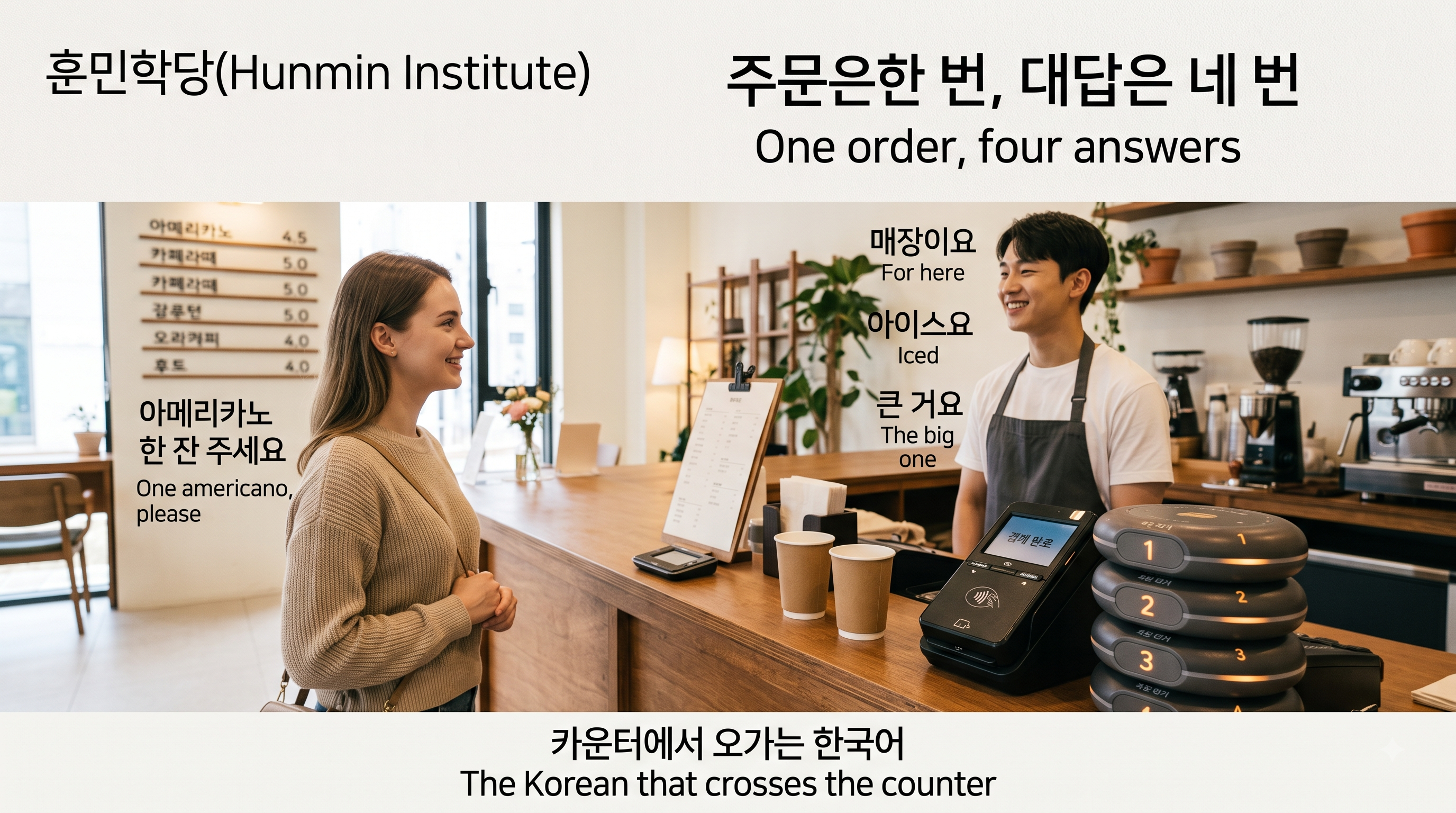
한국 카페에서는 주문은 한 번이고 대답은 네 번입니다
In a Korean cafe the hard part is not the order but the four replies that follow.
Learn the counter replies and the Korean you need after the buzzer.
한국 카페에서 어려운 것은 주문이 아니라 그 뒤에 이어지는 네 번의 짧은 대답입니다.
이 글에서 카운터에서 오가는 대답과 진동벨을 받은 뒤의 한국어를 익힙니다.
The learning services for the teaching materials published on this blog are free and open to everyone on the Hunmin Institute website ↗, with no account needed.
이 글에서 배우는 핵심 회화
Key Expressions in This Lesson
카페에서 오가는 말은 몇 마디로 정해져 있습니다. 아래 여덟 문장은 좌우가 한 쌍의 대화가 아니라 각각 따로 익히는 문장입니다. 먼저 눈에 담고 본문으로 들어가십시오.
Only a few lines pass across a cafe counter. The two columns are not paired dialogue; each sentence is learned on its own. Take them in first, then move into the main text.
| 듣는 말 Listening |
하는 말 Speaking |
|---|---|
| 뭐 드릴까요? [mwo deurilkkayo] What can I get you? |
아메리카노 한 잔 주세요. [amerikano han jan juseyo] One americano, please. |
| 드시고 가세요? [deusigo gaseyo] Will you have it here? |
매장이요. [maejangiyo] For here. |
| 사이즈 어떤 걸로 드릴까요? [saijeu eotteon geollo deurilkkayo] What size would you like? |
큰 거요. [keun geoyo] The big one. |
| 진동벨 울리면 가져가세요. [jindongbel ullimyeon gajyeogaseyo] Come get it when the buzzer rings. |
와이파이 비밀번호 뭐예요? [waipai bimilbeonho mwoyeyo] What is the Wi-Fi password? |
첫째 줄은 소단락 1에서, 둘째 줄과 셋째 줄은 소단락 2에서, 넷째 줄은 소단락 4에서 다루고, 옵션을 더하고 빼는 말은 소단락 3에서 다룹니다.
The first row is covered in Section 1, the second and third in Section 2, and the fourth in Section 4, while the words for adding and reducing options come in Section 3.
1. 값을 먼저 내고 시작합니다
You Pay Before You Drink
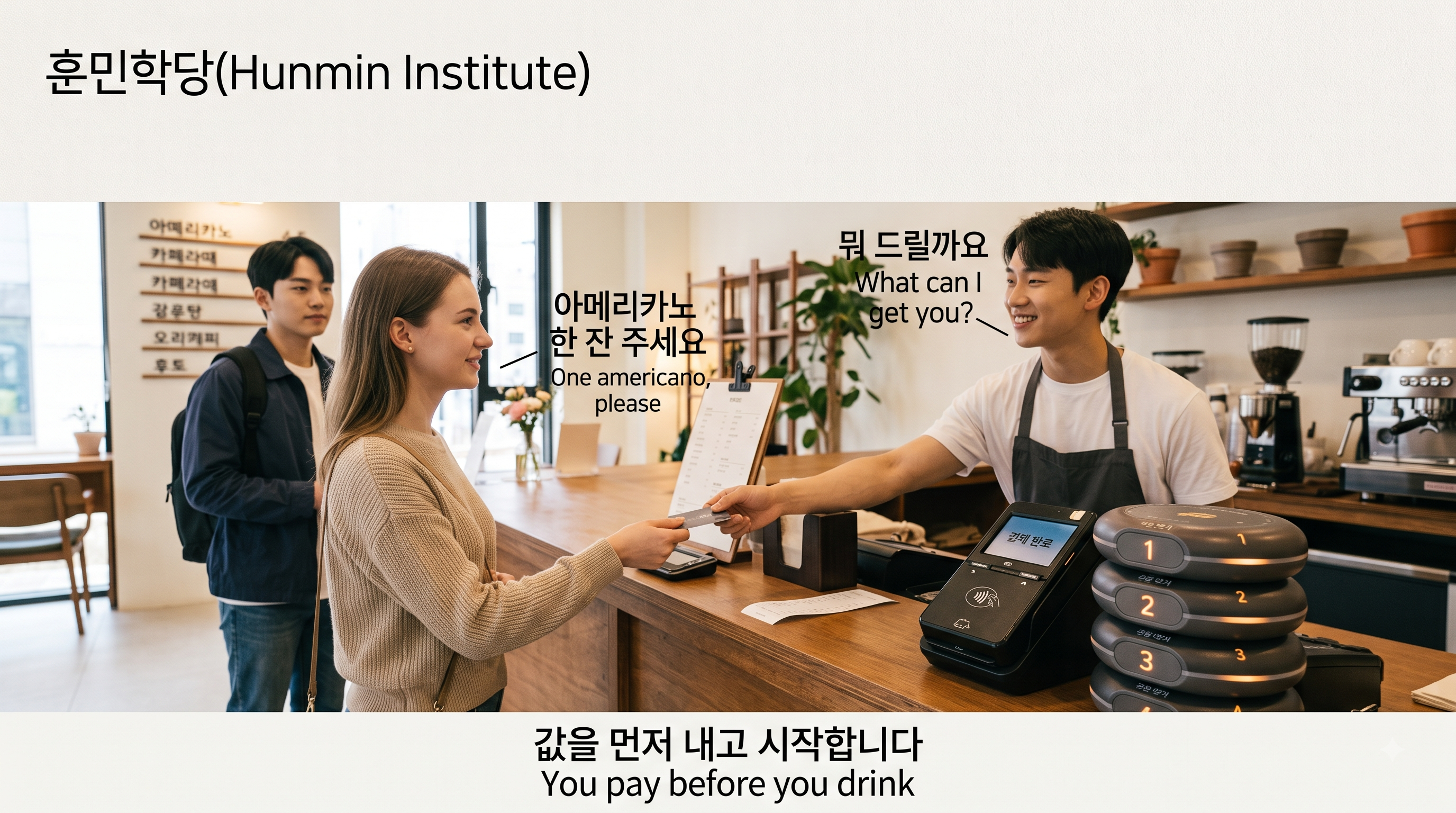
식당은 앉은 뒤에 부르지만 카페는 서서 말합니다. 문을 열면 카운터 앞에 줄이 있고, 차례가 오면 주문과 계산이 한자리에서 끝납니다.
In a restaurant you sit down and then call someone over; in a cafe you stand and speak. There is a line at the counter, and when your turn comes the order and the payment finish in one place.
한국 카페는 대체로 선불입니다. 주문한 뒤 값을 치르고 음료를 받는 순서이며, 좌석까지 가져다주는 개인 카페 가운데는 후불인 곳도 있습니다. 선불이라는 것은 줄 앞에서 머뭇거릴 시간이 짧다는 뜻이기도 합니다.
Korean cafes usually take payment up front. You order, pay, then receive the drink, though some independent cafes with table service charge afterwards. Paying first also means there is little time to hesitate at the head of the line.
그래서 첫 문장은 짧게 끝내는 편이 낫습니다. 메뉴 이름과 잔 수만 말하면 됩니다.
So keep your first sentence short. The name of the drink and how many cups is enough.
여기서 쓰는 표현부터 배워봅시다. 주문하고 값을 치를 때 오가는 말입니다.
Start with the expressions you will use here. These go back and forth as you order and pay.
| 듣는 말 Listening |
하는 말 Speaking |
|---|---|
| 뭐 드릴까요? [mwo deurilkkayo] What can I get you? |
아메리카노 한 잔 주세요. [amerikano han jan juseyo] One americano, please. |
| 사천오백 원입니다. [sacheonobaek wonimnida] That is 4,500 won. |
카드 되나요? [kadeu doenayo] Do you take cards? |
| 카드 주세요. [kadeu juseyo] Your card, please. |
여기요. [yeogiyo] Here you are. |
| 적립하세요? [jeongniphaseyo] Would you like points? |
아니요, 괜찮아요. [aniyo, gwaenchanayo] No, I am fine. |
응용 Apply It
↳ [명사] 한 잔 주세요
[noun] han jan juseyo
One [noun], please.
ex [아메리카노] 한 잔 주세요./[라떼] 한 잔 주세요./[녹차] 한 잔 주세요.
ROM [amerikano] han jan juseyo/[latte] han jan juseyo/[nokcha] han jan juseyo
EN One americano, please./One latte, please./One green tea, please.
▶잔은 음료를 세는 말이고 개는 물건을 세는 말입니다.
Jan counts drinks; gae counts objects.
커피 두 개라고 해도 알아듣지만 두 잔이 자연스럽습니다. 세는 말이 대상에 따라 갈리는 것이 한국어 숫자의 특징이며, 카운터는 그것이 가장 자주 드러나는 자리입니다.
Coffee 두 개 is understood, but 두 잔 sounds natural. Korean picks a counter word to match what is being counted, and the cafe counter is where that shows up most often.
여기요는 식당 편에서 배운 부르는 말과 같은 형태지만 여기서는 뜻이 다릅니다. 카드를 건네며 여기요라고 하면 여기 있습니다라는 뜻이고, 이름이 불렸을 때 여기요라고 하면 제가 그 사람입니다라는 뜻입니다.
You already met 여기요 as a calling word. Handing over a card it means here you are; answering your name it means that is me. One word covers three situations.
적립하세요는 회원 적립을 묻는 말입니다. 필요 없으면 아니요, 괜찮아요로 짧게 끊으면 되고, 회원이면 휴대폰 번호를 눌러 달라는 말이 이어집니다.
적립하세요 asks whether you want loyalty points. If not, 아니요, 괜찮아요 closes it politely; if you are a member, you will be asked to key in your phone number.
2. 질문은 이어지고, 대답은 한 단어입니다
Questions Come Fast, Answers Stay Short
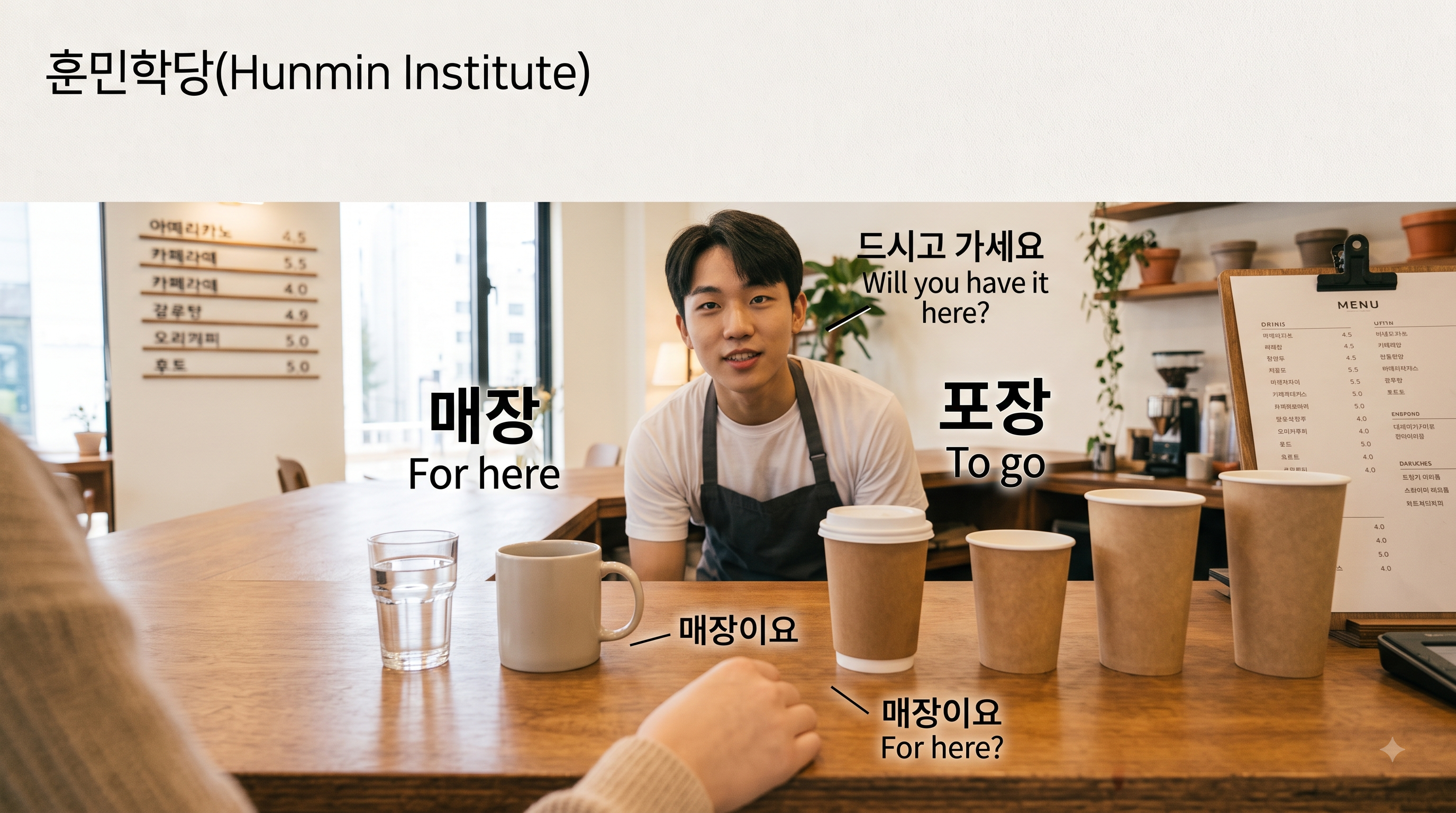
주문을 마치면 질문이 이어집니다. 마시고 갈 것인지, 크기는 어떤 것으로 할지, 따뜻한 것인지 찬 것인지, 옵션을 더할지 네 가지입니다. 묻는 순서는 매장마다 다르므로 순서를 외우기보다 네 가지가 온다는 것만 알아 두면 됩니다.
Once you order, the questions follow: whether you are staying, what size, hot or iced, and whether to add options. The order varies by shop, so rather than memorizing a sequence, just know that four are coming.
대답은 길 필요가 없습니다. 직원이 준 선택지 가운데 하나를 골라 뒤에 요만 붙이면 문장이 됩니다. 크기를 부르는 말부터 봅니다.
The answers need not be long. Take one of the choices the staff offers and add 요. Look at the size names first.
| 사이즈를 부르는 말 Size names |
통용 범위 Where it works |
|---|---|
| 스몰, 미디엄, 라지 [seumol, midieom, raji] Small, medium, large |
대부분의 카페에서 통합니다 Works in most cafes |
| 톨, 그란데, 벤티 [tol, geurande, benti] Tall, grande, venti |
특정 대형 프랜차이즈에서만 씁니다 Only at certain large chains |
| 작은 거요, 큰 거요 [jageun geoyo, keun geoyo] The small one, the big one |
어디서나 통합니다 Works anywhere |
여기서 쓰는 표현부터 배워봅시다. 자리와 크기, 온도를 두고 오가는 말입니다.
Start with the expressions you will use here. These go back and forth over seating, size, and temperature.
| 듣는 말 Listening |
하는 말 Speaking |
|---|---|
| 드시고 가세요? [deusigo gaseyo] Will you have it here? |
매장이요. [maejangiyo] For here. |
| 포장이세요? [pojangiseyo] Is it to go? |
포장이요. [pojangiyo] To go. |
| 사이즈 어떤 걸로 드릴까요? [saijeu eotteon geollo deurilkkayo] What size would you like? |
큰 거요. [keun geoyo] The big one. |
| 따뜻한 걸로 드릴까요? [ttatteutan geollo deurilkkayo] Would you like it hot? |
아이스요. [aiseuyo] Iced. |
▶처음 가는 카페에서는 큰 거요가 안전합니다.
At a new cafe, 큰 거요 is the safe answer.
사이즈 명칭은 매장마다 다릅니다. 그란데는 그 체계를 쓰는 매장에서만 통하므로 처음 가는 곳에서 말하면 되묻는 일이 생깁니다.
Size names differ by shop, so a chain-specific name invites a follow-up question elsewhere.
메뉴판을 손으로 가리키며 이걸로 주세요라고 해도 됩니다. 이름을 몰라서 막히는 일은 이 방법으로 대부분 넘어갑니다.
You can also point at the menu and say 이걸로 주세요. That clears most cases where you do not know the name.
드시고 가세요는 명령이 아니라 확인입니다. 매장에서 마실 것인지 묻는 말이며 뒤에 물음표가 붙는다고 생각하면 됩니다.
드시고 가세요 is a question, not an instruction. Hear a question mark at the end of it.
3. 옵션은 더하거나 빼는 말로 붙입니다
Options Are Added or Taken Away
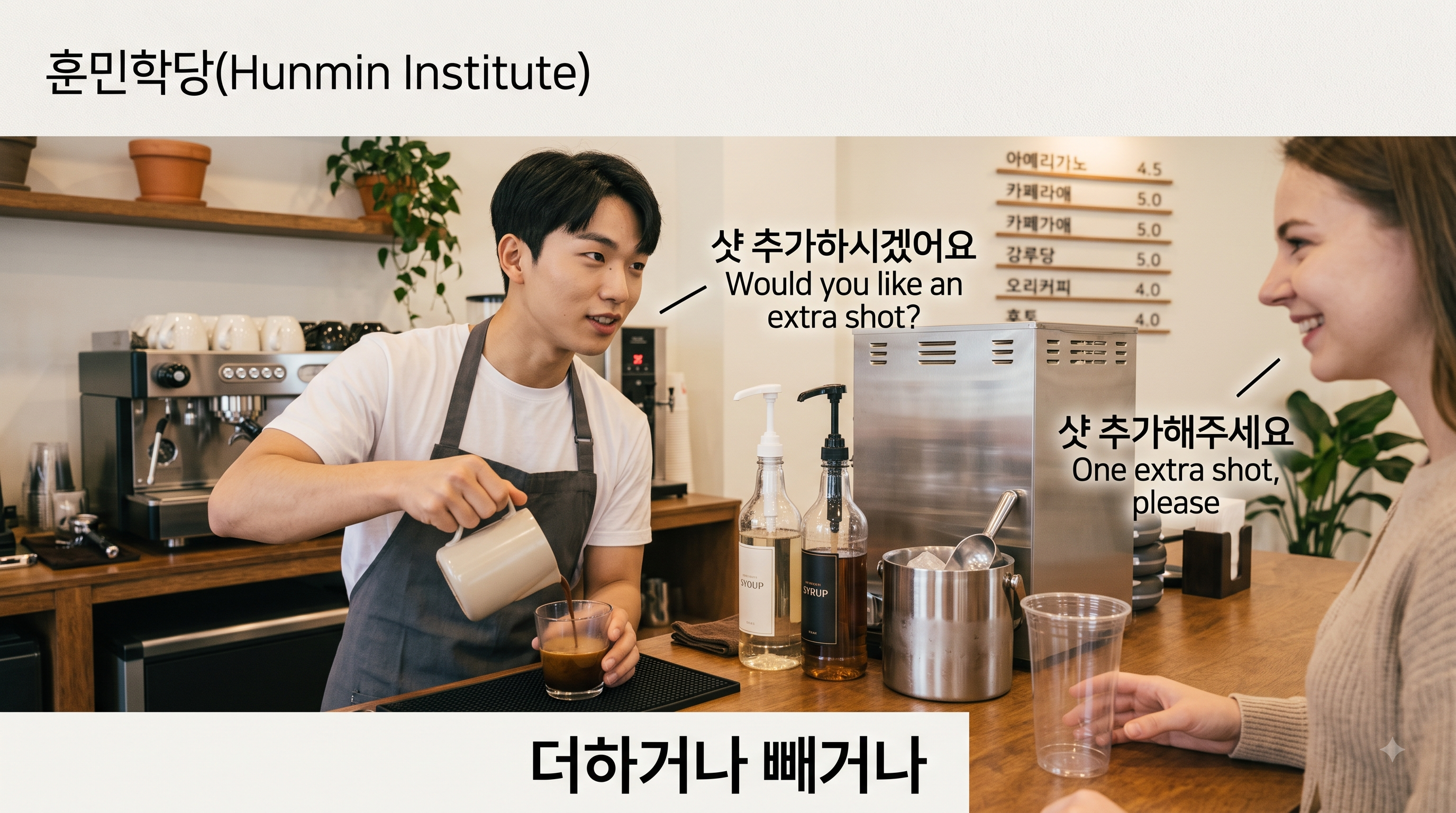
네 가지 질문 가운데 마지막이 옵션입니다. 진하게 할지, 얼음을 얼마나 넣을지, 단맛을 어떻게 할지입니다. 이 자리는 직원이 먼저 묻기도 하고 손님이 먼저 말하기도 합니다.
The last of the four questions is options: stronger, how much ice, how sweet. Sometimes the staff asks first, sometimes you speak first.
말하는 방식은 둘뿐입니다. 더하거나 빼는 것입니다. 추가해주세요와 적게 주세요 두 틀에 명사만 바꿔 넣으면 대부분의 요청이 됩니다.
There are only two moves: add or reduce. Swap the noun into 추가해주세요 or 적게 주세요 and you cover most requests.
여기서 쓰는 표현부터 배워봅시다. 옵션을 두고 오가는 말입니다.
Start with the expressions you will use here. These go back and forth over the options.
| 듣는 말 Listening |
하는 말 Speaking |
|---|---|
| 샷 추가하시겠어요? [syat chugahasigesseoyo] Would you like an extra shot? |
샷 추가해주세요. [syat chugahaejuseyo] One extra shot, please. |
| 얼음 많이 드릴까요? [eoreum mani deurilkkayo] Plenty of ice? |
얼음 적게 주세요. [eoreum jeokge juseyo] Less ice, please. |
| 시럽 빼 드릴까요? [sireop ppae deurilkkayo] Shall I leave out the syrup? |
덜 달게 해주세요. [deol dalge haejuseyo] Please make it less sweet. |
| 그건 추가 요금 있어요. [geugeon chuga yogeum isseoyo] There is an extra charge for that. |
우유 바꿀 수 있어요? [uyu bakkul su isseoyo] Can I change the milk? |
▶추가는 대개 값이 붙고, 적게는 값이 붙지 않습니다.
Adding usually costs; reducing does not.
샷 추가와 우유 변경은 오백 원 안팎의 추가 요금이 붙는 매장이 많습니다. 금액은 매장마다 다르므로 그건 추가 요금 있어요라는 말이 들리면 얼마예요라고 물으면 됩니다.
An extra shot or a milk change usually adds around 500 won, and the amount varies. If you hear 그건 추가 요금 있어요, just ask 얼마예요.
적게 주세요는 빼 달라는 말이 아니라 줄여 달라는 말입니다. 아예 넣지 말라면 빼 주세요를 씁니다.
적게 주세요 asks for less, not for none. To leave it out entirely, use 빼 주세요.
덜 달게 해주세요는 식당 편의 덜 맵게 해주세요와 같은 틀입니다. 형용사만 바꾸면 그대로 쓰입니다.
덜 달게 해주세요 uses the same pattern as 덜 맵게 해주세요. Only the adjective changes.
4. 진동벨을 받으면 자리를 뜹니다
Take the Buzzer and Step Away
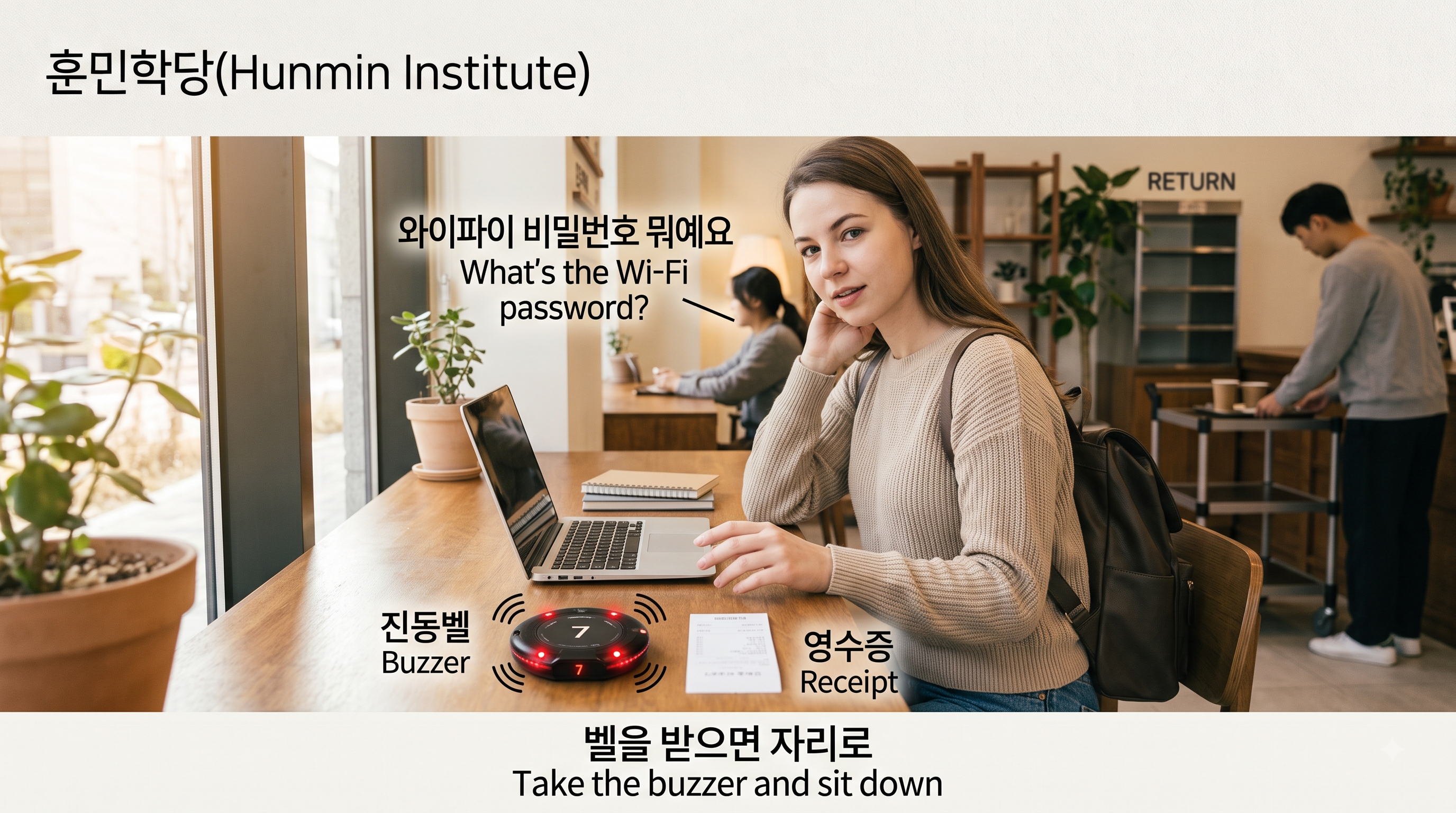
계산이 끝나면 손바닥만 한 기계를 하나 건네줍니다. 진동벨입니다. 음료가 준비되면 울리고 불이 들어옵니다. 벨을 받았으면 카운터를 떠나 자리에 앉는 것이 맞습니다. 서서 기다리면 뒷사람이 주문할 자리가 없어집니다.
After you pay you are handed a small device that fits in your palm: the buzzer. It vibrates and lights up when your drink is ready. Once you have it, step away and sit down. Standing there leaves no room for the next customer to order.
진동벨을 쓰는 곳이 많지만 전부는 아닙니다. 벨이 없는 매장에서는 직원이 음료 이름이나 주문 번호를 부르므로 그때는 귀를 열어 두어야 합니다.
Many shops use buzzers, but not all. Where there is none, the staff calls out the drink name or an order number, so keep an ear open.
여기서 쓰는 표현부터 배워봅시다. 음료를 받고 자리를 정리할 때 오가는 말입니다.
Start with the expressions you will use here. These go back and forth as you collect your drink and clear your table.
| 듣는 말 Listening |
하는 말 Speaking |
|---|---|
| 진동벨 울리면 가져가세요. [jindongbel ullimyeon gajyeogaseyo] Come get it when the buzzer rings. |
네, 알겠습니다. [ne, algetseumnida] Got it. |
| 아메리카노 나왔습니다. [amerikano nawatseumnida] The americano is ready. |
여기요. [yeogiyo] Over here. |
| 다 드시면 저기에 놓아 주세요. [da deusimyeon jeogie noa juseyo] Please leave it over there when you are done. |
컵 어디에 놓아요? [keop eodie noayo] Where do I put the cup? |
| 영수증 아래에 있어요. [yeongsujeung araee isseoyo] It is at the bottom of the receipt. |
와이파이 비밀번호 뭐예요? [waipai bimilbeonho mwoyeyo] What is the Wi-Fi password? |
▶영수증을 바로 버리지 마십시오.
Do not throw the receipt away yet.
와이파이 비밀번호와 화장실 비밀번호를 영수증 아래에 인쇄해 두는 매장이 많습니다. 묻기 전에 영수증을 먼저 보면 답이 있는 경우가 흔합니다.
Many cafes print the Wi-Fi and restroom codes at the bottom of the receipt. Check it before asking.
컵은 대개 반납대에 두고 나옵니다. 매장 안에서 마셨다면 유리컵이나 머그잔인 경우가 많으므로 그대로 두지 않고 반납대로 가져갑니다.
Cups usually go to a return station on your way out. If you drank inside, carry it over rather than leaving it on the table.
나왔습니다는 음료가 준비되었다는 말입니다. 이름을 부르지 않고 메뉴 이름만 부르는 곳이 많으므로 자기가 시킨 음료 이름을 기억해 두어야 합니다.
나왔습니다 means the drink is ready. Many shops call the drink rather than your name, so remember what you ordered.
카페에서 필요한 한국어는 주문 한 번과 대답 네 번, 옵션과 마무리입니다. 문장을 길게 만들려 하지 말고 선택지 뒤에 요를 붙이는 대답부터 손에 쥐면 줄이 밀리지 않습니다.
The Korean you need in a cafe is one order, four answers, the options, and the wrap-up. Get hold of the reply that adds 요 to a given choice and the line keeps moving.
Next: Korean Food Delivery Phrases: What to Write in the Request Box ↗
토픽 맛보기
TOPIK Preview
유형: TOPIK Ⅰ 읽기 [34~39], 대화, 빈칸에 알맞은 것 고르기
Type: TOPIK I Reading [34–39], dialogue, choose the correct word for the blank
( )에 들어갈 말로 가장 알맞은 것을 고르십시오.
Choose the most appropriate word for the blank.
가: 드시고 가세요? 나: 아니요, ( ). 뚜껑 닫아 주세요.
A: Will you have it here? B: No, ( ). Please close the lid.
① 포장이요
② 큰 거요
③ 샷 추가해주세요
④ 카드 되나요
Answer ▾
정답 ① 포장이요
Answer: ① 포장이요
드시고 가세요는 매장에서 마실 것인지 묻는 말입니다. 아니요라고 답하고 뚜껑을 닫아 달라고 했으므로 가져가겠다는 뜻인 포장이요가 들어갑니다. ②는 같은 카운터에서 나오는 말이지만 크기를 묻는 질문에 대한 대답이라 진술이 어긋나고, ③은 요청이라는 성격만 맞아 일부만 걸리며, ④는 그럴듯해 보여도 결제 수단을 묻는 말이라 지문에 근거가 없습니다. 흉내 낸 대문항은 TOPIK Ⅰ 읽기 [34~39]입니다.
드시고 가세요 asks whether you will drink in. The reply is 아니요 and asks for the lid to be closed, so 포장이요 fits. ② belongs to the same counter but answers a size question, ③ only matches in being a request, and ④ asks about payment, which the exchange never raises. The item type modeled here is TOPIK I Reading [34–39].
FAQ
Q1. 아아라고 말해도 알아듣나요?Answer ▾
Q1. Will they understand if I say 아아?
A1. 알아듣지만 카운터에서는 잘 쓰지 않습니다. 친구끼리 무엇을 마실지 이야기할 때 쓰는 줄임말이며, 주문할 때는 아이스 아메리카노라고 말하는 것이 보통입니다.
A1. They will, but it is rarely used at the counter. It is shorthand friends use when deciding what to drink; when ordering, people say 아이스 아메리카노.
Q2. 카페에서 오래 앉아 있어도 되나요?Answer ▾
Q2. Is it fine to stay a long time?
A2. 대체로 괜찮습니다. 공부하거나 노트북을 쓰는 사람이 많고 콘센트가 있는 자리도 흔합니다. 다만 자리가 꽉 찬 시간에는 눈치를 보는 편이 좋고, 오래 있을 계획이면 음료를 한 잔 더 시키는 것이 자연스럽습니다.
A2. Usually yes. Plenty of people study or work on laptops, and outlets are common. When every seat is taken it pays to read the room, and if you plan to stay long, a second drink is the natural move.
Q3. 텀블러를 가져가면 할인이 되나요?Answer ▾
Q3. Do I get a discount with my own tumbler?
A3. 할인을 주는 매장이 많지만 금액과 시행 여부는 매장마다 다릅니다. 정부가 다회용컵 할인제를 추진하고 있어 앞으로 넓어질 수 있으나 아직 의무는 아닙니다. 주문할 때 텀블러에 주세요라고 말하고 할인되나요라고 물으면 됩니다.
A3. Many shops give one, though the amount and whether they offer it vary. The government is pushing a reusable-cup discount scheme, so it may spread, but it is not yet mandatory. Say 텀블러에 주세요 when ordering and ask 할인되나요.
Q4. 겨울에도 아이스 아메리카노를 시켜도 이상하지 않나요?Answer ▾
Q4. Is an iced americano odd in winter?
A4. 전혀 이상하지 않습니다. 한겨울에도 아이스 아메리카노를 들고 다니는 사람이 많아 오히려 흔한 주문입니다.
A4. Not at all. Plenty of people carry one through the coldest weeks, so it is an ordinary order year round.
Vocabulary and Pronunciation for Foreigners
| No | Korean | Romanisation | Meaning |
|---|---|---|---|
| 1 | 아메리카노 | amerikano | (n) americano [əˌmerɪˈkɑːnoʊ] |
| 2 | 매장 | maejang | (n) the shop floor, dining in [stɔːr] |
| 3 | 포장 | pojang | (n) takeaway, packing [ˈteɪkəweɪ] |
| 4 | 사이즈 | saijeu | (n) size [saɪz] |
| 5 | 진동벨 | jindongbel | (n) pager, buzzer [ˈbʌzər] |
| ▾ 단어 54개 더 보기 Show 54 more ↗ | |||
The blog page has limits of space and function, so only five words are shown here. The rest of the word list, the audio, the sentences and tables, the FAQ, the worksheet, the TOPIK questions and the lesson video are on the Hunmin Institute website ↗, free and open to everyone, with no account needed.
참고 기관
Official Sources
기후에너지환경부 ↗
Ministry of Climate, Energy and Environment
https://www.mcee.go.kr
기관 설명 보기 About this institute ▾
This ministry oversees the restriction on single-use plastic cups inside cafes. It runs an English site, but the disposable-item rules are detailed on the Korean pages. The cup rules are still being revised, so check the latest notice yourself.
※ 본 콘텐츠(원고, 이미지, 예문 포함)는 저작권법에 의해 보호받는 훈민학당의 저작물입니다. 무단 복제, 전재, 재배포 및 AI 학습 데이터로의 이용을 금합니다.
This content (manuscript, images, and example sentences) is the copyrighted property of Hunmin Institute, protected under copyright law. Unauthorized copying, reproduction, redistribution, and use as AI training data are prohibited.
'Real Talk' 카테고리의 다른 글
| Korean Subway Phrases: From the Gate to the Right Exit (0) | 2026.08.18 |
|---|---|
| Korean Food Delivery Phrases: What to Write in the Request Box (0) | 2026.08.18 |
| How to Order in a Korean Restaurant: Call, Ask, Pay (0) | 2026.08.16 |
| Korean Delivery Phrases: Parcels and Convenience Stores (0) | 2026.08.11 |
| Korean Part-Time Job Interview Phrases for Foreigners (0) | 2026.08.11 |


