
Korean Subway Phrases: From the Gate to the Right Exit
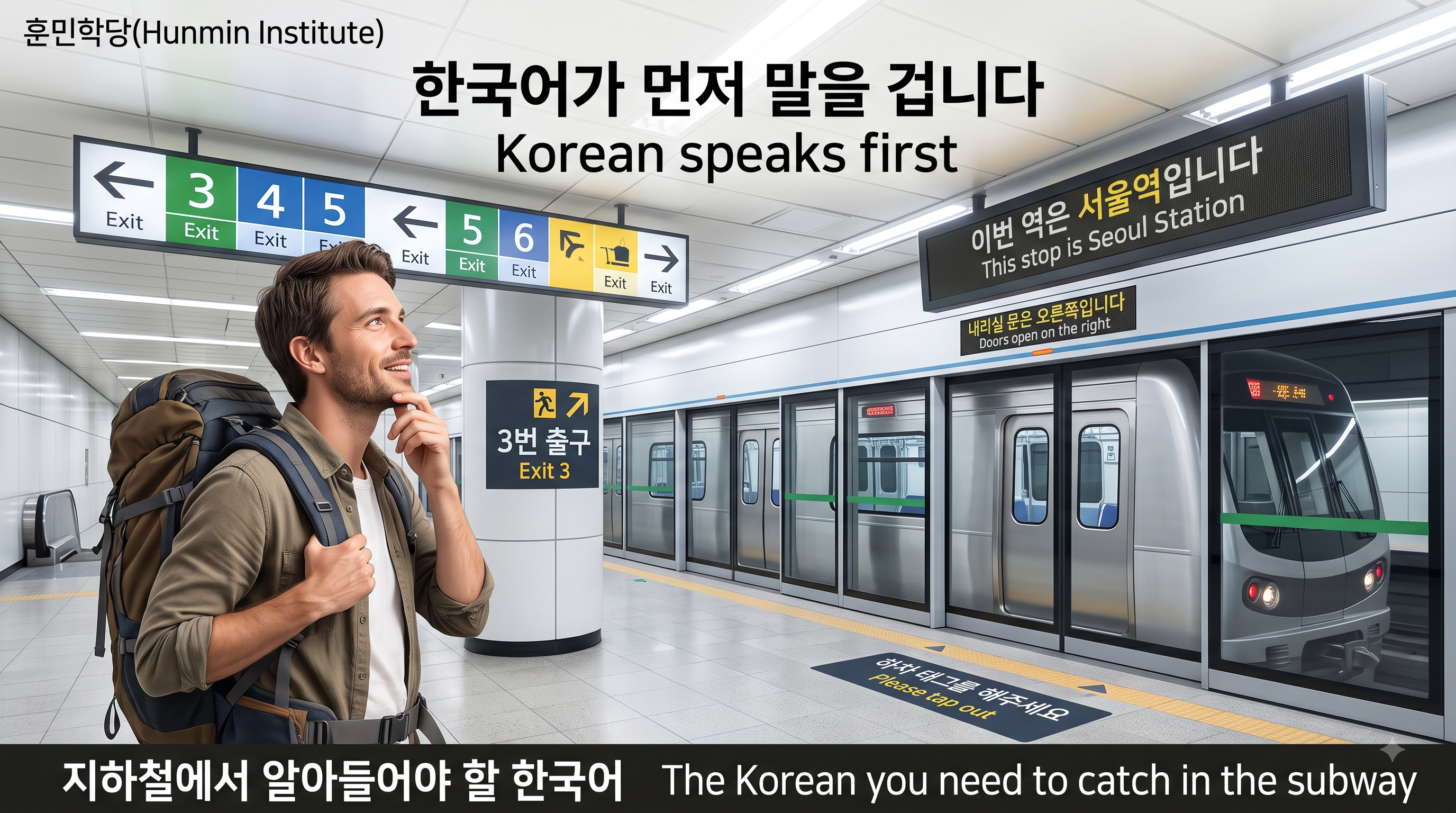
지하철에서는 한국어가 먼저 말을 겁니다
In the subway you never have to address anyone; the announcements do the talking.
Learn the gate, the platform, the four onboard phrases and your exit.
지하철에서는 누구에게도 말을 걸 필요가 없습니다. 대신 안내 방송과 표지판이 쉬지 않고 말을 겁니다.
이 글에서 개찰구와 승강장의 말, 방송에서 알아들어야 할 네 마디, 출구를 찾는 한국어를 익힙니다.
The learning services for the teaching materials published on this blog are free and open to everyone on the Hunmin Institute website ↗, with no account needed.
이 글에서 배우는 핵심 회화
Key Expressions in This Lesson
지하철에서 오가는 말은 몇 마디로 정해져 있습니다. 아래 여덟 문장은 좌우가 한 쌍의 대화가 아니라 각각 따로 익히는 문장이며, 왼쪽은 대부분 사람이 아니라 방송에서 나옵니다.
Only a few lines pass in the subway. The two columns are not paired dialogue; each sentence is learned on its own, and most of the left-hand ones come from announcements rather than from people.
| 듣는 말 Listening |
하는 말 Speaking |
|---|---|
| 하차 태그를 해주세요. [hacha taegeureul haejuseyo] Please tap your card when you exit. |
카드가 안 찍혀요. [kadeuga an jjikyeoyo] My card is not reading. |
| 이 열차는 급행 열차입니다. [i yeolchaneun geuphaeng yeolchaimnida] This train is an express. |
이 방향 맞아요? [i banghyang majayo] Is this the right direction? |
| 내리실 문은 오른쪽입니다. [naerisil muneun oreunjjogimnida] The doors will open on the right. |
여기서 갈아타요? [yeogiseo garatayo] Do I transfer here? |
| 3번 출구로 나가시면 됩니다. [sambeon chulguro nagasimyeon doemnida] Take Exit 3. |
출구 어디예요? [chulgu eodiyeyo] Where is the exit? |
첫째 줄은 소단락 1에서, 둘째 줄은 소단락 2에서, 셋째 줄은 소단락 3에서, 넷째 줄은 소단락 4에서 다룹니다.
The first row is covered in Section 1, the second in Section 2, the third in Section 3, and the fourth in Section 4.
1. 카드를 대고 들어가고, 대고 나옵니다
Tap In, Tap Out
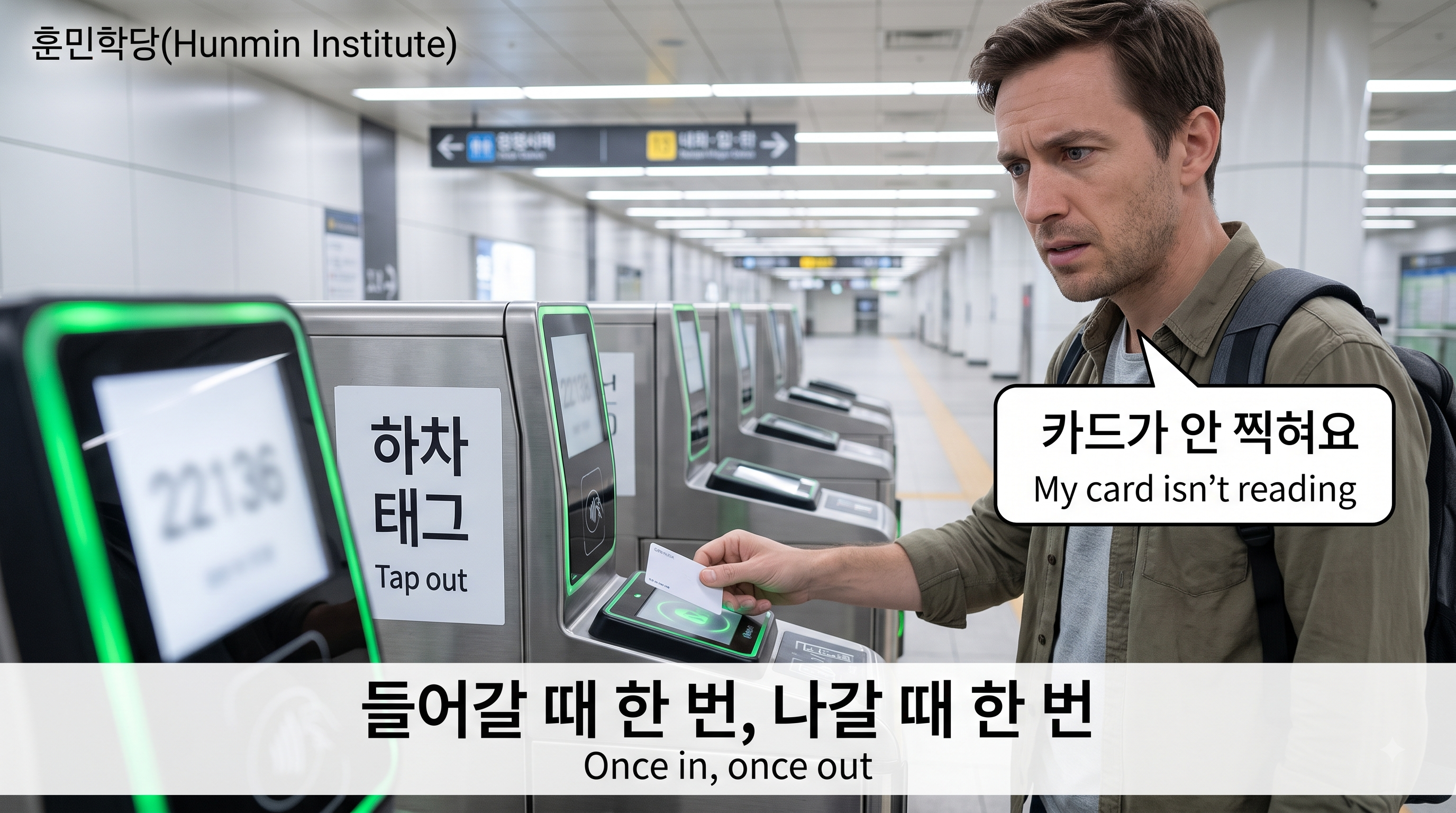
식당에서는 불렀고 카페에서는 답했고 배달에서는 적었습니다. 지하철에서는 아무 말도 하지 않아도 됩니다. 카드를 대고 들어가 열차를 타고 카드를 대고 나오면 끝입니다.
You called in the restaurant, answered in the cafe, and wrote for delivery. In the subway you need say nothing at all. Tap in, ride, tap out, done.
문제는 마지막 절차입니다. 내릴 때 카드를 대는 것은 문을 여는 동작이 아니라 요금을 정하는 동작입니다. 한국의 지하철 요금은 탄 곳과 내린 곳 사이의 거리로 계산되므로, 내릴 때 카드를 대지 않으면 얼마나 갔는지 알 수 없습니다.
The catch is the last step. Tapping out is not how you open the gate; it is how the fare is decided. Korean subway fares run by distance, so without the exit tap there is no record of how far you went.
그래서 2026년 3월 7일 첫차부터 하차 미태그 페널티가 시행되었습니다. 수도권 도시철도 구간만 이용하고 하차 태그 없이 나가면 다음에 탈 때 기본운임이 자동으로 더 붙습니다. 요금과 카드부터 정리해 봅니다.
So since the first train on 7 March 2026 an exit-tag penalty applies. Ride only the metropolitan subway network and leave without tapping out, and a base fare is added automatically the next time you tap in. First, the fares and the cards.
| 요금과 카드 (2026년 8월 기준) Fares and cards, as of August 2026 |
내용 Detail |
|---|---|
| 교통카드 기본운임 [gyotongkadeu gibonunim] Transit card base fare |
성인 1,550원, 10킬로미터 이하 구간 1,550 won for adults, up to 10 km |
| 1회용 승차권 [ilhoeyong seungchagwon] Single-use ticket |
교통카드보다 조금 비싸고 보증금 500원이 따로 붙으며, 내릴 때 환급기에서 돌려받습니다 Slightly more than the card fare, plus a 500 won deposit refunded at the machine after you exit |
| 환승 할인 [hwanseung harin] Transfer discount |
교통카드에만 적용되며 내린 뒤 정해진 시간 안에 갈아타야 합니다 Card only, and you must change within a set window |
| 하차 미태그 페널티 [hacha mitaegeu peneolti] Exit-tag penalty |
내릴 때 태그하지 않으면 다음 승차 때 성인 1,550원이 더 붙습니다. 선불과 후불 교통카드가 대상이고 정기권과 1회용 승차권, 우대권은 제외됩니다 1,550 won added at your next entry for adults. Prepaid and postpaid cards only; passes, single-use tickets and concession cards are exempt |
여기서 쓰는 표현부터 배워봅시다. 개찰구에서 오가는 말입니다.
Start with the expressions you will use here. These go back and forth at the gate.
| 듣는 말 Listening |
하는 말 Speaking |
|---|---|
| 하차 태그를 해주세요. [hacha taegeureul haejuseyo] Please tap your card when you exit. |
태그 안 했어요. [taegeu an haesseoyo] I did not tap out. |
| 다시 한 번 대주세요. [dasi han beon daejuseyo] Please tap it again. |
카드가 안 찍혀요. [kadeuga an jjikyeoyo] My card is not reading. |
| 잔액이 부족합니다. [janaegi bujokhamnida] Insufficient balance. |
어디서 충전해요? [eodiseo chungjeonhaeyo] Where do I top up? |
| 1층 편의점에서 파세요. [ilcheung pyeonuijeomeseo paseyo] They sell them at the convenience store downstairs. |
교통카드 어디서 사요? [gyotongkadeu eodiseo sayo] Where can I buy a transit card? |
응용 Apply It
↳ [명사]가 안 [동사]요
[noun]ga an [verb]yo
[noun] will not [verb].
ex 카드가 안 찍혀요./문이 안 열려요./충전이 안 돼요.
ROM kadeuga an jjikyeoyo/muni an yeollyeoyo/chungjeoni an dwaeyo
EN The card will not read./The door will not open./The top-up will not go through.
▶카드는 두 번 댑니다.
You tap twice.
들어갈 때 한 번, 나갈 때 한 번입니다. 나갈 때 대지 않으면 요금이 정해지지 않아 다음에 탈 때 기본운임이 더 붙습니다. 개찰구를 지나면서 화면에 금액이 뜨는지 확인하는 습관을 들이십시오.
Once going in, once coming out. Skip the second tap and the fare never settles, so a base fare is added at your next entry. Get into the habit of watching for the amount on the gate display.
1회용 승차권은 값이 더 비싸고 환승 할인도 없습니다. 하루에 두 번 이상 탈 계획이면 충전식 교통카드가 유리하며 편의점과 역 안 판매기에서 살 수 있습니다.
Single-use tickets cost more and get no transfer discount. If you will ride more than once a day, a rechargeable card wins, and convenience stores and station machines both sell them.
요금과 제도는 바뀔 수 있습니다. 이 글의 수치는 2026년 8월 기준이며 최신 정보는 맨 아래 참고 기관에서 확인하십시오.
Fares and rules change. The figures here are as of August 2026; check the official sources at the bottom.
2. 방향은 종착역 이름으로 적혀 있습니다
Direction Is Written as the Last Stop
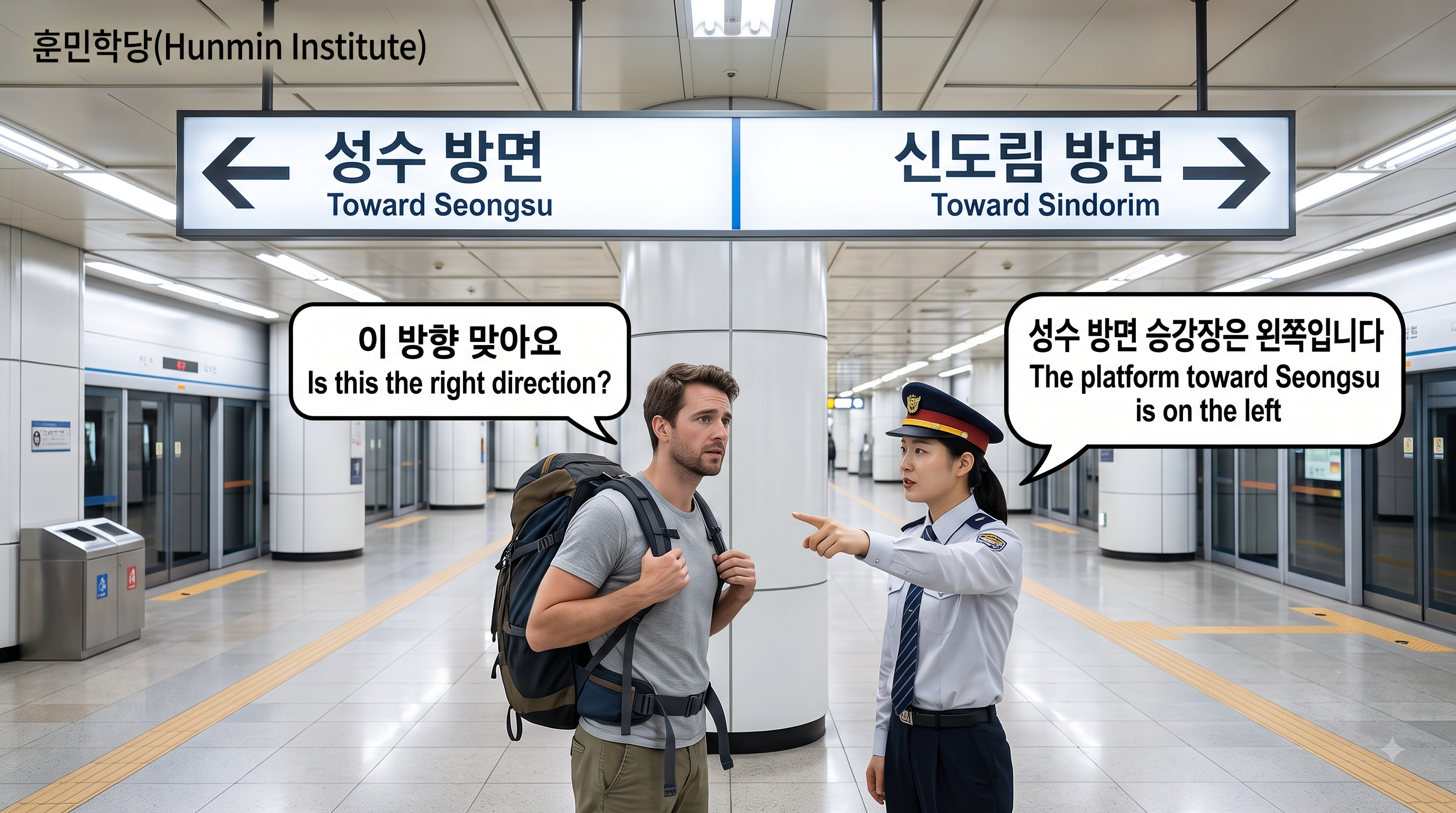
개찰구를 지나면 다음 문제가 기다립니다. 어느 쪽 승강장으로 가야 하는가입니다. 한국의 지하철은 상행과 하행이라는 말을 쓰지 않습니다. 대신 그 노선의 끝에 있는 역 이름을 방향으로 씁니다.
Past the gate the next problem waits: which platform. Korean subways do not label directions as inbound and outbound. They use the name of the station at the end of the line.
그러니까 사당 방면이라고 적혀 있으면 사당역으로 가는 방향이라는 뜻입니다. 목적지가 사당이 아니어도 사당 쪽으로 가는 열차라면 그 승강장이 맞습니다. 노선도에서 내 목적지가 어느 끝 역 쪽에 있는지 먼저 보아야 합니다.
So 사당 방면 means the direction toward Sadang Station. Your own stop need not be Sadang; if the train runs that way, that is your platform. Check the map first for which end your destination sits toward.
여기서 쓰는 표현부터 배워봅시다. 승강장에서 오가는 말입니다.
Start with the expressions you will use here. These go back and forth on the platform.
| 듣는 말 Listening |
하는 말 Speaking |
|---|---|
| 성수 방면 승강장은 왼쪽입니다. [seongsu bangmyeon seunggangjangeun oenjjogimnida] The platform toward Seongsu is on the left. |
이 방향 맞아요? [i banghyang majayo] Is this the right direction? |
| 이 열차는 급행 열차입니다. [i yeolchaneun geuphaeng yeolchaimnida] This train is an express. |
이거 우리 역에 서요? [igeo uri yeoge seoyo] Does this stop at my station? |
| 이번 역에서 반대편으로 갈아타시기 바랍니다. [ibeon yeogeseo bandaepyeoneuro garatasigi baramnida] Please change to the opposite platform here. |
반대로 탔어요. [bandaero tasseoyo] I got on going the wrong way. |
| 안전선 밖으로 물러나 주시기 바랍니다. [anjeonseon bakkeuro mulleona jusigi baramnida] Please stand back behind the safety line. |
2호선 맞아요? [ihoseon majayo] Is this Line 2? |
▶급행은 모든 역에 서지 않습니다.
Express trains skip stations.
급행 열차는 주요 역만 서고 나머지를 지나칩니다. 안내 방송에서 급행이라는 말이 들리면 내 목적지에 서는지 승강장 전광판에서 확인해야 합니다.
Express trains call only at major stations and run past the rest. When you hear 급행, check the platform display for whether your stop is on the list.
반대 방향으로 탔다면 다음 역에서 내려 반대편 승강장으로 건너가면 됩니다. 같은 역 안에서 건너갈 수 있는 역이 많고, 개찰구를 나가야 하는 역이라도 정해진 시간 안에 다시 타면 요금이 다시 붙지 않습니다.
If you boarded the wrong way, get off at the next stop and cross to the other platform. Many stations let you cross inside; where you must exit, re-entering within the allowed window avoids a second fare.
방면은 목적지가 아니라 방향입니다. 사당 방면 열차를 탄다고 사당까지 가는 것이 아니라 사당 쪽으로 간다는 뜻입니다.
방면 marks a direction, not a destination. Boarding a 사당 방면 train does not mean riding to Sadang; it means heading that way.
3. 방송에서 알아들어야 할 네 마디
Four Phrases to Catch in the Announcements
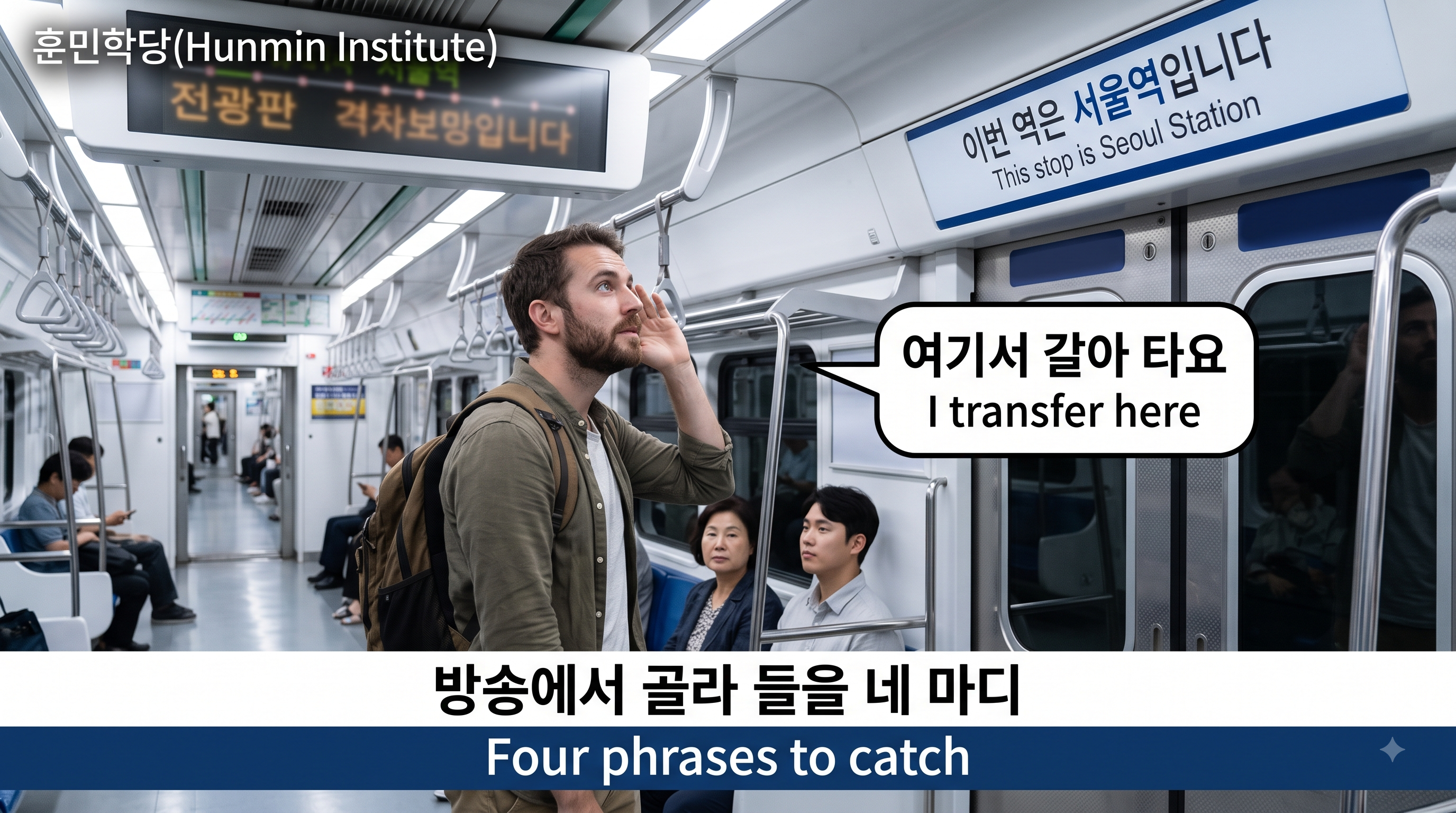
열차에 타면 방송이 계속 나옵니다. 전부 알아들을 필요는 없습니다. 실제로 필요한 것은 네 마디뿐이며, 이 넷만 잡으면 내릴 자리를 놓치지 않습니다.
Once aboard, the announcements never stop. You do not need to follow all of them. Four phrases are enough to keep you from missing your stop.
첫째는 이번 역, 둘째는 잠시 후, 셋째는 내리실 문, 넷째는 갈아타실 분입니다. 순서도 대체로 정해져 있습니다. 잠시 후로 시작하는 예고가 먼저 나오고, 역에 닿으면 이번 역이 나옵니다.
They are 이번 역, 잠시 후, 내리실 문 and 갈아타실 분. The order is fairly fixed: the 잠시 후 warning comes first, then 이번 역 as you pull in.
여기서 쓰는 표현부터 배워봅시다. 방송이 던지는 네 마디와 그때 쓰는 말입니다.
Start with the expressions you will use here. These are the four announcement phrases and what you say in reply.
| 듣는 말 Listening |
하는 말 Speaking |
|---|---|
| 잠시 후 서울역에 도착하겠습니다. [jamsi hu seoullyeoge dochakhagetseumnida] We will shortly arrive at Seoul Station. |
여기서 내려요. [yeogiseo naeryeoyo] I get off here. |
| 이번 역은 서울역입니다. [ibeon yeogeun seoullyeogimnida] This stop is Seoul Station. |
여기가 서울역이에요. [yeogiga seoullyeogieyo] So this is Seoul Station. |
| 내리실 문은 오른쪽입니다. [naerisil muneun oreunjjogimnida] The doors will open on the right. |
내릴게요. [naerilgeyo] Getting off, please. |
| 1호선으로 갈아타실 분은 이번 역에서 내리시기 바랍니다. [ilhoseoneuro garatasil buneun ibeon yeogeseo naerisigi baramnida] Passengers transferring to Line 1, please get off here. |
여기서 갈아타요. [yeogiseo garatayo] I transfer here. |
▶이번 역과 다음 역을 헷갈리지 마십시오.
Do not confuse ibeon yeok with daeum yeok.
이번 역은 지금 도착한 역이고, 다음 역은 그다음에 설 역입니다. 잠시 후 서울역에 도착하겠습니다라는 방송이 나오면 아직 도착하지 않은 것이고, 이번 역은 서울역입니다가 나오면 지금 문이 열립니다.
이번 역 is the stop you have reached; 다음 역 is the one after. 잠시 후 서울역에 도착하겠습니다 means you are not there yet, while 이번 역은 서울역입니다 means the doors are opening now.
한국어 방송은 대개 한국어와 영어가 이어서 나옵니다. 다만 영어 방송은 역 이름만 짧게 말하는 경우가 많아 환승 안내는 한국어에만 있는 일이 있습니다.
Announcements usually run in Korean and then English, but the English version often gives only the station name, so transfer details may exist in Korean alone.
내릴 준비를 할 때는 문 앞으로 미리 나가 서 있는 것이 보통입니다. 사람이 많은 시간에는 내릴게요라고 말하며 지나가면 길을 비켜 줍니다.
People usually move toward the doors before the train stops. In a crowd, saying 내릴게요 as you pass gets you a path.
4. 출구 번호를 모르면 지상에서 헤맵니다
Without the Exit Number You Are Lost Aboveground
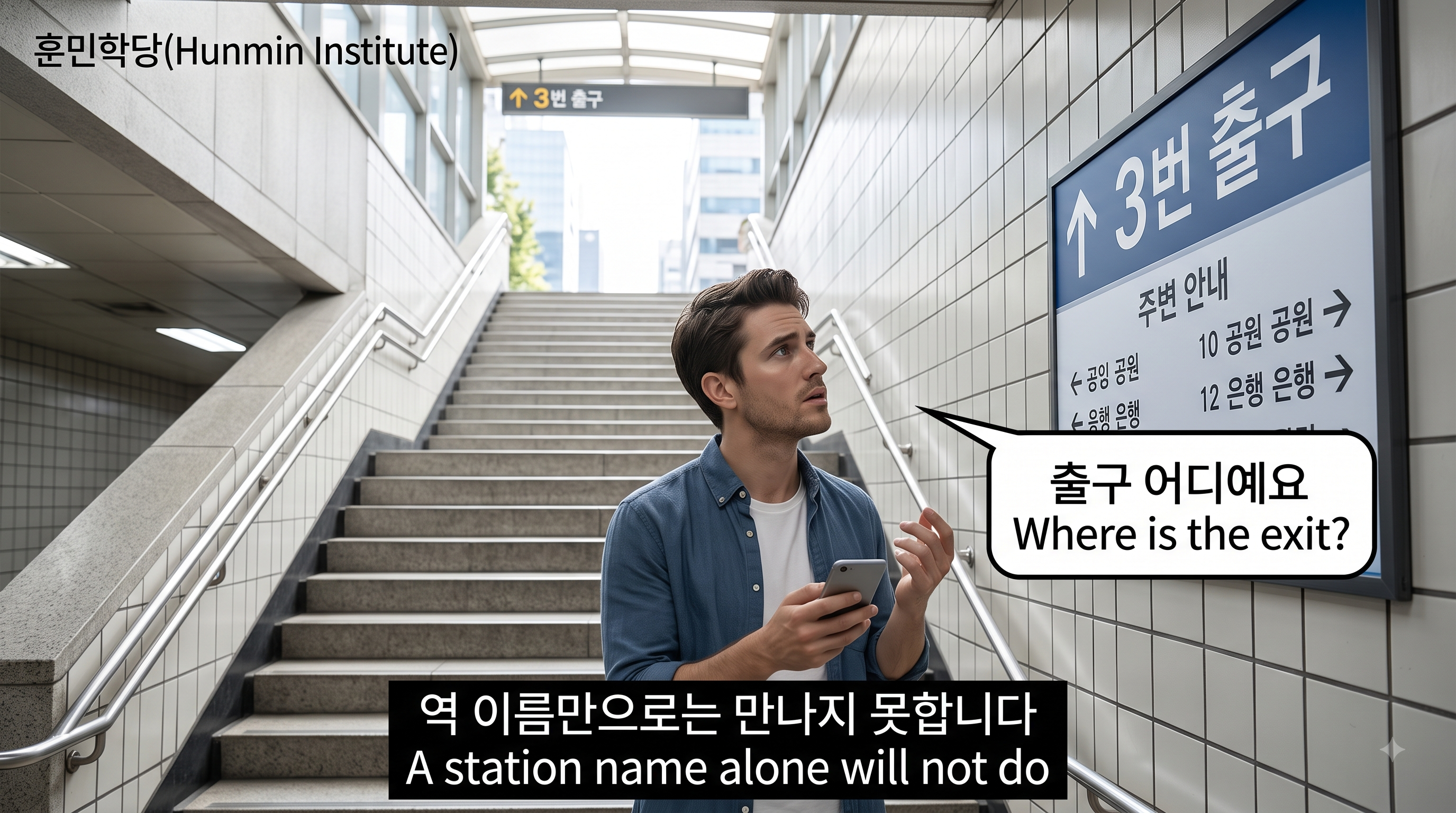
열차에서 내렸다고 끝이 아닙니다. 큰 역은 출구가 열 개를 넘고, 어느 출구로 나가느냐에 따라 지상에서의 위치가 수백 미터씩 갈립니다. 그래서 한국에서 약속을 잡을 때는 역 이름만 말하지 않고 몇 번 출구인지를 함께 말합니다.
Getting off the train is not the end. Large stations have more than ten exits, and the one you choose can put you hundreds of meters off. That is why arrangements in Korea name an exit number, not just a station.
환승도 같은 원리입니다. 환승 통로에는 갈아탈 노선 번호와 색이 표지판에 붙어 있고, 방향은 다시 종착역 이름으로 적혀 있습니다.
Transfers work the same way. Corridor signs carry the line number and its color, and direction is again written as the name of the last stop.
여기서 쓰는 표현부터 배워봅시다. 지상으로 나가며 오가는 말입니다.
Start with the expressions you will use here. These go back and forth as you head for the street.
| 듣는 말 Listening |
하는 말 Speaking |
|---|---|
| 3번 출구로 나가시면 됩니다. [sambeon chulguro nagasimyeon doemnida] Take Exit 3. |
출구 어디예요? [chulgu eodiyeyo] Where is the exit? |
| 몇 번 출구에서 볼까요? [myeot beon chulgueseo bolkkayo] Which exit shall we meet at? |
2번 출구에서 만나요. [ibeon chulgueseo mannayo] Let us meet at Exit 2. |
| 2호선은 이쪽입니다. [ihoseoneun ijjogimnida] Line 2 is this way. |
2호선 어디예요? [ihoseon eodiyeyo] Where is Line 2? |
| 개찰구 안쪽에 있습니다. [gaechalgu anjjoge itseumnida] It is inside the gates. |
화장실 어디예요? [hwajangsil eodiyeyo] Where is the restroom? |
▶출구 번호는 약속의 일부입니다.
The exit number is part of the plan.
강남역에서 만나자는 말만으로는 만나지 못합니다. 강남역 11번 출구처럼 번호를 붙여야 장소가 정해지며, 한국 사람끼리도 그렇게 약속합니다. 역 안 표지판에는 출구 번호와 함께 그 출구로 나가면 무엇이 있는지가 적혀 있으니 목적지 이름이 보이는 출구를 고르면 됩니다.
Meet me at Gangnam Station is not enough. It takes a number, as in Gangnam Station Exit 11, and Koreans arrange it that way among themselves. Station signs list what stands above each exit, so pick the one showing your destination.
화장실은 개찰구 안쪽에 있는 역과 바깥쪽에 있는 역이 갈립니다. 나가기 전에 쓰는 편이 안전합니다.
Restrooms sit inside the gates at some stations and outside at others, so it is safer to use one before you leave.
2번 출구의 2번과 이번 역의 이번은 소리가 같습니다. 뒤에 붙는 말이 출구인지 역인지로 구분하면 됩니다.
The 2번 of Exit 2 and the 이번 of 이번 역 sound alike. Tell them apart by what follows, the exit or the stop.
지하철에서 필요한 한국어는 개찰구에서 막혔을 때 묻는 말, 방향을 확인하는 말, 방송에서 알아듣는 네 마디, 출구를 찾는 말입니다. 말하기보다 듣기가 훨씬 많은 자리이니 방송을 흘려듣지 말고 네 마디만 골라 들으십시오.
The Korean you need in the subway is what to ask when the gate stops you, how to confirm a direction, the four phrases in the announcements, and how to find your exit. Listening outweighs speaking here, so pick out those four rather than tuning the announcements out.
Next: Korean Bus Phrases: Read the Color, Signal Twice ↗
토픽 맛보기
TOPIK Preview
유형: TOPIK Ⅰ 읽기 [40~42], 안내문, 일치하지 않는 내용 고르기
Type: TOPIK I Reading [40–42], notice, choose the statement that does not match
다음을 읽고 내용이 같지 않은 것을 고르십시오.
Read the following and choose the statement that does not match.
지하철 이용 안내 / 내리실 때에도 카드를 대주세요. / 대지 않으면 다음에 타실 때 요금이 더 붙습니다. / 1회용 승차권은 내리실 때 보증금을 돌려드립니다. / 환승 할인은 교통카드에만 적용됩니다.
Subway notice / Please tap your card when you get off too. / If you do not, a fare is added the next time you ride. / Single-use tickets refund the deposit when you exit. / The transfer discount applies to transit cards only.
① 카드는 내릴 때도 대야 합니다.
② 내릴 때 카드를 대지 않으면 손해를 봅니다.
③ 1회용 승차권은 보증금을 돌려받습니다.
④ 1회용 승차권도 환승 할인을 받습니다.
Answer ▾
정답 ④ 1회용 승차권도 환승 할인을 받습니다
Answer: ④ 1회용 승차권도 환승 할인을 받습니다
안내문이 환승 할인은 교통카드에만 적용된다고 했으므로 1회용 승차권도 받는다는 ④는 진술이 어긋납니다. ①은 내리실 때에도 카드를 대라는 줄에서, ②는 대지 않으면 요금이 더 붙는다는 줄에서, ③은 보증금을 돌려준다는 줄에서 각각 확인됩니다. 흉내 낸 대문항은 TOPIK Ⅰ 읽기 [40~42]입니다.
The notice says the transfer discount applies to transit cards only, so ④ contradicts it. ① follows from the line about tapping on the way out, ② from the added fare, and ③ from the deposit refund. The item type modeled here is TOPIK I Reading [40–42].
FAQ
Q1. 교통카드는 어디서 사나요?Answer ▾
Q1. Where do I buy a transit card?
A1. 역 안의 판매기와 편의점에서 살 수 있습니다. 카드값을 내고 산 뒤 원하는 금액을 충전해서 씁니다. 잔액이 남으면 나중에 돌려받을 수 있고, 편의점 결제에도 쓸 수 있습니다.
A1. Station machines and convenience stores both sell them. You pay for the card, then load whatever amount you want. Leftover balance can be refunded later, and the card also works at convenience stores.
Q2. 반대 방향으로 탔는데 개찰구를 나가야 하면 요금을 또 내나요?Answer ▾
Q2. If I have to exit the gate to switch platforms, do I pay again?
A2. 같은 역에서 정해진 시간 안에 다시 들어가면 요금이 다시 붙지 않는 제도가 있습니다. 다만 노선과 운영 기관에 따라 적용이 다르므로, 나가기 전에 승강장을 다시 살펴 건너갈 수 있는지 확인하는 편이 낫습니다.
A2. Re-entering the same station within a set window avoids a second fare, though the rule varies by line and operator. Before you leave, check the platform again for a way to cross inside.
Q3. 안내 방송이 너무 빨라서 역 이름을 못 알아듣습니다.Answer ▾
Q3. The announcements are too fast to catch the station name.
A3. 열차 안 전광판과 문 위 노선도에 다음 역이 표시됩니다. 방송을 놓쳤어도 화면을 보면 됩니다. 역 이름 몇 개를 미리 눈으로 익혀 두면 소리로도 잡히기 시작합니다.
A3. Displays inside the car and the map above the doors show the next stop, so a missed announcement is not a problem. Learn a few station names by sight and they start landing by ear.
Q4. 짐이 많은데 계단만 있으면 어떻게 하나요?Answer ▾
Q4. What if I have luggage and there are only stairs?
A4. 대부분의 역에 엘리베이터가 있습니다. 다만 위치가 출구마다 달라 표지판을 따라가야 합니다. 엘리베이터 어디예요라고 물으면 됩니다.
A4. Most stations have a lift, but its location differs by exit, so follow the signs. You can also ask 엘리베이터 어디예요.
Vocabulary and Pronunciation for Foreigners
| No | Korean | Romanisation | Meaning |
|---|---|---|---|
| 1 | 개찰구 | gaechalgu | (n) ticket gate [ɡeɪt] |
| 2 | 승강장 | seunggangjang | (n) platform [ˈplætfɔːrm] |
| 3 | 환승 | hwanseung | (n) transfer [ˈtrænsfɜːr] |
| 4 | 출구 | chulgu | (n) exit [ˈeksɪt] |
| 5 | 교통카드 | gyotongkadeu | (n) transit card [ˈtrænzɪt kɑːrd] |
| ▾ 단어 50개 더 보기 Show 50 more ↗ | |||
The blog page has limits of space and function, so only five words are shown here. The rest of the word list, the audio, the sentences and tables, the FAQ, the worksheet, the TOPIK questions and the lesson video are on the Hunmin Institute website ↗, free and open to everyone, with no account needed.
참고 기관
Official Sources
서울교통공사 ↗
Seoul Metro
https://www.seoulmetro.co.kr
기관 설명 보기 About this institute ▾
This is the operator that runs the exit-tag penalty. It has an English section where the passenger terms and notices of rule changes are published. Fares and rules can be revised, so check before you ride.
서울특별시 ↗
Seoul Metropolitan Government
https://news.seoul.go.kr/traffic
기관 설명 보기 About this institute ▾
This is where fares and transfer rules are published. English pages let you check the base fare and the transfer conditions whatever your nationality.
※ 본 콘텐츠(원고, 이미지, 예문 포함)는 저작권법에 의해 보호받는 훈민학당의 저작물입니다. 무단 복제, 전재, 재배포 및 AI 학습 데이터로의 이용을 금합니다.
This content (manuscript, images, and example sentences) is the copyrighted property of Hunmin Institute, protected under copyright law. Unauthorized copying, reproduction, redistribution, and use as AI training data are prohibited.
'Real Talk' 카테고리의 다른 글
| Korean Taxi Phrases: Speak, Watch the Meter, Pay (0) | 2026.08.18 |
|---|---|
| Korean Bus Phrases: Read the Color, Signal Twice (0) | 2026.08.18 |
| Korean Food Delivery Phrases: What to Write in the Request Box (0) | 2026.08.18 |
| How to Order Coffee in Korean: From Counter to Buzzer (0) | 2026.08.17 |
| How to Order in a Korean Restaurant: Call, Ask, Pay (0) | 2026.08.16 |


