
Korean Food Delivery Phrases: What to Write in the Request Box
부탁은 글로 먼저 하고 전화는 마지막에 옵니다
Whether the food lands at your door or in your hand is decided by the request box.
Learn the lines to write there and the Korean spoken when it arrives.
배달에서 음식이 문 앞에 놓일지 손에 건네질지는 앱의 요청사항 칸에 무엇을 적었느냐로 갈립니다.
이 글에서 요청사항에 적는 문장과 도착 순간에 오가는 한국어를 익힙니다.

The learning services for the teaching materials published on this blog are free and open to everyone on the Hunmin Institute website ↗, with no account needed.
이 글에서 배우는 핵심 회화
Key Expressions in This Lesson
배달에서 오가는 말은 몇 마디로 정해져 있습니다. 아래 여덟 문장은 좌우가 한 쌍의 대화가 아니라 각각 따로 익히는 문장이며, 그 가운데 일부는 소리가 아니라 화면 위의 글로 도착합니다.
Only a few lines pass in a delivery. The two columns are not paired dialogue; each sentence is learned on its own, and some of them arrive as text on a screen rather than as speech.
| 듣는 말 Listening |
하는 말 Speaking |
|---|---|
| 수저, 포크 필요하세요? [sujeo, pokeu piryohaseyo] Do you need utensils? |
수저 빼주세요. [sujeo ppaejuseyo] No utensils, please. |
| 공동현관 비밀번호 좀 알려주세요. [gongdonghyeongwan bimilbeonho jom allyeojuseyo] Could you give me the entrance code? |
3층으로 오세요. [samcheungeuro oseyo] Come to the third floor. |
| 네, 문 앞에 두겠습니다. [ne, mun ape dugetseumnida] Sure, I will leave it at the door. |
문 앞에 두고 가주세요. [mun ape dugo gajuseyo] Please leave it at the door. |
| 배달이 완료되었습니다. [baedari wallyodoeeotseumnida] Delivery complete. |
음료가 안 왔어요. [eumnyoga an wasseoyo] The drink did not come. |
첫째 줄은 소단락 1에서, 둘째 줄은 소단락 2에서, 셋째 줄은 소단락 3에서, 넷째 줄은 소단락 4에서 다룹니다.
The first row is covered in Section 1, the second in Section 2, the third in Section 3, and the fourth in Section 4.
1. 배달은 말이 아니라 글로 부탁합니다
Delivery Is Asked in Writing
식당에서는 종업원을 불렀고 카페에서는 직원의 질문에 답했습니다. 배달에서는 아무도 마주 서 있지 않습니다. 부탁할 말이 있으면 앱의 요청사항 칸에 적어야 합니다.
In a restaurant you called someone over; in a cafe you answered the staff. With delivery nobody is standing in front of you. Anything you want to ask goes into the request box in the app.
요청사항 칸은 대화창이 아닙니다. 기사는 여러 건을 동시에 옮기며 요청사항을 짧게 훑습니다. 길게 쓰면 뒤쪽이 지나가고 짧게 쓰면 지켜집니다. 문장 하나에 한 가지만 담는 편이 안전합니다.
The request box is not a chat window. Drivers carry several orders at once and skim the note. Write long and the end gets passed over; write short and it gets followed. One request per line is the safe habit.
큰 앱은 가게에 남기는 칸과 기사에게 남기는 칸이 따로 있습니다. 음식에 대한 부탁은 앞쪽에, 오는 길과 받는 방식에 대한 부탁은 뒤쪽에 적습니다. 칸이 하나뿐인 앱이면 음식 요청을 먼저 쓰고 줄을 바꿔 배달 요청을 씁니다.
Larger apps split the note in two: one for the shop, one for the driver. Food requests go in the first, the route and the handover in the second. If your app has only one box, write the food request first, then start a new line for the delivery request.
여기서 쓰는 표현부터 배워봅시다. 요청사항 칸에 적는 말입니다.
Start with the expressions you will use here. These are the lines you write in the request box.
| 듣는 말 Listening |
하는 말 Speaking |
|---|---|
| 수저, 포크 필요하세요? [sujeo, pokeu piryohaseyo] Do you need utensils? |
수저 빼주세요. [sujeo ppaejuseyo] No utensils, please. |
| 일회용 수저는 요청 시 제공됩니다. [ilhoeyong sujeoneun yocheong si jegongdoemnida] Disposable utensils are provided on request. |
수저 주세요. [sujeo juseyo] Utensils, please. |
| 가게 사장님께 남길 말 [gage sajangnimkke namgil mal] Note for the shop |
덜 맵게 해주세요. [deol maepge haejuseyo] Please make it less spicy. |
| 라이더님께 남길 말 [raideonimkke namgil mal] Note for the driver |
문 앞에 두고 가주세요. [mun ape dugo gajuseyo] Please leave it at the door. |
응용 Apply It
↳ [명사] 빼주세요
[noun] ppaejuseyo
Please leave out [noun].
ex [수저] 빼주세요./[오이] 빼주세요./[소스] 빼주세요.
ROM [sujeo] ppaejuseyo/[oi] ppaejuseyo/[soseu] ppaejuseyo
EN No utensils, please./No cucumber, please./No sauce, please.
▶수저는 이제 요청해야 옵니다.
Utensils now come only if you ask.
예전에는 배달 음식에 일회용 수저가 당연히 따라왔습니다. 대형 배달앱이 2021년에 기본값을 바꾸면서 요청해야 받는 방식이 되었습니다. 법으로 정해진 것이 아니라 앱의 설정이므로 앱마다 표시가 다릅니다.
Disposable utensils used to come with every order. In 2021 the major delivery apps flipped the default, so now you receive them only on request. This is an app setting rather than a law, so the wording differs by app.
집에 수저가 없다면 수저 주세요라고 적어야 합니다. 여행자나 갓 이사한 사람이 자주 놓치는 자리입니다.
If you have no cutlery at home, write 수저 주세요. Travelers and people who have just moved in miss this often.
빼주세요는 식당 편의 고기 빼주세요와 같은 틀입니다. 음식에서 무언가를 덜어 달라는 요청에 그대로 쓰입니다.
빼주세요 is the same pattern as 고기 빼주세요 from the restaurant post. It works for anything you want left out.
2. 주소보다 중요한 것은 문 앞까지의 길
The Path to Your Door Matters More Than the Address

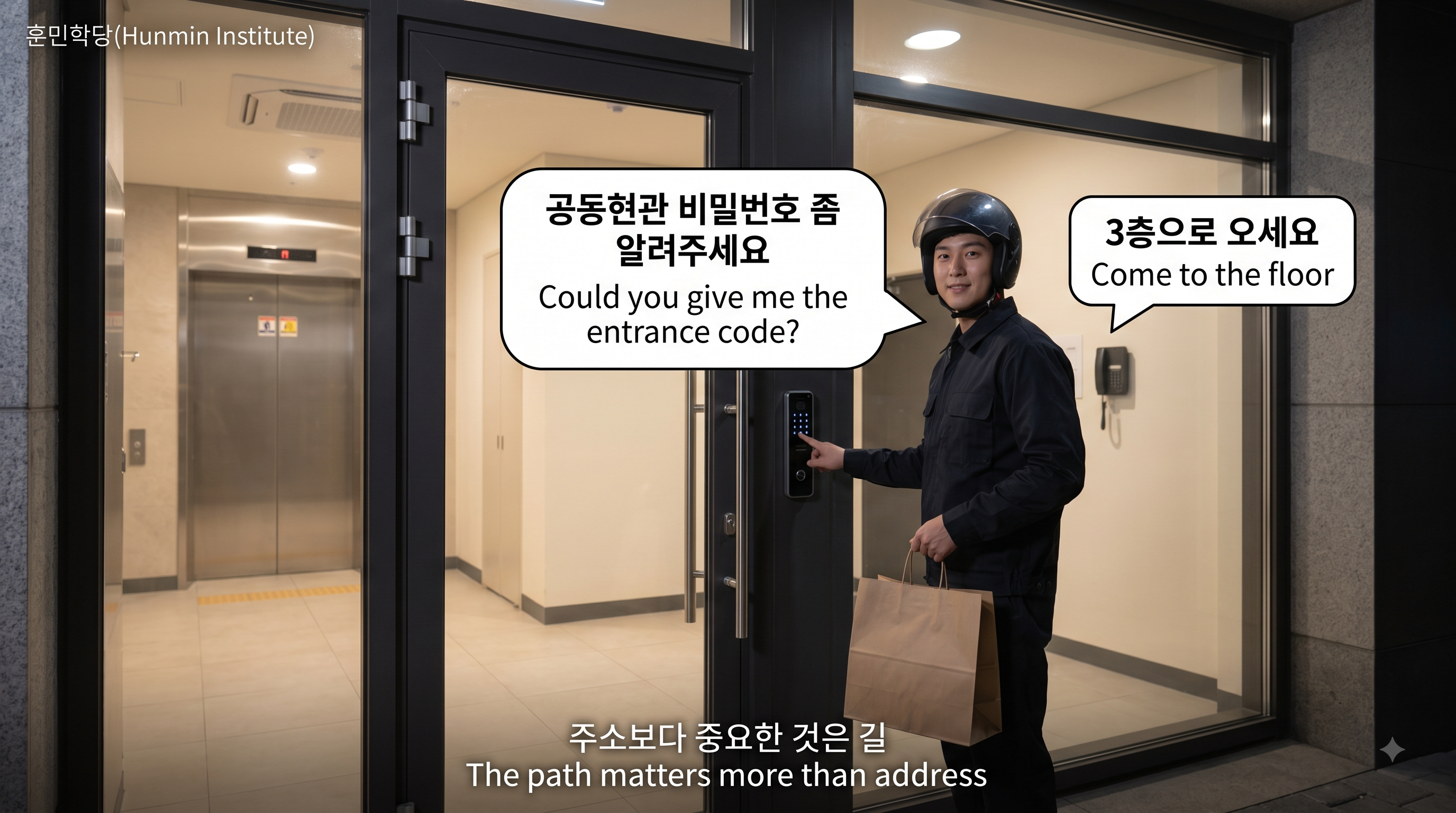
주소는 앱에 이미 저장되어 있습니다. 기사가 모르는 것은 그 주소에서 당신의 문까지 오는 길입니다. 아파트와 오피스텔은 공동현관이 잠겨 있어 비밀번호가 없으면 건물 안으로 들어올 수 없습니다.
The address is already saved in the app. What the driver does not know is the path from that address to your door. Apartment buildings have a locked main entrance, and without the code nobody gets in.
그래서 요청사항에 적는 첫 줄은 대개 비밀번호입니다. 여기에 층수와 호수, 갈림길이 있으면 방향까지 한 줄로 붙입니다. 적어 두지 않으면 기사가 전화를 걸고 그만큼 음식이 식습니다.
So the first line of the note is usually the code, followed by the floor, the unit, and a direction if the way forks. Leave it out and the driver calls, and the food cools while you talk.
여기서 쓰는 표현부터 배워봅시다. 문 앞까지의 길을 알리는 말입니다.
Start with the expressions you will use here. These tell the driver the way to your door.
| 듣는 말 Listening |
하는 말 Speaking |
|---|---|
| 공동현관 비밀번호 좀 알려주세요. [gongdonghyeongwan bimilbeonho jom allyeojuseyo] Could you give me the entrance code? |
공동현관 비밀번호는 1234예요. [gongdonghyeongwan bimilbeonhoneun il i sam sa yeyo] The entrance code is 1234. |
| 몇 호세요? [myeot hoseyo] Which unit? |
302호예요. [samgongi hoyeyo] It is unit 302. |
| 다 왔는데 어디로 갈까요? [da wanneunde eodiro galkkayo] I am here. Which way? |
3층으로 오세요. [samcheungeuro oseyo] Come to the third floor. |
| 앞쪽 건물 맞나요? [apjjok geonmul mannayo] Is it the front building? |
뒷문으로 오세요. [dwinmuneuro oseyo] Come to the back door. |
▶글로 쓸 때와 말할 때가 다릅니다.
Writing and speaking take different forms.
요청사항에는 공동현관 비밀번호 1234처럼 명사로 끊어 적습니다. 문장으로 길게 적으면 훑는 눈에 걸리지 않습니다.
In the note, write it as a phrase: 공동현관 비밀번호 1234. A full sentence is easy to skim past.
전화로 말할 때는 문장이 됩니다. 공동현관 비밀번호는 1234예요, 302호예요처럼 예요를 붙여 말합니다. 같은 내용이 글에서는 명사로, 말에서는 문장으로 갈립니다.
On the phone it becomes a sentence ending in 예요. The same content is a phrase in writing and a sentence in speech.
숫자는 하나씩 끊어 읽습니다. 1234는 천이백삼십사가 아니라 일이삼사이고, 302호는 삼백이 호가 아니라 삼공이 호입니다.
Read the digits one by one. 1234 is il i sam sa, not the full number, and 302 is sam gong i.
3. 문 앞에 둘지 손에 받을지
At the Door or in Your Hand
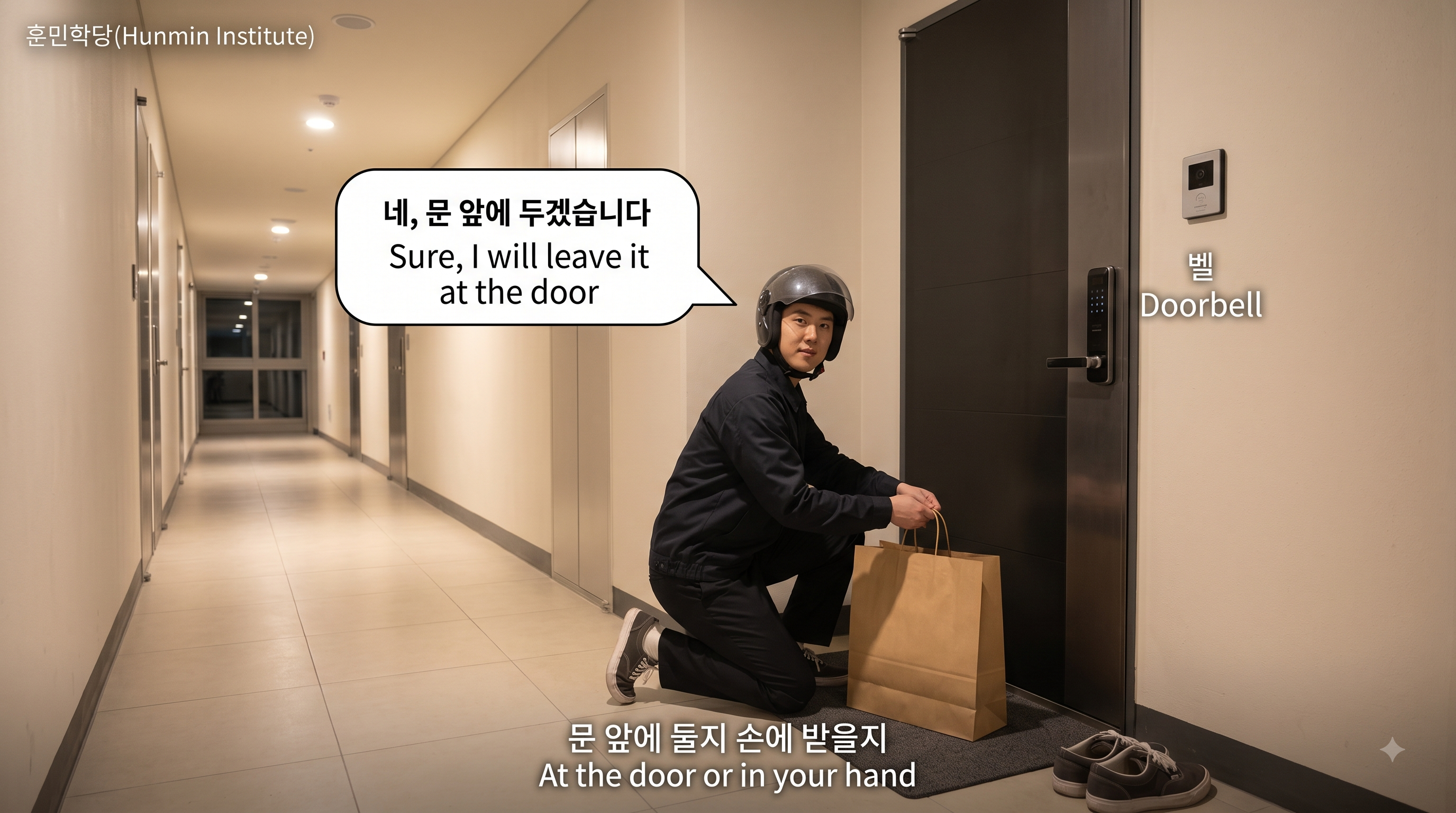
받는 방식도 요청사항으로 정합니다. 문 앞에 두고 가는 방식과 직접 손에 받는 방식이 있고, 적어 두지 않으면 기사가 그때그때 판단합니다. 벨을 누르는 곳도 있고 전화를 거는 곳도 있어 결과가 예측되지 않습니다.
How you receive it is also set in the note. If you write nothing the driver decides on the spot. Some ring, some call, so the outcome is unpredictable.
자고 있는 사람이 있거나 문을 열기 어려운 사정이 있으면 그것까지 한 줄로 적습니다. 다만 이유는 쓰지 않고 부탁만 씁니다. 문장이 짧을수록 지켜집니다. 요청사항 칸이 실제로 어떤 모양인지 먼저 봅니다.
If someone is asleep or you cannot open the door, put that in one line too. Write the request, not the reason: the shorter the line, the more reliably it is followed. First, what the box actually looks like.
| 요청사항을 쓰는 상황 When you write it |
칸에 적는 내용 What goes in the box |
|---|---|
| 아기가 자고 있을 때 A baby is sleeping |
공동현관 1234 / 302호 문 앞 / 벨 누르지 마세요 Entrance 1234 / door of unit 302 / please do not ring |
| 문을 열기 어려울 때 You cannot open the door |
공동현관 1234 / 302호 문 앞 / 노크해주세요 Entrance 1234 / door of unit 302 / please knock |
| 밖에 있다가 들어올 때 You are on your way home |
공동현관 1234 / 302호 문 앞 / 도착하면 문자 주세요 Entrance 1234 / door of unit 302 / please text on arrival |
| 직접 받고 싶을 때 You want it handed over |
공동현관 1234 / 302호 / 벨 눌러 주세요 Entrance 1234 / unit 302 / please ring the bell |
여기서 쓰는 표현부터 배워봅시다. 받는 방식을 두고 오가는 말입니다.
Start with the expressions you will use here. These settle how the food is handed over.
| 듣는 말 Listening |
하는 말 Speaking |
|---|---|
| 네, 문 앞에 두겠습니다. [ne, mun ape dugetseumnida] Sure, I will leave it at the door. |
문 앞에 두고 가주세요. [mun ape dugo gajuseyo] Please leave it at the door. |
| 문자 드리겠습니다. [munja deurigetseumnida] I will send you a text. |
벨 누르지 마세요. [bel nureuji maseyo] Please do not ring the bell. |
| 노크했습니다. [nokeuhaetseumnida] I knocked. |
노크해주세요. [nokeuhaejuseyo] Please knock. |
| 나와 주시겠어요? [nawa jusigesseoyo] Could you come out? |
지금 나갈게요. [jigeum nagalgeyo] I am coming out now. |
▶마세요는 금지가 아니라 부탁입니다.
Maseyo is a request, not a prohibition.
벨 누르지 마세요는 명령처럼 보이지만 요청사항에서는 부탁으로 읽힙니다. 한국어의 마세요는 손윗사람에게도 쓸 수 있는 정중한 형태입니다. 전화하지 마세요, 초인종 누르지 마세요처럼 동사만 바꾸면 그대로 쓰입니다.
벨 누르지 마세요 looks like an order but reads as a request here. 마세요 is a polite form you can use even with someone older, and swapping the verb gives you 전화하지 마세요 or 초인종 누르지 마세요.
이유는 쓰지 않아도 됩니다. 아기가 자고 있어서 벨을 누르지 말아 달라고 길게 쓰기보다 벨 누르지 마세요 한 줄이 더 잘 지켜집니다.
You do not need to give a reason. One short line is followed more reliably than a long explanation.
경비실이나 무인택배함에 두어 달라고 할 수도 있습니다. 다만 음식은 식으므로 문 앞이 기본입니다.
You can ask for the security office or a parcel locker, but food goes cold, so the door is the default.
4. 도착한 뒤에 오는 말들
What Comes After It Arrives
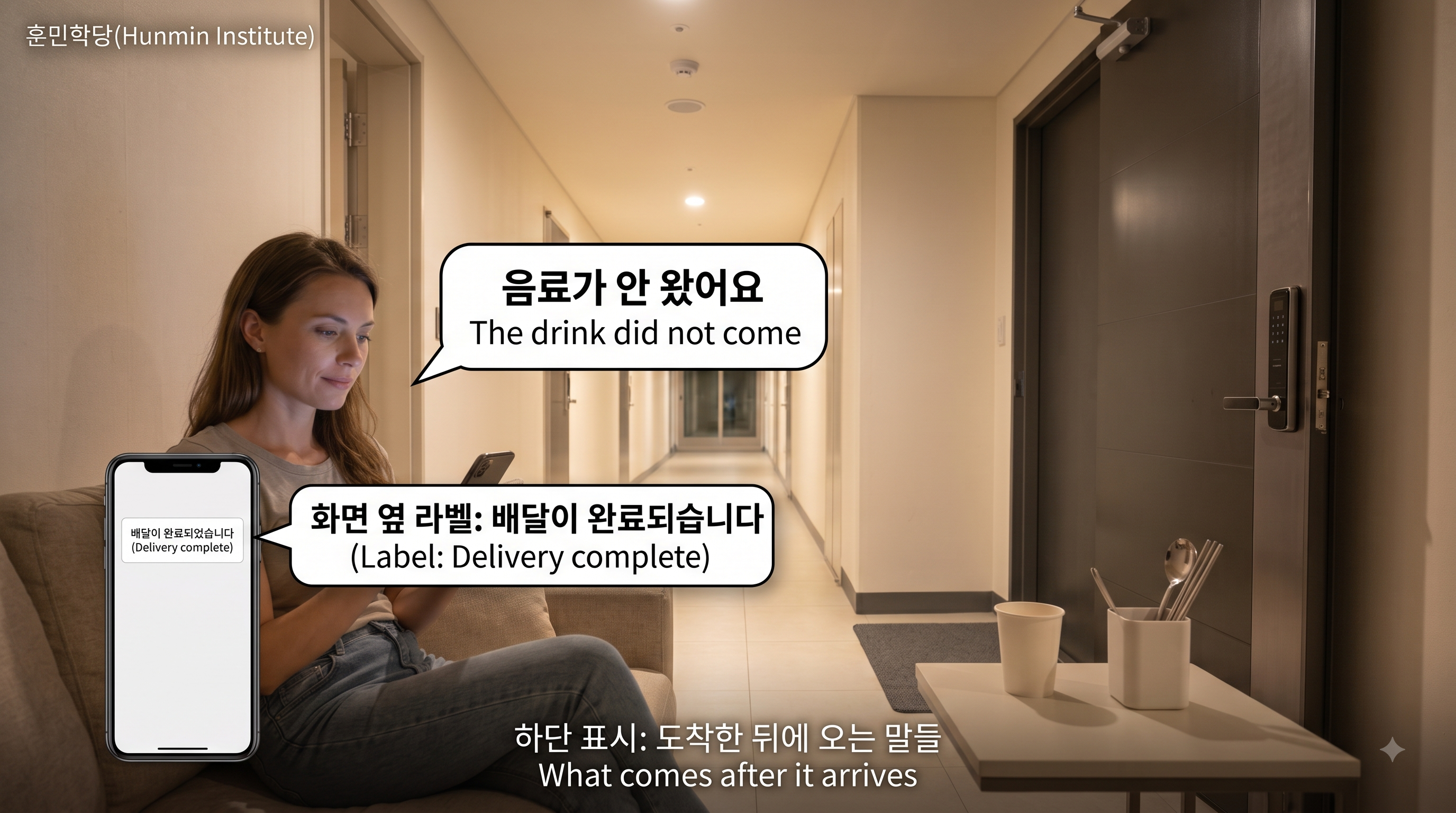
음식이 출발하면 앱이 알림을 보냅니다. 지금 출발했습니다, 곧 도착합니다, 배달이 완료되었습니다 순으로 이어지며 이 문장들은 듣는 것이 아니라 화면에서 읽는 말입니다. 벨을 누르지 말아 달라고 적었다면 알림이 유일한 신호이므로 확인하는 습관이 필요합니다.
Once the food leaves, the app sends notifications in order: it has just left, it is arriving soon, delivery complete. These are read on a screen rather than heard. If you asked the driver not to ring, the notification is your only signal.
받은 뒤에 빠진 것이 있으면 그때는 말로 해결합니다. 앱의 문의 창이나 가게 전화로 무엇이 안 왔는지 짧게 알리면 됩니다.
If something is missing, that part is settled in speech. Use the app inquiry window or call the shop and say briefly what did not arrive.
여기서 쓰는 표현부터 배워봅시다. 도착한 뒤에 오가는 말입니다.
Start with the expressions you will use here. These go back and forth once the food has arrived.
| 듣는 말 Listening |
하는 말 Speaking |
|---|---|
| 지금 출발했습니다. [jigeum chulbalhaetseumnida] It has just left. |
네, 알겠습니다. [ne, algetseumnida] Got it. |
| 배달이 완료되었습니다. [baedari wallyodoeeotseumnida] Delivery complete. |
확인했습니다. [hwaginhaetseumnida] Confirmed. |
| 확인해 보겠습니다. [hwaginhae bogetseumnida] I will check. |
음료가 안 왔어요. [eumnyoga an wasseoyo] The drink did not come. |
| 다시 보내드릴게요. [dasi bonaedeurilgeyo] We will send it again. |
다른 게 왔어요. [dareun ge wasseoyo] The wrong item came. |
▶안 왔어요는 사실을 알리는 말입니다.
An wasseoyo simply reports what happened.
안 왔어요는 항의가 아니라 상황을 알리는 문장입니다. 화를 내지 않고 무엇이 빠졌는지만 말하면 대개 바로 처리됩니다.
It is a report, not a complaint. Say what is missing without anger and it is usually fixed at once.
받침이 있는 말에는 이, 없는 말에는 가가 붙습니다. 젓가락이, 음료가, 소스가처럼 갈립니다.
Words ending in a consonant take 이 and words ending in a vowel take 가: 젓가락이, 음료가, 소스가.
배달이 완료되었습니다 대신 문 앞에 두고 갑니다라는 문구가 뜨는 앱도 있습니다. 둘 다 음식이 문 앞에 놓였다는 뜻이며, 알림이 왔는데 아무것도 없으면 먼저 문 밖을 살피고 그다음에 알립니다.
Some apps show 문 앞에 두고 갑니다 instead of 배달이 완료되었습니다. Both mean the food is at your door, and if the notice arrives with nothing there, check outside first, then report it.
배달에서 필요한 한국어는 요청사항에 적는 말과 길을 알리는 말, 받는 방식을 정하는 말, 도착한 뒤에 알리는 말입니다. 길게 쓰지 말고 한 줄에 한 가지만 담으면 대부분 그대로 지켜집니다.
The Korean you need for delivery is what you write in the note, how you describe the way in, how you settle the handover, and what you say afterwards. Keep one request per line and most of it is followed.
Next: Korean Subway Phrases: From the Gate to the Right Exit ↗
토픽 맛보기
TOPIK Preview
유형: TOPIK Ⅰ 읽기 [40~42], 안내문, 일치하지 않는 내용 고르기
Type: TOPIK I Reading [40–42], notice, choose the statement that does not match
다음을 읽고 내용이 같지 않은 것을 고르십시오.
Read the following and choose the statement that does not match.
요청사항 / 공동현관 비밀번호 1234 / 302호, 3층으로 오세요 / 문 앞에 두고 가주세요. 벨 누르지 마세요.
Request note / Entrance code 1234 / Unit 302, come to the third floor / Please leave it at the door. Please do not ring the bell.
① 집은 3층에 있습니다.
② 음식은 문 앞에 놓아야 합니다.
③ 도착하면 벨을 눌러야 합니다.
④ 건물에 들어갈 때 번호가 필요합니다.
Answer ▾
정답 ③ 도착하면 벨을 눌러야 합니다
Answer: ③ 도착하면 벨을 눌러야 합니다
요청사항에 벨 누르지 마세요라고 적혀 있으므로 벨을 눌러야 한다는 ③은 진술이 어긋납니다. ①은 3층으로 오세요와 302호에서, ②는 문 앞에 두고 가주세요에서, ④는 공동현관 비밀번호 1234에서 각각 확인됩니다. 흉내 낸 대문항은 TOPIK Ⅰ 읽기 [40~42]입니다.
The note says not to ring, so ③ contradicts it. ① follows from the third floor and unit 302, ② from leaving it at the door, and ④ from the entrance code. The item type modeled here is TOPIK I Reading [40–42].
FAQ
Q1. 요청사항을 한국어로 쓰기 어려우면 영어로 써도 되나요?Answer ▾
Q1. Can I write the request in English?
A1. 큰 앱들이 영어 화면을 지원하기 시작했지만 요청사항 칸은 다릅니다. 그 칸을 읽는 사람은 번역기가 아니라 한국인 기사입니다. 짧은 영어가 통하는 경우도 있지만 확실하지 않으므로 이 글의 문장을 복사해 두었다가 붙여 넣는 편이 안전합니다. 특히 비밀번호와 층수는 숫자만 적으면 언어와 상관없이 전달됩니다.
A1. The larger apps now offer English interfaces, but the request box is different: the person reading it is a Korean driver, not a translator. Short English sometimes works, but copying the lines from this post is safer. Codes and floor numbers travel fine as digits either way.
Q2. 공동현관 비밀번호를 적는 것이 위험하지 않나요?Answer ▾
Q2. Is it risky to write the entrance code?
A2. 걱정된다면 도착하면 전화 주세요라고 적고 직접 문을 열어 주는 방법이 있습니다. 다만 전화를 받아야 하므로 음식이 조금 늦어집니다. 두 방법 가운데 상황에 맞는 쪽을 고르면 됩니다.
A2. If it worries you, write 도착하면 전화 주세요 and let the driver in yourself. You will have to take the call, so the food arrives a little later. Pick whichever suits the situation.
Q3. 배달이 오지 않는데 어떻게 물어보나요?Answer ▾
Q3. What if the delivery does not arrive?
A3. 앱의 주문 내역에서 배달 상태를 먼저 확인합니다. 출발했다고 되어 있으면 기다리고, 완료로 되어 있는데 음식이 없으면 문 밖을 살핀 뒤 아직 못 받았어요라고 알립니다.
A3. Check the order status in the app first. If it says the order has left, wait; if it says complete and there is nothing there, look outside your door, then report it with 아직 못 받았어요.
Q4. 팁을 줘야 하나요?Answer ▾
Q4. Should I tip?
A4. 한국의 배달에는 팁 문화가 없습니다. 앱에서 결제한 금액이 전부입니다. 다만 화면에 배달팁이라는 말이 보일 수 있는데 이것은 기사에게 주는 팁이 아니라 배달비를 가리키는 말입니다. 이미 주문 금액에 포함되어 있으므로 따로 낼 것이 없습니다.
A4. There is no tipping culture for delivery in Korea; what you pay in the app is all of it. The word 배달팁 on screen means the delivery fee rather than a gratuity, and it is already included.
Vocabulary and Pronunciation for Foreigners
| No | Korean | Romanisation | Meaning |
|---|---|---|---|
| 1 | 요청사항 | yocheongsahang | (n) request note [rɪˈkwest] |
| 2 | 공동현관 | gongdonghyeongwan | (n) main entrance of a building [ˈentrəns] |
| 3 | 비밀번호 | bimilbeonho | (n) code, password [koʊd] |
| 4 | 수저 | sujeo | (n) spoon and chopsticks [ˈkʌtləri] |
| 5 | 알림 | allim | (n) notification [ˌnoʊtɪfɪˈkeɪʃn] |
| ▾ 단어 50개 더 보기 Show 50 more ↗ | |||
The blog page has limits of space and function, so only five words are shown here. The rest of the word list, the audio, the sentences and tables, the FAQ, the worksheet, the TOPIK questions and the lesson video are on the Hunmin Institute website ↗, free and open to everyone, with no account needed.
참고 기관
Official Sources
※ 본 콘텐츠(원고, 이미지, 예문 포함)는 저작권법에 의해 보호받는 훈민학당의 저작물입니다. 무단 복제, 전재, 재배포 및 AI 학습 데이터로의 이용을 금합니다.
This content (manuscript, images, and example sentences) is the copyrighted property of Hunmin Institute, protected under copyright law. Unauthorized copying, reproduction, redistribution, and use as AI training data are prohibited.
'Real Talk' 카테고리의 다른 글
| Korean Bus Phrases: Read the Color, Signal Twice (0) | 2026.08.18 |
|---|---|
| Korean Subway Phrases: From the Gate to the Right Exit (0) | 2026.08.18 |
| How to Order Coffee in Korean: From Counter to Buzzer (0) | 2026.08.17 |
| How to Order in a Korean Restaurant: Call, Ask, Pay (0) | 2026.08.16 |
| Korean Delivery Phrases: Parcels and Convenience Stores (0) | 2026.08.11 |


