
The Dish That Is Cooked by Time, Not by Fire
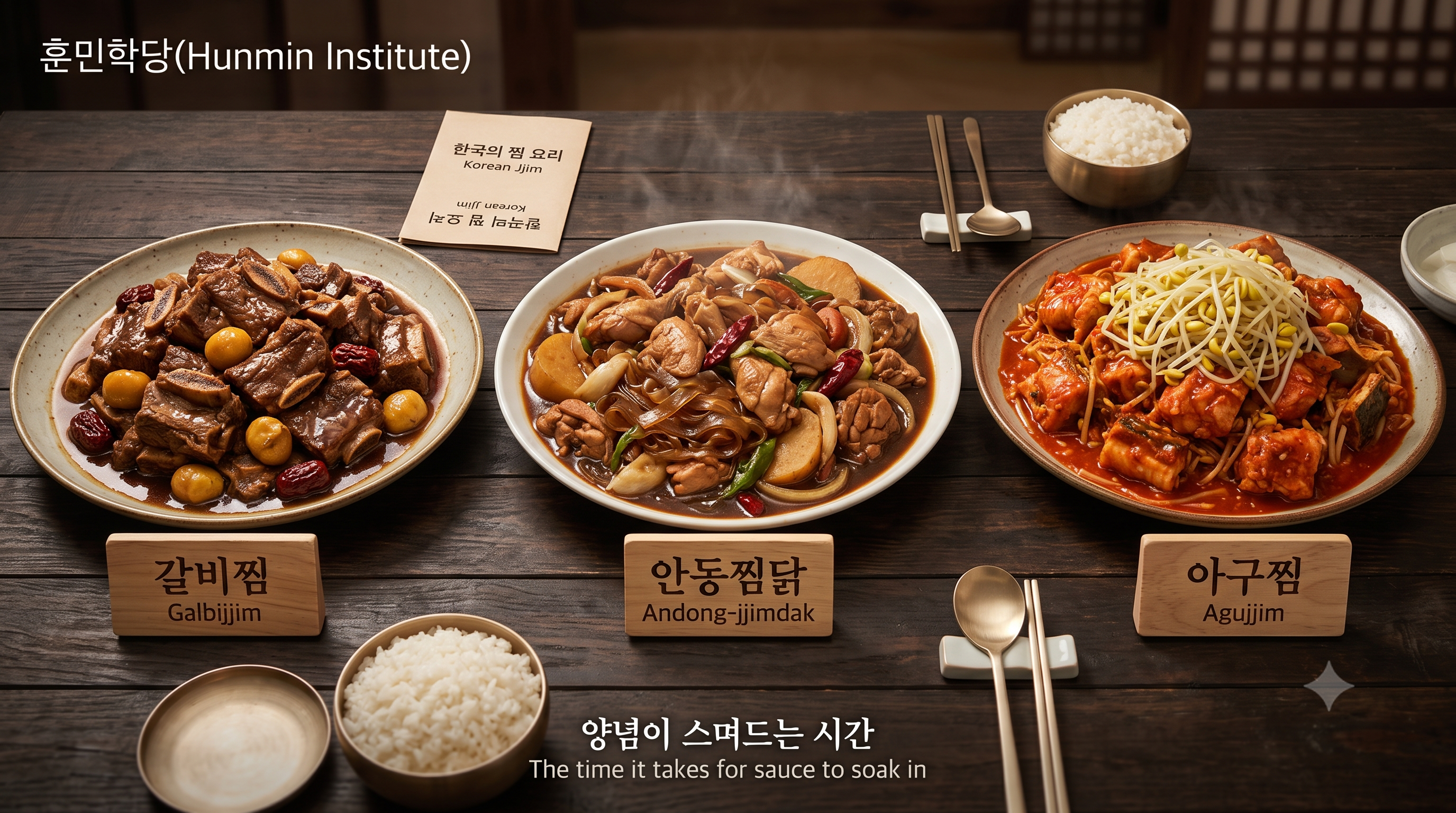
한국의 찜 요리, 양념이 스며드는 시간
Jjim is not a way of cooking ingredients but of waiting for seasoning to sink in.
Learn how three jjim dishes differ and the Korean for ordering them.
찜은 재료를 익히는 조리법이 아니라 양념이 안쪽까지 배기를 기다리는 조리법입니다.
이 글에서 대표 찜 세 가지의 차이와 주문할 때 쓰는 한국어를 익힙니다.
All learning services for the teaching materials published on this blog are free for blog subscribers on the Hunmin Institute website ↗.
이 글에서 배우는 핵심 회화
Key Expressions in This Lesson
찜을 파는 식당에서 오가는 말은 몇 마디로 정해져 있습니다. 아래 여섯 문장은 좌우가 한 쌍의 대화가 아니라 각각 따로 익히는 문장입니다. 먼저 눈에 담고 본문으로 들어가십시오.
Only a few lines go back and forth at a jjim restaurant. The two columns are not paired dialogue; each sentence is learned on its own. Take them in first, then move into the text.
| 듣는 말 Listening |
하는 말 Speaking |
|---|---|
| 몇 분이세요? [myeot bunieseyo] How many in your party? |
갈비찜 이 인분 주세요. [galbijjim i inbun juseyo] Galbijjim for two, please. |
| 이 인분부터 돼요. [i inbunbuteo dwaeyo] Two servings minimum. |
순한 맛으로 주세요. [sunhan maseuro juseyo] Mild, please. |
| 다 드시면 볶아 드릴까요? [da deusimyeon bokka deurilkkayo] Shall I fry the rice when you are done? |
밥 볶아 주세요. [bap bokka juseyo] Please fry the rice. |
자리에 앉고 주문하는 말은 소단락 1에서, 음식별로 갈리는 말은 소단락 2와 3에서, 마지막 밥까지는 소단락 4에서 다룹니다.
Being seated and ordering come in Section 1, the lines that differ by dish in Sections 2 and 3, and everything up to the rice at the end in Section 4.
찜이란 무엇인가
What Jjim Is
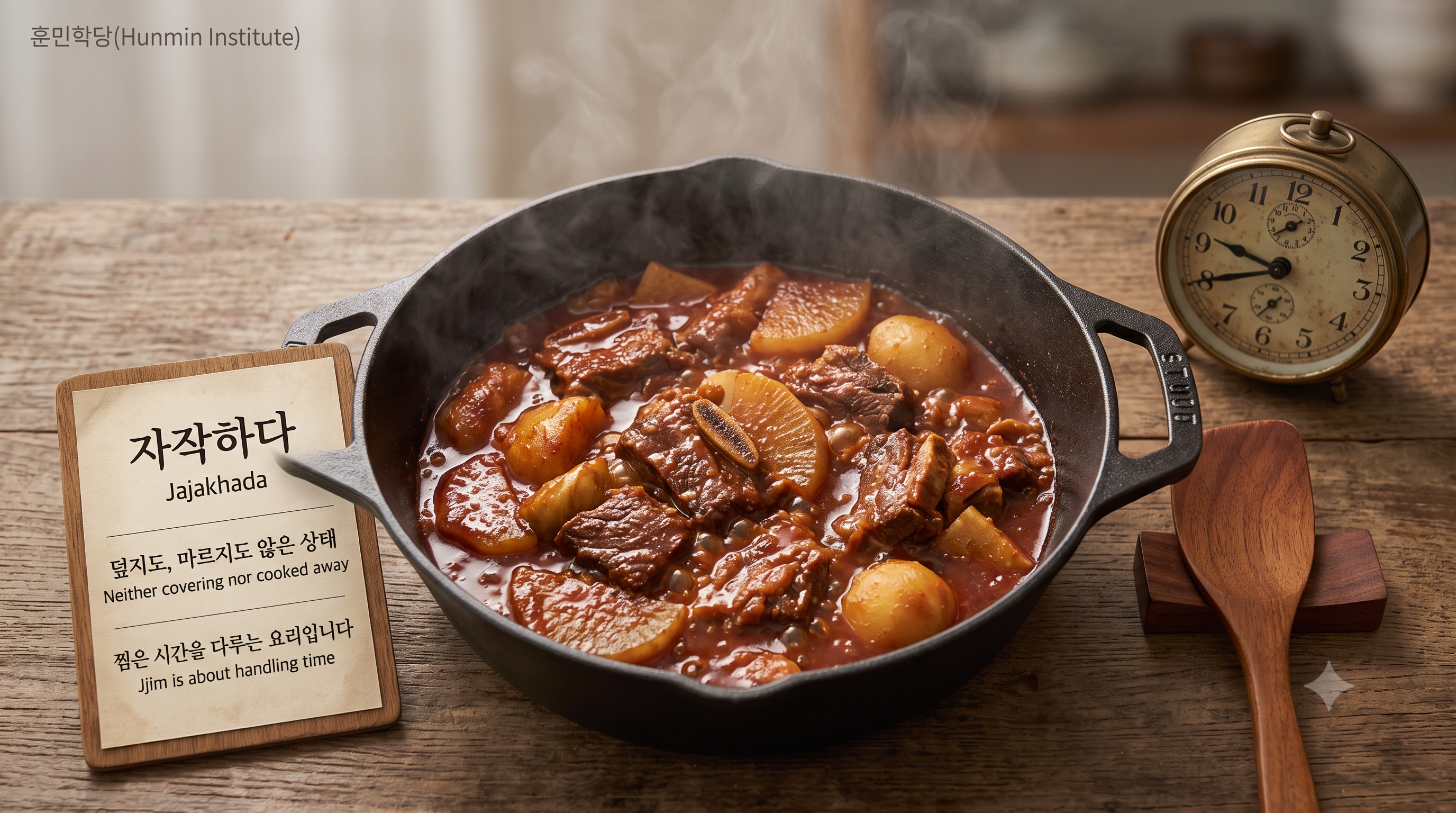
찜은 재료를 양념과 함께 오래 끓이거나 쪄서 만드는 조리법이며, 완성되었을 때 국물이 자작하게 남습니다. 불이 아니라 시간을 다루는 요리이므로 자리에 앉는 순간부터 오가는 말을 먼저 보십시오.
Jjim simmers or steams ingredients slowly together with seasoning, leaving a shallow layer of thick sauce when it is done. It handles time rather than fire, so start with the lines exchanged from the moment you sit down.
| 듣는 말 Listening |
하는 말 Speaking |
|---|---|
| 몇 분이세요? [myeot bunieseyo] How many in your party? |
두 명이요. [du myeongiyo] Two people. |
| 이 인분부터 돼요. [i inbunbuteo dwaeyo] Two servings minimum. |
혼자인데 돼요? [honjainde dwaeyo] I am alone. Is that all right? |
| 맵기 어떻게 해 드릴까요? [maepgi eotteoke hae deurilkkayo] How spicy would you like it? |
순한 맛으로 주세요. [sunhan maseuro juseyo] Mild, please. |
응용 Apply It
↳ [고른 것]으로 주세요
[goreun geot]euro juseyo
Make it [the one you chose], please
ex [순한 맛]으로 주세요/[큰 걸]로 주세요/[따뜻한 걸]로 주세요
ROM [sunhan mat]euro juseyo/[keun geol]lo juseyo/[ttatteutan geol]lo juseyo
EN Make it mild, please/Make it the large one, please/Make it the warm one, please
| 한국어 Korean |
무엇을 가리키는가 What it refers to |
|---|---|
| 찜 [jjim] |
양념과 함께 오래 익혀 국물이 자작하게 남는 조리법 A method of long cooking with seasoning, leaving a shallow sauce |
| 찌개 [jjigae] |
국물을 떠먹는 음식, 숟가락이 앞섭니다 A dish eaten for its broth, where the spoon leads |
| 인분 [inbun] |
사람 수만큼의 몫을 세는 단위 The counter for portions, one per person |
| 명 [myeong] |
사람을 세는 단위, 자기 일행에게 씁니다 The counter for people, used of your own party |
| 분 [bun] |
사람을 높여 세는 단위, 식당이 손님에게 씁니다 The polite counter for people, used by staff for guests |
▶인분은 몫을 세고 명은 사람을 셉니다. 두 단위를 섞어 쓰지 마십시오.
인분 counts portions and 명 counts people. Do not mix the two counters.
일 인분, 이 인분, 삼 인분처럼 씁니다. 두 명이 와서 이 인분을 시키는 것이지 두 명분이라고 하지 않습니다. 반대로 사람 수를 답할 때는 두 명이요라고 하며, 자기 일행에게 분을 쓰면 어색해집니다.
Use 일 인분, 이 인분, 삼 인분. Two people order 이 인분, never 두 명분. Answering a headcount you say 두 명이요, and using 분 about your own party sounds off.
찜과 찌개는 다릅니다. 찌개는 국물을 떠먹는 음식이라 숟가락이 앞서고, 찜은 국물이 재료 안으로 들어간 뒤 남은 것을 밥에 비벼 먹는 음식이라 젓가락이 앞섭니다. 조리 시간도 찌개는 십오 분, 갈비찜은 두 시간을 넘깁니다.
Jjigae is eaten for its broth, so the spoon leads. With jjim the sauce goes into the ingredients and what remains is mixed into rice, so chopsticks lead. A jjigae boils in fifteen minutes; galbijjim runs past two hours.
찜은 종류가 많습니다. 재료 이름 뒤에 찜을 붙이면 그대로 이름이 되어 계란찜, 생선찜, 두부찜처럼 씁니다. 이 글에서는 식당에서 가장 자주 만나는 세 가지를 다룹니다.
Jjim comes in many forms: add 찜 after an ingredient and you have the name, as in 계란찜, 생선찜, and 두부찜. This article takes the three you will meet most often at a restaurant.
갈비찜, 시간이 만드는 음식
Galbijjim, a Dish Made by Time
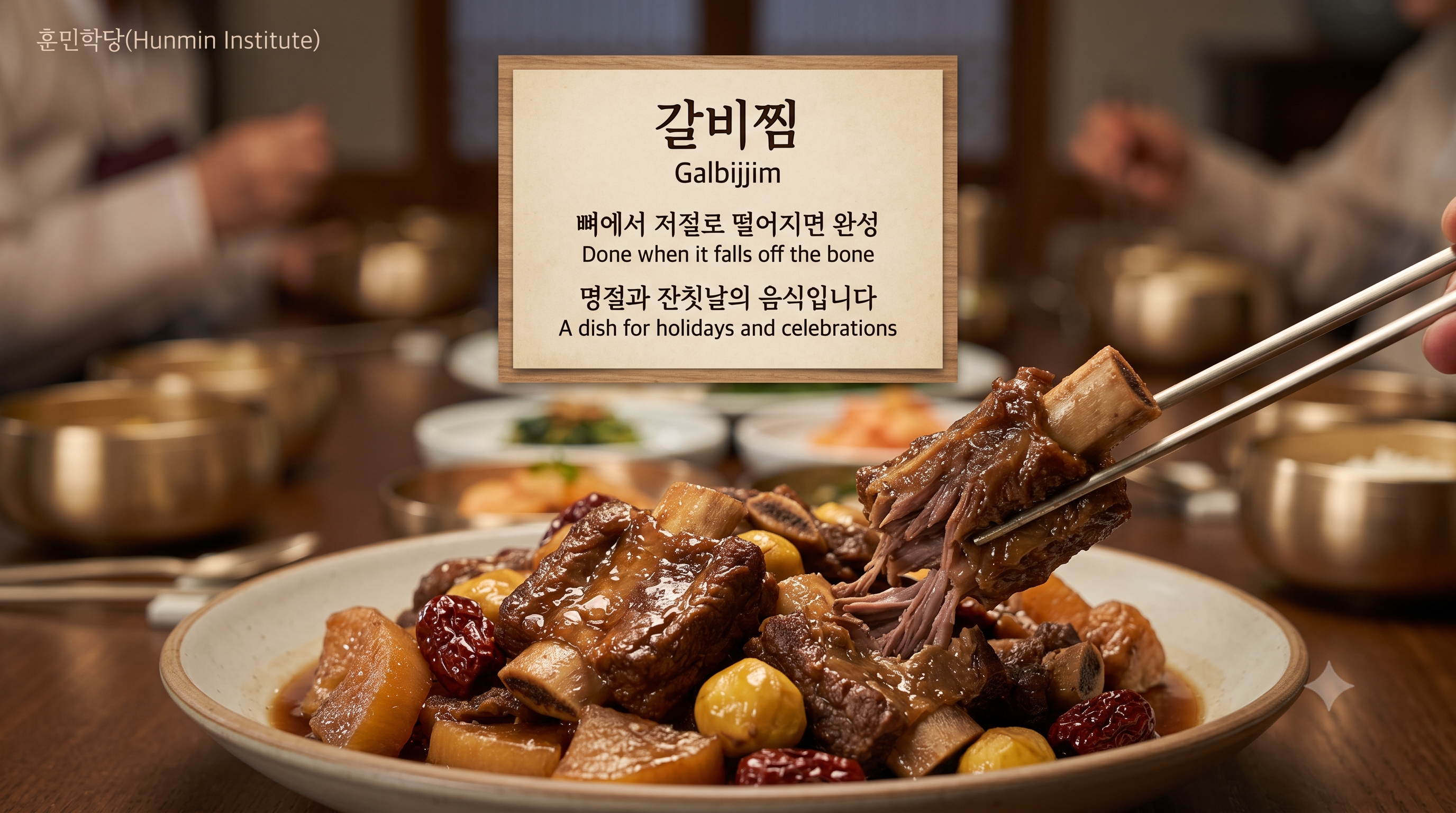
갈비찜은 소갈비를 간장 양념에 오래 조려 만들며 무와 당근, 밤, 대추를 함께 넣는 경우가 많습니다. 이 그릇 앞에서 오가는 말부터 확인하십시오.
Galbijjim is beef short ribs braised at length in a soy-based sauce, often with radish, carrot, chestnut, and jujube. Start with the lines exchanged in front of this dish.
| 듣는 말 Listening |
하는 말 Speaking |
|---|---|
| 갈비찜 나왔습니다. [galbijjim nawatseumnida] Here is your galbijjim. |
갈비찜 이 인분 주세요. [galbijjim i inbun juseyo] Galbijjim for two, please. |
| 뼈는 여기에 놓으세요. [ppyeoneun yeogie noeuseyo] Put the bones here. |
이거 안 매워요? [igeo an maewoyo] This is not spicy, right? |
| 고기가 부드럽죠? [gogiga budeureopjyo] The meat is tender, isn’t it? |
네, 잘 떨어져요. [ne, jal tteoreojyeoyo] Yes, it comes away easily. |
| 한국어 Korean |
무엇입니까 What it is |
|---|---|
| 소갈비 [sogalbi] |
소의 갈비뼈에 붙은 살, 갈비찜의 주재료 Meat on the rib bone of beef, the main ingredient |
| 간장 [ganjang] |
콩으로 담근 짠 장, 이 요리 양념의 기본 A salty soybean sauce, the base of this seasoning |
| 무 [mu] |
양념을 머금어 부드러워지는 흰 뿌리채소 A white root vegetable that softens as it soaks up sauce |
| 대추 [daechu] |
붉은 열매, 단맛을 더하려고 넣습니다 A red fruit added for sweetness |
| 조리다 [jorida] |
양념을 끼얹으며 국물이 줄 때까지 익히는 것 Cooking with sauce until the liquid reduces |
▶완성 여부를 판단하는 기준은 하나입니다. 젓가락으로 살짝 당겼을 때 고기가 뼈에서 저절로 떨어지는가입니다.
There is one test: does the meat come away from the bone at a light pull of the chopsticks?
힘을 주어 뜯어야 한다면 아직 덜 된 것이고, 좋은 갈비찜집은 이 상태를 만들기 위해 시간을 아끼지 않습니다. 양념은 간장이 기본이지만 단맛이 함께 옵니다. 배나 양파를 갈아 넣어 자연스러운 단맛을 내는 집이 많고, 이 단맛이 고기의 기름진 맛을 눌러 줍니다.
If you have to tear at it, it is not there yet, and a good galbijjim restaurant does not save time getting to that point. The base is soy sauce, but sweetness comes with it. Many kitchens grate in pear or onion, and that sweetness tempers the richness of the meat.
갈비찜에는 문화적인 무게가 있습니다. 명절과 잔칫날, 손님을 대접하는 자리에 오르는 음식입니다. 갈비가 비싸기도 하지만 손이 많이 가기 때문입니다. 어머니가 갈비찜을 하신다는 말은 오늘이 보통 날이 아니라는 뜻입니다.
Galbijjim carries cultural weight. It appears on holidays, at celebrations, and when guests are received, both because short ribs are expensive and because the dish takes real labour. When a mother says she is making galbijjim, today is not an ordinary day.
돼지갈비로 만들면 돼지갈비찜이 됩니다. 값이 낮고 맛이 더 진한 편이라 일상적으로 먹는 쪽에 가깝습니다. 메뉴판에서 갈비찜과 돼지갈비찜이 나란히 있으면 값 차이가 그대로 재료 차이입니다.
Made with pork ribs it becomes dwaeji-galbijjim, cheaper and heavier in flavour, closer to everyday eating. When both sit side by side on a menu, the price gap is the difference in the meat.
안동찜닭과 아구찜, 간장과 고추의 갈림길
Andong-jjimdak and Agujjim, Where Soy Parts from Chili
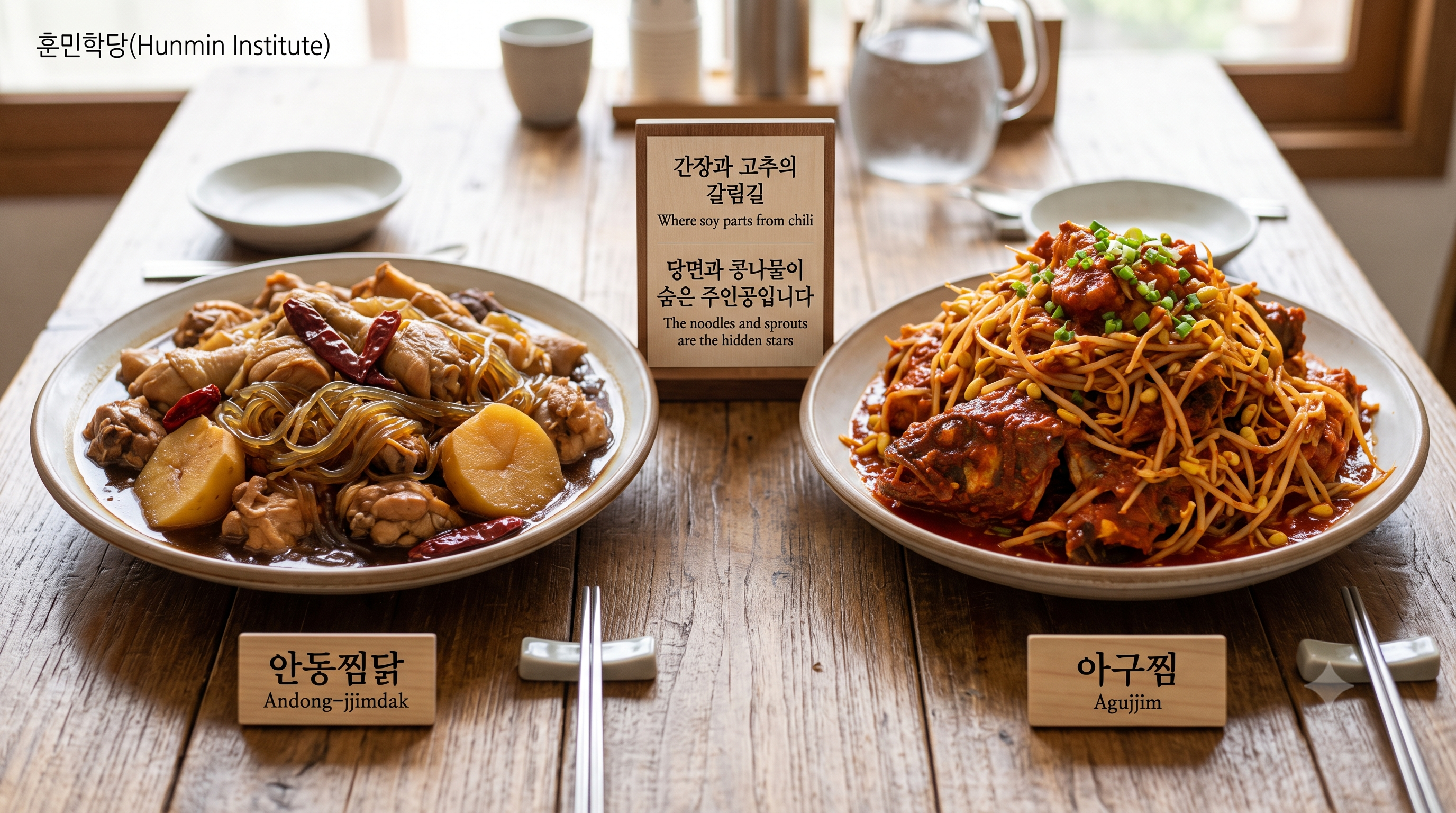
나머지 두 가지는 양념의 방향이 정반대입니다. 하나는 간장으로 가고 하나는 고추로 가며 둘 다 지역에서 시작되었습니다. 두 그릇 앞에서 오가는 말부터 보십시오.
The other two head in opposite directions, one toward soy sauce and the other toward chili, and both began in a particular place. Start with the lines exchanged in front of the two pots.
| 듣는 말 Listening |
하는 말 Speaking |
|---|---|
| 조금 매울 수 있어요. [jogeum maeul su isseoyo] It may be a little spicy. |
안 맵게 해 주세요. [an maepge hae juseyo] Not spicy, please. |
| 당면 더 넣어 드릴까요? [dangmyeon deo neoeo deurilkkayo] Shall I add more glass noodles? |
당면 좀 더 주세요. [dangmyeon jom deo juseyo] More glass noodles, please. |
| 콩나물 더 드릴까요? [kongnamul deo deurilkkayo] Would you like more bean sprouts? |
이거 뭐가 들어가요? [igeo mwoga deureogayo] What goes in this? |
| 한국어 Korean |
무엇입니까 What it is |
|---|---|
| 당면 [dangmyeon] |
고구마 전분으로 만든 굵은 국수 Thick noodles made from sweet potato starch |
| 마른 고추 [mareun gochu] |
말린 고추, 통째로 넣어 매운맛을 뽑습니다 Whole dried chilies used to draw out heat |
| 고춧가루 [gochutgaru] |
고추를 빻은 가루, 아구찜 양념의 기본 Ground chili, the base of agujjim seasoning |
| 아귀 [agwi] |
생김새가 험한 바닷물고기, 요리 이름은 아구찜입니다 A rough-looking sea fish; the dish is called agujjim |
| 콩나물 [kongnamul] |
콩에서 기른 싹, 아삭하게 씹힙니다 Sprouts grown from beans, crisp between the teeth |
▶안동찜닭은 매운맛을 내면서도 고추장이나 고춧가루를 쓰지 않습니다.
Andong-jjimdak carries heat without chili paste or flakes.
마른 고추를 통째로 넣어 매운맛을 뽑아내기 때문에 텁텁하지 않고 깔끔하게 지나갑니다. 한국의 매운 음식이 부담스러우셨던 분이라면 이 방식은 다르게 느껴지실 겁니다.
Whole dried chilies draw out the spice, so it passes cleanly rather than sitting heavy. If Korean heat has felt like too much before, this will feel different.
안동찜닭은 경상북도 안동의 구시장 골목에서 나온 음식입니다. 1990년대 후반 그 골목의 닭집들이 손님 취향에 맞춰 간장 양념과 채소를 더해 내놓기 시작한 것이 지금의 형태가 되었습니다. 사람들이 가장 좋아하는 재료는 닭고기가 아니라 당면인 경우가 많은데, 양념을 가장 많이 머금기 때문입니다.
The dish came out of an alley in the old market of Andong, North Gyeongsang Province, where in the late 1990s the chicken shops began adding soy seasoning and vegetables to suit their customers. The favourite ingredient is often not the chicken but the glass noodles, which soak up more sauce than anything else in the pot.
아구찜은 방향이 다릅니다. 아귀와 콩나물을 매운 양념에 버무려 쪄 내며 경상남도 마산이 유명합니다. 아귀는 과거 어촌에서 그물에 걸리면 도로 바다에 버리던 물고기였다고 전해지는데, 그것이 항구 노동자들의 값싼 한 끼가 되었다가 지역을 대표하는 요리가 되었습니다. 진짜 주인공은 콩나물이라는 말도 있습니다.
Agujjim goes another way, tossing monkfish and bean sprouts in a spicy sauce and steaming them, with Masan in South Gyeongsang Province the best known source. Fishing villages once threw the monkfish back into the sea; it became a cheap meal for dock workers and from there a dish that represents the region. Some say the real star is the bean sprouts.
주문할 때 알아 둘 것
What to Know When Ordering
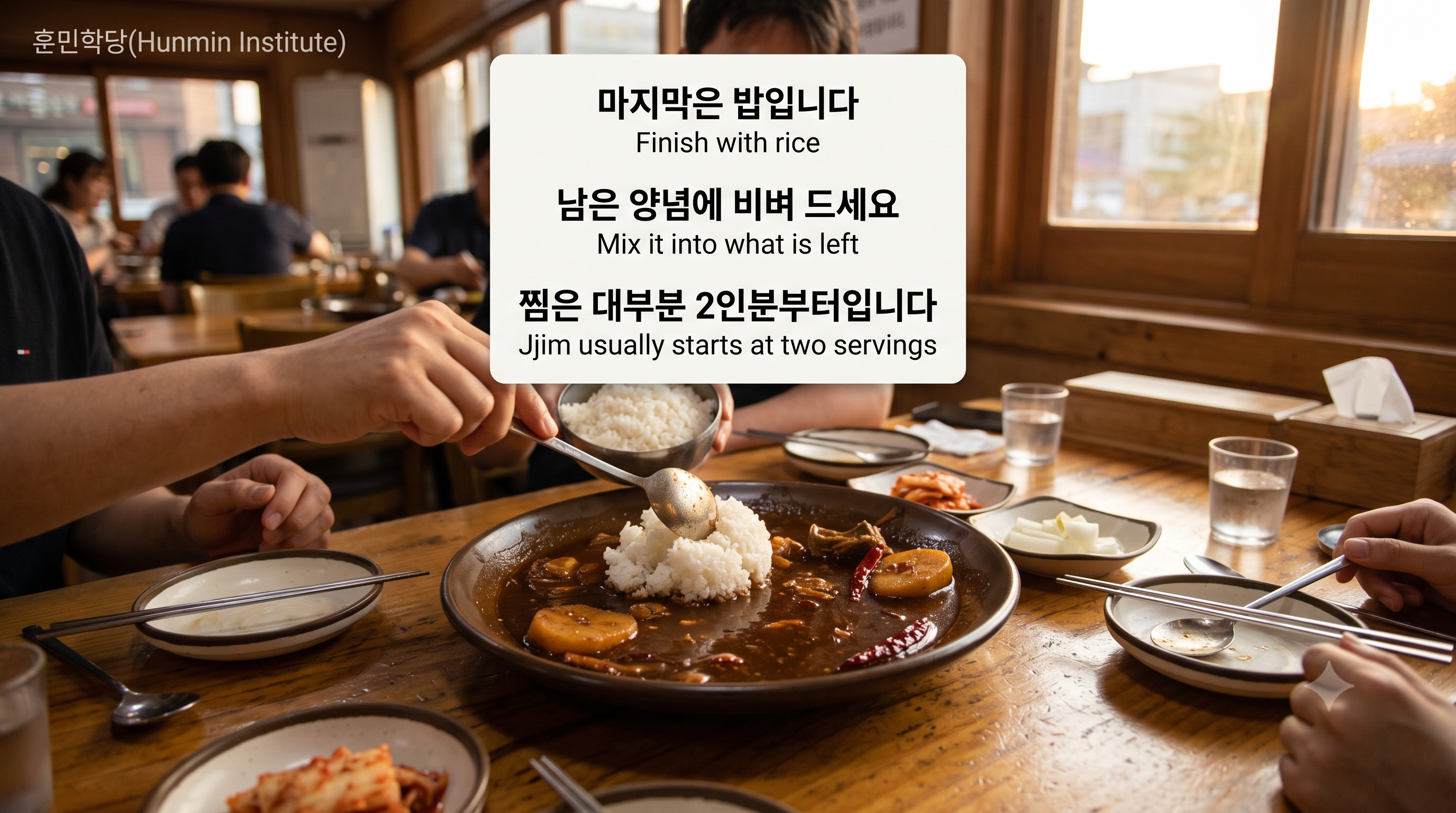
세 가지를 알고 들어가시면 됩니다. 인분 단위와 매운맛 조절, 그리고 마지막 밥입니다. 끝자리에서 오가는 말부터 보십시오.
Three things to know before you go in: portion sizes, spice level, and the rice at the end. Start with the lines exchanged as the meal closes.
| 듣는 말 Listening |
하는 말 Speaking |
|---|---|
| 다 드시면 볶아 드릴까요? [da deusimyeon bokka deurilkkayo] Shall I fry the rice when you are done? |
네, 볶아 주세요. [ne, bokka juseyo] Yes, please fry it. |
| 공기밥 드릴까요? [gonggibap deurilkkayo] Would you like a bowl of rice? |
공기밥 하나 주세요. [gonggibap hana juseyo] One bowl of rice, please. |
| 포장해 드릴까요? [pojanghae deurilkkayo] Shall I wrap it up for you? |
포장해 주세요. [pojanghae juseyo] Please wrap it up. |
| 구분 Category |
갈비찜 Galbijjim |
안동찜닭 Andong-jjimdak |
아구찜 Agujjim |
|---|---|---|---|
| 주재료 Main ingredient |
소갈비 Beef short ribs |
닭고기, 당면 Chicken and glass noodles |
아귀, 콩나물 Monkfish and bean sprouts |
| 양념 기반 Sauce base |
간장 Soy sauce |
간장, 마른 고추 Soy sauce and dried chili |
고춧가루 양념 Red chili seasoning |
| 매운맛 Spice level |
없음 Not spicy |
조절 가능 Adjustable |
매움 Spicy |
| 맛의 방향 Flavour direction |
달고 짭짤함 Sweet and savoury |
달고 짭짤하며 칼칼함 Sweet, savoury, clean heat |
맵고 개운함 Hot and refreshing |
| 배경 Background |
명절과 잔칫날 음식 A holiday and celebration dish |
안동 구시장 골목에서 시작 Began in an Andong market alley |
마산 항구의 음식 A dish of the Masan port |
| 숨은 주인공 Hidden star |
무와 밤 Radish and chestnut |
당면 Glass noodles |
콩나물 Bean sprouts |
| 추천 대상 Best for |
매운 음식이 어려운 분 Those who avoid spice |
처음 드시는 분 First-timers |
매운맛을 즐기는 분 Those who enjoy heat |
▶접시 바닥에 남은 양념이 이 음식의 절반입니다.
The sauce left at the bottom of the plate is half the dish.
공기밥을 시켜 비벼 드시거나 밥 볶아 주세요라고 부탁하십시오. 이 과정을 건너뛰면 절반만 드신 셈입니다. 볶아 드릴까요의 드릴까요는 직원이 무엇을 해 주겠다고 제안하는 말끝이라 잘라 드릴까요, 포장해 드릴까요처럼 앞의 동사만 바뀝니다.
Order a bowl of rice and mix it in, or say 밥 볶아 주세요. Skip this and you have had only half. The ending 드릴까요 offers to do something for you, so only the verb in front changes, as in 잘라 드릴까요 or 포장해 드릴까요.
찜은 대부분 이 인분부터 주문할 수 있습니다. 한 그릇씩 나오는 음식이 아니라 큰 접시에 담겨 나와 나눠 먹는 구조이기 때문입니다. 혼자 여행 중이시라면 들어가기 전에 혼자인데 돼요라고 물어보십시오.
Most jjim starts at two servings, because it arrives on one large plate to share rather than in individual bowls. Travelling alone, ask 혼자인데 돼요 before you sit down.
안동찜닭과 아구찜은 대부분 맵기를 조절해 줍니다. 갈비찜은 원래 맵지 않습니다. 무엇을 고를지 망설이신다면 맵지 않고 부드러운 것은 갈비찜, 달콤하고 짭짤한 것은 안동찜닭, 매운 것을 각오하셨다면 아구찜입니다.
Andong-jjimdak and agujjim can usually be adjusted, while galbijjim is not spicy to begin with. If you cannot decide: tender and not spicy is galbijjim, sweet and savoury is Andong-jjimdak, and ready for heat is agujjim.
찜은 불이 아니라 시간을 다루는 요리이고, 그 시간이 만든 양념이 접시 바닥에 남습니다. 오늘 나온 문장 가운데 딱 세 개만 외우자면 갈비찜 이 인분 주세요, 순한 맛으로 주세요, 밥 볶아 주세요입니다. 아래 단어장에서 오늘의 어휘를 정리하고 가시기 바랍니다.
Jjim handles time rather than fire, and the sauce that time built is what stays at the bottom of the plate. If you memorise only three of today’s lines, make them 갈비찜 이 인분 주세요, 순한 맛으로 주세요, and 밥 볶아 주세요. Work through the vocabulary list below before you go.
Next: Korean Skin Is a Habit, Not a 10-Step Routine ↗
토픽 맛보기
TOPIK Preview
유형: TOPIK Ⅰ 읽기 [34~39], 대화, 빈칸에 알맞은 것 고르기
Type: TOPIK I Reading [34–39], dialogue, choose the correct word for the blank
( )에 들어갈 말로 가장 알맞은 것을 고르십시오.
Choose the most appropriate word for the blank.
가: 몇 분이세요? 나: 두 ( ).
A: How many in your party? B: ( ), please.
① 명이요
② 장이요
③ 개요
④ 시요
Answer ▾
정답 ① 명이요
Answer: ① 명이요
사람 수를 묻는 말이므로 사람을 세는 단위인 명이 옵니다. ②의 장은 지문과 같은 세는 자리에 쓰이지만 표를 세는 단위라 진술이 어긋나고, ③의 개는 물건을 세는 단위라 일부만 맞으며, ④의 시는 그럴듯해 보여도 시각을 세는 단위라 사람 수의 답이 되지 않습니다. 흉내 낸 대문항은 TOPIK Ⅰ 읽기 [34~39]이고 배점은 2점입니다.
The question asks how many people, so the answer takes 명. ② 장 sits in the same counting slot but counts tickets, so it does not fit; ③ 개 counts objects and is only partly right; ④ 시 looks plausible but counts hours, which cannot answer a headcount. The item type modeled here is TOPIK I Reading [34–39], worth 2 points.
FAQ
Q1. 찜과 찌개는 어떻게 다른가요?Answer ▾
Q1. How is jjim different from jjigae?
A1. 국물의 역할이 다릅니다. 찌개는 국물을 떠먹는 음식이고 찜은 국물이 재료 속으로 들어가게 만드는 음식입니다. 그래서 찌개는 국물이 넉넉하고 찜은 자작하게 남습니다.
A1. The broth plays a different role. Jjigae is eaten for its broth; jjim drives the sauce into the ingredients. So jjigae comes with plenty of liquid and jjim with only a shallow layer.
Q2. 혼자서도 먹을 수 있나요?Answer ▾
Q2. Can I eat it alone?
A2. 식당에 따라 다릅니다. 찜은 대체로 이 인분부터 주문하는 음식이라 일 인분을 받지 않는 곳이 많습니다. 다만 일 인분 메뉴를 두는 식당도 늘고 있으니 들어가기 전에 확인하시는 편이 좋습니다.
A2. It depends on the restaurant. Jjim generally starts at two servings, and many places will not take an order for one. Single-serving menus are becoming more common, so check before going in.
Q3. 매운 음식을 못 먹는데 어떤 것을 골라야 하나요?Answer ▾
Q3. I cannot eat spicy food. Which should I choose?
A3. 갈비찜을 권합니다. 간장 양념이라 전혀 맵지 않고 단맛이 돕니다. 안동찜닭은 맵기 조절이 가능하니 순한 맛으로 주문하시면 되고, 아구찜은 매운맛이 기본이므로 피하시는 편이 좋습니다.
A3. Galbijjim. Its soy-based sauce is not spicy at all and carries sweetness. Andong-jjimdak can be adjusted, so order it mild, while agujjim is spicy by default.
Q4. 남은 음식을 포장해 갈 수 있나요?Answer ▾
Q4. Can I take leftovers home?
A4. 대부분 가능합니다. 포장해 주세요라고 말씀하시면 됩니다. 다만 가게마다 방침이 다르고 포장 용기 값을 따로 받는 곳도 있으니 계산 전에 물어보시는 편이 좋습니다.
A4. Usually yes. Say 포장해 주세요. Policies differ by restaurant, though, and some charge for the container, so ask before paying.
Q5. 찜 요리 이름은 어떻게 만들어지나요?Answer ▾
Q5. How are jjim dish names formed?
A5. 재료 이름 뒤에 찜을 붙이면 그대로 이름이 되어 계란찜, 생선찜, 두부찜처럼 씁니다. 안동찜닭처럼 지역명이 앞에 붙는 경우도 있는데, 이때는 그 지역에서 시작된 방식이라는 뜻입니다.
A5. Add 찜 after the ingredient and you have the name: 계란찜, 생선찜, 두부찜. Some carry a place name in front, as with Andong-jjimdak, marking the style that began there.
Vocabulary and Pronunciation for Foreigners
| No | Korean | Romanisation | Meaning |
|---|---|---|---|
| 1 | 찜 | jjim | (n) a braised or steamed dish [breɪzd] |
| 2 | 인분 | inbun | (n) serving, portion [ˈsɜːrvɪŋ] |
| 3 | 순한 맛 | sunhan mat | (n) mild [maɪld] |
| 4 | 공기밥 | gonggibap | (n) a bowl of rice [boʊl əv raɪs] |
| 5 | 포장 | pojang | (n) takeaway, wrapping [ˈteɪkəweɪ] |
| ▾ 단어 59 개 더 보기 Show 59 more ↗ | |||
The blog page has limits of space and function, so only five words are shown here. The rest of the word list, the audio, the sentences and tables, the FAQ, the worksheet, the TOPIK questions and the lesson video are on the Hunmin Institute website ↗, free for blog subscribers.
참고 기관
Official Sources
한식진흥원 ↗
Korean Food Promotion Institute
https://www.hansik.or.kr
기관 설명 보기 About this institute ▾
A public institute under the Ministry of Agriculture, Food and Rural Affairs that compiles and publishes material on Korean recipes and food culture. It has English pages where dish names and origins can be checked, so it is the place to look when you want more kinds of jjim.
※ 본 콘텐츠(원고, 이미지, 예문 포함)는 저작권법에 의해 보호받는 훈민학당의 저작물입니다. 무단 복제, 전재, 재배포 및 AI 학습 데이터로의 이용을 금합니다.
This content (manuscript, images, and example sentences) is the copyrighted property of Hunmin Institute, protected under copyright law. Unauthorized copying, reproduction, redistribution, and use as AI training data are prohibited.
'K-Culture' 카테고리의 다른 글
| Korean Skin Is a Habit, Not a 10-Step Routine (0) | 2026.07.25 |
|---|---|
| Hangeul: The Alphabet a King Refused to Give Up (0) | 2026.07.25 |
| Korean Noodle Dishes Part 2: Jjajangmyeon, Bibim-guksu, Kongguksu (0) | 2026.07.25 |
| Korean Noodle Dishes Part 1: Kalguksu to Naengmyeon (0) | 2026.07.25 |
| Bunsik vs Hansik: Know the Difference (0) | 2026.07.22 |


