
Three Bowls, Three Seasons, and the Words That Order Them
한국의 면 요리 1탄, 칼국수 잔치국수 냉면
Kalguksu, janchi-guksu, and naengmyeon divide by weather and by the occasion.
Learn what sets them apart and the Korean you use to order them.
칼국수와 잔치국수, 냉면은 날씨와 자리로 갈립니다.
이 글에서 세 국수의 차이와 주문할 때 쓰는 한국어를 익힙니다.

All learning services for the teaching materials published on this blog are free for blog subscribers on the Hunmin Institute website ↗.
이 글에서 배우는 핵심 회화
Key Expressions in This Lesson
국수집에서 오가는 말은 몇 마디로 정해져 있습니다. 아래 여섯 문장은 좌우가 한 쌍의 대화가 아니라 각각 따로 익히는 문장입니다. 먼저 눈에 담고 본문으로 들어가십시오.
Only a few lines go back and forth in a noodle shop. The two columns are not paired dialogue; each sentence is learned on its own. Take them in first, then move into the text.
| 듣는 말 Listening |
하는 말 Speaking |
|---|---|
| 몇 분이세요? [myeot buniseyo] How many people? |
칼국수 하나 주세요. [kalguksu hana juseyo] One kalguksu, please. |
| 물냉면이요, 비빔냉면이요? [mullaengmyeoniyo bibimnaengmyeoniyo] Mul or bibim? |
안 맵게 해 주세요. [an maepge hae juseyo] Not spicy, please. |
| 면 잘라 드릴까요? [myeon jalla deurilkkayo] Shall I cut the noodles? |
김치 좀 더 주세요. [gimchi jom deo juseyo] More kimchi, please. |
세 국수의 이름과 재료는 소단락 1에서 3까지, 주문에서 오가는 말은 소단락 4에서 다룹니다.
The names and ingredients come in Sections 1 to 3, and the lines exchanged when ordering come in Section 4.
칼국수, 칼로 썰어 만든 뜨거운 국수
Kalguksu, Noodles Cut by Knife
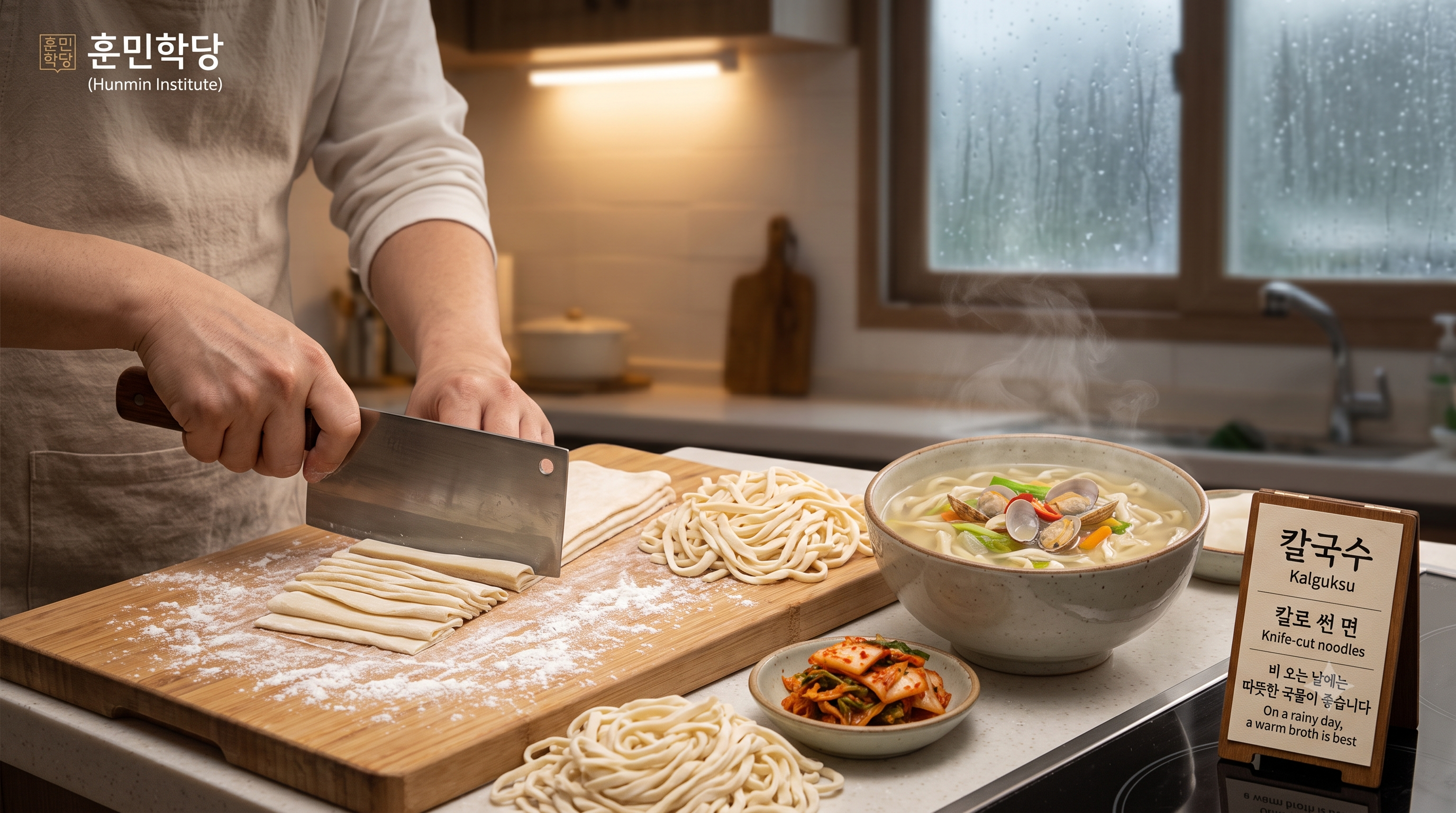
이름이 조리 도구에서 왔습니다. 반죽을 얇게 밀어 접은 뒤 칼로 썰어 면을 만듭니다. 이 국수를 시킬 때 오가는 말부터 확인하십시오.
The name comes from the tool: the dough is rolled thin, folded, and sliced with a knife. Start with the lines exchanged when you order it.
| 듣는 말 Listening |
하는 말 Speaking |
|---|---|
| 바지락으로 하시겠어요? [bajirageuro hasigesseoyo] Would you like the clam one? |
칼국수 하나 주세요. [kalguksu hana juseyo] One kalguksu, please. |
| 뜨거우니까 조심하세요. [tteugeounikka josimhaseyo] Careful, it is hot. |
국물에 뭐 들어가요? [gungmure mwo deureogayo] What is in the broth? |
| 겉절이 더 드릴까요? [geotjeori deo deurilkkayo] Would you like more geotjeori? |
겉절이 좀 더 주세요. [geotjeori jom deo juseyo] More geotjeori, please. |
응용 Apply It
↳ [명사] 하나 주세요
[myeongsa] hana juseyo
One [noun], please
ex [칼국수] 하나 주세요/[냉면] 하나 주세요/[잔치국수] 하나 주세요
ROM [kalguksu] hana juseyo/[naengmyeon] hana juseyo/[janchiguksu] hana juseyo
EN One kalguksu, please/One naengmyeon, please/One janchi-guksu, please
| 한국어 Korean |
메뉴판에서 무슨 뜻인가 What it means on a menu |
|---|---|
| 칼국수 [kalguksu] |
칼로 썰어 만든 면을 뜨거운 국물에 냅니다 Noodles sliced by knife, served in hot broth |
| 바지락칼국수 [bajirak kalguksu] |
조개로 낸 시원한 국물, 껍데기째 끓여 냅니다 A clean broth from clams, boiled shells and all |
| 닭칼국수 [dak kalguksu] |
닭을 고아 낸 부드러운 국물, 살을 찢어 얹습니다 A mild broth simmered from chicken, with shredded meat on top |
| 사골 [sagol] |
뽀얗고 묵직한 국물, 오래 우려야 나옵니다 A milky, hearty stock that takes long simmering |
| 겉절이 [geotjeori] |
아직 익지 않은 김치, 칼국수에 함께 나옵니다 Kimchi not yet fermented, served alongside kalguksu |
▶칼국수는 국물 이름이 앞에 붙습니다. 앞의 말만 보면 무슨 국물인지 알 수 있습니다.
Kalguksu takes the broth name in front, so the first word tells you the broth.
바지락칼국수, 닭칼국수, 해물칼국수처럼 재료가 앞에 붙는 구조는 한국 음식 이름 전체에 걸쳐 반복됩니다. 김치찌개와 된장찌개도 같은 방식입니다.
The ingredient goes first, and this structure repeats across Korean dish names, as in 김치찌개 and 된장찌개.
기계로 뽑은 면과 달리 가장자리가 고르지 않아 국물을 잘 붙잡습니다. 겉절이는 갓 버무려 아직 익지 않은 김치로, 매콤한 한 조각이 담백한 국물을 살립니다. 비 오는 날 한국 사람들이 칼국수를 찾는 이유가 여기 있습니다.
Unlike machine-made noodles the edges are uneven, so they grip the broth. Geotjeori is kimchi tossed fresh and not yet fermented, and one spicy bite lifts the light broth. That is why Koreans look for kalguksu on rainy days.
잔치국수, 기쁜 날에 나누는 국수
Janchi-guksu, Noodles Shared on Happy Days
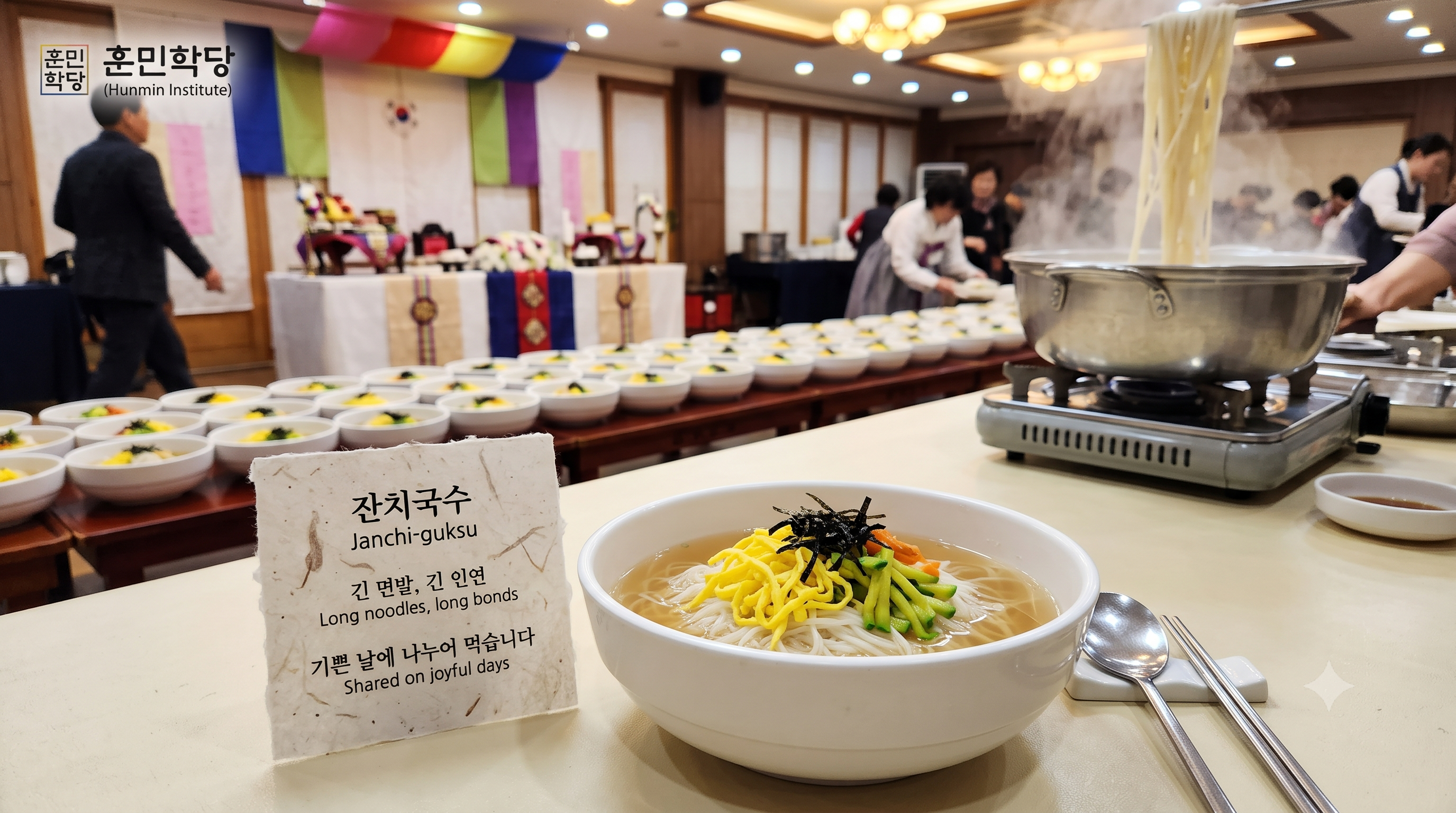
맛보다 의미가 먼저인 음식입니다. 이름도 재료도 모두 한국어 표현으로 이어지므로 그 자리에서 오가는 말부터 보십시오.
Its meaning comes before its taste, and both the name and the ingredients lead into Korean expressions, so start with the lines exchanged there.
| 듣는 말 Listening |
하는 말 Speaking |
|---|---|
| 잔치국수 드셔 보셨어요? [janchiguksu deusyeo bosyeosseoyo] Have you tried janchi-guksu? |
이거 뭐 얹은 거예요? [igeo mwo eonjeun geoyeyo] What is on top of this? |
| 고명 더 얹어 드릴까요? [gomyeong deo eonjeo deurilkkayo] Shall I add more garnish? |
멸치 들어가요? [myeolchi deureogayo] Does it have anchovy in it? |
| 언제 국수 먹여 줄 거야? [eonje guksu meogyeo jul geoya] When will you feed me noodles? |
국물이 담백해요. [gungmuri dambaekaeyo] The broth is light and clean. |
| 한국어 Korean |
어디에서 만나는 말인가 Where you meet it |
|---|---|
| 잔치 [janchi] |
결혼식이나 생일 같은 자리, 잔칫날과 잔칫상처럼 붙습니다 A wedding or a birthday gathering, as in 잔칫날 and 잔칫상 |
| 소면 [somyeon] |
가늘고 긴 면, 오래 살라는 소망을 담습니다 Long thin noodles carrying a wish for a long life |
| 멸치 육수 [myeolchi yuksu] |
맑고 담백한 국물, 채식이면 피해야 합니다 A clear, light broth; avoid it if you are vegetarian |
| 고명 [gomyeong] |
위에 얹는 달걀지단과 애호박, 김 The egg, zucchini, and seaweed laid on top |
| 국수 먹여 주다 [guksu meogyeo juda] |
결혼한다는 뜻, 친한 사이에서만 씁니다 To get married; used only among close friends |
▶국수 먹여 줄 거야를 직역하면 뜻이 사라집니다. 결혼 이야기입니다.
Translate 국수 먹여 줄 거야 literally and the meaning vanishes. It is about marriage.
한 솥에 많은 사람 몫을 낼 수 있고, 가늘고 긴 소면에 오래 살라는 소망이 담겨 잔칫상에 올랐습니다. 이 풍습이 지금도 말에 남아 있어 결혼을 묻는 자리에서 국수가 등장합니다.
One pot fed many, and the long thin somyeon carried a wish for a long life, so it went on the banquet table. The custom survives in speech, and noodles appear whenever marriage is asked about.
국물은 멸치를 우려 맑고 담백합니다. 그 위에 달걀지단과 애호박, 김을 가늘게 썰어 얹는데 이것을 고명이라고 하며, 비빔밥이나 떡국에서도 같은 말을 씁니다.
The broth is simmered from anchovies, clear and light. The strips of egg, zucchini, and seaweed on top are called gomyeong, a word used for bibimbap and tteokguk as well.
냉면, 여름을 이기는 차가운 국수
Naengmyeon, Cold Noodles for the Summer
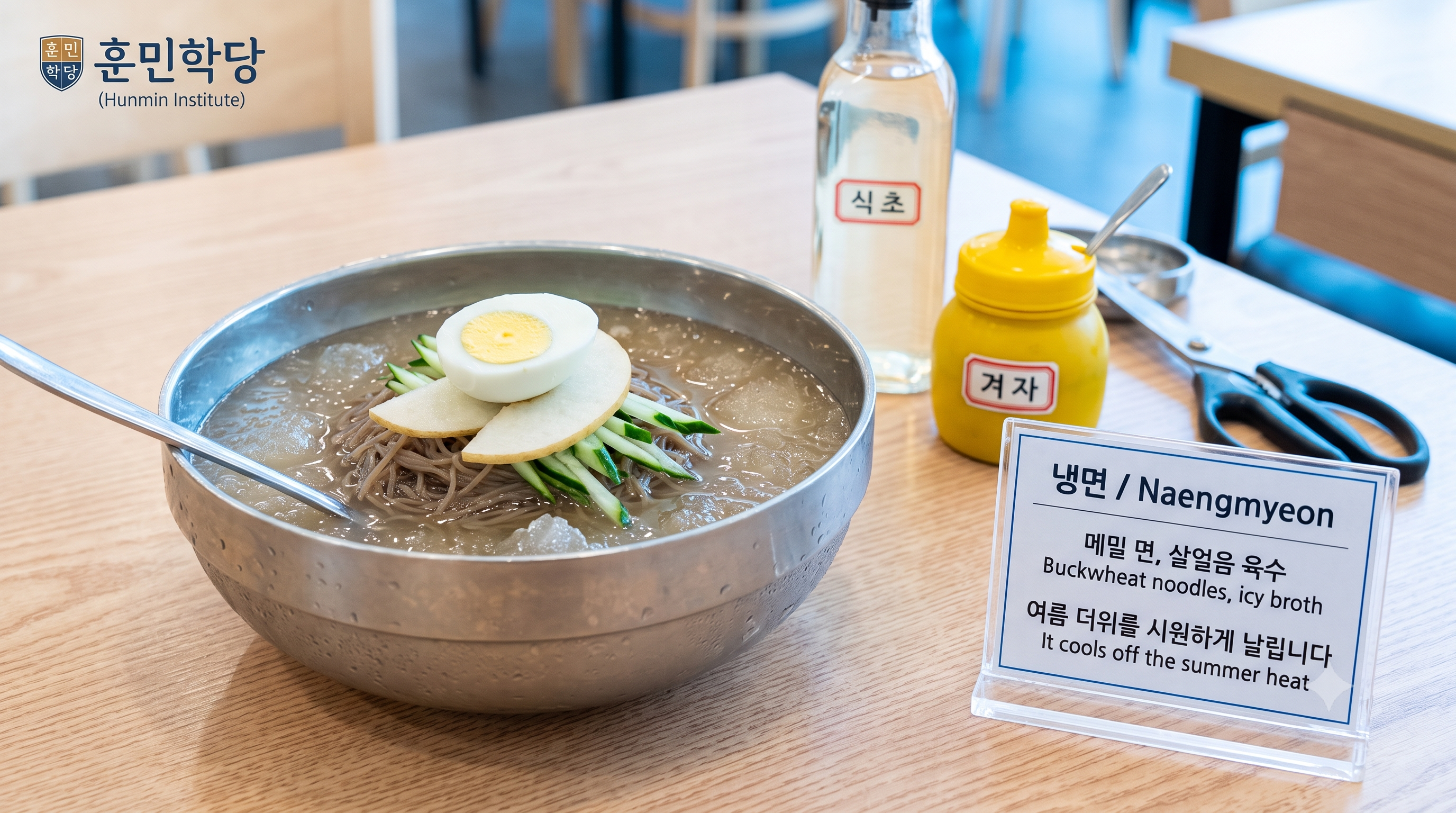
이름 그대로 차가운 국수입니다. 종류가 갈리므로 고르는 자리에서 오가는 말부터 나눠 보십시오.
As the name says, cold noodles. The kinds divide, so start by sorting the lines exchanged as you choose.
| 듣는 말 Listening |
하는 말 Speaking |
|---|---|
| 물냉면이요, 비빔냉면이요? [mullaengmyeoniyo bibimnaengmyeoniyo] Mul or bibim? |
물냉면으로 주세요. [mullaengmyeoneuro juseyo] Mul-naengmyeon, please. |
| 식초하고 겨자 넣으셨어요? [sikchohago gyeoja neoeusyeosseoyo] Did you add vinegar and mustard? |
이거 매워요? [igeo maewoyo] Is this spicy? |
| 면 잘라 드릴까요? [myeon jalla deurilkkayo] Shall I cut the noodles? |
네, 잘라 주세요. [ne, jalla juseyo] Yes, please cut them. |
| 한국어 Korean |
메뉴판에서 무슨 뜻인가 What it means on a menu |
|---|---|
| 물냉면 [mullaengmyeon] |
차가운 국물에 말아 내며 맵지 않습니다 Served in chilled broth, not spicy |
| 비빔냉면 [bibimnaengmyeon] |
국물 없이 양념에 비비며 맵습니다 Mixed with sauce and no broth, and it is spicy |
| 메밀 [memil] |
냉면 면의 재료, 툭툭 끊어집니다 What the noodles are made of; it snaps cleanly |
| 동치미 [dongchimi] |
냉면 육수로 쓰는 김치 국물, 겨울에 담급니다 The kimchi liquid used as broth, made in winter |
| 평양냉면, 함흥냉면 [pyeongyangnaengmyeon, hamheungnaengmyeon] |
평양은 맑은 국물, 함흥은 매운 양념 Pyongyang is clear broth, Hamhung is spicy sauce |
▶물과 비빔은 국물의 유무를 가르는 말입니다. 냉면 앞에만 붙는 것이 아닙니다.
물 and 비빔 mark whether there is broth, and they do not attach to naengmyeon alone.
비빔국수와 비빔밥처럼 비빔이 붙으면 섞어 먹는 음식입니다. 이 한 글자만 알아도 처음 보는 메뉴의 성격이 짐작됩니다.
비빔국수 and 비빔밥 both mean something you mix, so this one word lets you guess at a menu you have never seen.
본래 북쪽 지방에서 겨울에 살얼음 언 동치미 국물에 말아 먹던 음식이었습니다. 면은 메밀로 만들어 밀가루 면보다 질기고 툭툭 끊어지며, 육수는 소고기를 우린 맑은 국물이나 동치미를 차갑게 식혀 씁니다.
It began in the north as a winter dish, served in dongchimi broth with thin ice. The noodles are buckwheat, tougher and quicker to snap, and the broth is chilled beef stock or dongchimi.
평양냉면은 처음엔 밍밍하지만 먹을수록 깊고, 함흥냉면은 국물 없이 매운 양념에 비비며, 진주냉면은 해물 육수에 고명이 화려합니다. 식초와 겨자는 한꺼번에 넣지 말고 맛을 보며 조절하십시오.
Pyongyang is subdued but deepens as you eat, Hamhung is mixed with spicy sauce and no broth, and Jinju uses seafood stock with lavish garnish. Add vinegar and mustard a bit at a time rather than all at once.
국수집에서 오가는 한국어
The Korean Spoken at a Noodle Shop
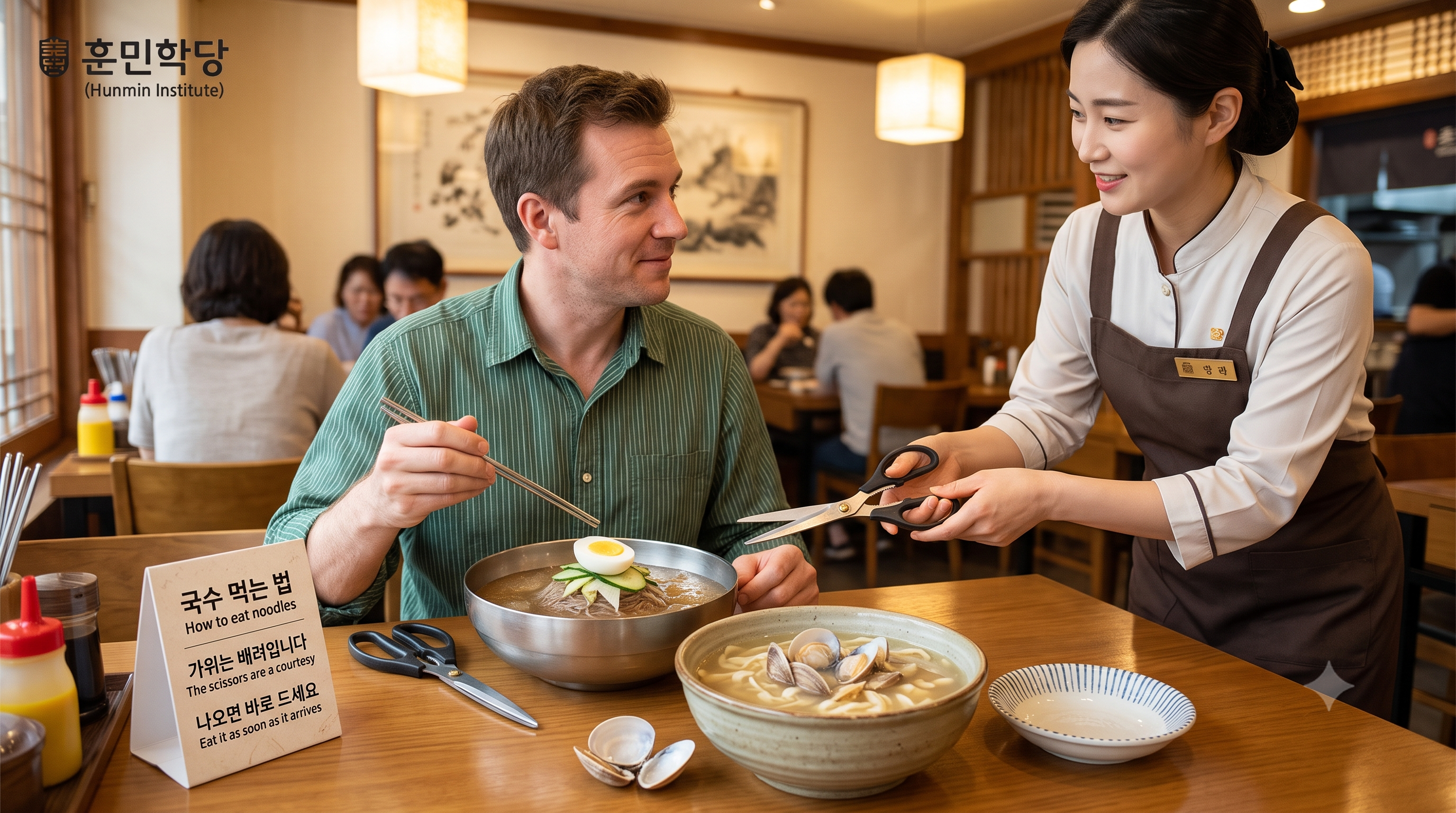
여기서 쓰는 표현부터 배워 봅시다. 자리에 앉고 부탁하고 나오기까지가 몇 마디로 끝납니다.
Now for the expressions used here. Being seated, asking for something, and leaving all fit into a few lines.
| 듣는 말 Listening |
하는 말 Speaking |
|---|---|
| 몇 분이세요? [myeot buniseyo] How many people? |
두 명이요. [du myeongiyo] Two people. |
| 여기 앉으세요. [yeogi anjeuseyo] Please sit here. |
앞접시 좀 주세요. [apjeopsi jom juseyo] A small plate, please. |
| 더 필요하신 거 있으세요? [deo piryohasin geo isseuseyo] Do you need anything else? |
김치 좀 더 주세요. [gimchi jom deo juseyo] More kimchi, please. |
| 구분 Category |
칼국수 Kalguksu |
잔치국수 Janchi-guksu |
냉면 Naengmyeon |
|---|---|---|---|
| 면 재료 Noodle base |
밀가루 Wheat flour |
밀가루 소면 Thin wheat somyeon |
메밀 Buckwheat |
| 면의 특징 Texture |
두툼하고 쫄깃함 Thick and chewy |
가늘고 긺 Thin and long |
질기고 툭툭 끊어짐 Tough with a clean snap |
| 국물 Broth |
닭, 바지락, 사골 Chicken, clams, beef bone |
멸치 Dried anchovies |
소고기, 동치미 Beef, dongchimi |
| 온도 Temperature |
뜨거움 Hot |
따뜻함 Warm |
차가움 Cold |
| 먹는 때 When |
비 오는 날, 추운 날 Rainy and cold days |
결혼식 등 잔칫날 Weddings and celebrations |
무더운 여름 Hot summer days |
| 곁들임 Served with |
겉절이 김치 Fresh geotjeori kimchi |
고명 Gomyeong garnish |
식초, 겨자 Vinegar and mustard |
| 매운맛 Spice |
없음, 김치는 매움 Mild, the kimchi is spicy |
없음 Mild |
물냉면 없음, 비빔냉면 매움 Mul mild, bibim spicy |
▶좀은 부탁을 부드럽게 만드는 말입니다. 넣고 빼는 것만으로 말투가 달라집니다.
좀 softens a request. Adding or dropping it alone changes your tone.
하나 주세요는 개수를 세어 주문하는 틀입니다. 하나, 둘, 셋 대신 일 인분, 이 인분으로도 말합니다. 안 맵게의 안은 부정을, 게는 그 상태로 만들어 달라는 뜻을 만들며 안 짜게, 덜 맵게로 갈아 끼우면 식당 어디서나 쓰입니다.
하나 주세요 is the frame for ordering by count, and 일 인분 or 이 인분 works for servings. In 안 맵게, 안 makes it negative and 게 asks for that state; swap in 안 짜게 or 덜 맵게 and it works in any restaurant.
물냉면이요, 비빔냉면이요는 둘 중 하나를 고르라는 질문입니다. 국물이 있으면 물, 양념에 비비면 비빔이며, 드릴까요가 들리면 나에게 해 주겠다는 뜻이므로 네 또는 괜찮아요로 답하면 됩니다.
물냉면이요, 비빔냉면이요 asks you to pick one: 물 for broth, 비빔 for the sauced version. When you hear 드릴까요 something is being offered to you, so 네 or 괜찮아요 is enough.
냉면 그릇 옆의 가위는 무례한 도구가 아니라 배려입니다. 면을 자르라고 주는 것이니 편하게 쓰십시오. 바지락칼국수의 조개는 껍데기째 끓이므로 그릇 바닥에 껍데기가 남는 것도 자연스럽습니다.
The scissors beside the naengmyeon bowl are a courtesy, not a rudeness. They are there for cutting the noodles, so use them freely. Clams in bajirak-kalguksu are boiled in their shells, so shells at the bottom of the bowl are normal too.
세 국수는 재료보다 날씨와 자리로 갈립니다. 비 오는 날에는 칼국수, 기쁜 날에는 잔치국수, 무더운 여름에는 냉면입니다. 면이 국물을 계속 빨아들이므로 나오는 즉시 드시는 편이 가장 맛있으며, 오늘 나온 음식 이름과 주문 문장은 아래 단어장에서 정리하고 가시기 바랍니다.
The three are divided by weather and occasion more than by ingredient: kalguksu on a rainy day, janchi-guksu on a happy one, naengmyeon in high summer. Noodles keep drinking the broth, so they taste best the moment they arrive. Gather the dish names and ordering lines from today in the vocabulary list below.
Next: Korean Noodle Dishes Part 2: Jjajangmyeon, Bibim-guksu, Kongguksu ↗
토픽 맛보기
TOPIK Preview
유형: TOPIK Ⅰ 읽기 [34~39], 대화, 빈칸에 알맞은 것 고르기
Type: TOPIK I Reading [34–39], dialogue, choose the correct word for the blank
( )에 들어갈 말로 가장 알맞은 것을 고르십시오.
Choose the most appropriate word for the blank.
가: 비빔냉면 매운데 괜찮으세요? 나: 안 ( ) 해 주세요.
A: Bibim-naengmyeon is spicy. Is that all right? B: Please make it not ( ).
① 맵게
② 매워
③ 맵다
④ 매운
Answer ▾
정답 ① 맵게
Answer: ① 맵게
해 주세요 앞에는 어떤 상태로 만들어 달라는 뜻의 게가 붙으므로 맵게가 맞습니다. ②는 지문과 같은 낱말이지만 문장을 끝맺는 형태라 뒤가 이어지지 않고, ③은 사전에 실리는 기본형이라 일부만 걸리며, ④는 그럴듯해 보여도 뒤에 명사가 와야 하는 꾸밈말이라 이 자리에 근거가 없습니다. 흉내 낸 대문항은 TOPIK Ⅰ 읽기 [34~39]이고 배점은 2점입니다.
Before 해 주세요 comes 게, which asks for something to be made a certain way, so 맵게 is correct. ② uses the same word but ends a sentence, leaving nothing to follow; ③ is the dictionary form and only partly fits; ④ looks plausible but modifies a following noun, so nothing here supports it. The item type modeled here is TOPIK I Reading [34–39], worth 2 points.
FAQ
Q1. 매운 음식을 못 먹는데 괜찮을까요?Answer ▾
Q1. I cannot eat spicy food. Is that all right?
A1. 세 가지 모두 기본은 맵지 않습니다. 다만 겉절이 김치는 맵고 함흥냉면과 비빔냉면은 매운 양념을 씁니다. 안 맵게 해 주세요라고 하시면 됩니다.
A1. All three are mild by default. The geotjeori is spicy, and Hamhung or bibim naengmyeon use a spicy sauce. Just say 안 맵게 해 주세요.
Q2. 채식을 하는데 먹을 수 있나요?Answer ▾
Q2. I am vegetarian. Can I eat these?
A2. 기본 조리법은 맞지 않습니다. 잔치국수는 멸치, 칼국수는 닭이나 조개, 냉면은 소고기를 씁니다. 국물에 뭐 들어가요라고 먼저 물으십시오.
A2. The standard recipes do not fit: janchi-guksu uses anchovy, kalguksu chicken or clams, and naengmyeon beef. Ask 국물에 뭐 들어가요 before you order.
Q3. 겨울에도 냉면을 먹나요?Answer ▾
Q3. Do Koreans eat naengmyeon in winter?
A3. 먹습니다. 본래 겨울 음식이었고, 고깃집에서는 계절과 상관없이 고기 뒤에 냉면으로 마무리합니다.
A3. Yes. It began as a winter dish, and at barbecue restaurants it closes the meal year round.
Q4. 면을 잘라 달라고 해도 되나요?Answer ▾
Q4. Is it okay to ask them to cut the noodles?
A4. 됩니다. 면 좀 잘라 주세요라고 하시면 되고, 직원이 먼저 물어보기도 합니다. 냉면 그릇 옆에 놓인 가위가 그 용도입니다.
A4. Yes. Say 면 좀 잘라 주세요, and the staff often offers first. The scissors beside a naengmyeon bowl are there for exactly that.
Q5. 국수는 한 그릇이 한 끼가 되나요?Answer ▾
Q5. Is one bowl of noodles a full meal?
A5. 칼국수와 냉면은 한 그릇이 한 끼가 됩니다. 잔치국수는 양이 적은 편이라 곱빼기로 시키거나 김밥을 함께 시키는 사람이 많습니다.
A5. Kalguksu and naengmyeon make a full meal on their own. Janchi-guksu tends to be a smaller portion, so many people order a large size or add gimbap.
Vocabulary and Pronunciation for Foreigners
| No | Korean | Romanisation | Meaning |
|---|---|---|---|
| 1 | 칼국수 | kalguksu | (n) knife-cut noodle soup [naɪf kʌt] |
| 2 | 냉면 | naengmyeon | (n) cold noodles [koʊld ˈnuːdlz] |
| 3 | 국물 | gungmul | (n) broth [brɔːθ] |
| 4 | 김치 | gimchi | (n) kimchi [ˈkɪmtʃi] |
| 5 | 면 | myeon | (n) noodles [ˈnuːdlz] |
| ▾ 단어 58 개 더 보기 Show 58 more ↗ | |||
The blog page has limits of space and function, so only five words are shown here. The rest of the word list, the audio, the sentences and tables, the FAQ, the worksheet, the TOPIK questions and the lesson video are on the Hunmin Institute website ↗, free for blog subscribers.
※ 본 콘텐츠(원고, 이미지, 예문 포함)는 저작권법에 의해 보호받는 훈민학당의 저작물입니다. 무단 복제, 전재, 재배포 및 AI 학습 데이터로의 이용을 금합니다.
This content (manuscript, images, and example sentences) is the copyrighted property of Hunmin Institute, protected under copyright law. Unauthorized copying, reproduction, redistribution, and use as AI training data are prohibited.
'K-Culture' 카테고리의 다른 글
| Korean Jjim: The Braised Dishes You Should Not Miss (0) | 2026.07.25 |
|---|---|
| Korean Skin Is a Habit, Not a 10-Step Routine (0) | 2026.07.25 |
| Hangeul: The Alphabet a King Refused to Give Up (0) | 2026.07.25 |
| Korean Noodle Dishes Part 2: Jjajangmyeon, Bibim-guksu, Kongguksu (0) | 2026.07.25 |
| Bunsik vs Hansik: Know the Difference (0) | 2026.07.22 |


