Twenty-Eight Letters, Three Years, and a King Who Would Not Stop
한글, 세종대왕이 끝내 포기하지 않은 문자
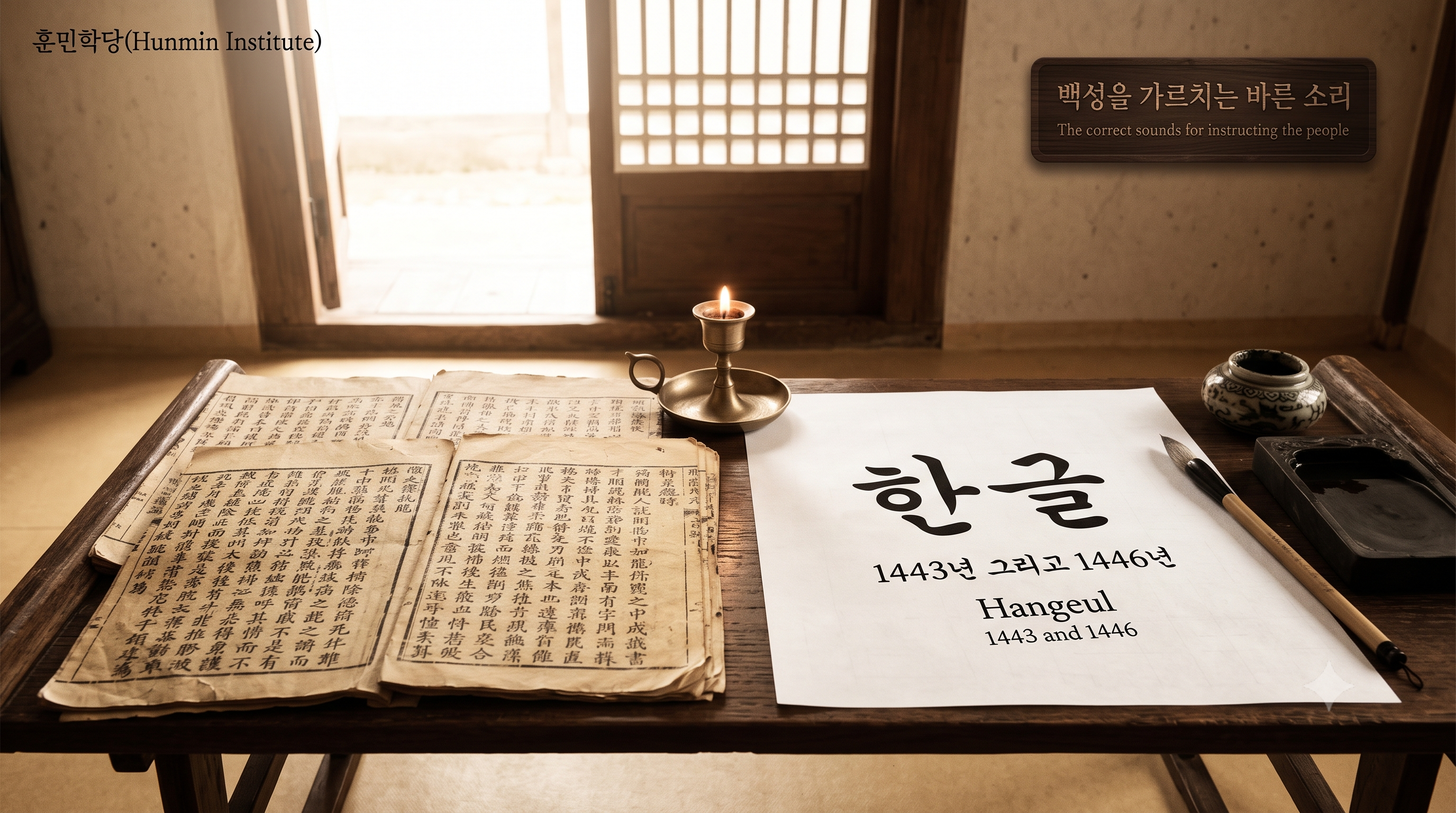
The history of Hangeul's creation sits in the three years between 1443 and 1446.
This post teaches those years and the Korean for talking about Hangeul.
한글 창제의 역사는 1443년 완성과 1446년 반포 사이 3년에 압축되어 있습니다.
이 글에서 그 3년의 과정과 한글을 설명하는 한국어를 익힙니다.
All learning services for the teaching materials published on this blog are free for blog subscribers on the Hunmin Institute website ↗.
이 글에서 배우는 핵심 회화
Key Expressions in This Lesson
한글은 배우는 대상이면서 동시에 이야깃거리입니다. 아래 여섯 문장은 좌우가 한 쌍의 대화가 아니라 각각 따로 익히는 문장입니다. 먼저 눈에 담고 본문으로 들어가십시오.
Hangeul is both what you learn and what you end up talking about. The two columns are not paired dialogue; each sentence is learned on its own. Take them in first, then move into the text.
| 듣는 말 Listening |
하는 말 Speaking |
|---|---|
| 한글 읽을 줄 알아요? [hangeul ilgeul jul arayo] Can you read Hangeul? |
한글은 세종대왕이 만들었어요. [hangeureun sejongdaewangi mandeureosseoyo] King Sejong created Hangeul. |
| 한국어 어렵죠? [hangugeo eoryeopjyo] Korean is hard, right? |
한글은 배우기 쉬워요. [hangeureun baeugi swiwoyo] Hangeul is easy to learn. |
| 이거 한번 읽어 보세요. [igeo hanbeon ilgeo boseyo] Try reading this. |
한글날은 시월 구일이에요. [hangeullareun siwol guirieyo] Hangeul Day is October 9. |
이 문장들은 소단락 1에서 다루고, 그 안에 담긴 역사는 소단락 2에서 6까지 이어집니다.
These lines come in Section 1, and the history behind them runs from Sections 2 to 6.
한글을 설명할 때 쓰는 한국어
The Korean for Talking About Hangeul
한국인을 만나면 한글은 반드시 화제에 오릅니다. 그때 쓸 말부터 표로 확인하십시오.
Hangeul comes up whenever you meet Koreans, so start with the lines you will need.
| 듣는 말 Listening |
하는 말 Speaking |
|---|---|
| 한글이랑 한국어는 달라요. [hangeurirang hangugeoneun dallayo] Hangeul and Korean are not the same. |
훈민정음은 한글의 옛 이름이에요. [hunminjeongeumeun hangeurui yet ireumieyo] Hunminjeongeum is the old name for Hangeul. |
| 발음이 좋으시네요. [bareumi joeusineyo] Your pronunciation is good. |
자음과 모음을 합쳐서 써요. [jaeumgwa moeumeul hapchyeoseo sseoyo] Consonants and vowels combine into one block. |
| 한글 언제 배웠어요? [hangeul eonje baewosseoyo] When did you learn Hangeul? |
아직 배우는 중이에요. [ajik baeuneun jungieyo] I am still learning. |
응용 Apply It
↳ [동사]기 쉬워요
[dongsa]gi swiwoyo
[Verb]-ing is easy
ex [한글은 배우]기 쉬워요/[이 글자는 읽]기 쉬워요/[이 이름은 찾]기 쉬워요
ROM [hangeureun baeu]gi swiwoyo/[i geuljaneun il]gi swiwoyo/[i ireumeun chat]gi swiwoyo
EN Hangeul is easy to learn/This letter is easy to read/This name is easy to find
| 한국어 Korean |
무엇을 가리키는가 What it refers to |
|---|---|
| 한글 [hangeul] |
글자를 가리키는 말 The name of the script itself |
| 한국어 [hangugeo] |
말을 가리키는 말 The name of the spoken language |
| 훈민정음 [hunminjeongeum] |
한글의 옛 이름이자 창제 당시의 공식 명칭 The old name, and the official name at creation |
| 자음 [jaeum] |
닿소리, 열네 자를 씁니다 Consonant; fourteen are in use |
| 모음 [moeum] |
홀소리, 열 자를 씁니다 Vowel; ten are in use |
▶한글과 한국어를 섞어 쓰지 마십시오. 학습자가 가장 자주 혼동하는 지점입니다.
Do not mix 한글 and 한국어. This is the mistake learners make most.
한글은 글자이고 한국어는 말입니다. 한글을 배웠다고 하면 글자를 읽을 줄 안다는 뜻이고, 한국어를 배웠다고 해야 말을 익혔다는 뜻이 됩니다.
한글 is the script; 한국어 is the language. Saying you learned 한글 means you can read the letters, while learning 한국어 means you learned the language.
어렵죠의 죠는 질문이 아니라 동의를 구하는 말끝이고, 읽을 줄 알아요는 능력을 말하는 틀입니다. 할 줄 알아요, 운전할 줄 알아요처럼 쓰며 안다는 뜻이 아니라 할 수 있다는 뜻입니다.
The ending 죠 seeks agreement rather than information, and 을 줄 알다 states an ability: 할 줄 알아요, 운전할 줄 알아요. It means can do, not know.
시월 구일에서 십월이 아니라 시월이라고 읽는 점에도 주의하십시오. 유월과 시월 두 달만 이렇게 소리가 줄어듭니다.
Note also that October is 시월, not 십월. Only June and October drop a sound this way.
한글이 없던 시절, 조선 사람들은 어떻게 글을 썼을까
How Did People in Joseon Write Before Hangeul?
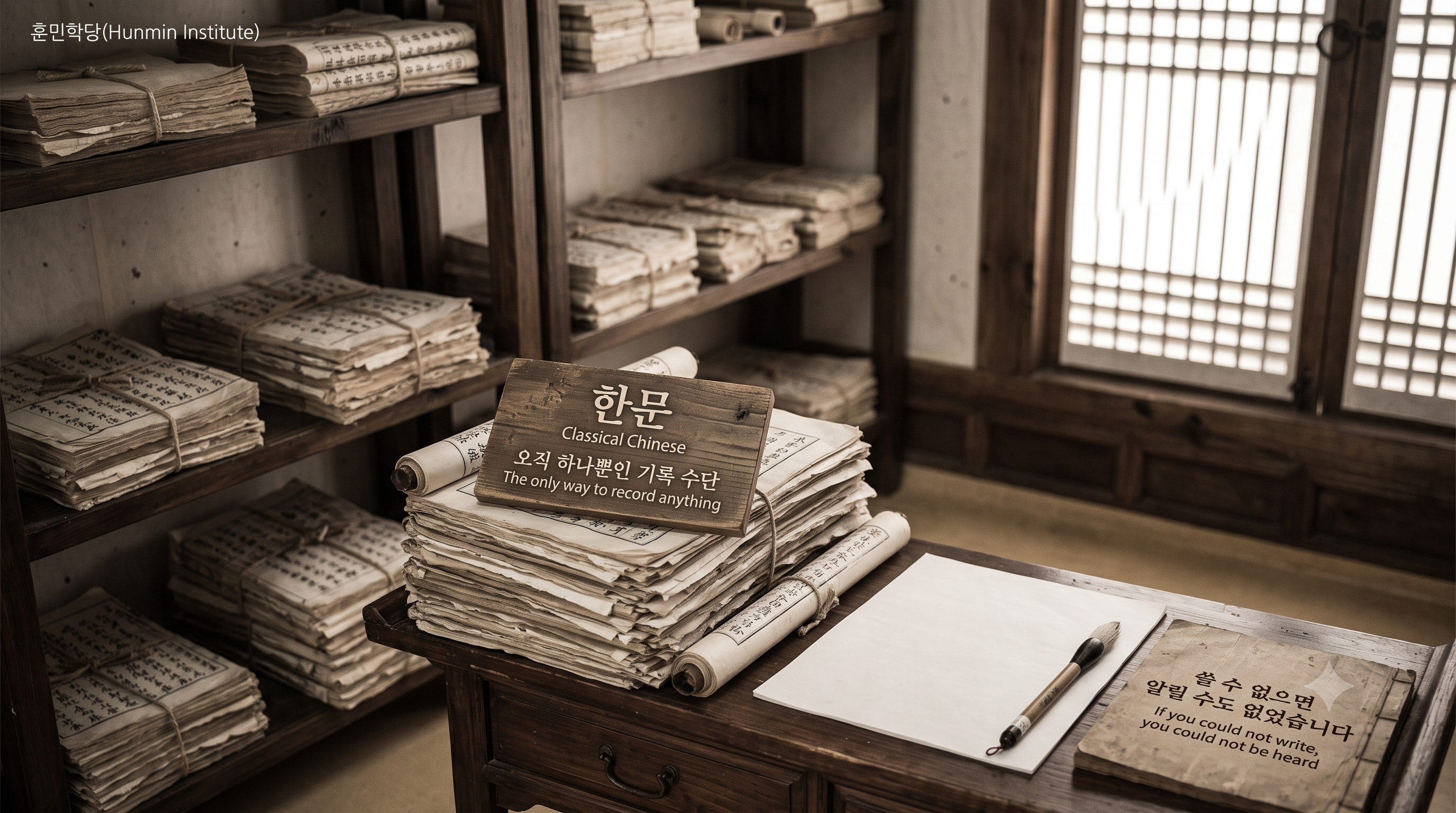
1443년 이전의 한반도에는 우리말을 적을 수 있는 우리 문자가 없었습니다. 이 시기를 설명할 때 오가는 말부터 확인하십시오.
Before 1443 the Korean Peninsula had no writing system of its own for recording Korean. Start with the lines exchanged whenever this period comes up.
| 듣는 말 Listening |
하는 말 Speaking |
|---|---|
| 옛날에는 한자로 썼어요. [yennareneun hanjaro sseosseoyo] In the old days people wrote in Chinese characters. |
한문은 배우기 어려웠어요. [hanmuneun baeugi eoryeowosseoyo] Classical Chinese was hard to learn. |
| 백성들은 글을 몰랐어요. [baekseongdeureun geureul mollasseoyo] The common people could not read or write. |
그럼 글은 누가 썼어요? [geureom geureun nuga sseosseoyo] Then who did the writing? |
| 억울한 일이 많았어요. [eogulhan iri manasseoyo] There were many wrongs no one could speak of. |
관청에 어떻게 알렸어요? [gwancheonge eotteoke allyeosseoyo] How did they inform the government office? |
| 한국어 Korean |
이 시대에서 무슨 뜻인가 What it meant then |
|---|---|
| 한문 [hanmun] |
글을 적는 유일한 수단, 우리말과 문법이 달랐습니다 The only means of writing; its grammar differed from Korean |
| 양반 [yangban] |
학습에 드는 시간을 감당한 소수 The few who could afford years of study |
| 백성 [baekseong] |
글을 배울 시간이 없던 대다수 The majority with no time to learn |
| 관청 [gwancheong] |
사정을 문서로 내야 하는 곳 Where your case had to be submitted in writing |
| 억울하다 [eogulhada] |
부당한 일을 당하고도 말하지 못하는 상태 Wronged with no way to speak of it |
▶글을 못 쓴다는 것은 자신의 사정을 세상에 알릴 방법이 없다는 뜻이었습니다.
Being unable to write meant having no way to make your situation known.
한문은 글자 수가 많고 문법 구조도 우리말과 달랐습니다. 제대로 읽고 쓰려면 수년에서 십수 년의 학습이 필요했고 그 시간을 감당할 수 있는 사람은 소수의 양반이었습니다.
Classical Chinese had a vast inventory of characters and a grammar unlike Korean. Reading and writing it properly took years, and only a small noble class could afford that time.
문제는 불편함으로 끝나지 않았습니다. 글을 모르면 억울한 일을 당해도 관청에 사정을 문서로 제출할 수 없었습니다. 억울하다는 말은 지금도 한국인이 자주 쓰는데, 그 뿌리에는 말할 수단이 없던 시절이 놓여 있습니다.
The problem did not end with inconvenience. Those who could not write had no way to submit their case to a government office. Koreans still use 억울하다 often, and at its root lies an age with no means of speaking.
백성에게 묻는 왕, 그리고 1443년의 완성
A King Who Asked His People, and the Year 1443
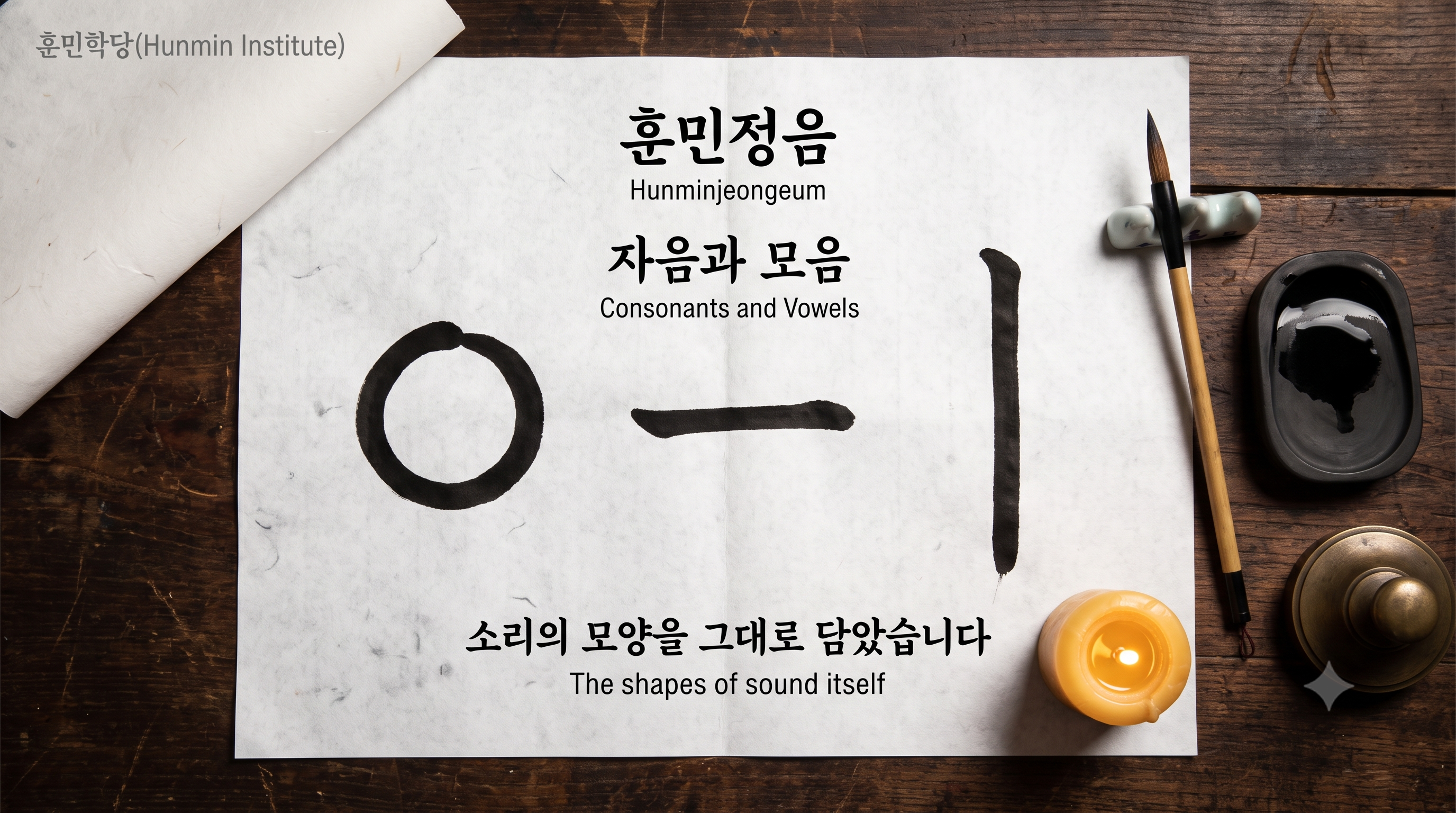
한글이 왜 만들어졌는지 이해하려면 세종대왕이 나라를 다스린 방식부터 볼 필요가 있습니다. 그 이야기를 나눌 때 오가는 말이 아래에 있습니다.
To understand why Hangeul was created, look first at how King Sejong governed. The lines below are the ones exchanged when that story comes up.
| 듣는 말 Listening |
하는 말 Speaking |
|---|---|
| 세종대왕이 직접 만들었어요. [sejongdaewangi jikjeop mandeureosseoyo] King Sejong made it himself. |
언제 만들었어요? [eonje mandeureosseoyo] When was it made? |
| 백성을 위해서 만들었어요. [baekseongeul wihaeseo mandeureosseoyo] He made it for the people. |
왜 만들었어요? [wae mandeureosseoyo] Why was it made? |
| 처음에는 스물여덟 자였어요. [cheoeumeneun seumullyeodeol jayeosseoyo] At the start there were twenty-eight letters. |
지금은 몇 자예요? [jigeumeun myeot jayeyo] How many letters are there now? |
| 한국어 Korean |
무엇을 가리키는가 What it refers to |
|---|---|
| 민본사상 [minbonsasang] |
백성을 나라의 근본으로 삼는 생각 The people as the foundation of the state |
| 찬성 [chanseong] |
1430년 세법 여론조사에서 98,657명이 낸 답 The answer given by 98,657 people in the 1430 tax survey |
| 반대 [bandae] |
같은 조사에서 74,149명이 낸 답 The answer given by 74,149 people in the same survey |
| 시행 [sihaeng] |
제도를 실제로 적용하는 일 Putting a system into actual use |
| 창제 [changje] |
문자를 새로 만드는 일, 한글 창제처럼 씁니다 Making a writing system from scratch; used as 한글 창제 |
▶과반이 찬성했는데도 세종은 시행을 미뤘습니다.
Even with a majority in favor, Sejong postponed enactment.
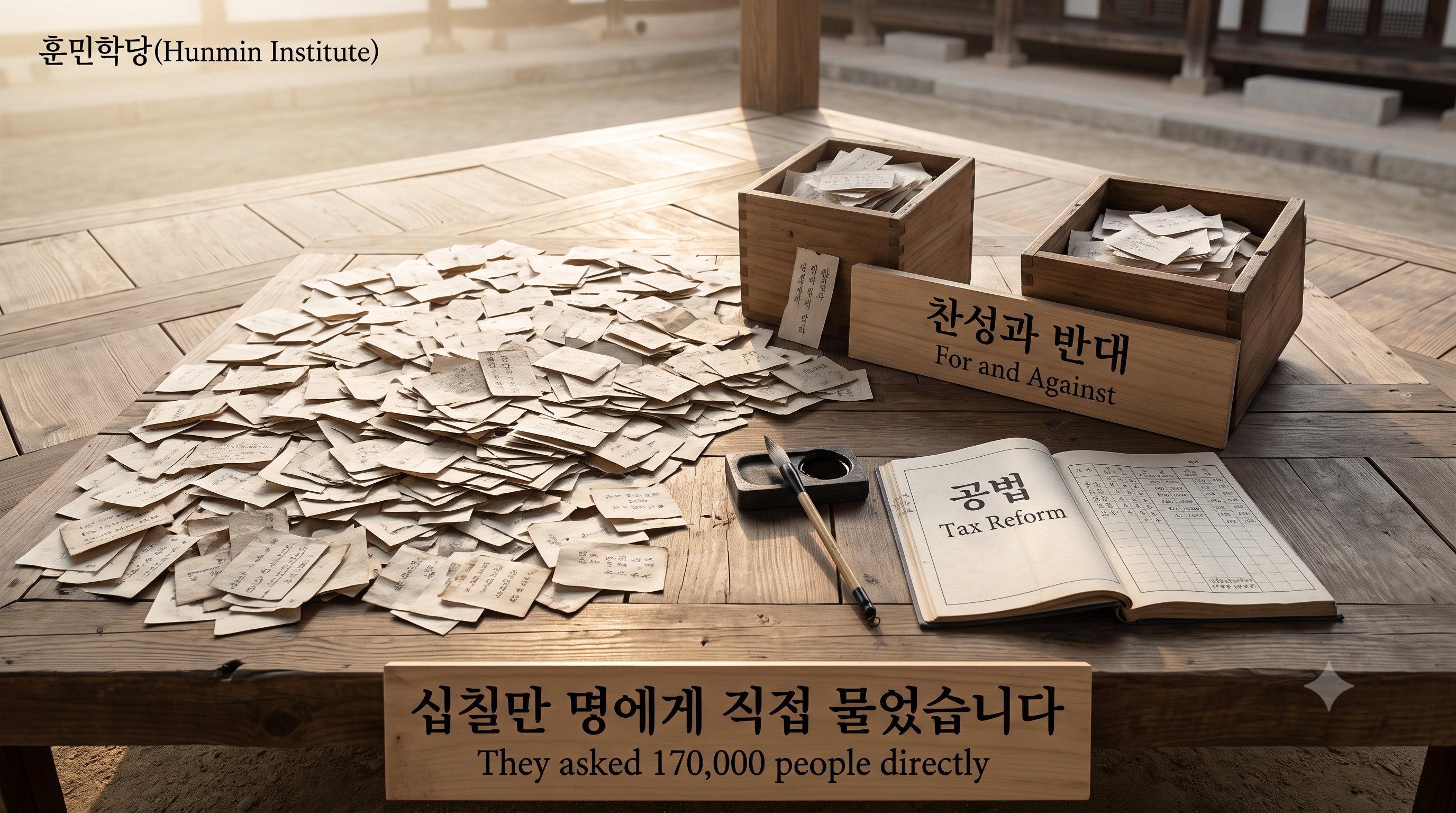
1430년 세법 개편에서 세종은 중앙의 관리부터 시골의 백성에 이르기까지 직접 찬반을 묻도록 했습니다. 3월 5일부터 8월 10일까지 다섯 달 동안 172,806명이 답했고 결과는 찬성 98,657명, 반대 74,149명으로 약 57퍼센트가 찬성이었습니다.
In the 1430 tax reform, Sejong ordered that everyone from officials in the capital to villagers be asked directly. From March 5 to August 10, over five months, 172,806 people answered: 98,657 in favor and 74,149 opposed, roughly 57 percent approval.
반대한 사람이 7만 명이 넘는다는 사실을 그냥 넘기지 않은 것입니다. 이후 제도를 다듬고 지역별로 시험 운영을 거쳐 1444년 최종 확정까지 14년이 더 걸렸습니다. 이것이 민본사상이 실제로 작동한 방식입니다.
He was unwilling to set aside more than 70,000 objections. He refined the system, ran regional trials, and took fourteen more years to finalize it in 1444. This is how minbon actually worked.
1443년 12월, 세종대왕은 새 문자의 완성을 알립니다. 자음은 소리를 낼 때 혀와 입, 목이 만드는 모양을 본떴고 모음은 하늘과 땅과 사람의 형상을 기본으로 삼았습니다. 처음에는 28자였고 현재는 그중 24자를 사용합니다.
In December 1443 he announced that the new script was complete. The consonants imitate the shapes the tongue, mouth, and throat form when producing sound, while the vowels are based on heaven, earth, and humanity. There were 28 letters at creation, and 24 remain in use.
1444년, 새 문자를 반대한 사람들
1444: Those Who Opposed the New Script
문자가 완성되었다고 해서 곧바로 백성에게 전달된 것은 아닙니다. 반대와 반포를 말할 때 쓰는 문장부터 보십시오.
A completed script did not mean it reached the people right away. Start with the lines used to talk about the opposition and the promulgation.
| 듣는 말 Listening |
하는 말 Speaking |
|---|---|
| 반대하는 사람도 많았어요. [bandaehaneun saramdo manasseoyo] There were many who opposed it too. |
누가 반대했어요? [nuga bandaehaesseoyo] Who opposed it? |
| 상소를 올렸어요. [sangsoreul ollyeosseoyo] They submitted a petition to the king. |
왜 반대했어요? [wae bandaehaesseoyo] Why did they oppose it? |
| 세종은 직접 설명했어요. [sejongeun jikjeop seolmyeonghaesseoyo] Sejong explained it himself. |
그래서 어떻게 됐어요? [geuraeseo eotteoke dwaesseoyo] So what happened in the end? |
| 시기 Date |
사건 Event |
의미 Significance |
|---|---|---|
| 1443년 12월 December 1443 |
훈민정음 창제 공개 Hunminjeongeum is completed and announced |
28자의 새 문자가 처음으로 세상에 모습을 드러냄 A new script of 28 letters is revealed for the first time |
| 1444년 2월 February 1444 |
최만리 등 일곱 학자의 반대 상소 Choe Malli and six other scholars submit a petition of opposition |
집현전 내부에서 제기된 반대 Opposition from inside the Hall of Worthies |
| 1444년에서 1446년 1444 to 1446 |
해례본 편찬과 용비어천가 실전 검증 Compilation of the Haeryebon and practical testing through Yongbieocheonga |
제자 원리를 증명하고 성능을 시험한 시기 A period spent proving the design principles and testing the script |
| 1446년 9월 September 1446 |
훈민정음 반포 Promulgation of the Hunminjeongeum |
백성이 마침내 문자를 손에 넣음 The people finally receive the script |
| 1459년 1459 |
훈민정음 언해본 간행 Publication of the Hunminjeongeum Eonhaebon |
한글로 옮겨져 백성이 직접 읽게 됨 Rendered into Hangeul so ordinary people could read it |
▶반대는 바깥이 아니라 가장 가까운 곳에서 나왔습니다.
The opposition came not from outside but from those closest to him.
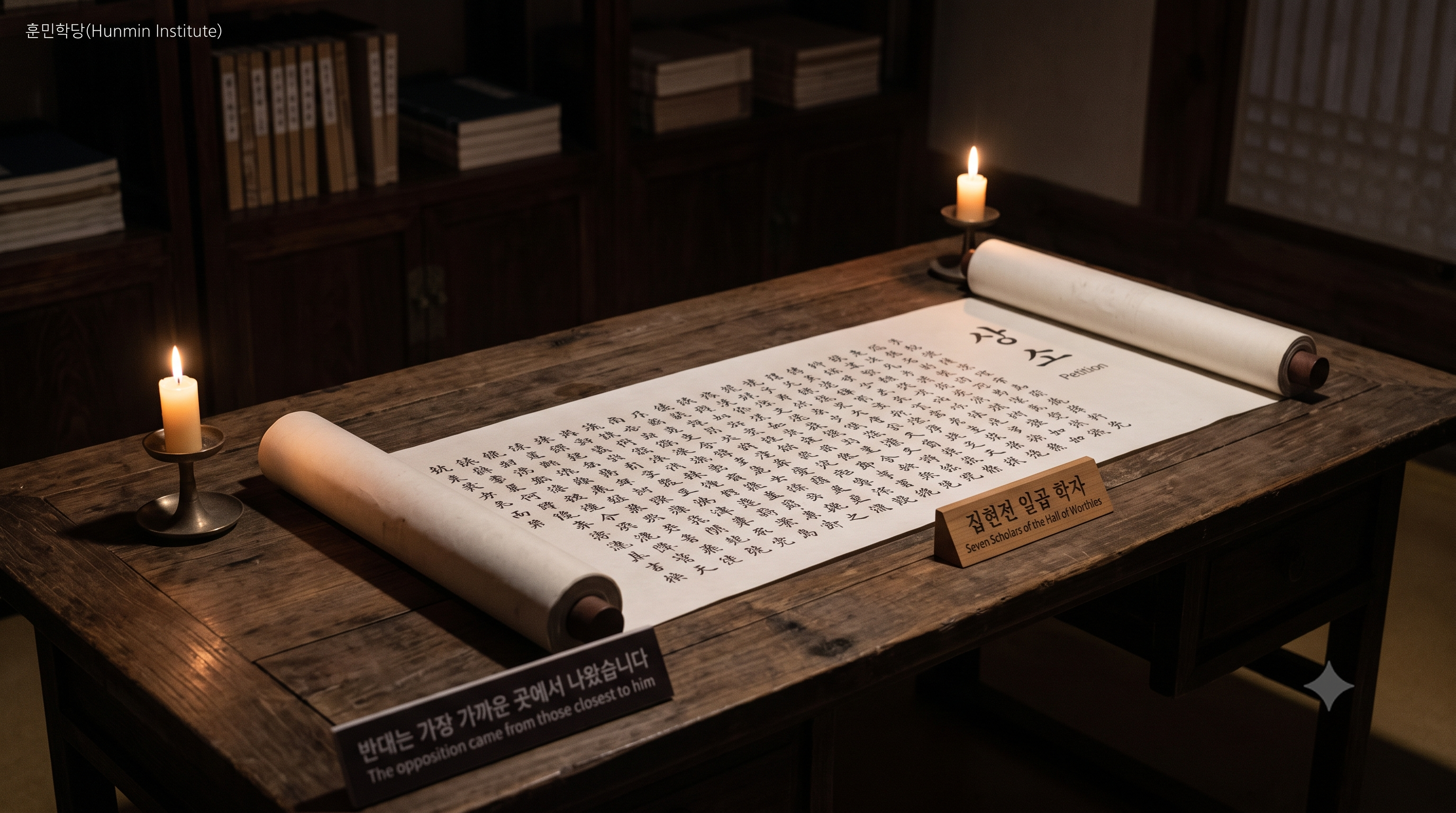
1444년 2월, 집현전 부제학 최만리를 비롯한 일곱 명의 학자가 반대 상소를 올립니다. 집현전은 세종이 직접 인재를 모아 키운 학문 기관이었습니다.
In February 1444 seven scholars led by Choe Malli, deputy head of the Hall of Worthies, submitted a petition against the new script. The Hall was the academy Sejong had personally staffed.
첫째 배경은 사대주의와 성리학적 명분론입니다. 조선은 중국 중심의 국제 질서 안에서 명나라와의 관계를 국가 운영의 기본 틀로 삼았고, 이 틀에서 보면 중국과 다른 문자를 따로 만드는 일은 스스로 그 질서 밖으로 나가는 행위로 비칠 수 있었습니다.
The first reason was deference to the China-centered order together with Neo-Confucian doctrines of legitimacy. Within that framework a separate script could look like stepping outside the order.
둘째는 지식의 대중화에 대한 부담입니다. 한문 해독 능력은 사대부라는 신분을 뒷받침하는 실질적인 자격이었습니다. 세종은 상소를 덮지 않고 학자들을 직접 불러 논쟁했으며, 힘으로 누르는 대신 새 문자가 왜 이런 모양인지를 조목조목 설명하는 답을 준비합니다.
The second was unease about the popularization of knowledge, since reading Classical Chinese was the practical credential behind the scholar-official class. Sejong summoned the scholars and debated them, preparing an explanation of why the letters took these shapes rather than pressing them down by authority.
반포까지의 3년 동안 벌어진 일
What Happened During the Three Years Before Promulgation
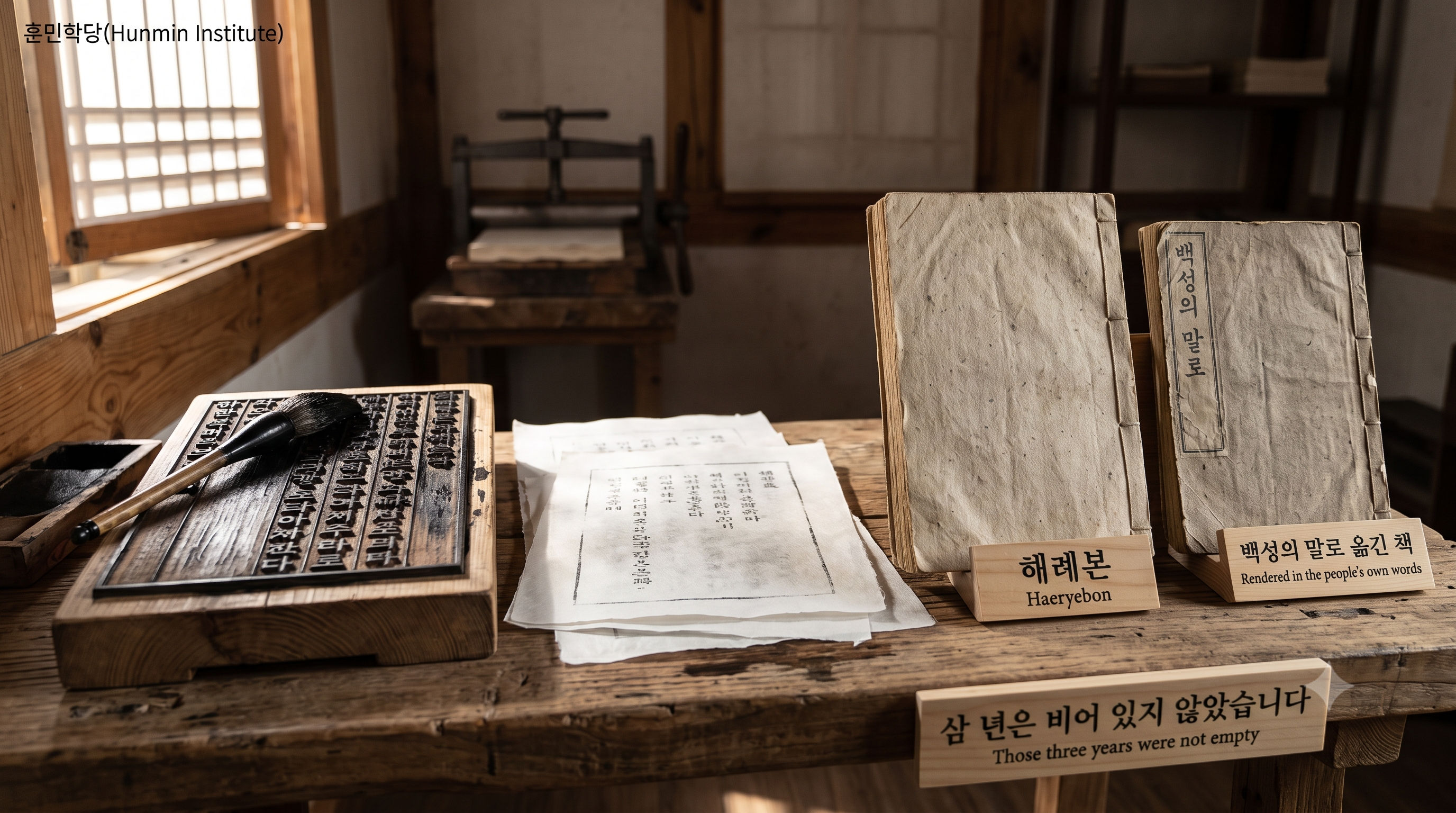
1443년부터 1446년까지의 3년은 비어 있던 시간이 아닙니다. 이 시기의 책을 두고 오가는 말부터 보십시오.
The three years from 1443 to 1446 were not empty time. Start with the lines exchanged about the books of that period.
| 듣는 말 Listening |
하는 말 Speaking |
|---|---|
| 해례본은 한문으로 썼어요. [haeryeboneun hanmuneuro sseosseoyo] The Haeryebon was written in Classical Chinese. |
두 책은 뭐가 달라요? [du chaegeun mwoga dallayo] How do the two books differ? |
| 언해본은 한글로 옮겼어요. [eonhaeboneun hangeullo omgyeosseoyo] The Eonhaebon was rendered into Hangeul. |
몇 년에 나왔어요? [myeot nyeone nawasseoyo] What year did it come out? |
| 창제와 반포는 달라요. [changjewa banponeun dallayo] Creation and promulgation are not the same. |
어디에서 볼 수 있어요? [eodieseo bol su isseoyo] Where can I see it? |
| 한국어 Korean |
어떤 책이고 무슨 일인가 What book, what act |
|---|---|
| 해례본 [haeryebon] |
1446년 한문 해설서, 설득 대상은 지식층 The 1446 commentary in Classical Chinese, aimed at the intellectual class |
| 언해본 [eonhaebon] |
해례본을 한글로 옮긴 판본, 1459년 월인석보 앞머리에 실림 The Haeryebon rendered into Hangeul, placed at the front of the 1459 Worin Seokbo |
| 용비어천가 [yongbieocheonga] |
한글로 지은 최초의 장편 작품, 새 문자의 성능을 시험한 자료 The first long work written in Hangeul, a test of what the new script could do |
| 편찬 [pyeonchan] |
자료를 모아 책으로 엮는 일 Gathering material into a book |
| 반포 [banpo] |
널리 알려 쓰게 하는 일, 창제와는 다른 말입니다 Announcing it for public use; not the same word as creation |
▶해례본이 한문으로 쓰인 이유는 설득해야 할 첫 대상이 백성이 아니었기 때문입니다.
The Haeryebon was written in Classical Chinese because the first audience to persuade was not the people.
1446년에 나온 훈민정음 해례본은 글자의 제자 원리와 사용법을 체계적으로 설명한 책입니다. 반대하는 지식층을 설득하려면 그들의 문자로 써야 했습니다.
The Hunminjeongeum Haeryebon of 1446 explained systematically how the letters were designed and used. To persuade the opposing intellectual class, it had to be written in their script.
해례본과 언해본은 서로 다른 책입니다. 해례본이 한문 해설서라면, 이를 한글로 옮겨 일반 백성이 직접 읽을 수 있게 만든 것이 언해본입니다. 현재 전해지는 언해본은 세종 사후인 1459년 간행된 월인석보 앞머리에 실려 있습니다.
The Haeryebon and the Eonhaebon are different books. The surviving Eonhaebon appears at the front of the Worin Seokbo, published in 1459 after Sejong died.
오늘 우리가 배우는 한글
The Hangeul We Learn Today
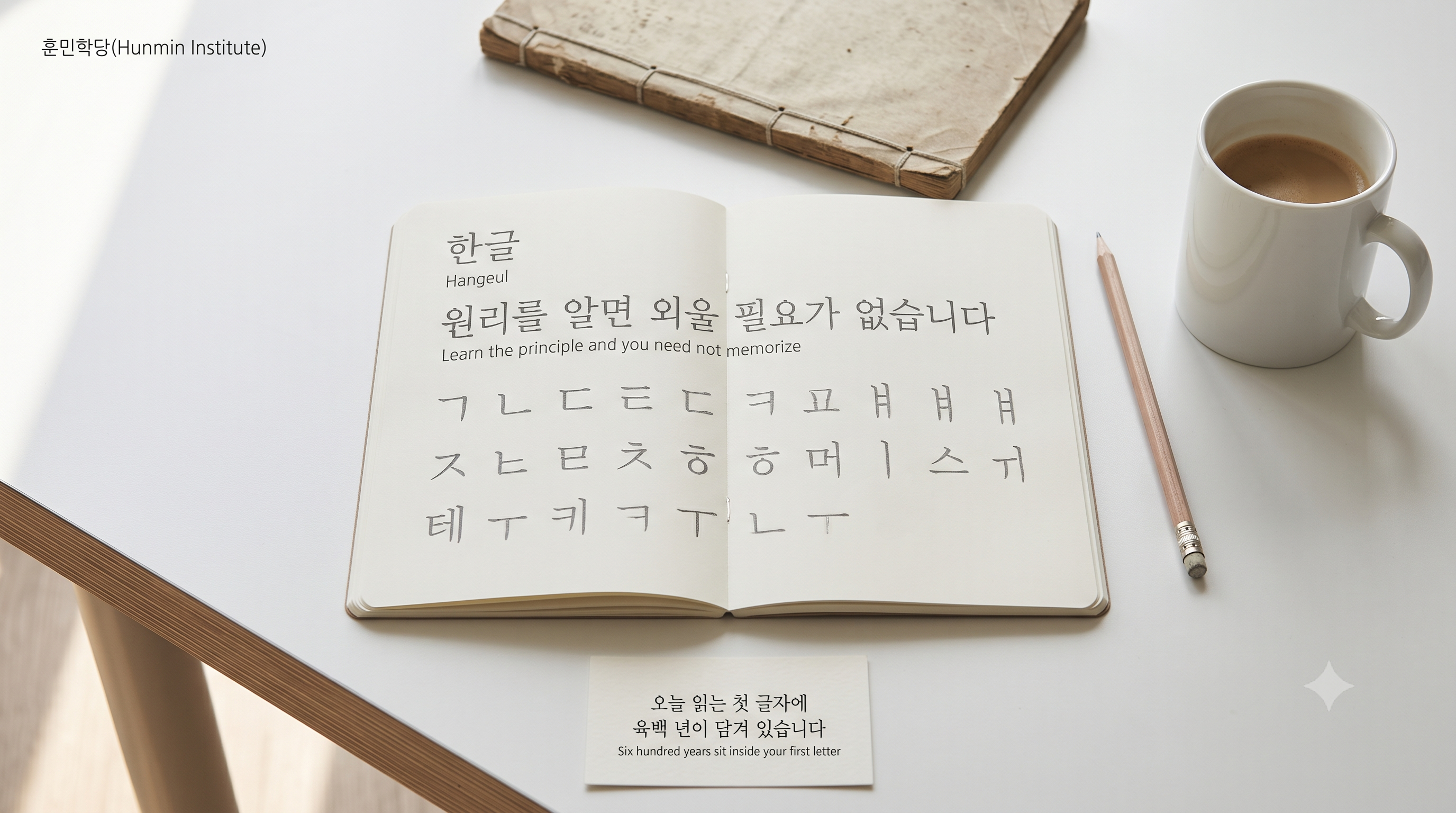
오늘의 한글은 기록으로 남아 세계가 인정한 문자입니다. 지금 쓰는 말로 정리하면 이렇습니다.
Today's Hangeul is a script preserved in record and recognized worldwide. In present-day terms it comes to this.
| 듣는 말 Listening |
하는 말 Speaking |
|---|---|
| 한글날은 공휴일이에요. [hangeullareun gonghyuirieyo] Hangeul Day is a public holiday. |
한글날이 언제예요? [hangeullari eonjeyeyo] When is Hangeul Day? |
| 세계기록유산에 올랐어요. [segyegirogyusane ollasseoyo] It was inscribed on the Memory of the World register. |
어디에 가면 볼 수 있어요? [eodie gamyeon bol su isseoyo] Where can I go to see it? |
| 며칠 만에 읽을 수 있어요. [myeochil mane ilgeul su isseoyo] You can read it within a few days. |
저도 읽을 수 있어요. [jeodo ilgeul su isseoyo] I can read it too. |
| 한국어 Korean |
지금 어디에서 만나는가 Where you meet it now |
|---|---|
| 세계기록유산 [segyegirogyusan] |
훈민정음 해례본이 1997년 10월 등재 The Hunminjeongeum Haeryebon was inscribed in October 1997 |
| 조합 원리 [johap wolli] |
자음과 모음을 모아 한 글자, 글자 수를 외울 필요가 없습니다 Consonants and vowels form one block; there is no inventory to memorize |
| 국립한글박물관 [gungnip hangeul bangmulgwan] |
서울 용산에 있으나 복구공사로 휴관 중이며 2028년 10월 재개관 예정입니다 In Yongsan, Seoul, but closed for repair work and due to reopen in October 2028 |
| 세종대왕릉 [sejongdaewangneung] |
경기도 여주에 있습니다 It is in Yeoju, Gyeonggi-do |
| 한글날 [hangeullal] |
시월 구일 공휴일, 반포를 기념하는 날입니다 A public holiday on October 9, marking the promulgation |
▶만든 사람과 이유와 원리가 함께 기록되어 전해지는 문자는 한글이 사실상 유일합니다.
Hangeul is effectively the only script whose creator, purpose, and design principles were all recorded together.
이 가치를 인정받아 훈민정음 해례본은 1997년 10월 유네스코 세계기록유산으로 등재되었습니다. 배우기 쉽다는 점도 여기서 나옵니다. 원리만 이해하면 글자 수를 통째로 외울 필요가 없으므로 많은 외국인 학습자가 며칠 만에 한글을 읽어냅니다.
In recognition of this, the Hunminjeongeum Haeryebon was inscribed on the UNESCO Memory of the World Register in October 1997. Grasp the principle and there is no inventory to memorize, which is why many learners read Hangeul within days.
한글을 직접 보러 가고 싶다면 소장처와 개관 여부를 먼저 확인하십시오. 해례본 원본은 서울 간송미술관에 있고, 국립한글박물관은 2025년 화재 이후 복구공사로 휴관 중이며 2028년 10월 재개관을 목표로 하고 있습니다.
If you want to see Hangeul in person, check where it is held and whether the doors are open. The original Haeryebon is at the Kansong Art Museum in Seoul, while the National Hangeul Museum has been closed since a 2025 fire and aims to reopen in October 2028.
지금 여러분이 배우고 있는 이 문자는 한 사람이 십 년 넘게 고민하고, 반대에 답하고, 끝내 포기하지 않아서 남은 결과입니다. 첫 글자를 읽는 순간 그 3년의 시간도 함께 이어받는 셈이며, 오늘 나온 어휘는 아래 단어장에서 정리하고 가시기 바랍니다.
The script you are learning exists because one man thought it through for over a decade, answered his critics, and refused to give up. The moment you read your first letter you inherit those three years as well, so gather the words from today in the vocabulary list below.
Next: Bunsik vs Hansik: Know the Difference ↗
토픽 맛보기
TOPIK Preview
유형: TOPIK Ⅰ 읽기 [34~39], 대화, 빈칸에 알맞은 것 고르기
Type: TOPIK I Reading [34–39], dialogue, choose the correct word for the blank
( )에 들어갈 말로 가장 알맞은 것을 고르십시오.
Choose the most appropriate word for the blank.
가: 한글 읽을 줄 알아요? 나: 네, 한글은 배우기 ( ).
A: Can you read Hangeul? B: Yes, Hangeul is ( ) to learn.
① 쉬워요
② 쉽다
③ 쉬운
④ 쉽게
Answer ▾
정답 ① 쉬워요
Answer: ① 쉬워요
배우기 뒤에는 문장을 끝맺는 형태가 와야 하므로 쉬워요가 맞습니다. ②는 지문과 같은 낱말을 쓰지만 사전에 실리는 기본형이라 문장이 끝나지 않고, ③은 뒤에 명사가 와야 하는 꾸밈말이라 일부만 맞으며, ④는 그럴듯해 보여도 뒤에 동사가 와야 하는 형태라 이 자리에 근거가 없습니다. 흉내 낸 대문항은 TOPIK Ⅰ 읽기 [34~39]입니다.
After 배우기 the sentence needs a closing form, so 쉬워요 is correct. ② uses the same word but is the dictionary form, which leaves the sentence unfinished; ③ modifies a following noun and is only partly right; ④ looks plausible but modifies a following verb, so nothing here supports it. The item type modeled here is TOPIK I Reading [34–39].
FAQ
Q1. 한글은 세종대왕이 혼자 만들었나요?Answer ▾
Q1. Did King Sejong create Hangeul alone?
A1. 세종대왕이 직접 만들었다는 기록이 세종실록에 남아 있습니다. 다만 완성 이후 해례본 편찬과 보급 과정에는 정인지와 신숙주를 비롯한 집현전 학자 여덟 명이 함께 참여했습니다.
A1. The Annals of King Sejong record that he created it himself. After its completion, eight scholars of the Hall of Worthies including Jeong In-ji and Sin Suk-ju took part in compiling the Haeryebon and spreading the script.
Q2. 훈민정음과 한글은 다른 말인가요?Answer ▾
Q2. Are Hunminjeongeum and Hangeul different things?
A2. 같은 문자를 가리키는 다른 이름입니다. 훈민정음은 창제 당시의 공식 명칭이고, 한글이라는 이름은 20세기 초 주시경을 중심으로 쓰이기 시작했습니다.
A2. They are two names for the same script. Hunminjeongeum was the official name at creation, while Hangeul came into use in the early twentieth century around Ju Si-gyeong.
Q3. 해례본과 언해본은 어떻게 다른가요?Answer ▾
Q3. How do the Haeryebon and the Eonhaebon differ?
A3. 해례본은 1446년 한문으로 쓰인 해설서이고, 언해본은 그 내용을 한글로 옮긴 판본입니다. 대상 독자가 각각 지식층과 일반 백성으로 다릅니다.
A3. The Haeryebon is the 1446 commentary in Classical Chinese; the Eonhaebon renders its content in Hangeul. Their intended readers differ.
Q4. 한글은 정말 며칠 만에 배울 수 있나요?Answer ▾
Q4. Can Hangeul really be learned in a few days?
A4. 읽는 것은 가능합니다. 자음과 모음의 조합 원리만 익히면 글자를 소리 내어 읽을 수 있습니다. 다만 뜻을 이해하고 문장을 구사하는 것은 별개의 학습 과정입니다.
A4. Reading it is possible. Once you learn how consonants and vowels combine, you can sound out the letters. Understanding meaning is a separate process.
Q5. 훈민정음 해례본 원본은 어디에서 볼 수 있나요?Answer ▾
Q5. Where can I see the original Hunminjeongeum Haeryebon?
A5. 원본은 서울 간송미술관이 소장하고 있으며 상설로 공개되지는 않습니다. 국립한글박물관은 복구공사로 휴관 중이므로 방문 전에 누리집 공지를 확인하시기 바랍니다.
A5. The original is held by the Kansong Art Museum in Seoul and is not on permanent display. The National Hangeul Museum is closed for repair work, so check its website notices before visiting.
Vocabulary and Pronunciation for Foreigners
| No | Korean | Romanisation | Meaning |
|---|---|---|---|
| 1 | 한글 | hangeul | (n) Hangeul, the Korean script [ˈhɑːnɡuːl] |
| 2 | 한국어 | hangugeo | (n) the Korean language [kəˈriːən] |
| 3 | 훈민정음 | hunminjeongeum | (n) Hunminjeongeum [hunminˈdʒʌŋɯm] |
| 4 | 세종대왕 | sejongdaewang | (n) King Sejong the Great [kɪŋ ˈseɪdʒʌŋ] |
| 5 | 한글날 | hangeullal | (n) Hangeul Day [ˈhɑːnɡuːl deɪ] |
| ▾ 단어 59 개 더 보기 Show 59 more ↗ | |||
The blog page has limits of space and function, so only five words are shown here. The rest of the word list, the audio, the sentences and tables, the FAQ, the worksheet, the TOPIK questions and the lesson video are on the Hunmin Institute website ↗, free for blog subscribers.
참고 기관
Official Sources
국립한글박물관 ↗
National Hangeul Museum
https://www.hangeul.go.kr
기관 설명 보기 About this institute ▾
This is the national institution devoted to the creation and history of Hangeul. It has an English site where you can browse the collection and exhibition information. Note that the galleries have been closed for repair work since a 2025 fire, with reopening targeted for October 2028, so check the notices on the site before planning a visit.
국사편찬위원회 조선왕조실록 ↗
National Institute of Korean History, Annals of the Joseon Dynasty
https://sillok.history.go.kr
기관 설명 보기 About this institute ▾
This is the primary source for the 1443 creation, the 1444 petition of opposition, and the 1446 promulgation. An English site sits separately at esillok.history.go.kr, but only part of the translation has been released, so the original entries must be read on the Korean site.
※ 본 콘텐츠(원고, 이미지, 예문 포함)는 저작권법에 의해 보호받는 훈민학당의 저작물입니다. 무단 복제, 전재, 재배포 및 AI 학습 데이터로의 이용을 금합니다.
This content (manuscript, images, and example sentences) is the copyrighted property of Hunmin Institute, protected under copyright law. Unauthorized copying, reproduction, redistribution, and use as AI training data are prohibited.
'K-Culture' 카테고리의 다른 글
| Korean Jjim: The Braised Dishes You Should Not Miss (0) | 2026.07.25 |
|---|---|
| Korean Skin Is a Habit, Not a 10-Step Routine (0) | 2026.07.25 |
| Korean Noodle Dishes Part 2: Jjajangmyeon, Bibim-guksu, Kongguksu (0) | 2026.07.25 |
| Korean Noodle Dishes Part 1: Kalguksu to Naengmyeon (0) | 2026.07.25 |
| Bunsik vs Hansik: Know the Difference (0) | 2026.07.22 |


