
One Syllable in the Middle Decides the Whole Relationship
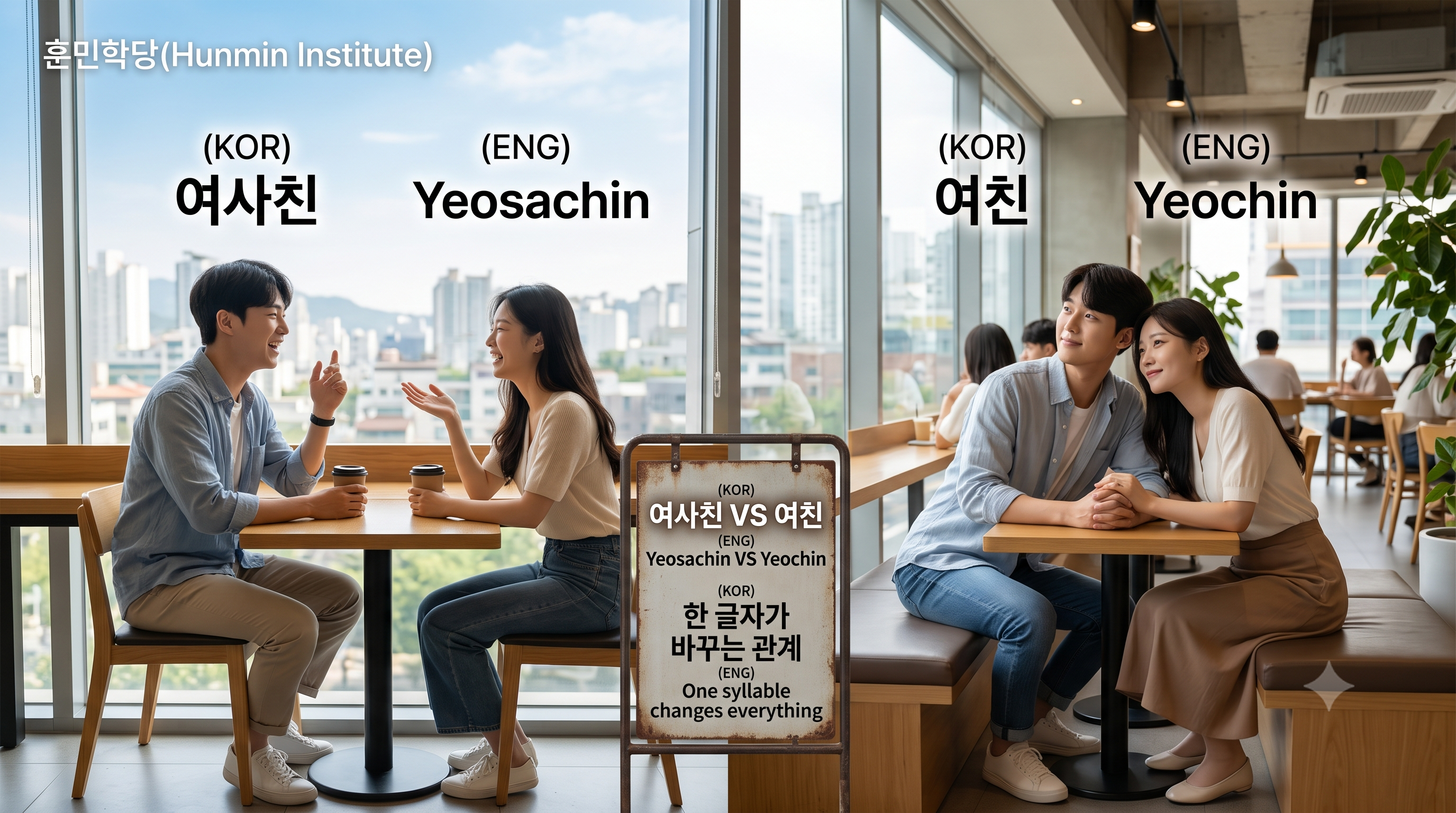
여사친과 여친, 한 글자가 바꾸는 관계
Yeochin and yeosachin are contractions split by one syllable in the middle.
Learn the lines Koreans use to state a relationship and the frames behind them.
여친과 여사친은 한국어 줄임말이며, 가운데 글자 하나로 관계가 갈립니다.
이 글에서 관계를 밝힐 때 오가는 말과 그 문장의 틀을 익힙니다.
All learning services for the teaching materials published on this blog are free for blog subscribers on the Hunmin Institute website ↗.
이 글에서 배우는 핵심 회화
Key Expressions in This Lesson
이 글의 핵심 회화는 관계를 묻고 답하는 말이며, 여사친과 여친이 갈리는 자리가 바로 이 대화입니다. 아래 여섯 문장은 좌우가 한 쌍의 대화가 아니라 각각 따로 익히는 문장입니다. 먼저 눈에 담고 본문으로 들어가십시오.
The key conversation here is how a relationship is asked about and answered, which is exactly where yeosachin and yeochin part ways. The two columns are not paired dialogue; each sentence is learned on its own. Take them in first, then move into the text.
| 듣는 말 Listening |
하는 말 Speaking |
|---|---|
| 너 여친 있어? [neo yeochin isseo] Do you have a girlfriend? |
걔 그냥 여사친이야. [gyae geunyang yeosachiniya] She is just a friend of mine. |
| 둘이 사귀어? [duri sagwieo] Are you two dating? |
우리 그냥 친구 사이야. [uri geunyang chingu saiya] We are just friends. |
| 걔랑 무슨 사이야? [gyaerang museun saiya] What are you two to each other? |
어떻게 아는 사이예요? [eotteoke aneun saiyeyo] How do you two know each other? |
첫째 줄과 둘째 줄은 소단락 1에서, 셋째 줄은 소단락 4에서 다룹니다.
The first two rows are covered in Section 1, and the third in Section 4.
관계를 말할 때 오가는 한국어
The Korean Used to State a Relationship
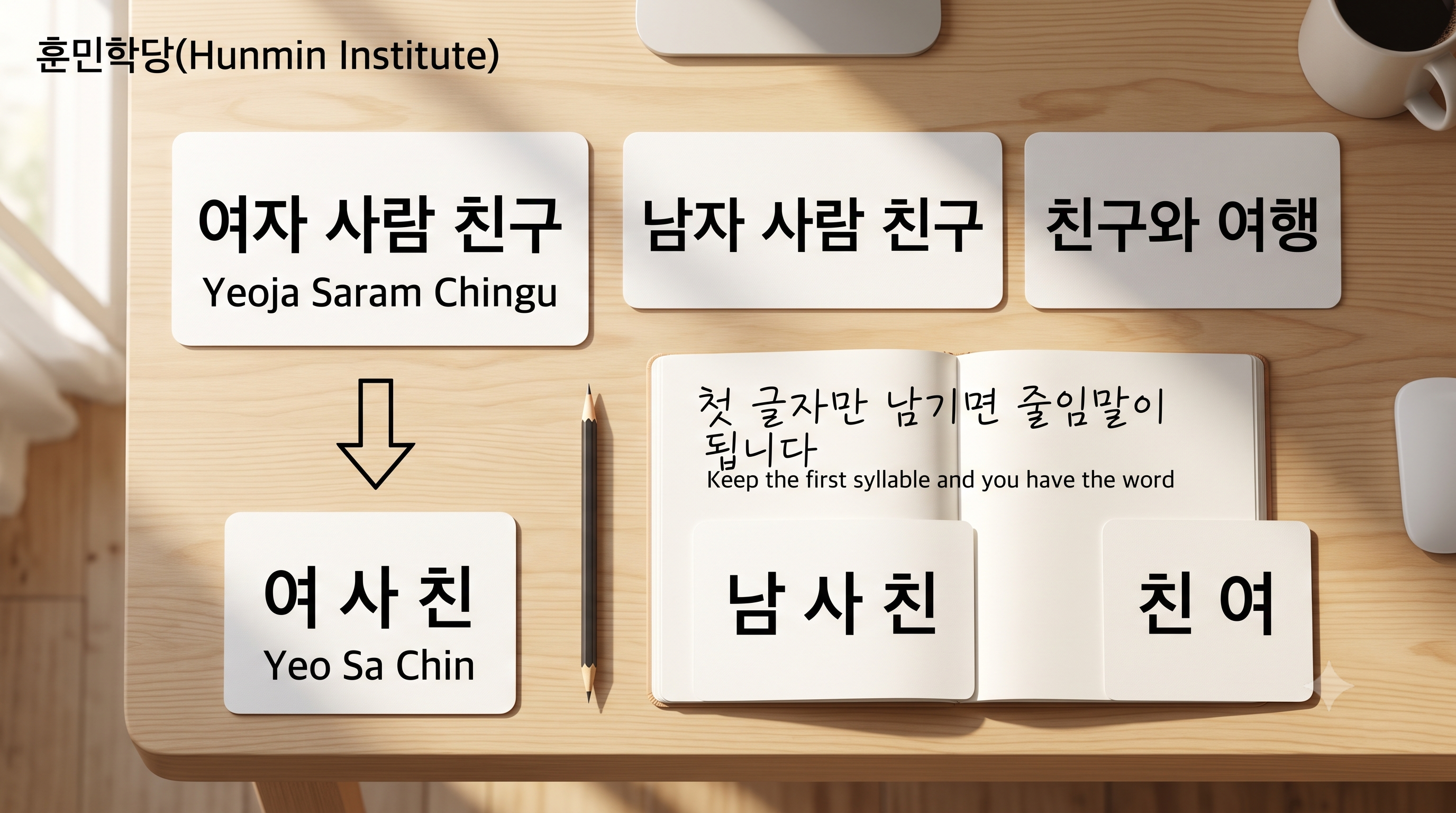
여사친과 여친은 설명으로 배우는 말이 아니라 대화에서 튀어나오는 말입니다. 뜻을 외우기 전에 관계를 묻고 답할 때 오가는 말부터 보십시오.
These words do not live in explanations; they come out in conversation. Before memorising definitions, look at the lines exchanged when a relationship is asked about.
| 듣는 말 Listening |
하는 말 Speaking |
|---|---|
| 너 여친 있어? [neo yeochin isseo] Do you have a girlfriend? |
걔 그냥 여사친이야. [gyae geunyang yeosachiniya] She is just a friend of mine. |
| 둘이 사귀어? [duri sagwieo] Are you two dating? |
우리 그냥 친구 사이야. [uri geunyang chingu saiya] We are just friends. |
| 썸 타는 거 아니야? [sseom taneun geo aniya] Are you not in a sseom? |
나 남친 없어. [na namchin eopseo] I do not have a boyfriend. |
| 소개팅할래? [sogaetinghallae] Want a blind date? |
우리 사귄 지 백일 됐어. [uri sagwin ji baegil dwaesseo] We have been dating a hundred days. |
응용 Apply It
↳ 그냥 [명사]야
geunyang [myeongsa]ya
We are just [noun]
ex 그냥 [친구]야/그냥 [아는 사이]야/그냥 [동기]야
ROM geunyang [chingu]ya/geunyang [aneun sai]ya/geunyang [donggi]ya
EN We are just friends/We just know each other/We are just in the same year
| 한국어 Korean |
무엇을 가리키는가 What it refers to |
|---|---|
| 여사친 [yeosachin] |
여자 사람 친구의 줄임말, 연인이 아닙니다 Short for 여자 사람 친구; not a partner |
| 여친 [yeochin] |
여자친구의 줄임말, 연인입니다 Short for 여자친구; a romantic partner |
| 사이 [sai] |
두 사람의 관계를 가리키는 말 The noun for the relation between two people |
| 썸 [sseom] |
사귀기 전 서로 호감이 오가는 단계 The stage of mutual interest before dating |
| 소개팅 [sogaeting] |
아는 사람이 자리를 만들어 주는 일대일 만남 A one-on-one meeting arranged by someone you know |
▶그냥은 관계를 축소해 못 박는 말이고, 사이는 두 사람의 관계를 가리키는 명사입니다.
그냥 pins a relationship down by shrinking it; 사이 is the noun for the relation between two people.
틀은 그냥 [명사]야입니다. 그냥 친구야, 그냥 아는 사이야처럼 뒤의 말만 바꾸면 되고 영어의 just와 자리가 같습니다. 사이는 친구 사이야, 아는 사이야, 어떻게 아는 사이예요가 모두 같은 틀입니다.
The pattern is 그냥 [noun]야, as in 그냥 친구야 or 그냥 아는 사이야, and it sits where English puts just. 사이 runs through 친구 사이야, 아는 사이야, and 어떻게 아는 사이예요 alike.
사귄 지 백일 됐어는 지 다음에 시간, 그다음에 되다를 붙이는 틀입니다. 온 지 한 달 됐어, 배운 지 일 년 됐어처럼 어디에나 씁니다. 여기의 지는 그때부터 지금까지 흐른 시간을 가리키는 말입니다.
The frame is 지 plus a length of time plus 되다: 온 지 한 달 됐어, 배운 지 일 년 됐어. This 지 marks time elapsed since.
걔는 그 아이의 준말이며 친구끼리만 씁니다. 어른 앞에서는 그 친구나 그분으로 바꾸십시오. 이 한 글자를 잘못 쓰면 내용이 옳아도 무례하게 들립니다.
걔 is a contraction of 그 아이 and belongs among friends. In front of an elder, use 그 친구 or 그분. Getting this one word wrong makes a correct sentence sound rude.
한국인은 왜 말을 줄이는가
Why Koreans Shorten Their Words
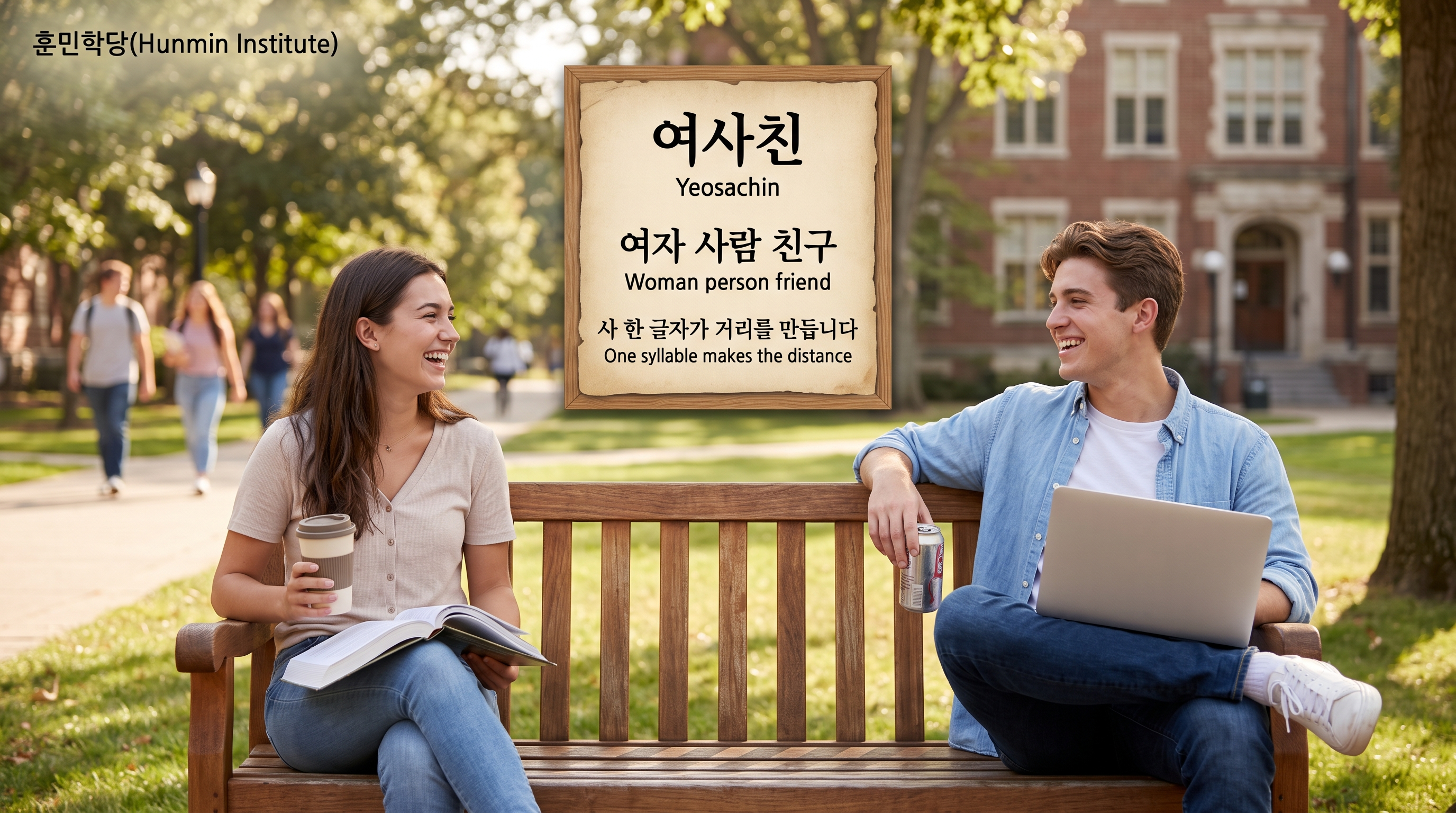
원리는 단순합니다. 각 단어의 첫 글자만 남기고 붙입니다. 여자 사람 친구에서 여, 사, 친을 떼면 여사친이 되고 여자친구에서 여와 친을 떼면 여친이 됩니다. 뜻을 모르는 줄임말을 만났을 때 오가는 말부터 보십시오.
The principle is simple: keep the first syllable of each word and join them. 여자 사람 친구 becomes 여사친, and 여자친구 becomes 여친. Start with the lines exchanged when you meet a contraction you do not know.
| 듣는 말 Listening |
하는 말 Speaking |
|---|---|
| 그거 줄임말이야. [geugeo jurimmariya] That is a contraction. |
그게 무슨 뜻이에요? [geuge museun tteusieyo] What does that mean? |
| 사전에는 없는 말이야. [sajeoneneun eomneun mariya] It is not in the dictionary. |
원래 말이 뭐예요? [wollae mari mwoyeyo] What is the full form? |
| 젊은 사람들만 써. [jeolmeun saramdeulman sseo] Only younger people use it. |
시험에도 나와요? [siheomedo nawayo] Does it come up on exams too? |
| 한국어 Korean |
무엇입니까 What it is |
|---|---|
| 줄임말 [jurimmal] |
긴 말을 짧게 줄인 말 A long expression cut short |
| 한자어 [hanjaeo] |
한자에서 온 말, 한 글자가 뜻을 지닙니다 Words from Chinese characters; each syllable carries meaning |
| 고유어 [goyueo] |
한자에서 오지 않은 우리말, 사람이 그 예입니다 Words not from Chinese, such as 사람 |
| 신조어 [sinjoeo] |
새로 만들어진 말, 여사친이 그 예입니다 A newly made word, such as 여사친 |
| 표준어 [pyojuneo] |
사전에 오른 공식 형태, 시험은 여기서 나옵니다 The official form in the dictionary; exams draw on it |
▶첫 글자만 남겨도 뜻이 살아남는 이유는 한자어에 있습니다.
Sino-Korean vocabulary is why one syllable can keep the meaning.
한국어 어휘의 상당 부분이 한자어이고 한자는 한 글자가 그 자체로 뜻을 지닙니다. 여자의 여는 여자를 뜻하는 한자이고 친구의 친은 가깝다는 뜻의 한자입니다. 가운데 사만 한자가 아니라 고유어 사람의 첫 글자입니다.
Much of Korean vocabulary is Sino-Korean, where each character carries meaning on its own. The 여 in 여자 is the character for woman and the 친 in 친구 the character for close. Only the 사 in the middle is not a character but the first syllable of the native word 사람.
줄임말이 늘어난 배경에는 문자 메시지가 있습니다. 메신저로 대화하는 시간이 길어지면서 짧게 쓰는 습관이 자리를 잡았고 지금은 말할 때도 그대로 씁니다. 다만 이 표현들은 국어사전에 실려 있지 않습니다. 젊은 세대가 자기들끼리 쓰기 시작한 말이 퍼진 것이고, 사전이 담지 못한 관계에 직접 이름을 붙인 셈입니다.
Text messaging lies behind their rise: as conversation moved to messenger apps, writing short took hold, and now people speak that way too. These words are not in the dictionary. They spread from how younger Koreans talk, naming relationships the dictionary had left unnamed.
사 한 글자가 만드는 거리
The Distance Made by One Syllable
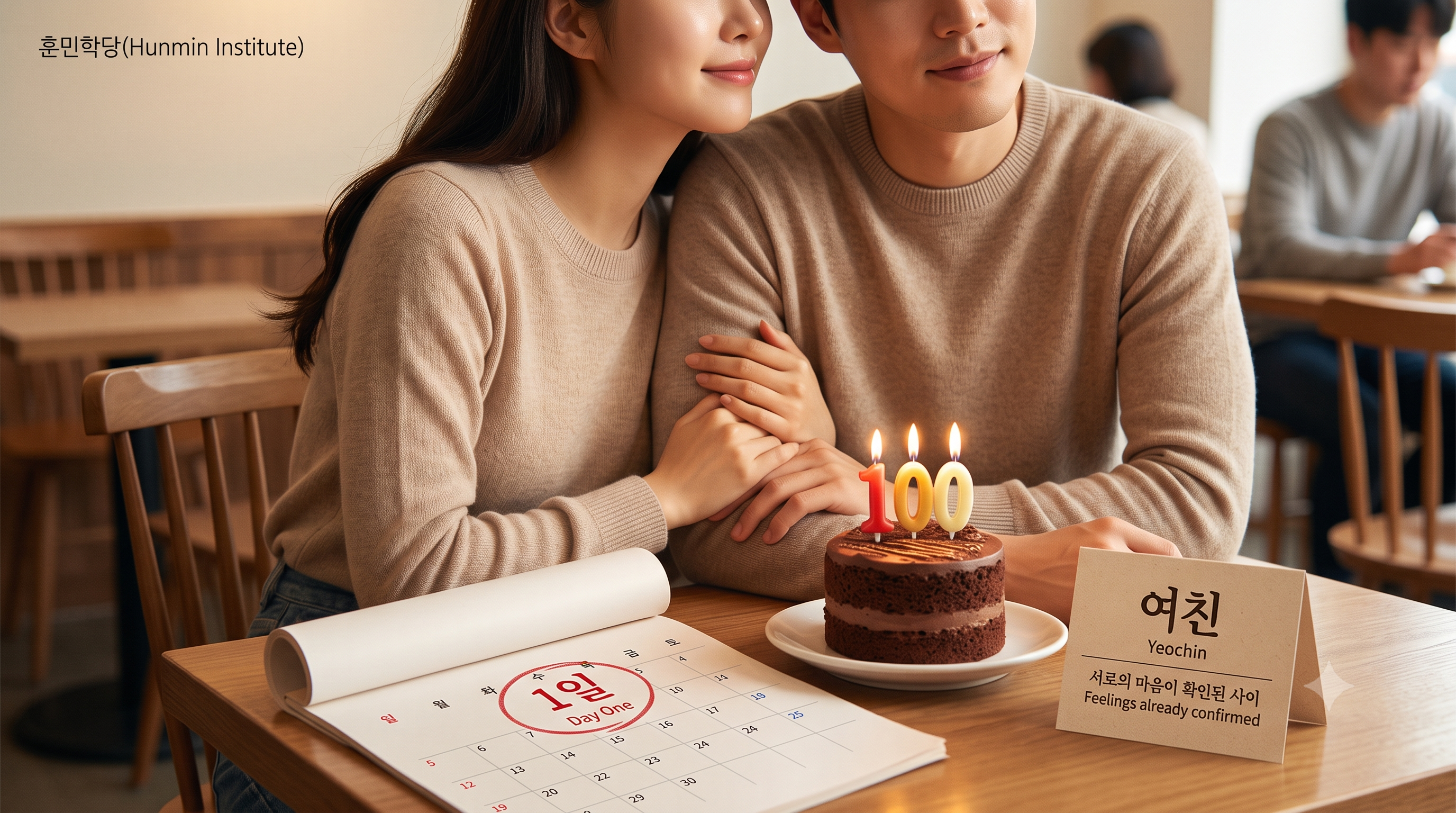
한 글자가 빠지고 들어가는 것만으로 관계의 성격이 통째로 갈립니다. 이 차이를 두고 실제로 오가는 말부터 보십시오.
One syllable going in or out changes the whole character of the relationship. Start with the lines that actually go back and forth about the difference.
| 듣는 말 Listening |
하는 말 Speaking |
|---|---|
| 여친이야, 여사친이야? [yeochiniya yeosachiniya] Is she a yeochin or a yeosachin? |
여사친이야, 그냥 친구. [yeosachiniya geunyang chingu] A yeosachin, just a friend. |
| 사귄 지 얼마나 됐어? [sagwin ji eolmana dwaesseo] How long have you two been dating? |
사귀는 사이 아니야. [sagwineun sai aniya] We are not dating. |
| 그럼 뭐야? [geureom mwoya] Then what are you? |
그냥 아는 사이야. [geunyang aneun saiya] We just know each other. |
| 구분 Category |
여사친 / 남사친 Yeosachin / Namsachin |
여친 / 남친 Yeochin / Namchin |
|---|---|---|
| 원래 말 Full form |
여자 사람 친구 / 남자 사람 친구 yeoja saram chingu / namja saram chingu |
여자친구 / 남자친구 yeoja chingu / namja chingu |
| 직역 Literal meaning |
여자인 사람인 친구 Woman person friend |
여자인 친구 Woman friend |
| 관계 Relationship |
친구 Friend |
연인 Romantic partner |
| 연애 감정 Romantic feelings |
없음 None |
있음, 서로 확인됨 Yes, mutually confirmed |
| 배타성 Exclusivity |
없음 None |
있음 Yes |
| 핵심 글자 Key syllable |
사가 들어감 Contains 사, meaning person |
사가 빠짐 No 사 |
| 격식 자리 Formal settings |
줄이지 않고 말하기 Use the full form |
줄이지 않고 말하기 Use the full form |
▶여자 사람 친구라고 하면 여자이고, 사람이고, 친구라는 세 정보만 남습니다.
여자 사람 친구 leaves exactly three pieces of information: woman, person, friend.
연인이라는 의미가 빠지는 것이고, 가운데 사 한 글자가 그 일을 합니다. 영어와 비교하면 이해가 빠릅니다. girlfriend는 연인을 뜻하지만 female friend는 그렇지 않습니다. 다만 영어의 female friend는 그저 여성인 친구를 뜻하고 그 이상의 규범이 따라오지 않지만, 한국의 여사친에는 태도가 함께 따라옵니다.
The meaning of lover drops out, and the single syllable 사 does that work. A comparison with English helps: girlfriend means a partner, female friend does not. In English no further norms attach, while the Korean 여사친 brings conduct with it.
연인이 아니라고 선을 그은 이상 그 선을 넘지 않는 것이 예의로 여겨지고, 상대에게 연인이 생기면 만남의 빈도를 줄이는 것도 자연스러운 일로 봅니다. 단어 하나가 관계의 규칙까지 담고 있는 셈입니다.
Once the line is drawn, not crossing it counts as good manners, and seeing less of each other when one starts dating is treated as natural. A single word carries the rules with it.
여친은 여자친구의 줄임말이고 연인 관계를 뜻합니다. 다른 점은 서로의 마음이 확인되었다는 것입니다. 한국에서는 이 확인 과정을 중요하게 여겨 사귀기로 한 날을 기억하고 그날을 기준으로 백일, 이백일을 셉니다.
여친 shortens 여자친구 and means a romantic partner. What separates it is that both hearts have been confirmed. Koreans treat that moment as important, remembering the day they agreed to date and counting a hundred days from it.
쓸 때 주의할 것
Cautions Before You Use Them
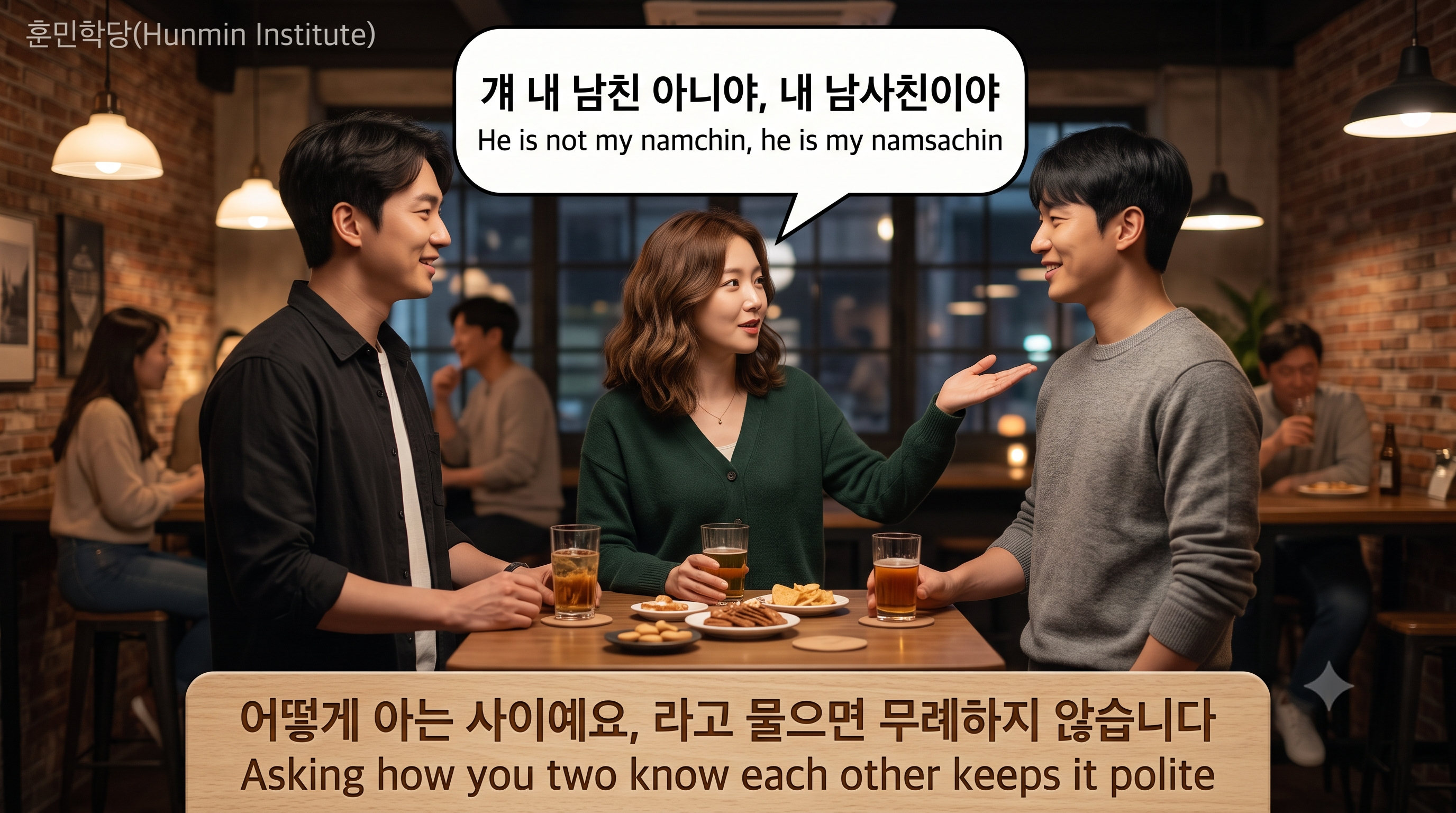
같은 뜻이라도 자리에 따라 골라 써야 합니다. 격식 자리에서 실제로 오가는 말부터 보십시오.
The same meaning needs different wording depending on where you are. Start with the lines exchanged in a formal setting.
| 듣는 말 Listening |
하는 말 Speaking |
|---|---|
| 여자친구분이세요? [yeojachingubuniseyo] Is she your girlfriend? |
아니요, 그냥 친구예요. [aniyo geunyang chinguyeyo] No, just a friend. |
| 그 친구는 어떻게 아세요? [geu chinguneun eotteoke aseyo] How do you know her? |
대학 때부터 알고 지냈어요. [daehak ttaebuteo algo jinaesseoyo] We have known each other since university. |
| 두 분 사이가 좋으시네요. [du bun saiga joeusineyo] You two get along well. |
어떻게 아는 사이예요? [eotteoke aneun saiyeyo] How do you two know each other? |
| 자리 Setting |
이렇게 씁니다 What to say |
피할 말 What to avoid |
|---|---|---|
| 또래 친구와 With peers |
여사친, 여친, 걔 여사친, 여친, 걔 |
지나치게 딱딱한 표현 Overly stiff wording |
| 직장 상사와 With a supervisor |
여자친구, 친구, 그 친구 여자친구, 친구, 그 친구 |
여친, 걔 여친, 걔 |
| 처음 만난 어른과 With an elder you just met |
여자친구, 그분 여자친구, 그분 |
줄임말 전부 All contractions |
| 메신저에서 In messages |
줄임말 자유롭게 Contractions are fine |
상대가 어른일 때는 제외 Except when writing to an elder |
| 관계를 물을 때 When asking about a relationship |
어떻게 아는 사이예요 어떻게 아는 사이예요 |
여친이에요 같은 단정 Labels such as 여친이에요 |
| 시험과 글쓰기 Exams and writing |
표준어 형태 Standard forms |
신조어와 은어 Coined words and slang |
▶상대의 관계를 먼저 단정하지 마십시오.
Do not define someone’s relationship for them.
한국에서는 상대가 스스로 소개하기 전에 관계를 규정하는 것을 실례로 봅니다. 함께 있는 두 사람을 보고 여친이냐고 묻기보다 어떻게 아는 사이예요라고 물으시면 무례하지 않게 대화를 이어 갈 수 있습니다. 이 문장은 관계를 열어 두고 묻는 틀이라 어느 자리에서나 안전합니다.
Labelling it before they introduce it is considered rude. Rather than asking whether she is a 여친, ask 어떻게 아는 사이예요 and the conversation stays polite. The question leaves the answer open, which makes it safe anywhere.
격식을 갖춘 자리에서는 줄이지 마십시오. 회사 상사나 처음 만난 어른에게는 여자친구, 남자친구처럼 줄이지 않은 형태가 안전합니다. 줄이지 않은 형태에서도 여자친구와 여자 사람 친구는 다르다는 점을 잊지 마십시오. 앞은 연인이고 뒤는 친구입니다.
Do not shorten in formal settings. With a boss or an older person you have just met, the unshortened 여자친구 and 남자친구 are safer. Even unshortened, remember that 여자친구 and 여자 사람 친구 differ: the first is a partner, the second a friend.
남녀가 정말 친구가 될 수 있는가 하는 질문은 한국에서도 오래된 논쟁이고 사람마다 답이 다릅니다. 그래서 이 단어는 단순한 호칭이 아니라 관계를 설명하고 방어하는 말로도 쓰입니다. 오늘 나온 문장 가운데 딱 세 개만 외우자면 걔 그냥 여사친이야, 우리 그냥 친구 사이야, 어떻게 아는 사이예요입니다.
Whether a man and a woman can really be just friends is a long-running debate in Korea, and answers differ. So the word is not only a label but a way to explain and defend a relationship. If you memorise only three of today’s lines, make them 걔 그냥 여사친이야, 우리 그냥 친구 사이야, and 어떻게 아는 사이예요.
Next: Mildang: The Push and Pull Before the Confession ↗
토픽 맛보기
TOPIK Preview
유형: TOPIK Ⅰ 읽기 [34~39], 대화, 빈칸에 알맞은 것 고르기
Type: TOPIK I Reading [34–39], dialogue, choose the correct word for the blank
( )에 들어갈 말로 가장 알맞은 것을 고르십시오.
Choose the most appropriate word for the blank.
한국에 온 지 일 년 ( ).
It has ( ) a year since I came to Korea.
① 됐어요
② 있어요
③ 했어요
④ 갔어요
Answer ▾
정답 ① 됐어요
Answer: ① 됐어요
지 다음에 기간이 오면 되다로 받는 것이 이 틀의 짝이므로 ①이 정답입니다. 온 지 일 년 됐어요, 사귄 지 백일 됐어요처럼 씁니다. ②는 존재를 나타내는 말이라 지문의 지 뒤에 붙지 않아 진술이 어긋나고, ③은 행위를 했다는 뜻만 맞아 일부만 걸리며, ④는 그럴듯해 보여도 이동을 가리켜 흐른 시간을 말하는 자리에 근거가 없습니다. 흉내 낸 대문항은 TOPIK Ⅰ 읽기 [34~39]이고 배점은 2점입니다.
When 지 is followed by a length of time, 되다 completes the frame, so ① is correct. It works as in 온 지 일 년 됐어요 or 사귄 지 백일 됐어요. ② states existence and cannot follow 지 here, ③ only carries the sense of having done something, and ④ refers to movement, which has no basis in a sentence about elapsed time. The item type modeled here is TOPIK I Reading [34–39], worth 2 points.
FAQ
Q1. 썸 타는 사이는 여친인가요, 여사친인가요?Answer ▾
Q1. Is someone you are in a sseom with a yeochin or a yeosachin?
A1. 둘 다 아닙니다. 사귀기로 한 적이 없으니 여친이 아니고, 서로 호감이 있으니 여사친이라고 부르기도 어색합니다. 이 단계에는 정해진 호칭이 없어서 아는 사람이나 그냥 아는 사이로 말하는 경우가 많습니다.
A1. Neither. There has been no agreement to date, so not a yeochin, and there is mutual interest, which makes yeosachin sound off. The stage has no fixed label, so people usually say 아는 사람 or 그냥 아는 사이.
Q2. 백일은 어느 날부터 세나요?Answer ▾
Q2. From which day is the hundredth day counted?
A2. 사귀기로 한 날을 1일로 잡고 셉니다. 그래서 만난 날이 아니라 서로 마음을 확인한 날이 기준이며, 그날을 기억하지 못하면 백일도 이백일도 세지 못합니다.
A2. The day you agreed to date counts as day one. The reference point is the day you confirmed each other’s feelings, not the day you met, so forgetting it means losing the count.
Q3. 남녀가 정말 친구가 될 수 있다고 한국인들은 생각하나요?Answer ▾
Q3. Do Koreans believe men and women can really be just friends?
A3. 의견이 갈립니다. 가능하다고 보는 사람도, 어렵다고 보는 사람도 많습니다. 이 논쟁 자체가 여사친이라는 단어가 만들어진 이유이기도 합니다.
A3. Opinions divide. Plenty say yes, plenty say it is difficult. That very debate is part of why the word exists.
Q4. 이런 줄임말이 한국어 시험에도 나오나요?Answer ▾
Q4. Do these abbreviations appear on Korean language tests?
A4. 토픽 같은 공인 시험에는 나오지 않습니다. 표준어가 아니기 때문입니다. 다만 드라마와 예능, 실제 대화에서는 계속 들리므로 시험용 어휘와 생활용 어휘를 나눠 익히시면 됩니다.
A4. They do not appear on official exams such as TOPIK, since they are not standard Korean. You will keep hearing them in dramas, variety shows, and real conversation, so learn exam vocabulary and everyday vocabulary as two separate sets.
Q5. 남자 쪽은 뭐라고 하나요?Answer ▾
Q5. What are the words for the male side?
A5. 같은 원리로 만들어집니다. 남자 사람 친구는 남사친, 남자친구는 남친입니다. 여를 남으로 바꾸기만 하면 되므로 한 쌍을 익히면 네 단어가 함께 풀립니다.
A5. They are built the same way: 남자 사람 친구 gives 남사친 and 남자친구 gives 남친. Swap 여 for 남 and learning one pair gives you all four.
Vocabulary and Pronunciation for Foreigners
| No | Korean | Romanisation | Meaning |
|---|---|---|---|
| 1 | 여사친 | yeosachin | (n) a female friend, not a partner [fiːmeɪl frend] |
| 2 | 여친 | yeochin | (n) girlfriend [ˈɡɜːrlfrend] |
| 3 | 사이 | sai | (n) the relation between two people [rɪˈleɪʃn] |
| 4 | 썸 | sseom | (n) the talking stage before dating [ˈtɔːkɪŋ steɪdʒ] |
| 5 | 그냥 | geunyang | (adv) just, simply [dʒʌst] |
| ▾ 단어 49 개 더 보기 Show 49 more ↗ | |||
The blog page has limits of space and function, so only five words are shown here. The rest of the word list, the audio, the sentences and tables, the FAQ, the worksheet, the TOPIK questions and the lesson video are on the Hunmin Institute website ↗, free for blog subscribers.
참고 기관
Official Sources
국립국어원 ↗
National Institute of Korean Language
https://www.korean.go.kr
기관 설명 보기 About this institute ▾
This is the body that sets standard Korean and its language norms. The contractions in this post are not standard and do not appear in the standard dictionary; their usage can be checked in Urimalsaem, the open dictionary run by the same institute. Learners can also use the Korean Basic Dictionary, which carries definitions in eleven languages and has an English interface. Norms are revised over time, so check the current source directly for forms you will use on an exam.
※ 본 콘텐츠(원고, 이미지, 예문 포함)는 저작권법에 의해 보호받는 훈민학당의 저작물입니다. 무단 복제, 전재, 재배포 및 AI 학습 데이터로의 이용을 금합니다.
This content (manuscript, images, and example sentences) is the copyrighted property of Hunmin Institute, protected under copyright law. Unauthorized copying, reproduction, redistribution, and use as AI training data are prohibited.
'K-Words' 카테고리의 다른 글
| Mildang: The Push and Pull Before the Confession (0) | 2026.07.25 |
|---|
