
The Rope Holds Only While the Tension Lasts
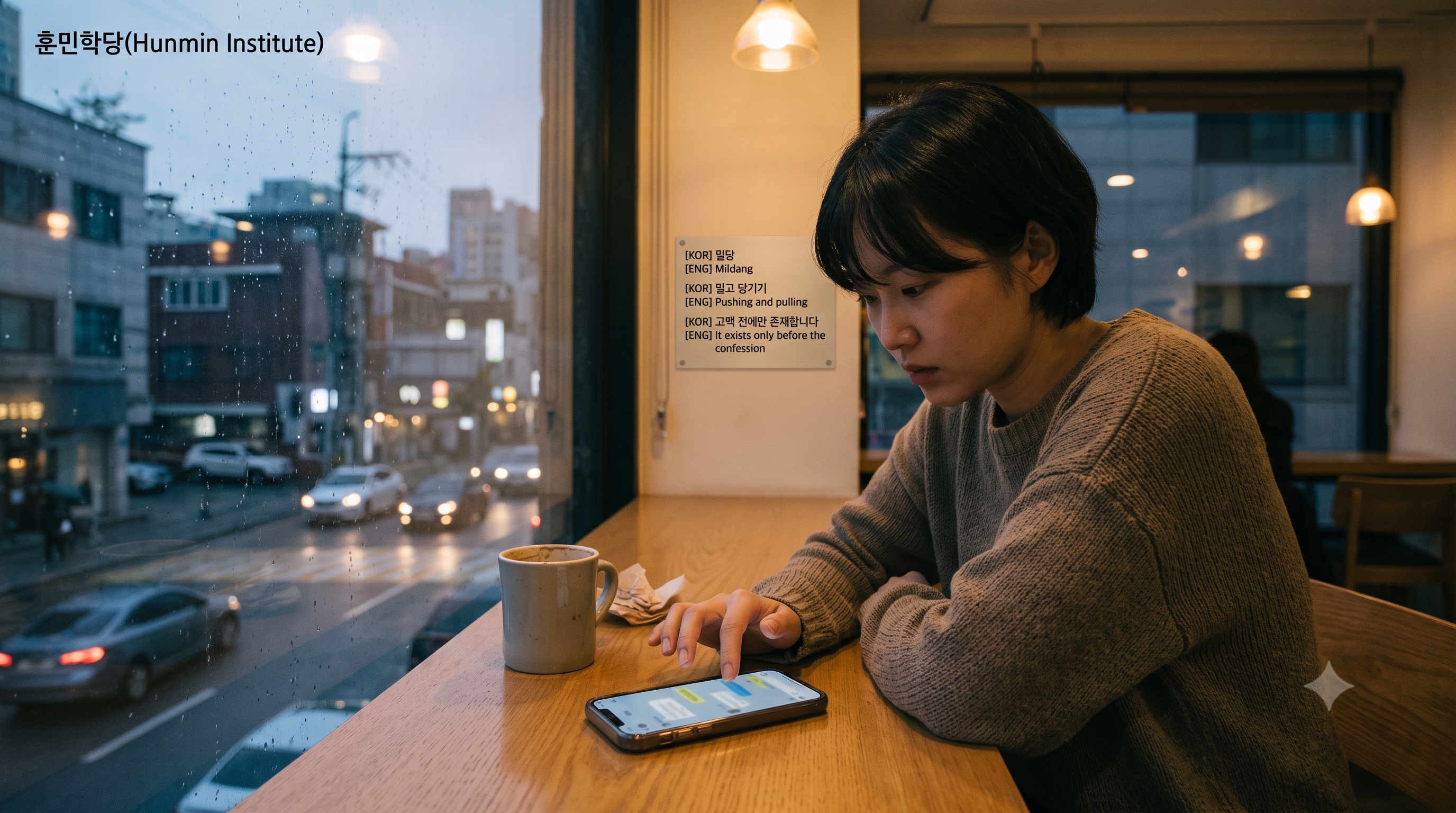
밀당, 고백 전에 벌어지는 밀고 당기기
Mildang is a Korean contraction of push and pull, spacing replies to set distance.
Learn why mildang works and the Korean used at each dating stage.
밀당은 밀고 당기기를 줄인 한국어 줄임말로, 답장 간격으로 거리를 조절하는 방식입니다.
이 글에서 밀당이 작동하는 이유와 연애 단계에서 쓰는 한국어를 익힙니다.
All learning services for the teaching materials published on this blog are free for blog subscribers on the Hunmin Institute website ↗.
이 글에서 배우는 핵심 회화
Key Expressions in This Lesson
고백 전후에 오가는 말은 몇 마디로 정해져 있습니다. 아래 여덟 문장은 좌우가 한 쌍의 대화가 아니라 각각 따로 익히는 문장입니다. 먼저 눈에 담고 본문으로 들어가십시오.
The lines exchanged around a confession come down to a few. The eight sentences below are not paired dialogue; each is learned on its own. Take them in first, then move into the text.
| 듣는 말 Listening |
하는 말 Speaking |
|---|---|
| 밥 한번 먹자. [bap hanbeon meokja] Let us grab a meal sometime. |
우리 사귀자. [uri sagwija] Let us date. |
| 왜 이렇게 답장이 늦어? [wae ireoke dapjangi neujeo] Why are your replies so slow? |
읽고 답 안 했지? [ilgo dap an haetji] You read it and did not reply, right? |
| 나도 좋아해. [nado joahae] I like you too. |
나랑 만나 볼래? [narang manna bollae] Would you go out with me? |
| 밀당 너무 심하면 정떨어져. [mildang neomu simhamyeon jeongtteoreojyeo] Overdo the push and pull and the feeling dies. |
너 어장관리 하는 거야? [neo eojanggwalli haneun geoya] Are you keeping me on a string? |
첫째 줄은 소단락 1에서, 둘째 줄은 소단락 2에서, 셋째 줄은 소단락 3에서, 넷째 줄은 소단락 4에서 다룹니다.
The first row is covered in Section 1, the second in Section 2, the third in Section 3, and the fourth in Section 4.
연애 단계에서 오가는 한국어
The Korean Exchanged at Each Dating Stage
밀당은 설명보다 문장으로 익히는 편이 빠릅니다. 무엇을 밀고 무엇을 당기는지가 오가는 말 안에 다 들어 있으니, 고백 앞뒤에서 실제로 오가는 말부터 보십시오.
Mildang is learned faster through sentences than through explanation, because what is being pushed and pulled is already inside the lines people exchange. Start with what actually passes around a confession.
| 듣는 말 Listening |
하는 말 Speaking |
|---|---|
| 밥 한번 먹자. [bap hanbeon meokja] Let us grab a meal sometime. |
우리 사귀자. [uri sagwija] Let us date. |
| 오늘 뭐 해? [oneul mwo hae] What are you doing today? |
너 좋아해. [neo joahae] I like you. |
| 좀 생각해 볼게. [jom saenggakae bolge] Let me think about it. |
우리 무슨 사이야? [uri museun saiya] What are we to each other? |
응용 Apply It
↳ 우리 [동사]자
uri [dongsa]ja
Let us [verb]
ex 우리 [사귀]자/우리 [만나]자/우리 [밥 먹]자
ROM uri [sagwi]ja/uri [manna]ja/uri [bap meok]ja
EN Let us date/Let us meet/Let us eat together
| 한국어 Korean |
무엇을 가리키는가 What it refers to |
|---|---|
| 고백 [gobaek] |
마음을 말로 밝히는 일, 관계의 전환점 Saying your feelings out loud; the turning point of a relationship |
| 사귀다 [sagwida] |
연인 관계를 맺고 이어 가는 일 To be in and continue a romantic relationship |
| 반말 [banmal] |
친한 사이에서 쓰는 말투 Casual speech used among close friends |
| 존댓말 [jondaenmal] |
높여 말하는 말투, 어른과 처음 만난 사이에 씁니다 Polite speech, used with elders and people you have just met |
| 한번 [hanbeon] |
횟수가 아니라 언젠가라는 뜻으로 붙는 말 Not a count but a word meaning sometime |
▶자는 함께 하자고 권하는 말끝이고, 볼래는 의향을 묻는 부드러운 틀입니다.
자 proposes doing something together; 볼래 softly asks about willingness.
우리 사귀자는 곧바로 관계를 정하자는 말이고, 나랑 만나 볼래는 상대에게 답을 고를 여지를 남깁니다. 부담이 적어 고백에 더 자주 쓰이는 쪽은 뒤엣것입니다.
우리 사귀자 asks to settle the relationship on the spot, while 나랑 만나 볼래 leaves the other person room to choose. The second carries less pressure, which is why confessions reach for it more often.
두 말투 모두 반말이라 친한 사이에서만 씁니다. 어른이나 처음 만난 사람에게 쓰면 무례하게 들리므로 존댓말로는 만나 보실래요처럼 바꿔야 합니다.
Both are casual speech and belong among close friends. Used with an elder or a stranger they sound rude, so the polite form becomes 만나 보실래요.
밀당이란 무엇이고 왜 하는가
What Mildang Is and Why People Do It

밀당은 밀고 당기기를 줄인 말입니다. 줄이 팽팽해야 끊어지지 않는다는 발상이 이 단어에 들어 있으며, 답장 속도를 두고 오가는 말이 그 현장입니다.
Mildang is short for 밀고 당기기, pushing and pulling. The idea inside the word is that a rope holds only while the tension lasts, and the lines about reply speed are where it happens.
| 듣는 말 Listening |
하는 말 Speaking |
|---|---|
| 왜 이렇게 답장이 늦어? [wae ireoke dapjangi neujeo] Why are your replies so slow? |
읽고 답 안 했지? [ilgo dap an haetji] You read it and did not reply, right? |
| 바빠서 못 봤어. [bappaseo mot bwasseo] I was busy and missed it. |
일부러 그러는 거야? [ilbureo geureoneun geoya] Are you doing this on purpose? |
| 나 원래 답장 느려. [na wollae dapjang neuryeo] I am always slow to reply. |
읽씹은 하지 마. [ikssibeun haji ma] Do not read it and leave me hanging. |
| 한국어 Korean |
무엇입니까 What it is |
|---|---|
| 밀당 [mildang] |
밀고 당기기의 줄임말, 마음을 재는 과정 Short for pushing and pulling; the process of gauging feelings |
| 답장 [dapjang] |
받은 말에 돌려주는 말, 속도가 마음으로 읽힙니다 A message sent back; its speed reads as feeling |
| 읽씹 [ikssip] |
읽고도 답하지 않는 것, 읽다와 씹다를 붙인 말 Reading without replying, from 읽다 and 씹다 |
| 자존심 [jajonsim] |
지키고 싶은 마음, 밀당의 진짜 동력 The self-regard people protect; the engine of mildang |
| 무심하다 [musimhada] |
관심 없는 태도, 밀당에서는 연기인 경우가 많습니다 Showing no interest; in mildang often performed |
▶읽씹은 두 동사의 앞 글자를 잘라 붙인 말입니다.
읽씹 is built by cutting the first syllable from two verbs.
읽다의 읽과 씹다의 씹을 붙였습니다. 한국어에는 이렇게 앞 글자만 모아 새 말을 만드는 방식이 흔해서 밀당과 썸도 같은 원리로 생겼습니다. 뜻을 모르는 줄임말을 만나면 원래 단어 두 개를 찾아보시면 대개 풀립니다.
It joins 읽 from 읽다, to read, with 씹 from 씹다, to ignore. Korean often builds new words this way, and 밀당 and 썸 came about by the same route. When a contraction is unfamiliar, look for the two original words.
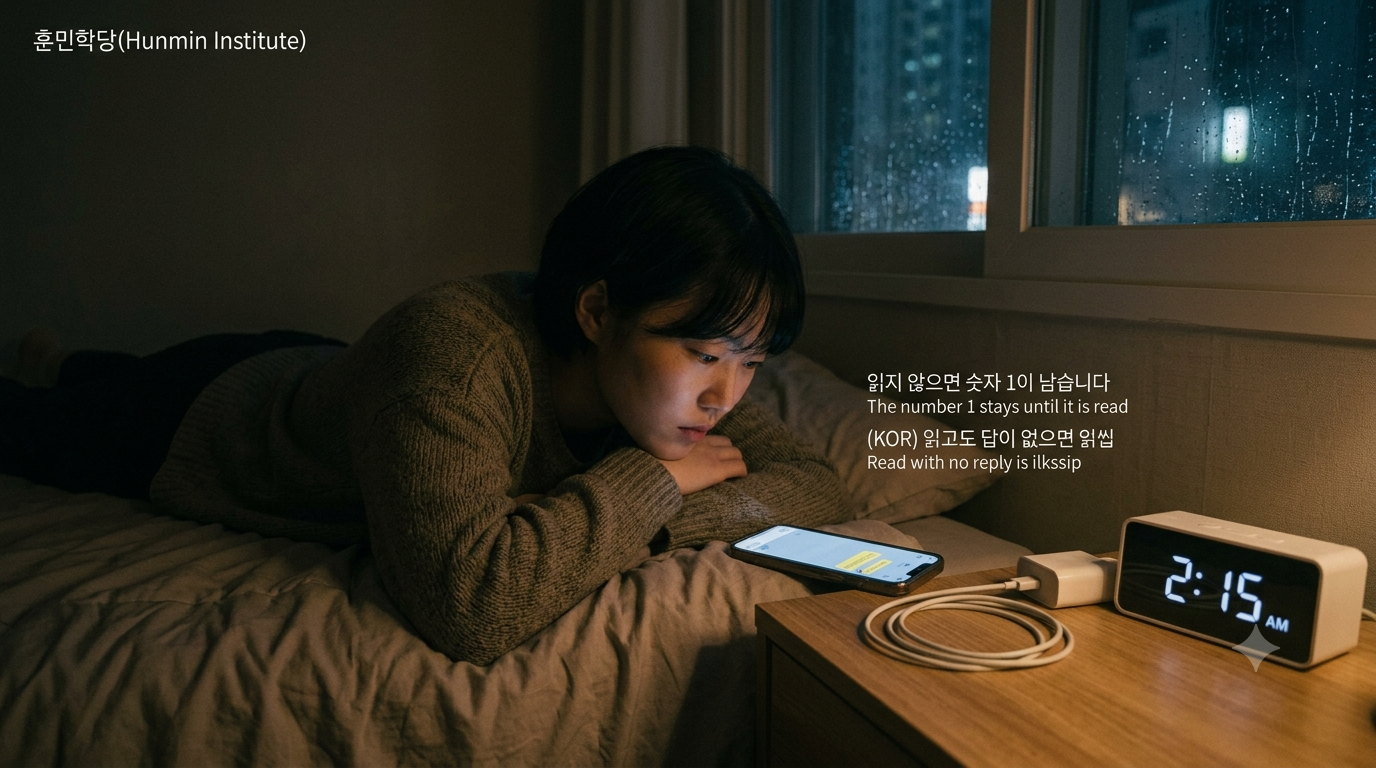
이 신호가 한국에서 특히 잘 읽히는 이유가 있습니다. 메신저에서는 상대가 메시지를 읽지 않으면 숫자 1이 남아 있고 읽으면 사라집니다. 그래서 읽었는지, 읽고도 답을 안 하는지가 전부 드러납니다. 답장 속도가 곧 마음의 크기로 읽히는 문화가 여기서 나옵니다.
These signals read clearly in Korea for a reason. In a messenger app a number 1 sits beside an unread message and vanishes once it is opened, so whether it was read, and read and ignored, is all visible. This is where reply speed came to stand for feeling.
밀당의 정체는 자존심을 지키려는 마음입니다. 먼저 마음을 내보이는 쪽이 약자가 된다고 느끼기 때문에 자기 패를 늦게 여는 것이며, 동시에 상대의 진심을 재는 시험지이기도 합니다.
At its core mildang protects pride. Showing your feelings first can feel like taking the weaker position, so people hold their cards back, and it doubles as a test of how much the other person means it.
한국 연애의 단계, 고백이 기준점입니다
The Stages, with the Confession as the Line
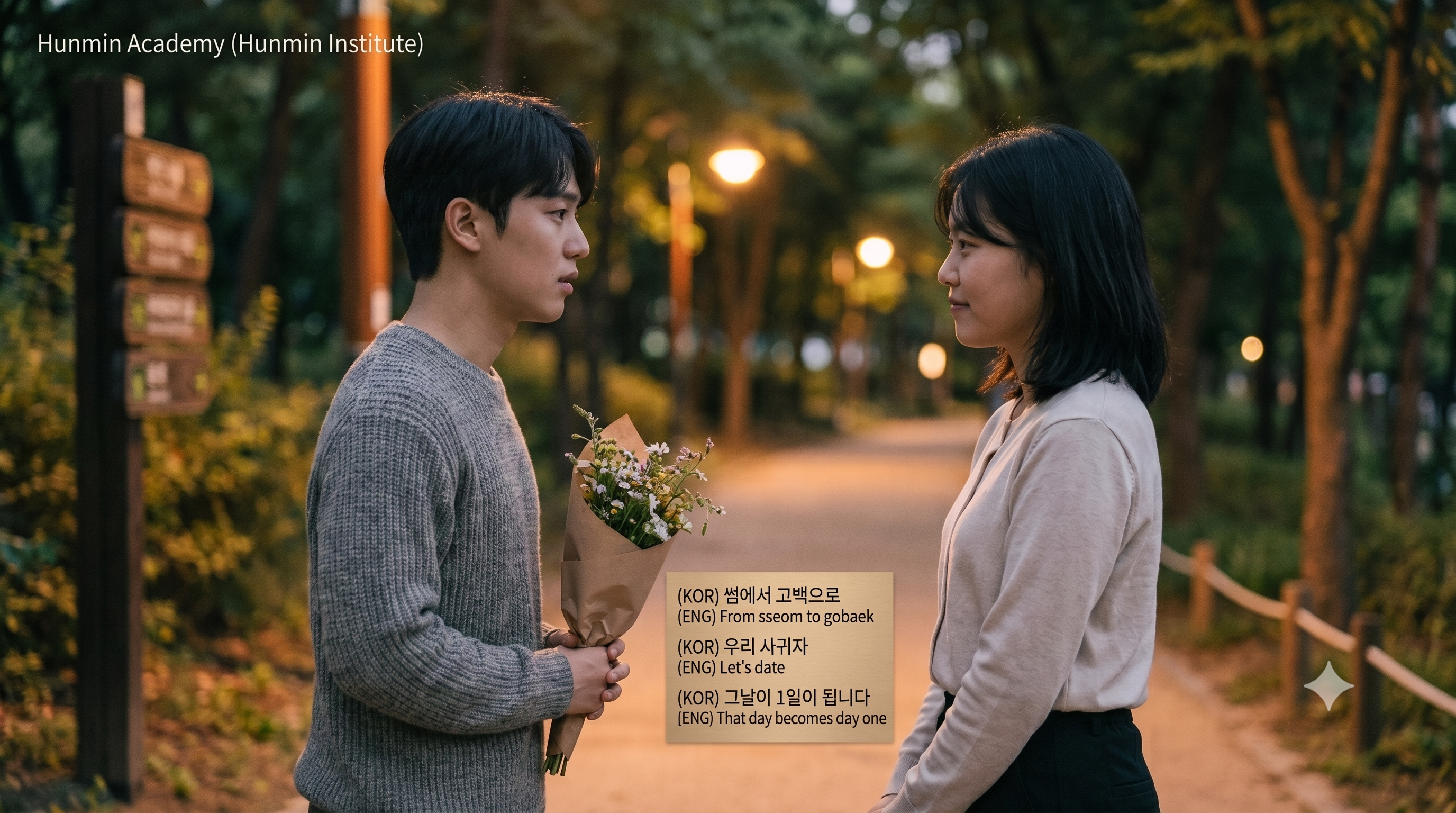
한국 연애에는 이름이 붙은 단계가 있습니다. 어느 단계에 있는지에 따라 쓰는 말이 갈리므로, 고백하는 자리에서 오가는 말부터 보십시오.
Korean relationships come with named stages, and which stage you are in decides which words you use. Start with the lines exchanged at the confession itself.
| 듣는 말 Listening |
하는 말 Speaking |
|---|---|
| 나도 좋아해. [nado joahae] I like you too. |
나랑 만나 볼래? [narang manna bollae] Would you go out with me? |
| 우리 오늘부터 1일이야. [uri oneulbuteo iririya] Today is day one for us. |
우리 사귀자. [uri sagwija] Let us date. |
| 생각할 시간 좀 줘. [saenggakal sigan jom jwo] Give me some time to think. |
기다릴게. [gidarilge] I will wait. |
| 단계 Stage |
무엇인가 What it is |
상태 Status |
핵심 Key point |
|---|---|---|---|
| 썸 Sseom |
서로 관심이 있는 상태 Mutual interest |
연인 아님 Not a couple |
영어 something에서 온 말 From the English word something |
| 밀당 Mildang |
마음을 재는 밀고 당기기 Pushing and pulling to gauge feelings |
연인 아님 Not a couple |
고백 전에만 존재 Exists only before the confession |
| 고백 Gobaek |
말로 하는 선언 A spoken declaration |
전환점 Turning point |
우리 사귀자라는 한마디 The line: let us date |
| 사귐 Sagwim |
공식 연인 관계 An official relationship |
연인 A couple |
그날이 1일, 백일을 센다 That day is day one; a hundred days are counted |
| 어장관리 Eojang-gwalli |
여러 사람을 곁에 두는 태도 Keeping several people around |
단계 아님 Not a stage |
밀당과 달리 부정적 Unlike mildang, purely negative |
▶한국에서는 누군가 말로 선언해야 관계가 공식이 됩니다.
In Korea someone has to say it out loud for a relationship to be official.
썸에서 시작해 밀당을 거쳐 고백에 이르고, 고백이 받아들여지면 사귐이 됩니다. 데이트를 이어 가다 자연스럽게 연인이 되는 방식과는 다릅니다. 우리 사귀자라는 한마디가 그 선언이고, 그 말이 받아들여진 날이 1일이 됩니다.
It begins with sseom, moves through mildang, arrives at the confession, and becomes a relationship once accepted. That differs from drifting into a couple over a run of dates. 우리 사귀자 is the declaration, and the day it is accepted becomes day one.
밀당이 존재하는 이유가 여기서 분명해집니다. 고백은 위험을 감수하는 일이고 거절당하면 관계가 끝날 수도 있습니다. 그래서 그 말을 꺼내기 전에 상대의 마음을 확인하려는 것이며, 고백이 받아들여지는 순간 밀고 당길 이유가 사라집니다.
This makes the reason for mildang clear. A confession is a risk, and rejection can end everything, so people gauge the other person before speaking. The moment it is accepted, there is nothing left to push or pull.
밀당과 어장관리는 다릅니다
Mildang Is Not Eojang-gwalli
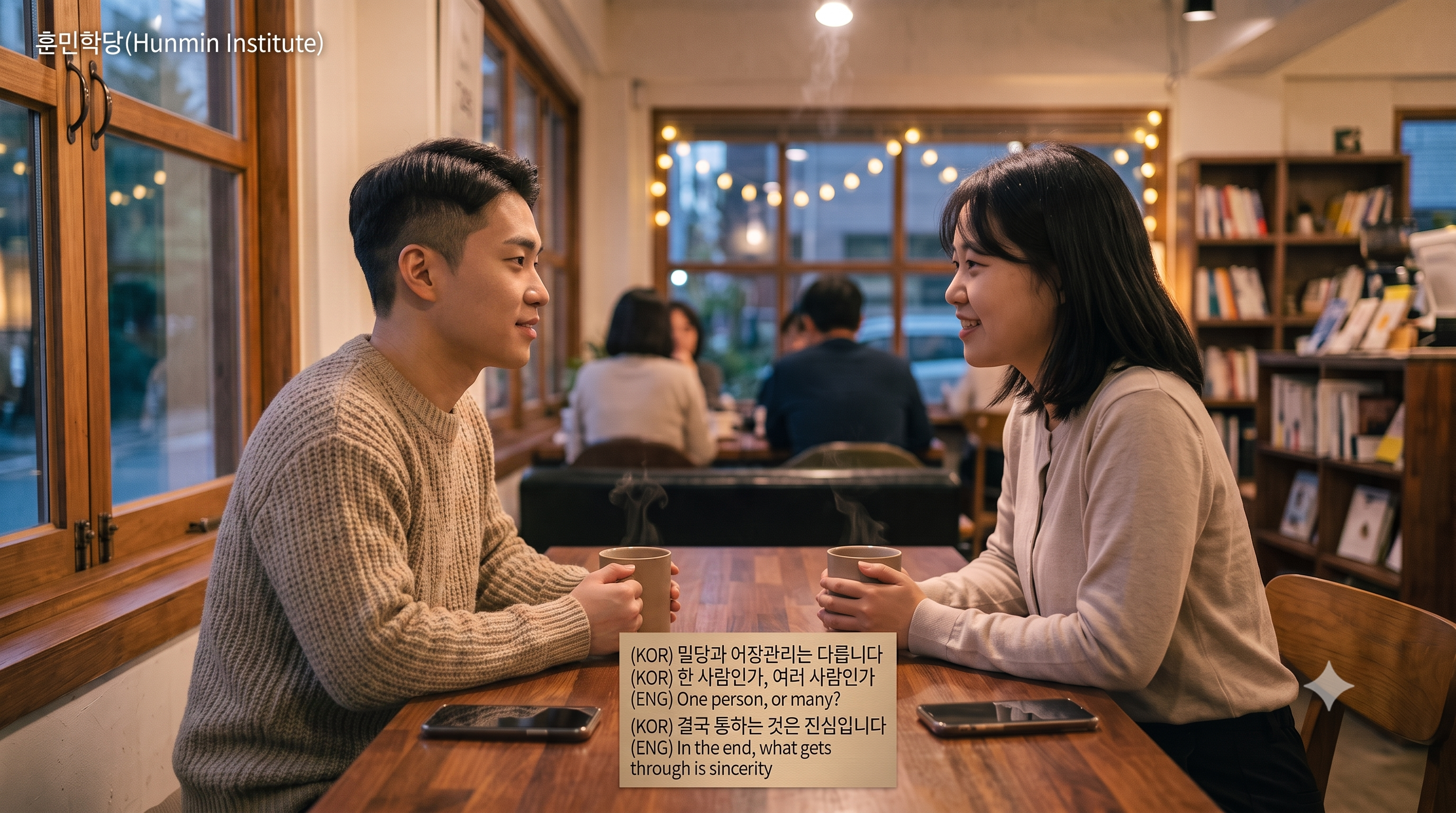
한국인이 분명하게 구분하는 두 단어가 있습니다. 밀당과 어장관리이며, 이 구분이 말로 튀어나오는 자리부터 보십시오.
Koreans draw a clear line between two words, 밀당 and 어장관리. Start with the place where the distinction surfaces in speech.
| 듣는 말 Listening |
하는 말 Speaking |
|---|---|
| 너 어장관리 하는 거야? [neo eojanggwalli haneun geoya] Are you keeping me on a string? |
나 진심이야. [na jinsimiya] I mean it. |
| 밀당 너무 심하면 정떨어져. [mildang neomu simhamyeon jeongtteoreojyeo] Overdo the push and pull and the feeling dies. |
나 너밖에 없어. [na neobakke eopseo] There is no one but you. |
| 우리 그만하자. [uri geumanhaja] Let us stop this. |
한 번만 믿어 줘. [han beonman mideo jwo] Trust me just once. |
| 구분 Category |
밀당 Mildang |
어장관리 Eojang-gwalli |
|---|---|---|
| 대상 Target |
한 사람 One person |
여러 사람 Several people |
| 목적 Purpose |
관계를 진전시키기 위해 To move one relationship forward |
관심만 붙잡아 두기 위해 To hold attention in place |
| 사귈 마음 Intent to date |
있음 Present |
없음 Absent |
| 언제까지 Duration |
고백 전까지 Until the confession |
끝이 정해져 있지 않음 No set end |
| 사회적 평가 How it is judged |
눈감아 주기도 함 Sometimes let pass |
부정적으로 봄 Seen negatively |
| 영어 대응 English equivalent |
playing hard to get playing hard to get |
breadcrumbing breadcrumbing |
▶둘의 차이는 대상과 목적에 있습니다.
The difference lies in target and purpose.
밀당은 한 사람과의 관계를 진전시키기 위한 과정이고, 어장관리는 여러 사람을 붙잡아 두기 위한 태도입니다. 한국에서 밀당은 눈감아 주기도 하지만 어장관리는 그렇지 않습니다. 어장관리라는 말을 들었다면 그것은 비난입니다.
Mildang moves one relationship forward; eojang-gwalli holds several people in place. Koreans may let mildang pass, but not eojang-gwalli. If the word is used about someone, it is an accusation.
밀당도 지나치면 문제가 됩니다. 밀당 너무 심하면 정떨어져라는 말이 그래서 생겼습니다.
Even mildang goes wrong when overdone, which is why the phrase 밀당 너무 심하면 정떨어져 exists at all.
밀당은 한국어를 배우는 사람에게 낯선 개념이 아니라 낯선 순서입니다. 고백이라는 선이 있고 그 선 앞에서만 밀고 당기며, 선을 넘는 순간 세는 것은 날짜뿐입니다. 오늘 나온 문장 가운데 딱 세 개만 외우자면 너 좋아해, 우리 사귀자, 우리 무슨 사이야입니다.
For a learner, mildang is not a strange idea so much as a strange order. There is a line called the confession, the pushing and pulling happens only in front of it, and once the line is crossed the only thing left to count is days. If you memorise only three of today’s lines, make them 너 좋아해, 우리 사귀자, and 우리 무슨 사이야.
The K-Words curriculum ends here. From yeosachin and yeochin through mildang you have finished both posts, and along the way you picked up how words the dictionary never took in are built and what relationships they carry. Now, meeting an unfamiliar contraction in a drama, you can find the two original words and work it out yourself. Congratulations on finishing.
토픽 맛보기
TOPIK Preview
유형: TOPIK Ⅰ 읽기 [34~39], 대화, 빈칸에 알맞은 것 고르기
Type: TOPIK I Reading [34–39], dialogue, choose the correct word for the blank
( )에 들어갈 말로 가장 알맞은 것을 고르십시오.
Choose the most appropriate word for the blank.
가: 나랑 만나 볼래? 나: 미안해. ( ).
A: Would you go out with me? B: I am sorry. ( ).
① 좀 생각해 볼게
② 오늘부터 1일이야
③ 우리 무슨 사이야
④ 오늘 뭐 해
Answer ▾
정답 ① 좀 생각해 볼게
Answer: ① 좀 생각해 볼게
미안해가 앞에 왔으므로 거절 쪽의 말이 이어져 ①이 정답입니다. ②는 지문과 같은 연애 장면의 말이지만 사귀기로 한 뒤에 하는 말이라 시점이 정반대이고, ③은 관계를 묻는 말이라 답의 일부만 걸치며, ④는 그럴듯해 보여도 안부를 묻는 말이라 고백에 대한 대답이 되지 않습니다. 흉내 낸 대문항은 TOPIK Ⅰ 읽기 [34~39]이고 배점은 2점입니다.
미안해 sets up a refusal, so the reply leans that way and ① is correct. ② comes from the same dating scene but belongs after a couple has formed, which reverses the timing; ③ asks about the relationship rather than answering; ④ sounds plausible but is small talk, not a reply to a confession. The item type modeled here is TOPIK I Reading [34–39], worth 2 points.
FAQ
Q1. 상대가 답장을 늦게 하면 밀당인가요?Answer ▾
Q1. If someone replies late, is that mildang?
A1. 꼭 그렇지는 않습니다. 일과 학업으로 바쁜 경우가 많고 단순히 휴대전화를 늦게 확인했을 수도 있습니다. 한 번의 지연이 아니라 반복되는 패턴으로 판단하시는 편이 정확합니다.
A1. Not necessarily. People are often busy with work or study and may simply have checked their phone late. Judge by a repeated pattern rather than a single delay.
Q2. 밀당에는 어떻게 대응해야 하나요?Answer ▾
Q2. How should I respond to mildang?
A2. 같이 밀당으로 맞서면 관계가 길어지기만 합니다. 상대의 속도를 존중하되 자기 마음은 분명히 전하시는 편이 낫습니다. 밀당을 싫어하는 사람도 많고 솔직한 태도를 신뢰로 받아들이는 경우가 많습니다.
A2. Answering mildang with mildang only drags things out. Respect their pace but state your own feelings clearly. Plenty of people dislike mildang and read directness as trustworthiness.
Q3. 고백은 보통 누가 먼저 하나요?Answer ▾
Q3. Who usually confesses first?
A3. 정해진 규칙은 없습니다. 남성이 먼저 하는 경우가 여전히 많다고들 하지만 요즘은 여성이 먼저 말하는 경우도 흔합니다. 외국인 학습자라면 순서보다 표현을 정확히 익히는 편이 도움이 됩니다.
A3. There is no rule. Men are still said to go first more often, though women confessing first is common now. For a learner, getting the wording right matters more than who goes first.
Q4. 고백을 거절당했는데 계속 연락해도 되나요?Answer ▾
Q4. Can I keep in touch after being turned down?
A4. 상대가 먼저 연락해 오지 않는다면 간격을 두시는 편이 낫습니다. 거절 뒤에도 같은 빈도로 연락하면 부담으로 받아들여지고, 한국에서는 그런 행동을 집착으로 보는 시선이 있습니다.
A4. Unless they reach out first, it is better to leave space. Keeping the same frequency after a refusal reads as pressure, and in Korea that behaviour is seen as clinging.
Q5. 사귀기로 하면 서로를 뭐라고 부르나요?Answer ▾
Q5. What do couples call each other once they start dating?
A5. 이름이나 애칭을 그대로 쓰는 경우가 가장 많고, 오빠나 언니처럼 부르던 호칭을 유지하기도 합니다. 여친과 남친은 남에게 소개할 때 쓰는 말이지 상대를 부르는 말이 아닙니다.
A5. Most keep using a name or a pet name, and some keep whatever they used before, such as 오빠 or 언니. 여친 and 남친 are for introducing someone to others, not for addressing them.
Vocabulary and Pronunciation for Foreigners
| No | Korean | Romanisation | Meaning |
|---|---|---|---|
| 1 | 밀당 | mildang | (n) the push and pull of early dating [pʊʃ ənd pʊl] |
| 2 | 고백 | gobaek | (n) a spoken confession of feelings [kənˈfeʃn] |
| 3 | 답장 | dapjang | (n) a reply to a message [rɪˈplaɪ] |
| 4 | 읽씹 | ikssip | (n) reading a message and not replying [rɛd ənd ɪɡˈnɔːrd] |
| 5 | 어장관리 | eojanggwalli | (n) keeping several people on a string [ˈbredkrʌmɪŋ] |
| ▾ 단어 49 개 더 보기 Show 49 more ↗ | |||
The blog page has limits of space and function, so only five words are shown here. The rest of the word list, the audio, the sentences and tables, the FAQ, the worksheet, the TOPIK questions and the lesson video are on the Hunmin Institute website ↗, free for blog subscribers.
참고 기관
Official Sources
국립국어원 ↗
National Institute of Korean Language
https://www.korean.go.kr
기관 설명 보기 About this institute ▾
This is the body that sets standard Korean and its language norms. 밀당, 썸 and 읽씹 are not standard and do not appear in the standard dictionary; their usage can be checked in Urimalsaem, the open dictionary run by the same institute. Learners can also use the Korean Basic Dictionary, with definitions in eleven languages including English and an English interface. Norms are revised over time, so check the current source directly for forms you will use on an exam.
※ 본 콘텐츠(원고, 이미지, 예문 포함)는 저작권법에 의해 보호받는 훈민학당의 저작물입니다. 무단 복제, 전재, 재배포 및 AI 학습 데이터로의 이용을 금합니다.
This content (manuscript, images, and example sentences) is the copyrighted property of Hunmin Institute, protected under copyright law. Unauthorized copying, reproduction, redistribution, and use as AI training data are prohibited.
'K-Words' 카테고리의 다른 글
| Yeosachin vs Yeochin: One Syllable Changes Everything (0) | 2026.07.25 |
|---|
