Three Things Trip You Before the Principles Do
한국어는 규칙보다 뜻을 먼저 잡아야 합니다
Korean is not a language you memorize; it runs on principles.
Learn what to study first and in what order.
한국어는 외울 언어가 아니라 원리로 된 언어입니다.
이 글에서 무엇부터 공부해야 하는지 그 순서를 익힙니다.
The learning services for the teaching materials published on this blog are free and open to everyone on the Hunmin Institute website ↗, with no account needed.
이 글에서 배우는 핵심 문장
Key Sentences in This Lesson
한국어를 배우는 동안 가장 자주 듣게 되는 문장과 가장 자주 쓰게 되는 문장입니다. 좌우는 한 쌍의 대화가 아니라 각각 따로 익히는 문장입니다. 먼저 눈에 담고 본문으로 들어가십시오.
These are the sentences you hear most often while learning Korean and the ones you use most often. The two columns are not paired dialogue; each is learned on its own. Take them in first, then move into the text.
| 듣는 문장 Listening |
쓰는 문장 Writing |
|---|---|
| 그건 한국어에는 없어요. [geugeon hangugeoeneun eopseoyo] Korean does not have that. |
이건 한국어에만 있는 거예요? [igeon hangugeoeman inneun geoyeyo] Is this something only Korean has? |
| 무슨 뜻인지 알겠어요? [museun tteusinji algesseoyo] Do you see what it means? |
이게 무슨 뜻이에요? [ige museun tteusieyo] What does this mean? |
| 말 편하게 하세요. [mal pyeonhage haseyo] You can speak casually with me. |
아니에요, 저는 이게 편해요. [anieyo jeoneun ige pyeonhaeyo] No, I am more comfortable this way. |
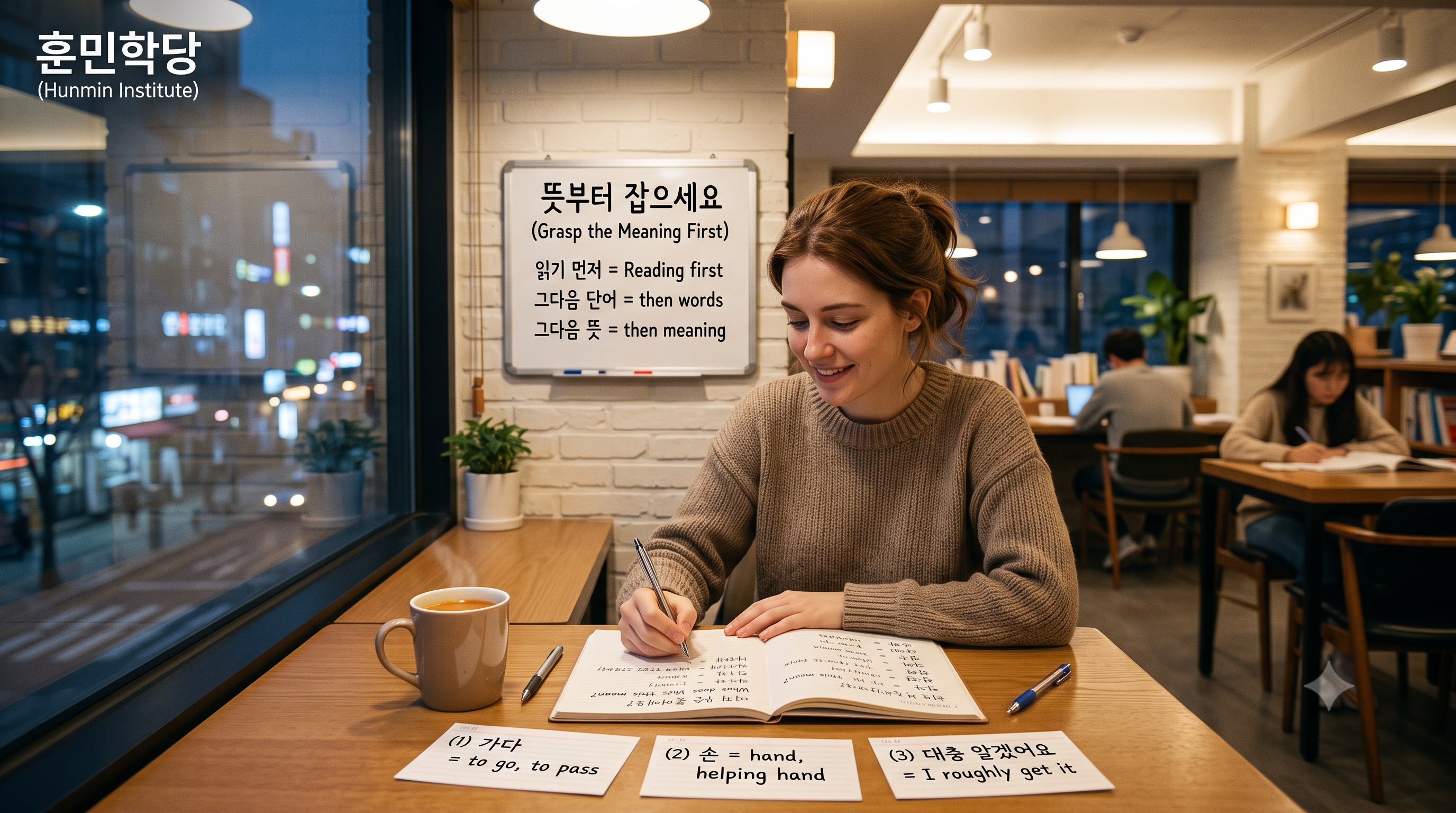
첫째 줄은 소단락 2에서, 둘째 줄은 소단락 3에서, 셋째 줄은 소단락 4에서 각각 다룹니다.
The first row is covered in Section 2, the second in Section 3, and the third in Section 4.
1. 한글은 글자 모양 안에 소리가 들어 있습니다
Hangul Carries Sound Inside Its Shapes
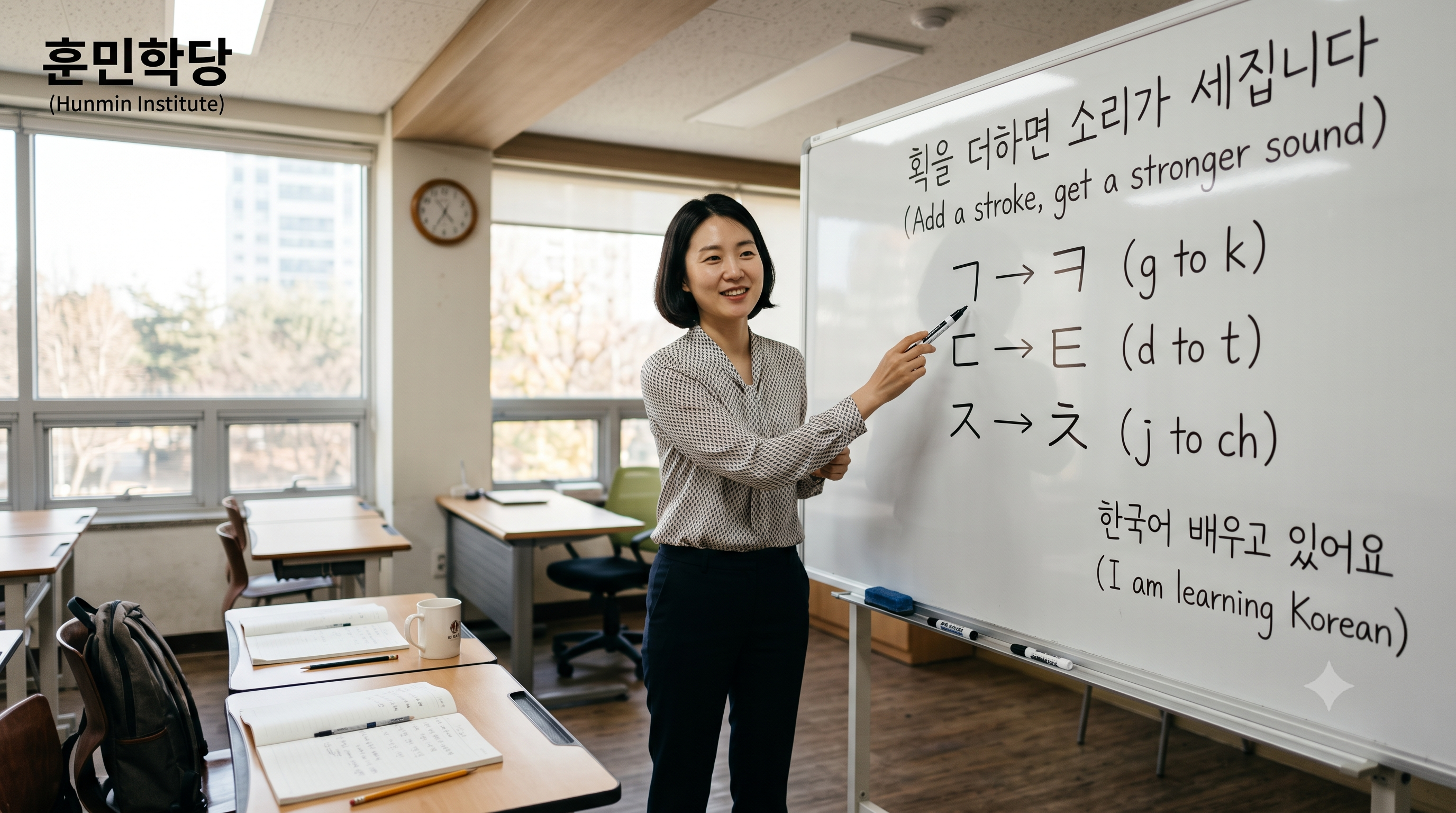
한글이 과학적이라는 말의 뜻은 하나입니다. 글자 모양 안에 소리가 들어 있다는 것입니다. 같은 자리에서 나는 소리끼리는 모양도 닮았고, 소리가 세질수록 획이 하나씩 늘어납니다. 글자를 두고 오가는 문장부터 보십시오.
Calling Hangul scientific means one thing: the shape of a letter carries its sound. Letters made in the same place of the mouth look alike, and a stronger sound adds one more stroke. Start with the sentences exchanged about the letters.
| 듣는 문장 Listening |
쓰는 문장 Writing |
|---|---|
| 소리 나는 자리가 같아요. [sori naneun jariga gatayo] They are made in the same place. |
이 글자는 어떻게 읽어요? [i geuljaneun eotteoke ilgeoyo] How do you read this letter? |
| 소리가 세지면 획이 늘어요. [soriga sejimyeon hoegi neureoyo] A stronger sound adds a stroke. |
이 둘은 뭐가 달라요? [i dureun mwoga dallayo] What is the difference between these two? |
| 한 번 소리 내서 읽어 보세요. [han beon sori naeseo ilgeo boseyo] Try reading it aloud once. |
소리 내서 읽어 볼게요. [sori naeseo ilgeo bolgeyo] I will read it aloud. |
응용 Apply It
↳ 이 [명사]는 어떻게 읽어요?
i [myeongsa]neun eotteoke ilgeoyo
How do you read this [noun]?
ex 이 [글자]는 어떻게 읽어요?/이 [단어]는 어떻게 읽어요?/이 [문장]은 어떻게 읽어요?
ROM i [geulja]neun eotteoke ilgeoyo/i [daneo]neun eotteoke ilgeoyo/i [munjang]eun eotteoke ilgeoyo
EN How do you read this letter?/How do you read this word?/How do you read this sentence?
| 소리 나는 자리 Where it is made |
약한 소리 Weaker sound |
센 소리 Stronger sound |
|---|---|---|
| 혀 뒤쪽이 목구멍 가까이에서 막습니다 The back of the tongue closes near the throat |
ㄱ [giyeok] giyeok |
ㅋ [kieuk] kieuk |
| 혀끝이 윗잇몸에 닿습니다 The tip of the tongue touches the upper gum |
ㄷ [digeut] digeut |
ㅌ [tieut] tieut |
| 혓바닥이 입천장 앞쪽에 닿습니다 The blade of the tongue touches the front of the palate |
ㅈ [jieut] jieut |
ㅊ [chieut] chieut |
▶원리가 있다는 말은 외울 것이 적다는 뜻입니다.
Having a principle means there is less to memorise.
스물넷 낱자를 따로 외우는 것이 아니라 몇 개의 기본 모양과 획을 더하는 방식만 알면 나머지가 따라옵니다. 소리도 문장도 같은 방식으로 조립됩니다.
You do not memorise twenty-four letters one by one. Learn a few base shapes and how strokes are added, and the rest follows. Sounds and sentences are assembled the same way.
여기서 원리와 문법을 갈라 두십시오. 원리는 글자와 소리가 조립되는 방식이고, 문법은 그 위에 얹히는 정밀한 규칙입니다. 원리는 처음부터 알아 두면 학습 전체가 가벼워지지만, 문법의 정밀도는 뒤로 미뤄도 늦지 않습니다.
Separate principle from grammar here. The principle is how letters and sounds are assembled; grammar is the fine rule set laid on top of it. Knowing the principle early lightens everything, while grammatical precision can wait.
그런데 원리가 있는 언어인데도 배우는 사람은 자주 막힙니다. 언어 자체가 어려워서가 아니라 다른 데 걸림돌이 있기 때문입니다. 그 걸림돌 셋을 차례로 보겠습니다.
Yet learners still get stuck, even with a principled language. Not because the language is hard, but because the obstacles sit elsewhere. Here are the three of them in turn.
2. 첫 번째 걸림돌, 모국어의 자로 한국어를 재는 것
Obstacle One, Measuring Korean With Your Own Language
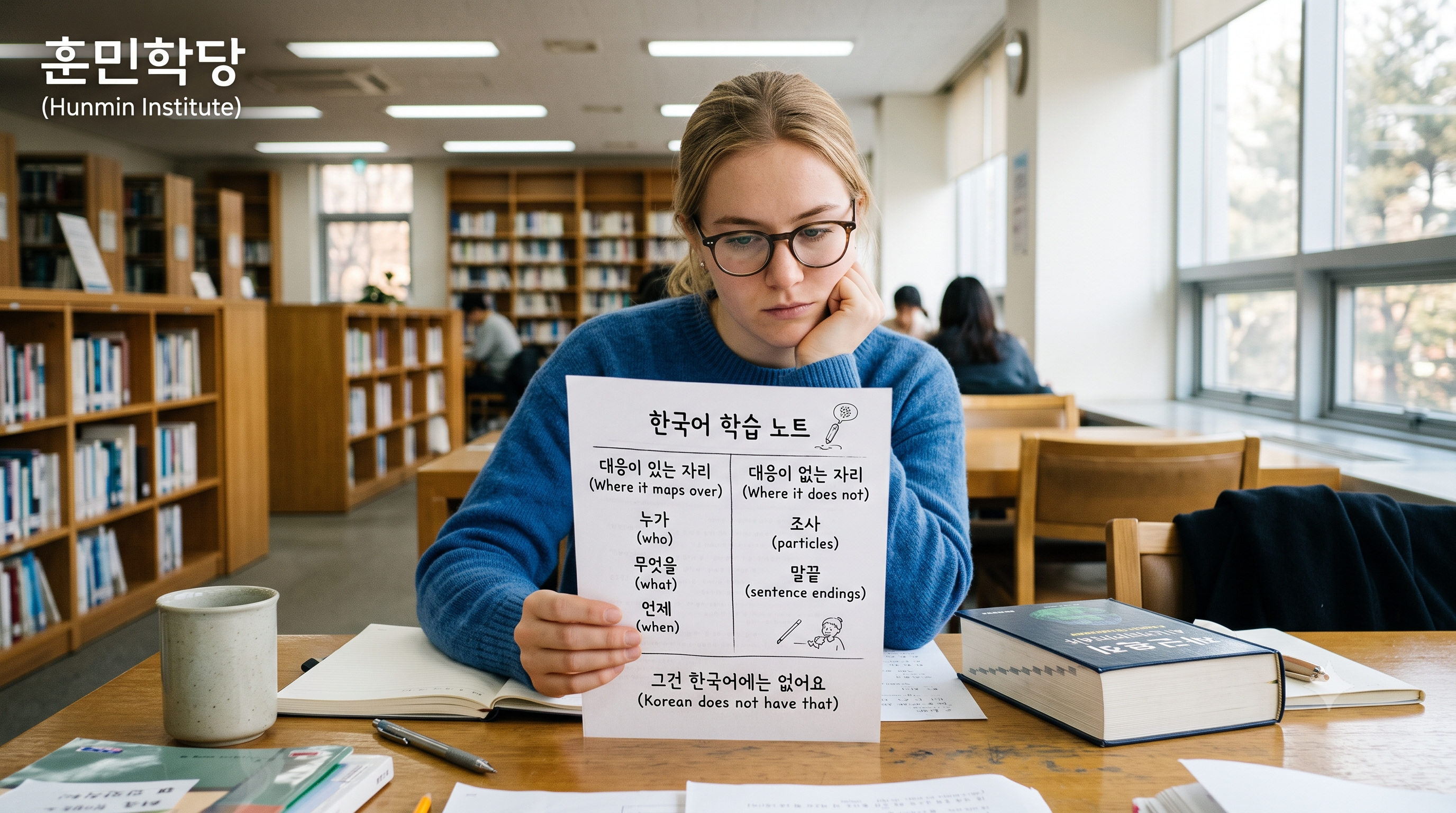
새 언어를 자기 말과 견주는 것은 자연스러운 일입니다. 문제는 견줄 수 있는 자리와 그럴 수 없는 자리를 가르지 않는 데서 생기므로, 대응이 없는 자리에 부딪혔을 때 오가는 문장부터 보십시오.
Comparing a new language with your own is natural. The trouble is failing to tell apart the places where comparison works from the places where it does not, so start with the sentences exchanged when you hit a slot that does not map.
| 듣는 문장 Listening |
쓰는 문장 Writing |
|---|---|
| 그건 한국어에는 없어요. [geugeon hangugeoeneun eopseoyo] Korean does not have that. |
이건 한국어에만 있는 거예요? [igeon hangugeoeman inneun geoyeyo] Is this something only Korean has? |
| 그냥 그렇게 써요. [geunyang geureoke sseoyo] That is just how we say it. |
제 말에는 이런 게 없어요. [je mareneun ireon ge eopseoyo] My language does not have anything like this. |
| 비슷해 보여도 달라요. [biseutae boyeodo dallayo] They look similar but they are different. |
이거랑 비슷한 게 있어요? [igeorang biseutan ge isseoyo] Is there anything similar to this? |
| 자리 Slot |
한국어에서 벌어지는 일 What happens in Korean |
|---|---|
| 대응을 찾을 수 있는 자리 [daeeungeul chajeul su inneun jari] |
누가 무엇을 했는가, 언제 일어났는가, 묻는 말인가 아닌가는 어느 언어에나 있습니다 Who did what, when it happened, and whether it is a question exist in every language |
| 조사 [josa] |
단어 뒤에 붙어 그 단어의 역할을 정합니다 Particles attach behind a word and assign its role |
| 말끝 [malkkeut] |
상대와 나의 관계를 드러냅니다 The sentence ending reveals your relationship with the listener |
| 생략 [saengnyak] |
서로 이미 아는 것은 문장에서 통째로 빠집니다 Whatever both sides already know drops out of the sentence entirely |
| 어순 [eosun] |
서술어가 문장 끝에 옵니다 The predicate comes at the end of the sentence |
▶그냥 그렇게 써요는 불친절한 답이 아니라 정확한 답일 때가 있습니다.
That is just how we say it can be the precise answer, not a lazy one.
자기 말에 없는 자리를 만나면 대개 무엇에 해당하느냐고 묻게 됩니다. 그런데 해당하는 것이 없을 때, 원어민은 설명할 말을 찾지 못해 그냥 그렇게 쓴다고 답합니다. 없는 것을 없다고 받아들이는 순간부터 그 자리는 빠르게 익혀집니다.
Meeting a slot your language lacks, you ask what it corresponds to. When nothing does, the native speaker has no words for it and says that is just how we say it. The moment you accept that nothing corresponds, that slot starts coming quickly.
여기서 유의할 것이 하나 있습니다. 자기 말과 한국어가 닮아 보일수록 오히려 위험합니다. 닮은 자리는 대응을 믿게 만들고, 그 믿음이 굳으면 나중에 고치기가 훨씬 어렵습니다.
One caution. The more your language resembles Korean, the more dangerous it gets. Resemblance makes you trust the mapping, and once that trust hardens it is far harder to undo.
3. 두 번째 걸림돌, 한 단어가 여러 뜻을 맡습니다
Obstacle Two, One Word Carries Several Meanings
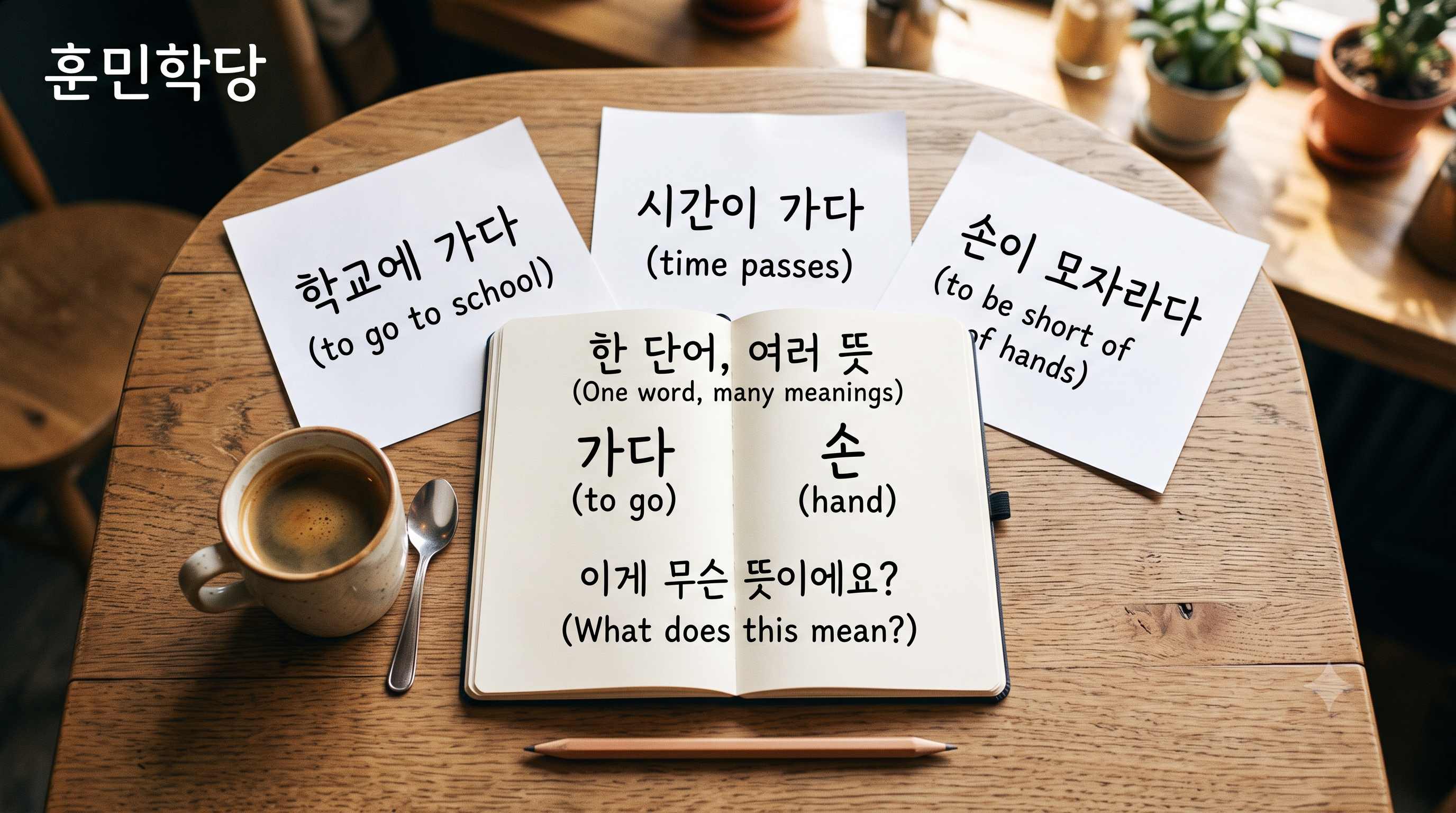
사전을 찾았는데도 문장이 풀리지 않는 일이 자주 생깁니다. 단어는 알겠는데 그 자리에서 무슨 뜻인지 모르겠는 상태이므로, 뜻을 물을 때 오가는 문장부터 보십시오.
You look a word up and the sentence still will not open. You know the word but not what it means right there, so start with the sentences exchanged when you ask about meaning.
| 듣는 문장 Listening |
쓰는 문장 Writing |
|---|---|
| 무슨 뜻인지 알겠어요? [museun tteusinji algesseoyo] Do you see what it means? |
이게 무슨 뜻이에요? [ige museun tteusieyo] What does this mean? |
| 여기서는 다른 뜻이에요. [yeogiseoneun dareun tteusieyo] It means something else here. |
예를 하나만 들어 주세요. [yereul hanaman deureo juseyo] Could you give me just one example? |
| 앞뒤를 보고 정하세요. [apdwireul bogo jeonghaseyo] Decide it from what comes before and after. |
사전에는 없는 뜻이네요. [sajeoneneun eomneun tteusineyo] This meaning is not in the dictionary. |
| 한국어 Korean |
이렇게 씁니다 How it is used |
|---|---|
| 가다 [gada] |
학교에 가다는 자리를 옮기는 것, 시간이 가다는 시간이 지나는 것, 금이 가다는 갈라진 자국이 생기는 것입니다 학교에 가다 is moving from place to place, 시간이 가다 is time passing, and 금이 가다 is a crack forming |
| 손 [son] |
손을 씻다는 몸의 손, 손이 모자라다는 일할 사람, 손이 크다는 씀씀이가 넉넉한 성격입니다 손을 씻다 is the hand on your body, 손이 모자라다 is people to work, and 손이 크다 is a generous way of spending |
| 에 [e] |
집에 있다는 자리, 세 시에 만나다는 때, 학교에 가다는 방향입니다 집에 있다 marks place, 세 시에 만나다 marks time, and 학교에 가다 marks direction |
| 뜻 [tteut] |
말이 가리키는 내용, 사전이 아니라 장면이 정합니다 What a word points to; the scene decides it, not the dictionary |
| 장면 [jangmyeon] |
그 말이 놓인 앞뒤 상황 The surrounding situation a word sits in |
▶뜻을 정하는 것은 사전이 아니라 그 말이 놓인 장면입니다.
Meaning is settled by the scene the word sits in, not by the dictionary.
하나의 형태가 여러 일을 맡는 것은 결함이 아니라 경제성입니다. 새 단어를 만들지 않고 이미 아는 단어를 늘려 쓰는 방식이며, 학습자에게는 외울 단어가 줄어든다는 뜻이기도 합니다.
One form doing several jobs is economy, not a flaw. Instead of coining new words, Korean stretches the ones you already know, which means fewer words for you to memorise.
같은 일이 조사에서도 벌어집니다. 에 하나가 장소도 시각도 방향도 맡고, 은과 이가는 같은 자리에 놓여도 말하는 사람의 관심이 어디에 있는지를 갈라 놓습니다. 지금 잡아 두실 것은 하나입니다. 형태 하나에 뜻이 여럿이면 뜻은 문장 밖의 장면이 정해 준다는 사실입니다.
The same happens with particles. 에 alone handles place, time, and direction, while 은 and 이가 sit in the same slot yet split where the speaker’s attention lies. Hold on to one thing for now: when one form carries many meanings, the scene outside the sentence decides which one applies.
4. 세 번째 걸림돌, 존댓말은 예의가 아니라 관계 표시입니다
Obstacle Three, Polite Speech Marks Relationship, Not Manners

존댓말을 나이 서열로만 배우면 곧 막힙니다. 존댓말은 나와 상대가 어떤 사이인지를 드러내는 표시이므로, 말을 낮추자는 제안이 오갈 때 쓰는 문장부터 보십시오.
Learn polite speech as an age ranking and you will stall fast. It marks what kind of relationship you and the listener are in, so start with the sentences used when dropping the polite form is suggested.
| 듣는 문장 Listening |
쓰는 문장 Writing |
|---|---|
| 말 편하게 하세요. [mal pyeonhage haseyo] You can speak casually with me. |
아니에요, 저는 이게 편해요. [anieyo jeoneun ige pyeonhaeyo] No, I am more comfortable this way. |
| 편하게 불러 주세요. [pyeonhage bulleo juseyo] Just call me however is comfortable. |
존댓말로 어떻게 말해요? [jondaenmallo eotteoke malhaeyo] How do I say it politely? |
| 그냥 말 놓으세요. [geunyang mal noeuseyo] Just drop the polite form. |
조금 더 익숙해지면요. [jogeum deo iksukaejimyeonyo] Once I get a bit more used to it. |
| 상황 Situation |
이렇게 씁니다 What you say |
|---|---|
| 처음 만난 사람 [cheoeum mannan saram] |
나이와 상관없이 요를 붙입니다 Attach 요 regardless of age |
| 가게와 식당 [gagewa sikdang] |
손님이라도 요를 붙이며 직원이 쓰는 더 높은 말끝을 따라 할 필요는 없습니다 Attach 요 even as the customer; you need not copy the higher endings staff use |
| 직장 [jikjang] |
상대가 후배여도 요를 붙이는 곳이 많습니다 Many workplaces keep 요 even toward juniors |
| 친해진 뒤 [chinhaejin dwi] |
상대가 먼저 제안했을 때만 반말로 넘어갑니다 Move to casual speech only when they offer first |
| 판단이 서지 않을 때 [pandani seoji aneul ttae] |
요를 붙입니다 Attach 요 |
▶판단이 서지 않으면 요를 붙이십시오.
When in doubt, attach 요.
요를 붙여서 실례가 되는 경우는 거의 없습니다. 조금 거리를 두는 사람으로 보일 뿐입니다. 반대로 반말을 잘못 쓰면 관계 자체가 어긋납니다. 초급에서는 한쪽으로 몰아 두는 편이 안전합니다.
Attaching 요 almost never offends. At worst you come across as slightly distant. Misused casual speech, by contrast, damages the relationship itself. At the beginner stage, err to one side.
외국인이라서 봐주겠거니 기대할 필요도 없습니다. 요 하나만 꾸준히 붙여도 말을 배우는 태도가 상대에게 그대로 전해집니다.
Do not count on being excused as a foreigner either. Steadily attaching 요 alone conveys how seriously you are learning.
5. 그래서 첫 목표는 의미 파악입니다
So Your First Goal Is Grasping the Meaning

여러분은 원어민이 아닙니다. 모두 알아듣고 모두 정확히 말해야 한다는 목표는 처음부터 잘못 잡힌 목표이므로, 다 알아듣지 못한 채로도 대화를 이어 가는 문장부터 보십시오.
You are not a native speaker. Aiming to catch everything and say everything correctly is a goal set wrong from the start, so begin with the sentences that keep a conversation going even when you have not caught it all.
| 듣는 문장 Listening |
쓰는 문장 Writing |
|---|---|
| 이해되셨어요? [ihaedoesyeosseoyo] Did you get it? |
대충 알겠어요. [daechung algesseoyo] I roughly get it. |
| 다시 말씀드릴게요. [dasi malsseumdeurilgeyo] I will say it again. |
다시 말해 주시겠어요? [dasi malhae jusigesseoyo] Could you say that again? |
| 너무 빨랐나요? [neomu ppallannayo] Was that too fast? |
천천히 부탁드려요. [cheoncheonhi butakdeuryeoyo] Slowly, please. |
| 순서 Order |
이유 Why |
|---|---|
| 먼저 읽기 [meonjeo ilgi] |
읽지 못하면 단어를 만나도 쌓이지 않습니다 Words you meet do not stack up if you cannot read |
| 그다음 단어 [geudaeum daneo] |
뜻을 잡는 일의 대부분은 아는 단어의 수가 결정합니다 How many words you know decides most of the meaning you catch |
| 그다음 큰 틀의 뜻 [geudaeum keun teurui tteut] |
문장을 다 풀지 못해도 무슨 이야기인지는 잡힙니다 You can catch what it is about without parsing every sentence |
| 나중에 정밀한 문법 [najunge jeongmilhan munbeop] |
먼저 붙들면 한 문장에서 하루가 갑니다 Grab it first and one sentence eats your whole day |
| 나중에 발음 교정 [najunge bareum gyojeong] |
뜻이 통하면 발음은 쓰면서 다듬어집니다 Once meaning gets through, pronunciation smooths out with use |
▶대충 알겠어요는 포기가 아니라 진도입니다.
I roughly get it is progress, not giving up.
한 문장도 놓치지 않겠다는 태도는 초급에서 가장 빨리 지치게 만듭니다. 모르는 단어를 세 개쯤 넘기고도 무슨 이야기인지 잡아내는 힘이 붙으면 그때부터 한국어가 늘기 시작합니다.
Refusing to miss a single sentence is what burns beginners out fastest. Korean starts growing the day you can skip three unknown words and still catch what it is about.
첫 목표는 하나로 좁히십시오. 상대가 무슨 말을 하는지 큰 틀에서 잡아내는 것입니다. 그 목표를 세우면 무엇을 먼저 하고 무엇을 뒤로 미룰지가 저절로 갈립니다.
Narrow the first goal to one thing: catching the broad shape of what the other person is saying. Set that, and what comes first and what waits sorts itself out.
한국어는 원리로 된 언어이지만 그 원리를 만나기 전에 세 가지가 발목을 잡습니다. 자기 말의 자로 재는 것, 한 형태에 여러 뜻이 얹혀 있는 것, 존댓말을 나이로 이해하는 것입니다. 이 셋을 알고 나면 남는 결론은 하나입니다. 문법의 정확도를 앞세우지 말고 뜻을 잡는 데 힘을 실으십시오. 그러려면 단어가 있어야 하고, 단어를 쌓으려면 먼저 읽을 수 있어야 합니다.
Korean runs on principles, but three things trip you before you reach them: measuring it with your own language, one form carrying many meanings, and reading polite speech as age. Knowing those three leaves one conclusion. Put your weight on catching meaning rather than on grammatical precision. That takes words, and stacking words takes reading first.
Next: How to Read Hangul: The Complete Roadmap ↗
토픽 맛보기
TOPIK Preview
유형: TOPIK Ⅰ 읽기 [43~45], 설명문, 일치하는 내용 고르기
Type: TOPIK I Reading [43–45], expository text, choose the matching statement
다음 글의 내용과 같은 것을 고르십시오.
Choose the statement that matches the following passage.
한국어에서는 에 하나가 여러 일을 합니다. 집에 있다에서는 있는 곳을 가리킵니다. 세 시에 만나다에서는 만나는 때를 가리킵니다.
In Korean, 에 alone does several jobs. In 집에 있다 it points to where something is. In 세 시에 만나다 it points to when something happens.
① 에는 한 가지 형태로 여러 일을 한다.
② 에는 있는 곳을 가리킬 때만 쓴다.
③ 에가 하는 일은 모두 두 가지다.
④ 에는 하는 일에 따라 형태가 달라진다.
Answer ▾
정답 ① 에는 한 가지 형태로 여러 일을 한다
Answer: ① 에 does several jobs with one form
지문은 에 하나가 있는 곳과 때를 모두 가리키는 모습을 보이고 있으므로 형태 하나가 여러 일을 한다는 진술이 맞습니다. ②는 있는 곳이 지문에 나오지만 그때만 쓴다고 해 진술이 어긋나고, ③은 예로 든 것이 둘일 뿐인데 하는 일이 둘로 정해졌다고 해 일부만 맞으며, ④는 그럴듯해 보여도 형태가 달라진다는 말은 지문에 없습니다. 흉내 낸 대문항은 TOPIK Ⅰ 읽기 [43~45]이고 배점은 3점입니다.
The passage shows 에 pointing to both a place and a time, so one form doing several jobs is correct. ② names the place use that does appear but limits it to that alone, which contradicts the passage. ③ is partly right, since only two uses were given, but it turns two examples into a fixed total. ④ sounds plausible yet the passage never says the form changes. The item type modeled here is TOPIK I Reading [43–45], worth 3 points.
FAQ
Q1. 단어는 하루에 몇 개가 적당한가요?Answer ▾
Q1. How many words a day is right?
A1. 개수보다 다시 만나는 횟수가 중요합니다. 하루에 열 개를 새로 외우는 것보다 어제 본 열 개를 오늘 다시 만나는 편이 남습니다. 뜻이 헷갈리면 국립국어원이 운영하는 한국어기초사전에서 확인하십시오.
A1. How often you meet a word matters more than how many. Seeing yesterday’s ten again today beats memorising ten new ones. When a meaning is unclear, check the Korean Basic Dictionary run by the National Institute of Korean Language.
Q2. 드라마나 예능으로 공부해도 되나요?Answer ▾
Q2. Can I study with dramas and variety shows?
A2. 뜻을 잡는 연습으로는 좋습니다. 다만 등장인물끼리는 반말을 주로 쓰므로 말끝을 그대로 따라 쓰지는 마십시오.
A2. Good practice for catching meaning. Characters mostly speak casually to each other, though, so do not copy their endings directly.
Q3. 학원에 다녀야만 늘까요?Answer ▾
Q3. Do I have to attend a language school?
A3. 필수는 아닙니다. 다만 혼자 하면 틀린 채로 굳는 부분을 잡아 줄 사람이 없으므로, 한 달에 한 번이라도 확인받을 자리를 만드시기 바랍니다.
A3. Not required. On your own, though, no one catches what hardens wrong, so arrange somewhere to be checked even once a month.
Q4. 한국인 친구가 없는데 말하기 연습은 어떻게 하나요?Answer ▾
Q4. I have no Korean friends. How do I practise speaking?
A4. 읽은 문장을 소리 내어 말하는 것으로 시작하십시오. 상대가 없어도 입이 문장의 길이에 익숙해집니다. 이 글의 문장표에 실린 문장을 매일 한 번씩 소리 내어 읽는 것으로 충분합니다.
A4. Start by saying aloud the sentences you read. Even without a partner, your mouth gets used to the length of a sentence. Reading the sentences in this post’s tables aloud once a day is enough.
Q5. 한국어능력시험을 언제부터 준비하면 되나요?Answer ▾
Q5. When should I start preparing for the TOPIK?
A5. 읽기가 자리 잡은 뒤가 좋습니다. 시험은 정해진 형식이 있어서 형식에 익숙해지는 데 시간이 들고, 읽지 못하면 그 시간이 배로 늘어납니다. 이 글의 토픽 맛보기는 시험 준비가 아니라 문제의 생김새에 눈을 익히는 자리이니 부담 없이 풀어 보시면 됩니다.
A5. After reading is settled. The test has fixed formats, getting used to them takes time, and that time doubles if you cannot read. The TOPIK Preview here is not preparation but a look at what the questions look like, so take it lightly.
Vocabulary and Pronunciation for Foreigners
| No | Korean | Romanisation | Meaning |
|---|---|---|---|
| 1 | 뜻 | tteut | (n) meaning [ˈmiːnɪŋ] |
| 2 | 조사 | josa | (n) a particle attached to a word [ˈpɑːrtɪkl] |
| 3 | 존댓말 | jondaenmal | (n) polite speech [pəˈlaɪt spiːtʃ] |
| 4 | 원리 | wolli | (n) principle [ˈprɪnsəpl] |
| 5 | 대충 | daechung | (adv) roughly [ˈrʌfli] |
| ▾ 단어 51 개 더 보기 Show 51 more ↗ | |||
The blog page has limits of space and function, so only five words are shown here. The rest of the word list, the audio, the sentences and tables, the FAQ, the worksheet, the TOPIK questions and the lesson video are on the Hunmin Institute website ↗, free and open to everyone, with no account needed.
참고 기관
Official Sources
국립국어원 ↗
National Institute of Korean Language
https://www.korean.go.kr
기관 설명 보기 About this institute ▾
This institute sets Korean orthography, the standard pronunciation rules, and the Romanisation system. The Language Norms menu at the top of the site holds the original texts, and learners can use the Korean Basic Dictionary run by the same institute, which carries definitions in eleven languages including English. Norms can be revised, so check here whenever a spelling is unclear.
※ 본 콘텐츠(원고, 이미지, 예문 포함)는 저작권법에 의해 보호받는 훈민학당의 저작물입니다. 무단 복제, 전재, 재배포 및 AI 학습 데이터로의 이용을 금합니다.
This content (manuscript, images, and example sentences) is the copyrighted property of Hunmin Institute, protected under copyright law. Unauthorized copying, reproduction, redistribution, and use as AI training data are prohibited.
'One-Pass Method' 카테고리의 다른 글
| How to Read Hangul: The Complete Roadmap (0) | 2026.07.20 |
|---|---|
| Hunmin Institute: Where Your Korean Goal Becomes a Plan (0) | 2026.07.20 |

